Our readers keep the lights on and my smoothie glass nicely filled. As an Amazon Associate, I earn from qualifying purchases.
Painting laminate, thermofoil, or pre-finished cabinets feels like a roll of the dice until you use a primer that actually bonds to slick surfaces. A standard wall primer will peel off glossy cabinet doors within weeks, leaving you with a mess instead of a makeover. The difference between a cabinet refinish that lasts a decade and one that fails in months comes down to the bonding agent in your first coat.
I’m Mohammad Maruf — the founder and writer behind WellFizz. I spend my time digging through technical data sheets, user-build reports, and paint chemistry to understand which formulations handle the real-world demands of kitchen and bathroom cabinetry.
This guide breaks down the top formulas that deliver real adhesion to challenging substrates, so you can choose the right best bonding primer for cabinets without wasting time on products that peel.
How To Choose The Best Bonding Primer For Cabinets
A bonding primer does more than cover old color — it creates a chemical grip that standard primers cannot achieve on non-porous surfaces. Before you pick one, understand the three factors that determine whether your cabinet paint job will last or lift.
Substrate Compatibility
Laminate, thermofoil, melamine, and pre-finished wood all have slick, non-absorbent surfaces. Look for a primer that explicitly states it bonds to glossy or hard-to-coat materials. Acrylic urethane formulas and oil-based stain blockers generally outperform basic latex primers on these substrates.
Dry Time and Recoat Window
Kitchen cabinets need multiple coats, and waiting 24 hours between each one adds days to your project. Products that dry to the touch in 30 minutes and accept topcoats within an hour save significant time. Fast-dry oil primers balance speed with the strong adhesion needed for cabinets.
Stain Blocking Capability
Kitchen cabinets accumulate grease, water marks, and tannin bleed from wood. A bonding primer that also seals stains prevents discoloration from showing through your final paint. Water-based stain blockers handle most kitchen stains, while oil-based options lock in stubborn water damage and smoke residue.
Quick Comparison
On smaller screens, swipe sideways to see the full table.
| Model | Category | Best For | Key Spec | Amazon |
|---|---|---|---|---|
| XIM UMA Acrylic Bonder and Primer | Premium Bonding | Laminate and Formica adhesion | Low-temperature application down to 35°F | Amazon |
| INSL-X Cabinet Coat | Urethane Acrylic | Factory-like cabinet finish | 87–112 sq ft per quart coverage | Amazon |
| Rust-Oleum Zinsser Odorless Oil-Base | Stain Blocker | Water stain sealing | Dries to touch in 30 minutes | Amazon |
| INSL-X Aqua Lock Plus | 100% Acrylic | New drywall and plaster sealing | Tack-free in 30 minutes | Amazon |
| Rust-Oleum Farm & Implement Enamel Primer | Oil-Based Enamel | Metal and outdoor equipment | Covers 130 sq ft per quart | Amazon |
In‑Depth Reviews
1. XIM UMA Acrylic Bonder and Primer/Sealer

XIM UMA stands apart from conventional primers because it is formulated specifically as a bonder first and a primer second. Its modified acrylic chemistry creates a mechanical grip on glossy laminate, Formica, and pre-finished cabinet surfaces without days of sanding. Users report passing the fingernail scratch test after curing, which is the benchmark for real adhesion on slick substrates.
The low-temperature application range down to 35°F makes it useful for garages, unheated workshops, and basement cabinet projects where temperature control is limited. Its excellent leveling behavior reduces brush marks on flat cabinet panels, and the low odor profile means you can work indoors without overwhelming fumes. Coverage is generous, though the exact square footage depends on surface porosity.
This primer also bonds well to old paint, Bondo, and MDF, making it a versatile choice for mixed-material cabinet refaces. Some users note it goes on slightly lighter than expected and may require two coats on dark substrates, but the adhesion results justify the extra coat. For anyone painting laminate or thermofoil cabinets, this is the formula that eliminates the worry of peeling.
Why it’s great
- Designed for non-porous surfaces like laminate and Formica
- Low odor and low-temperature application flexibility
- Self-leveling formula reduces brush strokes on flat panels
Good to know
- May require two light coats for full opacity on dark substrates
- Coverage information is not printed on the label
2. INSL-X Cabinet Coat Urethane Acrylic Satin Enamel

The INSL-X Cabinet Coat is a urethane acrylic enamel that blurs the line between primer and topcoat. It claims super adhesion to hard-to-coat surfaces without a separate primer, making it a time-saver for cabinet refinishing projects. The satin sheen delivers a factory-like finish that resists chipping, food stains, grease, and water — the four big enemies of kitchen cabinet paint.
This formula is produced by Benjamin Moore & Co., which gives it a pedigree in high-performance architectural coatings. Coverage ranges from 87 to 112 square feet per quart, slightly denser than standard primers. Users note it self-levels well but warn against foam rollers, which introduce air bubbles that mar the smooth finish. Brush application requires care to avoid visible lines, though the paint is forgiving enough for experienced DIYers.
The durable cured finish has held up for decades on MDF cabinets in homes with heavy use, according to long-term reviews. It requires adequate surface prep and a proper respirator due to its urethane content. For those wanting an all-in-one product that primes and finishes in fewer coats, this is the most efficient path to a professional cabinet look.
Why it’s great
- Adheres to hard surfaces without a separate primer coat
- Durable satin finish resists grease and water stains
- Covers 87–112 sq ft per quart for efficient application
Good to know
- Requires a high-quality respirator during application
- Foam rollers cause air bubbles — use a brush or microfiber roller
3. Rust-Oleum Zinsser Odorless Oil-Base Stain Blocker Primer

The Zinsser Odorless Oil-Base primer solves two cabinet painting problems at once: stain blocking and adhesion on glossy surfaces. Its oil-based formula seals water stains, smoke damage, and tannin bleed from wood knots, preventing them from migrating through your final topcoat. The flat bright white finish does not yellow over time, a common complaint with traditional oil primers.
It dries to the touch in 30 minutes and covers up to 100 square feet per quart, making it one of the faster oil primers on the market. The low-VOC formulation reduces the strong solvent smell typically associated with oil-based products, though reviewers note it is not completely odorless. Application on wood, drywall, plaster, and masonry is straightforward, and the high-solids formula provides excellent coverage over existing topcoats.
Cabinets that have suffered water damage from dishwashers or sink leaks benefit most from this primer because it locks in the stain while bonding to the compromised surface. It is also effective on previously painted cabinets where tannin bleed is an issue. The trade-off is oil-based cleanup requiring mineral spirits, but the stain-blocking performance justifies the extra step.
Why it’s great
- Seals water, smoke, and tannin stains effectively
- Dries to touch in 30 minutes for fast project progression
- Low-VOC oil formula with reduced odor profile
Good to know
- Oil-based cleanup requires mineral spirits
- Not completely odorless despite marketing claims
4. INSL-X Aqua Lock Plus 100% Acrylic Stain Blocking Primer Sealer

The INSL-X Aqua Lock Plus is a 100% acrylic primer sealer that bridges the gap between interior and exterior usability. It offers excellent adhesion to a wide range of surfaces including wood, drywall, plaster, masonry, and even galvanized metal, which makes it a versatile choice for cabinet projects that also involve trim or countertops. The water-based formula cleans up with soap and water while still providing stain-blocking performance.
It dries tack-free in 30 minutes and accepts topcoats in as little as one hour, which accelerates cabinet painting timelines significantly. Coverage is rated at 75 to 100 square feet per quart, slightly less than some competitors, but the acrylic formulation sands easily between coats for a smoother final finish. The low odor is a practical advantage for indoor work without full ventilation.
Reviewers praise its performance on new drywall and plaster sealing, but also report success on challenging surfaces like PT decking and old galvanized steel. For cabinet work, it works best as a sealer over new wood or previously painted surfaces where tannin bleed is not a primary concern. It is not specifically formulated for glossy laminate, so sanding those surfaces remains essential.
Why it’s great
- Water-based formula with easy soap-and-water cleanup
- Tack-free in 30 minutes, topcoat in 1 hour
- Sands smoothly for a refined cabinet finish
Good to know
- Lower coverage per quart compared to some oil alternatives
- Requires sanding for adhesion on glossy laminate surfaces
5. Rust-Oleum Farm & Implement Enamel Primer Quart, Gray
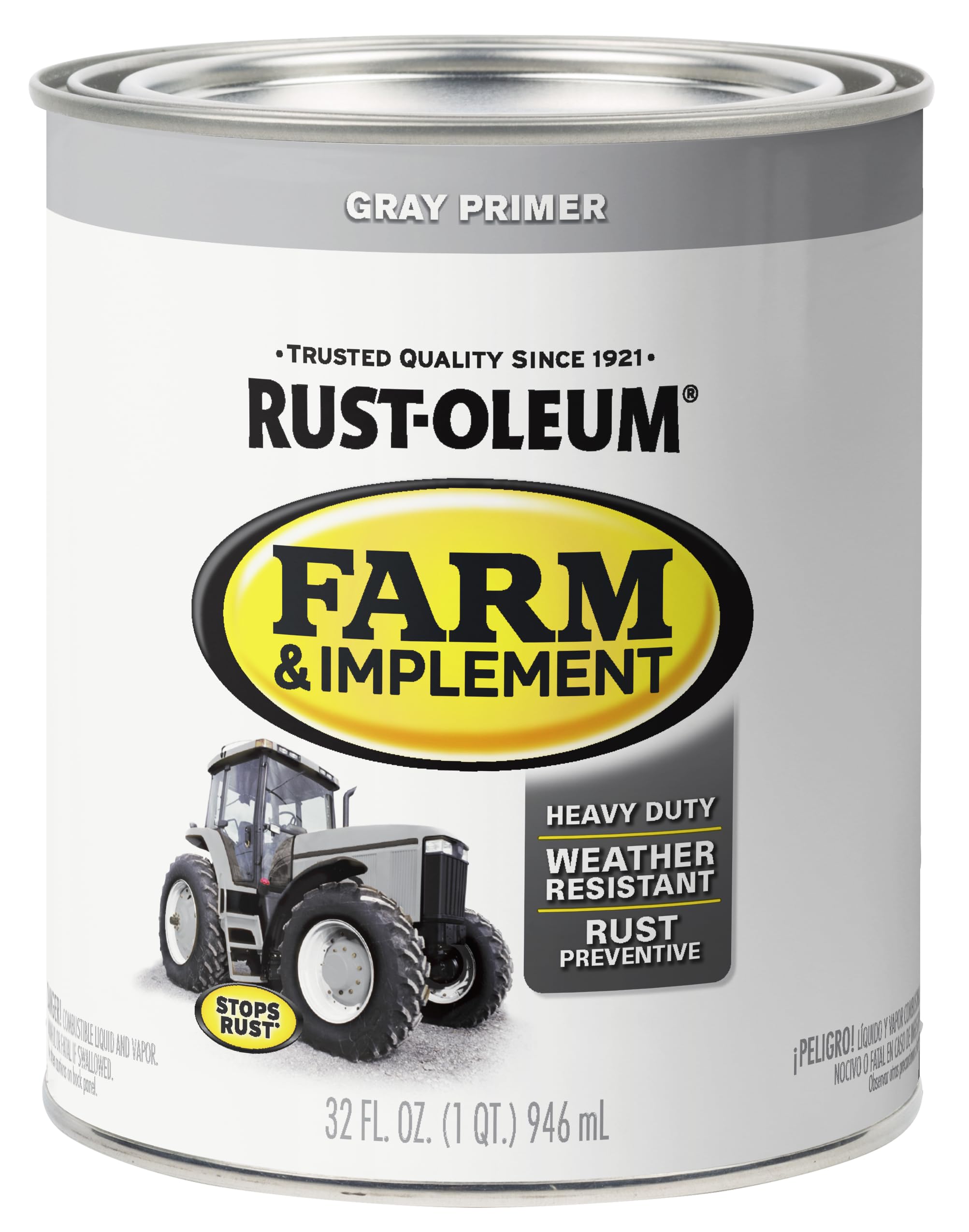
The Rust-Oleum Farm & Implement Enamel Primer is a heavy-duty oil-based formula designed for metal surfaces like tractors, trailers, and lawn mowers. While not a cabinet primer by design, its rust-preventative chemistry and ultra-durable flat finish make it suitable for workshop, garage, or outdoor cabinet storage units made of metal. Its coverage of up to 130 square feet per quart is the highest of any product in this comparison.
It dries to the touch in 2 to 4 hours and requires full cure before topcoating. The oil-based enamel bonds aggressively to bare metal and resists chipping and weather damage, making it a candidate for industrial-style cabinetry or metal filing cabinets. Users report excellent adhesion with minimal surface prep, and the thick consistency levels smoothly without dripping when applied correctly.
Cleanup requires mineral spirits, and the gray primer color is not neutral white, which means topcoat colors may shift slightly. This primer excels in utility settings where durability matters more than aesthetics. For metal cabinets in a garage, shed, or workshop, this primer provides the toughest bond of any product here, albeit in a narrower use case.
Why it’s great
- Highest coverage at 130 sq ft per quart
- Rust-preventative formula ideal for metal cabinets
- Ultra-durable finish resists chipping and weather
Good to know
- Gray primer color may affect topcoat color accuracy
- Oil-based cleanup requires mineral spirits
FAQ
Can I use a bonding primer over stained cabinets without sanding?
How long should I wait before painting over a bonding primer on cabinets?
Will a bonding primer cover dark cabinet colors in one coat?
Final Thoughts: The Verdict
For most users, the best bonding primer for cabinets winner is the XIM UMA Acrylic Bonder and Primer because it delivers reliable adhesion on laminate and Formica without the heavy sanding regimen that kills DIY motivation. If you want a self-priming system that also serves as the finish coat, grab the INSL-X Cabinet Coat. And for sealing stubborn water stains on kitchen cabinets, nothing beats the Zinsser Odorless Oil-Base Primer.

Mo Maruf
I created WellFizz to bridge the gap between vague wellness advice and actionable solutions. My mission is simple: to decode the research and give you practical tools you can actually use.
Beyond the data, I am a passionate traveler. I believe that stepping away from the screen to explore new environments is essential for mental clarity and physical vitality.