Our readers keep the lights on and my smoothie glass nicely filled. As an Amazon Associate, I earn from qualifying purchases.
Breaking down a whole brisket or slicing a bone-in rib roast puts immense stress on a cutting board—the wrong surface will dull your knife, absorb bacteria-laden juices, or warp under the strain. The choice between plastic, bamboo, acacia, and walnut isn’t cosmetic; it determines your knife’s edge retention, the cleanliness of your prep, and the stability of the cut itself. The decision matters more for raw protein prep than for any other kitchen task.
I’m Mohammad Maruf — the founder and writer behind WellFizz. My research focuses on materials science in kitchen tools, specifically how polymer density and wood grain orientation affect knife longevity and hygiene in high-use meat prep scenarios.
If you’ve been grabbing any wooden slab from the cabinet, you’re likely dulling your blades faster than necessary or risking cross-contamination from unsealed pores. This guide isolates the critical specs—from HDPP polymer density and end-grain construction to juice-catch capacity and dishwasher tolerance—to help you find the best boards for cutting meat that match your actual prep volume and cleaning routine.
How To Choose The Best Boards For Cutting Meat
Raw meat introduces two threats: bacterial fluid migration and knife-edge collision. The material, thickness, and surface design of your board directly manage both. Choosing wrong means either scrubbing absorbed juices out of a porous surface or sharpening your chef knife weekly. Focus on four factors that change the outcome.
Material: Polymer vs. Hardwood vs. Bamboo
High-density polypropylene (HDPP) is the only material that survives a commercial dishwasher without warping and is fully non-porous, meaning meat juices cannot soak below the surface. Wood—acacia, walnut, bamboo—requires hand washing and periodic oiling to seal the grain. Among wood species, end-grain walnut is the least abrasive to knife edges because the fibers are compressed perpendicular to the blade path. Bamboo is the hardest common wood, so it holds up to cleavers but accelerates edge dulling. Acacia sits in the middle, offering decent durability with moderate softness.
Thickness and Weight for Stability
Meat cutting involves lateral force: slicing, sawing, and pressing. A board under ¾ inch thick will bow or slide, especially on wet countertops. Boards targeting 1.5 inches or more provide enough mass to stay stationary during heavy carving. Polypropylene boards often rely on a textured base or rubberized feet to resist sliding, whereas thick hardwood boards simply use weight. For cleaver or bone work, prioritize a board that weighs at least five pounds.
Juice Groove and Spout Geometry
Carving a roast releases a significant volume of liquid. A shallow groove will overflow onto the counter, while a deep channel with a corner pour spout allows you to drain collected juices into a pan for gravy. Some designs include a removable tray that doubles as a separate surface for raw meat, keeping the upper board dry for cooked slicing—a massive advantage for cross-contamination control in a single workflow.
Dishwasher Safety vs. Hand Wash
If you process raw poultry or ground meat several times a week, the ability to run the board through a high-temperature sanitize cycle is non-negotiable for hygiene. Only solid polypropylene boards are truly dishwasher-safe. Wood boards, regardless of oil coating, will crack, warp, or dry out in the dishwasher. Bamboo boards delaminate when repeatedly exposed to the heat and moisture of a dishwasher cycle. Decide honestly whether your cleaning habit matches the board’s care requirement, or you’ll buy a replacement within six months.
Quick Comparison
On smaller screens, swipe sideways to see the full table.
| Model | Category | Best For | Key Spec | Amazon |
|---|---|---|---|---|
| Thirteen Chefs 18×12 | Plastic | High-volume raw meat prep | ¾” HDPP polymer | Amazon |
| Prodyne Prep & Slice | Plastic + Tray | Grilling and marinating workflow | 2″ total height w/ tray | Amazon |
| GAOMON 24×18 Acacia | Hardwood | Large turkey carving | 24x18x1.1″ acacia | Amazon |
| GAOMON 20×15 Acacia | Hardwood | Dual-side reversible prep | 1.5″ thick acacia | Amazon |
| Socisen 3-Pack Bamboo | Bamboo | Multi-size versatility | 5-layer bamboo | Amazon |
| Greener Chef 24″ Bamboo | Bamboo | Carving with juice drainage | Pour spout & spikes | Amazon |
| BABILONIA Walnut | Hardwood | Knife preservation | 1.7″ end-grain walnut | Amazon |
In‑Depth Reviews
1. Thirteen Chefs 18×12 Poly Cutting Board

This board uses high-density polypropylene, which is structurally superior to standard polyethylene. The ¾-inch thickness provides sufficient mass to stay put during heavy chopping, and the HDPP formulation tolerates restaurant dishwasher temperatures up to 200°F without warping or releasing chemicals. At 18 by 12 inches, it easily accommodates a full brisket flat or a batch of chicken thighs without crowding the blade.
Black HDPP is particularly smart for meat prep because it hides both knife scars and staining from beet or berry juices. The textured surface reduces food slippage—a real safety bonus when your hands are greasy. Unlike wood, this board needs zero oiling or conditioning, and the non-porous surface means raw chicken juice sits on top rather than soaking into fibers, making a simple soap-and-hot-water rinse genuinely sanitizing.
Some users report minor sliding on polished granite, and the polypropylene surface will develop visible cut lines over time. Those grooves can trap debris if you don’t scrub thoroughly.
Why it’s great
- Dishwasher-safe at commercial hygiene temps
- Non-porous surface prevents bacterial absorption
- Extra weight resists sliding and warping
Good to know
- Poly surface will show knife scars over time
- Not intended for hot pans or oven use
2. Prodyne Prep & Slice Bar-B-Board
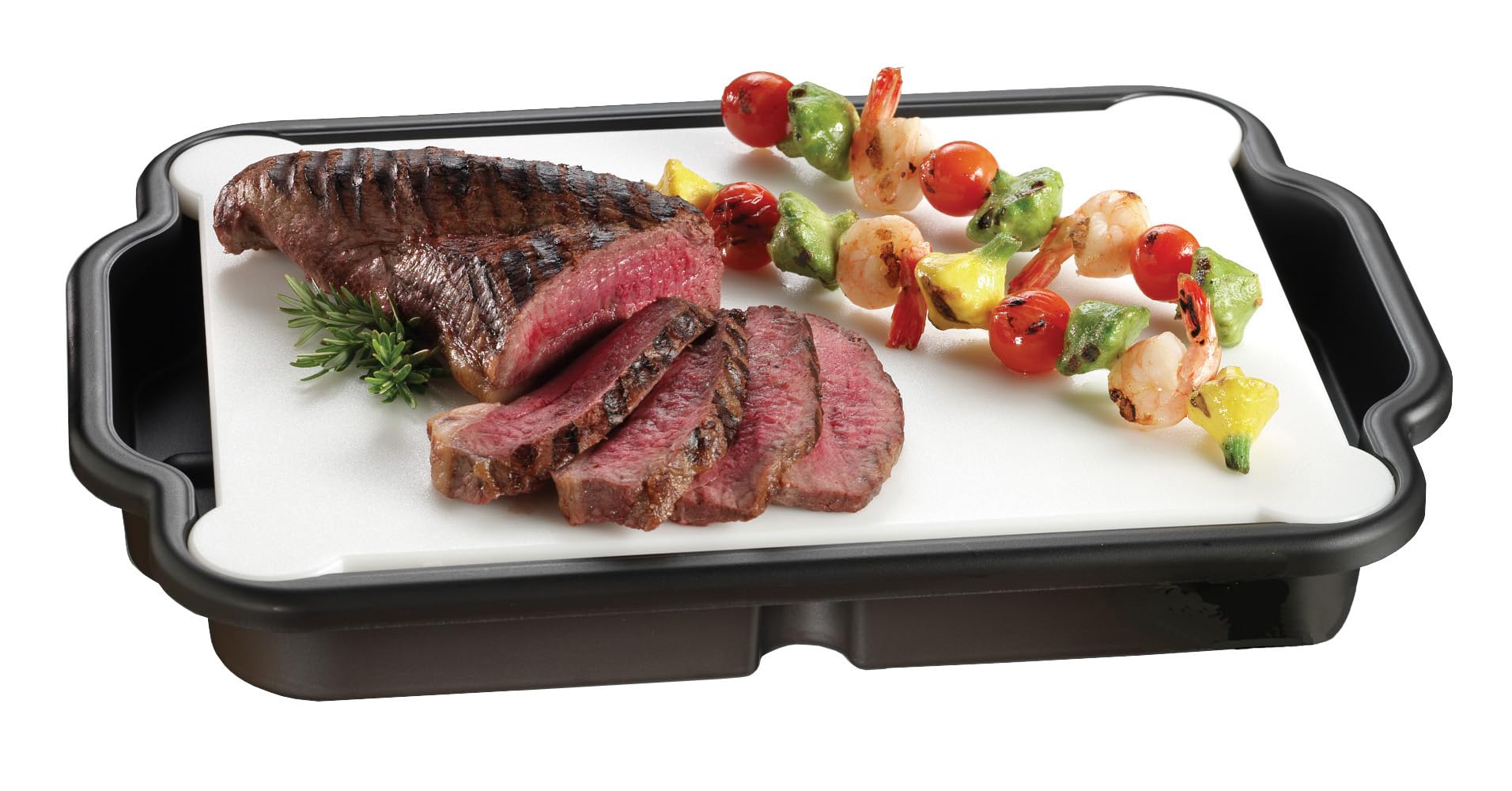
The Prodyne solves a specific meat prep problem: managing fluids. The white polypropylene board sits atop a black base tray, creating a two-level system. You place raw meat on the base tray for seasoning and marinating, then move it to the upper board after cooking for slicing. This keeps raw juices contained below and prevents cross-contamination between uncooked protein and the carving surface—a workflow that’s hard to replicate with a single flat slab.
At 18.25 by 13.25 inches with a combined two-inch height, the board is large enough for steaks, chops, and whole chicken, yet light enough to carry directly to the grill. The tray catches marinade runoff and any liquid that escapes during rest, so your counter stays dry. Both components are dishwasher-safe as long as you skip the heated dry cycle, which simplifies cleanup after handling sticky teriyaki or garlic butter.
The PP material is less dense than HDPP, so it will show cut marks more quickly, and the board may flex if you bear down with a cleaver on large bones. It’s also not intended for heavy-duty butchering. But for the barbecue cook who values an organized, fluid-management system over brute strength, this design is tough to beat.
Why it’s great
- Dual-level design prevents cross-contamination
- Tray captures all marinade and carving juices
- Light enough for easy transport to grill
Good to know
- Not stable for heavy cleaver work
- Plastic scratches faster than hardwood
3. GAOMON 24×18 Acacia Cutting Board

The 24-by-18-inch surface is the single largest board in this selection, and that size is not decorative—it is essential when carving a full turkey, a standing rib roast, or multiple pork shoulders for a gathering. Acacia wood provides a water-resistant grain that resists moisture ingress better than bamboo, and the 1.1-inch thickness offers enough stability for moderate-force carving without feeling like a butcher block.
A perimeter juice groove catches the majority of runoff during slicing, though the groove is not as deep as dedicated carving boards with corner reservoirs, so very liquid-rich cuts may still drip over the edge during transfer. The board is reversible, giving you a flat surface for vegetables and a grooved surface for protein, which reduces the need for multiple boards. Recessed handholds on each side make lifting this large slab manageable despite its size.
Being natural acacia, this board requires hand washing only and periodic mineral oil treatment to maintain its water resistance. Some users note that the wood shows cut marks more readily than harder bamboo, but that wear actually helps preserve knife edges by absorbing the impact rather than reflecting it. For the home cook who hosts large meals and wants a single board that does double duty as a serving platter, this is a compelling option.
Why it’s great
- Massive 24×18 surface handles whole roasts
- Juice groove and reversible design add flexibility
- Acacia grain is naturally water-resistant
Good to know
- Hand wash only; not dishwasher safe
- Wood requires regular oiling to prevent drying
4. GAOMON 20×15 Acacia Cutting Board 1.5″

Where the GAOMON 24-inch board sacrifices thickness for area, this 20-inch version prioritizes mass. At 1.5 inches thick, the acacia slab is heavy enough to stay planted on the counter during aggressive chopping. The reversible design is genuinely useful: one side features a deep perimeter groove that catches nearly all the liquid from a carved roast, while the flat side offers a clean surface for vegetables or bread, keeping flavors separate.
The wood is sanded smooth with no burrs or splinters, and the natural grip of the acacia grain prevents slippage even without rubber feet. At this thickness, the board acts as a small butcher block, providing a deadening effect that reduces the vibration transferred to your knife. Users consistently note that the board feels like a professional tool rather than a mid-price kitchen accessory.
Like any natural wood board, it demands hand washing and thorough drying. The 3.74-kilogram weight is substantial—you won’t want to move it back and forth between counter and sink frequently. However, if you have a dedicated prep zone and want a board that will not flex, warp, or wander during a busy meal prep session, this thickness-to-area ratio is the sweet spot.
Why it’s great
- 1.5-inch thickness provides rock-solid stability
- Deep juice groove effectively contains carving liquids
- Reversible sides for meat vs. vegetable prep
Good to know
- Heavy; not portable or easy to store vertically
- Requires oiling every few weeks to maintain seal
5. Socisen 3-Pack Bamboo Cutting Board Set

If your kitchen handles multiple meat types simultaneously—say, slicing raw chicken for stir-fry while dicing beef for stew—a multi-board system prevents cross-contamination without interrupting workflow. This Socisen three-pack includes a 17-inch board for primary cutting, a medium board for vegetables, and a small board for fruit, each with rubber feet and rounded handles.
The bamboo is constructed using a five-layer splicing technique that resists cracking better than single-piece boards, though the edge-grain orientation means the surface is harder than end-grain wood. That hardness translates to excellent durability under heavy chop, but expect to sharpen your knives a bit more frequently. The FSC-certified bamboo is finished with food-grade mineral oil and arrives ready to use, though the manufacturer recommends re-oiling after washing.
Users report that the boards handle daily use well, with the larger board being particularly popular for ribs and tenderloins. The non-slip feet are adequate but can lose grip on very smooth surfaces after repeated washing. The main limitation is that the juice groove on the large board is relatively shallow—not ideal for carving a wet roast, but fine for general slicing and prep.
Why it’s great
- Three sizes allow separate boards for raw meat, produce, and bread
- 5-layer bamboo construction resists cracking
- Non-slip feet and handles improve safety
Good to know
- Bamboo is hard on knife edges
- Shallow juice groove may overflow during carving
6. Greener Chef 24″ Bamboo Carving Board
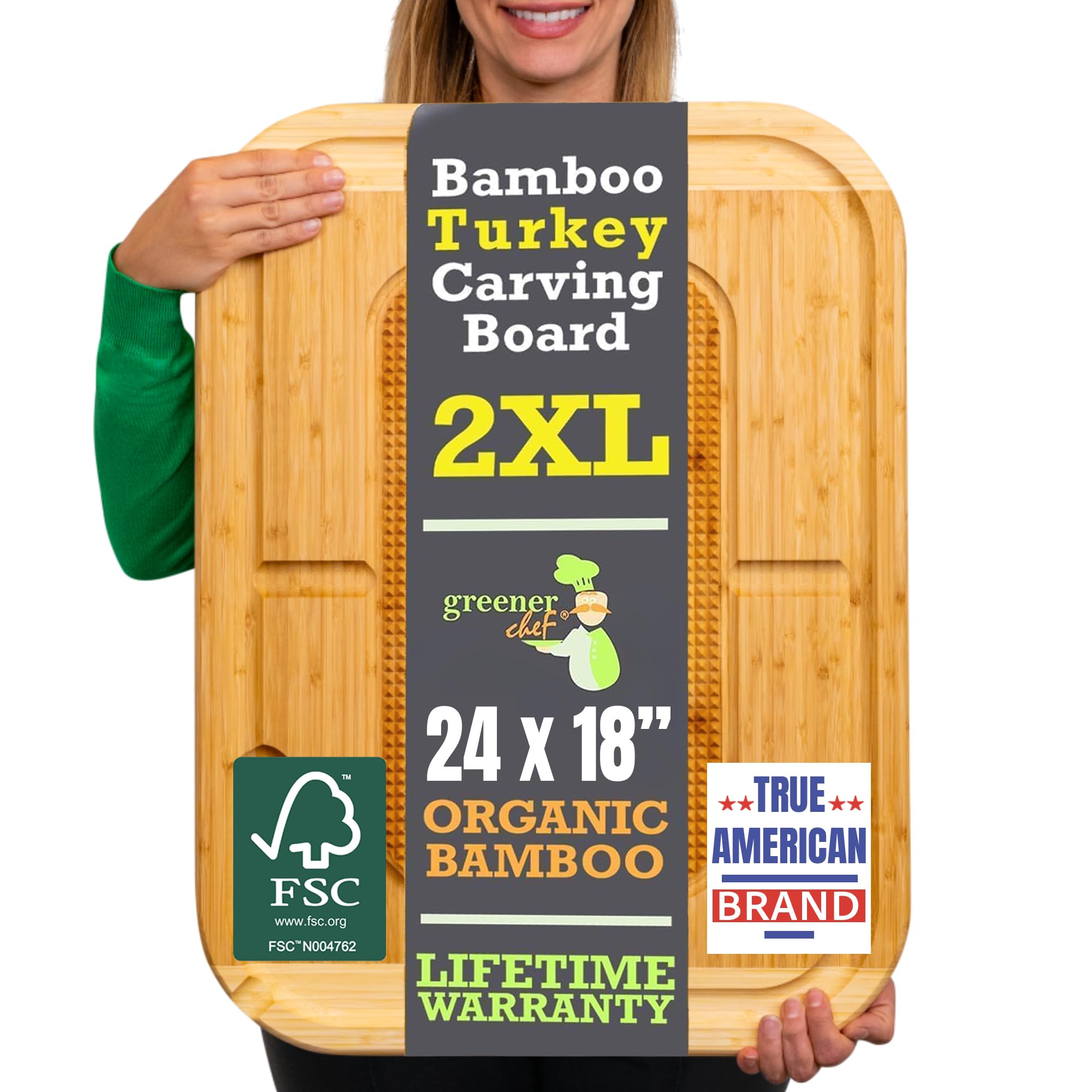
The Greener Chef board is built around one job: carving large roasts and turkeys. It includes four stainless steel spikes that hold the meat in place, plus a deep juice channel that terminates in a corner reservoir with a pour spout. This design captures every drop of pan-ready liquid and lets you drain it without tilting the entire board—a small detail that becomes essential when you are juggling hot meat and gravy prep.
The two-tone bamboo construction is lightweight for its size—6.8 pounds for a 24-by-18-inch surface—making it easier to move than a solid acacia board of the same dimensions. The reverse side is flat with a deep well that can hold up to half a cup of liquid, effectively giving you two functional surfaces. The diamond-textured pattern on the carving side prevents the meat from sliding, which is a significant safety improvement when slicing through a slippery turkey skin.
The bamboo needs hand washing, and the diamond grooves can snag sponges, requiring a stiff brush to clean thoroughly. Some users note that the board comes dry and benefits from an immediate oiling before first use. The lifetime replacement warranty from an American brand provides peace of mind if the board ever splits or warps. This is a specialized tool, not an all-purpose prep board, but for its niche it performs perfectly.
Why it’s great
- Integrated meat spikes hold roasts securely
- Corner reservoir with pour spout for gravy collection
- Lightweight for its massive 24×18 size
Good to know
- Diamond grooves are difficult to scrub clean
- Bamboo surface is harder on knives than acacia
7. BABILONIA American Black Walnut Cutting Board
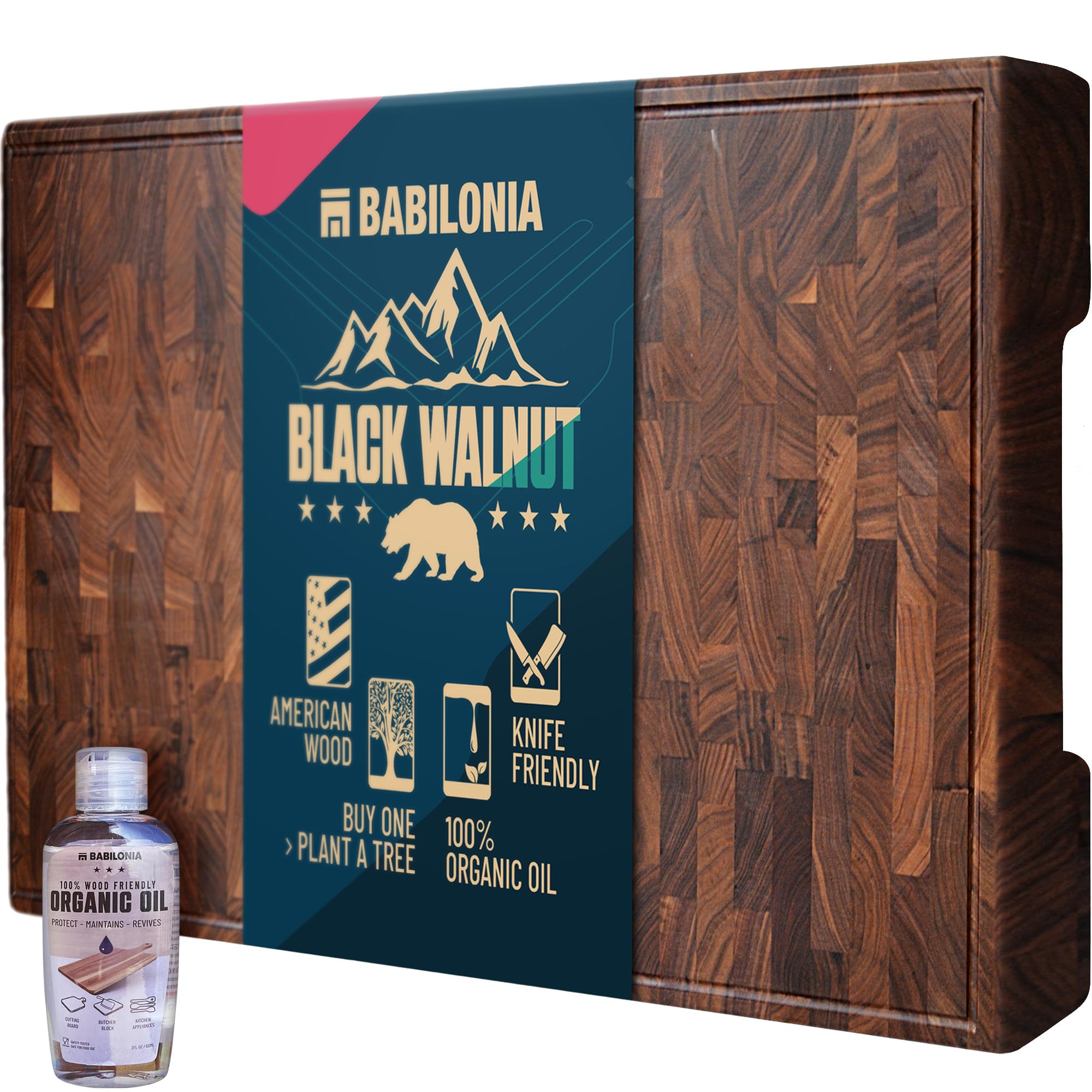
End-grain construction is the industry standard for butcher blocks because the wood fibers run perpendicular to the knife edge. Each cut pushes fibers apart rather than shearing them, which dramatically reduces blade dulling. This BABILONIA board uses American black walnut assembled in a checkerboard pattern, creating a surface that self-heals from knife marks over time. At 1.7 inches thick, the board is heavy enough for serious work but compact enough for daily storage.
The design includes a built-in notch and a removable side plate that lets you slide chopped ingredients directly into a bowl or pan without lifting the board—a convenience that is genuinely useful when prepping large quantities of diced meat or mirepoix. The reverse side is flat for serving or dough work. Hidden handles on the sides make carrying easier, and the food-grade mineral oil included in the package means you can start using it immediately without a separate purchase.
The walnut construction is softer than bamboo or acacia, so it will show more visible wear if you scrape with a knife edge rather than lifting your cuts. Some users have reported splitting within a few months, though the vendor’s replacement policy seems responsive. This board is best suited for the home cook who owns quality knives and wants to maximize the time between sharpening sessions while enjoying a beautiful, functional surface.
Why it’s great
- End-grain walnut is the most knife-friendly surface available
- Notch and slide plate speed up ingredient transfer
- Pre-oiled and includes mineral oil bottle
Good to know
- Soft wood shows deep cut marks with heavy use
- Durability concerns reported; not for commercial volume
FAQ
Is it safe to use a plastic board for raw chicken and then wash it for reuse?
Will an acacia board dull my knives faster than a walnut board?
How often should I oil a wooden meat cutting board?
Final Thoughts: The Verdict
For most users, the boards for cutting meat winner is the Thirteen Chefs 18×12 Poly Board because HDPP construction offers the best balance of hygiene, durability, and zero-maintenance convenience for high-volumes of raw protein prep. If you want end-grain knife preservation and a beautiful serving surface, grab the BABILONIA American Black Walnut Board. And for the grill-focused cook who needs a built-in marinade system and clean workflow, nothing beats the Prodyne Prep & Slice.

Mo Maruf
I created WellFizz to bridge the gap between vague wellness advice and actionable solutions. My mission is simple: to decode the research and give you practical tools you can actually use.
Beyond the data, I am a passionate traveler. I believe that stepping away from the screen to explore new environments is essential for mental clarity and physical vitality.