Our readers keep the lights on and my smoothie glass nicely filled. As an Amazon Associate, I earn from qualifying purchases.
Sitting down for a family game night with a preschooler often means explaining rules for twenty minutes, handling a meltdown when a piece gets bumped, and packing it all up before anyone actually won. The right board game for young kids sidesteps all of that by using non-competitive mechanics, chunky wooden pieces, and rounds that last as long as a single Bluey episode.
I’m Mohammad Maruf — the founder and writer behind WellFizz. I’ve spent years studying the cognitive development markers in early childhood play and analyzing how game mechanics like turn-taking, fine-motor tweezing, and cooperative goal-setting translate into tangible social skills for children aged two through six.
After reviewing the latest preschool-friendly designs, this guide narrows down the strongest options for your family’s shelf. Here is everything you need to confidently pick the best board games for young kids without trial and error or buyer’s remorse.
How To Choose The Best Board Games For Young Kids
The preschool game aisle is packed with licensed characters and flashy boxes, but the real test is whether a three-year-old can grasp the core mechanic without a parent reading the manual aloud. Focus on three pillars: age-appropriate complexity, physical component safety, and the social dynamic of the game itself. The wrong pick leads to frustration; the right one builds skills every time the box opens.
Age Rating vs. Actual Readiness
A manufacturer’s printed age is a starting point, not a rule. Many games rated for age three work perfectly for a sharp two-and-a-half-year-old, while some age-four games require color matching and patience that frustrate a late preschooler. Always check whether the game requires reading, counting above five, or complex strategic planning. The sweet spot for most families is a game that a four-year-old can play independently after two rounds with an adult.
Component Durability and Safety
Young kids mouth pieces, drop tokens, and bend cardboard. Look for chunky wooden pieces, thick puzzle-grade cardboard, and rounded edges. Games with small plastic parts under 1.5 inches in any dimension pose a choking hazard for children under three. A box that doubles as the game board is a strong signal the manufacturer prioritized storage and setup convenience.
Cooperative vs. Competitive Mechanics
Competitive games where one person loses can trigger tears in kids under six. Cooperative games where every player works toward a shared goal teach teamwork, communication, and emotional regulation. If you prefer a competitive game, look for one that hides the loss condition — like a race where every snail finishes — so the child focuses on the process rather than the outcome.
Quick Comparison
On smaller screens, swipe sideways to see the full table.
| Model | Category | Best For | Key Spec | Amazon |
|---|---|---|---|---|
| Ravensburger Snail’s Pace Race | Cooperative Racing | Non-competitive first game | 6 wooden snails, 2 color dice | Amazon |
| Educational Insights Frankie’s Food Truck Fiasco | Shape Matching | Fine motor skill development | Frankie Squeezer tweezers tool | Amazon |
| Jumping High Five Baby Dinosaur Rescue | Cooperative Rescue | Team-based problem solving | Image-based item cards, no reading | Amazon |
| eeBoo Puppy Fuffle | Counting & Strategy | Simple counting practice | Spinner board, 16 x 16 inch board | Amazon |
| Peaceable Kingdom Acorn Soup | Toddler Matching | Ages 2 and up introduction | 8 recipe cards, 24 wooden ingredients | Amazon |
In‑Depth Reviews
1. Ravensburger Snail’s Pace Race

Ravensburger’s Snail’s Pace Race is the gold standard for a first board game because it eliminates the single most stressful element for young children: losing. Every snail moves forward based on dice rolls, and the game ends when the slowest snail crosses the finish line — meaning no child is last. The six chunky wooden snails are tactile, easy for small hands to grip, and they click satisfyingly against the board as they advance.
The two color dice replace numbers with colors, so a three-year-old doesn’t need to count — they simply match the color on the die to a snail and move it one space forward. Rounds clock in at around 15 minutes, which aligns perfectly with the attention span of a preschooler. The board itself is sturdy cardboard with bright, uncluttered artwork that doesn’t overwhelm the eye.
Parent reviews consistently note that this game teaches turn-taking and patience without the emotional fallout of competitive play. The non-competitive structure means older siblings can help younger ones without creating an unfair advantage, and the whole family breathes easier knowing no one cries at the end. It won the Parent’s Choice Gold Seal Award for good reason — this is the game you reach for when introducing board games to any child aged three and up.
Why it’s great
- Non-competitive mechanism prevents meltdowns
- Six chunky wooden snails are durable and safe for 3-year-olds
- 15-minute rounds match preschool attention spans
Good to know
- Game can feel simple for a sharp 5-year-old after several plays
- Box shipped with labels directly on the surface leaves sticky residue
2. Educational Insights Frankie’s Food Truck Fiasco
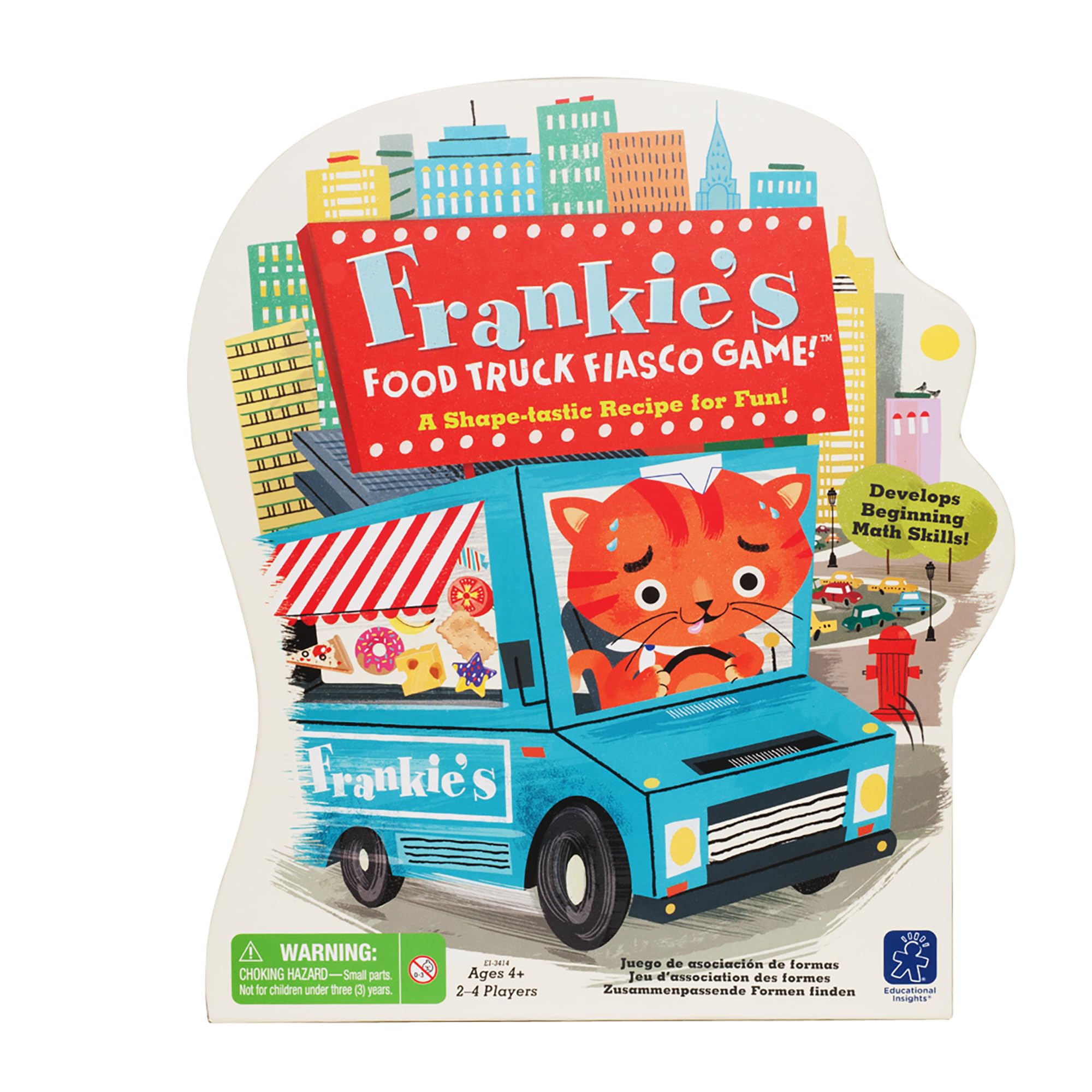
Frankie’s Food Truck Fiasco turns shape recognition into a physical challenge that strengthens the same hand muscles kids use for writing later. The centerpiece is the Frankie Squeezer — a pair of oversized tweezers — which players use to pick up food-shaped pieces matching the geometric shape shown on the spinner. A four-year-old must coordinate the squeeze pressure and aim simultaneously, building fine motor control with every turn.
The game includes a spinner with four possible actions: find a shape, lose a turn, steal from another player, or return a piece to the board. This variety introduces mild strategic thinking — should you try to steal a piece your opponent needs? — without requiring reading or counting. The box lid unfolds to become the game board, making setup and storage a single motion rather than a separate step.
Special education teachers have praised this game for its ability to engage children who struggle with traditional board games. The non-identical pieces per category add a layer of complexity beyond simple matching, because the child must recognize that a square-shaped cracker and a square-shaped sandwich both count as squares. For families who want a game that builds cognitive and physical skills simultaneously, this is the strongest mid-range option available.
Why it’s great
- Frankie Squeezer develops fine motor skills needed for handwriting
- Box doubles as game board for instant setup and storage
- Shape matching teaches geometry through familiar food objects
Good to know
- The squeezer can be difficult for very small hands to operate
- Some spinner actions (steal, lose a turn) frustrate sensitive children
3. Jumping High Five Baby Dinosaur Rescue

Baby Dinosaur Rescue flips the entire board game paradigm by making the lava the enemy rather than the other players. Everyone works together to guide baby dinosaur tokens across the valley to safety before the lava token reaches the end of the path. The image-based item cards mean no reading is required — a child as young as four can look at the picture, match it to the matching item on the board, and move the corresponding dinosaur forward.
The cooperative mechanic naturally encourages communication because players must decide together which dinosaur to move and which item card to use. This builds early problem-solving and shared decision-making in a low-pressure setting. The game plays in roughly 20 minutes, giving enough depth for a preschooler to feel engaged without exhausting their attention span. The artwork is colorful and the dinosaur theme appeals broadly to kids aged four through six.
Some parents note the color contrast between the dinosaur tokens and the board could be stronger, and the lightweight tokens can accidentally shift during play. A few reviewers also mention that the “lava wins” outcome — where baby dinosaurs don’t make it — can upset particularly sensitive children. Overall, this is an excellent choice for families who want a screen-free experience that prioritizes teamwork over individual victory and can handle one read-through of the rules before diving in.
Why it’s great
- Fully cooperative with no individual winner or loser
- Image-based gameplay requires zero reading ability
- Dinosaur theme is highly engaging for the preschool age group
Good to know
- Lightweight tokens can be bumped out of position during play
- Losing scenario where dinosaurs don’t survive may upset some kids
4. eeBoo Puppy Fuffle
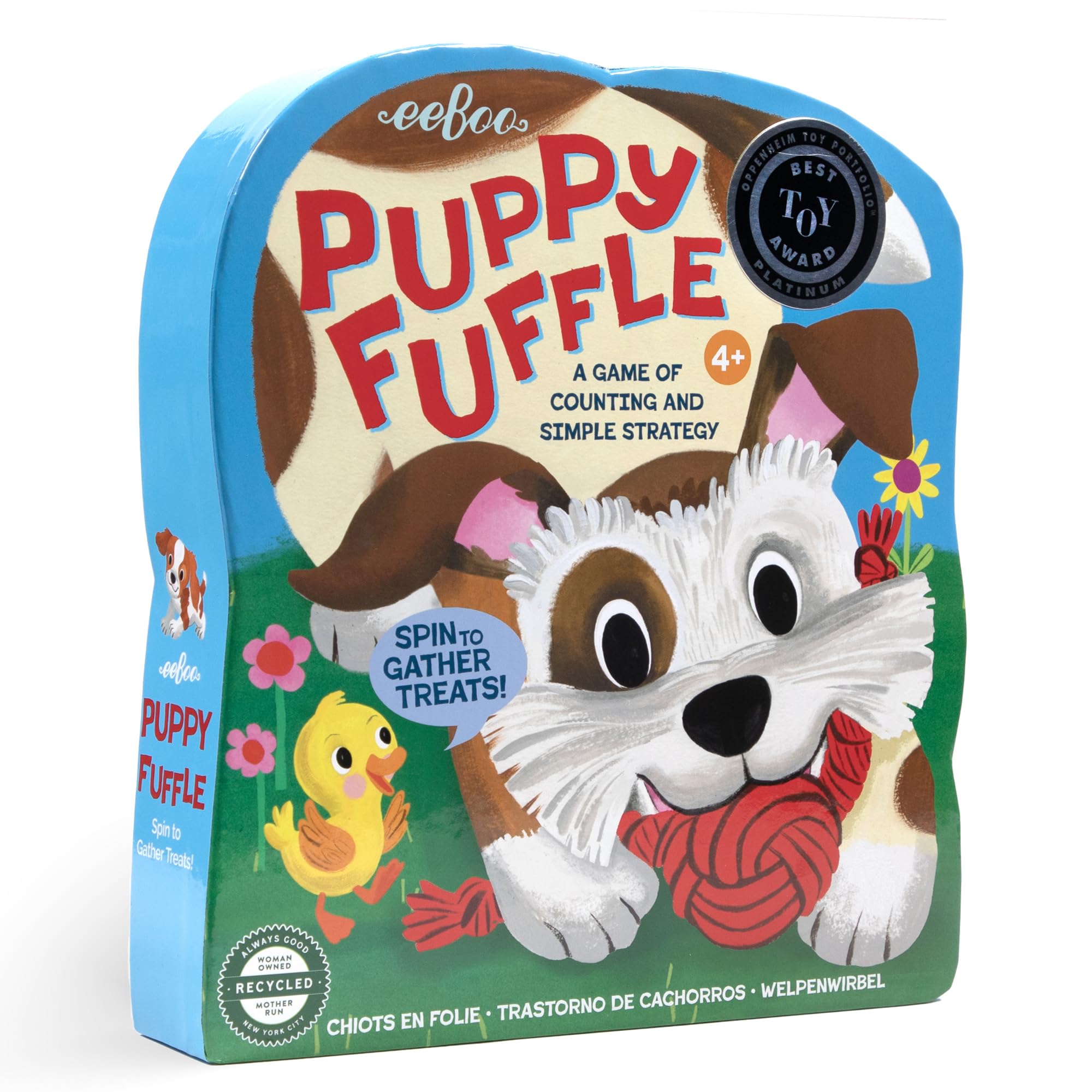
Puppy Fuffle introduces simple counting and a touch of light strategy through a theme that preschoolers instinctively love: gathering toys and treats for a puppy. The 16-inch square board shows a circular path with illustrated spaces, and players spin to determine how many spaces their puppy token moves. When a puppy lands on a space with a toy or treat tile, they add it to their corner collection. The spinner can also direct a player to snag a tile from an opponent’s corner, which adds a mild competitive edge without being punishing.
The component quality is a standout. eeBoo uses recycled board printed with vegetable-based inks, and the game box is sturdy enough to survive years of use. The tiles are thick and resist bending even when a three-year-old grabs them excitedly. The numbers on the spinner go from 1 to 5, which makes it an excellent tool for reinforcing early counting without feeling like a classroom exercise. A 15-minute game time means it works equally well for a quick round before dinner or a longer family game night with multiple rounds.
Parents report that children as young as late two-year-olds can grasp the core mechanic of spinning and moving, though the “steal from opponent” rule requires a bit of coaching. The puppy theme is broadly appealing, and the bright, clean artwork keeps the board from looking cluttered. For families who want a gentle introduction to competitive play where the stakes are low and the counting practice is baked into the fun, this is a premium pick that holds up to repeated play.
Why it’s great
- Teaches counting from 1 to 5 through natural gameplay
- Sustainably sourced with recycled board and vegetable inks
- Components are thick and resist toddler bending and tearing
Good to know
- Stealing tiles from opponents can upset some young players
- Spinner can be difficult for very small fingers to flick accurately
5. Peaceable Kingdom Acorn Soup

Acorn Soup is the rare board game designed explicitly for children as young as two years old, and it succeeds by stripping away every unnecessary element until only the core matching activity remains. The premise is simple: Squirrel needs to make soup, and the child follows recipe cards to pick up the correct wooden ingredients and place them in a bowl using the included wooden spoon. The recipe cards show pictures only — no words — so even a pre-verbal toddler can participate.
The physical components are the star here. Twenty-four chunky wooden pieces shaped like food items — acorns, berries, mushrooms, and leaves — are large enough that they pose no choking risk and small enough that a two-year-old can grasp them. The wooden spoon adds a scooping motion that builds hand-eye coordination and fine motor control. The 8 recipe cards offer enough variety that the game doesn’t feel repetitive, but the core action is consistent enough that toddlers can learn the routine after one or two demonstrations.
Parent reviews consistently highlight that this is the first game their child could play independently without an adult constantly stepping in to correct them. The included parent guide offers suggestions for expanding play — like counting ingredients or naming colors — as the child grows. The biggest drawback is component count: a few parents reported missing pieces on arrival, so checking the bag immediately is wise. For the price, Acorn Soup delivers more play value per dollar than any other game on this list for the under-three set.
Why it’s great
- Designed specifically for children as young as 24 months
- Chunky wooden ingredients are safe and easy for small hands
- Parent guide includes expansion ideas for growing children
Good to know
- Some units have arrived missing one or two wooden pieces
- Game is very simple and may not hold the interest of 3.5+ year olds
FAQ
What is the ideal age to introduce board games to a child?
Should I buy a cooperative or competitive game for my preschooler?
How many players should a preschool board game support?
Final Thoughts: The Verdict
For most families, the best board games for young kids winner is the Ravensburger Snail’s Pace Race because it removes the stress of losing entirely while teaching turn-taking and color matching through chunky wooden pieces and simple color dice. If you want a game that builds fine motor skills and shape recognition, grab the Educational Insights Frankie’s Food Truck Fiasco with its clever tweezers mechanic. And for a toddler just turning two, nothing beats the Peaceable Kingdom Acorn Soup for safe, screen-free matching play with chunky wooden ingredients.

Mo Maruf
I created WellFizz to bridge the gap between vague wellness advice and actionable solutions. My mission is simple: to decode the research and give you practical tools you can actually use.
Beyond the data, I am a passionate traveler. I believe that stepping away from the screen to explore new environments is essential for mental clarity and physical vitality.