Our readers keep the lights on and my smoothie glass nicely filled. As an Amazon Associate, I earn from qualifying purchases.
Finding a board game that actually holds a nine-year-old’s attention—without devolving into eye-rolling boredom or arguments over who cheated—is harder than it should be. At this age, kids crave strategy, humor, and just enough chaos to keep things interesting.
I’m Mohammad Maruf — the founder and writer behind WellFizz. I analyze game mechanics, age-appropriateness, and component quality to deliver buying guides that separate instant classics from one-and-done shelf-fillers.
After diving into player counts, playtimes, and the specific mix of luck versus skill that keeps this age group engaged, I’ve assembled a tight list of contenders for the best board games for 9 year olds that balance genuine challenge with real replay value.
How To Choose The Best Board Games For 9 Year Olds
Nine-year-olds occupy a sweet spot: they have outgrown simple matching games but lack the patience for complex rulebooks that take an hour to explain. The best choices land somewhere between accessible and challenging.
Consider player count and group dynamics
A game designed for 2–4 players can feel stale if you have a larger family or frequent visitors. Look for titles that stretch to 5–6 players or include flexible team modes, which reduces the chance of one child being left out.
Check the balance between luck and skill
Pure chance games frustrate kids who want to feel smart, while overly strategic games can cause analysis paralysis. A strong middle ground—where spatial reasoning, creative answers, or resource management matters alongside card draws—keeps every round fresh.
Estimate real playtime, not box claims
Game boxes promise “15–20 minutes,” but with setup, rule clarifications, and sibling shenanigans, actual play often runs longer. For 9-year-olds, a sweet spot is roughly 20–45 minutes once everyone knows the flow. Longer games risk losing focus; shorter ones feel too quick.
Quick Comparison
On smaller screens, swipe sideways to see the full table.
| Model | Category | Best For | Key Spec | Amazon |
|---|---|---|---|---|
| Monkey Palace | Strategy/Building | LEGO-loving families | 45-minute playtime, 2–4 players | Amazon |
| Exploding Kittens Board Game | Party/Strategy | Large groups & high energy | Folding board, 2–6 players, ages 7+ | Amazon |
| Spin Master Tetris Board Game | Spatial Puzzle | Fans of the video game | 2–4 players, 20-minute rounds | Amazon |
| Smug Owls Card Game | Creative Party | Groups wanting laugh-out-loud answers | 3–15 players, 15-minute rounds | Amazon |
| Hcusus Magnet Chess Game | Travel/Strategy | Portable two-player action | 40 magnetic pieces, 2–4 players | Amazon |
In‑Depth Reviews
1. Monkey Palace – LEGO Board Game

The genius of Monkey Palace is how it forces players to build with real LEGO bricks—stacking towers that grow precarious and eventually collapse under their own weight, creating unpredictable scoring moments. Each turn, you place monkeys and climb the structure, but the instability of the bricks adds a physical tension no cardboard game can replicate. The 231 included elements mean you are constructing a new board every single round, which keeps creative kids fully engaged.
Under the hood, the game uses a simple banana-based economy where you spend resources to claim spaces and earn points, but the collapsing tower mechanic means you rarely feel safe. The recommended age of 10+ is a soft guideline; many 8- and 9-year-olds with LEGO experience pick it up quickly after one practice round. Setup is slightly longer the first time due to sorting bricks, but subsequent sessions flow much faster.
Reviews consistently praise the “just right” challenge level that pushes families to think and build together without causing frustration. The only recurring note is that the 2–4 player limit and the need for concrete table space can be constraints for larger groups. Still, for a family with a LEGO lover, this delivers more replay value per dollar than most modern hobby games.
Why it’s great
- Physical brick-building adds real stakes and laughter when towers collapse
- Each game feels unique thanks to the rebuildable board
Good to know
- Limited to 4 players, which can exclude larger gatherings
- Initial setup and component sorting takes longer than average card games
2. Exploding Kittens: The Board Game
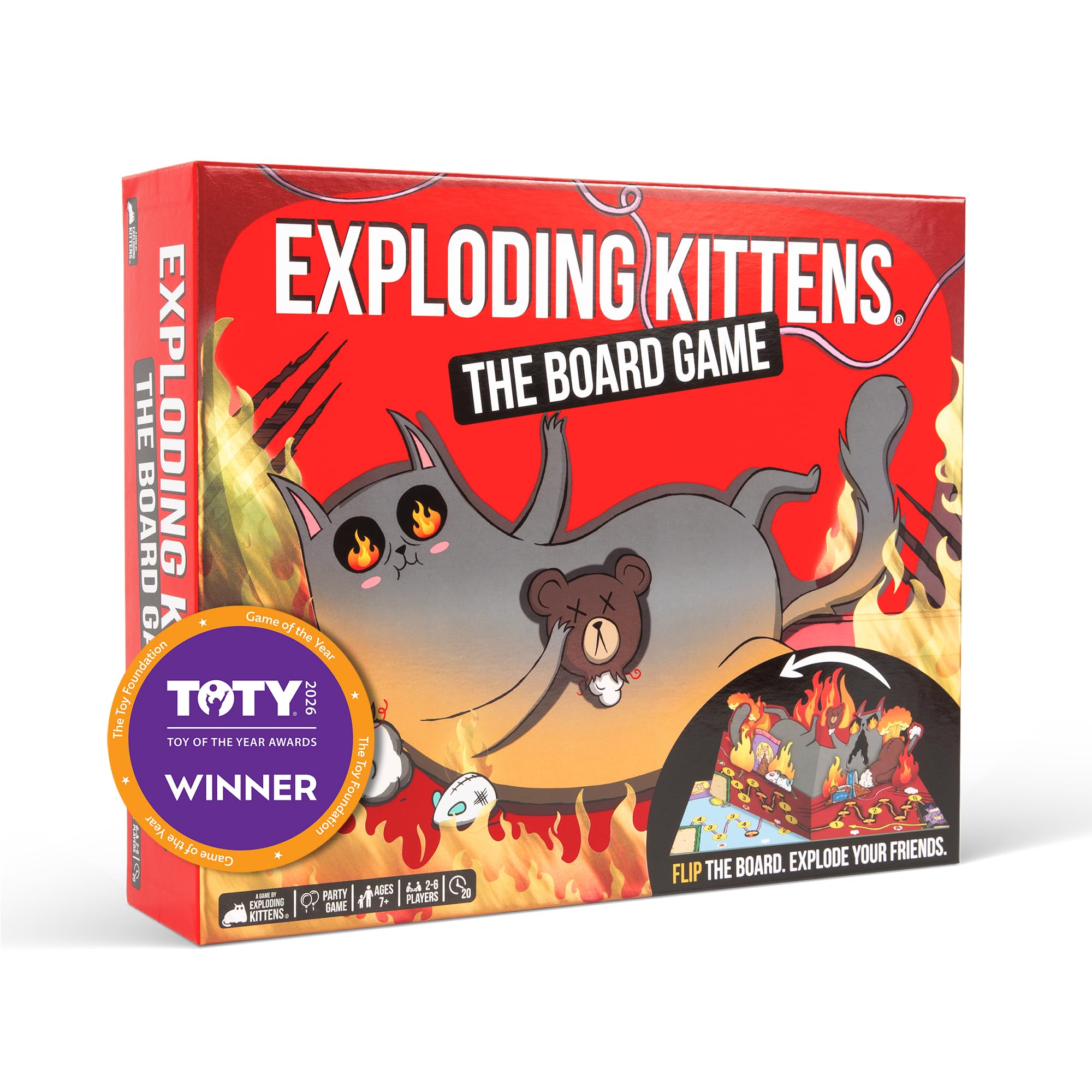
The Exploding Kittens franchise has built a loyal fanbase on absurd humor and simple risk-reward rules, and this board game version cranks up the physical drama by letting the board itself transform mid-game. Your goal remains the same—avoid getting eliminated by a cat that literally explodes—but now a wrong move can trigger a board flip that reveals an entirely new path, reshaping strategy on the fly. The pop-up board and character standees (including TacoCat and GnomeCat) give it a production value that feels special right out of the box.
What makes this work for 9-year-olds is the pace: rounds can run anywhere from 20 minutes to an hour depending on how aggressively players use action cards, but no turn ever feels slow. The toy industry’s Toy of the Year recognition for 2026 signals the quality, and the 65 action cards plus 26 move cards ensure variety over repeated plays. The one downside is that the board’s flip mechanism can feel stiff initially, though it loosens up after a handful of games.
Customer reviews highlight its success at parties and family nights, with the caveat that it may not feel as “action-packed” as the original card game for some. Still, the physical board transformation adds a tactile surprise that cards alone cannot match, making it a strong choice for a group with diverse ages.
Why it’s great
- Board-flip mechanic keeps every game unpredictable
- High-quality components and hilarious character designs appeal to kids and adults
Good to know
- Board fold may be stiff for the first few sessions
- Game length can vary widely from 20 minutes to over an hour
3. Spin Master Games: Tetris Board Game
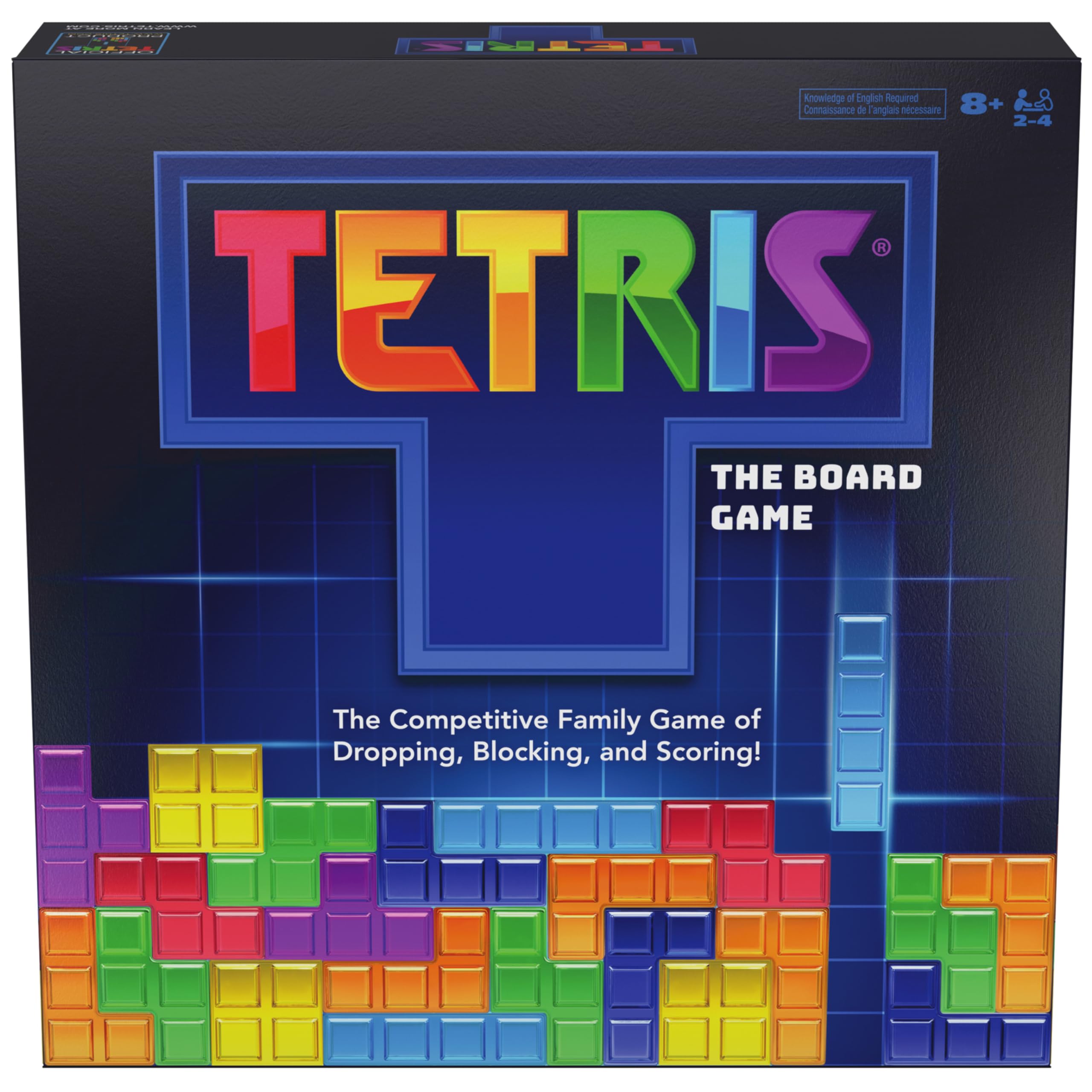
If your 9-year-old already knows the satisfying click of dropping Tetriminos on a screen, this board game version translates that spatial puzzle into a head-to-head competition that rewards quick thinking and strategic sabotage. Instead of clearing lines for score alone, you now drop Tetrimino cards onto your own grid while potentially sending Garbage Drop pieces to block an opponent’s line-completion. The semi-translucent Tetrimino tiles feel eerily close to the video game aesthetic, which is a nice touch for purists.
The game mechanics blend area control with reactive blocking, meaning kids must plan their own board while watching what opponents are doing. This dual focus trains spatial reasoning and situational awareness without feeling like homework. The 20-minute estimated playtime is accurate once everyone understands the basic flow, and the components—4 grids, 128 Tetriminos, and a central gameboard—are sturdy enough for regular use. The main concern from buyers is occasionally bent puzzle pieces in the box, so inspect upon arrival.
Parents report that competitive siblings love the sabotage element, though sore losers may find the blocking mechanism frustrating. It is best suited for kids who enjoy puzzles and can handle a moderate amount of direct competition.
Why it’s great
- Authentic Tetris feel translated to physical tabletop play
- Sabotage mechanics add a layer of strategy beyond solo puzzle-solving
Good to know
- Some pieces may arrive slightly bent from packaging
- Direct competition can frustrate kids who dislike being blocked
4. Runaway Parade Games: Smug Owls Card Game

Smug Owls flips the typical game-night dynamic by making creativity the primary skill—there is no single correct answer to the riddles it generates. Players flip cards to build a nonsensical riddle, then everyone competes to deliver the most clever, weird, or hilarious answer to win the favor of the Smug Owl judge. With over 130,000 possible riddle combinations from the same deck, it stays fresh far longer than games with finite question sets.
The real selling point for 9-year-olds is the flexibility: you can play with as few as 3 or as many as 15 people, which makes it the clear winner for birthday parties, sleepovers, or multi-family gatherings. The hand-drawn retro owl artwork charmed testers, and the 30-second learn time means no lengthy rule-reading before the fun starts. Each game lasts about 15 minutes, so it works as a filler between longer board games or as the main event for a whole evening of rotating judges.
The subjective judging can cause minor friction among siblings if a player feels the judge is unfair, but that is part of the charm for many families. It fosters creative thinking and language skills without feeling like an educational exercise.
Why it’s great
- Huge player range makes it ideal for large groups
- Near-infinite riddle combinations prevent repetition
Good to know
- Subjective judging can lead to sibling arguments over fairness
- Best played with a group that enjoys improv-style humor
5. Hcusus Magnetic Chess Game
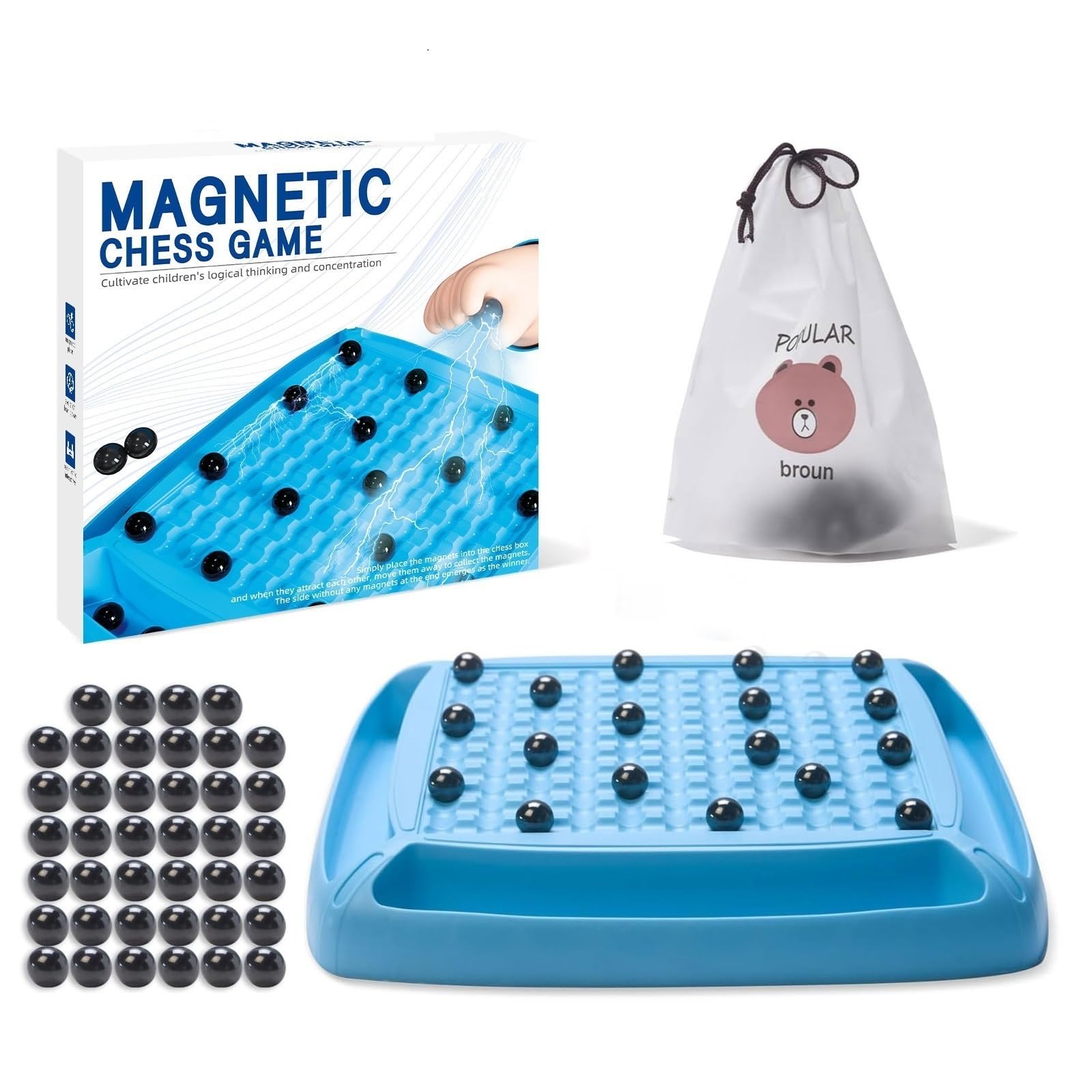
This compact magnetic strategy game strips away the board-game clutter and delivers a head-to-head challenge that fits in a storage bag. The premise is simple: players take turns placing magnetic pieces on a board, trying to avoid attracting opposing magnets while positioning their own forces strategically. The tactile snap of the magnets connecting adds a satisfying physical feedback that digital games cannot replicate.
For 9-year-olds who enjoy abstract strategy (similar to checkers or basic chess but with simpler rules), this offers a low-commitment way to build logical thinking without a massive time investment. The board measures just 11 x 11 inches and the thickness of cardboard means it can be tossed in a backpack for restaurants, car rides, or camping trips. The blue color scheme and bag packaging are straightforward and could be more premium, but the gameplay itself delivers more depth than the price suggests.
Customer reviews consistently mention that it works well as a “sensory” game for children who need hands-on engagement—the magnetic action is oddly calming. The primary limitations are the 2–4 player count (best as a duo game) and the lack of official expansion options, but for the price, it is a fantastic entry-level strategy game.
Why it’s great
- Extremely portable and quick to set up
- Magnetic pieces provide satisfying tactile feedback
Good to know
- Best as a two-player game despite claiming 2–4 players
- Packaging is utilitarian rather than gift-box quality
FAQ
Should I follow the age rating on the box exactly?
How many players should a board game support for a 9-year-old’s birthday?
Final Thoughts: The Verdict
For most families, the board games for 9 year olds winner is the Monkey Palace LEGO board game because it uniquely merges physical building with strategy, creating the kind of memorable crashes and laughs that keep kids begging for “one more round.” If you need a game for larger groups, grab the Smug Owls card game for its ridiculous riddle-solving. And for a portable two-player option that travels easily, nothing beats the Hcusus magnetic chess game.

Mo Maruf
I created WellFizz to bridge the gap between vague wellness advice and actionable solutions. My mission is simple: to decode the research and give you practical tools you can actually use.
Beyond the data, I am a passionate traveler. I believe that stepping away from the screen to explore new environments is essential for mental clarity and physical vitality.