Our readers keep the lights on and my smoothie glass nicely filled. As an Amazon Associate, I earn from qualifying purchases.
Finding a game that keeps a six-year-old from crying when they lose, an eight-year-old from getting bored after two rounds, and both from scattering tiny pieces across the living room floor is the real challenge. The sweet spot for this age range sits between simple matching and light strategy — not too babyish, not too advanced.
I’m Mohammad Maruf — the founder and writer behind WellFizz. I’ve spent years analyzing the mechanisms and components of family board games to identify which titles actually survive repeat play without grating on the adults.
My focus is on games that balance friction-free rules, durable components, and real engagement for both kids and parents. After sifting through the market, I’ve found the top contenders for the board games for 6-8 year olds category that deliver consistent, screen-free fun.
How To Choose The Best Board Games For 6-8 Year Olds
The difference between a game that collects dust and one that gets pulled out every weekend comes down to three specific factors: the type of challenge it offers, how long it holds attention, and how its physical pieces hold up. Here is what to watch for.
Cooperative vs. Competitive Dynamics
At ages six to eight, emotional regulation is still developing. A game where everyone wins or loses together removes the sting of elimination and encourages communication. Cooperative titles like Castle Panic teach strategy without singling out a single loser, while competitive games like Zingo Bingo keep the pressure low through fast, simple rounds. Choose based on your child’s temperament.
Playtime and Attention Span
A 45-minute game might work for an eight-year-old but lose a six-year-old after 15 minutes. Look for estimated playtimes in the 20-to-30-minute range, which matches the typical attention window for this age. Games with adjustable difficulty or variable round lengths, such as the Tetris board game, let you scale the session up or down.
Component Durability and Safety
Board game pieces get dropped, chewed, and thrown. Cards need thick stock, tiles should be rigid, and all edges must be smooth. Avoid games with hundreds of tiny pieces that scatter easily. A few robust tokens, like the mole rat movers in Space Escape, are safer and easier to track than a pile of cardboard chits.
Quick Comparison
On smaller screens, swipe sideways to see the full table.
| Model | Category | Best For | Key Spec | Amazon |
|---|---|---|---|---|
| Space Escape | Cooperative | Teamwork & communication | Estimated 30 min playtime | Amazon |
| Castle Panic 2nd Ed. | Cooperative | Strategy & monster defense | 1-6 players, 45 min games | Amazon |
| Zingo Bingo | Competitive | Early reading & matching | 7 players, double-sided cards | Amazon |
| Water Doodle Mat | Creative Play | Mess-free drawing | 40 x 28 inch reusable mat | Amazon |
| Tetris Board Game | Strategy | Real-life puzzle challenge | 152 Tetrimino pieces included | Amazon |
In‑Depth Reviews
1. Peaceable Kingdom Space Escape

Space Escape stands out because it forces kids to talk to each other. The cooperative premise — get the mole rats to the escape pod before snakes bite them — requires players to discuss every move aloud, making it a stealth exercise in communication and shared decision-making. The game board is sturdy, and the plastic mole rat movers have survived plenty of enthusiastic table knocks.
The 51-card deck splits each turn into two actions: one for the players and one for the snakes. That dual-action mechanic keeps adults engaged because the snake movements add genuine unpredictability. With an estimated 30-minute playtime, it fits neatly into a weeknight slot without dragging on. The instructions are clear enough for a seven-year-old to grasp after one demonstration.
One note on the age rating: the box says ages seven and up, but younger six-year-olds who are comfortable with simple strategic thinking can join with a little coaching. The cooperative format means nobody gets benched, so siblings of mixed ages can play together. It is one of the few games in this category that rewards replay through escalating difficulty rather than pure luck.
Why it’s great
- True cooperative play eliminates losing frustration.
- High-quality components that hold up to regular use.
- Each game feels different due to card-based snake movement.
Good to know
- Younger six-year-olds may need adult help with strategy.
- Only supports up to four players at once.
2. Fireside Games Castle Panic 2nd Edition

Castle Panic introduces a tower-defense mechanic that feels more like a video game than a board game, which clicks immediately with kids who play screen-based strategy games. The goal is simple: defend the castle towers from waves of monsters by trading cards and coordinating attacks with other players. The 3D towers add a tactile element that draws kids into the board’s physical space.
The 2nd Edition includes four play modes — cooperative, solo, competitive Master Slayer, and Overlord mode where one player controls the monsters. That variety means the game stays fresh long after the first dozen plays. The card-trading mechanic encourages negotiation, and the escalating monster difficulty keeps the tension high. Parents will appreciate the strategic depth, which requires real planning without overwhelming younger players.
With a 45-minute estimated playtime, this is the longest game in the lineup. It is best suited for eight-year-olds who can maintain focus, though a coached seven-year-old can participate. The reinforced box and thick card stock are built for rough handling. Pro tip: keep snacks nearby because the game creates genuine excitement that can delay dinner.
Why it’s great
- Four modes offer exceptional replay value.
- 3D castle towers are a huge hit with kids.
- Cooperative play builds teamwork without singling out losers.
Good to know
- 45-minute playtime may be too long for some six-year-olds.
- Small monster tokens can be misplaced if not stored properly.
3. ThinkFun Zingo Bingo

Zingo Bingo has been a classroom staple for years because it teaches reading and matching skills without feeling like homework. The Zinger device — a plastic dispenser that shoots out tiles — adds a tactile novelty that kids find irresistible. Each tile features both a picture and a word, so pre-readers can match by shape while early readers sound out the text. The double-sided cards offer two difficulty levels, extending the game’s lifespan.
Setup takes under a minute, and rounds last roughly 10 to 15 minutes. That speed makes it perfect for short attention spans or for filling five-minute gaps between dinner and bath time. The included extra card supports up to seven players, which is rare for a game this compact. The components are durable: the Zinger mechanism is simple enough to survive repeated use, and the tiles are thick enough to withstand drops off the table.
The main trade-off is that the game relies on luck rather than strategy. Once a child has memorized the tile set, the challenge diminishes. For the price, however, the number of plays before it gets stale is high. It works equally well for a four-year-old and an eight-year-old, making it one of the few games that bridges the sibling age gap effectively.
Why it’s great
- Zinger device adds a fun physical interaction.
- Two difficulty levels grow with the child.
- Supports up to seven players for group play.
Good to know
- Gameplay is luck-based with little strategic depth.
- May lose appeal once the tile images are memorized.
4. Spin Master Games Tetris Board Game
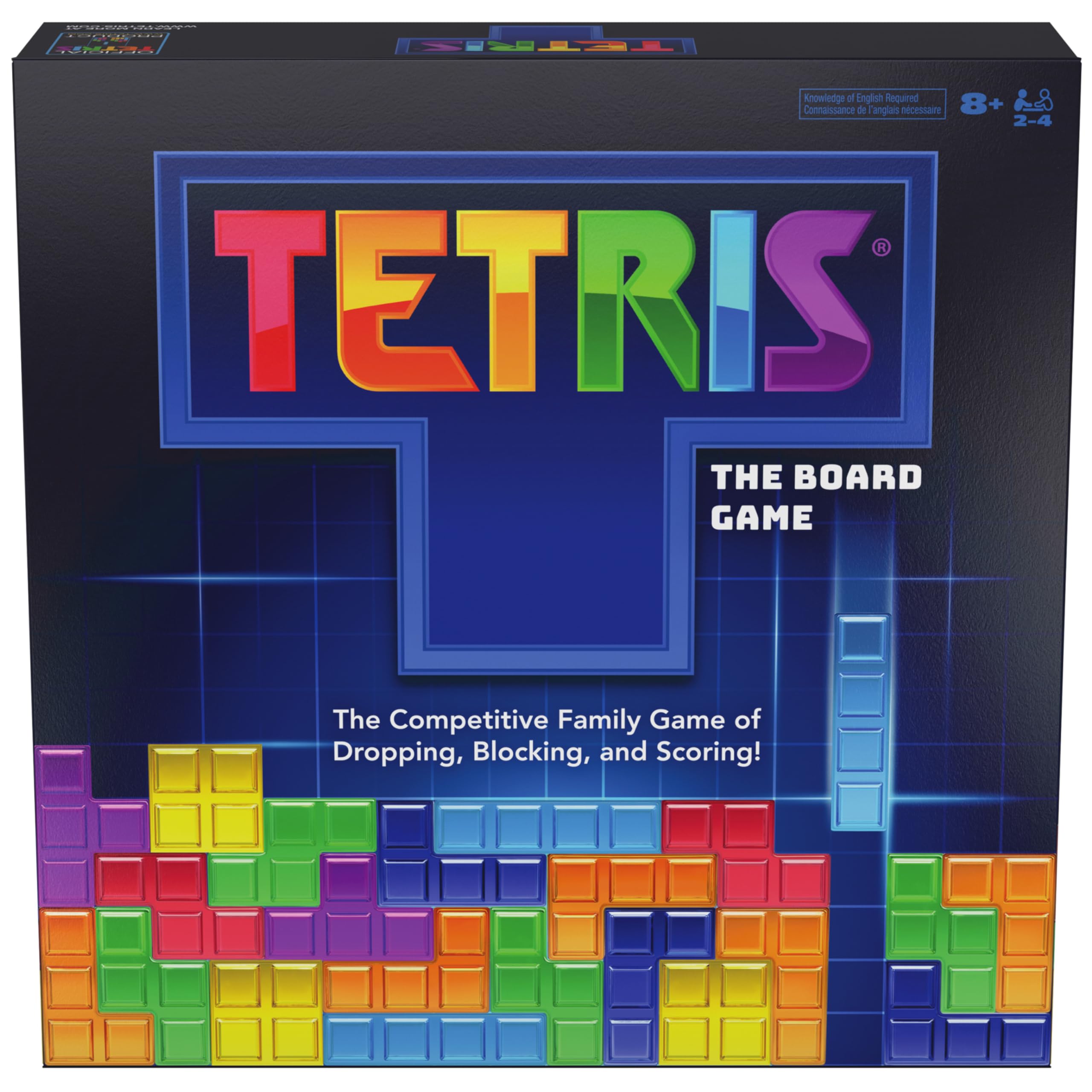
The Tetris board game translates the iconic digital puzzle into a physical format that rewards spatial reasoning and quick thinking. Players drop semi-translucent Tetrimino pieces onto their own grid, trying to complete lines before their opponents block them. The multiplayer component adds a competitive twist absent from the video game: you can place a black Garbage Drop piece in an opponent’s grid to sabotage their progress.
The component quality is solid. The 152 Tetrimino pieces fit snugly into the four plastic grids, and the translucent material makes it easy to see completed lines. The 20-minute estimated playtime is ideal for this age range — fast enough to stay engaging, short enough to avoid frustration. The instructions are straightforward, and kids familiar with the digital game will grasp the rules immediately.
One consideration: the box recommends ages eight and up, and the spatial planning required can be challenging for younger six-year-olds. The competitive sabotage mechanic may lead to some hurt feelings if a child gets blocked repeatedly. For older kids in the seven-to-eight range who enjoy puzzles, this game offers a satisfying screen-free alternative that exercises the same mental muscles.
Why it’s great
- Faithful physical adaptation of a classic game.
- Semi-translucent pieces look and feel premium.
- Fast 20-minute rounds hold attention well.
Good to know
- Competitive blocking can cause frustration in sensitive kids.
- Small pieces may be easily lost without careful storage.
5. Toyk Water Doodle Mat

The Water Doodle Mat is not a board game in the traditional sense, but it fills the same niche of structured, screen-free entertainment that keeps kids occupied. Fill the pens with clean water, draw on the mat, and watch the colors disappear within three to ten minutes as the water evaporates. The 40-by-28-inch surface is large enough for multiple kids to draw simultaneously.
The mess-free aspect is the standout feature. No ink, no paint, no stains on furniture or walls. The polyester mat is foldable and portable, making it a solid travel companion for restaurants or road trips. The included drawing molds, templates, and booklet add variety beyond freehand drawing. The pens are easy for small hands to grip, and the water-only system means refills are as simple as a tap.
Be aware that this is an open-ended activity rather than a structured game with rules and winners. It lacks the strategic depth and social interaction of the other options on this list. For parents who want quiet, independent playtime without cleanup, it is a fantastic supplementary option. Just keep the filled pens upright to avoid accidental drips between uses.
Why it’s great
- Zero mess and no ink means no cleanup.
- Large surface accommodates multiple kids.
- Portable and foldable for travel use.
Good to know
- No rules or structure — purely creative play.
- Pens must be stored upright to prevent dripping.
FAQ
What age is appropriate for the Tetris board game?
Are cooperative games better than competitive games for this age group?
How many small pieces do these games typically include?
Final Thoughts: The Verdict
For most families, the board games for 6-8 year olds winner is the Peaceable Kingdom Space Escape because it combines genuine cooperative strategy with the right 30-minute playtime and durable components that survive repeat use. If you want a deeper strategic challenge that grows with older kids, grab the Fireside Games Castle Panic 2nd Edition. And for mess-free creative play that keeps hands busy without any cleanup, nothing beats the Toyk Water Doodle Mat.

Mo Maruf
I created WellFizz to bridge the gap between vague wellness advice and actionable solutions. My mission is simple: to decode the research and give you practical tools you can actually use.
Beyond the data, I am a passionate traveler. I believe that stepping away from the screen to explore new environments is essential for mental clarity and physical vitality.