Our readers keep the lights on and my smoothie glass nicely filled. As an Amazon Associate, I earn from qualifying purchases.
The transition from simple toddler toys to structured family game night can be a tricky one. A five or six-year-old is ready for rules, turn-taking, and a bit of strategy, but a game that drags on or requires reading will quickly lose their attention. The best options in this space use vibrant themes, physical components, and simple mechanics to keep young minds engaged without causing frustration.
I’m Mohammad Maruf — the founder and writer behind WellFizz. My research into early childhood development and family play patterns focuses on identifying toys and games that balance entertainment with social and cognitive skill-building for this specific age band.
After analyzing play patterns, component durability, and educational value, these are the five top-rated games that define the current standard for the board games for 5-6 year olds market today.
How To Choose The Best Board Game For A 5-6 Year Old
Not every game on the shelf is built for this specific developmental stage. Prioritizing the right balance of challenge and fun ensures the game returns to the table night after night. Here’s what to look for when making your selection.
Understand the Age Rating and Skill Ceiling
A game labeled “ages 4+” is not always perfect for a 6-year-old. Look for games that offer a skill ceiling — a way for the gameplay to remain interesting as the child improves. Some games use double-sided boards or advanced rule variants to extend replayability without introducing frustration.
Prioritize Core Skill-Building Mechanics
Games for this age group should teach something tangible: color matching, counting, turn-taking, or strategic decision-making. Avoid games that rely heavily on luck without any player agency. The best games let the child feel in control of the outcome, which builds confidence and critical thinking.
Consider Component Size and Durability
Small pieces that can be easily lost or swallowed are a genuine risk. Thick cardboard tiles, chunky wooden pieces, and well-constructed spinners are hallmarks of a quality game. The game box should also be durable enough to survive being packed away (and frequently pulled out) by little hands.
Balance Playtime with Attention Span
A 30-minute game is often too long for a 5-year-old. Aim for games with a total playtime of 10 to 20 minutes. If a game is too quick, it can always be played twice. If it is too long, it will be abandoned mid-way. This is the most common reason a board game sits unused on the shelf.
Quick Comparison
On smaller screens, swipe sideways to see the full table.
| Model | Category | Best For | Key Spec | Amazon |
|---|---|---|---|---|
| Sneaky, Snacky Squirrel | Fine Motor | Color matching & dexterity | Includes squirrel squeezer tool | Amazon |
| Zingo Bingo | Language & Matching | Pre-readers & early readers | Includes Zinger tile dispenser | Amazon |
| Number Hunter | STEM Math | Addition & subtraction practice | Includes 50 challenge cards | Amazon |
| Rainbow Unicorn Rescue | Cooperative | Teamwork & imagination | Two ways to play (co-op or competitive) | Amazon |
| Dragon Adventure | Fantasy | Story-driven strategic play | Image-based movement cards | Amazon |
In‑Depth Reviews
1. Educational Insights The Sneaky, Snacky Squirrel Game

This game earns the top spot because it perfectly targets the fine motor and cognitive sweet spot for this age group. Players use a squirrel-shaped squeezer to pick up colored acorns and place them on their log, but the spinner introduces strategic elements like stealing from opponents or losing all your acorns. The physical action of squeezing the tool builds hand strength and dexterity in a way that feels like play, not therapy.
The board itself is cleverly designed to fold into the box for storage, making setup and cleanup a natural part of the game cycle. With a playtime of about 10-15 minutes, it is long enough to feel meaningful but short enough to hold a 5-year-old’s attention for multiple rounds. The components are thick and durable, surviving the enthusiastic handling of preschoolers.
Customer feedback consistently highlights how quickly children grasp the rules, often wanting to play multiple times in a row. It teaches winning and losing gracefully in a low-stakes environment. The only caveat is that the acorns are small, so it is best suited for children who are past the mouthing stage.
Why it’s great
- Excellent fine motor skill development tool.
- Teaches turn-taking, color recognition, and sportsmanship.
- Durable build with a clever storage-integrated board.
Good to know
- Small acorn pieces are a potential choking hazard for children under 3.
- May be outgrown quickly by advanced 6-year-olds.
2. ThinkFun Zingo Bingo

Zingo is a modern take on bingo that has earned its status as a classroom and household staple. The unique Zinger device dispenses two picture tiles at a time, and players race to match them to their card. The fast-paced nature keeps kids engaged, while the picture-based matching means no reading is required, making it accessible for pre-readers and early readers alike. This newest edition supports up to seven players, making it ideal for playdates or larger families.
The double-sided cards offer two levels of play, which extends the game’s lifespan as the child’s skills develop. The tiles and cards are made from thick, laminated material that withstands significant wear. At a brisk 10-15 minute playtime, it is one of the most replayable games in this lineup. It also promotes visual discrimination and quick thinking, skills that translate directly to early reading confidence.
Parents frequently report that this game becomes a fast favorite, often requested over more traditional options. The element of speed adds a gentle competitive edge without causing tears. The only potential downside is the Zinger device, while fun, can sometimes jam if overfilled, and the tiles can be a bit noisy when stored in the plastic unit.
Why it’s great
- No reading required; pure picture matching for pre-readers.
- Supports up to 7 players right out of the box.
- Two difficulty levels extend replay value significantly.
Good to know
- The Zinger device can occasionally jam with the tiles.
- Gameplay can be noisy, which may be distracting for some kids.
3. Clever Fox Play Number Hunter Math Board Game
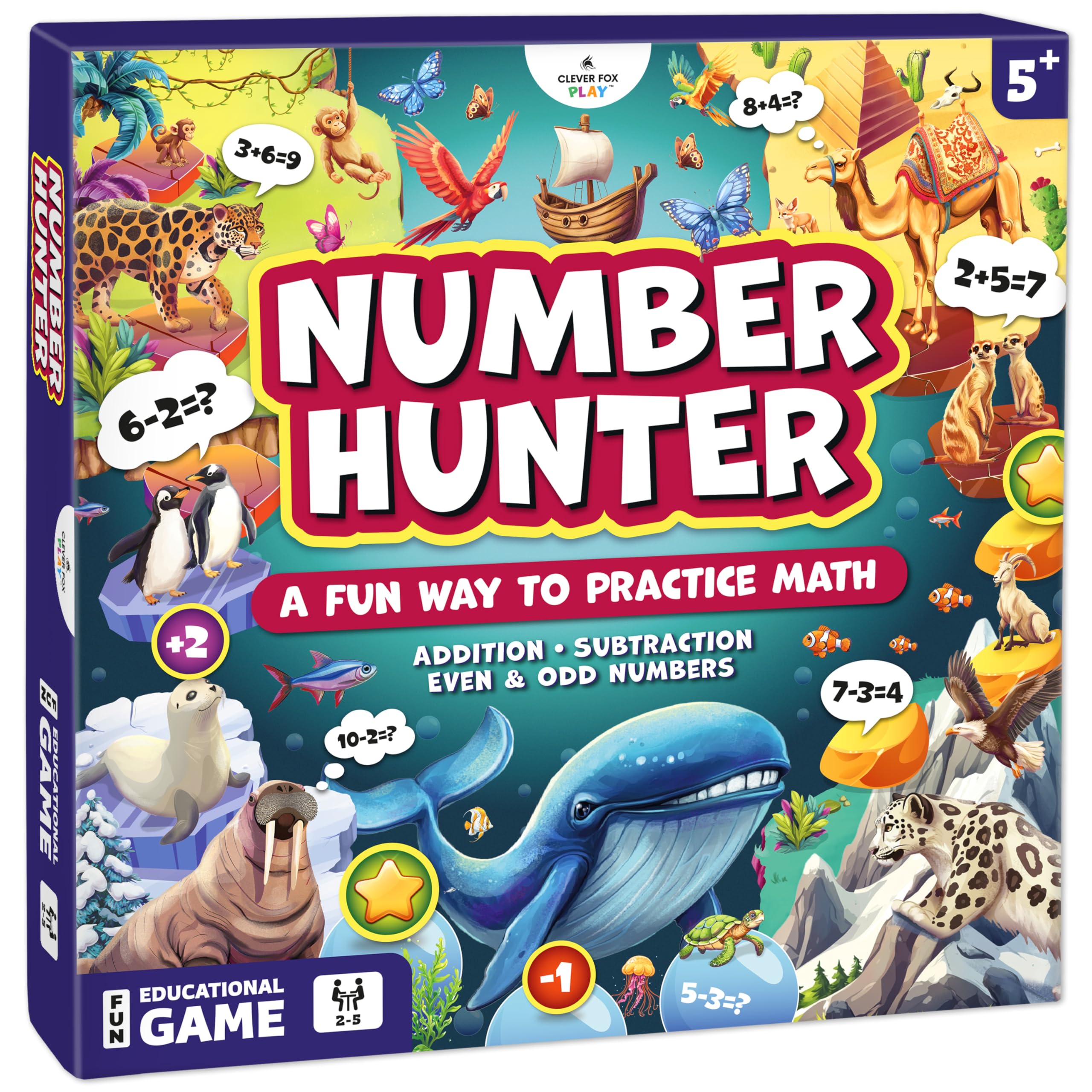
Number Hunter transforms basic arithmetic into an adventure. Players roll dice, add or subtract the numbers, and move their piece around a colorful track. The standout feature here is the integration of action challenges: landing on a star tile might require hopping on one leg or completing a mini math puzzle. This physical component is a secret weapon for keeping high-energy 5 and 6-year-olds engaged with a learning objective.
The game comes with 50 challenge cards, two number dice, and an operation die, offering a variety of math problems without ever feeling like a worksheet. It reinforces addition, subtraction, and the concept of odd and even numbers. The components are made from non-toxic, child-safe materials, and the box is sturdy enough for frequent use in a homeschool or classroom setting.
Reviews confirm its effectiveness: children who struggle with math drills often take to this game because the competition provides a natural motivation to calculate quickly. The game is especially strong for 1st and 2nd graders (ages 6-7), but can be simplified for a 5-year-old just learning to count. The only limitation is that the math focus may not appeal to every child every day.
Why it’s great
- Teaches addition, subtraction, and odd/even concepts seamlessly.
- Action cards (hopping, balancing) keep active children engaged.
- High-quality, durable components suited for frequent play.
Good to know
- Math theme may not appeal to children who dislike numbers.
- Best for kids already familiar with basic counting concepts.
4. Rainbow Unicorn Rescue

Rainbow Unicorn Rescue is a cooperative game where players work together to rescue unicorns, rather than competing against each other. This makes it an excellent choice for sensitive children or siblings who struggle with the “winner/loser” dynamic. The Rainbow Cards add a layer of silliness, prompting players to make animal sounds or strike goofy poses, which generates laughter and lightens the mood.
The game offers two modes: competitive head-to-head or cooperative, which is a rare and valuable feature in this category. The cooperative mode teaches teamwork and communication, as players must decide together how to use their movement cards. With a quick 10-15 minute playtime, it is perfect for a wind-down activity before dinner or as a warm-up for more complex games. The wooden pieces and board are well-made and visually appealing.
Customer feedback highlights how even reluctant players get drawn in by the unicorn theme and the silly card prompts. The lack of reading required makes it accessible for the full age range. The spinner mechanism can occasionally stick right out of the box, but a simple fix resolves it. For families seeking a non-confrontational game night experience, this is a winner.
Why it’s great
- Cooperative mode eliminates competition stress for sensitive kids.
- Two play modes (co-op and competitive) increase variety.
- Silly Rainbow Cards generate laughter and engagement.
Good to know
- Spinner can be sticky initially; may require lubrication.
- Unicorn theme may not appeal to every child.
5. Jumping High Five My First Dragon Adventure

My First Dragon Adventure offers a story-driven experience that appeals to the imagination of a 5-6 year old. The premise — finding a dragon to relight a magical s’mores fire — is whimsical and immediately engaging. Players use numbered image-based cards to move through enchanted lands, which means no reading is required, and the game is accessible for the entire age range.
The game develops basic counting, strategic thinking, and communication skills. Unlike many kids’ games that rely purely on luck, this one introduces a small degree of decision-making: players can choose which card to play to maximize their movement. This element of choice is a gateway to more complex strategy games later. The vibrant board and detailed cards create a rich narrative environment that encourages creative storytelling during play.
Parents consistently report that this game is a hit not just with the intended 5-year-old, but also with older siblings and adults. The varied scoring system adds replayability, and the straightforward design allows families to create house rules for even more longevity. The game is made by a small, family-owned business, which adds a nice touch of authenticity. The main drawback is that if played strictly by the book, the game can have a shorter lifespan for advanced players.
Why it’s great
- Engaging fantasy story captures young imaginations immediately.
- Image-based cards require no reading.
- Teaches basic counting and strategic card selection.
Good to know
- If played strictly by the rules, may be outgrown by advanced 7-year-olds.
- Box dimensions are small, which can make storage on a shelf a bit awkward.
FAQ
Are board games for 5-6 year olds worth the investment given short attention spans?
Can a 5-year-old play a game designed for ages 7 and up without help?
What is the ideal number of players for a board game for this age group?
How do I know if a game will be too difficult for my child?
Final Thoughts: The Verdict
For most families, the best board games for 5-6 year olds winner is the Educational Insights The Sneaky, Snacky Squirrel Game because it masterfully combines fine motor skill development with simple, engaging strategy. If you want a game that supports early reading and can handle a crowd, grab the ThinkFun Zingo Bingo. And for a cooperative experience that builds teamwork and silliness in equal measure, nothing beats the Rainbow Unicorn Rescue.

Mo Maruf
I created WellFizz to bridge the gap between vague wellness advice and actionable solutions. My mission is simple: to decode the research and give you practical tools you can actually use.
Beyond the data, I am a passionate traveler. I believe that stepping away from the screen to explore new environments is essential for mental clarity and physical vitality.