Our readers keep the lights on and my smoothie glass nicely filled. As an Amazon Associate, I earn from qualifying purchases.
Finding a game that holds a four-year-old’s attention without causing a meltdown over complex rules is the real challenge of family game night. You need options that build fine motor control, encourage turn-taking, and are simple enough for little hands to manage independently. This guide focuses on games that deliver genuine play value for this specific age group, not just colorful boxes.
I’m Mohammad Maruf — the founder and writer behind WellFizz. I’ve spent years analyzing the hardware and design choices that make a board game work for preschoolers, from spinner durability to the weight of playing pieces.
After reviewing dozens of options, I’ve built a focused list of the very best board games for 4 year olds that prioritize skill-building and real enjoyment over marketing fluff.
How To Choose The Best Board Games For 4 Year Olds
Not every game labeled “ages 4 and up” is truly appropriate. A successful game for this age prioritizes simple rules, tactile interaction, and a playtime that respects a short attention span. Look for mechanics that encourage cooperation or simple turn-taking over competitive pressure.
Motor Skill & Dexterity Requirements
The best games for this age actively build hand-eye coordination. Games that use tongs, squeezers, or mallets to manipulate pieces are superior to those that only require placing cards. A game that asks a child to pick up a small plastic bug with tongs is doing more for their development than one that just matches pictures.
Quick Comparison
On smaller screens, swipe sideways to see the full table.
| Model | Category | Best For | Key Spec | Amazon |
|---|---|---|---|---|
| Educational Insights The Sneaky, Snacky Squirrel Game | Fine Motor | Skill-building & turn-taking | Squirrel squeezer tool for acorns | Amazon |
| NATIONAL GEOGRAPHIC My First Safari Board Game | Cooperative | Teamwork & animal learning | Cooperative play with 3 difficulty levels | Amazon |
| Bed Bugs Board Game | Action/Motor | High-energy hand-eye coordination | Motorized vibrating bed board | Amazon |
| Hasbro® Don’t Break The Ice Game | Skill/Chance | Classic suspense & fine motor tapping | 32 small ice blocks + 2 mallets | Amazon |
| EPOCH Games Super Mario Blow Up Shaky Tower | Balancing | Character-driven fine motor play | 7 Mario action figures included | Amazon |
In‑Depth Reviews
1. Educational Insights The Sneaky, Snacky Squirrel Game

The Sneaky, Snacky Squirrel Game is a masterclass in preschool game design, combining a satisfying tactile tool with a simple, engaging objective. The star of the show is the squirrel-shaped squeezer, which requires genuine fine motor control to operate. Children use it to pick up colorful acorns and match them to their log, reinforcing color recognition with every successful grab.
The spinner introduces just enough unpredictability — with spaces like “steal an acorn” or “lose all your acorns” — to teach strategic thinking and emotional resilience without overwhelming a four-year-old. The game board itself folds into the box for storage, making setup and cleanup painless for parents. Each round lasts about 10 to 15 minutes, perfectly matching a preschooler’s attention span.
Customer reviews consistently note how quickly children grasp the rules. The game is designed for 2 to 4 players and works for ages 3 and up. The acorn pieces are substantial, but as with any small object, supervision is advised. This is a game that builds skills without feeling like homework.
Why it’s great
- Develops strong fine motor skills with the unique squeezer
- Teaches turn-taking, color matching, and sportsmanship
- Quick 10-minute rounds suit short attention spans
Good to know
- Acorns are a potential choking hazard for children under 3
- Too simple for children older than 5
2. Bed Bugs Board Game
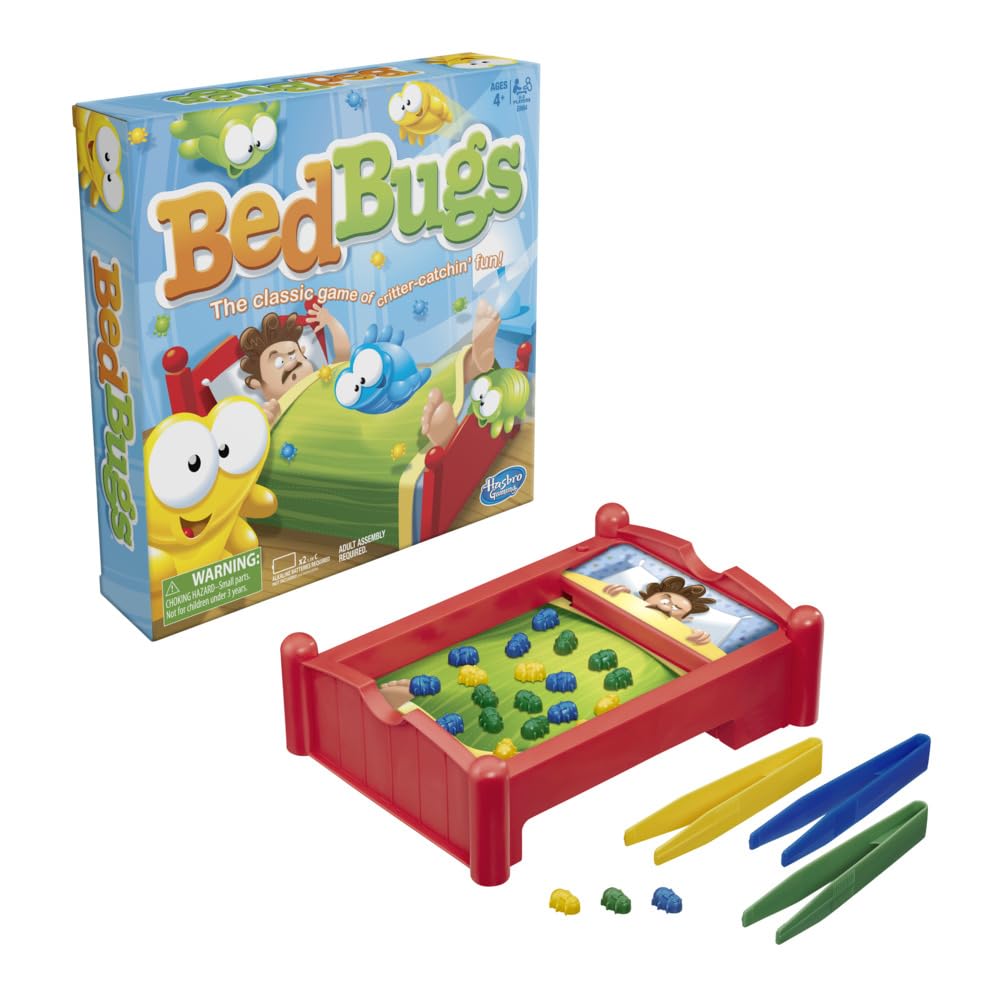
Bed Bugs turns the concept of a board game on its head with a motorized “bed” that vibrates to make plastic bugs bounce and hop around. It’s an active, laugh-inducing game that relies entirely on hand-eye coordination. Each player uses a colored pair of tongs to catch the bugs matching their color, racing to clear their set first.
The physicality of the game is its biggest strength — the buzzing, unpredictable movement of the bugs keeps children fully engaged and reacting in real time. Setup is minimal, and the game plays in about 20 minutes. It’s designed for 2 to 3 players and is explicitly for ages 4 and up.
Some feedback notes that the bugs can stop moving if pressed too hard into the vibrating bed, and the game can feel repetitive after several plays. However, as a tool for building quick reflexes and color matching under a timer-like pressure, it is unmatched. The chunky tongs are easy for small hands to grip.
Why it’s great
- High-energy, motorized action keeps kids focused
- Excellent for developing quick hand-eye coordination
- Easy to learn with minimal rules
Good to know
- Bugs can get stuck if pressed down too hard
- Limited to 2-3 players only
3. NATIONAL GEOGRAPHIC My First Safari Board Game

My First Safari flips the competitive script by making everyone a teammate. Players work together to spot all the animals on the board before the sun token moves all the way across to “sunset.” This cooperative mechanic is perfect for four-year-olds, as it eliminates the sting of losing and encourages verbal collaboration and shared excitement.
The game includes a full-color Learning Guide packed with facts about 21 different animals, transforming playtime into a low-pressure educational moment. The difficulty is adjustable with three levels, meaning the game can grow with your child. The components — including 5 safari explorer tokens and 36 item cards — are sturdy and designed for small hands.
A minor complaint from users involves the difficulty of snapping the small explorer figures into their plastic stands, which can require some adult patience. However, once set up, the game plays smoothly. It is a fantastic choice for building social skills like taking turns and making group decisions without the pressure of direct competition.
Why it’s great
- Zero competition means no tears; everyone wins together
- Three difficulty levels extend the game’s lifespan
- Teaches animal facts and cooperative strategy
Good to know
- Explorer figures are surprisingly hard to attach to their stands
- Box is compact, but pieces are small and need organization
4. Hasbro® Don’t Break The Ice Game

Don’t Break The Ice is a timeless test of precision and nerve. Players take turns using a small mallet to tap out plastic ice blocks from a frame, all while trying to keep Phillip the Penguin balanced on top. The tension builds with every tap, and the moment the ice finally breaks, the penguin falls with a satisfying “ker-plop.”
This game requires zero batteries, zero reading, and zero setup beyond placing the ice blocks. It is a pure, tactile experience that teaches cause and effect, turn-taking, and fine motor control. The game is designed for 2 to 4 players and is rated for ages 3 and up.
While the build quality of the plastic frame and mallets is adequate, some reviews note it feels less durable than older versions of the game. The 30-minute estimated playtime is generous; real games often end much quicker. This is an excellent entry-level game that provides a genuine thrill for its simple premise.
Why it’s great
- No batteries, no messy pieces, instant setup
- Builds suspense and teaches cause and effect
- Simple enough for a 3-year-old to understand instantly
Good to know
- Plastic components feel slightly less robust than classic versions
- Can be too simple for children over age 5
5. EPOCH Games Super Mario Blow Up Shaky Tower
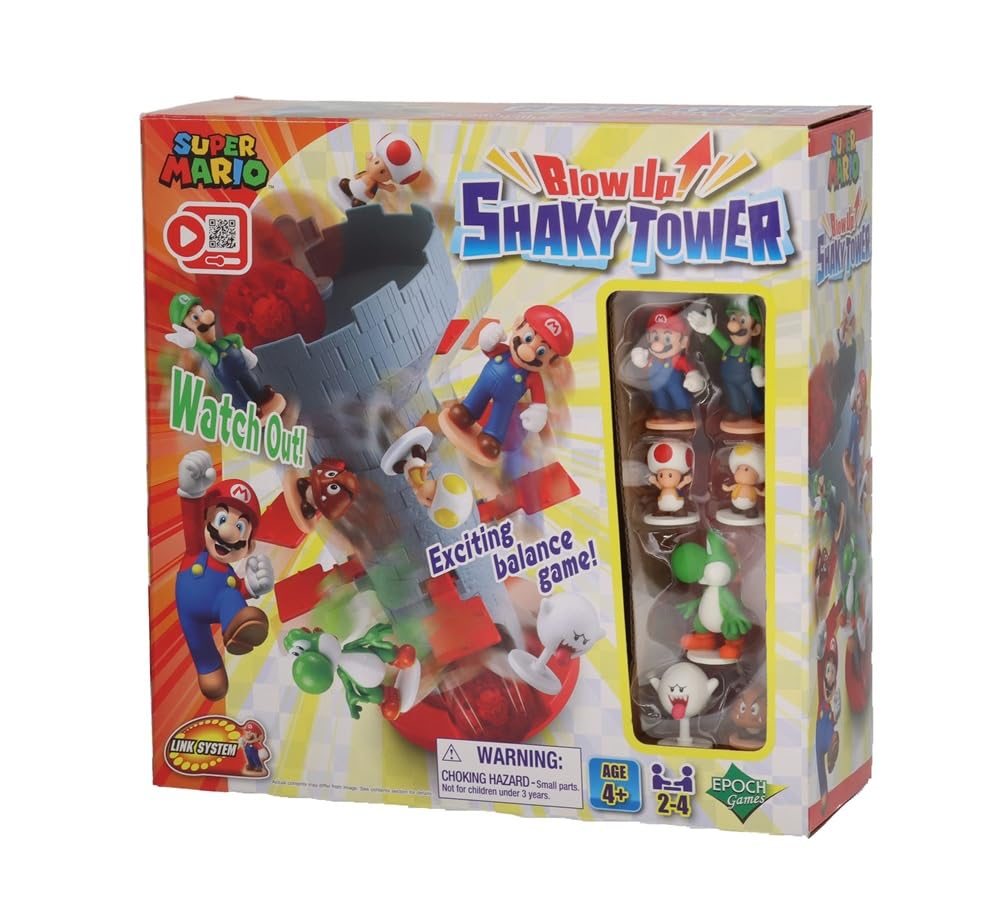
The Super Mario Blow Up Shaky Tower leverages the powerful appeal of Mario, Luigi, Yoshi, and other classic characters to drive a balancing game. Players roll a die that tells them how many figures to place on or remove from the wobbly tower structure. The goal is to keep the tower from shaking and sending the characters flying.
The game is a fantastic test of steady hands and spatial awareness. The collectible figurines are high-quality and compatible with other EPOCH Super Mario games, adding replay value for fans. It requires minor assembly to set up the tower, but once built, it stays together well during play.
Some users report that the tower can be unstable even before play begins if not assembled perfectly, and the instructions could be clearer. However, for a child who loves Mario, the excitement of handling these recognizable figures outweighs the occasional setup frustration. It is great for 2-4 players ages 4 and up.
Why it’s great
- Licensed Super Mario characters are a huge engagement draw
- Develops fine motor control and spatial reasoning
- Collectible figures add long-term value for fans
Good to know
- Requires some initial assembly of the tower frame
- Can be unstable if parts are not snapped in completely
FAQ
Are cooperative board games better for a 4-year-old than competitive ones?
What is the ideal number of players for a board game for a 4-year-old?
How do I know if a game has too many small parts for a 4-year-old?
Final Thoughts: The Verdict
For most users, the board games for 4 year olds winner is the Educational Insights The Sneaky, Snacky Squirrel Game because it perfectly balances fine motor skill development with engaging, simple rules. If you want cooperative play that teaches teamwork and animal facts, grab the NATIONAL GEOGRAPHIC My First Safari Board Game. And for high-energy, laugh-out-loud motor skill action, nothing beats the Bed Bugs Board Game.

Mo Maruf
I created WellFizz to bridge the gap between vague wellness advice and actionable solutions. My mission is simple: to decode the research and give you practical tools you can actually use.
Beyond the data, I am a passionate traveler. I believe that stepping away from the screen to explore new environments is essential for mental clarity and physical vitality.