Our readers keep the lights on and my smoothie glass nicely filled. As an Amazon Associate, I earn from qualifying purchases.
The transition to solid foods is a messy, thrilling milestone, and the right tools can mean the difference between a confident self-feeder and a frustrated little one who just wants to fling everything off the tray. Standard adult spoons are too long, too deep, and too rigid for a 6-month-old’s emerging pincer grasp, which is why a dedicated set of baby-led weaning utensils exists in the first place. The goal is simple: a utensil that lets a baby grip, lift, and munch without requiring the wrist rotation they won’t master for another year or more.
I’m Mohammad Maruf — the founder and writer behind WellFizz. My research focuses on the intersection of developmental milestones and product design, analyzing handle ergonomics, silicone shore hardness, and suction mechanics to identify which utensils truly support independent feeding rather than just looking cute on a registry.
After evaluating dozens of sets against the specific demands of baby-led weaning — shallow spoon bowls that don’t require scooping, handles thick enough for a palmar grasp, and materials that can survive being tossed onto the floor mid-meal — I’ve assembled a clear guide to the best blw utensils for every stage and budget.
How To Choose The Best BLW Utensils
Baby-led weaning utensils are not just smaller spoons. They are engineered around a fundamental developmental limitation: babies under 18 months cannot rotate their wrists to scoop food toward themselves. This single constraint dictates everything from handle shape to bowl depth, and ignoring it is the number one reason a set ends up on the floor instead of in your baby’s mouth.
Handle Design and Grasp Stage
At 6 months, babies use a palmar grasp — essentially a whole-hand fist around the handle. The handle should be thick (around 0.5 to 0.7 inches in diameter) and contoured to prevent slipping. At 9 to 12 months, a pincer grasp emerges, and thinner handles with finger rests become appropriate. A set that offers two spoon sizes per stage, like a shorter pre-spoon and a longer training spoon, covers the transition without forcing a second purchase.
Spoon Bowl Geometry and Flexibility
The bowl must be shallow and wide enough to hold puree or soft solids without requiring the baby to tilt the spoon. A deep, concave bowl demands wrist rotation that a 6-month-old simply cannot perform. The material should be flexible (food-grade silicone with a shore hardness around A50 to A70) so it is gentle on gums and emerging teeth, but stiff enough that it doesn’t collapse when the baby bites down. Open-channel spoons, which look like a paddle with a groove, are particularly effective for gripping soft solids like avocado or banana.
Material Safety and Cleaning
Look for 100% food-grade silicone certified BPA-free, phthalate-free, and PVC-free. Silicone is naturally non-porous, resistant to bacterial growth, and dishwasher-safe. Avoid hard plastics that can chip or crack, and avoid wooden utensils that can splinter after repeated washing. Stainless steel is durable for toddlers over 12 months, but the tips must be rounded and the handles short enough to prevent gagging.
Suction Base Compatibility
If your BLW approach involves a dedicated plate or bowl, the suction strength of that base directly impacts utensil success. A weak suction means the plate slides away during scooping, which frustrates the baby and undermines the entire self-feeding attempt. Strong 4-point suction cups on silicone plates and bowls keep the vessel stationary, allowing the baby to focus entirely on the utensil-to-mouth motion. Test the suction on your specific high-chair tray before committing to a set.
Quick Comparison
On smaller screens, swipe sideways to see the full table.
| Model | Category | Best For | Key Spec | Amazon |
|---|---|---|---|---|
| NumNum Baby Spoons Set | Pre-Spoon | First stage self-feeding (6+ months) | Open-channel bowl; 0.6″ handle width | Amazon |
| Olababy 3-Piece Set | Training + Parent Spoon | Parent-led + baby-led combo | Dual spoon sizes; suction bowl included | Amazon |
| O’doe Baby Weaning Set 15-Pcs | Complete Set | All-in-one feeding system | 15 pieces; dual utensil sizes | Amazon |
| Munchkin Raise Toddler Set | Transitional | Toddler self-feeding (12+ months) | Stainless steel tips; rest keeps tips off table | Amazon |
| 100% Silicone Baby Feeding Set 9-Pcs | Complete Silicone Set | Full mealtime ecosystem | 9 pieces; 4-point suction plate + bowl | Amazon |
In‑Depth Reviews
1. NumNum Baby Spoons Set

The NumNum GOOtensils are the gold standard for the earliest BLW stage precisely because they eliminate the need for scooping entirely. The patented pre-spoon is an all-flat, contoured paddle that grips purees and soft solids through an open-channel design — the food essentially sticks to the spoon without any wrist rotation from the baby. At 0.6 inches wide, the handle is thick enough for a 6-month-old’s palmar grasp, and the textured surface prevents the spoon from sliding through their fist mid-meal.
The set includes two distinct shapes: a shorter, wider pre-spoon for first-stage purees and teething, and a longer, narrower open-channel spoon for slightly thicker soft solids like mashed sweet potato or ripe avocado. Both are made from food-grade silicone with a shore hardness that is stiff enough to hold its shape when loaded but flexible enough to be gentle on gums. The 20-gram weight is nearly imperceptible for a baby’s hand, reducing the likelihood of the spoon being dropped in frustration.
Pediatric OTs frequently recommend this set because it honors the developmental reality that wrist rotation doesn’t typically emerge until age 2. The spoons are dishwasher-safe, BPA-free, and phthalate-free. The only trade-off is that these are not intended for the advanced scooping stage — once your baby masters wrist rotation around 18 months, you will need a transitional spoon with a deeper bowl. But for the critical 6-to-18-month window, nothing else addresses the core BLW mechanic as directly.
Why it’s great
- Completely eliminates need for wrist rotation at the earliest stage
- Thick, contoured handle (0.6″) ideal for palmar grasp
- Two distinct spoon shapes for transitioning food textures
- Dishwasher-safe, BPA-free, and pediatric OT recommended
Good to know
- Not suitable for the advanced scooping stage (18+ months)
- Only 2 spoons per pack, so you may want a backup set
- Open-channel design is less effective for very runny purees
2. Olababy 3-Piece Parent Led and Baby Led Weaning Set
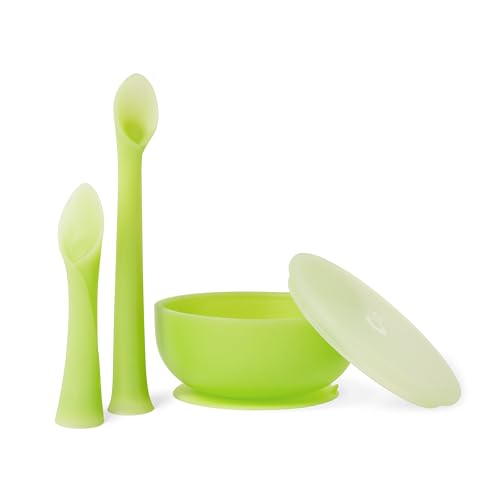
The Olababy set is uniquely positioned as a hybrid system that serves both parent-led and baby-led feeding approaches simultaneously. It includes two spoons: a longer, ergonomically curved spoon designed for the parent’s hand to pre-load and offer to the baby, and a shorter, fully flexible training spoon designed for the baby’s own hand. The training spoon’s flexible material allows the baby to scoop food at any angle without needing wrist rotation, and its softness protects emerging teeth and sensitive gums.
The suction bowl that comes with the set is a notable upgrade over standalone utensil purchases. The suction base is designed to stick securely to smooth high-chair trays and tables, preventing the bowl from sliding or flipping during active scooping attempts. The bowl also features a smart lip — a slightly raised edge on one side — that acts as a scraping edge, helping the baby load food onto the spoon more effectively. The included lid turns the bowl into a storage or steaming vessel, adding utility beyond mealtime.
Like the NumNum set, Olababy uses 100% food-grade silicone that is BPA-free, PVC-free, and phthalate-free. The bowl and spoons are dishwasher-safe. One caveat: some users report that the suction base can lose grip on slightly textured or uneven surfaces, and the bowl’s capacity is relatively small for larger appetites. If you are looking for a minimalist, high-quality starter set that grows with your baby from parent-led spooning to independent self-feeding, this is a strong contender.
Why it’s great
- Includes two spoon sizes: one for parent, one for baby self-feeding
- Suction bowl with smart lip aids scooping and prevents spills
- Flexible silicone training spoon is gentle on gums
- Dishwasher-safe and made from toxin-free food-grade silicone
Good to know
- Suction base may not hold on textured or non-smooth surfaces
- Bowl capacity is modest; best for smaller first-meal portions
- Some users experienced longer shipping times
3. O’doe Baby Weaning Set 15-Pcs

The O’doe set is the most comprehensive all-in-one solution on this list, packing 15 pieces into a single purchase. Beyond the core utensils — which include two large toddler spoons and forks for the 12+ month stage and two smaller silicone utensils for the 6+ month stage — you also get a suction plate, suction bowl, adjustable bib with food catcher, sippy cup with snack cap, fruit feeder, freezer tray with lid, and even a baby toothbrush. This is a complete feeding ecosystem for parents who prefer to buy once rather than piecemeal.
The utensils themselves are ergonomically shaped for small hands, with short handles and rounded, shallow bowls that support the BLW principle of easy loading. The large spoons and forks are suitable for the transition phase when the baby begins practicing wrist rotation, while the smaller silicone utensils are flexible enough for the earliest palmar grasp stage. The suction plate and bowl feature strong non-slip bases that hold firmly on smooth surfaces, and the divided plate helps keep different foods separated for babies who are sensitive to textures mixing.
All components are made from 100% food-grade silicone that is BPA-free, PVC-free, and phthalate-free. The set is microwave-safe, freezer-safe, and dishwasher-safe, which significantly reduces cleanup time. The only notable downside is that the smaller utensils, while functional, are slightly less refined in their ergonomics compared to dedicated BLW brands like NumNum or Olababy. The handle width on the small spoons may be slightly narrow for some 6-month-old fists. However, the sheer breadth of included items makes this the best value proposition for families who want a full feeding arsenal from the start.
Why it’s great
- 15-piece set covers nearly every feeding need from 6 months onward
- Includes both small silicone utensils and larger toddler spoons/forks
- Strong suction plate and bowl prevent spills and sliding
- Dishwasher-safe, freezer-safe, and microwave-safe
Good to know
- Small utensils have slightly narrower handles than dedicated BLW brands
- Some pieces (like the toothbrush) may feel like filler for some users
- Large spoons may be too big for babies under 10 months
4. Munchkin Raise Toddler Fork and Spoon Set

At 12 months and beyond, many babies are ready to transition from silicone spoons to utensils with more structure. The Munchkin Raise set is designed specifically for this stage. The handles are ergonomically shaped for toddler hands — shorter and thicker than adult utensils but not as bulbous as first-stage BLW spoons. The forks and spoons feature stainless steel tips with rounded edges, providing enough rigidity to spear soft fruits or scoop yogurt without being sharp enough to cause injury.
The standout feature of this set is the built-in rest at the base of each utensil. This small plastic extension keeps the tips elevated off the table surface, preventing them from touching bacteria-laden high-chair trays or restaurant tables. For parents who prioritize hygiene during on-the-go mealtimes, this is a meaningful design detail that most toddler utensils ignore. The set includes 3 forks and 3 spoons, giving you spares for when inevitably one gets dropped at the park or lost under the car seat.
The utensil material is a hybrid: the handle is BPA-free plastic, and the tip is stainless steel. While this combination is durable and easy to clean (dishwasher-safe), the stainless steel can feel cold against a baby’s gums if they still tend to chew on the utensil. This set is best reserved for toddlers who have already established a pincer grasp and are ready for a more traditional eating experience. For the 6-to-12-month BLW stage, stick with all-silicone options; for 12 months and up, the Munchkin Raise provides excellent value and practical hygiene features.
Why it’s great
- Built-in rest keeps utensil tips off table surfaces for better hygiene
- Ergonomic toddler-sized handles with rounded stainless steel tips
- 6-piece set (3 forks + 3 spoons) provides backups for travel and loss
- BPA-free plastic handles and dishwasher-safe construction
Good to know
- Stainless steel tips may be cold against gums for teething babies
- Not suitable for the earliest BLW stage (6-12 months)
- Plastic handles, while durable, are not as soft as silicone alternatives
5. 100% Silicone Baby Feeding Set 9-Pcs
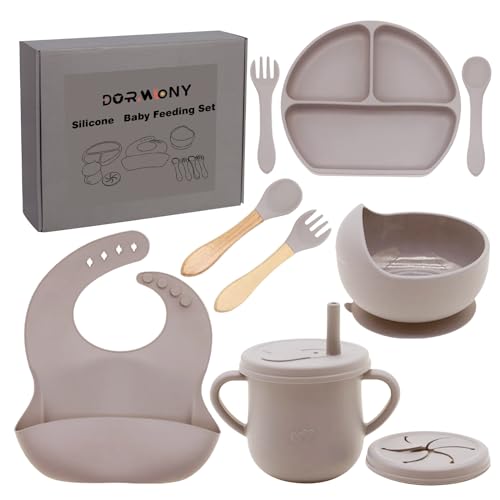
This 9-piece silicone set from an Amazon-focused brand offers a complete mealtime solution at a comfortable entry-level price point. The set includes a suction divided plate, a suction bowl, two sets of spoons and forks (four utensils total), a training straw sippy cup, and an adjustable bib with a food catcher. Every component is made from 100% food-grade silicone that is BPA-free, phthalate-free, and PVC-free. The utensils feature short, easy-grip handles that are suitable for the 6-month-plus range, with shallow bowls that support the BLW principle of minimal scooping effort.
The suction mechanics are a clear priority here. Both the plate and bowl use a 4-point suction cup system — four individual suction points rather than one large base — which provides a more secure grip on uneven surfaces like some high-chair trays. The divided plate keeps foods separated, which is helpful for babies who are still developing their palate and need visual distinction between items. The tall curved sidewalls of the bowl assist with scooping, acting as a natural barrier that guides the spoon toward the food rather than pushing it off the plate.
One practical consideration: the utensils are on the larger side compared to dedicated first-stage BLW spoons like the NumNum set. Several users noted that the spoons and forks may be slightly too big for a 6-month-old who is just starting their self-feeding journey. This set is likely better suited for babies in the 9-to-12-month range who already have some experience with self-feeding and need a full system that includes a cup, bib, and containment vessels. The flexibility and ease of cleanup (dishwasher-safe) are strong positives, but the utensil sizing is the main reason this set sits at the entry-level tier rather than at the top of the list.
Why it’s great
- 9-piece set covers utensils, plate, bowl, cup, and bib in one purchase
- 4-point suction system on plate and bowl prevents spills effectively
- 100% food-grade silicone is soft, flexible, and dishwasher-safe
- Divided plate helps with food separation for sensory development
Good to know
- Utensils are on the larger side; better suited for 9+ months
- Suction may still be defeated by a determined baby who flips the plate
- Sippy cup lid is removable by child, which may lead to more spills
FAQ
At what age should I start using BLW utensils?
Can my baby use regular silicone spoons for BLW?
How do I clean BLW utensils that have been chewed on?
Final Thoughts: The Verdict
For most families starting their baby-led weaning journey, the best blw utensils winner is the NumNum Baby Spoons Set because its open-channel pre-spoon design completely eliminates the need for wrist rotation, directly addressing the core developmental limitation of babies under 18 months. If you prefer a hybrid system that includes a parent-feeding spoon and a suction bowl, grab the Olababy 3-Piece Set. And for families who want a complete 15-piece feeding ecosystem that covers utensils, plates, cups, and storage in one purchase, nothing beats the O’doe Baby Weaning Set.

Mo Maruf
I created WellFizz to bridge the gap between vague wellness advice and actionable solutions. My mission is simple: to decode the research and give you practical tools you can actually use.
Beyond the data, I am a passionate traveler. I believe that stepping away from the screen to explore new environments is essential for mental clarity and physical vitality.