Our readers keep the lights on and my smoothie glass nicely filled. As an Amazon Associate, I earn from qualifying purchases.
Lip-sync lag, tangled headphone cords, and the struggle to watch TV at your own volume without disturbing the whole house — these are the daily frustrations that a quality Bluetooth transmitter receiver solves. The right unit bridges the gap between your non-wireless TV, stereo, or gym equipment and your favorite Bluetooth earbuds or hearing aids, delivering private, hassle-free audio.
I’m Mohammad Maruf — the founder and writer behind WellFizz. My deep-dive research into Bluetooth codecs, latency figures, and audio passthrough configurations separates the few units that actually deliver on their wireless promises from the many that fall short.
After analyzing seven top contenders across mid-range and premium price tiers, I’ve identified the specific models that minimize delay, support multiple listeners, and integrate seamlessly with your existing gear to earn the title of truly the best bluetooth transmitter receiver for your specific setup.
How To Choose The Best Bluetooth Transmitter Receiver
Buying a Bluetooth transmitter receiver is not a one-category-fits-all decision. The wrong choice can mean audio that drifts out of sync with the picture, limited range that drops signal in the next room, or a device that simply won’t connect to your TV because of port mismatches. Focus on these four factors to get a unit that matches your exact hardware and listening habits.
Latency: The Frame Rate Killer
The delay between a character’s lips moving on screen and the sound reaching your ears is the single biggest complaint in this category. Standard Bluetooth (SBC codec) can introduce 150-300ms of delay, which you will notice. For TV and movies, you need a transmitter and headphones that both support aptX Low Latency (around 40ms) or aptX Adaptive (which dynamically shifts between 30-80ms). Without matching codecs, don’t expect perfect sync.
Ports: Optical vs. AUX vs. RCA
Before you buy anything, flip your TV around and look at the audio outputs. Optical (TOSLINK) and 3.5mm AUX are the two most common ports found on a Bluetooth transmitter receiver. If your TV only has HDMI ARC, you will need an HDMI audio extractor. If you have an older stereo system with RCA jacks, ensure the transmitter has RCA input or an included adapter. Buying a unit that doesn’t match your TV’s output ports is the most common return reason.
Single vs. Dual vs. Auracast Audio
If you want to watch a movie with a partner, look for “Dual Link” — the ability to transmit to two Bluetooth headphones simultaneously. Some premium units offer Auracast, which is a newer standard that broadcasts audio to an unlimited number of Auracast-compatible devices like specific hearing aids. Classic dual-link uses standard Bluetooth pairing and is more universal for regular earbuds.
Transmitter vs. Receiver Mode
Not all units are strictly one-way. Most devices in this list are designed primarily as Bluetooth transmitters (sending audio *from* your TV *to* your headphones). However, a “receiver” mode flips the direction, allowing you to stream music *from* your phone *to* an older wired stereo. A combo unit gives you flexibility for both use cases.
Quick Comparison
On smaller screens, swipe sideways to see the full table.
| Model | Category | Best For | Key Spec | Amazon |
|---|---|---|---|---|
| 1Mii B03+ | Mid-Range | Multi-Codec Flexibility | aptX HD, Adaptive, LL | Amazon |
| Avantree Orbit Pro | Premium | Soundbar Passthrough | 50m / 164ft Range | Amazon |
| Avantree Audikast 3 | Mid-Range | Budget Dual Link | Bluetooth 5.3 | Amazon |
| Avantree Audikast 4 | Premium | Hearing Aid Auracast | Auracast Broadcast | Amazon |
| Twelve South AirFly Pro | Mid-Range | Travel & In-Flight Use | 25+ hr Battery Life | Amazon |
| YMOO 2.4GHz | Value | Ultra-Low Latency Non-BT | 20ms Latency | Amazon |
| AirFly Pro 2 Deluxe | Premium | Travel with Dual Share | Bluetooth 5.3 | Amazon |
In‑Depth Reviews
1. 1Mii B03+ Bluetooth 5.3 Transmitter Receiver
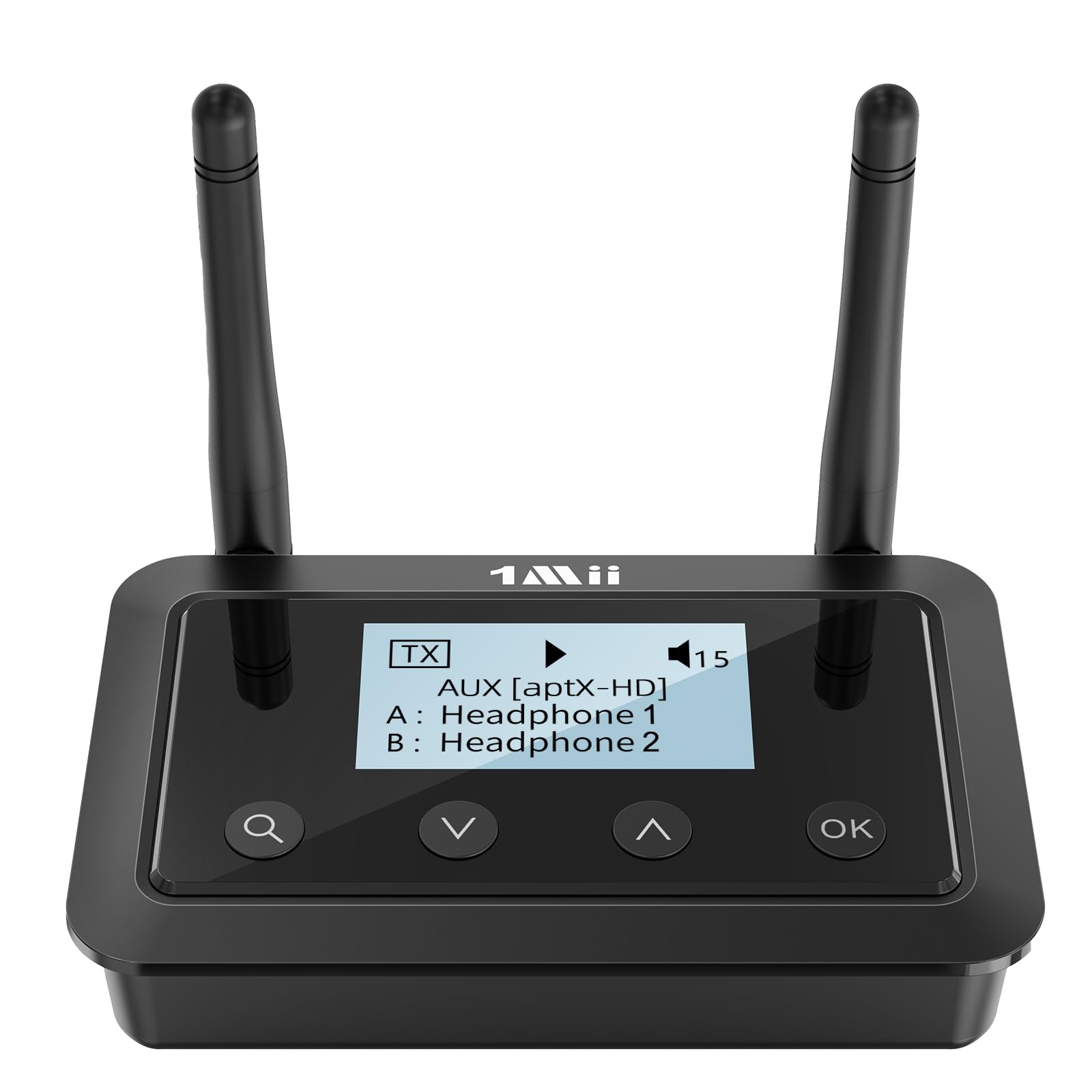
The 1Mii B03+ earns its top spot by supporting the widest family of aptX codecs — Low Latency, HD, and Adaptive — meaning it’s future-proofed no matter which premium headphones you own. The built-in LCD screen makes pairing and navigating device history far less frustrating than button-mashing on a featureless puck. Its family-friendly Bypass Mode lets you send TV audio to your soundbar while simultaneously broadcasting to Bluetooth headphones, a feature households with differing hearing preferences will use daily.
Range is a strong suit here, with tested indoor reach of 70-100 feet through walls and up to 230 feet line-of-sight, which is on the high end for this price tier. The unit supports both optical and RCA inputs alongside 3.5mm AUX, covering almost every legacy audio source. In receiver mode, it can add Bluetooth streaming to an older wired stereo system without fuss.
One consistent user observation is that connecting two aptX Low Latency headphones forces the codec to standard aptX for stability, which is a minor trade-off. There’s also a small subset of reports noting a gradual degradation in range and occasional static after a year of use. But for sheer codec compatibility, feature density, and signal flexibility, this is the most versatile all-around unit on the list.
Why it’s great
- Supports aptX HD, Adaptive, and Low Latency codecs
- Bypass Mode outputs to soundbar and Bluetooth simultaneously
- LCD display and history memory for 8 devices
Good to know
- Dual aptX LL connection downgrades codec to aptX for stability
- Cannot operate in TX and RX modes at the same time
- Some reports of range degradation over 12+ months
2. Avantree Orbit Pro

The Orbit Pro is the go-to unit for anyone with a home theater system who wants to preserve Dolby Digital surround sound on their main speakers while sending a stereo mix to headphones. Its soundbar passthrough automatically converts 5.1 surround audio to PCM stereo for Bluetooth without forcing you to manually change your TV’s audio settings every time you switch between headphones and speakers.
The included LCD screen is large and readable, and the dedicated remote control lets you adjust volume and navigate multiple paired devices from across the room — a concrete advantage over units that rely on tactile buttons on the transmitter itself. With a rated range of 50 meters (164 feet) line-of-sight, it covers large open-floor layouts without dropping signal. It also supports dual-link pairing for two headphones simultaneously.
The primary drawback is the lack of an auto-connect feature; you must press a button on the unit to reconnect previously paired headphones, rather than having them link automatically when powered on. The remote is also limited to volume control and cannot initiate pairing. While it sits at a higher price point, the clean passthrough integration makes it the best option for home theater setups that prioritize seamless speaker-to-headphone transitions.
Why it’s great
- Soundbar passthrough with automatic 5.1 to stereo conversion
- Remote control and large LCD screen for easy use
- Extended 50-meter range for large rooms
Good to know
- No auto-connect; requires manual button press to link headphones
- Remote controls volume only, not pairing or device selection
- Higher price tier with features not needed for basic TV setups
3. Avantree Audikast 3

The Audikast 3 strips away unnecessary frills to focus on one thing: reliable dual-link audio transmission for TV. Using a Qualcomm chipset with Bluetooth 5.3, it supports aptX Adaptive for near-synced TV audio, and the dual-link feature lets two viewers watch the same show at their own preferred volume without any extra cable splitting. The dedicated volume control on the unit itself is a convenience some pricier units lack.
Setup is straightforward via optical or 3.5mm, though you must ensure your TV’s audio output is set to PCM, as Dolby Digital formats are not supported and will produce silence. The boosted optical volume setting is a real bonus for viewers who find standard TV headphone outputs too quiet, particularly those using hearing aids in standard Bluetooth mode.
Some users have noted that the 2.4GHz Bluetooth signal can interfere with nearby WiFi networks if the unit is placed directly next to the router. Placing the transmitter a few feet away or using a longer optical cable resolves the issue. For a straightforward, no-screen, dual-pairing transmitter that just works at its price point, this is the best entry-level value.
Why it’s great
- Qualcomm chipset with Bluetooth 5.3 and aptX Adaptive
- Dual-link for two headphones simultaneously
- Boosted optical volume setting for quiet audio sources
Good to know
- No HDMI or RCA input; optical/AUX only
- Can interfere with 2.4GHz WiFi when placed too close
- No screen; pairing status reliant on LED indicators
4. Avantree Audikast 4
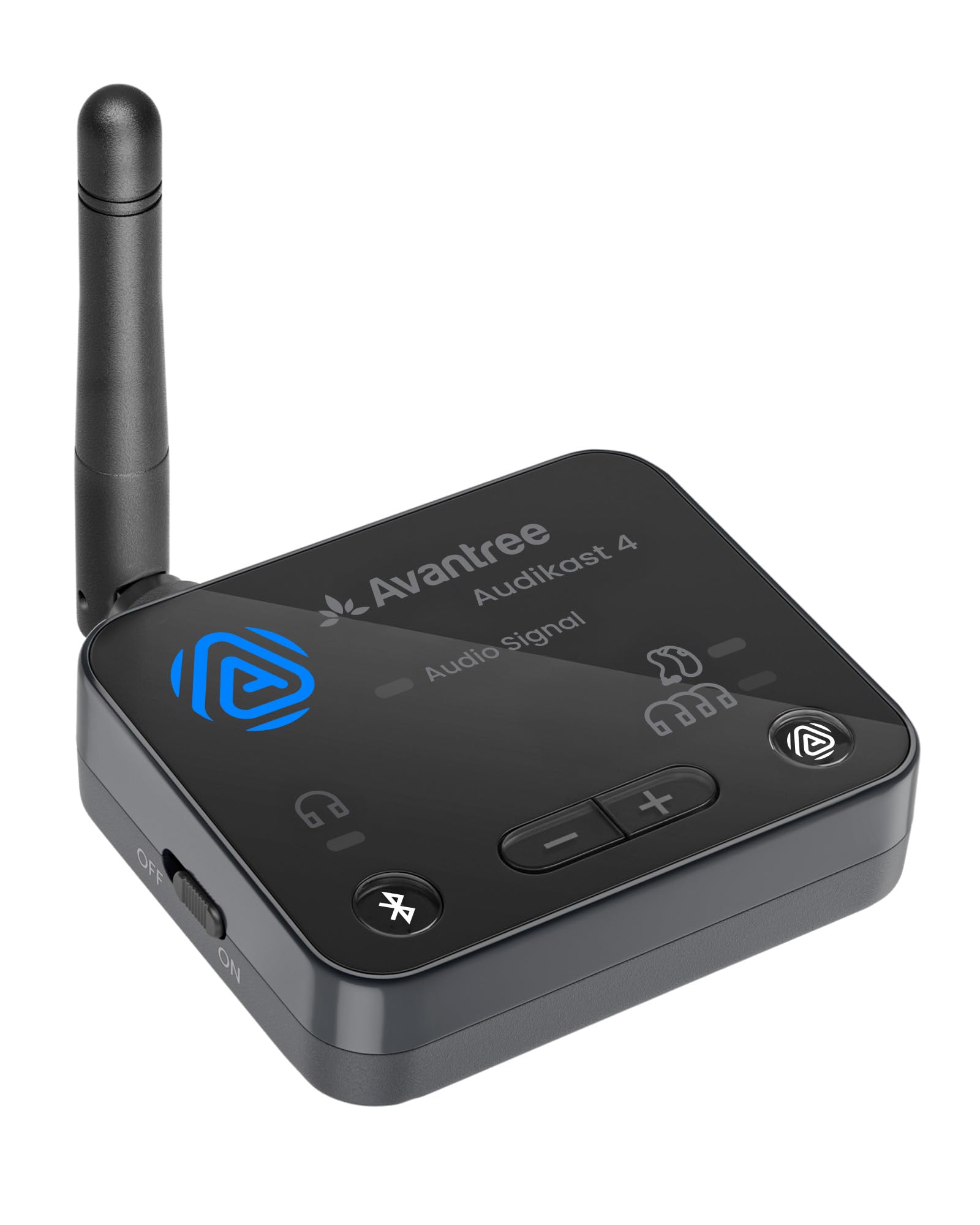
The Audikast 4 is a purpose-built bridge for hearing aid users, supporting Auracast broadcast audio — the emerging standard that streams directly to Auracast-enabled hearing aids from brands like Oticon, ReSound, Starkey, and Jabra. In practice, this means the user hears TV audio directly in their hearing aids without the need for an intermediary neckloop or streamer, and they can adjust their own volume independently of the TV speaker.
It also supports classic Bluetooth for standard headphones, but in that mode it connects to only one device at a time, which is a limitation compared to the Audikast 3’s dual-link. The form factor is compact and plugs into optical or AUX ports. Avantree offers firmware upgrades to keep the Auracast compatibility current as the standard evolves.
The catch is that it is strictly for users with Auracast-compatible hearing aids; standard hearing aids without Auracast will not benefit. Some users have reported an initial setup that required deleting and reinstalling the app to get the Auracast broadcast working. For anyone with a modern Auracast hearing aid, however, this device solves the “TV too loud for everyone else, too quiet for me” problem more elegantly than any Bluetooth-only alternative.
Why it’s great
- Auracast broadcast for next-gen hearing aids
- Firmware upgradeable for future Auracast standards
- Users control volume independently of TV
Good to know
- Classic Bluetooth mode limited to one device only
- Only works with Auracast-compatible hearing aids
- Initial Auracast pairing may require app troubleshooting
5. Twelve South AirFly Pro

The AirFly Pro has been the go-to gadget for frequent flyers for years, and for good reason: it’s the most portable and flight-ready option at this price. With over 25 hours of battery life, a single charge covers even the longest transpacific routes (with hours to spare), and it can be used while charging via USB-C. It plugs directly into any 3.5mm audio jack — the kind found on airplane seatback screens, gym treadmills, and older car stereos — and instantly turns that wired source into a Bluetooth signal.
Dual-pairing is supported, letting two people share one movie on a flight. The built-in microphone also adds a receiver function, so you can use it to stream music from your phone to an AUX-only car stereo. The compact metal-and-plastic build fits easily into a tech pouch without needing a separate case.
The primary limitation for home use is that it only has a 3.5mm AUX input, no optical port, so TV connection requires a separate optical-to-3.5mm converter. Pairing can also be finicky on the first use, particularly with AirPods, and the black model’s TX/RX labels are reportedly hard to read in dim light. It is optimized for mobility, not as a permanent home theater fixture.
Why it’s great
- 25+ hour battery covers ultra-long flights
- Works as both transmitter and receiver
- Ultra-compact form factor designed for travel
Good to know
- No optical input; AUX only limits TV compatibility
- Initial pairing can be finicky with some earbuds
- TX/RX labels hard to read on the black model
6. Twelve South AirFly Pro 2 Deluxe

The AirFly Pro 2 Deluxe is the upgraded version of the classic travel transmitter, jumping to Bluetooth 5.3 and adding aptX HD Adaptive support for higher-quality audio on flights and with gaming devices. The dedicated pairing buttons for each of the two headphone slots make sharing audio on an iPad or airline screen significantly simpler than the single-button system on the original. It also includes a USB-C charging cable and international plug adapter, thoughtful touches for globetrotters.
Battery life is rated at over 25 hours, and the unit can be used while charging from a seatback USB port — essential for 17-hour flights where the battery might otherwise run short. In receiver mode, it pairs to an AUX car stereo, making it a dual-function device that earns its space in your bag. The compact plastic enclosure is lighter than the original AirFly Pro.
The Deluxe model’s main cost is on the price tag, and the lack of an optical input keeps it confined to 3.5mm sources — no direct TV connection without an adapter. Some users have reported that the auto-shutdown feature can be finicky, turning off if no Bluetooth device connects within a minute, which can be confusing during initial setup. For frequent travelers who want the latest Bluetooth standard, it’s the premium travel pick.
Why it’s great
- Bluetooth 5.3 with aptX HD Adaptive
- Dedicated pairing buttons for dual headphone sharing
- Can be used while charging via USB-C
Good to know
- Expensive for a single-purpose travel accessory
- No optical input; AUX-only limits TV use
- Auto-shutdown feature can be overzealous during pairing
7. YMOO 2.4GHz Wireless Audio Transmitter Receiver
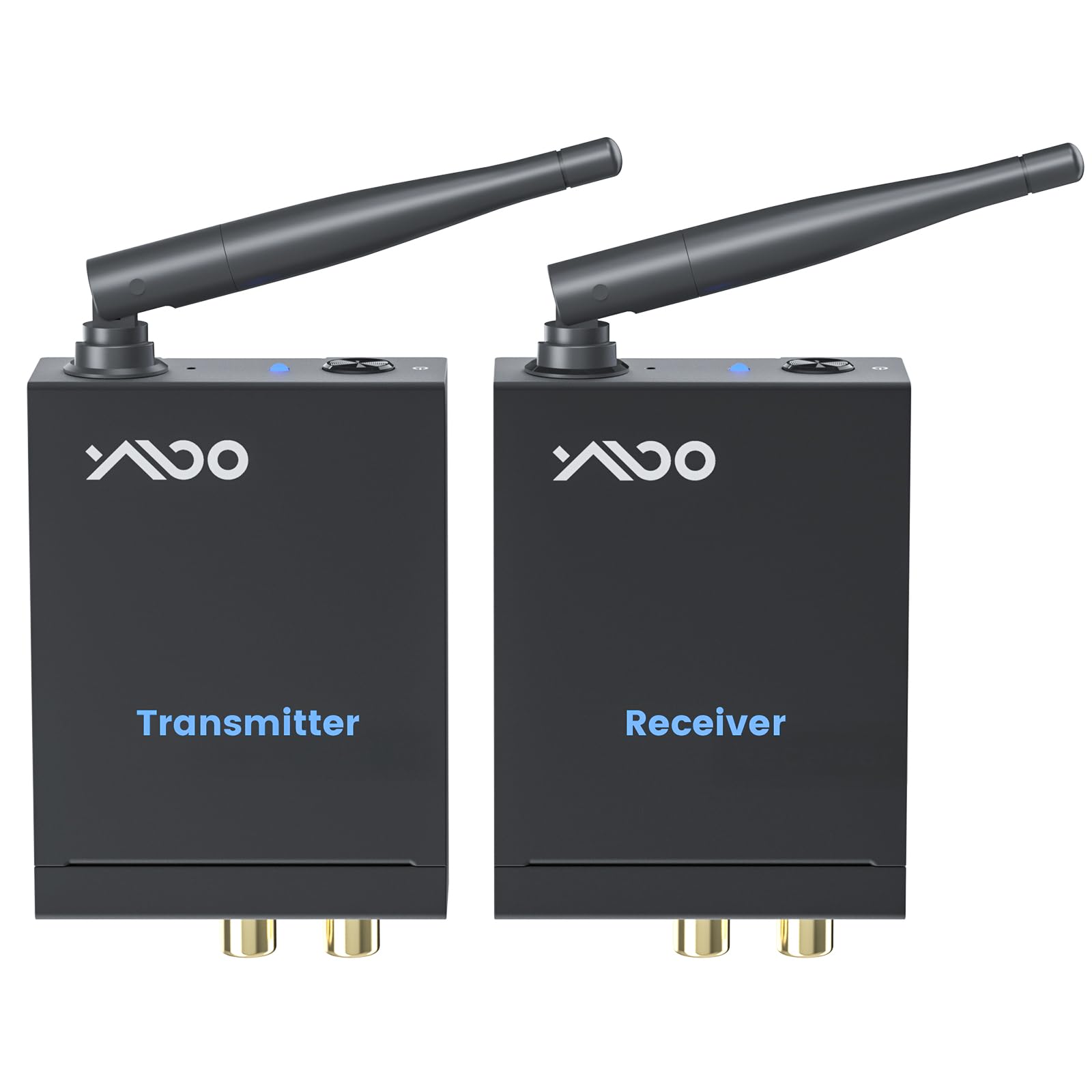
The YMOO stands apart because it is not a Bluetooth device. It uses 2.4GHz radio frequency technology, which delivers an ultra-low latency of less than 20ms — faster than even aptX Low Latency Bluetooth. This makes it the best option for situations where any perceivable audio delay is unacceptable, such as connecting a jukebox to a speaker system in a different room, or syncing audio from a DJ’s mixer to a far-set of speakers. The kit comes with one transmitter and one receiver, both with metal shells that resist drops and collisions.
The range is excellent: advertised at 328 feet line-of-sight and a practical 60-70 feet through walls, based on user testing with brick and sheetrock. The plug-and-play pairing means the transmitter and receiver link automatically when powered on, requiring zero app setup or Bluetooth menu scrolling. It uses RCA and 3.5mm AUX connections, so it pairs well with powered speakers, soundbars, and TV stereo outputs.
The trade-off is that this is not a universal headphone solution. It connects a specific receiver unit to your speakers, not to Bluetooth earbuds. The 2.4GHz signal can also be disrupted by WiFi routers broadcasting on the same frequency band, requiring careful placement away from the router. For its target use case — sending hi-fi audio from one wired device to another across a house — the YMOO delivers the lowest latency of any option reviewed.
Why it’s great
- 20ms latency is undetectable to the human ear
- Long range: tested 70+ feet through brick and sheetrock
- Automatic pairing with no app or Bluetooth menu navigation
Good to know
- Does not connect to Bluetooth headphones; receiver-to-speaker only
- 2.4GHz signal can conflict with WiFi routers
- No optical input; limited to RCA and AUX
FAQ
What is aptX Low Latency and why do I need it for TV?
Can I use a Bluetooth transmitter receiver with a TV that only has HDMI ports?
Why does my Bluetooth transmitter not work with my soundbar connected?
What is the difference between Dual Link and Auracast for sharing audio?
Final Thoughts: The Verdict
For most users, the best bluetooth transmitter receiver winner is the 1Mii B03+ because it supports the widest range of aptX codecs, includes a helpful LCD screen, and offers both dual-link headphone sharing and soundbar bypass mode. If you need a wireless audio bridge for a home theater setup with a soundbar, grab the Avantree Orbit Pro for its dedicated remote and flawless surround passthrough. And for air travelers who want the most portable unit with a 25+ hour battery, nothing beats the Twelve South AirFly Pro.

Mo Maruf
I created WellFizz to bridge the gap between vague wellness advice and actionable solutions. My mission is simple: to decode the research and give you practical tools you can actually use.
Beyond the data, I am a passionate traveler. I believe that stepping away from the screen to explore new environments is essential for mental clarity and physical vitality.