Our readers keep the lights on and my smoothie glass nicely filled. As an Amazon Associate, I earn from qualifying purchases.
Setting up a true surround sound system used to mean running speaker wire across the room, hiding it under rugs, and learning terms like impedance matching. Bluetooth has changed that completely. You can now build a legitimate multi-channel home theater without a single hardwired connection to the TV—streaming music, movies, and gaming audio from your phone or tablet with no lag. The catch is that not every “Bluetooth surround” system handles channel separation, latency, or soundstage depth the same way.
I’m Mohammad Maruf — the founder and writer behind WellFizz. I spend my time cross-referencing audio specs, analyzing driver configurations, and stress-testing wireless protocols to separate genuine theater-grade sound from marketing hype.
So whether you’re mounting satellites on the wall or hiding a sub behind the couch, finding the best bluetooth surround sound system means matching the right channel count, room size, and connectivity to your actual space.
How To Choose The Best Bluetooth Surround Sound
Bluetooth surround sound systems range from compact 5.1 soundbars with wireless rears to full-scale 11-channel monsters with dual subwoofers. The right choice depends on room size, listening habits, and how much cable you’re willing to tolerate.
Channel Configuration
A 5.1 system covers left, center, right, two surrounds, and a subwoofer. A 5.1.2 adds two height channels for overhead effects like rain or helicopter rotors — that’s the .2 number. A 7.1.4 expands to seven ear-level speakers plus four height channels. For true Dolby Atmos immersion, you want at least .2 height channels. Pure Bluetooth streaming limits some codecs, but HDMI eARC wired to the TV paired with Bluetooth music streaming from your phone gives you the best of both worlds.
Wireless Stability and Subwoofer Performance
Not all wireless connections are equal. Budget systems use 2.4GHz bands that can drop out if your router is nearby. Premium systems use dedicated 5GHz transmission or proprietary protocols that lock the signal. Subwoofer driver size — 8-inch for modest rooms, 10-inch for serious bass, dual 10-inch or dual 8-inch for theater levels — dictates low-end authority. Look for frequency response down to at least 28Hz for deep, physical bass you feel in your chest.
Room Calibration and Voice Clarity
A system that sounds great in the showroom can sound muddy in your living room. Automated room correction (AI RoomFit, Easy Sound Calibration, or similar) adjusts EQ and delay based on speaker placement. Voice clarity technology — like JBL PureVoice or Polk VoiceAdjust — isolates dialog so you never crank the volume during quiet scenes only to get blasted by explosions.
Quick Comparison
On smaller screens, swipe sideways to see the full table.
| Model | Category | Best For | Key Spec | Amazon |
|---|---|---|---|---|
| ULTIMEA Skywave X50 | 5.1.4 Soundbar | Wireless convenience with Dolby Atmos | 28Hz subwoofer extension | Amazon |
| JBL Bar 500MK2 | 5.1 Soundbar | Big bass and clear dialogue | 10″ wireless subwoofer | Amazon |
| Sony BRAVIA Theater System 6 | 5.1ch System | Cinematic Atmos with BRAVIA TV pairing | Dolby Atmos / DTS:X | Amazon |
| Polk Audio MagniFi Max AX SR | 7.1.2 Soundbar | Multi-room streaming and voice clarity | 3x HDMI 2.0 inputs | Amazon |
| ULTIMEA Poseidon D50 | 5.1 Soundbar | Budget 5.1 with app EQ control | 320W peak power | Amazon |
| Donner MAMP4 | 5.1 Receiver | Karaoke and passive speaker setups | 60W per channel RMS | Amazon |
| WiiM Sound Smart Speaker | Smart Speaker | Hi-res music with multi-room sync | 24-bit/192 kHz DAC | Amazon |
| Nakamichi Shockwafe 11.2.6 | 11.2.6 System | Full theater scale with dual 10″ subs | 2300W peak output | Amazon |
| Nakamichi Dragon 11.4.6 | 11.4.6 System | Reference-grade cinema sound at home | AMT tweeter array | Amazon |
In‑Depth Reviews
1. ULTIMEA Skywave X50 5.1.4ch
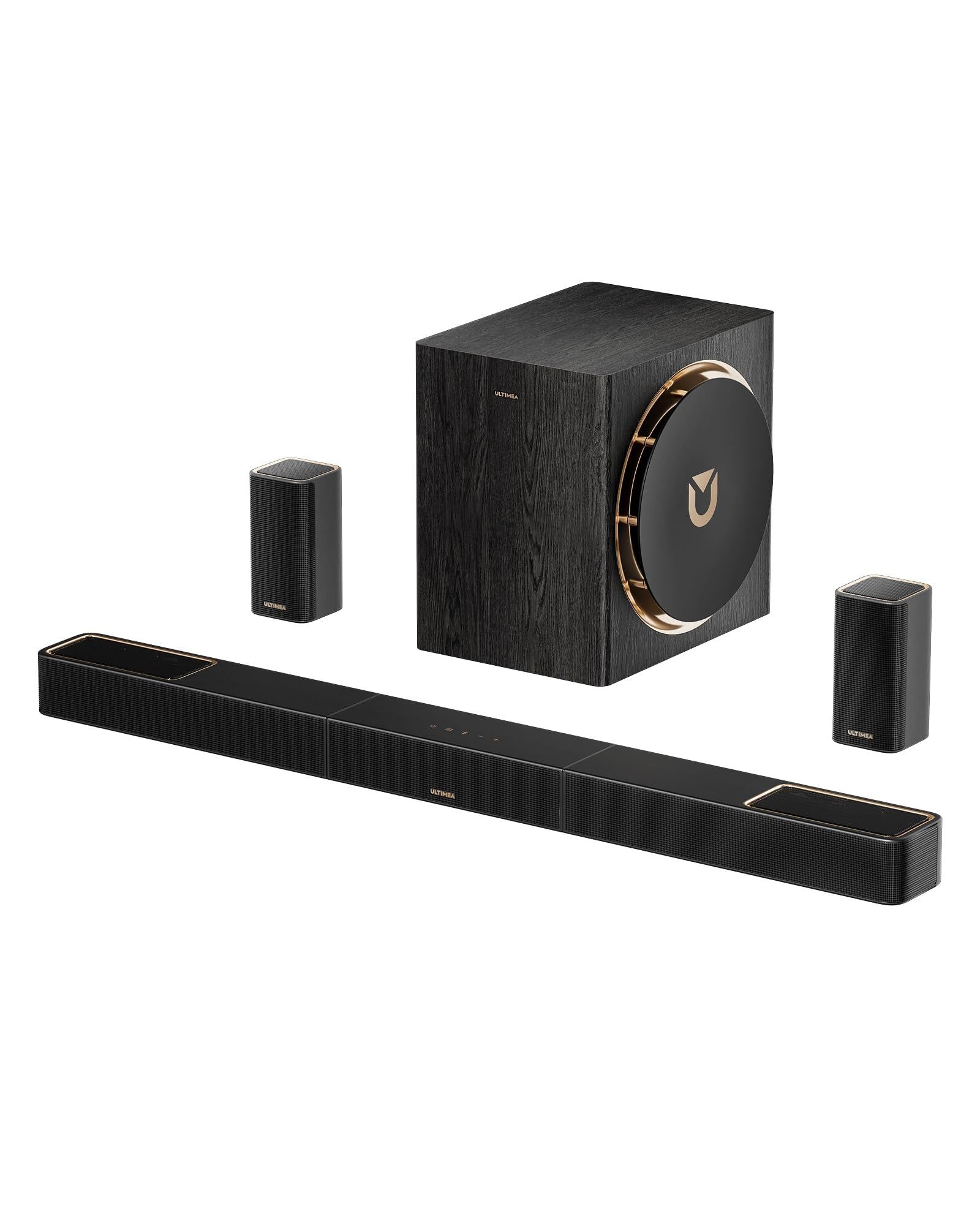
The Skywave X50 hits the sweet spot where wireless convenience meets genuine Dolby Atmos immersion. Dual 5GHz transmission keeps the satellite speakers and 8-inch subwoofer completely wire-free — no audio dropouts, no interference, just plug in power and pair. The GaN amplifier runs cooler and more efficiently than traditional Class-D silicon, driving 760W peak with distortion below 0.5% at reference levels.
The NEURACORE multi-channel engine processes up to 17 discrete channels from a triple-core DSP. That matters when content has object-based audio: helicopters pan overhead, rain falls from above, and the up-firing drivers in the soundbar create a genuine height layer rather than a vague sense of “elevation.” The wood-crafted subwoofer hits down to 28Hz, which is deep enough to reproduce the lowest organ notes and LFE effects in modern action films.
Setup is genuinely plug-and-play — the wireless rears and sub sync automatically with no manual pairing. The HDMI eARC connection passes 4K HDR without signal degradation, and the metal grille with rose gold accents looks more like furniture than electronics. For anyone wanting true wireless Dolby Atmos without running speaker wire or buying a separate AVR, this is the benchmark to beat.
Why it’s great
- Fully wireless rears and sub — no cable runs
- GaN amplifier stays cool at high volume
- 28Hz subwoofer extension for deep, physical bass
- Up-firing drivers create genuine height effects
Good to know
- Wireless rears require their own power outlets
- No dedicated center channel driver for dialogue
- App EQ has 10 bands but no full graphic RTA
2. JBL Bar 500MK2
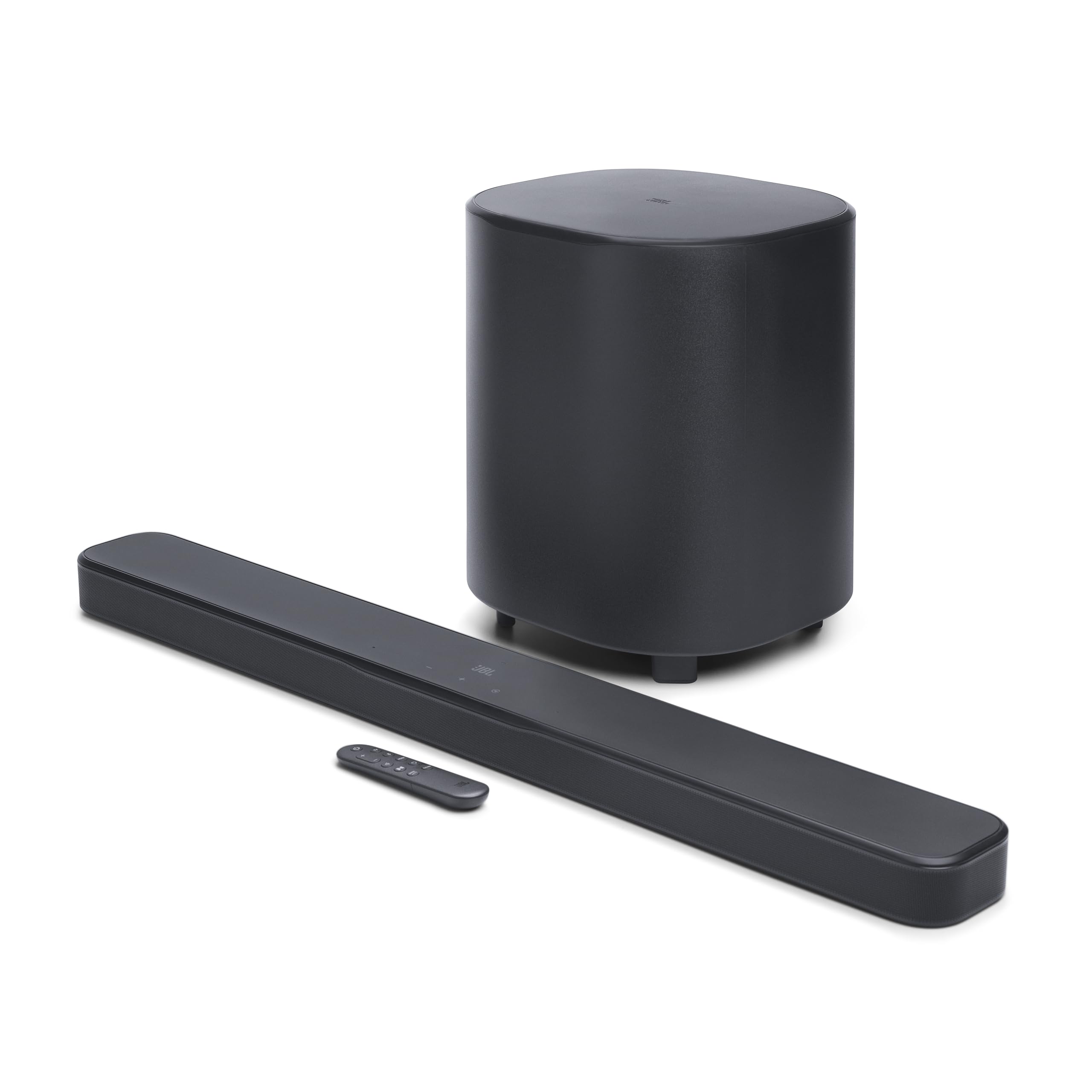
The Bar 500MK2 is built around a single dominating spec: a 10-inch wireless subwoofer that delivers 750W of system power. That 10-inch driver moves enough air to pressurize a 20×15-foot living room without distorting, and the wireless connection stays locked even when the sub is placed behind a couch 30 feet from the soundbar. The sub’s cabinet is ported and tuned low enough that explosions in action films have weight, not just boom.
MultiBeam 3.0 simulates a wider soundstage using beamforming from the bar’s seven drivers — it doesn’t have physical rear speakers, so the surround effect is virtual. Where the system shines is PureVoice 2.0, which continuously analyzes the audio track and adjusts dialogue levels in real time. Whispered lines stay intelligible even at low volume, and loud scenes never distort the center image. Room calibration runs automatically on setup, measuring reflection points and adjusting EQ to your specific walls and furniture.
Connectivity is extensive: HDMI eARC with 4K Dolby Vision passthrough, AirPlay 2, Google Cast, Spotify Connect, and Roon Ready. The JBL ONE app gives you a precise equalizer and software update control. It won’t give you the discrete overhead channels of the Skywave X50, but for a 5.1 virtual system with chest-thumping bass and flawless dialogue, it’s hard to beat at this level.
Why it’s great
- 10-inch subwoofer delivers deep, distortion-free bass
- PureVoice 2.0 keeps dialogue crystal clear
- Auto room calibration adapts to your space
- Multi-platform streaming (AirPlay, Cast, Spotify Connect)
Good to know
- Surround is virtual — no rear speakers included
- No individual channel level adjustment in app
- Subwoofer requires wired power at its location
3. Sony BRAVIA Theater System 6

Sony’s HT-S60 is a proper 5.1-channel system with physically separate front-firing speakers, a dedicated center channel, two wired rear satellites, and a wireless subwoofer. Unlike a single-bar solution, the discrete center channel anchors dialogue to the screen — not to a phantom center between the L/R drivers. The rear speakers are wired to a small receiver box that connects wirelessly to the soundbar, so you still avoid running cable from the TV to the back of the room.
Dolby Atmos and DTS:X decoding are native, not upmixed. Sony’s Vertical Sound Engine creates the illusion of overhead effects from the front bar, though the lack of up-firing drivers means the height layer is more diffused than discrete. The BRAVIA Connect app handles all volume, input, and EQ adjustments, and pairing with a compatible Sony TV unlocks Voice Zoom 3 — which can isolate or amplify human speech independently from the rest of the mix. That’s a killer feature for sports announcers or dialogue-heavy dramas.
Build quality is typical Sony: dense, sturdy components with a metal grille on the soundbar. The subwoofer is powerful enough to shake a medium room at volume 40 out of 100, but the sub requires a wired connection to the soundbar — you can’t place it wirelessly across the room. The inclusion of actual rear speakers with a dedicated center channel makes this a true cinematic system for buyers who want brute-force separation rather than virtualized processing.
Why it’s great
- Dedicated center channel for anchored dialogue
- Dolby Atmos and DTS:X native decoding
- Voice Zoom 3 with compatible Sony TVs
- Wireless rear receiver eliminates long cable runs
Good to know
- Subwoofer must be wired to soundbar
- Rear speakers have exposed cables between satellite and receiver
- No up-firing drivers — height effects are virtualized
4. Polk Audio MagniFi Max AX SR

The MagniFi Max AX SR is a 7.1.2-channel system that includes Polk’s patented SDA 3D processing and two up-firing drivers for Dolby Atmos height effects. The bundle comes with the SR2 wireless surround speakers and a 10-inch wireless subwoofer, giving you a complete package out of the box — no separate rears to buy later. Three HDMI inputs (all 4K-capable) let you connect a streaming box, game console, and cable TV simultaneously without an external switch.
Polk’s VoiceAdjust technology is tuned for older content and poorly mixed broadcasts where actors mumble over loud background music. It boosts the center channel without affecting the left/right stereo field or the subwoofer output. The up-firing drivers produce a tangible overhead effect, though the height channel is more diffuse than the dedicated ceiling-mounted speakers in a traditional setup. Still, for a single-box-plus-rears system, the soundstage width and localization of effects like rain or gunfire is impressive — especially in rooms with flat, reflective ceilings.
The system also handles full-house audio streaming via Wi-Fi, AirPlay 2, Chromecast, and Spotify Connect. That means you can play music on the soundbar and then group it with other Polk speakers in different rooms through the Polk Connect app. The subwoofer wireless range is solid — Polk officially recommends 15 feet, but many users report stable connection at over 20 feet through walls.
Why it’s great
- Three HDMI inputs for multiple devices
- VoiceAdjust improves dialogue without raising overall volume
- Up-firing drivers for discrete height channels
- Multi-room streaming via AirPlay, Chromecast, and Spotify
Good to know
- Surround speakers need to be near power outlets
- App required for full EQ adjustment
- No headphone output on the soundbar
5. ULTIMEA Poseidon D50

The Poseidon D50 proves you don’t need a dedicated receiver to get 5.1 surround sound in a small to medium room. This 320W peak system includes two wired rear speakers, a wireless subwoofer, and a center-channel bar that anchors dialogue. The SurroundX technology takes stereo PCM signals and upmixes them to a 5.1 layout — useful for older movies and music that lack native multi-channel encoding.
What sets the D50 apart from other budget soundbars is the ULTIMEA app’s EQ control: 121 preset matrices across four styles (Bass, Pop, Classical, Rock) plus six optimized modes for Movie, Music, Voice, Sport, Game, and Night. A 10-band customizable equalizer lets you dial in the exact frequency curve you want. The rear speakers connect via 19.6-foot cables, which is generous enough to place them on side tables or mounted on rear walls in most living rooms.
Bluetooth 5.3 streaming keeps audio synced with video, so lip-sync issues are minimal. HDMI ARC is available for one-cable TV connection. The subwoofer uses BASSMX technology that actually produces a tactile low-end punch for its size — it won’t rattle pictures off the wall like a 10-inch driver, but it adds real presence to action scenes. For under , you’re getting a legitimate multi-channel layout with granular EQ control that many systems double the price can’t match.
Why it’s great
- True 5.1 layout with wired rear speakers
- 10-band customizable EQ in the app
- 19.6-foot rear speaker cables for flexible placement
- Bluetooth 5.3 for low-latency streaming
Good to know
- Rear speakers are wired to the soundbar
- Subwoofer bass is good for size, not room-shaking
- No up-firing height channels
6. Donner MAMP4 Stereo Receiver
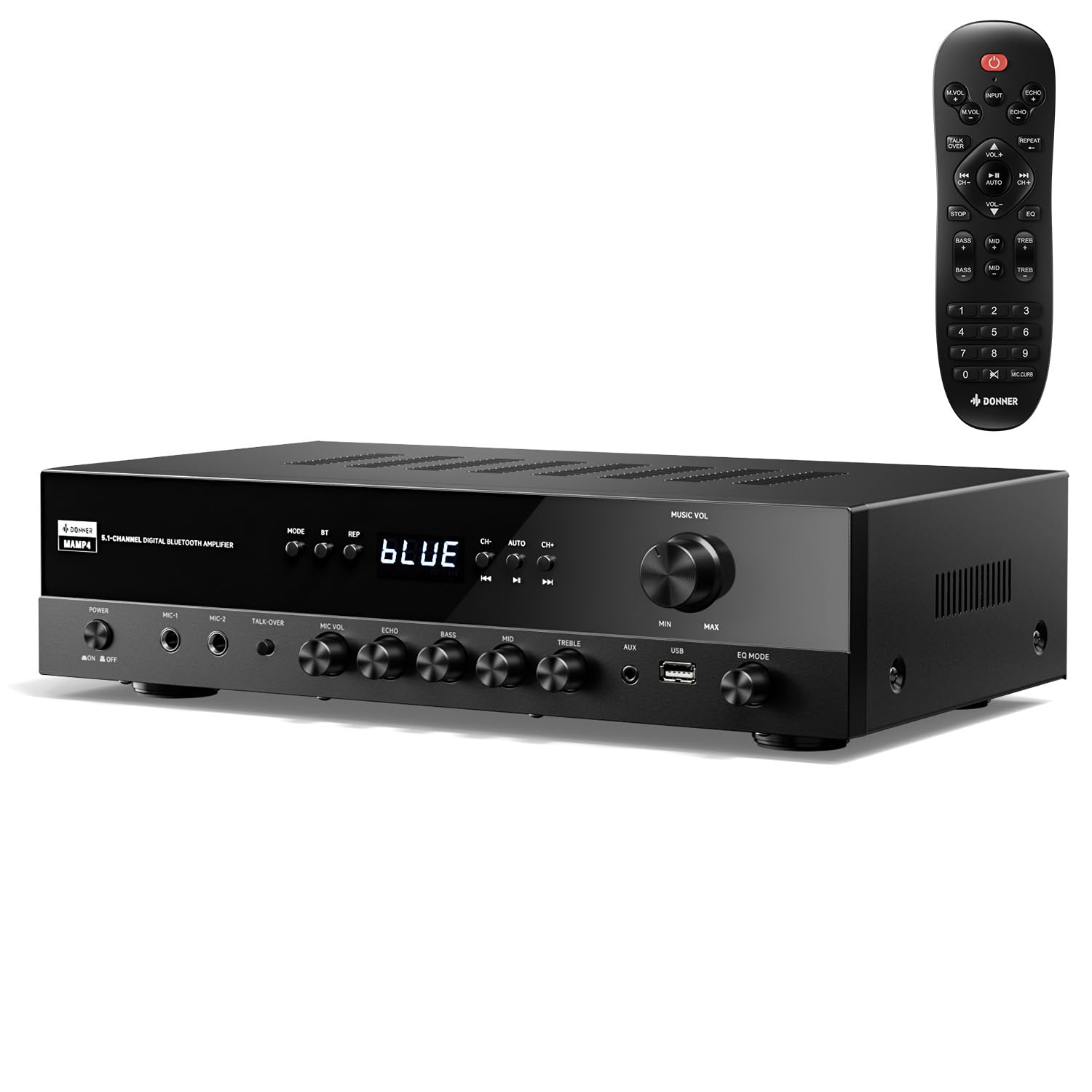
The Donner MAMP4 is not a soundbar — it’s a 5.1-channel amplifier that drives passive speakers and a subwoofer, giving you total control over which speakers you pair with it. This is for buyers who already own speakers and want to add Bluetooth capability without replacing everything. Bluetooth 5.3 streams directly to the receiver, and the amp delivers 60W RMS per channel to the front left/right and 25W RMS across three surround/center channels.
What makes the MAMP4 unique at its price is the dual 1/4-inch microphone jacks with independent echo and Talkover control. That makes it a functional karaoke receiver — you can plug in two mics, adjust reverb, and use the Talkover function to lower background music during announcements. The onboard EQ lets you independently adjust treble, midrange, and bass, and the receiver auto-saves your settings so you don’t have to re-dial them after power-off.
Input selection is broad: Bluetooth 5.3, USB (up to 64GB flash drives), RCA, AC-3, optical, coaxial, and FM radio with direct frequency entry. The FM tuner is a nice extra for talk radio or local music stations. The unit is heavy (6 kg) due to the toroidal transformer inside, which means it runs cooler and with less noise than switching power supplies. Just note there is no HDMI input, so TV audio must connect via optical, coaxial, or RCA.
Why it’s great
- Powers your own passive speakers — no forced pairing
- Dual mic inputs with echo for karaoke
- Full treble, mid, and bass EQ onboard
- Optical, coaxial, USB, FM — wide input variety
Good to know
- No HDMI input — TV needs optical or RCA
- Bluetooth range is limited (reported ~10 ft through walls)
- Some units have reliability concerns with channel failure
7. WiiM Sound Smart Speaker
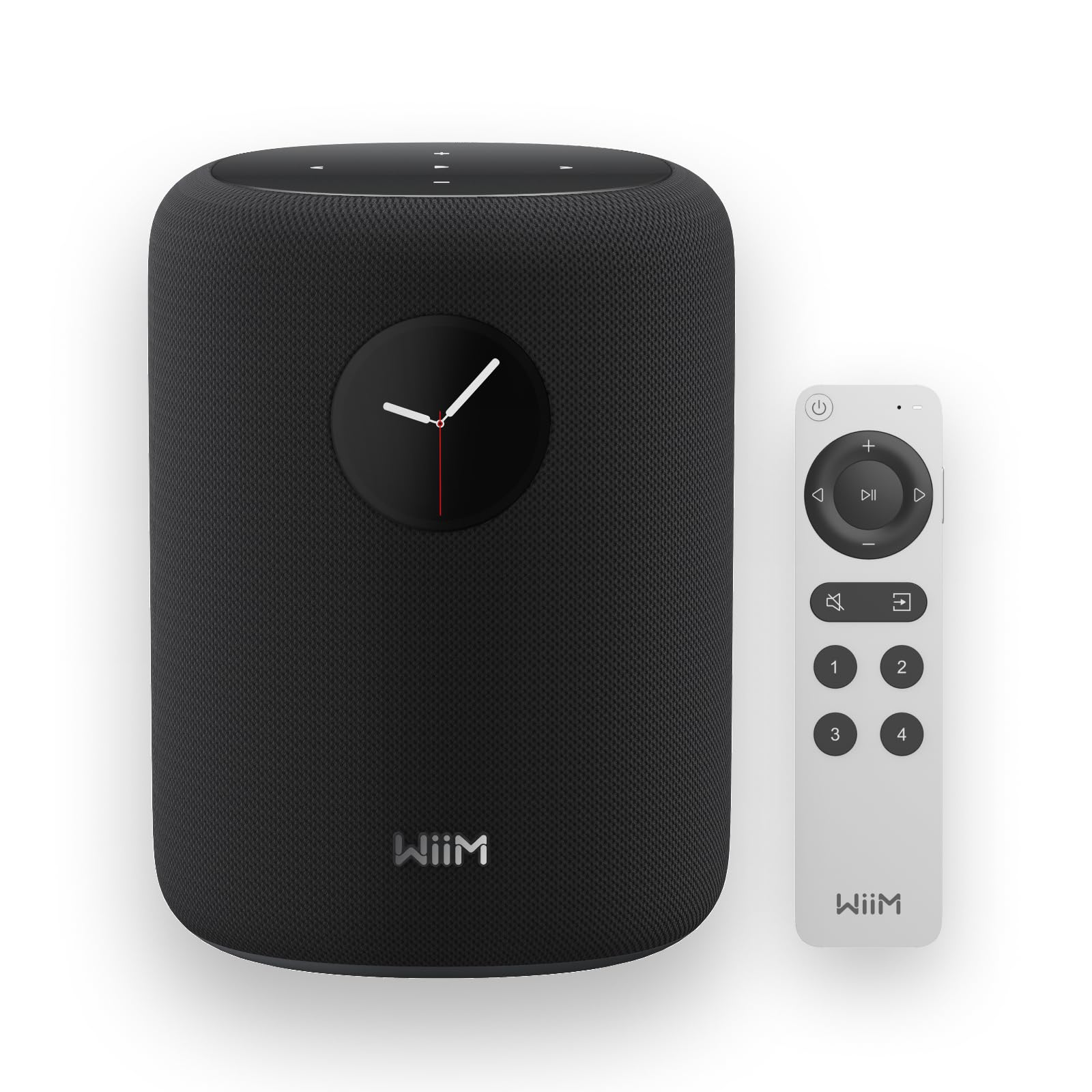
The WiiM Sound is a smart speaker first — it’s not a traditional surround sound system, but it fits into a Bluetooth surround setup when you pair two for stereo or combine it with the WiiM Sub Pro and compatible WiiM components for a modular home theater. The core of this unit is the 1.8-inch touch display that shows album art, track info, and gives you playback control without needing a phone. The 100W peak amplifier drives a 4-inch paper-cone woofer and dual 1-inch silk-dome tweeters for natural, non-fatiguing sound.
AI RoomFit calibration is one-tap: you hold the speaker at your listening position, and the microphone measures how sound reflects off your walls and furniture, then adjusts the EQ curve. The result is balanced bass without boominess and clear vocals even in acoustically challenging rooms. The speaker supports Wi-Fi 6E and Bluetooth 5.3, with Google Cast, Spotify Connect, TIDAL Connect, Qobuz Connect, DLNA, Roon, and Alexa Cast built in. You can join WiiM multi-room groups or Google Cast groups for whole-house sync.
For surround use, you can pair two WiiM Sounds as left and right channels, add the WiiM Sub Pro for dedicated low-end, and integrate with other WiiM components as center or surround speakers. This modularity means you can start with one speaker and expand to a full 5.1 system over time — no forced all-at-once purchase. The included WiiM Voice Remote 2 Lite with USB-C charging adds convenience for couch control.
Why it’s great
- Touch display shows album art and track info
- AI RoomFit calibration adapts EQ to your room
- Hi-res 24-bit/192 kHz DAC for high-fidelity streaming
- Modular design expands to full surround over time
Good to know
- Single speaker is stereo, not surround out of the box
- No native AirPlay — uses Google Cast instead
- Requires WiiM Sub Pro for dedicated bass in surround setups
8. Nakamichi Shockwafe 11.2.6
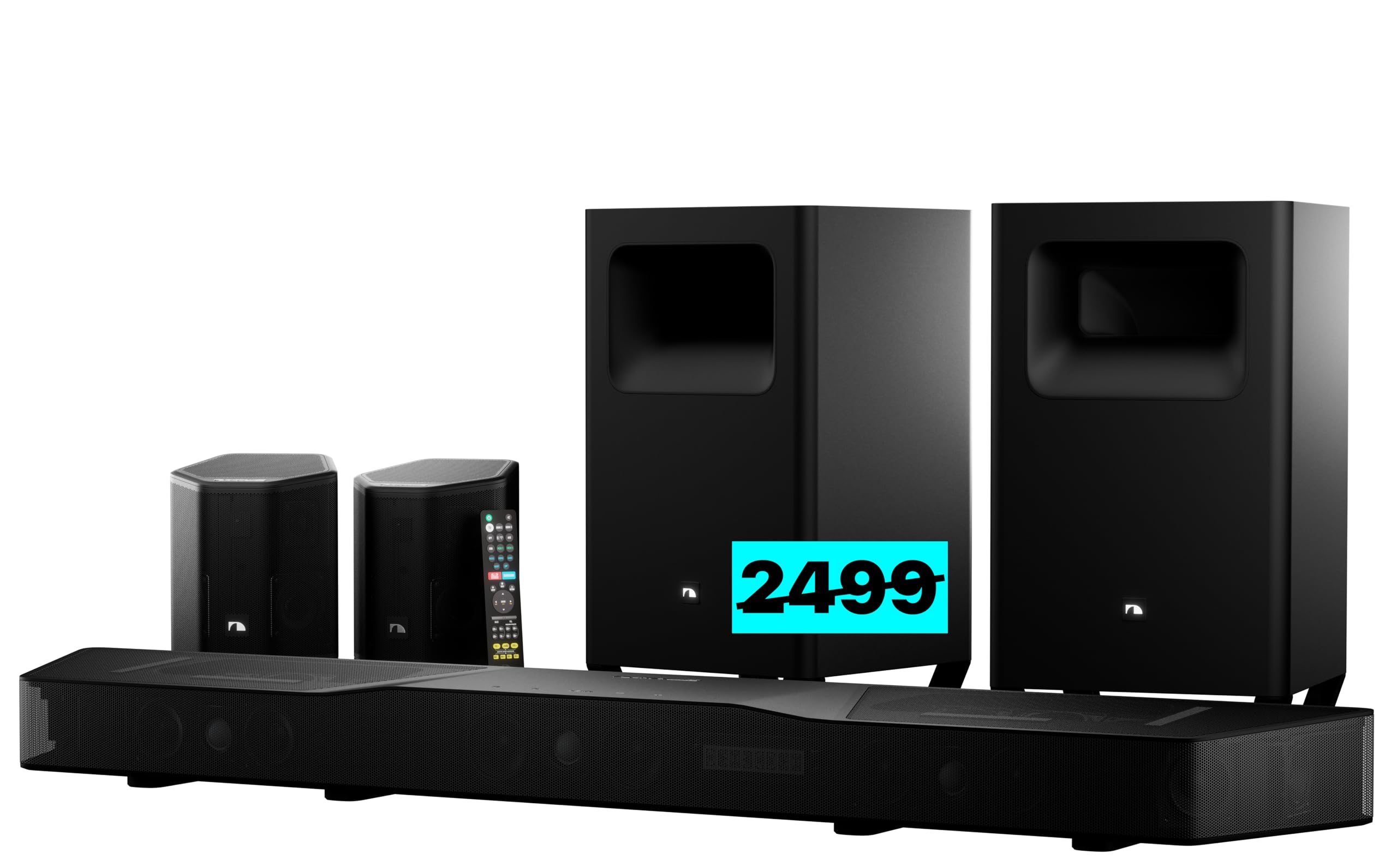
The Shockwafe 11.2.6 is not a soundbar — it’s a full-scale home theater system with a 54-inch soundbar chassis, two 10-inch wireless subwoofers, and bipolar surround speakers that fire sound from both sides and above. With 11 ear-level channels, 2 dedicated sub channels, and 6 discrete height channels (four up-firing, two bipolar height), it produces a 360-degree sound bubble that rivals traditional wired setups with separate AVRs.
The dual 10-inch subwoofers are the standout feature. Each sub uses a flared port design that moves air efficiently without port noise, producing deep, articulate bass down to frequencies you feel more than hear. The bipolar surround speakers have drivers on two faces — one firing into the room, one firing upward — which creates the presence of six discrete surround channels from just two physical enclosures. Dialogue stays crystal clear even during heavy effects, thanks to the center channel’s dedicated processing.
HDMI 2.1 inputs (two) support 4K 120Hz with Dolby Vision and HDR10+, making this system ideal for gaming alongside movies. The backlit remote gives you direct access to sound modes, speaker levels, and subwoofer trim. Wireless connectivity is rock solid — the subs and rears use a dedicated protocol that avoids 2.4GHz router interference. The system ships in three large boxes, so measure your space before ordering. It’s the most immersive soundbar-based system you can buy without moving to full AVR territory.
Why it’s great
- Dual 10-inch subwoofers for room-pressurizing bass
- 6 discrete height channels for true Atmos overhead effects
- Bipolar surrounds create 6 channels from 2 speakers
- HDMI 2.1 with 4K 120Hz for gaming
Good to know
- 32.5 lb soundbar + 32.7 lb per sub — heavy hardware
- 54-inch width requires a large media console or stand
- No wired analog inputs for legacy gear
9. Nakamichi Dragon 11.4.6

The Dragon 11.4.6 is the most advanced soundbar-based surround system on the market. It replaces dome tweeters with seven HiFi Air Motion Transformers — folded-ribbon drivers that move air 4x faster than conventional tweeters — ensuring pristine high-frequency extension and zero compression at loud volumes. The 58-inch chassis is packed with drivers that produce a towering front soundstage with pinpoint imaging. This is not a soundbar; it’s a single-piece front array that replaces a stack of separates.
The subwoofer configuration is equally serious: dual-opposing 8-inch drivers in each sub cabinet cancel out cabinet resonance, producing clean, controlled bass that doesn’t bloom or distort. The system supports up to four sub enclosures total if you want to pressurize larger rooms. The Pro-Cinema Engine processes Dolby Atmos (up to 24.1.10) and DTS:X Pro (up to 30.2) at true AVR depth — meaning it decodes object-based metadata with the same precision as a dedicated preamp/processor. Bipolar Omni-Motion surround speakers project sound from both sides and above, with PerfectHeight Mechanism that locks overhead effects into the sweet spot.
Setup is easier than the complexity suggests: the on-screen display guides you through speaker distance and level calibration with a visual interface, and the backlit remote gives you control over every channel’s trim. HDMI 2.1 inputs (three of them) support 4K 120Hz and Dolby Vision. The Dragon is expensive — but when you hear a helicopter pan from front-left overhead to rear-right with zero gap in the sound field, you understand why it costs what it does. It’s the closest you can get to a professional cinema processor without building a dedicated room and wiring twelve speakers.
Why it’s great
- HiFi AMT tweeters for distortion-free highs
- Dual-opposing subs eliminate cabinet resonance
- Pro-Cinema Engine decodes up to 30.2 channels
- Three HDMI 2.1 inputs with 4K 120Hz passthrough
Good to know
- High price point requires serious commitment
- 58-inch chassis needs a wide entertainment center
- No analog RCA inputs for legacy sources
FAQ
Can I get true Dolby Atmos from a Bluetooth surround sound system?
What Bluetooth codec matters most for surround sound?
Do wireless surround speakers need their own power outlet?
How important is the subwoofer frequency extension below 30Hz?
Final Thoughts: The Verdict
For most users, the best bluetooth surround sound winner is the ULTIMEA Skywave X50 because it delivers true 5.1.4 Dolby Atmos with fully wireless rear speakers and a 28Hz subwoofer at a price that undercuts every major competitor’s 5.1 system. If you want room-shaking bass and crystal-clear dialogue without physical rear speakers, grab the JBL Bar 500MK2. And for the absolute pinnacle of soundbar-based immersion with dual 10-inch subwoofers and 6 height channels, nothing beats the Nakamichi Shockwafe 11.2.6.

Mo Maruf
I created WellFizz to bridge the gap between vague wellness advice and actionable solutions. My mission is simple: to decode the research and give you practical tools you can actually use.
Beyond the data, I am a passionate traveler. I believe that stepping away from the screen to explore new environments is essential for mental clarity and physical vitality.