Our readers keep the lights on and my smoothie glass nicely filled. As an Amazon Associate, I earn from qualifying purchases.
Getting true surround sound without a tangle of speaker wires or a dedicated AV receiver is the goal for modern home theaters. A Bluetooth Surround Sound System cuts the cord on the front end while delivering the spatial audio that makes movies, games, and music feel alive. The challenge is sorting through soundbars with phantom surround and actual multi-speaker setups that use wireless rear channels.
I’m Mohammad Maruf — the founder and writer behind WellFizz. I’ve spent hundreds of hours cross-referencing amplifier specifications, driver configurations, and real-world user feedback on wireless surround systems to understand what separates a gimmick from a genuine home theater upgrade.
This guide breaks down the best options across different room sizes and budgets, from compact soundbars with detachable rears to full 5.1.4-channel powerhouses, so you can find the right bluetooth surround sound system for your space.
How To Choose The Best Bluetooth Surround Sound System
Not every system labeled “surround” actually places sound behind you. True surround requires discrete rear channels with physical speakers. The decision often comes down to how the rear speakers connect and whether the system can decode modern object-based audio formats like Dolby Atmos.
Wireless Rear Speaker Architecture
The biggest differentiator is how the rear speakers receive their signal. Some systems use a dedicated 2.4GHz or 5GHz wireless link between the soundbar and the rear speakers. Others use Bluetooth, which can introduce latency. The best systems pair the rear speakers to a separate wireless receiver that plugs into a wall outlet, eliminating the need for speaker wire runs across the room.
Object-Based Audio Support
Dolby Atmos and DTS:X add a height dimension to the soundstage. For the effect to work, the system needs either up-firing drivers in the soundbar or the rear speakers, or physical height speakers. If your ceiling is vaulted or has fans/textures, up-firing Atmos loses effectiveness. In that case, focus on systems with good channel separation rather than height virtualization.
Amplifier Power and Subwoofer Size
Peak wattage numbers are marketing figures, but they correlate with headroom. A system with 400–500 watts RMS will fill a medium living room without distortion. The subwoofer driver size is more meaningful: an 8-inch driver delivers tight bass for music, while a 10-inch driver moves more air for cinematic explosions. Rooms over 300 square feet benefit from a 10-inch or larger subwoofer.
HDMI eARC vs. Optical
For full surround sound with Dolby Atmos from streaming services, you need HDMI eARC. Optical connections are limited to compressed 5.1 Dolby Digital and cannot carry Atmos metadata. A system without HDMI eARC will still produce surround sound, but you will lose the overhead audio channels and object-based positioning.
Quick Comparison
On smaller screens, swipe sideways to see the full table.
| Model | Category | Best For | Key Spec | Amazon |
|---|---|---|---|---|
| Bose Smart Ultra Soundbar | All-in-One Soundbar | Spatial audio with voice control | Six transducers, two up-firing drivers | Amazon |
| JBL Bar 700MK2 | Detachable Surround | Wireless portability and convenience | 10-inch wireless subwoofer, 780W peak | Amazon |
| ULTIMEA Skywave X50 | 5.1.4ch Powerhouse | Full immersive Atmos with wireless rears | 8-inch subwoofer, GaN amplifier, 5.1.4ch | Amazon |
| Sony BRAVIA Theater System 6 | 5.1ch Soundbar | Bass-heavy cinema with clear dialogue | Dedicated center channel, Dolby Atmos | Amazon |
| Klipsch Reference Cinema 5.1.4 | Passive Speaker System | Upgrade path with Dolby Atmos height effects | Satellite speakers with up-firing drivers | Amazon |
| Amazon Fire TV Soundbar Plus 5.1 | 5.1ch Soundbar | Ecosystem integration with Fire TV | Dedicated center dialogue channel | Amazon |
| Bobtot 5.1 Home Theater | Component System | Traditional receiver-based setup | 10-inch subwoofer, 1200W peak | Amazon |
| ULTIMEA Aura A60 | 7.1ch Soundbar | Wired surround at entry-level price | 4 wired surround speakers, 4-inch sub | Amazon |
| LG S40TR | 4.1ch Soundbar | Compact setup with wireless rears | Wireless subwoofer and rear speakers | Amazon |
In‑Depth Reviews
1. Bose Smart Ultra Dolby Atmos Soundbar

The Bose Smart Ultra Soundbar packs six transducers — including two custom-engineered upward-firing dipole drivers — into a single chassis. Bose TrueSpace technology analyzes non-Atmos content and up-mixes it into a spatial audio field that genuinely projects sound beyond the physical speaker boundaries. Dialogue clarity is exceptional thanks to the A.I. Dialogue Mode, which intelligently balances voice frequencies against background effects without sounding artificial.
Setup requires the Bose Music app for initial AdaptIQ room calibration, which uses the included headset to measure acoustic reflections. This is not a plug-and-play experience for those who avoid smartphone apps. The soundbar supports HDMI eARC, optical, Bluetooth, and Wi-Fi with AirPlay 2 and Chromecast built-in. Voice control via Amazon Alexa and Google Assistant is integrated, and the Bose Voice4Video expansion lets you control TV and cable functions hands-free.
The subwoofer performance is good for a soundbar’s virtual bass, but the system truly shines when paired with the optional Bose Bass Module 700 and Surround Speakers 700. Without those additions, the surround field is impressive but not as rear-oriented as a dedicated multi-speaker system. For a single-component solution that leverages Dolby Atmos and voice control, this is the premium pick.
Why it’s great
- Excellent spatial audio with up-firing dipole drivers
- AI Dialogue Mode keeps speech crisp without manual adjustment
- Supports AirPlay 2, Chromecast, Alexa, and Google Assistant
Good to know
- Requires app-based setup with account creation
- Surround field benefits from optional rear speakers
- Wi-Fi connectivity can be finicky without a dedicated reset button
2. JBL Bar 700MK2 7.1 Channel Soundbar

The JBL Bar 700MK2 solves the rear speaker placement problem in an elegant way: the surround speakers detach from the main soundbar and run on internal rechargeable batteries. You pick them up, place them behind your seating area, and enjoy true 7.1-channel surround with no wires or wall outlets needed near the speakers. The batteries last for several movie sessions before needing a recharge back on the soundbar dock.
Under the hood, the system delivers 780 watts of peak power through a 10-inch wireless subwoofer that produces deep, room-shaking bass. Dolby Atmos is supported via MultiBeam 3.0, which uses beamforming to create a wide soundstage. The PureVoice 2.0 technology automatically optimizes dialogue based on ambient noise and volume level, ensuring conversations stay audible during action-heavy scenes.
The JBL ONE app provides a 10-band equalizer for fine-tuning the sound signature. The system supports HDMI eARC, optical, USB, Bluetooth, and Wi-Fi with AirPlay, Google Cast, Spotify Connect, and Tidal Connect. A Night Listening mode mutes the subwoofer and main bar, routing audio exclusively through the detachable speakers for late-night viewing. The detachable speaker’s maximum volume could be higher for large rooms, but for most living rooms the output is sufficient.
Why it’s great
- Detachable rear speakers require no power outlets near seating
- 10-inch subwoofer delivers authoritative low-frequency extension
- Extensive streaming support with multi-room capability
Good to know
- Rear speaker output may feel limited in very large rooms
- App is needed to access full EQ and calibration settings
- Lower mid-bass response could use a bump from the app EQ
3. ULTIMEA Skywave X50 5.1.4ch
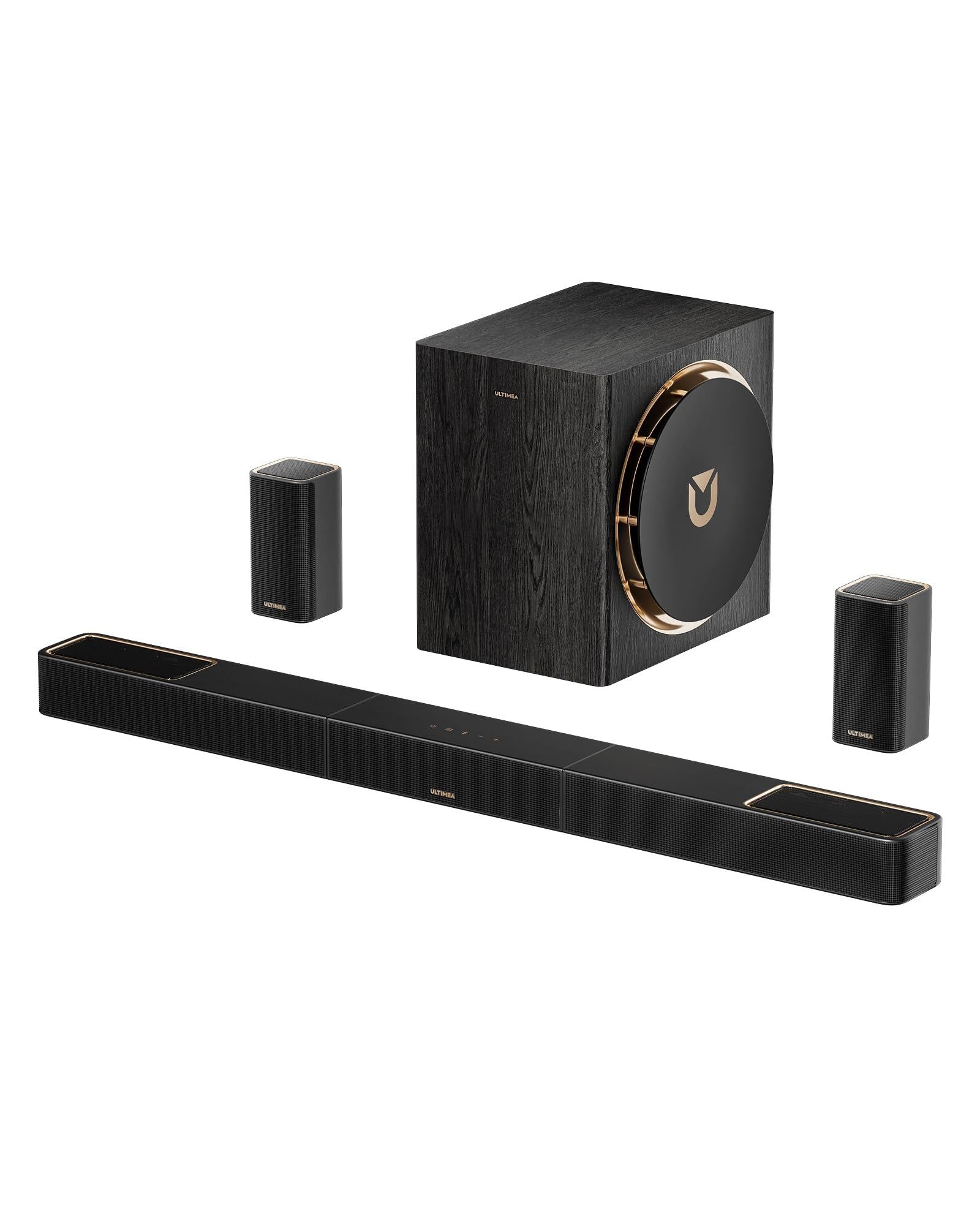
The ULTIMEA Skywave X50 brings a true 5.1.4-channel configuration — including two up-firing drivers in the rear speakers — to deliver Dolby Atmos height effects from both the front and back. The system uses dual 5GHz wireless transmission for the rear speakers and subwoofer, minimizing interference and dropouts. Power comes from a GaN (gallium nitride) amplifier that runs cooler and more efficiently than traditional silicon-based amps, pushing 760 watts of peak power.
The 8-inch subwoofer utilizes Gravus Ultra-Linear Bass Technology with an oversized waveguide and precision-engineered acoustic chamber to produce clean bass down to 28Hz. The NEURACORE multi-channel audio engine, driven by a triple-core DSP and dual-core MCU, processes 24-bit/192kHz audio with less than 0.5% total harmonic distortion. The system supports HDMI eARC with 4K HDR pass-through, optical, Bluetooth, and USB inputs.
Setup is plug-and-play with the rear speakers and subwoofer pairing automatically to the soundbar. The Ultimea App offers 121 expert EQ presets and a 10-band custom equalizer. The wood-crafted subwoofer enclosure and rose gold accents make this one of the best-looking systems in its class. While the price sits in the mid-to-premium range, the channel count and amplifier technology rival systems costing significantly more.
Why it’s great
- Full 5.1.4-channel configuration with up-firing rear speakers
- GaN amplifier provides clean power with minimal heat
- Wireless subwoofer and rears use stable 5GHz connection
Good to know
- Recommended for rooms between 108 and 270 square feet
- App required for the most precise EQ adjustments
- Height effect diminished if room has vaulted ceilings
4. Sony BRAVIA Theater System 6 (HT-S60)

The Sony BRAVIA Theater System 6 delivers a 5.1-channel setup with a dedicated center channel speaker, two front-firing speakers, two wireless rear speakers, and a subwoofer. The subwoofer produces powerful, clean bass that fills medium to large living rooms without distortion. Dolby Atmos and DTS:X support ensure compatibility with the latest streaming and Blu-ray audio formats. Dialogue is handled by the center channel with Voice Zoom 3 technology that enhances vocal frequencies when paired with a compatible BRAVIA TV.
The rear speakers connect wirelessly to a separate amplifier box that must be plugged into a power outlet near the TV, then wired to the rear speakers. This is a hybrid approach: the rears are not fully wireless because they still need speaker wire from the amp box, but the amp box receives the signal wirelessly. Setup is straightforward via HDMI eARC, and the BRAVIA Connect app provides control over sound profiles and volume.
Sound quality is cinematic with strong low-end extension and clear midrange. The Multi Stereo mode plays the same audio from all speakers, creating a room-filling presence for parties. The system lacks a pure dialogue-only mode, which some users may miss for late-night viewing. The subwoofer connects to the main soundbar via a wired connection, so placement is constrained by the cable length.
Why it’s great
- Dedicated center channel delivers crystal-clear dialogue
- Powerful bass output suitable for action movies and music
- Voice Zoom 3 enhances dialogue when paired with BRAVIA TVs
Good to know
- Subwoofer is wired — not wireless
- Rear speakers require wiring to a separate amp box
- No dedicated dialogue-only or night listening mode
5. Klipsch Reference Cinema Dolby Atmos 5.1.4

The Klipsch Reference Cinema system is a true passive speaker setup, meaning it requires an external AV receiver to power the speakers. It includes four satellite speakers — each with a dedicated up-firing Dolby Atmos driver — a center channel speaker, and a powered subwoofer with a built-in amplifier. The satellite speakers use Klipsch’s Tractrix 90° x 90° horn technology paired with aluminum tweeters for high-frequency extension and clarity.
This system is for buyers who want a traditional component-based surround setup with the ability to upgrade individual pieces over time. The satellites produce impressive high-end response and the up-firing drivers bounce sound off the ceiling for overhead effects. The subwoofer, while not the most powerful in this class, delivers tight bass that integrates well with the satellites. The system supports standard 5.1.4 channel configurations, meaning five ear-level channels, one subwoofer, and four height channels.
Setup is significantly more involved than a soundbar system. You need speaker wire (not included), a compatible AV receiver with Atmos processing, and patience for calibration. The satellites feature threaded mounting points and magnetic grilles, but the wire connection posts are close to the mounting threads, making banana plugs with narrow barrels ideal. For those building a long-term home theater, this provides the best upgrade path.
Why it’s great
- True component system with individual upgrade options
- Up-firing Atmos drivers in every satellite for unified height effects
- Tractrix horn and aluminum tweeters for detailed high frequencies
Good to know
- Requires an external AV receiver — not a standalone system
- Speaker wire, receiver, and calibration tools not included
- Subwoofer output may feel underpowered for very large rooms
6. Amazon Fire TV Soundbar Plus 5.1

The Amazon Fire TV Soundbar Plus is a 5.1-channel system that includes a soundbar with a dedicated center channel, two wireless rear speakers, and a wireless subwoofer. All components are pre-paired out of the box, making setup nearly instant — plug each speaker into power, connect the soundbar to your TV via HDMI eARC, and the system syncs automatically. Dialogue clarity is the standout feature, with the center channel and a five-level dialogue boost ensuring voices are audible without raising overall volume.
Dolby Atmos and DTS:X are supported, though the system relies on virtual processing rather than dedicated up-firing drivers. The subwoofer produces deep, punchy bass that enhances explosions and musical low-end. The soundbar includes Movie, Music, Sports, and Night modes that adjust the audio profile based on content. The rear speakers are compact and plug into standard wall outlets, with no wiring needed between them and the soundbar.
This system integrates tightly with Amazon’s Fire TV ecosystem, allowing the soundbar to be controlled from the Fire TV interface and remote. It also works with non-Amazon TVs via standard HDMI-ARC. The subwoofer requires at least 12 inches of clearance from walls to avoid boomy bass. Build quality is decent for the mid-range price point, though the plastic enclosures feel less premium than metal-grille competitors.
Why it’s great
- Pre-paired components for near-instant setup
- Excellent dialogue clarity with adjustable center channel boost
- Seamless control with Fire TV interface and remote
Good to know
- No dedicated up-firing drivers for Atmos height effects
- Subwoofer placement needs clearance from walls
- Build uses plastic rather than metal enclosures
7. Bobtot Home Theater 5.1 System (1200W)
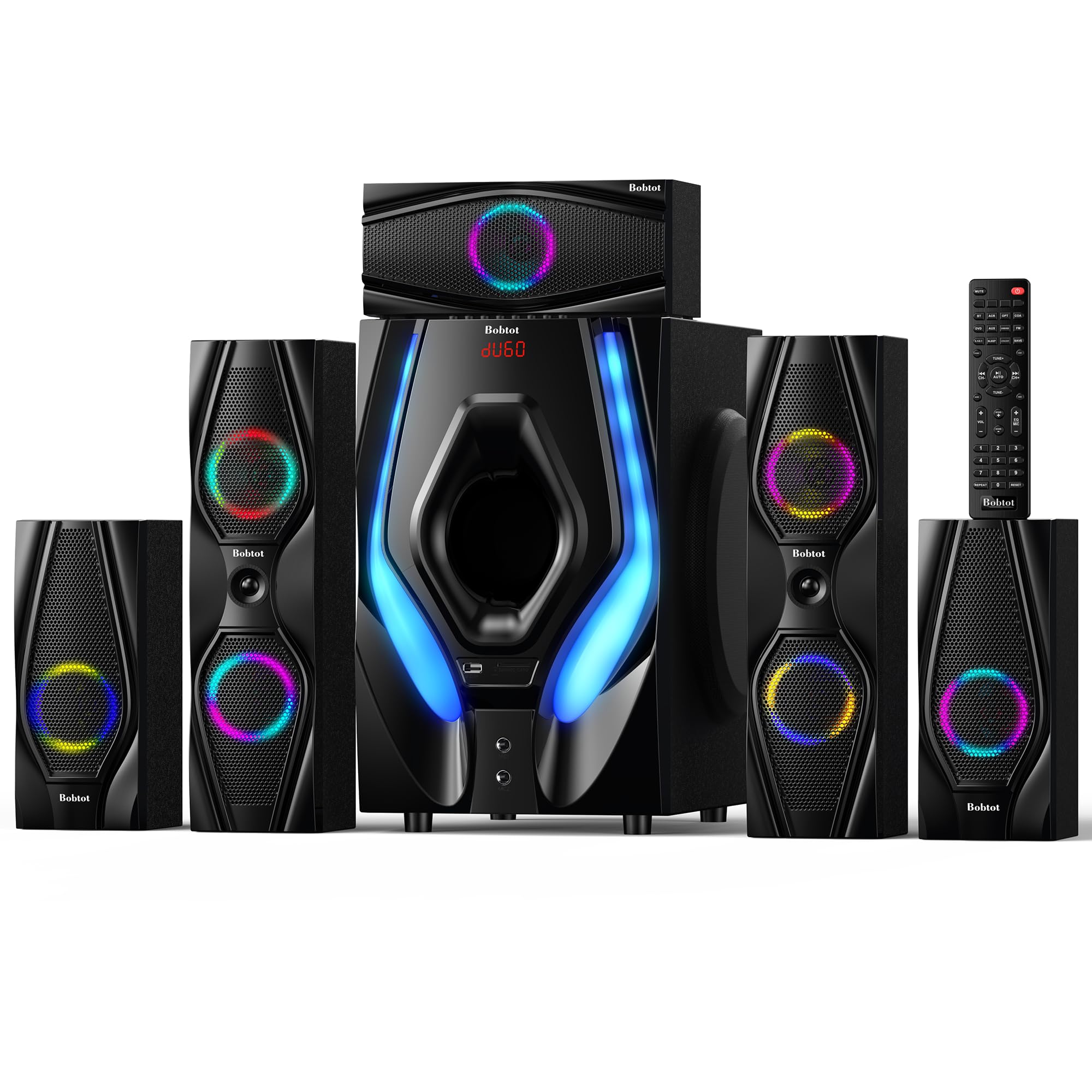
The Bobtot 5.1 system is a traditional home-theater-in-a-box setup where the subwoofer houses the built-in amplifier and receiver. It includes four satellite speakers, a center channel, and a 10-inch subwoofer rated at 1200 watts peak power. The system supports Bluetooth 5.3 for wireless audio streaming from phones and tablets, along with ARC, optical, coaxial, AUX, USB, and SD card inputs. It also includes FM radio and two 1/4-inch microphone inputs with echo control for karaoke.
The speakers connect to the subwoofer via long built-in cables — 13 feet for the front pair, 31 feet for the rears, and 10 feet for the center. This provides flexibility for room placement without buying additional wire. The system features LED ambient lighting on the subwoofer with four modes: beat-sync, solid on, spectrum EQ analyzer, and off. The remote control allows independent volume adjustment for each speaker and the subwoofer.
Sound quality is impressive for the budget-friendly tier, with thunderous bass from the 10-inch driver and clear high frequencies. The midrange can distort slightly at maximum volume, but at normal listening levels the system sounds full and immersive. Some users have reported reliability issues with the amplifier board and wireless speaker connections. Customer support is email-based with a slower response time, so a longer warranty or purchase protection is advisable.
Why it’s great
- 10-inch subwoofer provides deep, room-filling bass
- Long built-in speaker cables (up to 31 feet for rears)
- Includes karaoke microphone inputs and FM radio
Good to know
- Speaker cables are fixed and cannot be extended
- Midrange distorts at very high volume levels
- Reported reliability issues with amplifier and wireless components
8. ULTIMEA Aura A60 7.1ch Soundbar

The ULTIMEA Aura A60 is a 7.1-channel soundbar system that includes two wired front surround speakers, two wired rear surround speakers, a 4-inch wired subwoofer, and the main soundbar. The rear speakers connect wirelessly to the soundbar for signal transmission but still need power from a wall outlet via included adapters. This gives you the placement flexibility of wireless rears with the reliability of a wired power connection. The system supports Dolby Atmos decoding and uses virtual processing to expand the soundstage.
The 4-inch subwoofer uses BassMX technology with an optimized magnetic circuit and diaphragm to produce rich low frequencies. The soundbar features 121 expert EQ presets accessible through the Ultimea App, plus a 10-band custom equalizer and six tailored modes (Movie, Music, Voice, Sport, Game, and Night). Connectivity includes HDMI eARC, optical, AUX, USB, and Bluetooth 5.3. The soundbar supports CEC synchronization, so it powers on and off with your TV.
Setup is straightforward, and the included cables (6-meter rear surround cable and shorter front cables) accommodate most room layouts. The system is recommended for spaces between 108 and 270 square feet. While the sound quality is good for the entry-level price — clear dialogue and decent surround imaging — it does not match the channel separation or bass extension of more expensive systems. The app provides deep control but lacks a speaker test tone feature.
Why it’s great
- True 7.1-channel configuration with four discrete surround speakers
- Extensive EQ customization via app (121 presets + 10-band)
- Includes HDMI eARC for full audio format support
Good to know
- All speakers are wired for power — not fully wireless
- 4-inch subwoofer limited in low-frequency output for large rooms
- Atmos height virtualization preferred to dedicated up-firing drivers
9. LG S40TR 4.1ch Soundbar

The LG S40TR delivers a 4.1-channel configuration — four channels backed by a wireless subwoofer and two wireless rear speakers — in a compact footprint that fits small to medium rooms. The rear speakers connect wirelessly to the soundbar without requiring a separate receiver or amp box, making this one of the simplest true-surround setups to install. The soundbar supports Dolby Digital and DTS Digital Surround, ensuring compatibility with standard streaming and broadcast audio.
LG’s AI Sound Pro analyzes the audio content in real time and adjusts the sound profile to optimize for movies, music, or dialogue. Clear Voice Plus enhances vocal frequencies through the center channel processing, improving speech intelligibility without raising overall volume. The WOW Interface allows control of the soundbar through compatible LG TV menus, and WOW Orchestra mode synchronizes the soundbar and LG TV speakers for a wider soundstage.
The subwoofer produces thumping bass that fills a room, and the rear speakers create a convincing surround field when placed behind the listening position. The system lacks Dolby Atmos support and uses HDMI ARC (not eARC), which limits bandwidth for higher-resolution audio formats. For an entry-level price, the LG S40TR offers genuine surround sound with minimal cables and a small physical footprint, making it ideal for apartments, bedrooms, or dens.
Why it’s great
- True wireless rear speakers with no additional amp or wiring
- AI Sound Pro auto-adjusts EQ based on content type
- Compact design with metal grille that resists dust
Good to know
- No Dolby Atmos or DTS:X support
- HDMI ARC — not eARC — limits audio format bandwidth
- Rear speakers are wired to each other for power
FAQ
Do I need a separate AV receiver for a Bluetooth Surround Sound System?
Can I add extra speakers to my wireless surround sound system later?
Will Bluetooth connectivity cause audio delay when watching movies?
What size room is best for a 5.1 wireless surround system?
Final Thoughts: The Verdict
For most users, the bluetooth surround sound system winner is the Bose Smart Ultra Soundbar because it combines exceptional spatial audio processing with voice control and a compact single-chassis design that works in almost any room. If you want true 5.1.4-channel immersion with wireless rear speakers that produce genuine height effects, grab the ULTIMEA Skywave X50. And for a budget-friendly entry point with basic surround sound and minimal setup, nothing beats the LG S40TR.

Mo Maruf
I created WellFizz to bridge the gap between vague wellness advice and actionable solutions. My mission is simple: to decode the research and give you practical tools you can actually use.
Beyond the data, I am a passionate traveler. I believe that stepping away from the screen to explore new environments is essential for mental clarity and physical vitality.