Our readers keep the lights on and my smoothie glass nicely filled. As an Amazon Associate, I earn from qualifying purchases.
The frustration is universal: you buy a compact stereo, bring it home, set it up on the shelf, hit play—and the sound is thin, brittle, and lifeless. That tiny sub- box with a Bluetooth label might stream a playlist, but it cannot fill a living room without breaking up at moderate volume. The real challenge is finding a system that delivers rich, full-range audio, handles multiple physical inputs (CDs, USB drives, FM radio, a turntable), and blends into your home decor without looking like leftover computer hardware. That is the exact standard a proper Bluetooth Stereo System For Home must meet.
I’m Mohammad Maruf — the founder and writer behind WellFizz. I’ve spent over a decade analyzing the mechanical guts of home audio hardware, from class-D amplifier topologies to the difference between a silk-dome tweeter and a piezo driver, and I know exactly where budget corners are cut versus where genuine engineering value exists.
I’ve hand-selected nine systems that span retro micro-shelf units, premium tabletop speakers, and a separates-component integrated amplifier, then distilled the specs, real owner experiences, and sonic trade-offs so you can confidently choose your best bluetooth stereo system for home without wasting time on hollow marketing claims.
How To Choose The Best Bluetooth Stereo System For Home
Home stereo buyers face a maze of power claims and driver sizes. Cutting through the noise means focusing on three pillars: real-world wattage, physical input flexibility, and the acoustic design of the speaker cabinet. Ignore the flashy peak-power numbers on the box—they are almost always measured at 10% total harmonic distortion, which sounds terrible. Instead, cross-reference RMS wattage, driver diameter, and tweeter type (silk-dome for smooth highs, metal-dome for brighter treble). A system that delivers clean audio at normal listening levels with a wired subwoofer output gives you a path to upgrade later.
RMS vs. Peak Power — Why It Matters For Your Room Size
A unit rated 30W RMS (continuous) will play loud enough for a 200-square-foot living room without audible distortion. “800W peak” from a budget chip-amp sounds impressive but collapses into harsh clipping above one-third volume. For bedrooms, dens, and kitchens, 20–40W RMS per channel is sufficient. Open-plan spaces over 400 square feet benefit from 60W RMS or more. Always check the fine print: if the manufacturer only publishes peak watts, expect the RMS figure to be roughly one-eighth of that number.
Inputs That Actually Matter For Daily Use
Bluetooth is table stakes now, but not all Bluetooth is equal. Version 5.0 or higher offers better range and connection stability. A CD transport with top-loading or slot-loading mechanism (avoid tray-loaders in dusty environments) is critical if you own physical albums. USB-A ports that read MP3/WMA from a flash drive let you play a library without a phone. FM radio with a detachable antenna jack (not a short, fixed wire) gives you the option to upgrade reception. For vinyl enthusiasts, a dedicated phono input with a built-in preamp eliminates the need for an external box.
Cabinet Construction And Driver Material
MDF (medium-density fiberboard) cabinets with internal bracing dampen resonance far better than thin plastic shells. A bass-reflex port (rear or front-facing) extends low-frequency output but requires at least 6 inches of clearance from a wall. Full-range drivers smaller than 3 inches cannot produce meaningful bass below 80 Hz; a dedicated subwoofer or a 5.25-inch woofer is needed for punchy low end. Tweeter material matters less than crossover quality, but silk-dome tweeters tend to sound warmer and less fatiguing over long listening sessions.
Quick Comparison
On smaller screens, swipe sideways to see the full table.
| Model | Category | Best For | Key Spec | Amazon |
|---|---|---|---|---|
| Denon PMA-600NE | Integrated Amp | Audiophile upgrade path | 70W x 2 (4 ohms), phono input | Amazon |
| Philips TAM8905/37 | Micro System | WiFi + CD + Internet Radio | 100W RMS, 5.25″ woofers | Amazon |
| Panasonic SC-PM700PP-K | Compact Shelf | Reliable CD + basic streaming | 80W RMS (40+40), bass-reflex | Amazon |
| Marshall Stanmore III | Tabletop Speaker | Style + loud, single-box sound | 5″ woofer, Bluetooth 5.2 | Amazon |
| Klipsch The One Plus | Tabletop Speaker | Wood veneer aesthetics + clarity | 4.5″ woofer, 2.25″ full-range x2 | Amazon |
| Bose SoundLink Plus | Portable Speaker | Outdoor/indoor versatility | 20 hr battery, IP67 | Amazon |
| Pyle PDA77BU | Receiver/Amp | Karaoke + multi-speaker setups | 800W peak, 2 mic inputs | Amazon |
| Hanlim HL-616 | Micro Shelf | Budget all-in-one for small rooms | 30W RMS, silk-dome tweeter | Amazon |
| WISCENT WTB-797 | Vintage Micro System | Retro design + CD/radio | 30W peak, 3″ full-range | Amazon |
In‑Depth Reviews
1. Denon PMA-600NE Bluetooth Stereo Amplifier

The Denon PMA-600NE is not a one-box system; it is a serious integrated amplifier that demands you pair it with your own speakers. That extra step rewards you with a level of sonic control most all-in-one units cannot touch. Its Advanced High Current (AHC) power supply delivers 70 watts per channel into four ohms, which provides clean, authoritative headroom for bookshelf speakers like the Elac Debut or Q Acoustics 3010i, even in medium-to-large rooms. The onboard DAC accepts optical and coaxial digital inputs, so you can connect a CD transport, TV, or game console directly without a separate converter.
A standout feature is the Analog Mode, which completely disengages the digital and Bluetooth receiver circuits, routing the signal through a pure analog path. For vinyl listeners, the built-in phono stage (moving magnet) means you plug a turntable directly into the amp without an external preamp. The headphone output drives 300-ohm Sennheisers with surprisingly low noise. Owners consistently note the sound signature leans warm and detailed—reminiscent of a 1970s receiver but with modern clarity.
The trade-off is complexity: you must source passive speakers, speaker wire, and possibly a subwoofer (the PMA-600NE includes a mono sub out). The remote volume lag is slightly annoying, and there is no physical loudness contour button. But if you value long-term upgradeability and genuine high-fidelity performance, this platform-based approach outperforms any micro-system at a similar total investment.
Why it’s great
- Analog Mode kills digital noise for pristine listening
- Phono input eliminates need for external preamp
- Strong 70W (4 ohm) output drives demanding speakers
Good to know
- Requires separate passive speakers and speaker wire
- Remote volume control has coarse steps
- No built-in CD transport or FM tuner
2. Panasonic Compact Stereo System SC-PM700PP-K

Panasonic has been refining the compact shelf system for decades, and the SC-PM700PP-K represents the current peak of their engineering within a moderate budget. The 80W RMS total power (40 watts per channel) feeds a dedicated 10-centimeter woofer and a 6-centimeter tweeter in each speaker cabinet, with a rear bass-reflex port that extends low-end reach. The result is a soundstage far more muscular than the unit’s physical footprint suggests—clear highs without sibilance and a punchy mid-bass that works well for pop, jazz, and spoken word.
Connectivity is complete: Bluetooth playback, a top-loading CD player (tray mechanism that owners report as fast and reliable), FM radio with 30-station presets, and a front-panel USB-A port for MP3 playback from flash drives. The front-panel knobs for bass and treble offer instant tone shaping without digging into menus, and the included remote covers every function. The matte-black front panel and metal chassis give it a clean, unassuming look that blends into any room.
The main weakness reported by long-term owners is CD compatibility: a small percentage of burned CD-Rs and a few pressed discs failed to read. This is not a universal problem, but if you rely heavily on physical CDs, budget for occasional disc rejection. The FM antenna is a fixed wire rather than a detachable dipole, which limits placement flexibility. For a mix of streaming, FM, and occasional CD listening, however, this Panasonic delivers the most well-rounded performance in its class.
Why it’s great
- 80W RMS provides genuine room-filling volume
- Bass-reflex ported cabinets add surprising low-end depth
- Intuitive front-panel bass/treble knobs for quick EQ
Good to know
- Intermittent CD read issues with some discs
- FM antenna is a fixed wire, not detachable
- No Wi-Fi streaming or multi-room support
3. Philips TAM8905/37 Bluetooth & WiFi Stereo System

The Philips TAM8905/37 steps decisively beyond standard Bluetooth shelf systems by adding dual-band Wi-Fi, Spotify Connect, and Internet Radio support. This means you can stream directly from your phone or laptop without Bluetooth compression, using your home network for higher bitrate playback. The 100W of total RMS power flows through a pair of 5.25-inch woofers with bass-reflex ports and dome tweeters, producing a sound that is noticeably louder and fuller than the 80W Panasonic—enough to fill an open-plan living area without strain.
Build quality leans premium: the central unit features a matte aluminum front panel, and the speaker cabinets are real wood veneer over MDF, not cheap vinyl wrap. The color display shows album art, artist, and track info—a rare luxury in this price tier. On the media front, you get a slot-loading CD player (gentle on discs), FM radio with presets, USB-A playback, aux-in, and a headphone jack. The remote is well laid out, and the whole system connects together with standard speaker wire rather than proprietary plugs.
A few owners reported that speaker wire connection to the central unit is fiddly—the spring clips are tight and require careful insertion. Bluetooth performance is fine, but the true value is the Wi-Fi streaming, which will appeal to Spotify users who want a seamless, high-quality pipeline. If you prioritize multi-source streaming (including global internet radio stations) and want a single elegant box that does everything, the Philips is a compelling step-up from simpler micro systems.
Why it’s great
- WiFi + Spotify Connect bypasses Bluetooth compression
- 100W RMS with 5.25″ woofers for genuine bass
- Album art display adds visual polish
Good to know
- Speaker wire spring clips are stiff and awkward
- No phono input for a turntable
- Heavier and larger than typical micro systems
4. Marshall Stanmore III Bluetooth Home Speaker
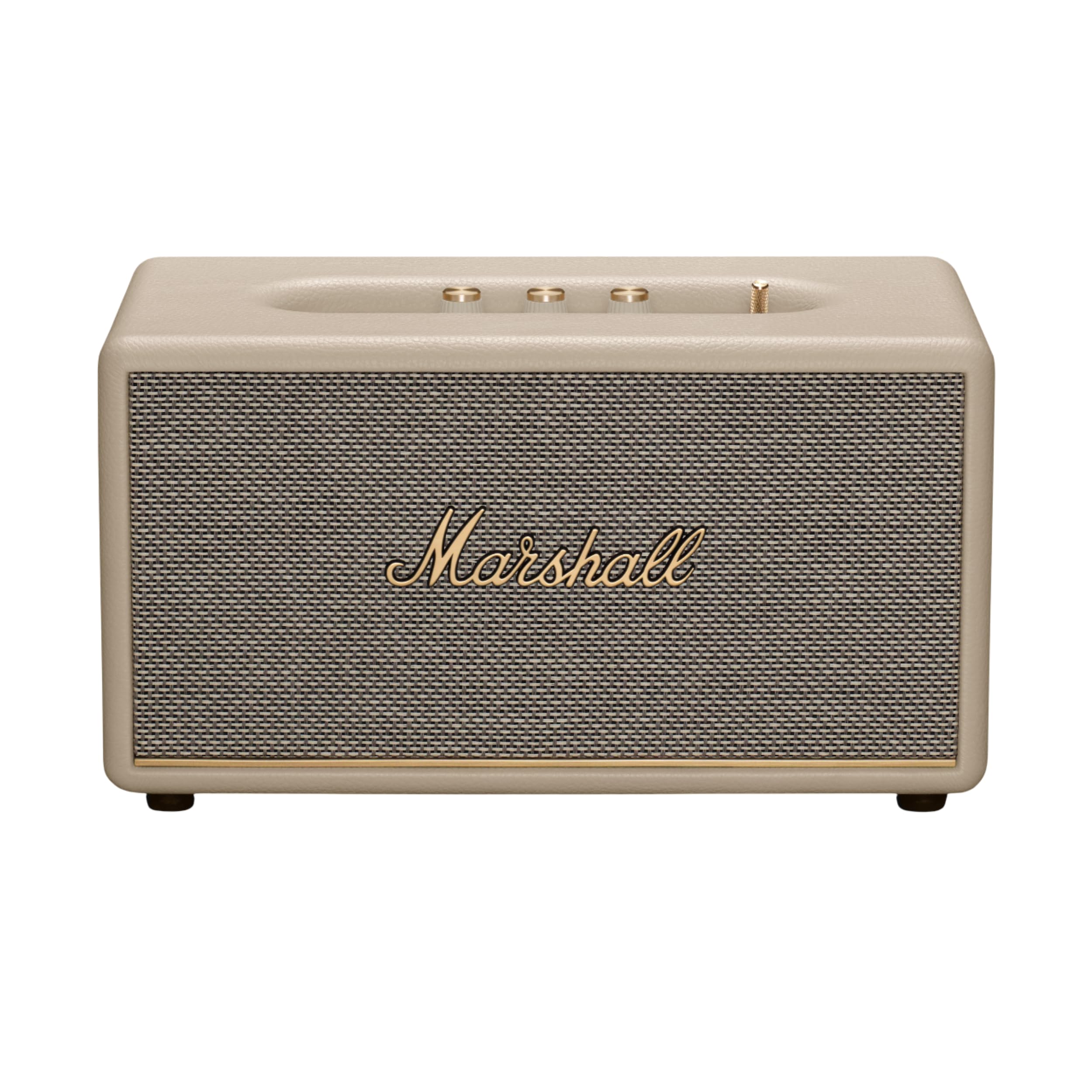
The Marshall Stanmore III is a single-box tabletop speaker that prioritizes iconic design and straightforward operation above modular flexibility. It houses a 5-inch woofer and two 0.75-inch tweeters in a ported cabinet clad in vegan leather with the brand’s signature gold-style hardware. The result is a sound that favors loud, energetic playback—rock, electronic, and hip-hop sound punchy and immediate. Physical knobs for volume, bass, and treble on the top panel let you dial in the tone without reaching for a phone app.
Bluetooth 5.2 ensures stable connections up to the rated 33-foot range, and the RCA and 3.5mm aux inputs accommodate a turntable or computer without Bluetooth. The Stanmore III does not include a CD player, FM tuner, or USB media playback; it is strictly a streaming speaker. The Marshall app (iOS and Android) unlocks a five-band EQ for deeper tuning and firmware updates. Owners report it fills a 1,300-square-foot space with clear, undistorted sound at high volume—impressive for a single enclosure.
The limitation is obvious: it is a mono-stereo hybrid with a single physical cabinet, so the stereo separation is artificially widened rather than truly discrete left-right. For critical listening or precise imaging, a two-speaker system will outperform it. But for a living room centerpiece that sounds great with minimal setup and looks like a guitar amp, the Stanmore III delivers a high emotional payoff. It is best for listeners who value design and loud, satisfying playback over modular expandability.
Why it’s great
- 5″ woofer produces loud, energetic bass at high volume
- Retro analog knobs for instant tone adjustment
- Premium build with leather and brass accents
Good to know
- No CD, FM, or USB playback
- Single cabinet limits true stereo separation
- Must remain plugged in (no battery)
5. Klipsch The One Plus Premium Bluetooth Speaker

The Klipsch The One Plus marries authentic mid-century modern furniture with a bi-amplified 2.1 stereo architecture. The real walnut veneer cabinet, tactile metal toggle switch, and knurled volume roller make it a piece of functional art. Under the veneer, two 2.25-inch full-range drivers handle the mids and highs, while a 4.5-inch high-excursion woofer delivers the low end—all tuned by Klipsch acousticians. The sound signature is clear and articulate rather than bass-heavy; highs are crisp without being edgy, and vocals sit forward in the mix.
Bluetooth 5.3 provides a stable 40-foot range, and the USB-C port supports both playback from a computer and reverse charging for your phone. The Klipsch Connect app adds a three-band EQ (bass, mid, treble) plus saved presets—a welcome tool for fine-tuning the voicing. Owners note that the speaker sounds thin out of the box but opens up significantly after one to two hours of break-in play. Once settled, it fills a 12×14-foot office or kitchen with room-filling clarity without strain.
Like the Marshall, The One Plus is a single-box solution with no CD, FM, or wired multi-room expansion. It is also limited to USB-C and Bluetooth inputs—there is no RCA or 3.5mm auxiliary jack, which may frustrate users who want to connect a turntable directly. The absence of stereo separation is noticeable on orchestral or wide-panned recordings. This is a speaker for design-conscious buyers who prioritize clarity and aesthetic harmony over feature breadth.
Why it’s great
- Real walnut veneer cabinet and tactile control knob
- Clear, articulate sound with excellent vocal clarity
- Bluetooth 5.3 offers strong 40-ft range
Good to know
- No analog RCA or 3.5mm aux input
- No CD, FM, or USB media playback
- Requires break-in period for optimal sound
6. Bose SoundLink Plus Portable Bluetooth Speaker

The Bose SoundLink Plus is not a traditional shelf stereo; it is a rugged, go-anywhere portable speaker with an IP67 dust and waterproof rating. But its bold, resonant audio and 20-hour battery life make it a legitimate primary or secondary audio source for home use, especially for those who want to move music between the kitchen, patio, and backyard. The Bose app provides a three-band EQ plus SimpleSync pairing with compatible Bose soundbars for whole-home coverage.
Sonically, the SoundLink Plus delivers the classic Bose house sound: clean, wide, and non-fatiguing, with bass that is present but never bloated. It does not have the absolute low-end extension of the Klipsch or Marshall, but it avoids distortion better at high volume. The USB-C charge-out port lets you use the speaker as an emergency power bank for your phone—a thoughtful detail for outdoor hangs. Pairing two units delivers true stereo separation (left-right) or Party Mode for synchronized mono output.
The obvious limits are the lack of a CD transport, FM tuner, or any line-level analog input. This is a pure wireless streaming device, and Bluetooth is the only protocol (no Wi-Fi). At over three pounds, it is not ultralight but remains easy to toss into a backpack. For users who want one speaker that lives indoors but occasionally ventures outside, the SoundLink Plus is the most versatile single-unit option on this list. For someone building a permanent, media-rich shelf system, a dedicated micro-component setup will serve better.
Why it’s great
- IP67 waterproof/dustproof for worry-free outdoor use
- 20-hour battery sustains all-day listening
- USB-C charge-out keeps your phone powered
Good to know
- No CD, FM, or line-level inputs
- Single-box mono/stereo hybrid, not true two-channel
- Heavier than ultralight portable competitors
7. Pyle PDA77BU Home Stereo Receiver with Bluetooth

The Pyle PDA77BU is a full-sized home stereo receiver that prioritizes brute-force power output and multi-input flexibility over compact styling. Its 800W peak amplifier (delivering approximately 100W RMS per channel into 4 ohms) can drive up to four passive speakers simultaneously, making it an ideal hub for a garage, workshop, or outdoor patio zone. The front panel features two 1/4-inch microphone jacks with independent volume, reverb, and delay controls—a rare feature that directly supports karaoke nights, speeches, or small events.
Beyond the microphones, the audio source options are extensive: Bluetooth 5.0 with a 30-foot range, USB-A direct MP3/WMA playback, SD card slot, FM radio with digital tuner and presets, plus RCA, 3.5mm, and aux inputs for connecting a TV, turntable, or gaming console. The digital LED display and full-function remote make navigation painless. Owners report easy setup and solid performance with four 6-ohm bookshelf speakers in a multi-room configuration.
The trade-off for all this power and connectivity is sound refinement. The Pyle amplifier does not offer the same clarity, low noise floor, or DAC quality as dedicated audiophile receivers like the Denon. At higher volume levels, the Bluetooth signal can introduce some compression artifacts, and the rotary controls feel less precise than premium brands. This unit is best suited for utility-focused installations where volume and input count matter more than subtle acoustic resolution. If you need a karaoke-capable hub for large spaces, this is your best bet.
Why it’s great
- Dual 1/4″ mic jacks with independent reverb/delay
- Drives four passive speakers for multi-zone coverage
- USB, SD, FM, and Bluetooth source versatility
Good to know
- Sound clarity lags behind class-leading integrated amps
- Bluetooth may produce compression artifacts at high volume
- Mechanical buttons and knobs lack premium feel
8. Hanlim HL-616 Home Stereo System with CD Player

The Hanlim HL-616 is a budget-conscious micro shelf system that competes directly with the WISCENT and similar entry-level units, but it carves a niche by including a silk-dome tweeter—a genuine upgrade over the budget piezo tweeters that cause harsh sibilance. The total RMS output is 30W (15W per channel), which translates to comfortable background listening in a bedroom, small office, or dorm room. The paired speakers are ported and run via standard wire from the main CD receiver module.
Input flexibility is solid for the price tier: tray-loading CD player (supports CD-R/RW and MP3 discs), FM radio (87.5–108 MHz), Bluetooth streaming, USB-A (up to 32GB), aux-in via 3.5mm, and a front headphone jack. The front-panel LED display shows CD track numbers clearly, and the included remote covers all essential functions. Owners who use this as a kitchen or office radio praise its easy setup and clean aesthetics (black front panel with a silver cabinet).
The drawbacks are predictable at this price point. The speaker wire is about three feet long, which limits placement options unless you extend it. At high volume, distortion creeps in noticeably—the 15W RMS per channel simply does not have the headroom for loud, clean playback in larger rooms. A reviewer noted that after several months one speaker began distorting even at low volume, suggesting quality control can be inconsistent. For undemanding listening at modest levels, the Hanlim delivers reasonable value. For anything louder than a casual background hum, budget for a higher-wattage system.
Why it’s great
- Silk-dome tweeter offers smoother highs than peers
- Easy out-of-box setup with CD, FM, Bluetooth, and USB
- Compact footprint fits small shelves and desks
Good to know
- Short 3-foot speaker wire limits placement flexibility
- Distortion becomes audible above moderate volume
- No independent bass/treble knobs on front panel
9. WISCENT WTB-797 Vintage Micro HiFi System

The WISCENT WTB-797 targets buyers who want a retro-styled micro system that looks at home on a mid-century credenza or a bedroom bookshelf. The brown wood-grain vinyl finish, top-loading CD lid, and visible full-range drivers evoke the late-1970s all-in-one aesthetic without sacrificing modern Bluetooth streaming. The rated 30W peak power (translating to roughly 15W RMS per channel) is modest, but in a small room like a bedroom or home office, the dual 3-inch full-range drivers produce clear sound at low to medium volume with acceptable warmth.
The feature set is surprisingly complete for a decor-focused unit: Bluetooth audio streaming, top-loading CD player (supports CD-R/RW and MP3 discs), FM radio with manual or auto-scan (30 station presets), USB-A playback, 3.5mm aux-in, and a headphone jack. The system also offers five EQ modes (flat, classic, rock, pop, jazz) and three CD repeat modes. The included remote control handles basic playback and track skipping from across the room. Owners note the FM antenna is a 90-centimeter fixed wire that must be placed high for good reception—a minor inconvenience.
The consistent weak point reported across multiple buyers is the remote control, which tends to fail after a few weeks due to a burnt IR component. Replacement remotes are available for about the price of a fast-food meal, but it is an annoyance on a new system. The CD lid is also fragile; users caution against rough handling. Sound quality is adequate for casual listening but does not compete with the Panasonic or Philips on volume, bass depth, or overall clarity. This is a style-first purchase for someone who values the vintage look above absolute audio fidelity.
Why it’s great
- Vintage brown wood-grain finish with top-loading CD
- Multi-source: Bluetooth, CD, FM, USB, aux-in
- Five EQ modes provide quick tone customization
Good to know
- Included remote is prone to early failure
- Top-loading CD mechanism feels delicate
- Low 30W peak power limits volume in larger rooms
FAQ
How many watts do I need to fill a 400-square-foot living room?
Can I connect a turntable to a Bluetooth stereo system without an external preamp?
What does “bass-reflex port” mean, and should I care?
Final Thoughts: The Verdict
For most users, the best bluetooth stereo system for home winner is the Panasonic SC-PM700PP-K because it delivers 80W RMS of clean, room-filling power, intuitive bass/treble controls, and reliable CD/FM/Bluetooth playback at a price that undercuts comparable units with similar build quality. If you want a separates-based, upgradable platform for serious listening, grab the Denon PMA-600NE. And for a gorgeous tabletop centerpiece that sounds loud and looks like a rock legend, nothing beats the Marshall Stanmore III.

Mo Maruf
I created WellFizz to bridge the gap between vague wellness advice and actionable solutions. My mission is simple: to decode the research and give you practical tools you can actually use.
Beyond the data, I am a passionate traveler. I believe that stepping away from the screen to explore new environments is essential for mental clarity and physical vitality.