Our readers keep the lights on and my smoothie glass nicely filled. As an Amazon Associate, I earn from qualifying purchases.
The moment your needle drops, every imperfection in your speaker chain becomes audible — a muddy midrange that smears vocals, a rolled-off top end that kills the sizzle of cymbals, or a boomy low end that rattles the stylus. Finding speakers that preserve the phono stage’s character without adding their own color is the real challenge.
I’m Mohammad Maruf — the founder and writer behind WellFizz. I’ve spent years analyzing amplifier topologies, crossover designs, and driver materials to understand how passive components interact with phono preamps and cartridge outputs.
Whether you need powered monitors with a flat response or a system with a dedicated phono stage for direct turntable connection, this guide covers the best bluetooth speakers for turntable setups that balance wireless convenience with audiophile-grade accuracy.
How To Choose The Best Bluetooth Speakers For Turntable
Matching a turntable to speakers isn’t like pairing a phone to a Bluetooth speaker. The phono cartridge outputs a signal that requires either a phono preamp (internal or external) and a line-level input, or speakers with a dedicated phono stage. The three factors below separate a system that reveals your vinyl’s detail from one that masks it.
Phono Stage or Line-Level Input
If your turntable lacks a built-in phono preamp, you need speakers with a dedicated phono/RCA input that includes RIAA equalization. Speakers like the Klipsch The Three Plus integrate this directly, so no external box is needed. For turntables with an internal preamp, standard RCA or AUX inputs work — but check that the speaker accepts line-level signals rather than expecting a moving-magnet or moving-coil cartridge, which would cause faint or distorted playback.
Crossover Design and Driver Material
A two-way or three-way crossover determines how cleanly the signal splits between woofer and tweeter. Silk dome tweeters deliver smooth, non-fatiguing highs — ideal for long listening sessions with vocal-heavy records. AMT (Air Motion Transformer) tweeters, found on the Fluance Ri71, offer faster transient response and wider off-axis dispersion, making the soundstage feel more open. Woofer material matters too: woven glass fiber drivers provide stiffness without the breakup modes of paper cones, keeping bass articulate rather than loose.
Amplifier Power and Speaker Sensitivity
Powered speakers with built-in amplifiers simplify turntable setups because you skip the separate receiver. Look for RMS power ratings between 50W and 150W for modest rooms, while peak SPL of 88 dB or higher ensures clean headroom during dynamic passages. If you plan to add a subwoofer later, confirm the speakers include a subwoofer output — a feature present on the PreSonus Eris Accent BT and the Fluance Ri71.
Quick Comparison
On smaller screens, swipe sideways to see the full table.
| Model | Category | Best For | Key Spec | Amazon |
|---|---|---|---|---|
| PreSonus Eris Accent | Powered Bookshelf | Studio accuracy on a budget | 50W RMS, 4″ woven woofer | Amazon |
| Edifier MR3 | Powered Monitor | Compact desktop Hi-Res monitoring | 18W×2 RMS, 3.5″ driver | Amazon |
| PreSonus Eris Accent BT | Powered Bluetooth Bookshelf | Wireless flexibility with studio DNA | 60W RMS, BT 5.3, Optical/Coax | Amazon |
| Klipsch The One Plus | Premium Tabletop | Single-speaker simplicity for small rooms | 2.25″ drivers + 4.5″ woofer | Amazon |
| Audio-Technica AT-SP3X | Compact Bookshelf | Matched turntable brand pairing | Dual RCA + Bluetooth, 76mm driver | Amazon |
| Klipsch The Three Plus | All-in-One Premium | Built-in phono input for direct turntable connection | 5.25″ woofer, Phono/RCA input | Amazon |
| Edifier MR5 | 3-Way Studio Monitor | Reference-grade three-way separation | 110W RMS, 5″ woofer, XLR inputs | Amazon |
| Fluance Ri71 | High-End Powered Bookshelf | AMT tweeter clarity with HDMI ARC | 120W, 5″ glass fiber woofer | Amazon |
| Fluance Ai81 Elite | Floorstanding Tower | Full-range floorstanding immersion | 150W, dual 6.5″ woven glass drivers | Amazon |
In‑Depth Reviews
1. Fluance Ri71 Reference Stereo Powered Bookshelf Speakers
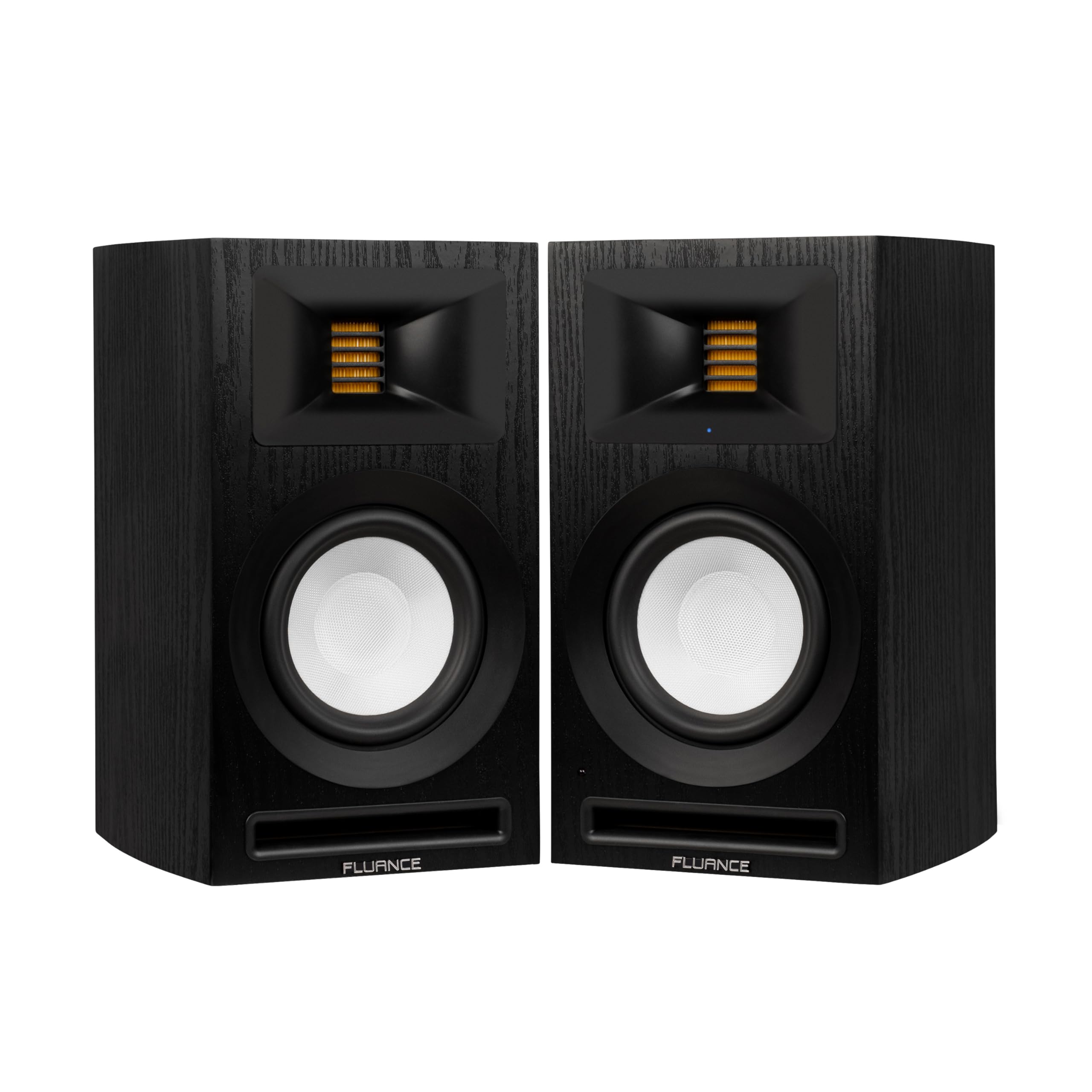
The Fluance Ri71 sits at the intersection of studio monitor precision and living-room convenience. Its Air Motion Transformer tweeter is rare in this price bracket — instead of pushing air like a dome, it squeezes air between folded pleats, delivering transient response that reveals the attack of every plucked string and ride cymbal. The 5-inch woven glass fiber woofer handles the midrange with warmth but avoids the boxy coloration that plagues cheaper paper cones.
Connectivity is where the Ri71 stands apart from typical powered bookshelf speakers. HDMI ARC allows it to serve double duty as a home theater pair, while RCA inputs accept line-level signals from any turntable with a built-in phono preamp. Bluetooth aptX HD ensures that when you stream from your phone, the codec keeps up with the resolution of your vinyl source.
Cabinets are inert MDF with internal bracing, so cabinet resonance doesn’t smear transients at higher volumes. The front-firing bass port gives you placement flexibility — you can tuck these near a wall without the muddy low end you’d get from rear-port designs. For vinyl listeners who also want a clean path to streaming and TV audio, this is the most versatile package.
Why it’s great
- AMT tweeter delivers extended, non-fatiguing highs with wide sweet spot
- HDMI ARC simplifies connection to modern TVs
- Front-firing port allows wall-proximity placement
Good to know
- Lacks a dedicated phono input — requires turntable with built-in preamp
- Bluetooth connectivity can be intermittent during heavy radio interference
2. Edifier MR5 2.0 Studio Monitor Bookshelf Speakers

The Edifier MR5 shatters the assumption that compact monitors can’t deliver full three-way separation. A dedicated 3.75-inch midrange driver sits between the 5-inch woofer and 1-inch silk dome tweeter, allowing the critical vocal band — typically the frequency range where vinyl’s analog warmth lives — to remain uncolored by the woofer’s cone breakup or the tweeter’s resonance. The active crossover operates silently, so phase cancellation between drivers is minimal.
Room compensation is the MR5’s hidden weapon. Physical rear knobs for high and low frequency adjustment let you tame bass nodes that appear when speakers are placed on a desk surface. The Edifier ConneX app adds desktop mode and acoustic space presets that notch out boundary gain without requiring a separate DSP box. For turntable setups near walls or in corners, this tuning flexibility prevents the low end from smearing the cartridge’s delicate signal.
With XLR and TRS balanced inputs, the MR5 integrates well with external phono preamps that output at higher line levels. Bluetooth 6.0 with LDAC support streams from your phone at 24-bit/96kHz, which means your digital library won’t sound thin when you switch sources. The 110W RMS amplifier drives the three drivers without audible compression, even during orchestral crescendos or dense electronic passages.
Why it’s great
- True three-way active design provides cleaner vocal reproduction
- Room compensation knobs and app presets address boundary reflections
- Balanced XLR/TRS inputs suit external phono preamp chain
Good to know
- Single RCA input may limit simultaneous source connections
- Treble and bass controls on rear panel are hard to adjust mid-session
3. Klipsch The Three Plus Premium Bluetooth Speaker System
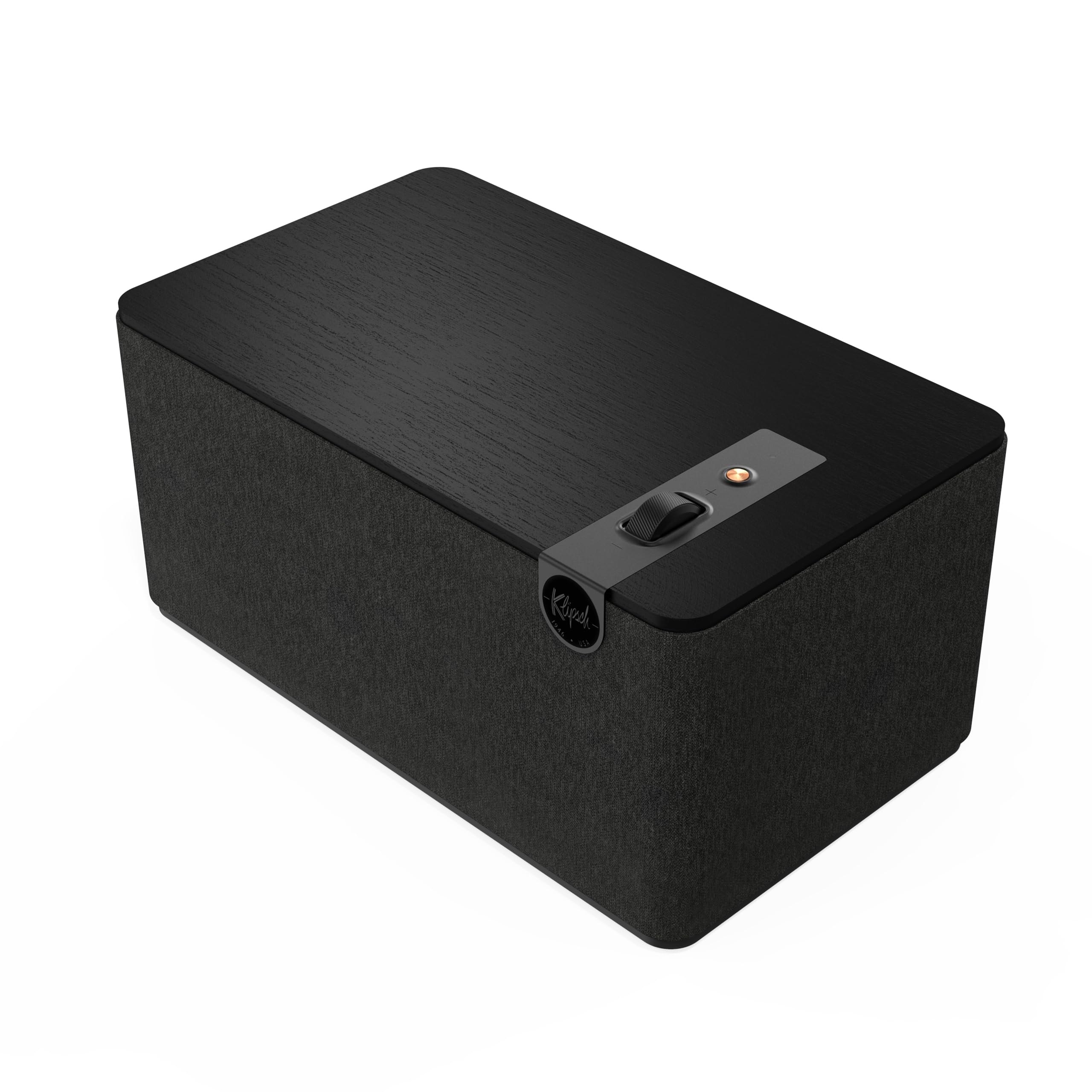
The Klipsch The Three Plus eliminates the most common turntable-speaker compatibility headache: the missing phono preamp. A dedicated phono/RCA input with built-in RIAA equalization means you can connect a turntable without a separate preamp box — the speaker handles the exaggerated bass cut and treble boost that vinyl requires. This single feature makes it the simplest path a buyer can take from unpacking to playing a record.
Inside the real wood veneer cabinet, dual 2.25-inch full-range drivers handle mid and high frequencies while a 5.25-inch high-excursion woofer delivers the low end. The biamplified 2.1 architecture keeps each driver in its optimal power band, which explains why the sound avoids the flatness that plagues single-driver tabletop speakers. The downside is the lack of stereo separation — this is a single-box system, so the left-right image won’t match a pair of bookshelf speakers.
The Klipsch Connect App unlocks broadcast mode, letting you link multiple The Three Plus units for multi-room playback. USB-C ports allow both audio playback and reverse charging, which is unusual in this category. The build quality and acoustic engineering justify the premium positioning, especially for listeners who value aesthetic integration over a traditional separate-speaker setup.
Why it’s great
- Built-in phono preamp accepts turntables without external gear
- Real wood veneer and tactile controls offer premium feel
- Broadcast mode connects multiple units for whole-home audio
Good to know
- Single-enclosure design limits stereo imaging compared to paired speakers
- App required for EQ tuning — default sound can seem underwhelming out of box
4. Fluance Ai81 Elite Powered 2-Way Floorstanding Tower Speakers

The Fluance Ai81 Elite solves a problem that turntable owners face when they outgrow bookshelf speakers: the need for real bass extension without adding a subwoofer. Dual 6.5-inch woven glass fiber drivers, stacked vertically in a floorstanding cabinet, move enough air to reproduce the low-frequency foundation of a kick drum or upright bass without strain. The integrated 150W amplifier runs each driver directly, avoiding the losses of passive crossovers and external receivers.
Down-firing bass ports direct low-frequency energy toward the floor rather than the listener, which reduces port noise and makes room placement less critical. The MDF cabinets are heavily braced to prevent panel resonance, so the sound remains clean even when you push the volume to fill a large living room or open-concept space. For turntable setups where the speakers serve as the primary music system, the Ai81 eliminates the need for a separate subwoofer or receiver.
RCA and optical inputs provide the line-level connection that turntables with built-in preamps need. Bluetooth 5.0 handles wireless streaming, though the codec support is standard SBC — not aptX or LDAC. The remote control offers bass and treble adjustment, which is useful for dialing in the sound after room placement. The trade-off for this power is physical footprint: the towers demand floor space that bookshelf speakers don’t.
Why it’s great
- Dual 6.5-inch drivers deliver deep bass without a subwoofer
- 150W integrated amplifier eliminates need for separate receiver
- Down-firing ports reduce placement sensitivity
Good to know
- Floorstanding form factor requires dedicated floor space
- Bluetooth codec limited to SBC, no aptX or LDAC support
5. PreSonus Eris Accent BT 60W Powered Bookshelf Bluetooth Speakers
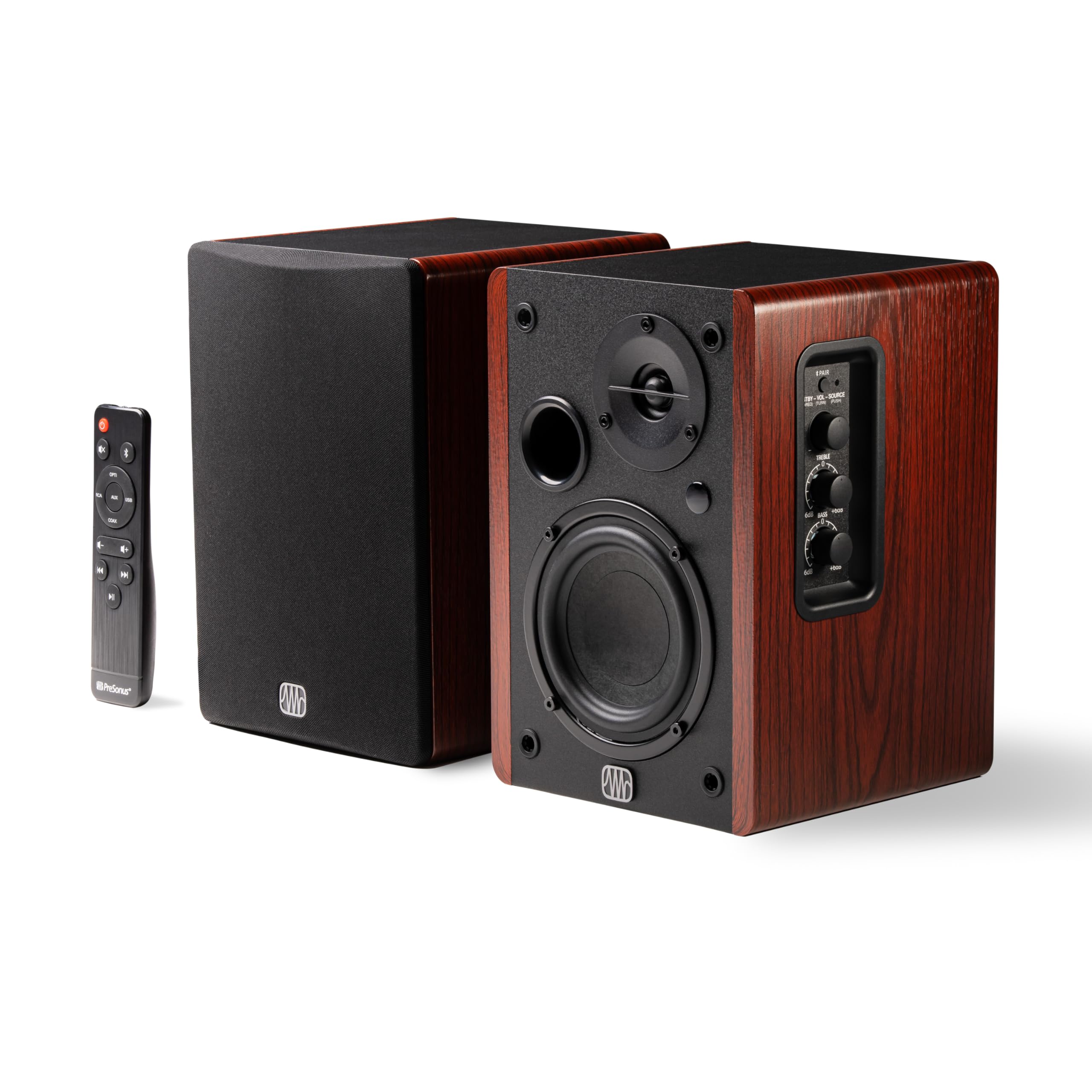
The PreSonus Eris Accent BT inherits the studio-monitor DNA of the Eris series and wraps it in a connectivity suite that turntable owners actually need. A 4-inch woven woofer and 13mm silk dome tweeter with a 2.8kHz crossover produce a flat response that reveals what your cartridge actually picks up from the grooves — no smiley-face EQ curve to flatter pop recordings at the expense of accuracy.
Where the non-BT version limits you to USB-C and RCA, the Accent BT adds Bluetooth 5.3, Optical, and Coaxial inputs, making it one of the most versatile options at its tier. The subwoofer output is the real prize for vinyl listeners who want to extend the low end without replacing the whole system — you can drop in a powered sub later and cross over the satellites at 80Hz, keeping the monitors free from bass distortion.
Front-panel controls for volume, treble, and bass let you tune the speaker to your room without digging through menus. The included remote adds convenience for couch listening. Some users report finicky Bluetooth pairing that occasionally requires a power cycle, but the wired connections via RCA or USB-C are rock-solid. For the price, the feature set and PreSonus’s studio pedigree make this a strong starting point.
Why it’s great
- Multiple wired inputs (USB-C, Optical, Coaxial, RCA) plus Bluetooth 5.3
- RCA subwoofer output enables easy system expansion
- Flat studio-monitor voicing suits critical turntable listening
Good to know
- Bluetooth pairing can be inconsistent and may require power cycling
- Woodgrain finish appearance may not match all decor styles
6. PreSonus Eris Accent Powered Bookshelf Speakers – 50W
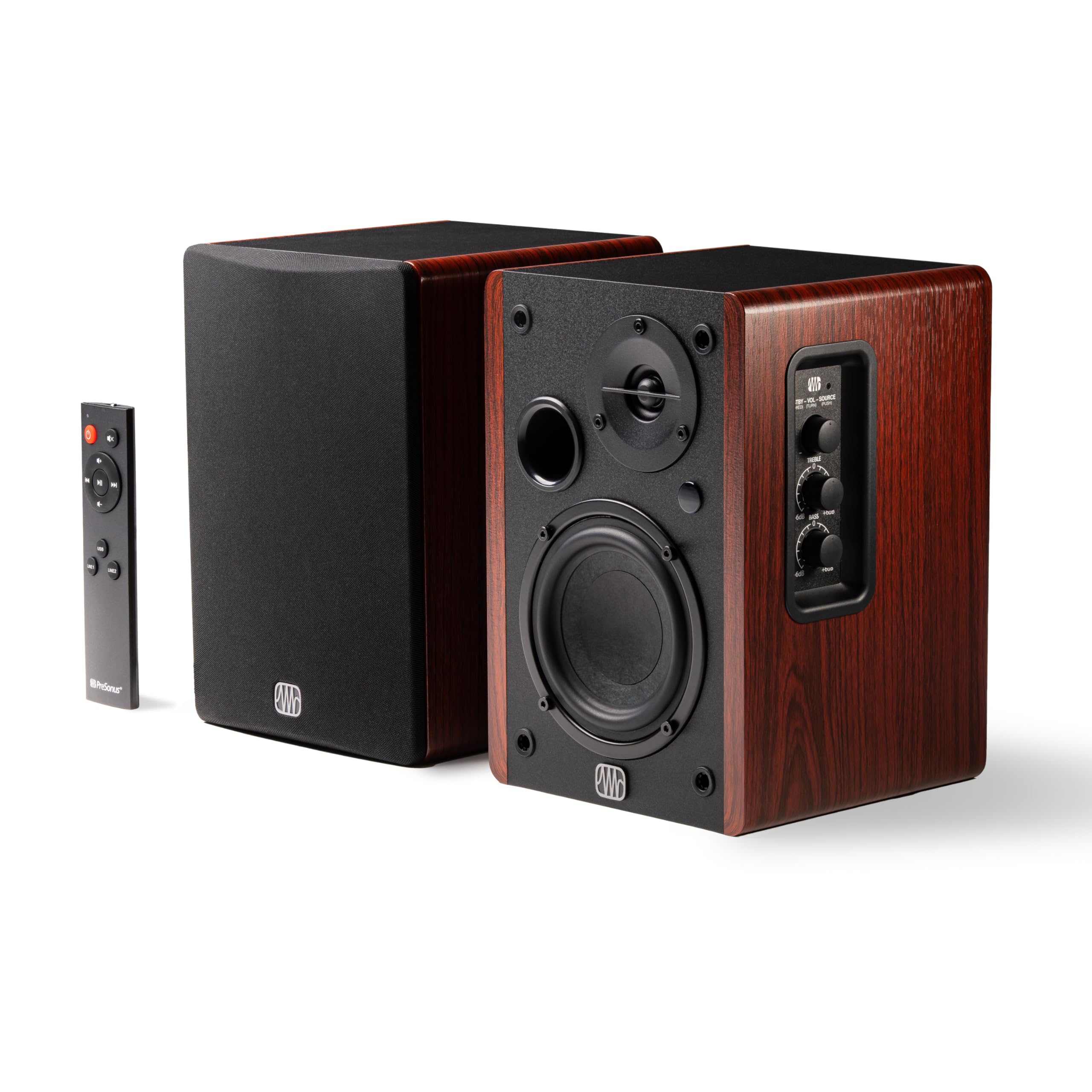
The non-BT version of the PreSonus Eris Accent removes wireless connectivity but keeps the audio architecture intact: 50W of RMS power (25W per channel) driving a 4-inch paper woofer and a 0.5-inch silk dome tweeter. The 55Hz to 20kHz frequency range covers the full musical spectrum, though the lowest octave (below 55Hz) requires a subwoofer via the dedicated RCA sub out.
USB-C and RCA inputs give you two ways to connect a turntable with a built-in phono preamp, while the front-panel volume, treble, and bass knobs offer immediate tonal adjustment. The remote control adds convenience for desktop setups where the speakers sit at ear level. Build quality matches what you’d expect from PreSonus — the wood-grain vinyl wrap looks convincing, and the cabinet weight (5.97 kg for the pair) suggests solid mass loading.
Customer feedback consistently praises the clarity and headroom, with many noting that the speakers outperform their size class in dynamic range. The trade-off is the lack of Bluetooth, which means the turntable must remain wired. For listeners who prefer a fully analog chain anyway, the omission is irrelevant. At this price point, the combination of studio heritage, remote control, and subwoofer expandability is unmatched.
Why it’s great
- Studio-grade flat response with adjustable treble and bass
- RCA subwoofer output allows low-end expansion
- Includes remote control for volume from a distance
Good to know
- No Bluetooth — turntable must connect via wired USB-C or RCA
- Paper woofer cone is less rigid than woven fiber alternatives
7. Edifier MR3 Powered Studio Monitor Speakers

The Edifier MR3 packs unexpectedly mature sound into a compact package, with 3.5-inch mid-low drivers and 1-inch tweeters that cover 52Hz to 40kHz. The Hi-Res Audio certification is not a gimmick — the extended top end beyond 20kHz reduces audible phase shift in the audible band, keeping cymbals and harmonics clean rather than rolled off. The MDF cabinets minimize distortion, which is critical when playing vinyl that already has surface noise to mask.
Connectivity is surprisingly deep for monitors of this size. Balanced TRS inputs join the standard RCA and AUX, making the MR3 compatible with professional phono preamps that output balanced signals. The front-panel headphone jack is welcome for late-night listening. Bluetooth 5.4 with multi-point connection lets you stream from two devices without re-pairing — useful for switching between a turntable and a phone.
The Edifier ConneX app provides three listening modes (Music, Monitor, Custom) with parametric EQ, though most users will stick to Monitor mode for the flattest response. Some owners note that the low end can’t compete with larger 5-inch monitors in bass extension, but the trade-off is a smaller desktop footprint. For a bedroom or office setup where space is at a premium, the MR3 delivers clarity that belies its dimensions.
Why it’s great
- Hi-Res Audio certified with extended 40kHz frequency response
- Balanced TRS inputs for pro-grade phono preamp connection
- Bluetooth 5.4 with multi-point device switching
Good to know
- 3.5-inch drivers limit bass extension compared to larger options
- Bluetooth pairing process can be unintuitive without manual
8. Klipsch The One Plus Premium Bluetooth Speaker System

The Klipsch The One Plus is designed for listeners who prioritize aesthetics and simplicity over stereo separation. The real walnut wood veneer cabinet and tactile brass-toned controls make it a furniture piece, not just a speaker. Inside, two 2.25-inch full-range drivers handle the mid-high frequencies and a 4.5-inch high-excursion woofer adds bass, all biamplified for audiophile-grade power handling.
For turntable integration, the lack of a dedicated phono input is the biggest limitation — you’ll need a turntable with a built-in preamp or an external phono stage, then connect via the AUX or USB-C input. Bluetooth 5.3 with 40-foot range covers wireless streaming from a phone or tablet. The Klipsch Connect App offers EQ adjustment, which is essential because the default tuning can sound thin until you adjust the bass and treble sliders.
Several owners report that the speaker needs a 1-2 hour break-in period before the drivers loosen up and the sound opens. After break-in, the clarity and tight bass justify the premium price for a single-box solution. The trade-off is physical: one speaker means no real stereo imaging. For a kitchen, office, or bedroom where mono playback is acceptable and looks matter, The One Plus is a compelling choice.
Why it’s great
- Real walnut wood veneer and premium tactile controls
- Biamplified 2.1 architecture with dedicated woofer
- Bluetooth 5.3 with 40-foot range
Good to know
- No built-in phono preamp — requires external turntable preamp
- Single-enclosure design lacks stereo separation of bookshelf pairs
9. Audio-Technica AT-SP3X Bookshelf Speakers

The Audio-Technica AT-SP3X is the entry-level option that prioritizes simplicity and brand synergy. Designed to pair with Audio-Technica turntables like the AT-LP120, these compact bookshelf speakers use dual RCA jacks for wired connection and Bluetooth for wireless streaming. The 76mm (3-inch) dynamic drivers are small, but the cabinet tuning extends the bass deeper than the driver size suggests, partly through a bass boost circuit built into the amplifier.
Multipoint Bluetooth is a feature usually reserved for more expensive speakers — the AT-SP3X lets you maintain two simultaneous Bluetooth connections. The touch-sensitive volume control and LED power indicator keep the front panel clean, while the included AC adapter with three international plug types makes this a travel-friendly option for collectors who move gear between locations.
Customer feedback repeatedly notes that these speakers get loud — sometimes too loud for their size — and that the bass boost circuit can feel heavy on certain records. The plastic enclosure doesn’t absorb vibration as well as MDF, so at higher volumes you may hear some cabinet resonance. For a starter system where the primary goal is a clean, simple two-speaker setup that matches your Audio-Technica turntable, the AT-SP3X delivers reliable performance without breaking the bank.
Why it’s great
- Multipoint Bluetooth supports simultaneous connections to two devices
- Compact size fits small shelves or desks without dominating the space
- Brand-matched design with Audio-Technica turntables
Good to know
- Plastic cabinet can resonate at higher volumes
- Bass boost circuit may over-emphasize low end on some recordings
FAQ
Can I connect a turntable without a built-in phono preamp to these speakers?
Why do my turntable speakers sound quiet when connected via RCA?
Do I need a subwoofer with bookshelf speakers for my turntable?
What is the ideal driver size for turntable speakers in a small room?
Final Thoughts: The Verdict
For most users, the best bluetooth speakers for turntable winner is the Fluance Ri71 because its AMT tweeter delivers clarity that bookshelf speakers at this price rarely achieve, and the HDMI ARC input makes it a true living room hub. If you want a simpler all-in-one solution with a dedicated phono input and no need for external preamps, grab the Klipsch The Three Plus. And for a budget-friendly starter system that expands with a subwoofer later, nothing beats the value of the PreSonus Eris Accent BT.

Mo Maruf
I created WellFizz to bridge the gap between vague wellness advice and actionable solutions. My mission is simple: to decode the research and give you practical tools you can actually use.
Beyond the data, I am a passionate traveler. I believe that stepping away from the screen to explore new environments is essential for mental clarity and physical vitality.