Our readers keep the lights on and my smoothie glass nicely filled. As an Amazon Associate, I earn from qualifying purchases.
The promise of a device that actually lets you hear conversations, stream music, and take phone calls without a pocket-sized relay has drawn millions toward wireless hearing solutions. But the market is packed with “amplifiers” that amplify everything—including the hum of a refrigerator and the whistle of feedback—while true Bluetooth rechargeable hearing aids must deliver clean speech separation, stable connectivity, and all-day power from a single charge.
I’m Mohammad Maruf — the founder and writer behind WellFizz. Over the past few years, I’ve analyzed the internal chipsets, battery architectures, and app-based fitting algorithms behind dozens of OTC hearing devices to separate engineered solutions from glorified sound boosters.
This guide compiles the top contenders to help you find the best bluetooth rechargeable hearing aids that actually fit your hearing profile, daily routine, and budget without the clinic markup.
How To Choose The Best Bluetooth Rechargeable Hearing Aids
Selecting your first pair—or upgrading from a basic amplifier—requires comparing three interconnected systems: the acoustic engine (chip architecture and noise handling), the wireless stack (Bluetooth version, codec support, and connection stability), and the power management (battery chemistry and charging case capacity). Below are the critical specs that separate a genuinely useful hearing tool from something you’ll shelve after a week.
Digital Chip Channels vs. Simple Amplification
A 16-channel digital chip allows the hearing aid to process different frequency bands independently, boosting speech frequencies (around 1–4 kHz) while reducing noise in other bands. Devices with fewer channels or analog-only circuits simply turn up the volume on everything, which makes noisy environments worse. Look for at least a 16-channel processor if you intend to use the aids in restaurants, family gatherings, or outdoors.
Native Bluetooth vs. Streamer-Dependent Connectivity
Many hearing aids marketed as “Bluetooth” actually require a separate neck-worn streamer to relay audio from your phone. True Bluetooth rechargeable hearing aids embed the radio directly inside each earpiece, letting you take calls and stream music without an intermediary device. Bluetooth 5.3 or 5.4 ensures lower latency, better power efficiency, and more stable connections at longer ranges (30–40 feet).
Battery Life: Real-World Runtime Metrics
Manufacturers often report “total hours with charging case,” but what matters is the single-charge runtime of the hearing aids themselves. For a full day of wear (16 waking hours), you need at least 16–20 hours of continuous use per charge. Fast-charge capability—e.g., 15 minutes for 6 hours of use—adds significant convenience. Also verify whether Bluetooth streaming drains the battery faster, which is typical.
Feedback Cancellation vs. Noise Reduction
Feedback cancellation is a specific algorithm that eliminates the high-pitched whistle caused when the microphone picks up its own amplified output (common during hugs or while wearing hats). Noise reduction is broader, referring to the suppression of ambient sounds like wind, traffic, or air conditioners. A quality device needs both, but feedback cancellation is the one that prevents embarrassing public squeals.
Quick Comparison
On smaller screens, swipe sideways to see the full table.
| Model | Category | Best For | Key Spec | Amazon |
|---|---|---|---|---|
| ELEHEAR-Beyond | RIC | Premium AI-powered clarity | 50dB gain / 24dB noise attenuation | Amazon |
| iBstone AuraLink | RIC | Professional-grade with app fitting | Bluetooth 5.4 / IP68 / 20 Hz–20 kHz | Amazon |
| Vivtone Xpure | RIC | All-day streaming with EQ tuning | 24-hour battery / 3-hour Bluetooth | Amazon |
| Nova (iBstone) | CIC | First-time users / zero feedback | 80% noise reduction / 1.5hr charge | Amazon |
| WASOCA (with App) | BTE | Budget-friendly app customization | 18-hour hearing / Bluetooth 2-in-1 | Amazon |
| Flaygo 16-Channel | CIC | Discreet all-day wear | 16-hour battery / 110hr case | Amazon |
| TTQ OTC | CIC | Value with Bluetooth 2-in-1 | 38dB gain / 5.5hr music | Amazon |
| JMTINA Invisible | CIC | Entry-level price point | 36hr case / FDA registered | Amazon |
| ELEHEAR-Beyond Gold | RIC | Scene-switching with translation | 100hr total / 15-min fast charge | Amazon |
In‑Depth Reviews
1. ELEHEAR-Beyond OTC Hearing Aids

The ELEHEAR-Beyond sits at the top because its VocClear AI architecture delivers a genuine 50 dB gain with 24 dB noise attenuation—specs that rival prescription-grade devices. The Receiver-in-Canal (RIC) form factor keeps the body discreet behind the ear while the receiver sits in the canal, reducing occlusion and feedback. Bluetooth 5.3 pairs natively with both iOS and Android, meaning you take calls and stream music directly without a neck loop.
The companion app offers 20 sound levels, treble/bass sliders, and a hearing test that builds a personalized profile. A single charge lasts 20 hours, and the charging case provides four additional full cycles, totaling 100 hours of run time. The 360-degree sound mode option lets you hear ambient surroundings when safety is a concern, which is a thoughtful touch for outdoor use.
Where it stumbles: the noise cancellation algorithm can make music sound slightly underwater, and some users report inconsistent performance in very noisy restaurants. However, with lifetime US-based customer support and a price point far below clinic models, it remains the most balanced, feature-rich Bluetooth rechargeable hearing aid for mild-to-moderate loss.
Why it’s great
- Outstanding app-based hearing test and 20-level customization
- 20-hour single-charge battery with 4 additional case cycles
- RIC design minimizes feedback and occlusion
Good to know
- Music quality can sound slightly compressed due to noise cancellation
- Restaurant performance varies; not a universal noise nuke
2. iBstone AuraLink Bluetooth Hearing Aids
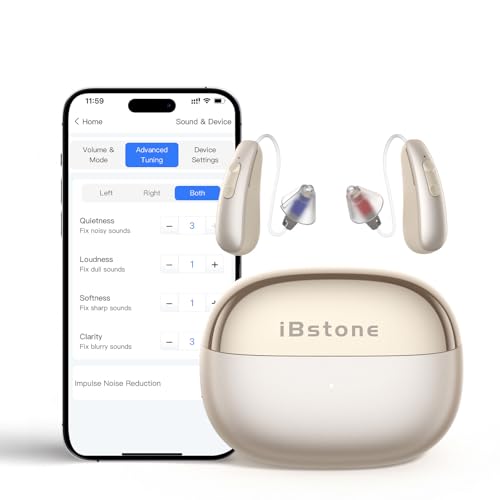
The AuraLink is the only unit in this lineup equipped with Bluetooth 5.4 and an IP68 dust/water resistance rating, making it the most future-proof and physically durable option. The RIC design is ultra-lightweight and includes multiple dome shapes for a customized seal. Its AI-driven adaptive intelligence continuously adjusts frequency response in real time based on your environment—no manual mode switching required.
The AuraFit app lets you run a hearing check, import audiologist test results, and enable tinnitus masking tones. The UV-sanitizing charging case adds a hygiene layer rarely seen at this price. US-based customer support and a lifetime service policy back the device, which has been voluntarily endorsed by over 1,000 clinicians. The frequency response spans 20 Hz–20 kHz, covering the full human hearing range.
Some users note that the wire from the body to the earpiece is stiff and slightly long, making the fit less secure for smaller ears. And while it performs well in quiet environments, its noise handling in extremely loud crowds still trails dedicated premium models. But for the combination of connectivity, durability, and clinical credibility, it’s a standout choice.
Why it’s great
- Bluetooth 5.4 with IP68 dust/water resistance
- UV-sanitizing case and clinician endorsements
- Full audiogram import and tinnitus masking via app
Good to know
- Stiff earhook wire may not hold shape for all ear sizes
- Background noise reduction is good but not class-leading in crowds
3. Vivtone Xpure Bluetooth Hearing Aids

Vivtone’s Xpure delivers a rare combination: 24-hour hearing aid runtime on a single charge plus 3 hours of continuous Bluetooth streaming. Most devices cut battery life by half when streaming, but the Xpure’s power management keeps you in the conversation all day. The RIC design minimizes distortion and feedback, and the companion app allows fine-tuning of volume and frequency to match your audiogram or personal preference.
Multiple preset sound modes—quiet, restaurant, outdoor—are accessible both on the device and in the app, giving you flexibility without forcing you into a smartphone-dependent workflow. The charging case provides roughly one week of standby power, and the hearing aids themselves fully recharge in 2.5 hours. Real-human phone support is included, which matters for first-time users who need setup guidance.
The only drawbacks are the lack of advanced features like automatic scene detection or AI-driven noise reduction—you have to manually switch modes. And the earpiece domes may require aftermarket retention wires for a truly secure fit during active movement. But for sheer runtime and streaming versatility, the Xpure is a compelling mid-range option.
Why it’s great
- 24-hour hearing aid runtime with 3-hour Bluetooth streaming
- App-based EQ and frequency fine-tuning
- Real human phone support included
Good to know
- No automatic scene detection; requires manual mode switching
- Domes may need aftermarket retention wires for secure fit
4. Nova Hearing Aids (iBstone)
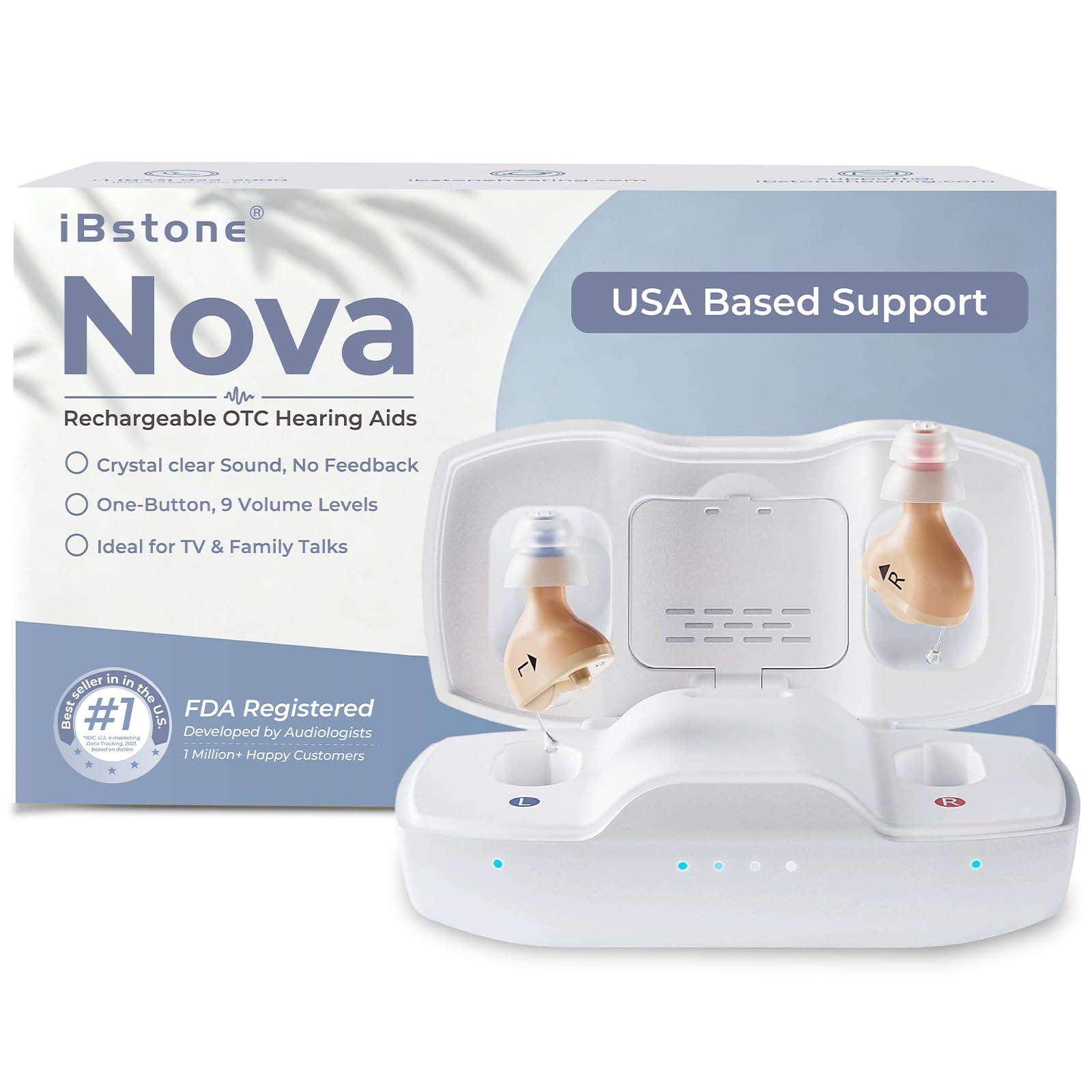
The Nova is designed specifically for first-time users who are terrified of feedback. Its proprietary chip achieves zero whistling even during hugs—a claim backed by dozens of user reports. The completely-in-canal (CIC) form factor makes it nearly invisible, and at just 0.14 oz per aid, you genuinely forget you’re wearing them after a few minutes. The included drying case automatically removes moisture, preserving the delicate electronics overnight.
Battery life is a strong 16–20 hours on a single charge, and the fast-charge feature fills the aids in 1.5 hours. The anti-lost lanyard is a thoughtful addition for active seniors who are prone to dropping small objects. Nine pairs of soft silicone domes ensure a pain-free fit for various ear canal sizes. Noise reduction is rated at 80%, and user feedback confirms that background hum is noticeably quieter than entry-level amplifiers.
The trade-off: the Nova lacks native Bluetooth streaming. It is a hearing aid first, with no phone call or music capability. Volume cycling through settings is also slightly cumbersome—you have to press the button multiple times rather than using a slider. But if feedback-free clarity and all-day comfort are your priorities, the Nova delivers at a mid-range price.
Why it’s great
- Zero feedback even during hugs or hat wearing
- Comfortable 16-hour CIC design with 9 dome sizes
- Included drying case and anti-lost lanyard
Good to know
- No native Bluetooth for calls or music streaming
- Volume mode cycling is button-based, not slider-based
5. WASOCA Bluetooth Hearing Aids (with App)
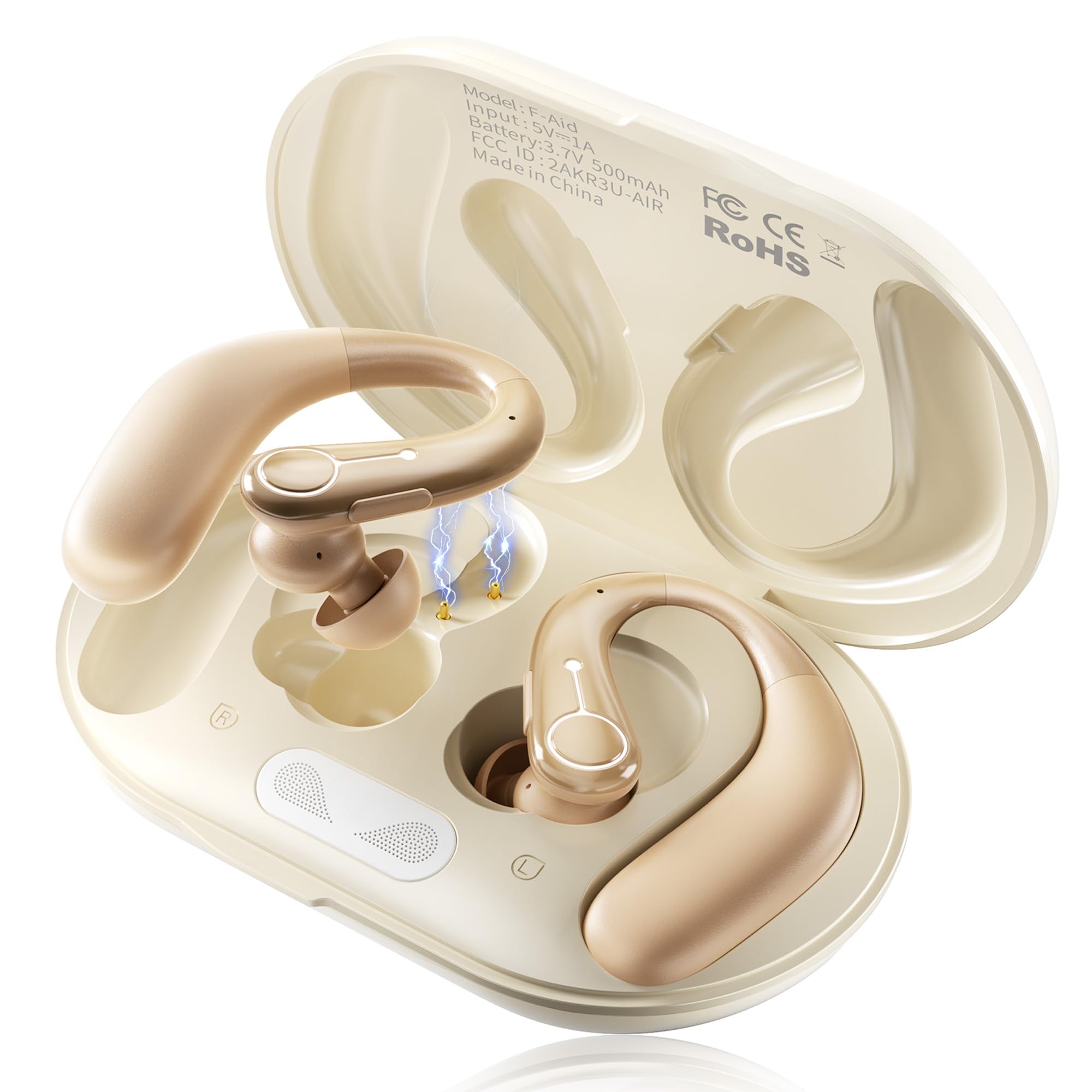
The WASOCA hearing aids pack a 16-channel digital chip into a behind-the-ear (BTE) form factor with three distinct noise reduction modes: universal, noise cancellation, and strong noise cancellation. The app conducts a hearing test and auto-adjusts frequency compensation, giving you a tailored profile without a clinic visit. Volume is adjustable in 5 levels, with independent left/right control for asymmetric hearing loss.
Bluetooth integration is 2-in-1, meaning the aids function as both hearing devices and wireless earbuds for phone calls, music, and TV streaming. The charging case features an LED display for remaining battery percentage, and the aids themselves run for 18 hours on a full charge. The ear-hook design ensures they stay put during exercise, and three sizes of earplugs help minimize feedback.
Where it falls short: some units have Bluetooth pairing glitches that require resetting, and the background noise reduction, while good, is not as smooth as premium AI-driven systems. The plastic build feels less premium than the RIC competitors. But for app-based fitting at a budget-friendly price, it’s a surprisingly capable entry point into the Bluetooth hearing aid world.
Why it’s great
- 16-channel chip with 3 noise cancellation modes
- App-based hearing test and auto-adjustment
- Independent left/right volume control
Good to know
- Occasional Bluetooth pairing issues reported
- Build quality feels less robust than RIC alternatives
6. Flaygo Rechargeable Hearing Aids (16-Channel)

Flaygo’s 16-channel digital chip uses adaptive filtering to isolate speech from background noise automatically. Unlike units that require manual mode switching, the Flaygo adjusts in real time—you simply put them in and they work. The CIC design is among the smallest on the market, sitting deep in the ear canal for near-invisibility. Medical-grade silicone shells prevent irritation during all-day wear.
Single-charge battery life is 16 hours, and the portable case holds an additional 110+ hours of charge, supporting up to 7 days of typical use. A digital power display on the case shows remaining capacity in real time. The aids automatically power on when removed from the case and power off when inserted, removing the need for physical buttons during daily handling.
The main limitation: there is no Bluetooth streaming for phone calls or music. These are hearing aids with automatic noise reduction, not multifunction streamers. Some users also report that achieving a perfect seal requires patience with the various ear tip sizes. But for those who prioritize discretion, comfort, and a “set-it-and-forget-it” experience, the Flaygo is an excellent mid-range CIC option.
Why it’s great
- Automatic real-time noise reduction with 16-channel processing
- Ultra-compact CIC design with medical-grade silicone
- 110-hour case capacity and auto on/off function
Good to know
- No Bluetooth streaming for calls or music
- Finding the perfect dome seal requires some trial and error
7. TTQ OTC Hearing Aids with Bluetooth
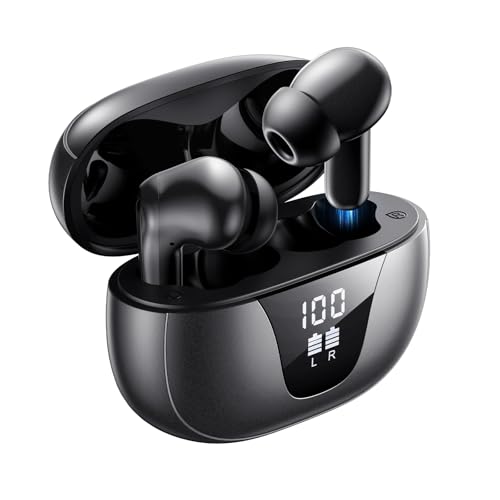
The TTQ OTC aids are among the most affordable options that still include true Bluetooth streaming for phone calls, music, and movies. The 38dB gain is appropriate for mild-to-moderate hearing loss, and the smart noise reduction algorithm identifies sounds in different frequency bands to reduce background hum while preserving speech. The form factor resembles a standard wireless earbud, making them discreet and socially indistinguishable from everyday audio gear.
Three noise reduction levels let you adapt to quiet rooms, busy streets, or loud gatherings. Battery life is about 5.5 hours of continuous music/hearing aid use, and the charging case provides a total of 60 hours. The case is compact enough to slip into a pocket. The 2-year warranty and responsive customer service—some users report full refunds for dissatisfaction—adds peace of mind at this price tier.
The compromises become apparent with prolonged use: feedback can occur if the earbud shifts even slightly during movement, and the sound profile can feel tinny or echoey compared to higher-end models. Volume inconsistency between left and right ears has also been noted. But for someone who wants basic Bluetooth hearing assistance without a major financial commitment, the TTQ is a functional entry point.
Why it’s great
- True Bluetooth streaming for calls, music, and movies
- Three adjustable noise reduction levels
- 2-year warranty with responsive customer service
Good to know
- Frequent feedback if the earbud shifts during movement
- Sound can be tinny or echoey with some volume inconsistency
8. JMTINA Invisible Hearing Amplifiers (FDA Registered)
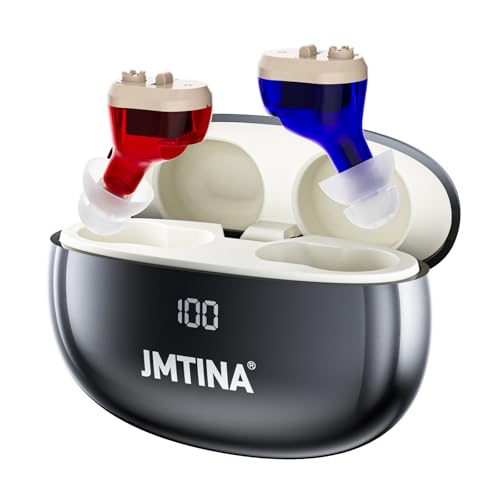
The JMTINA amplifiers offer the lowest price barrier to entry in this guide while still carrying FDA registration—a safety baseline that ensures the device meets basic emission and labeling standards. The CIC form factor is lightweight and nearly invisible, making them suitable for seniors who are self-conscious about wearing visible hearing aids. The charging case provides a total of 36 hours of use, and the three listening modes (quiet, noise, and outdoor) offer basic adaptability.
Gunmetal gray coloring helps the devices blend with natural ear tones. The package includes multiple ear tip sizes to improve fit and reduce feedback. As an amplifier rather than a fully digital hearing aid, the JMTINA is best suited for mild hearing loss where the primary goal is a simple volume boost in quiet settings.
The major caveats: there is no Bluetooth connectivity, no app support, and the noise cancellation is basic at best. Background noise can overwhelm speech in louder environments. Some users also report that the advertised “2 pack” sometimes arrives as a single unit—so it’s worth double-checking the package on arrival. For someone who needs a cheap, discreet backup pair or is just starting to explore amplification, the JMTINA serves a purpose, but it is not a long-term solution for active hearing needs.
Why it’s great
- Affordable entry point with FDA registration
- Lightweight CIC design is nearly invisible
- 36-hour total battery with charging case
Good to know
- No Bluetooth streaming or app control
- Basic noise handling, struggles in loud environments
9. ELEHEAR-Beyond Champagne Gold (App & Translation)

The Champagne Gold variant of the ELEHEAR-Beyond shares the same VocClear AI core as the standard model but adds four tailored scene modes (quiet, noisy, outdoor, music) that you can switch on the fly via the app. The 50 dB amplification and 24 dB noise attenuation remain best-in-class, and the 15-minute fast charge delivers 6 hours of use—invaluable for travel or emergency top-ups. The RIC design keeps the device lightweight and barely noticeable behind the ear.
What truly sets this variant apart is the inclusion of an AI translation feature, which listens to a foreign language and outputs a translated version to your ears—a rare addition that makes it uniquely useful for travelers or multilingual family environments. The app also offers tinnitus relief sounds and telephone speech enhancement. The champagne gold finish adds a touch of style that differentiates it from the clinical appearance of most hearing aids.
The downsides mirror the standard ELEHEAR: music occasionally sounds underwater due to aggressive noise processing, and the feedback cancellation, while good, isn’t perfect for everyone. The wire length from the body to the earpiece could also be more flexible for smaller ears. But if you want the most feature-dense Bluetooth rechargeable hearing aid on the market—complete with translation—the Champagne Gold edition is a strong premium contender.
Why it’s great
- AI translation feature for travelers and multilingual families
- Four scene modes plus 15-min fast charge for 6 hours
- Stylish champagne gold finish with 50 dB gain
Good to know
- Music audio can sound compressed from noise cancellation
- Earhook wire stiffness may not suit very small ears
FAQ
Can I use Bluetooth hearing aids to make phone calls without a streamer?
What does 16-channel digital processing actually do for me?
How long do the batteries really last on a single charge?
Will these hearing aids whistle when I hug someone or wear a hat?
Can I adjust the sound profile myself without visiting an audiologist?
Final Thoughts: The Verdict
For most users, the best bluetooth rechargeable hearing aids winner is the ELEHEAR-Beyond because it delivers the strongest combination of AI-powered noise handling, 50 dB gain, native Bluetooth 5.3, and a comprehensive app that replaces most clinic visits. If you want IP68 durability and future-proof Bluetooth 5.4, grab the iBstone AuraLink. And for all-day streaming without battery anxiety, nothing beats the Vivtone Xpure with its 24-hour runtime and 3-hour Bluetooth playback.

Mo Maruf
I created WellFizz to bridge the gap between vague wellness advice and actionable solutions. My mission is simple: to decode the research and give you practical tools you can actually use.
Beyond the data, I am a passionate traveler. I believe that stepping away from the screen to explore new environments is essential for mental clarity and physical vitality.