Our readers keep the lights on and my smoothie glass nicely filled. As an Amazon Associate, I earn from qualifying purchases.
The real problem with most Bluetooth receivers isn’t the connection — it’s the noise floor. A cheap chipset lets in a low-level hiss that kills quiet passages and flattens dynamic range, leaving your stereo sounding thin. For anyone serious about wireless audio, the receiver’s DAC, codec support, and output type determine whether streaming music is a marginal convenience or a genuine upgrade to your listening experience.
I’m Mohammad Maruf — the founder and writer behind WellFizz. I’ve spent years analyzing Bluetooth chipset roadmaps, DAC architectures, and real-world latency figures to separate the receivers that merely work from the ones that actually sound transparent.
Whether you are outfitting a passive PA monitor, modernizing a vintage amplifier, or setting up a whole-home audio zone, finding the right best bluetooth receiver means matching the correct codec, output stage, and form factor to your specific gear.
How To Choose The Best Bluetooth Receiver
The best Bluetooth receiver for your setup depends on three things: the input options your amplifier or mixer accepts, the codec your phone supports, and whether you need portability or permanent installation. A receiver that sounds stunning on a bookshelf system might hum with noise when plugged into a PA board, and a rugged XLR unit intended for a DJ rig is overkill for a desktop DAC chain. Matching the output type and codec to your gear is the single decision that determines whether wireless streaming sounds like a downgrade or an upgrade.
Output Type — XLR vs. RCA vs. Optical
XLR outputs deliver balanced audio, which cancels electrical noise over long cable runs — essential for live sound, PA systems, and studio monitors. RCA outputs are the standard for home amplifiers and receivers. Optical (Toslink) outputs bypass the receiver’s internal DAC entirely and send a pure digital signal to an external DAC, which is the preferred path for audiophiles who already own a high-end converter. If your mixer or amp lacks an optical input, stick to analog outputs; if it has optical, a receiver with that port offers the cleanest signal path.
Codec Support — LDAC, aptX HD, AAC
Android phones (version 8.0+) can transmit LDAC at up to 990 kbps, which approaches CD-quality resolution. iPhones cap out at AAC (256 kbps), but a receiver with a quality DAC still makes AAC sound clean. aptX HD (24-bit/48 kHz) sits between them and is common on many mid-range Android devices. If you stream from Apple Music or Spotify, a receiver with aptX HD or LDAC is useful but not critical — what matters more is a low-noise DAC that doesn’t introduce hiss. Budget receivers often use generic DACs that produce audible noise floors even with high-bitrate codecs.
Form Factor and Power Source
Inline XLR receivers (like the Xvive P3) plug directly into a microphone input and are bus-powered or battery-powered for portable use on stage. Desktop receivers (like the 1Mii DS220) sit on a shelf and require a wall outlet, but they offer multiple output options and superior DAC sections. Vehicle-focused receivers (like the NVX XUBT3) are wired into 12V systems and prioritize a physical control knob for safety while driving. Choosing the wrong form factor — like plugging a desktop receiver into a car’s auxiliary port — creates cable clutter and drains batteries.
Quick Comparison
On smaller screens, swipe sideways to see the full table.
| Model | Category | Best For | Key Spec | Amazon |
|---|---|---|---|---|
| Audioengine B1 | Premium | Audiophile home systems | 24-bit AKM DAC, Bluetooth 5.3 | Amazon |
| 1Mii DS220 | Mid-Range | Stereo systems with external DAC | LDAC, aptX HD, optical output | Amazon |
| Xvive P3 (B0DP4315W4) | Mid-Range | Live PA and DJ mixers | XLR output, BT 5.1, 8-hr battery | Amazon |
| Xvive P3 (B0C4NXYH5K) | Mid-Range | Portable XLR adapter | XLR output, BT 5.0, 8-hr battery | Amazon |
| Pyle PDA77BU | Premium | Multi-speaker karaoke setups | 800W peak, dual mic inputs, FM radio | Amazon |
| Donner Stereo Receiver | Premium | Home theater with karaoke | 1000W peak, optical/coaxial input | Amazon |
| NVX XUBT3 | Budget | Vehicle retrofits | Physical knob, 3.5mm + RCA output | Amazon |
In‑Depth Reviews
1. Audioengine B1

The Audioengine B1 is a desktop Bluetooth receiver built around a 24-bit AKM AK4396 DAC, the same chip found in dedicated stereo converters that cost several times more. This DAC handles upsampling of compressed streams, smoothing out digital harshness that cheaper receivers amplify. The unit supports Bluetooth 5.3 with aptX and AAC, and its range of roughly 100 feet is genuinely usable through walls — rarely a single dropout in typical home conditions.
Output options include both optical (Toslink) and RCA, letting you feed the digital signal straight into a preamplifier or use the internal DAC for analog output. The B1 can also act as a transmitter, sending audio from a TV or turntable preamp to Bluetooth headphones, though its primary design is as a stationary receiver for stereo systems. The aluminum chassis feels dense and resists vibration, and the external power supply keeps AC hum physically away from the analog circuitry.
The caveat is that the B1 is a receivers-only device — it lacks onboard EQ, remote control, or a battery for portable use. Some users report that the optical output occasionally loses sync after a power outage, requiring a power cycle to restore analog output. At this tier, those are minor trade-offs for a receiver that makes wired-quality wireless streaming genuinely achievable on a high-fidelity system.
Why it’s great
- High-end AKM 24-bit DAC for clean, detailed audio
- 100-foot range with zero stutter in real-world use
- Optical output bypasses internal DAC for external converters
Good to know
- No remote control or EQ adjustments
- Occasional analog output loss after power failure (fixable via reboot)
- Premium pricing targets serious audiophiles, not casual listeners
2. 1Mii DS220

The 1Mii DS220 packs LDAC and aptX HD codec support into a compact desktop form factor at a decisively mid-range price point, making it the most codec-versatile receiver here for Android users. Bluetooth 5.3 with dual antennas delivers a stable connection beyond 100 feet — rare for a receiver that costs under three figures. The OLED display shows the active codec, volume level, and connection status, removing the guesswork about what your phone is actually transmitting.
Outputs include optical, coaxial, and RCA, which means you can plug it into a legacy amplifier via analog cables or feed a clean digital stream into a dedicated DAC. The 7 EQ modes (Bass, Jazz, Classical, Rock, Pop, etc.) let you adjust the sound signature without touching your source device, though purists will likely leave it in Flat mode. The unit automatically reconnects to the last paired device on power-up, which saves a tap each time you sit down to listen.
The main limitation is the plastic enclosure — it feels lighter than the Audioengine B1, and the lack of rubber feet means it can slide on polished surfaces. A few users have noted that the 30-minute auto-shutdown timer can interrupt listening if you pause a track and walk away. For the money, however, the DS220 delivers LDAC-grade resolution and universal output flexibility that competes with receivers costing twice as much.
Why it’s great
- LDAC and aptX HD support for high-resolution wireless streaming
- OLED display clearly shows codec and connection status
- Optical, coaxial, and RCA outputs cover modern and legacy amps
Good to know
- Plastic enclosure lacks weight and rubber grip pads
- Auto shut-off after 30 minutes of inactivity may be inconvenient
- No balanced XLR outputs for professional audio gear
3. Xvive P3 (B0DP4315W4)

This iteration of the Xvive P3 is a dedicated XLR inline receiver designed for live sound, houses of worship, and DJ setups where balanced audio is non-negotiable. It plugs directly into a female XLR input on a mixer or active PA speaker, converting any Bluetooth source into a cable-free line-level signal without extra adapters. Bluetooth 5.1 and A2DP ensure stable transmission up to 100 feet, which has held up reliably through crowd noise and venue interference in field reports.
The P3 supports both mono (single unit) and stereo (dual unit) configurations via a press-and-hold stereo-link button — a feature that matters for DJs running two receivers for a true left-right signal path. The built-in rechargeable battery delivers over 8 hours of continuous playback, with a USB-C port that fully recharges in about 2 hours. At 0.94 x 1.04 x 4.6 inches, it fits snugly between XLR connectors on a crowded patch bay without blocking adjacent ports.
The trade-off is the absence of high-resolution codecs — the P3 operates at 16-bit/48 kHz, which is CD quality and perfectly adequate for live reinforcement but not audiophile-grade for critical home listening. The plastic-metal hybrid build feels durable but not ruggedized; one reviewer noted it survived semi-trailer wall range tests, but dropping it onto a concrete stage floor might be a different story. For a wireless XLR adapter, however, the price-to-reliability ratio is hard to beat.
Why it’s great
- Balanced XLR output eliminates noise over long cable runs
- Stereo-link lets two units pair for true left-right sound
- 8+ hour battery life with USB-C fast charging
Good to know
- Limited to 16-bit/48 kHz resolution — not for high-end home setups
- Not a ruggedized design; care needed in transit
- Requires a second unit for stereo in most mixer configurations
4. Xvive P3 (B0C4NXYH5K)

This earlier revision of the Xvive P3 covers the same core use case — plugging wireless audio into a professional XLR sound system — with Bluetooth 5.0 instead of 5.1. In practice, the difference is negligible for live performance; range is still specified at 30 meters (about 98 feet), and real-world reports confirm stable connectivity through auditorium sound boards and PA racks. The audio path uses the same 16-bit/48 kHz DAC architecture, so sound quality is identical to the newer version.
The battery endurance matches the updated model: roughly 8 hours per charge, enough for a full set of DJ gigs or a church service. The compact form factor — 0.11 kg and roughly the size of a marker — tucks into a gig bag pocket or sits on a mixer ledge without adding bulk. Users have praised its ease of use with JBL SRX speakers for background music during pack-down, and the lack of cables is consistently the most appreciated feature.
The downside is that this unit lacks the stereo-link feature of the newer model; it only outputs mono, so a true stereo setup requires manually pairing two units through a splitter rather than a dedicated button. The Bluetooth 5.0 chipset also has slightly higher latency than the 5.1 version, though most users report it is still imperceptible for speech and music playback. If you can find this version at a discount, it is functionally identical for mono applications — just verify the stereo-link is not a dealbreaker for your rig.
Why it’s great
- Proven reliability with JBL SRX and other active PA speakers
- Lightweight and compact for portable gigs
- 8-hour battery covers full event durations
Good to know
- Mono output only — no stereo-link button
- Bluetooth 5.0 has slightly higher latency than 5.1
- No high-resolution codec support (16-bit/48 kHz max)
5. Pyle PDA77BU

The Pyle PDA77BU is a full stereo receiver with a built-in Bluetooth 5.0 module, not a standalone dongle. It delivers 800 watts peak power across four channels, making it suitable for driving up to four passive speakers in a garage, home office, or karaoke room. The Bluetooth input streams from any phone or tablet, and the front panel includes independent volume, bass, treble, and balance controls alongside a digital LED display.
Beyond Bluetooth, the receiver offers USB and SD card playback, FM radio, RCA inputs for a turntable or DVD player, and two 1/4-inch microphone jacks with independent reverb and delay controls. This makes it a natural hub for family karaoke nights or community center events where multiple audio sources need to be switched quickly. The remote control replicates most front-panel functions, letting you adjust volume and switch inputs from across the room.
The 800-watt rating is peak power; continuous RMS output is lower, but adequate for medium-sized rooms with efficient speakers. A few users have reported intermittent Bluetooth dropouts when reconnecting to a smart TV, requiring a re-pair cycle. The receiver also lacks HDMI or optical inputs for TV audio, so connecting a modern television requires an RCA adapter. For a multi-function Bluetooth receiver that also functions as a full amplifier, the PDA77BU packs exceptional versatility into one box.
Why it’s great
- Amplifier and Bluetooth receiver in one unit — no separate components
- Dual mic inputs with reverb for karaoke and presentations
- USB, SD, FM, and RCA sources provide total input flexibility
Good to know
- Peak power rating far exceeds real-world continuous output
- Bluetooth reconnection to smart TVs sometimes requires re-pairing
- No HDMI or optical inputs for direct TV hookup
6. Donner Stereo Receiver

Donner’s stereo receiver expands on the Pyle formula by adding optical and coaxial digital inputs, allowing direct TV connection without adapters. The amplifier delivers 1000 watts peak (25 watts RMS x 4 channels) and supports up to eight speakers across four impedance-matched zones with independent volume controls per channel. Bluetooth 5.0 streaming is standard, and the unit also includes USB, FM, double RCA, and two microphone inputs with echo and talkover functions.
The upgraded remote control grants access to treble, midrange, bass, echo, and talkover settings in any input mode — a real advantage when you need to adjust the sound without walking to the rack. The talkover function automatically ducks the background music when the microphone is active, which is useful for events, announcements, or teaching environments. Users have noted the system pairs effortlessly with phones and tablets, and the digital inputs eliminate the audio degradation common with analog TV hookups.
Bass response has been a point of contention: some users report the amplifier struggles to drive towers with large woofers, producing thin low-end even with EQ cranked. The speaker terminal labeling (four sets of left/right connections) has also caused confusion — it is a two-channel amplifier with multiple speaker outputs, not a true four-channel unit. If your speakers are efficient (90 dB sensitivity or higher), the Donner receiver is a capable multi-zone streaming hub; with power-hungry floor-standers, look elsewhere.
Why it’s great
- Optical and coaxial inputs allow direct digital TV connection
- Four independent channel volume knobs for zone control
- Talkover function automatically lowers music during microphone use
Good to know
- Limited RMS power struggles with low-sensitivity tower speakers
- Speaker terminal layout can be confusing — it is a 2-ch amp with multiple outputs
- Some units may have remote reliability issues needing replacement
7. NVX XUBT3
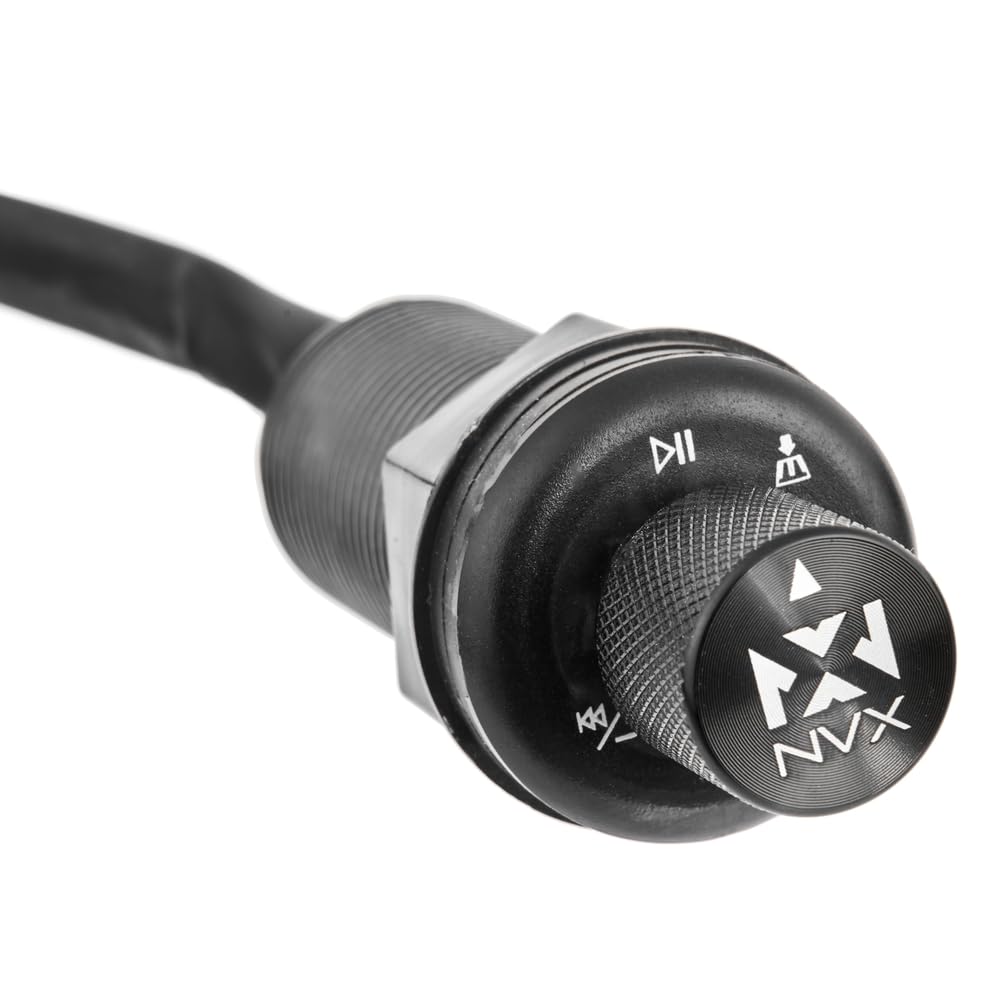
The NVX XUBT3 is a vehicle-focused Bluetooth receiver that replaces the need for a new head unit in classic cars, trucks, motorcycles, ATVs, and boats. It connects via a 3.5mm auxiliary input or RCA outputs to any existing radio that has an AUX port, and the single-knob interface controls track skip, pause, and volume — a critical safety feature when you cannot look at a touchscreen while driving. The knob mounts flush into a 3/4-inch dash hole or under the dashboard with the included bracket.
Audio quality through the XUBT3 is clean enough for daily driving, with stereo RCA outputs that feed directly into an external amplifier if your system has one. Users have successfully installed it in classic trucks (1964 Chevy dash after minor drilling) and on motorcycles, where the physical knob is far more usable than capacitive buttons. The unit is powered by the vehicle’s 12V system, so there is no battery to recharge.
Noise floor is the XUBT3’s Achilles’ heel. Several reports describe background static that becomes audible during quiet passages, especially when the engine is off. One user eliminated 90% of the noise by switching to a shielded cable for the trigger wire, but the remaining low hum is still present. Bluetooth range is also limited compared to desktop receivers — connectivity drops when the phone is not within a few feet of the unit, which can be annoying if you leave the phone in a pocket or bag. For the price, it works well for basic retrofits where a physical knob is the top priority, but expect to troubleshoot noise if you have a sensitive system.
Why it’s great
- Physical knob for safe, eyes-free control while driving
- Fits flush into standard 3/4-inch dash holes for clean retrofits
- RCA outputs allow connection to external car amplifiers
Good to know
- Background static is present and may require shielded cables to mitigate
- Bluetooth range is short — phone must be within a few feet
- Not a standalone amplifier — requires existing AUX-input radio
FAQ
Can I use an XLR Bluetooth receiver with a home stereo?
Does LDAC sound noticeably better than aptX on a Bluetooth receiver?
Why does my Bluetooth receiver produce static or humming?
Can I use two Xvive P3 units for true stereo sound?
Does the Audioengine B1 work as a Bluetooth transmitter?
Final Thoughts: The Verdict
For most users, the best bluetooth receiver winner is the Audioengine B1 because its 24-bit AKM DAC and Bluetooth 5.3 deliver genuinely high-fidelity wireless streaming without audible noise. If you want LDAC support and multiple output options at a lower price point, grab the 1Mii DS220. And for live sound applications requiring a balanced XLR connection, nothing beats the Xvive P3 for plug-and-play reliability in a professional audio chain.

Mo Maruf
I created WellFizz to bridge the gap between vague wellness advice and actionable solutions. My mission is simple: to decode the research and give you practical tools you can actually use.
Beyond the data, I am a passionate traveler. I believe that stepping away from the screen to explore new environments is essential for mental clarity and physical vitality.