Our readers keep the lights on and my smoothie glass nicely filled. As an Amazon Associate, I earn from qualifying purchases.
If your vintage amplifier or home stereo system sounds fantastic but lacks Bluetooth, you are missing out on the convenience of wireless streaming from your phone, tablet, or laptop. A dedicated receiver bridges that gap, converting your analog or digital inputs into a high-fidelity wireless hub without sacrificing audio quality. The challenge lies in picking the right one from a sea of options that vary wildly in codec support, DAC quality, and output connectivity.
I’m Mohammad Maruf — the founder and writer behind WellFizz. Over the years, I have analyzed hundreds of audio adapters, dissecting Bluetooth chipsets, DAC implementations, and real-world signal stability to separate genuine upgrades from noise.
Whether you are chasing lossless LDAC streaming or need a simple plug-and-play adapter for your garage rig, this guide breaks down the key specs and real-world trade-offs to help you find the ideal best bluetooth receiver for stereo for your exact setup.
How To Choose The Best Bluetooth Receiver For Stereo
Choosing a Bluetooth receiver for your stereo comes down to three core factors: audio codec support, the quality of the built-in DAC, and the physical outputs that match your equipment. A receiver that lacks the right codec or output will bottleneck your system’s potential, no matter how good your speakers are.
Codec Support: LDAC vs. aptX HD vs. AAC
The Bluetooth codec determines how audio is compressed and transmitted. LDAC (Sony’s proprietary codec) supports up to 990 kbps, offering near-lossless quality for Android users. aptX HD delivers 24-bit audio at 576 kbps and is widely compatible with newer Android devices and some PCs. AAC is the standard for Apple devices but often sounds thinner than aptX HD on non-Apple receivers. If you stream from an iPhone, prioritize a receiver with a high-quality DAC, as AAC is device-limited. Android users benefit most from LDAC or aptX HD support.
DAC Quality: The Heart of Sound Fidelity
The Digital-to-Analog Converter (DAC) inside the receiver directly impacts clarity, dynamic range, and noise floor. Budget receivers often use generic chips that introduce audible distortion or a constricted soundstage. Premium models integrate chips like the ESS ES9018K2M or ES9038Q2M, which deliver low harmonic distortion and high signal-to-noise ratios. For critical listening, a receiver with a dedicated audiophile DAC is worth the investment.
Output Connectivity: Analog vs. Digital
Your stereo’s input options dictate which receiver will work. RCA (analog) is universally compatible with most amplifiers, receivers, and powered speakers. Optical (TOSLINK) and Coaxial (SPDIF) digital outputs bypass the receiver’s DAC and use your stereo’s internal converter — ideal if your amp has a superior DAC. XLR (balanced) outputs are rare on consumer receivers but essential for professional audio gear, PA systems, or long cable runs where noise rejection matters.
Bluetooth Generation and Range
Bluetooth version (e.g., 5.0, 5.1, 5.3) affects connection stability, power efficiency, and range rather than audio quality directly. Newer versions offer better multipoint support and lower latency. For most home setups, Bluetooth 5.0 with Class 1 range (up to 100 feet line-of-sight) is sufficient. Pay attention to antenna design — external antennas provide significantly better range than internal ones, especially through walls.
Power and Form Factor
Some receivers include a built-in amplifier (like the Romicta or Pyle), meaning they can directly drive passive speakers. Others (like the 1Mii or SLASH 3) are purely signal adapters requiring an external amp. If you need a complete system, an all-in-one receiver simplifies setup. For upgrading an existing high-end stereo, a compact, cable-free adapter like the SLASH 3 is cleaner and avoids adding extra components to your rack.
Quick Comparison
On smaller screens, swipe sideways to see the full table.
| Model | Category | Best For | Key Spec | Amazon |
|---|---|---|---|---|
| 1Mii B06HD+ | Receiver | Audiophile upgrades | ES9018K2M DAC, LDAC/aptX HD | Amazon |
| SLASH 3 | Receiver | Cable-free setups | ESS ES9219 Quad DAC, LDAC/aptX Adaptive | Amazon |
| BluDento B2 | Receiver | Multi-device streaming | ES9018K2M DAC, LDAC/aptX HD, dual-device | Amazon |
| Romicta 4 Ch | Amplifier | All-in-one stereo + power | 50Wx4 RMS, Bluetooth 5.0 | Amazon |
| Donner MAMP2 | Amplifier | Karaoke & turntable use | 60Wx2 RMS, Bluetooth 5.3, Phono input | Amazon |
| blafili B3 | Receiver | Pro audio & DJ gear | XLR + RCA + Optical, LDAC/aptX HD | Amazon |
| Pyle PDA77BU | Amplifier | Garage & party systems | 800W peak, Bluetooth 5.0, dual mic | Amazon |
In‑Depth Reviews
1. 1Mii B06HD+ Hi-Res LDAC Bluetooth 5.3 Receiver
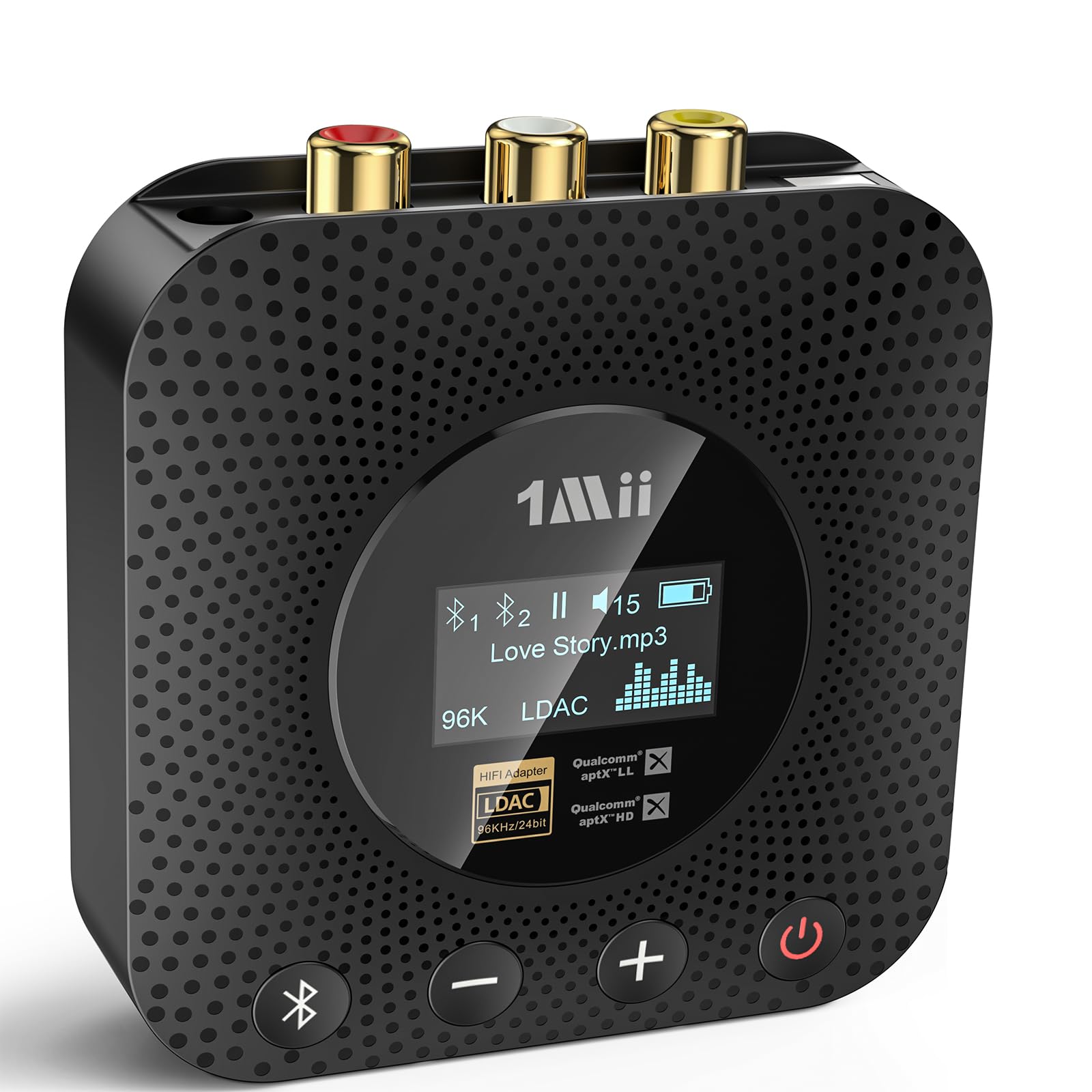
The 1Mii B06HD+ strikes a near-perfect balance between audio fidelity, connectivity options, and ease of use. It features an ESS ES9018K2M DAC capable of decoding LDAC at 990 kbps, making it one of the most capable receivers under most budgets for Android users who want lossless wireless streaming. The built-in Bluetooth 5.3 chip from Qualcomm ensures stable connections and support for aptX HD and aptX Low Latency, covering virtually every high-res codec available today.
Output flexibility is another strong suit — the B06HD+ offers both analog RCA and digital Optical/Coaxial outputs, allowing you to use your stereo’s internal DAC if it outperforms the receiver’s. The OLED display shows song name, sampling rate, battery level, and active codec, which is a thoughtful touch for tinkerers. Battery life is rated at 13 hours, making it portable enough to move between systems.
The only catch is the auto-off feature after ten minutes of inactivity, which requires a manual power-on to resume. Some users also noted that digital outputs may require switching codecs in developer options for older receivers. Despite these quirks, the B06HD+ delivers audiophile-grade performance in a compact, well-built package.
Why it’s great
- Supports LDAC, aptX HD, and aptX LL for broad device compatibility
- Analog and digital outputs suit any amplifier or receiver
- Clear OLED display with real-time codec information
Good to know
- Auto-off after 10 minutes of silence requires manual power-on
- Digital output may need codec switching for older receivers
2. SLASH 3 LDAC Hi-Fi Bluetooth DAC
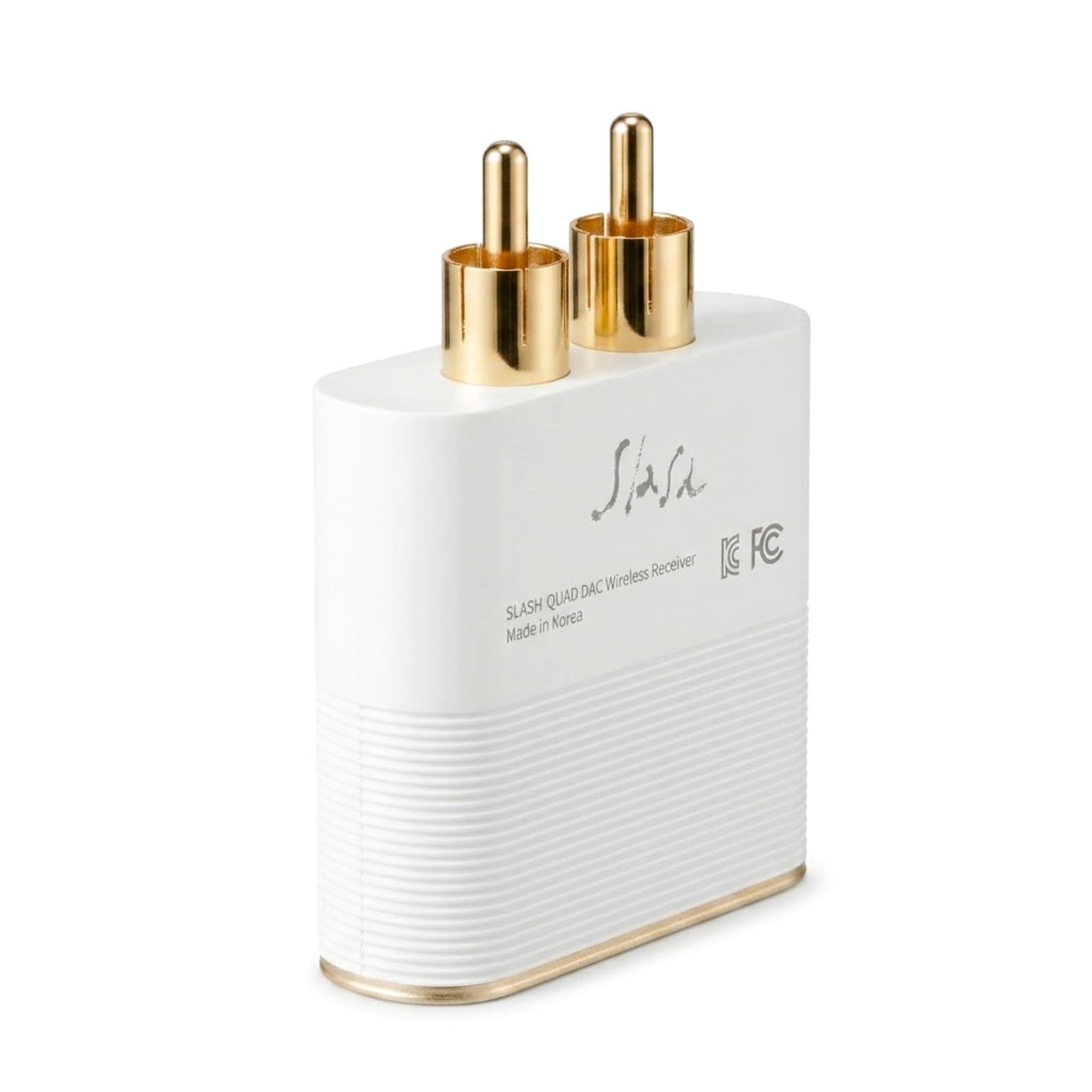
The SLASH 3 takes a radically minimalist approach — it plugs directly into the RCA inputs of your amplifier or powered speakers, eliminating the need for a separate cable between the receiver and your gear. This Direct Plug design makes it ideal for crowded racks, commercial counters, or anyone who values a clean aesthetic. Despite its tiny footprint, it packs an ESS ES9219 Quad DAC and a Qualcomm QCC5125 chipset, supporting LDAC up to 24-bit/96kHz and aptX Adaptive for dynamic bit-rate scaling.
Sound quality is a clear step above entry-level adapters. The ESS Quad DAC delivers a 130dB SNR, producing a black background with no audible hiss. The direct RCA connection minimizes signal path interference, and the aluminum housing with gold-plated connectors adds durability. Setup is truly plug-and-play — no apps, no Wi-Fi, just pair and stream.
The SLASH 3 is not rechargeable, requiring a constant USB-C power source. It also lacks optical or coaxial outputs, so you cannot bypass its internal DAC if your amplifier has a higher-quality converter. For users who prioritize simplicity and have a stereo with good RCA inputs, this is a near-flawless solution.
Why it’s great
- Ultra-compact direct-plug RCA design saves space and cable clutter
- ESS ES9219 Quad DAC offers exceptional clarity and low noise floor
- Supports LDAC and aptX Adaptive for high-res wireless streaming
Good to know
- Requires constant USB-C power — not battery-powered
- No digital outputs for bypassing the internal DAC
3. BluDento B2 LDAC/aptX HD Bluetooth 5.1 Receiver
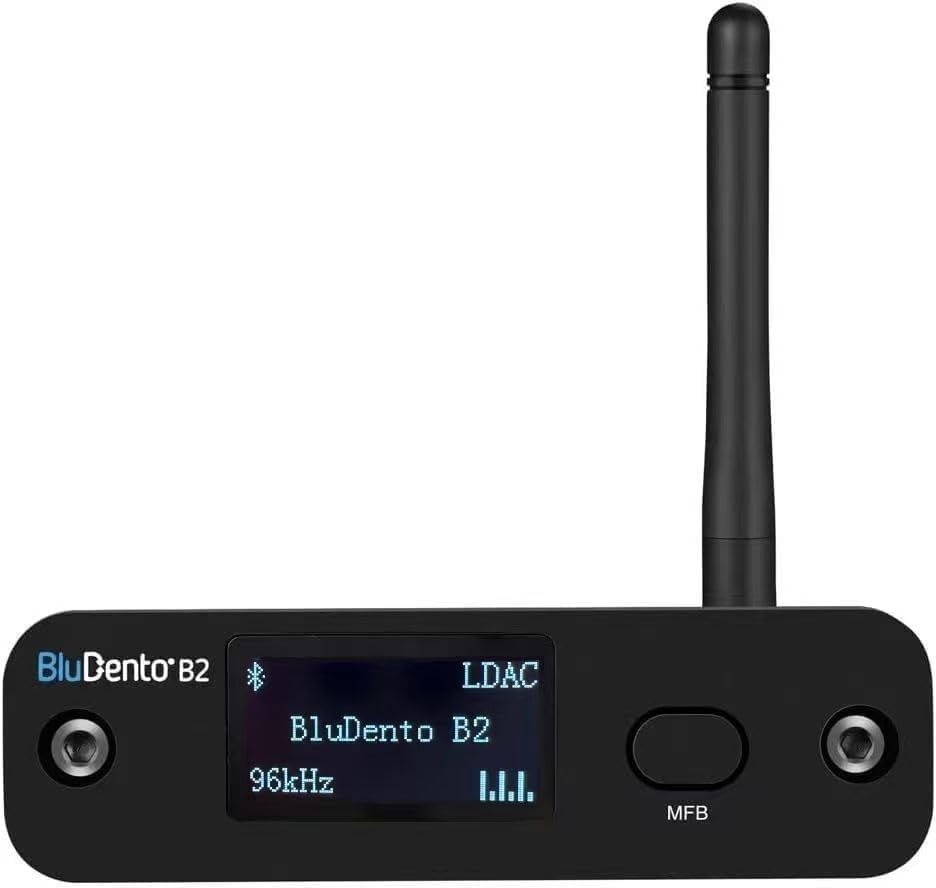
The BluDento B2 is a versatile contender that combines an ESS ES9018K2M DAC with Bluetooth 5.1, supporting LDAC, aptX HD, and aptX Low Latency. What sets it apart is simultaneous dual-device connection — you can have two phones or a phone and a tablet paired, and seamlessly switch playback between them. This is rare at this price point and ideal for households where multiple people stream to the same stereo.
Output options are comprehensive: analog RCA and 3.5mm AUX alongside digital Optical and Coaxial outputs. The external gain antenna provides extended range, with Class 1 Bluetooth technology reaching up to 100 feet in open air. The OLED display shows operational status and codec information, though it is smaller than the 1Mii’s screen. The aluminum chassis feels premium and resists interference.
The B2 lacks a built-in battery, so it must remain plugged in. Some users noted that the DAC chip in current units might be a TI PCM5102A rather than the advertised ESS, though sound quality remains excellent. For those who value multi-user convenience and broad output compatibility, the B2 is a strong mid-range pick.
Why it’s great
- Supports simultaneous two-device Bluetooth connections
- Analog and digital outputs for maximum system compatibility
- Excellent range with external antenna design
Good to know
- No internal battery — requires constant USB power
- DAC chip variant may differ from earlier advertised spec
4. blafili B3 Professional XLR Bluetooth v5.1 Receiver

The blafili B3 is built for professional environments where balanced audio is non-negotiable. It features XLR, RCA, Optical, and Coaxial outputs — all active simultaneously — making it one of the most versatile receivers for DJ mixers, PA systems, and high-end studio monitors. The ESS ES9018K2M DAC paired with the Qualcomm QCC5125 chipset delivers the same audiophile-grade decoding as the top consumer receivers, but with the added benefit of balanced XLR for noise rejection over long cable runs.
Setup is straightforward: pair via Bluetooth, select the appropriate output on your mixer or amp, and stream. The receiver supports LDAC, aptX HD, aptX Low Latency, AAC, and SBC, covering every major codec. The removable RP-SMA antenna provides solid range — up to 100 feet — and can be upgraded for even longer distances. The unit is powered via USB-C, and an optical cable is included in the box.
One unique feature is the ability to customize the Bluetooth broadcast name and passcode, which is helpful in commercial settings where multiple receivers might be in range. The only limitation is that XLR outputs are split left/right rather than a stereo pair, requiring proper channel assignment in your mixer. For home users who do not need balanced connections, the B3 may offer more outputs than necessary.
Why it’s great
- XLR output for professional balanced audio connectivity
- All outputs (XLR, RCA, Optical, Coaxial) are active simultaneously
- Customizable Bluetooth name and passcode for commercial use
Good to know
- XLR outputs mono left/right — requires proper mixer assignment
- No power adapter included; USB-C cable only
5. Romicta 4 Channel Bluetooth 5.0 Stereo Amplifier

The Romicta is not just a receiver — it is a full 4-channel amplifier with 50W RMS per channel, capable of driving up to four passive speakers simultaneously. This makes it a true all-in-one solution for someone building a budget home theater, desktop audio setup, or karaoke system from scratch. It supports Bluetooth 5.0 with a 33-foot range, plus USB, SD card, FM radio, and AUX inputs.
Sound quality is respectable for the category, with a THD of just 0.04% and dedicated bass and treble controls. The aluminum casing and bright LED display give it a more premium feel than most amp-receivers at this level. The remote control adds convenience for volume and input switching. The included microphone input expands its utility for karaoke or public address.
Durability appears to be a concern based on user feedback — there are reports of the volume knob failing after a few months. The amplifier also struggles with low-sensitivity speakers due to its modest power rating. If you need an all-in-one Bluetooth amplifier for casual use and understand its limitations, the Romicta offers solid value. For critical listening, a dedicated receiver paired with a separate amplifier is a better path.
Why it’s great
- Four channels with 50W RMS each drive multiple passive speakers
- Built-in FM tuner, USB/SD playback, and microphone input
- Dedicated bass and treble controls for easy tone shaping
Good to know
- Some units report volume control failure within months
- Modest power output struggles with low-sensitivity speakers
6. Donner Stereo Audio Amplifier MAMP2
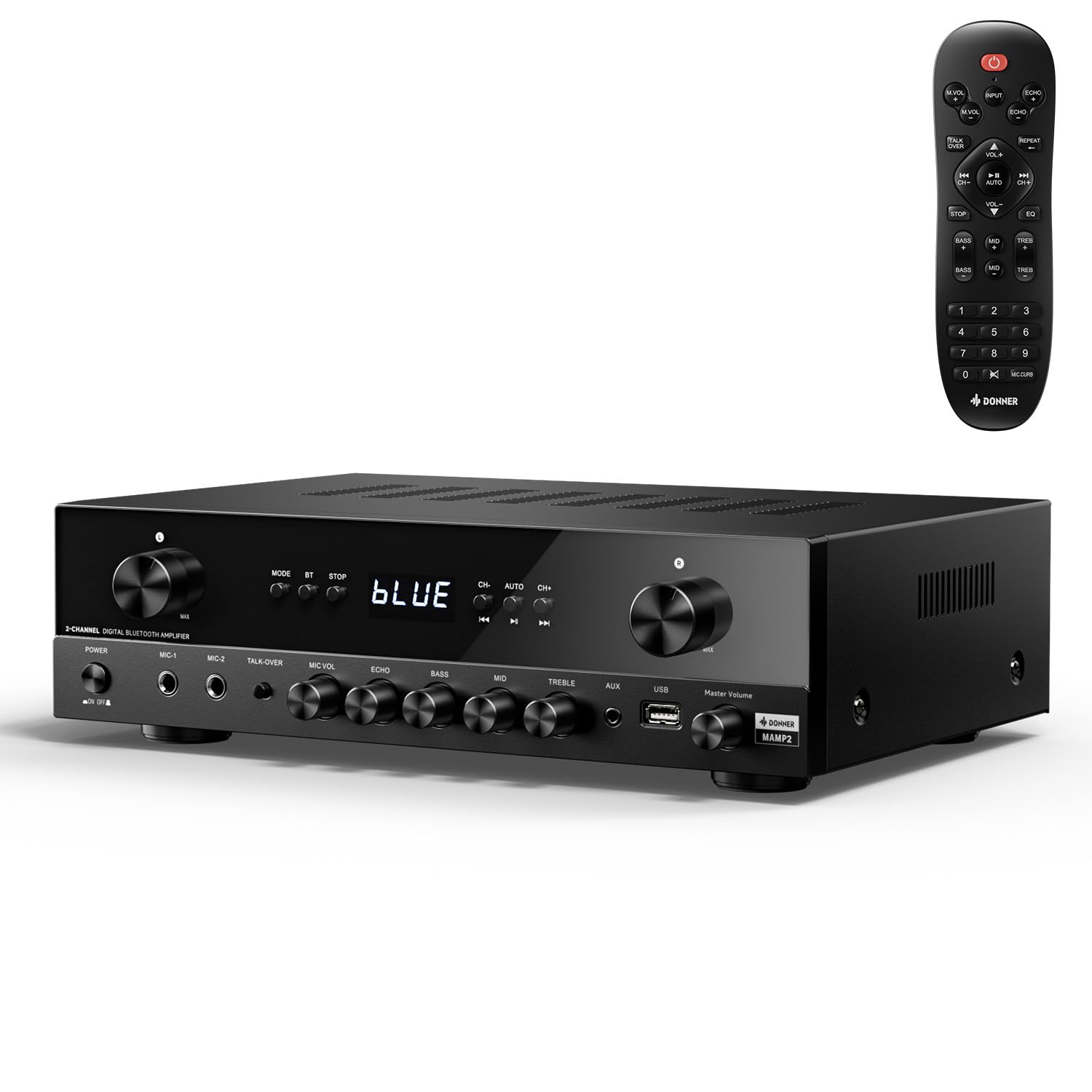
The Donner MAMP2 is a stereo amplifier and Bluetooth receiver hybrid that brings a surprising number of inputs to the table for its size. With 60W RMS per channel into 4-8 ohms, it can drive two pairs of passive speakers plus a subwoofer. The standout feature is the built-in phono input, making it one of the few affordable receivers that can directly connect a turntable without an external preamp. Dual 1/4-inch microphone jacks with independent reverb and echo controls cater to karaoke enthusiasts.
Bluetooth 5.3 provides modern connectivity with solid range, and the remote control allows adjustment of treble, midrange, and bass in any input mode. The front panel controls are intuitive, with a bright display and mechanical knobs. Users report that the sound is clear with crisp highs and full mids, though bass extension depends heavily on speaker pairing.
Some users found that banana plugs do not fit the binding posts, requiring bare wire connections. The optical input has also been reported as non-functional in isolated units. The MAMP2 is best suited for someone who wants a compact, feature-packed amplifier for a turntable-based or karaoke setup and is comfortable with minor compromises in build complexity.
Why it’s great
- Built-in phono input for direct turntable connection
- Dual mic inputs with reverb and echo for karaoke
- Full EQ control (treble, mid, bass) via remote
Good to know
- Binding posts do not accept banana plugs
- Occasional reports of non-functional optical input
7. Pyle Home Stereo Receiver PDA77BU

The Pyle PDA77BU is a high-power Bluetooth amplifier-receiver designed for spaces where volume and coverage take priority over microscopic detail. Its 800W peak power rating translates to loud, room-filling sound when paired with efficient speakers. Bluetooth 5.0 handles streaming duties, and the front panel includes dual 1/4-inch mic jacks, USB/SD card inputs, and an FM tuner. The digital LED display and remote control make it easy to navigate inputs and settings from across the room.
Build quality is utilitarian — the chassis is metal but the controls feel basic. Setup is simple, and the receiver connects to four speakers for multi-room audio or a larger soundstage. Users report that it pairs quickly with smartphones and tablets, and the independent mic volume controls are handy for karaoke or announcements. For a garage, workshop, or outdoor party system, this receiver delivers the raw power needed to cut through ambient noise.
The primary trade-off is audio refinement. The Pyle lacks high-res codec support (SBC only), and the amplifier stage introduces noticeable distortion at high volumes. Bluetooth reconnection can be finicky with some smart TVs, occasionally requiring re-pairing. If your priority is sheer volume and multiple input options at a budget-friendly price, the PDA77BU gets the job done. For critical listening, invest in a dedicated receiver and separate amplifier.
Why it’s great
- High peak power rating for loud, room-filling sound
- USB/SD card playback and FM radio for versatile sources
- Dual mic inputs with independent volume controls
Good to know
- Only supports basic SBC Bluetooth codec
- Bluetooth reconnection can be unreliable with some devices
FAQ
Will a Bluetooth receiver degrade sound quality compared to a wired connection?
Can I keep my receiver powered on all the time?
What does LDAC require on my phone to work?
Can I use a Bluetooth receiver with a turntable?
What is the difference between a Bluetooth receiver and a Bluetooth amplifier?
Final Thoughts: The Verdict
For most users, the best bluetooth receiver for stereo winner is the 1Mii B06HD+ because it combines an audiophile-grade ESS DAC, LDAC and aptX HD codec support, and both analog and digital outputs in a portable, well-built package. If you want a minimalist, cable-free design that plugs directly into your amplifier, grab the SLASH 3. And for professional setups requiring balanced XLR outputs or an all-in-one amplifier with phono input, the blafili B3 and Donner MAMP2 are unbeatable in their respective niches. Choose based on your existing gear, codec priorities, and whether you need amplification or just a clean signal path.

Mo Maruf
I created WellFizz to bridge the gap between vague wellness advice and actionable solutions. My mission is simple: to decode the research and give you practical tools you can actually use.
Beyond the data, I am a passionate traveler. I believe that stepping away from the screen to explore new environments is essential for mental clarity and physical vitality.