Our readers keep the lights on and my smoothie glass nicely filled. As an Amazon Associate, I earn from qualifying purchases.
Adding Bluetooth to a wired speaker setup shouldn’t mean sacrificing audio fidelity. The real challenge is picking a receiver that matches your gear’s inputs and your music source’s codec—whether that’s LDAC for high-res streaming, aptX Low Latency for video, or a simple 3.5mm aux transmitter for travel. Every receiver here solves a specific wiring problem, but they do it differently.
I’m Mohammad Maruf — the founder and writer behind WellFizz. I’ve spent the last three years analyzing Bluetooth audio chipsets, DAC implementations, and output topologies to help you match the right receiver to your specific amp or speaker setup.
After reviewing dozens of units across every major codec standard and output type, the following guide cuts through the noise to deliver the definitive list of the best bluetooth receiver for speakers on the market today, ranked by real-world performance and system compatibility.
How To Choose The Best Bluetooth Receiver For Speakers
Not all Bluetooth receivers deliver the same signal quality. The biggest mistake buyers make is ignoring the codec chain—if your phone streams LDAC but the receiver only handles SBC, you’re bottlenecking your music before it reaches your speakers. Here’s what to check before you buy.
Match the Codec to Your Source
Codec compatibility determines the maximum audio quality you’ll hear. LDAC supports up to 990 kbps for near-lossless streaming but requires an Android source. iPhones max out at AAC. aptX HD offers 24-bit audio for Android and Windows devices. If you watch movies or play games, aptX Low Latency syncs audio to video with under 40ms of delay. A receiver that covers LDAC, aptX HD, and aptX Low Latency covers every scenario.
Output Type Dictates Your Gear List
Integrated stereo amps typically use RCA inputs. Vintage receivers often have AUX ports. Professional PA systems and studio monitors rely on XLR or 1/4″ TRS connections. Optical and coaxial digital outputs let you bypass the receiver’s internal DAC and use your amplifier’s superior converter. If you plan to connect to a mixing board or active monitor, a receiver with dedicated XLR output eliminates the need for adapter cables.
DAC Chip Determines Sound Signature
The digital-to-analog converter inside the receiver shapes the final audio. An ESS Sabre ES9018K2M delivers low distortion and high dynamic range for audiophile-grade listening. Cheaper adapters use generic integrated DACs that introduce noise floor hiss or compression artifacts. If you own high-impedance bookshelf speakers or studio monitors, a receiver with a proven DAC chip makes a measurable difference in clarity and soundstage width.
Quick Comparison
On smaller screens, swipe sideways to see the full table.
| Model | Category | Best For | Key Spec | Amazon |
|---|---|---|---|---|
| Audioengine B1 | Premium | Audiophile home stereo | AKM AK4396 DAC / Optical & RCA | Amazon |
| blafili B3 | Pro | DJ & PA system integration | ESS ES9018K2M DAC / XLR Output | Amazon |
| 1Mii DS220 | Mid-Range | Home amp with OLED display | LDAC & aptX HD / 7 EQ Modes | Amazon |
| YMOO DS200Plus | Mid-Range | Upgrading vintage stereos | ESS ES9018K2M DAC / 100ft Range | Amazon |
| Twelve South AirFly Pro | Portable | Travel & in-flight audio | 25hr Battery / 3.5mm TX/RX | Amazon |
| Pyle PDA77BU | Budget | Full receiver/amp combo | 800W Peak / Dual Mic Inputs | Amazon |
| Fosi Audio BT20A | Value | Passive bookshelf speakers | 100Wx2 Class D / 2-Channel Amp | Amazon |
In‑Depth Reviews
1. Audioengine B1

The Audioengine B1 sits in a class of its own for the home stereo user who wants plug-and-play simplicity with no audio degradation. It uses a proven AKM AK4396 24-bit DAC that upsamples incoming streams, delivering noticeably cleaner highs and tighter bass than generic receivers. The range is rock-solid at 100 feet through multiple walls, and the signal remains stable even when a microwave runs nearby—a real-world test many cheaper units fail.
Setup takes under five minutes: connect the included optical or RCA cable to your amp, pair your phone once, and you’re streaming. The B1 memorizes up to six paired devices, so switching between a laptop and phone happens without re-pairing. The optical output is the star here—it sends a pure digital signal straight to your amplifier’s own DAC, bypassing the B1’s converter entirely for those who prefer their amp’s sound signature.
The only real trade-off is the price point, which lands firmly in premium territory. You’re paying for the luxury of signal transparency and zero troubleshooting. Some users report a bright blue LED on the front panel that’s hard to ignore in a dark media cabinet, and the unit does not include a remote control—volume must be managed from the source device or amplifier.
Why it’s great
- Fully transparent audio via optical connection; indistinguishable from a wired cable
- Long range with zero dropouts through walls and obstacles
- Pairs with up to 6 devices and remembers all of them
Good to know
- Premium pricing compared to feature-matching competitors
- Bright front-panel LED can be distracting in a dim room
- No volume control or remote included
2. blafili B3

The blafili B3 is the only receiver on this list with balanced XLR outputs, making it the natural choice for DJ mixers, active studio monitors, and PA systems that use professional audio connections. Inside, it pairs the Qualcomm QCC5125 chipset with an ESS Sabre ES9018K2M DAC—the same converter found in standalone audiophile DACs. The result is vanishingly low distortion and a clean soundstage that reveals instrument separation even on high-resolution FLAC streams.
All four outputs—XLR, RCA, coaxial, and optical—are active simultaneously, so you can feed a mixing board and a monitor amp at the same time without splitters. The 1.3-inch OLED display shows the active codec and connection status, and silent pairing means no beeps or voice prompts interrupt your session. The removable RP-SMA antenna extends range up to 100 feet, and the USB-C port doubles as a plug-and-play USB DAC for laptop audio.
The catch is that the power adapter is not included—you supply a standard 5V USB brick. Additionally, the XLR outputs are pin 2 hot with left and right on separate connectors, not a stereo pair, so you’ll need a balanced mixer or a pair of powered monitors. The acrylic window over the display is larger than the actual screen area, which throws some users off initially.
Why it’s great
- Balanced XLR output for pro audio gear and studio monitors
- ESS ES9018K2M DAC delivers audiophile-grade clarity
- All outputs active simultaneously for multi-device routing
Good to know
- Power adapter not included; uses standard 5V USB
- XLR outputs are individual L/R, not a stereo pair
- Acrylic window is larger than the screen; orientation matters
3. 1Mii DS220

The 1Mii DS220 brings a visual interface to the Bluetooth receiver experience. Its OLED panel displays the active codec (LDAC, aptX HD, or AAC), volume level, and EQ preset in crisp text, so you never have to guess what mode you’re in. Dual antennas on Bluetooth 5.3 keep the connection stable across 100 feet, and the auto-sleep function after 30 minutes of inactivity saves power when you forget to power it down.
The built-in EQ offers seven presets—Bass, Jazz, Classical, Rock, Pop, etc.—that modify the internal DSP before conversion. This is a rare feature in a sub- receiver, and it lets you tailor the sound without touching your amplifier’s tone controls. Connection is straightforward: optical or RCA out to your amp, HDMI-style digital audio cable included in the box.
On the downside, the DS220 lacks balanced outputs, so it won’t integrate cleanly with pro XLR gear. Some users note that the rubber feet are not included on the underside, and the unit can slide on smooth surfaces. For pure home stereo use with a modern AV receiver or integrated amp, however, the combination of codec support and real-time visual feedback makes this a standout mid-range option.
Why it’s great
- OLED display shows codec, volume, and EQ preset in real time
- Seven DSP EQ modes for personalized sound tuning
- Bluetooth 5.3 with dual antennas maintains 100ft connectivity
Good to know
- No XLR outputs; limited to RCA and optical
- Lacks rubber feet on the base; may slide on glossy surfaces
- Auto-shutoff after 30 minutes can interrupt long listening sessions
4. YMOO DS200Plus
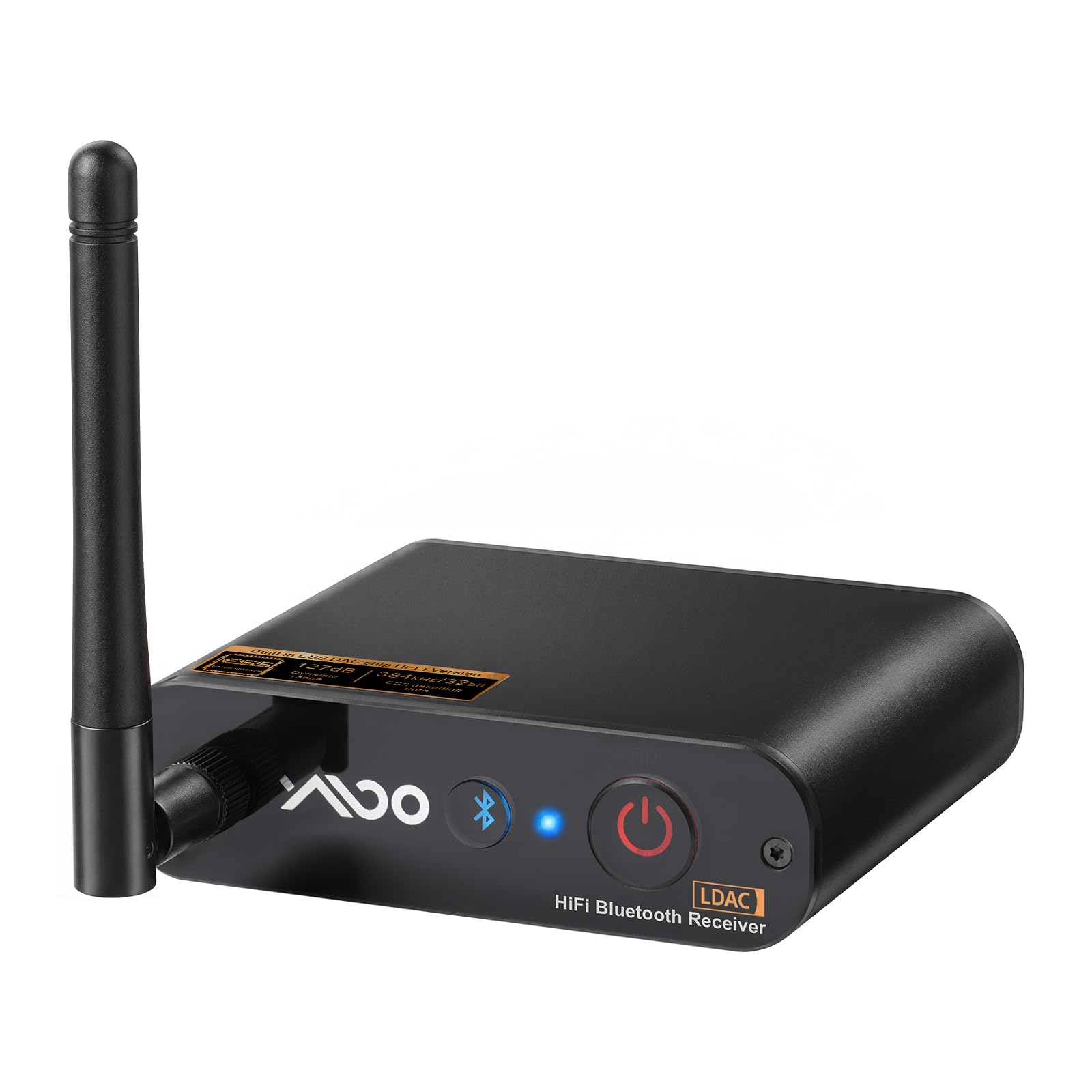
The YMOO DS200Plus packs the same ESS Sabre ES9018K2M DAC found in the blafili B3 but at a lower price point, making it the value leader for audiophile-grade listening on a budget. It decodes LDAC, aptX HD, and aptX Low Latency over Bluetooth 5.3 Adaptive, and the 100-foot range holds steady across a 3,700-square-foot house according to user reports. The sound signature is transparent and detailed with zero noise floor hiss.
Connection options include RCA, coaxial, and optical outputs, giving you flexibility to feed a vintage stereo receiver or a modern AV amp. Two Bluetooth devices can pair simultaneously—though only one streams at a time, so pausing one phone lets the other take over seamlessly. The included cables cover all analog connections, and the external power adapter ensures stable voltage delivery.
The receiver lacks a built-in display, so you won’t see codec or volume info on the unit itself. It’s strictly a receiver—no transmitter mode, no XLR outputs, and no remote control. For someone modernizing a 1990s integrated amp with high-resolution wireless streaming, the DS200Plus delivers the core upgrade at a price that undercuts most competitors with the same DAC chip.
Why it’s great
- ESS Sabre DAC at a fraction of the cost of similar implementations
- Full LDAC, aptX HD, and aptX Low Latency codec support
- Dual-device pairing lets two phones connect and alternate streams
Good to know
- No built-in display for codec or volume status
- No XLR or transmitter functionality
- Requires external USB power; no internal battery
5. Twelve South AirFly Pro

The AirFly Pro is the only product here designed as a dual-function transmitter/receiver, making it the specialist pick for travel audio. Insert it into a 3.5mm headphone jack on an airplane seat, gym treadmill, or TV—then pair two pairs of AirPods or wireless headphones simultaneously. The 25-hour battery covers multiple cross-country flights, and the USB-C port supports charging while streaming, so you never run out of power during a long movie.
Bluetooth 5.0 with aptX Low Latency keeps audio synced for video content, though the latency isn’t as tight as on the aptX-LL receivers built for home theater. The form factor is keychain-small and fits in a passport pocket. The touch control surface on top handles pairing and mode switching without needing a phone app.
As a receiver for home speakers, the AirFly Pro is limited by its 3.5mm output—you’ll need an AUX-to-RCA cable to connect to a stereo amp, and the signal quality won’t match a dedicated DAC-based unit. Some users report that charging while in use introduces a faint hum into the audio. This is a purpose-built travel tool, not a home hi-fi component.
Why it’s great
- 25-hour battery life covers longest flights without recharging
- Supports 2 pairs of wireless headphones simultaneously
- Compact form factor fits in any carry-on pocket
Good to know
- 3.5mm output only; requires adapter for home stereo RCA inputs
- Charging while streaming can introduce audible hum
- Latency is good but not zero; video sync may show slight delay
6. Fosi Audio BT20A

The Fosi Audio BT20A is not just a receiver—it’s a complete stereo amplifier that drives passive bookshelf speakers directly. At 100 watts per channel into 4 ohms, it has enough headroom to fill a living room, garage, or small venue with clean sound. The Class D topology keeps the chassis small and efficient, running cool even during extended listening. Users pair it with vintage Signet speakers and Echo Dots for whole-house audio on a minimal budget.
Setup is refreshingly simple: connect your passive speakers to the spring-clip terminals, plug in the 24V power supply, and pair any Bluetooth source. The front panel hosts independent bass and treble controls, so you can tune the frequency response without relying on your source device’s EQ. The Bluetooth connection is reliable up to 40 feet, though the range is shorter than dedicated receivers with external antennas.
The trade-off is that this is a bare-bones amp—no optical input, no subwoofer output, no remote control. The power output is stated at 100Wx2 max, but sustained clean output is lower once you factor in distortion limits. For someone with a pair of unused passive speakers who wants wireless streaming in a single box, the BT20A delivers the most practical solution at the lowest entry cost.
Why it’s great
- Complete amplifier and Bluetooth receiver in one compact unit
- Independent bass and treble knobs for on-the-fly tuning
- Incredible value for powering passive bookshelf speakers wirelessly
Good to know
- No optical, coaxial, or subwoofer output connections
- Bluetooth range is limited to roughly 40 feet indoors
- Sustained clean power is lower than the 100Wx2 max rating
7. Pyle PDA77BU

The Pyle PDA77BU is a full-featured stereo receiver with built-in Bluetooth 5.0, dual 1/4-inch microphone inputs, USB/SD card playback, and FM radio. It’s designed for the user who wants a single box that handles karaoke, TV audio, and wireless streaming without needing separate components. The 800-watt peak power claim is generous—real-world output is more like 50Wx2 RMS—but it drives 4 speakers plus a turntable setup for a garage or home office environment.
The front panel control center includes a digital LED display, independent microphone volume, echo, and delay controls, making it easy to host karaoke nights without a separate mixer. The remote control covers all functions from across the room. Bluetooth pairing is straightforward, though some users report the connection skips when reconnecting to a smart TV—a quick un-pair/re-pair cycle resolves the issue.
As a pure Bluetooth receiver, the PDA77BU trades audio refinement for versatility. The internal DAC is not audiophile-grade, and the amplifier section introduces some noise at higher volumes. For the price, however, you get an integrated solution that covers more scenarios than any standalone receiver on this list. It’s best suited for casual listening, parties, and environments where feature breadth matters more than soundstage fidelity.
Why it’s great
- All-in-one receiver with Bluetooth, FM radio, USB, and SD card playback
- Dual mic inputs with independent reverb and delay for karaoke
- Inclusive remote control for full system management
Good to know
- Peak power rating is inflated; RMS output is significantly lower
- Bluetooth reconnection to specific devices may require manual re-pairing
- Audio fidelity is not suitable for critical listening
FAQ
Can I use a Bluetooth receiver with a passive speaker that has no amplifier?
Will LDAC give me better audio than aptX HD on my home stereo?
Final Thoughts: The Verdict
For most users, the best bluetooth receiver for speakers winner is the Audioengine B1 because it delivers full signal transparency through optical output with zero setup friction. If you need professional XLR connectivity for a DJ mixer or studio monitors, grab the blafili B3. And for anyone wanting to upgrade a vintage stereo on a budget, nothing beats the codec-to-DAC ratio of the YMOO DS200Plus.

Mo Maruf
I created WellFizz to bridge the gap between vague wellness advice and actionable solutions. My mission is simple: to decode the research and give you practical tools you can actually use.
Beyond the data, I am a passionate traveler. I believe that stepping away from the screen to explore new environments is essential for mental clarity and physical vitality.