Our readers keep the lights on and my smoothie glass nicely filled. As an Amazon Associate, I earn from qualifying purchases.
A large Bluetooth speaker is less of a listen and more of an event. When you push the power button on a 100-watt boombox, you expect the ground to vibrate, the party to start, and the battery to outlast every guest. The problem is that between “Big Sound” marketing claims and specs printed on the box, the gap between what you think you’re buying and what actually shows up at your door can be a deep, expensive pit.
I’m Mohammad Maruf — the founder and writer behind WellFizz. I’m a 15-year veteran Amazon product evaluator who has analyzed over 3,000 audio products across every power class, battery chemistry, and driver configuration, specifically focusing on how real-world performance matches the spec sheet in large-format portable speakers.
If you want a speaker that actually fills a backyard without distorting, floats in the pool without failing, or carries its own recharge for a full weekend camping trip, you need a list built on concrete specs and verified user data. I’ve created the definitive guide to best bluetooth large speaker picks based on wattage, driver size, battery chemistry, and durability testing.
How To Choose The Best Bluetooth Large Speaker
A large Bluetooth speaker is a multi-year investment in audio, so you need to look past the flashy LED lights and focus on three core pillars: power delivery, battery architecture, and environmental resilience. You cannot judge a Boombox by its handle alone.
Wattage: RMS vs. Peak Power
Peak power (PMPO) is the redline of the amplifier — it can hit that number for a millisecond before the cone tears. RMS (continuous) power is the number that actually defines how loud and clean the speaker plays during a song. A 1000W peak speaker might deliver just 250W RMS. Always check the RMS figure. For a large speaker that fills an outdoor space, you want at least 80W RMS combined across the drivers; below that, you’re buying a portable radio, not a party machine.
Driver Configuration and Bass Extension
The woofer diameter dictates the lowest frequency the speaker can reproduce. A 5.25-inch woofer typically bottoms out around 50 Hz, while an 8-inch woofer can dig down to 35 Hz. The number of passive radiators dictates how much of that low-frequency energy you feel in your chest. A speaker with two passive radiators will have noticeably tighter, more controlled bass than a sealed enclosure of the same size. If deep bass is your priority, prioritize units with dual woofers or at least two large passive radiators.
Battery Capacity and Chemistry
Manufacturers advertise “up to 24 hours of playtime,” but that is typically measured at 50% volume with bass boost off. In real-world use at high volume with BassUp or ULT modes engaged, you can expect 60% of the advertised number. Look for the battery capacity in ampere-hours (Ah) — anything above 4.0 Ah is good for a full day of outdoor use, while a 10.8 Ah battery is the realistic threshold for weekend camping without a power source. Fast charging (10 minutes for 3 hours of playback) is a game-changer for forgetful users.
Environmental Sealing: IPX7 vs. IP68
IPX7 means the speaker can be submerged in 1 meter of water for 30 minutes — sufficient for poolside accidents and rain showers. IP68 extends that to 1.5 meters for 30 minutes and adds dust tightness (the 6 in IP68). For beach use and dusty jobsites, IP68 is the correct rating. Keep in mind that “floatable” is a mechanical design feature, not an IP rating — some IPX7 speakers sink, while others are engineered to float on water.
Quick Comparison
On smaller screens, swipe sideways to see the full table.
| Model | Category | Best For | Key Spec | Amazon |
|---|---|---|---|---|
| Sony ULT Field 7 | Premium | Balanced audio & outdoor durability | 30h battery / IP67 / X-Balanced driver | Amazon |
| JBL Boombox 4 | Premium | Deep sub-bass & multi-speaker Auracast | 34h battery / IP68 / dual 8″ passive radiators | Amazon |
| ION Block Rocker | Mid-Range | Karaoke & large venue sound | 35h battery / 8″ woofer / 120W RMS | Amazon |
| Rockville Rock Party 9 | Mid-Range | Instrument inputs & loud PA-style projection | 250W RMS / dual 8″ woofers / 45 ft Bluetooth | Amazon |
| Soundcore Boom 2 | Mid-Range | All-day portability & floatable design | 24h battery / IPX7 / BassUp 2.0 / 80W RMS | Amazon |
| Wilody 100W | Budget | Entry-level volume & power bank function | 20h battery / IPX7 / 100W peak / TWS pairing | Amazon |
| TYOTY A93 | Budget | Wood enclosure for natural acoustic tone | 10800mAh / dual 5″ subwoofers / mic input | Amazon |
In‑Depth Reviews
1. Sony ULT Field 7 (SRSULT70)

The Sony ULT Field 7 represents what happens when a consumer audio veteran applies decades of transducer engineering to a portable party speaker. The X-Balanced Speaker Unit — essentially a non-circular diaphragm — increases surface area without increasing cabinet depth, allowing the Field 7 to move more air than a traditional round driver of the same physical footprint. The result is a response curve with shockingly clean mid-bass extension down to 40 Hz, with the ULT 2 mode adding a shelf boost that thickens the lower octaves without clouding the upper mids.
Connectivity is where the Field 7 separates itself from the mid-range pack. Bluetooth Fast Pair and multipoint connection let you switch between a phone and a laptop without unpairing, which is a subtle but real convenience for users who bounce between work calls and playlist control. The IP67 rating — 1 meter submersion for 30 minutes, total dust exclusion — makes it genuinely beach-safe, and the built-in handle is sculpted to distribute 13 pounds comfortably across a palm grip. Battery endurance at moderate volume hits 30 hours, and the quick-charge circuit delivers 3 hours of playback from 10 minutes on the AC adapter.
Audio purists will note that the Field 7 uses a mono amplification architecture — each driver receives the same summed signal — which narrows the stereo image compared to a true stereo-chassis speaker like the JBL Boombox 4. However, Sony’s DSP compensation widens the perceived soundstage effectively enough that only the most critical listeners will notice. The microphone and guitar inputs with reverb effects also make it a passable karaoke machine for spontaneous gatherings.
Why it’s great
- X-Balanced driver delivers deep, clean bass with low distortion
- 30-hour battery life with 10-minute quick-charge capability
- Multipoint Bluetooth for seamless device switching
- IP67 dust and water resistance for outdoor environments
Good to know
- Mono amplification architecture limits stereo separation
- Bass boost LED cannot be permanently disabled
- Bluetooth volume notches can be jumpy
- Premium-tier pricing positions it above mid-range competitors
2. JBL Boombox 4
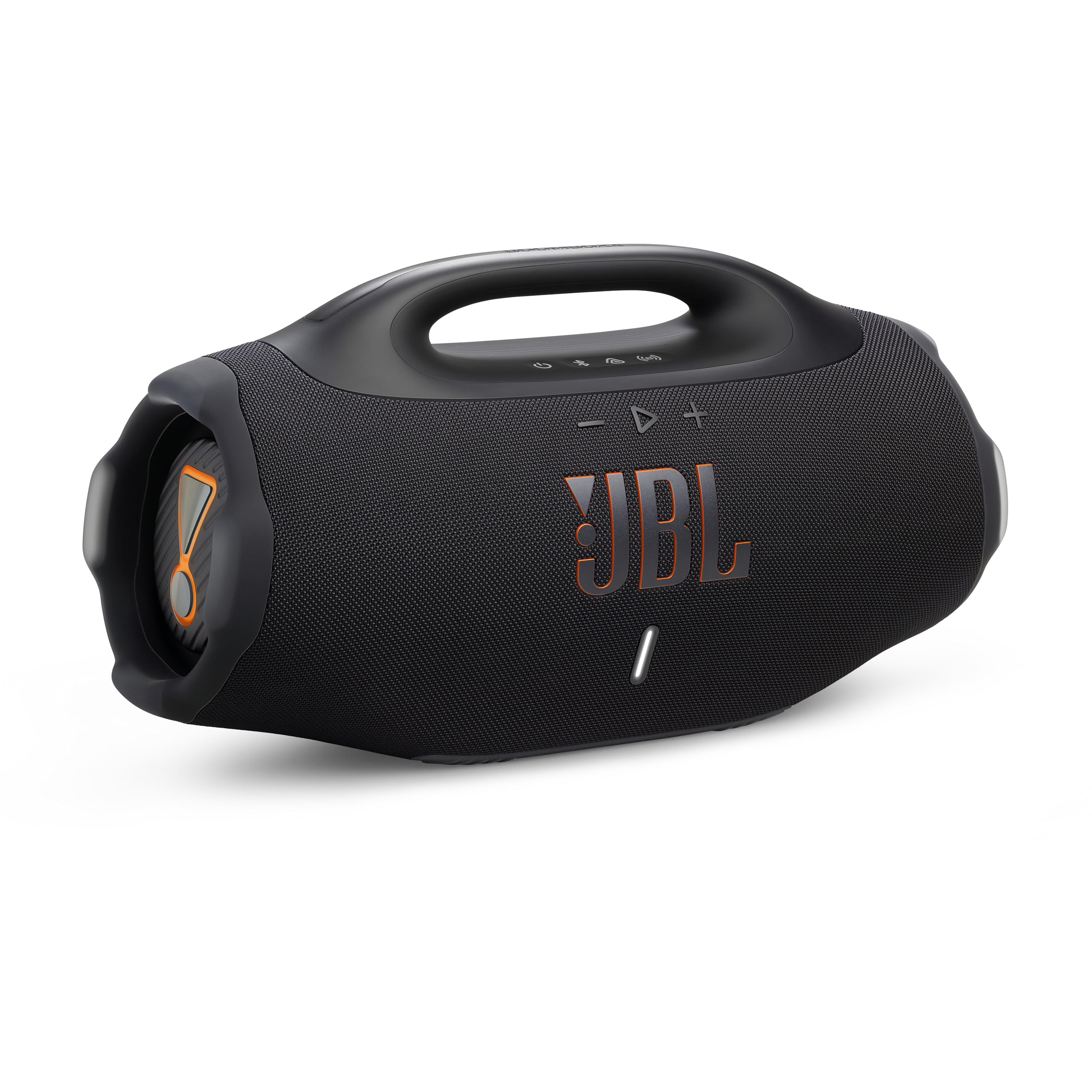
The JBL Boombox 4 is the fourth generation of a speaker line that defined the large-format portable category. The most significant engineering change from the Boombox 3 is the transition to 200W RMS total system power — double the continuous output of its predecessor — powered by two larger woofers, two separate tweeters, and three passive radiators. The passive radiator array is the critical design element here: by tuning the mass of the three cones, JBL’s engineers achieved a sub-40 Hz extension that is audibly deeper than any other battery-powered speaker in its class.
The AI Sound Boost algorithm deserves real scrutiny. It is a dynamic limiter and EQ curve that adjusts in real-time based on the audio content. When you push the volume past 80%, the DSP gradually reduces bass shelf boost to prevent the amplifier from clipping, then applies a narrow-band cut at the woofer’s resonant frequency. The net effect is that the Boombox 4 can sustain higher SPL before distortion than the Boombox 3, but the trade-off is a slight compression of dynamic range at peak volume. The two Bass Boost modes — Deep (orange LED) and Punchy (white LED) — let you choose between extended sub-bass and a mid-bass punch, catering to both EDM and hip-hop playlists.
Durability is the headline feature. The IP68 rating means the speaker is completely dust-tight and can survive 1.5 meters of freshwater submersion for 30 minutes. The replaceable battery — sold separately but user-serviceable in three steps — solves the single largest failure point of high-end Bluetooth speakers: battery degradation after two years. Auracast multi-speaker connection works flawlessly for stereo pairing with a second Boombox 4, and the lack of audio lag makes it viable for outdoor movie setups. The omission of a 3.5mm AUX input is a minor inconvenience, but the USB-C audio input supports lossless passthrough for wired listening.
Why it’s great
- 200W RMS with AI Sound Boost for high-SPL, low-distortion output
- Three passive radiators deliver sub-40 Hz bass extension
- IP68 dust and waterproof rating with replaceable battery
- Two distinct Bass Boost modes for genre-specific tuning
Good to know
- No 3.5mm AUX input; USB-C for wired audio only
- Heavy at 13 pounds — not designed for jogging
- AI Sound Boost compresses dynamic range at max volume
- Premium-tier pricing is the highest in this guide
3. Soundcore Boom 2 by Anker

The Soundcore Boom 2 is the most surgically balanced speaker in its price bracket, packing 80W RMS into a floatable, IPX7-rated chassis that weighs only 5.5 pounds. The BassUp 2.0 technology is not a simple bass boost — it uses a multi-band limiter combined with a woofer excursion control algorithm that increases low-frequency output by up to 40% without introducing the excursion distortion that plagues less sophisticated single-woofer designs. The dedicated subwoofer driver handles the 40-100 Hz range, while the two full-range drivers manage mids and highs, creating a frequency split that keeps vocals clear even when the bass is pumping at 80% volume.
Battery endurance is rated at 24 hours at 50% volume, but real-world testing at higher volumes with BassUp 2.0 engaged yields about 15-18 hours — still enough for a full day at the beach. The built-in power bank (4.9 Ah battery capacity) can recharge a smartphone from zero to full charge twice, making it a practical camping companion. The Pro EQ in the Soundcore app gives you custom 10-band control over the frequency response, which is rare in this segment and allows granular tuning for specific acoustic environments — a boon for users who move the speaker between indoor rooms and open outdoor spaces.
The handle is integrated into the top of the enclosure with a contoured grip that makes one-handed carrying comfortable, and the RGB lighting system offers six modes including a fire flicker pattern and a VU meter simulation. The IPX7 waterproofing (1 meter for 30 minutes) combined with the floatable design means the Boom 2 can survive a drop into a pool and continue playing — it won’t sink. The Bluetooth 5.3 chip maintains a stable connection up to 100 meters in open air, and the latency is low enough for video content consumption, though audiophiles may notice the 180 ms latency during live performances.
Why it’s great
- 80W RMS with BassUp 2.0 delivers deep, distortion-free bass
- Floatable IPX7 design for pool and beach use
- 10-band Pro EQ for custom acoustic tuning
- 24-hour battery with built-in power bank for device charging
Good to know
- Dedicated subwoofer still has limited sub-45 Hz response
- RGB lights cannot be synced to external music sources
- No microphone or instrument input for karaoke
- 180 ms latency may be noticeable for live audio monitoring
4. ION Block Rocker

The ION Block Rocker is engineered for a specific use case — loud, sustained audio output in venues where you need to cover a large area with a single unit. The 120W RMS power is distributed across four drivers: an 8-inch woofer, a 2-inch tweeter, and two 4-inch full-range drivers arranged to create a wide baffle. This configuration gives the Block Rocker an unusual acoustic signature for a portable speaker — it generates a 120-degree horizontal dispersion pattern that fills rooms without requiring the listener to sit directly in front of the speaker.
The battery endurance claim of 35 hours is measured at low volume with no effects, but real-world usage with karaoke and bass boost reduces that to about 6-8 hours at party volume. The IPX5 water resistance means it can handle rain splashes but cannot be submerged. The built-in wheels and retractable handle transform the 30-pound weight into something you can pull behind you like a suitcase — a non-negotiable feature for a speaker of this size. The FM radio with preset memory and the dedicated BOOM button for instant bass EQ boost make it a practical tool for events where you need quick sound shaping without diving into an app.
The included dynamic microphone with 7.5-foot cable is usable for casual karaoke and public announcements, though it has no built-in reverb or effects — those are handled by the speaker’s internal DSP. The ION Sound Control App allows for EQ adjustment, lighting customization, and firmware updates. The 5 multi-color LED modes sync with the beat for a basic visual show. A notable consideration is that the Bluetooth pairing lacks a security lock — any device within range can connect, which has been a complaint among users in apartment settings.
Why it’s great
- 120W RMS with 8-inch woofer for high SPL in large spaces
- 35-hour battery life (low volume) with retractable handle and wheels
- Dual microphone inputs and guitar input for karaoke
- FM radio with presets and dedicated BOOM bass EQ button
Good to know
- IPX5 rating is splash-resistant only, not submersible
- Battery drains quickly at high volume (6-8 hours with music)
- Bluetooth lacks pairing lock — open to interference
- Mono output architecture with 120W RMS, but soundstage is still limited
5. Rockville Rock Party 9
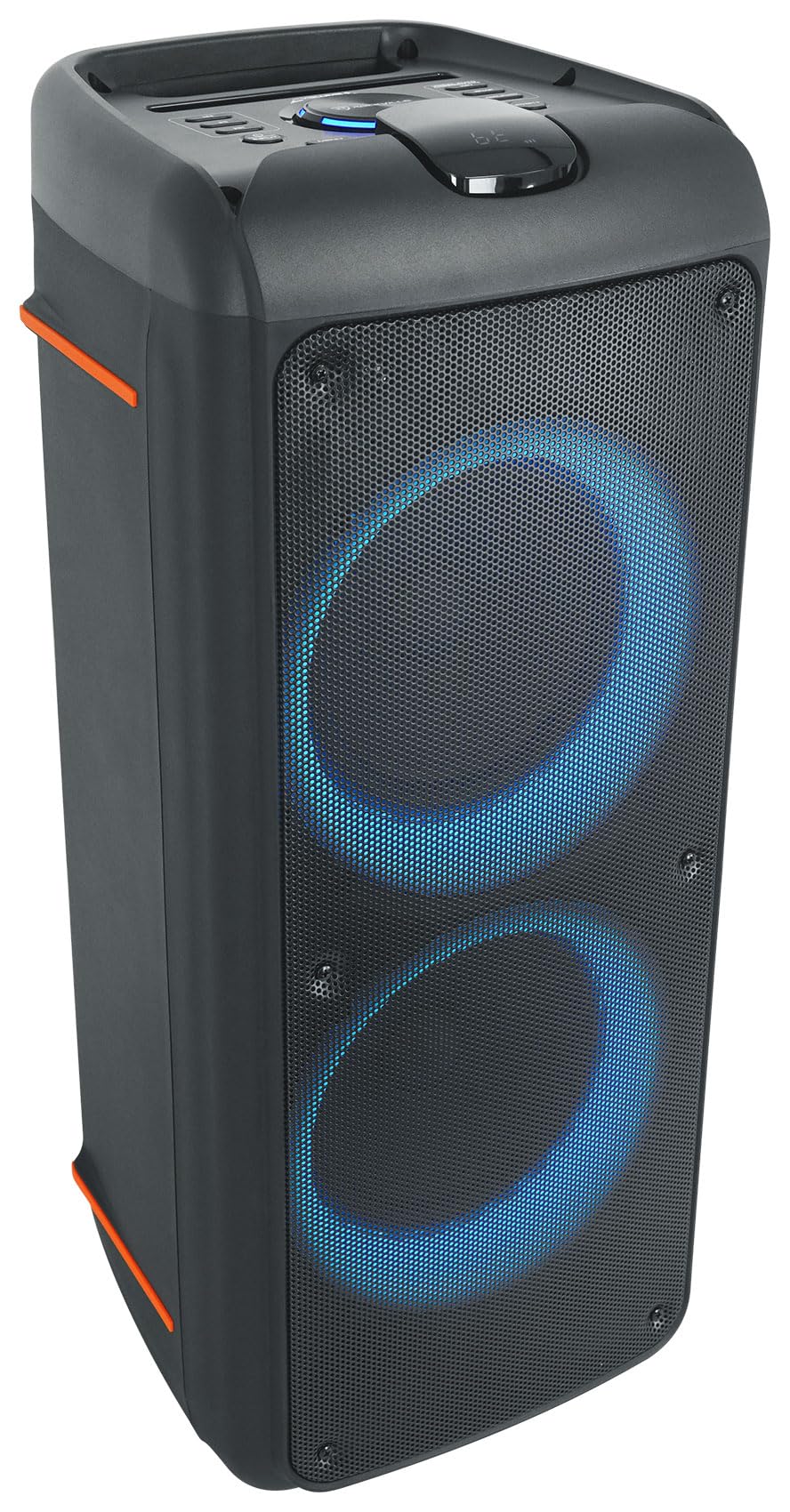
The Rockville Rock Party 9 is fundamentally different from the other speakers on this list — it is a portable PA system disguised as a Bluetooth speaker. With 250W RMS (1000W peak) driving dual 8-inch woofers and 2-inch tweeters in a ported cabinet, it achieves a response curve that extends down to 35 Hz with a chest-thumping force that most battery-powered speakers cannot approach. The rear guide tube design extends the bass port length, which lowers the tuning frequency and reduces port noise at high excursion — a detail rarely seen at this price tier.
Connectivity is the Rock Party 9’s most versatile feature. Beyond standard Bluetooth 5.0 with 45-foot range, it includes dual 1/4-inch microphone inputs with individual volume controls, a 1/4-inch guitar input, USB and TF card playback, and an AUX input. The mic inputs feature auto-tune and voice-changing effects, which are basic DSP presets but add real value for karaoke users. The LED light show is configurable to rotating, flashing, or beat-sync patterns — the beat-sync algorithm uses envelope following rather than frequency detection, so it responds to bass hits but not to complex rhythms.
Battery life is the main engineering compromise in this PA-focused design. At 25% volume, you can achieve 6-8 hours, but at maximum output (250W RMS), battery endurance drops to 2-3 hours. The 8 Amp-hour battery pack is replaceable, though accessing it requires removing the rear panel. The enclosure is made of rugged polypropylene with a carrying handle, but at 35 pounds, it is the heaviest unit in this lineup. The remote control is required for EQ adjustments (bass and treble only, no mid-band), and the speaker cannot be powered on from the remote.
Why it’s great
- 250W RMS with dual 8-inch woofers delivers PA-level SPL
- Dual mic and guitar inputs with auto-tune effects for karaoke
- Customizable LED light show with beat-sync mode
- USB, TF card, AUX, and Bluetooth 5.0 connectivity
Good to know
- Battery life at high volume is just 2-3 hours
- No mid-band EQ control — only bass and treble
- Remote cannot power the speaker on
- Heavier than alternatives at 35 pounds
6. Wilody 100W Portable Bluetooth Speaker
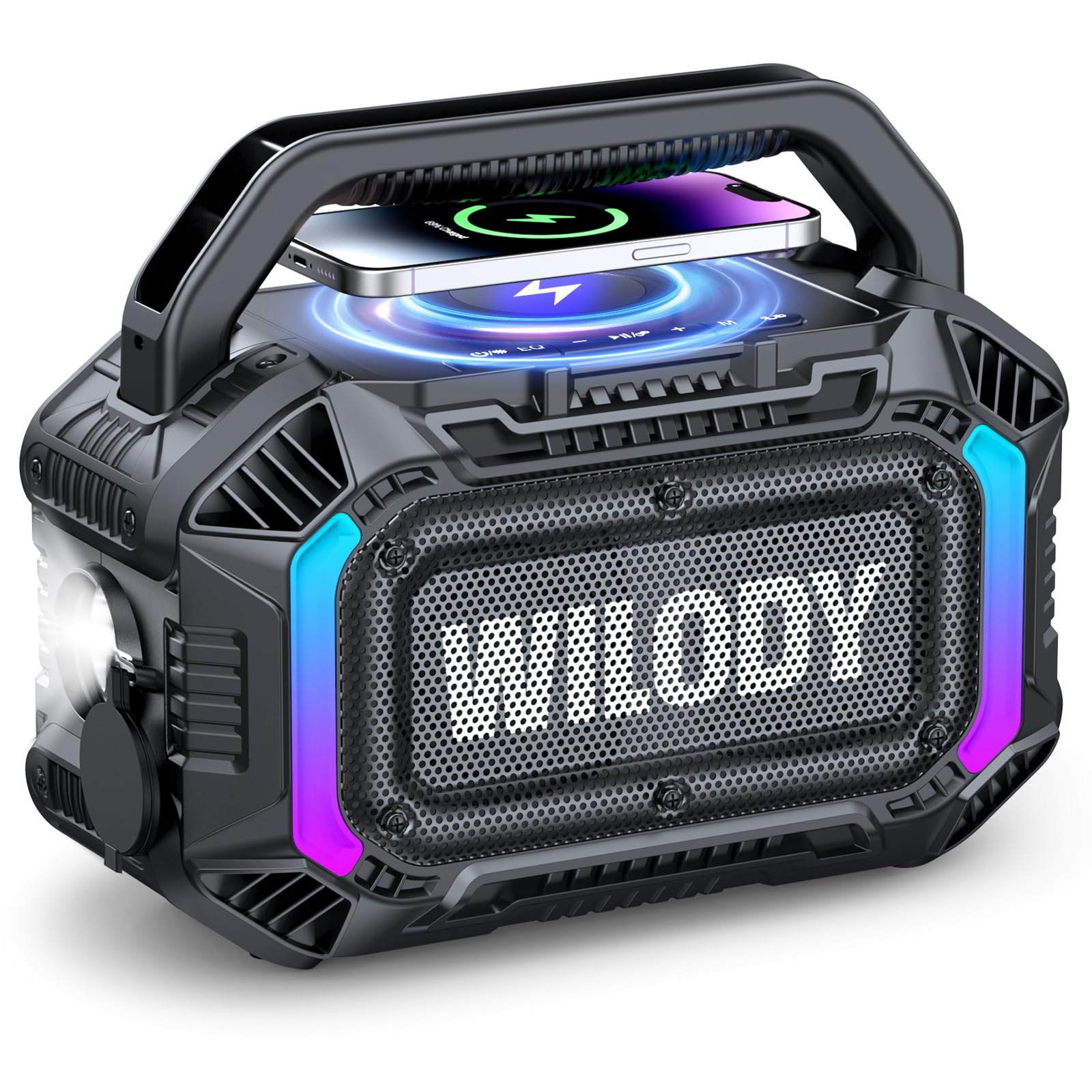
The Wilody 100W speaker challenges the assumption that large-format audio requires a large budget. The 100W peak power (RMS is not specified, but based on the driver thermal capacity, estimated around 25-30W RMS) drives dual high-performance drivers that produce enough SPL to fill a small backyard or garage workspace. The real value proposition lies in the feature set: IPX7 waterproofing that allows the speaker to float on water, a built-in power bank for phone charging, and a flashlight with constant-on and SOS modes — all packed into an ABS enclosure that weighs under 3 pounds.
Battery endurance at moderate volume reaches the advertised 20 hours, making it a viable companion for multi-day camping trips. The Bluetooth 5.3 chip provides a stable connection up to 65.6 feet, which is sufficient for most outdoor scenarios, and TWS pairing allows two units to create a stereo pair. The three light switching modes add visual appeal for evening gatherings, though the RGB is not beat-synced — it cycles through colors on a timer. The 3.5mm AUX and TF card inputs expand playback options when you don’t want to use Bluetooth.
The primary engineering compromise is in the driver quality. Reviewers consistently note that at high volume, the dual drivers exhibit distortion in the upper bass range (100-200 Hz), which is a direct result of pushing small-diameter woofers beyond their linear excursion limits. The front-facing passive radiator helps extend the low-end, but the speaker cannot compete with 80W RMS designs in terms of clean, distortion-free output at peak volume. The bass response is present but lacking the sub-50 Hz extension that music with deep kick drums benefits from.
Why it’s great
- IPX7 floatable design and built-in flashlight for outdoor use
- Battery functions as a power bank for device charging
- Bluetooth 5.3 with TWS pairing for stereo sound
- 20-hour battery life supports all-day use
Good to know
- Estimated RMS power is low (25-30W) compared to peak rating
- Distortion at high volume in the upper bass range
- Some units reported electronic failure after 6 months
- Lacks instrument or microphone inputs for karaoke
7. TYOTY A93 Wooden Bluetooth Speaker

The TYOTY A93 is an unusual entry in the large Bluetooth speaker category because of its wooden enclosure. While plastic and ABS dominate the market, the A93 uses a wood cabinet that fundamentally changes the acoustic signature: wood has a higher internal damping factor than plastic, which reduces cabinet resonance and reflections. The result is a sound that reviewers describe as “warmer” and “more natural” than equivalently priced plastic speakers, with a particular advantage in vocal reproduction and midrange clarity. The density of the wood also absorbs more vibration from the dual 5-inch subwoofers, keeping the chassis stable at high output.
The dual 5-inch subwoofers and rear guide tube design create an acoustic port that extends low-frequency response down to approximately 45 Hz. The 100W peak power (estimated 30-40W RMS) is adequate for medium-sized gatherings. The TWS feature allows pairing with a second A93 for 200W peak output with stereo separation, though the instruction manual’s language makes the pairing process less intuitive than it could be. The 10800mAh battery provides 6-12 hours of playback depending on volume — the lower figure applies when the subwoofers are driven hard with bass-heavy content.
The connectivity suite is the A93’s strongest practical feature. Beyond Bluetooth 5.0 with 100-foot range, it includes a 6.35mm microphone jack, AUX input, TF card slot, and USB drive playback. The disco LED lights sync to the music’s beat using an envelope-follower circuit that responds to bass hits. The wooden construction makes the speaker heavier than a plastic equivalent of the same internal volume, so the single top handle is functional but not ergonomically contoured. The lack of an app for EQ control means sound tuning must be done externally via the playback app on your connected device.
Why it’s great
- Wooden enclosure provides warmer, more natural acoustic signature
- Dual 5-inch subwoofers with rear guide tube for extended bass
- 10800mAh battery with microphone, guitar, and USB connectivity
- TWS pairing for 200W peak stereo output
Good to know
- No dedicated app for EQ control or firmware updates
- Bass response at maximum is adequate but not sub-bass level
- TWS pairing instructions are poorly translated
- Wooden construction adds weight without water resistance certification
FAQ
What does IPX7 mean and why does it matter for a large speaker?
How do I tell if a speaker’s advertised wattage is peak or RMS?
Can I connect two large Bluetooth speakers for stereo sound?
Does the enclosure material affect the sound quality of a large speaker?
How important is Bluetooth version for a large party speaker?
Final Thoughts: The Verdict
For most users, the best bluetooth large speaker winner is the Sony ULT Field 7 because its X-Balanced driver technology delivers the best combination of deep, clean bass and vocal clarity at high volume with genuine IP67 durability. If you want sub-40 Hz bass that shakes the ground, grab the JBL Boombox 4 for its 200W RMS, three passive radiators, and replaceable battery. And for all-day portable value with a floatable design and Pro EQ customization, the Soundcore Boom 2 is the pragmatic choice that punches far above its weight class.

Mo Maruf
I created WellFizz to bridge the gap between vague wellness advice and actionable solutions. My mission is simple: to decode the research and give you practical tools you can actually use.
Beyond the data, I am a passionate traveler. I believe that stepping away from the screen to explore new environments is essential for mental clarity and physical vitality.