Our readers keep the lights on and my smoothie glass nicely filled. As an Amazon Associate, I earn from qualifying purchases.
Specs are compiled from manufacturer listings and verified buyer reviews and can change over time — please confirm the key details on the product page before buying.
Your phone’s built-in microphone picks up room echo, traffic rumble, and the rustle of your own collar — turning your video into an amateur production before you’ve said a word. A Bluetooth lapel microphone fixes that by clipping your voice to your chest and sending crisp audio straight to your device, cutting out the background so your audience hears exactly what you want them to hear.
This guide is built by comparing the manufacturers’ published specifications and the patterns across verified customer reviews, so you get each pick’s real strengths and trade-offs instead of marketing spin.
Whether you are recording a podcast, live-streaming a keynote, or filming an outdoor interview, the right bluetooth lapel microphone separates your voice from the noise without weighing you down or emptying your wallet.
Our Picks at a Glance


How To Choose The Best Bluetooth Lapel Microphone
A tiny microphone has a huge impact on your video’s perceived quality. Not every clip-on mic is built the same — here is what separates a keeper from a wardrobe-muffle problem.
Noise Handling: SNR, SPL, and the Real-World Difference
The two numbers that tell you how a mic will perform in a loud room are Signal-to-Noise Ratio (SNR — a measure, in decibels, of how clean your voice sounds against the background) and Maximum Sound Pressure Level (SPL — also in decibels, the loudest sound the mic can capture before it distorts). An 80dB SNR gives you a noticeably quieter background hiss than a 70dB one, so your audience hears less electronic noise in quiet pauses. A 120dB SPL handles a shout or a slammed door without crackling, while a 116dB cap clips the peak and ruins a take.
Battery Life: Transmitter Run Time vs. Case Capacity
Manufacturers often quote a total figure that includes multiple recharges from the case — 30 hours or 36 hours sounds endless until you realize the transmitter itself may only last 8 or 9 hours on a single charge. If you film four-hour interviews back-to-back, check the per-transmitter run time first. The case matters for travel, but the individual mic endurance is what keeps a long session alive.
Connection Type: Bluetooth vs. Dedicated 2.4GHz Wireless
Most of the mics here use a dedicated 2.4GHz link between the transmitter and a USB-C or Lightning receiver you plug into your phone. This is not the same as a standard Bluetooth hands-free connection. A dedicated 2.4GHz link delivers lower latency — around 25ms (the delay between speaking and hearing the sound) vs. a typical 100-200ms over Bluetooth — and far fewer dropouts in crowded signal areas like convention halls or busy streets. If you need to walk away from your camera, look for a range rating of 300 feet or more.
Size, Weight, and Attachment Method
A mic that weighs under 10 grams and uses a strong magnetic clip means you can wear a thin silk shirt or a polo without the fabric sagging. Traditional spring-loaded lapel clips are fine on a thick jacket but can flip off a light collar. Also note whether the mic comes with a foam windscreen for outdoor use — it is the cheapest insurance against wind roar.
Quick Comparison
| Model | Best For | Battery Life (Total) | Wireless Range | SNR | Amazon |
|---|---|---|---|---|---|
| Hollyland Lark M2S Ultimate★ Best Overall | Universal compatibility (camera, USB-C, Lightning) | 30h | 1000 ft | 70dB | Amazon |
| MAONO Wave T5Top Performer | Voice presets and pro noise cancellation | 30h | 1000 ft | 80dB | Amazon |
| BOYA V30 | Extended recording sessions | 36h | 328 ft | 80dB | Amazon |
| RIBIU Wireless Lavalier | Budget-friendly dual-mic kit | 16h | 100 ft | — | Amazon |
| KUKIHO Wireless Lavalier | Maximum battery with charging case | 80h | 164 ft | — | Amazon |
| Hollyland Lark M2 | High fidelity dual-receiver camera work | 40h | 1000 ft | 70dB | Amazon |
| BOYA BOYALINK 2 | All-in-one adapter (Lightning, USB-C, 3.5mm) | 30h | 1000 ft | 85dB | Amazon |
In‑Depth Reviews
1. Hollyland Lark M2S Ultimate Combo
Our pick — over 4.5★ from 450+ verified ratings; the strongest balance of quality and price.
A pearl-sized mic that works with your phone, camera, and laptop right from the start — it includes three separate receivers so you never need an extra dongle.
The Hollyland Lark M2S is the rare kit that includes three receivers — a USB-C, a Lightning, and a 3.5mm TRS camera adapter — so you are never left scrambling for a dongle when you switch from an iPhone to a Sony A7 to a Windows laptop. The transmitter itself weighs just 7 grams and hides under a collar without a visible logo, which matters when you are filming a professional interview or a wedding and do not want the gear shouting at the audience.
Buyers report that the 70dB SNR delivers “excellent sound quality for size” and a “reliable connection” even in signal-heavy venues. The 9-hour per-transmitter run time (30 hours total with the charging case) means a full shooting day without hunting for an outlet. The catch is the noise cancellation — while the Advanced ENC chips cut low-frequency rumble well, a few owners note that the strongest setting can make the voice sound slightly processed, so plan to test the two available levels before a critical take.
The titanium clip is not just a durability boast — it survived a trip through a washer and dryer in one owner’s real-world test, proof of its build quality. That 116dB maximum SPL handles loud laughs or a raised voice in a busy café without clipping, though it is a shade behind the MAONO Wave T5’s 120dB SPL, which handles even louder peaks without distortion.
What everyone praises
- Triple-receiver ecosystem (USB-C, Lightning, 3.5mm) covers every device you own.
- 9-hour individual transmitter run time is enough for a full day of interviews.
- Titanium clip secures the 7-gram mic without fabric sagging and survived a washing machine.
- 300m (1000 ft) line-of-sight range is the class benchmark.
What to weigh
- Noise cancellation in the strongest mode can subtly degrade voice naturalness.
- The charging case adds 2.5 full charges, giving 30 hours total — strong but not the leader in total battery.
- At 70dB, the SNR trails the 80dB offered by the MAONO Wave T5 and BOYA V30 at lower prices.
Reach for this if: you own a mix of devices (iPhone, camera, laptop) and want one kit that works on all of them without extra adapters.
Think twice if: your priority is the absolute lowest noise floor — the 80dB SNR mics below give cleaner raw audio.
2. MAONO Wave T5
Four built-in vocal presets let you switch from a warm podcast voice to a crisp vlog tone instantly, without editing software.
The MAONO Wave T5 lives in that balance where pro specs meet genuinely thoughtful features. The 48kHz/24-bit recording delivers extended frequency range — 20Hz to 20kHz — and the 80dB SNR ensures the quiet parts of your speech do not get swallowed by floor noise. A 120dB maximum SPL means you can record a laugh or a clap without distortion. What really separates it from the BOYA V30 is the four one-tap voice filters: Vocal Enhancer for everyday clarity, Brightness for social media punch, Warmth for a gentle teaching tone, and Magnetic Radio for that deep broadcaster sound. Owners describe the audio as “so much clearer” than their built-in mic, and the noise cancellation in 3 modes across 14 levels handles everything from a bustling street to a loud machine shop.
The 9-hour per-transmitter battery (30 hours total with the charging case) is solid, and the kit ships with magnetic clips, necklace mounts, and a travel pouch. One buyer wished the receiver clip was included for pocket carry, but the consensus is that the audio quality and versatile presets justify the price. The only trade-off reported is that the microphone’s mute button also triggers the phone shutter, which can surprise you during a quiet recording.
Standout strengths
- Four professional voice presets eliminate post-production EQ work.
- 80dB SNR and 120dB SPL give clean, distortion-free audio even in loud environments.
- 3 noise-cancellation modes with 14 levels of granular control via the app.
- Magnetic clips and necklace mounts make attachment flexible on any collar.
Minor caveats
- Mute button doubles as phone shutter — easy to trigger accidentally.
- No dedicated clip for the receiver; it dangles from the phone.
Ideal for: vloggers and podcasters who want to dial in a specific voice texture without post-production work.
skip it if: you prefer a simpler, no-app workflow — the MAONO rewards a bit of initial configuration.
3. Hollyland Lark M2 (Camera + USB-C)
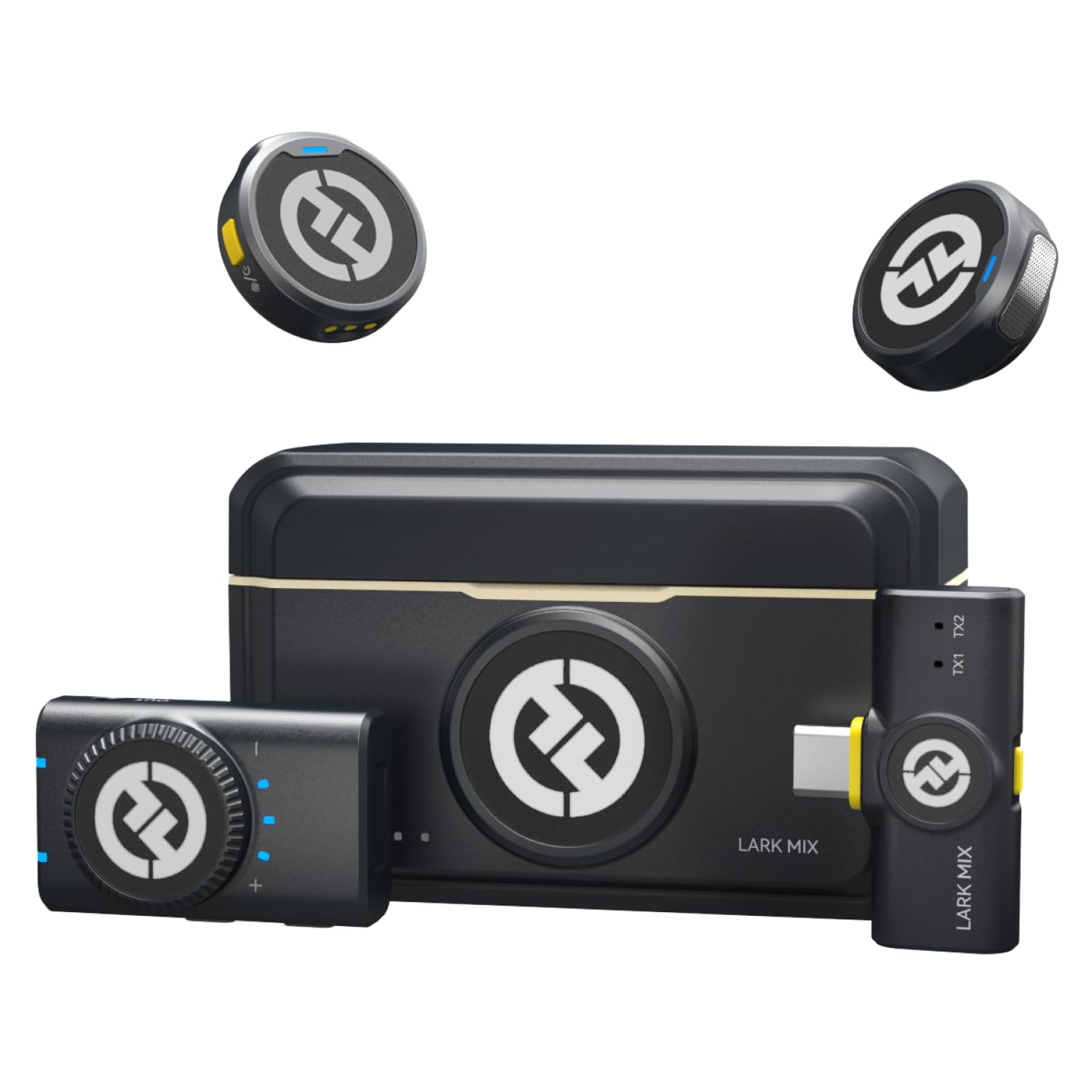
A 10-hour transmitter run time paired with a case that gives you 40 hours total — the longest endurance in this roundup, beating the M2S by 10 hours.
The Lark M2 is the sibling of the M2S but with a deliberate focus on marathon shooting. Each transmitter runs for 10 hours with noise cancellation off, and the charging case adds three full charges for 40 hours total — a solid lead over the 30-hour competitors. The 48kHz/24-bit audio with a 70dB SNR and 115dB SPL captures voice clearly, and the one-click noise cancellation button on the transmitter itself means you do not have to fumble with an app mid-recording. Owners say the audio quality is “exceptional” and the microphones are “tiny and lightweight,” with one upgrading from a Blue Yeti desk mic. The 300m (1000 ft) line-of-sight range, driven by a high-gain LDS antenna, holds steady even when you turn your back to the receiver.
The kit includes a camera receiver with a 3.5mm jack plus a dedicated USB-C receiver, making it easy to shoot with a mirrorless camera or an Android phone. The catch is a minor one: the mute button on the transmitter is also the pairing button, so you can inadvertently mute yourself during a take. If you primarily use an iPhone, get the M2S Ultimate instead, since the M2 does not include a Lightning receiver.
Why it earns its spot
- 40-hour total battery with case is the best endurance in this list.
- 10 hours per transmitter means no mid-session charge anxiety.
- One-touch noise cancellation on the transmitter works without an app.
- Mono/stereo switch on the camera receiver adds flexibility for post-recording editing.
What to watch for
- Mute button doubles as pairing button — easy to hit accidentally.
- Only two receivers (camera and USB-C) in the box; Lightning users need a separately purchased adapter.
- SNR of 70dB is one step behind the 80dB mics in this comparison.
Best for: all-day outdoor shoots or multi-guest interview days where battery anxiety is real.
Not for: iPhone-only creators who need a Lightning receiver in the box — get the M2S Ultimate instead.
4. BOYA BOYALINK 2

A single receiver that swaps between Lightning, USB-C, and 3.5mm — no extra dongles to lose, unlike the Hollyland kit’s three separate receivers.
The BOYA BOYALINK 2 solves the compatibility problem differently than the Hollyland: instead of multiple receivers, it uses a single 3-in-1 adapter that stores the Lightning and USB-C tips inside the receiver body. You flip the tip you need and plug directly into your phone or camera. The audio path is built around a 48kHz/24-bit codec with an SNR rated above 85dB and a 120dB SPL, which means the recorded voice sits well above the noise floor even in a noisy environment. The DSP noise cancellation operates in two levels (strong and weak) and can be adjusted within the BOYA app, alongside volume control across 6 levels, each providing a 6dB boost.
The 1000 ft claimed range comes from the same LDS antenna tech used by Hollyland, and the 25ms latency is low enough for live presentations without noticeable lip sync drift. The charging case holds a 1000mAh battery that gives two full recharges of the transmitters, each lasting 10 hours for a total of 30 hours. The microphone housing is metal and ABS plastic, and the mute button is also the pairing button — a design choice that a few owners found confusing, as one noted the mute indicator is hard to see in bright field conditions. The build is lightweight at 5.28 ounces, and the 6mm omnidirectional capsule captures sound from all directions.
What stands out
- 3-in-1 receiver with integrated Lightning/USB-C/3.5mm adapters — no separate dongles needed.
- SNR >85dB is the highest noise-floor spec in this roundup.
- 1000 ft range and 25ms latency keep audio synced even when you walk far from the camera.
- 1000mAh charging case with 30 hours total endurance.
What to note
- Mute button doubles as the pairing button; the indicator is small and can be hard to see outdoors.
- Plastic chassis feels less premium than the Hollyland’s titanium clip.
Ideal for: creators who move between iPhone, Android, and cameras regularly and want a single receiver for all three.
Consider another if: you want the most durable build — the metal and titanium clips elsewhere feel more rugged.
5. BOYA V30
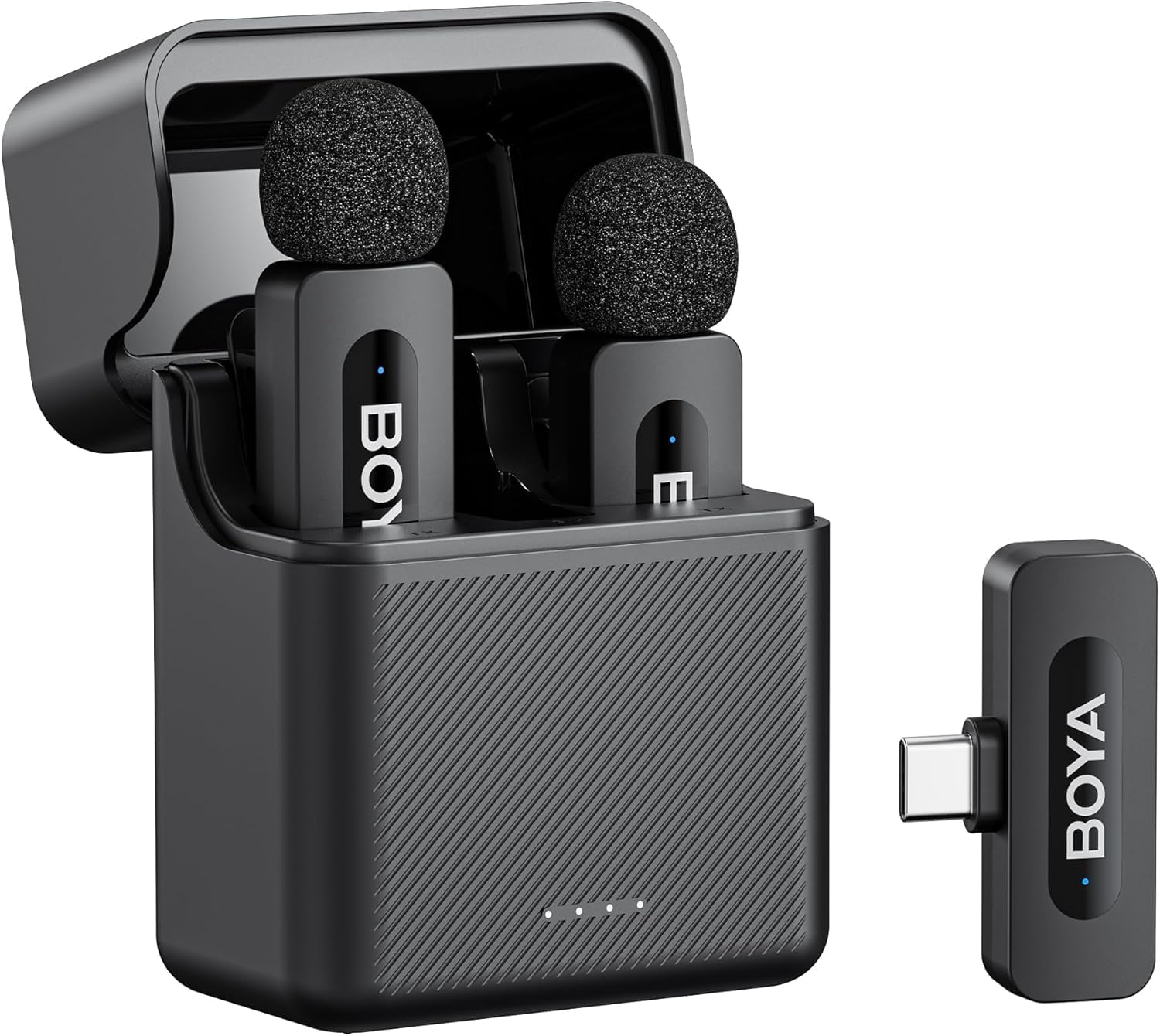
An 80dB SNR and 120dB SPL at a price that leaves room in your budget for a spare windscreen — pro-grade noise handling without the pro price tag.
The BOYA V30 punches hard at its price point. It delivers an 80dB SNR and a 120dB maximum SPL — specs you normally see on mics that cost twice as much. In plain terms: your voice sounds clean against background noise, and loud moments like a slammed door or a shout do not cause distortion. The 48kHz/16-bit audio is one step below the 24-bit rivals, but in real-world outdoor recording, owners mention “clear recordings with good external noise reduction” and the ability to “significantly reduce” ambient sound. The 36-hour total battery life (9 hours per transmitter, four charges in the case) offers 36 hours total compared to the Hollyland M2S’s 30 hours, making this a strong pick for back-to-back shoot days.
The dual-mode noise cancellation includes a dense windproof foam cover, and the 328 ft wireless range is adequate for most interview setups, though it is 328 ft compared to the 1000 ft flagships. The 2.4GHz connection is plug-and-play with USB-C devices — no app or Bluetooth pairing required. A few owners found the spring clip hard to open with large hands, and the high treble response can emphasize sibilance (the “s” sound) in some voices.
Why buyers love it
- 80dB SNR and 120dB SPL for clean, distortion-free voice pickup.
- 36 hours total battery — 6 hours more than the Hollyland M2S.
- Plug-and-play with USB-C phones; no app or Bluetooth required.
- Charger pass-through on the receiver lets you power your phone while recording.
Minor trade-offs
- Spring clip is tough to open for larger hands.
- Treble-heavy frequency response can exaggerate sibilance.
- Range of 328 ft is sufficient but well behind the 1000 ft flagships.
Grab this if: you want pro-level noise specs (80dB SNR, 120dB SPL) without spending pro-level money.
Look elsewhere if: you need 1000 ft of range or a titanium clip — this mic trades extreme range for everyday affordability.
6. RIBIU Wireless Lavalier
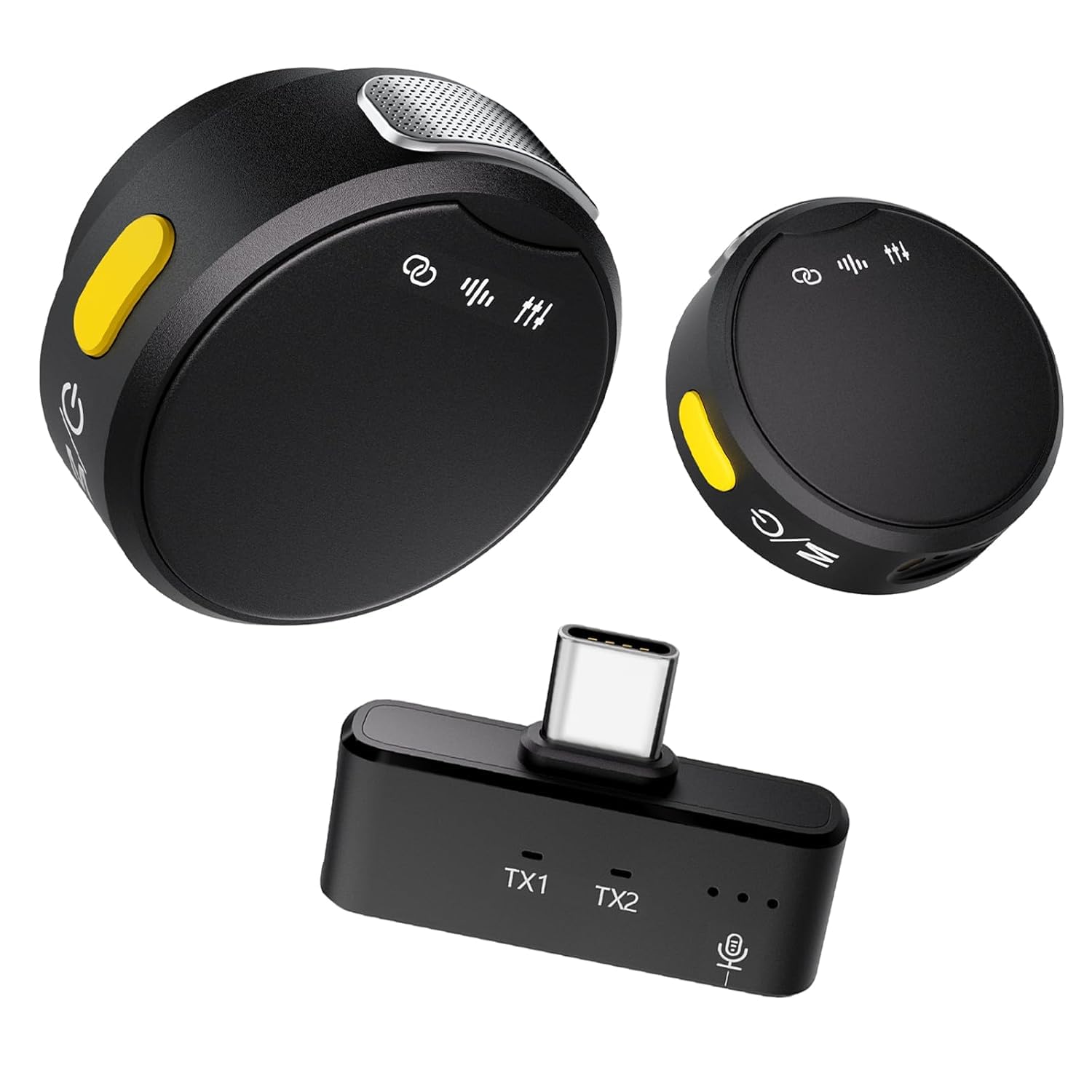
A button-sized dual-mic kit that includes a hard case, reverb effect, and 100 ft range while staying affordable — a rare value combination.
The RIBIU proves you do not need to spend triple digits for a reliable audio upgrade. Each transmitter weighs just 8.53 grams and runs for 8 hours, giving a combined 16-hour total from the charging case — enough for a full weekend of casual content creation. The DSP (Digital Signal Processing — a chip that processes audio to filter noise) noise cancellation chip, paired with a foam windscreen, handles moderate wind and room hum, and owners consistently call the sound quality “crisp” with “no static or background noise.” The 100 ft 2.4GHz transmission range suits small-to-medium spaces like home studios and coffee shops, though it will not cover a large conference hall.
A surprising bonus is the reverb effect and mute button — features rarely found at this price. The kit ships with both a USB-C receiver and a Lightning adapter, and the plug-and-play setup is instant. The hard carrying case keeps everything organized. One owner noted that the microphone works flawlessly with a DJI Osmo Pocket 3. The main concession at this price is the plastic enclosure, which does not feel as premium as the metal-bodied mics, but the build quality has few complaints given the value.
Budget-friendly highlights
- Sub-9-gram transmitters are barely noticeable on a collar.
- Reverb effect and mute button offer creative flexibility not common at this price.
- Hard carrying case included — rare in the budget tier.
- Plug-and-play with USB-C and Lightning devices.
Cost concessions
- 8-hour per-mic runtime requires daily charging for heavy users.
- 100 ft range compared to the BOYA V30’s 328 ft reach.
- Plastic build lacks the metal-clip durability of more expensive picks.
Best for: YouTubers, TikTok creators, and podcasters on a tight budget who need two functional mics and a hard case.
Not the pick if: you record in large outdoor spaces or need all-day battery beyond 8 continuous hours per mic.
7. KUKIHO Wireless Lavalier

An 80-hour total battery that redefines “charge once, shoot for the week” — 80-hour total compared to the Hollyland Lark M2’s 40-hour endurance.
The KUKIHO’s headline feature is the 80-hour total run time — the charging case holds a battery large enough to recharge the two transmitters multiple times, making it the clear endurance champion of this group. For a daily vlogger who films 3-4 hours per day, that means charging once a week instead of daily. The microphones themselves utilize a 2.4GHz wireless link with a 164 ft range and DSP noise reduction chips to filter out background hum. Owners describe the sound as “crisp” with “excellent noise cancellation” and emphasize the convenience of the case. The omnidirectional pickup captures sound from every direction relative to the mic, so you do not have to point the capsule perfectly at your mouth.
The kit includes two transmitters, a USB-C receiver, and an iOS adapter so it works with both current phone standards. The clip is a spring-loaded metal and plastic design, and the mics are small enough to wear discreetly. The trade-off is a slightly shorter range than the flagships — 164 feet vs. the 1000 feet of the Hollyland units — and the build uses a mix of metal and plastic that feels solid if not luxurious. One owner noted the mute function requires a double-click and the LED battery indicator uses four dots instead of a percentage, which is a minor interface friction.
What makes it stand out
- 80-hour total battery life is the highest in this listing — charge once, film for a week.
- Dual transmitters included for two-person interviews or backup recording.
- Omnidirectional pickup eliminates aiming concerns during active recording.
- Easy setup — no Bluetooth, no app required, just plug and go.
Where it compromises
- 164 ft range is functional but far behind the 1000 ft flagships.
- LED battery indicator shows four dots rather than a precise percentage.
- Plastic and metal build does not feel as premium as the Hollyland titanium clip.
Ideal for: marathon live streamers or travel vloggers who want to leave the charging cable at home for a week.
pass on it if: you regularly film in large outdoor spaces — the 164 ft range will restrict your movement.
Understanding the Specs
Signal-to-Noise Ratio (SNR)
This number, measured in dB, tells you how loud your voice sounds compared to the electronic hiss from the microphone’s circuitry. Higher is cleaner: an 80dB SNR means the voice sits 80 decibels above the noise floor, so background hum like an air conditioner or distant traffic is much quieter relative to your speech. A 70dB SNR is still good for most settings, but in a quiet room you will hear a faint static wash when you pause.
Maximum Sound Pressure Level (SPL)
Also in dB, this is the loudest sound the mic can handle before the audio distorts or clips. A 120dB SPL is roughly the level of a live rock concert or a loud shout microphoned directly — safe for most podcasting and vlogging. Dropping to 115dB or 116dB means very sudden peaks (a door slam, a scream, a dropped object) may crackle. If you record in unpredictable noise, aim for 120dB.
Wireless Range
This is the maximum line-of-sight distance between transmitter and receiver before the signal drops. Real-world performance in a room with walls and furniture will be shorter — figure about half the stated range. A 300m (1000 ft) rating is excellent for large studios or outdoor weddings. A 50m (164 ft) rating is enough for a typical home office or café, but you will lose signal if you walk into another room.
Sample Rate & Bit Depth (48kHz/24-bit vs. 48kHz/16-bit)
48kHz/24-bit captures a wider dynamic range (volume differences between quiet and loud) and preserves more subtle detail than 48kHz/16-bit. For speech-heavy content like podcasts and interviews, the difference is subtle — 16-bit still sounds good. For music, ASMR, or high-detail voice work, 24-bit gives a richer, more natural recording with less background noise in the quiet sections.
FAQ
Can I use Bluetooth lapel microphones with a desktop computer?
What is the difference between a Bluetooth lapel mic and a dedicated 2.4GHz wireless lapel mic?
How long does a full charge last in real-world use?
Will a magnetic clip damage my phone or camera?
Why does my audio sometimes cut out when I turn my back to the camera?
What does omnidirectional sound pickup mean for my recording?
Can I use a Bluetooth lapel microphone with an iPad or tablet?
Is a fabric windscreen enough for outdoor recording?
What does latency mean for live streaming or interviews?
Final Thoughts: The Verdict
If you want one dependable pick, the bluetooth lapel microphone winner is the Hollyland Lark M2S Ultimate Combo because it gives you three receivers in one box, a durable titanium clip, and 30 hours of total battery life — it just works on everything you own. If you want the highest noise-handling specs at a budget-friendly price, grab the BOYA V30 for its 80dB SNR and 120dB SPL. And for marathon shooters who need 80 hours of total endurance, the KUKIHO Wireless Lavalier is the one to reach for.
How We Picked
We do not accept paid placement. Every pick is matched to a real buyer and a real use-case; we do not hands-on test units.
Sources & Methodology
Specifications: manufacturer listings and product documentation. Review insights: verified customer reviews, as of July 2026. Pricing: not shown on this page (it changes often); check the current price via the retailer link.
As an Amazon Associate, WellFizz earns from qualifying purchases. This does not affect which products we feature.
Related Guides

Mo Maruf
I created WellFizz to bridge the gap between vague wellness advice and actionable solutions. My mission is simple: to decode the research and give you practical tools you can actually use.
Beyond the data, I am a passionate traveler. I believe that stepping away from the screen to explore new environments is essential for mental clarity and physical vitality.