Our readers keep the lights on and my smoothie glass nicely filled. As an Amazon Associate, I earn from qualifying purchases.
The silent hiss behind a dead input channel is often the first clue your vintage amplifier needs a wireless upgrade. A Bluetooth analog adapter bridges the gap between your solid-state or tube amp’s RCA inputs and the streaming world, but the wrong choice introduces ground loops, dropped codecs, and a noise floor that ruins the quiet passages. Getting the adapter right means understanding the DAC chip, the Bluetooth version, and the output topology before you ever plug in a cable.
I’m Mohammad Maruf — the founder and writer behind WellFizz. My research process for this guide involved cross-referencing independent measurements of signal-to-noise ratios, decoding latency reports, and reading through several hundred verified buyer experiences to isolate which adapters actually preserve analog warmth without adding digital artifacts.
Whether you’re upgrading a garage setup or a dedicated listening room, the following analysis will help you identify the best bluetooth analog adapter for amplifier that matches your system’s sensitivity and your listening habits.
How To Choose The Best Bluetooth Analog Adapter For Amplifier
Selecting an adapter for your amplifier is different from picking a general Bluetooth receiver. Your amplifier’s input stage expects a clean, line-level signal with a specific impedance and voltage range. An adapter that works perfectly with powered bookshelf speakers might sound thin or noisy when driving a tube preamp or a vintage integrated amp.
DAC Architecture and Signal-To-Noise Ratio
The digital-to-analog converter inside the adapter determines how much background noise you hear between songs. Budget adapters use generic CODEC chips that produce a SNR around 90 dB, which is fine for casual listening but audible during quiet acoustic passages. Adapters with dedicated DACs from ESS or AKM routinely deliver 110 dB or higher, dropping the noise floor below the threshold of human hearing even with high-gain amplifiers.
Output Topology: Unbalanced vs. Balanced
Standard RCA outputs are unbalanced, meaning the signal wire and ground share a common path that can pick up electromagnetic interference inside the adapter housing. If your amplifier has XLR inputs, a balanced output adapter (like those with true differential output stages) completely cancels common-mode noise. For most home amplifiers, a well-shielded RCA output with a dedicated ground lift switch is sufficient.
Bluetooth Codec Ecosystem
Every adapter supports SBC, but that is the baseline. The codec your source device natively streams determines real-world quality: iPhones use AAC (which performs well on Qualcomm chipsets), modern Android phones use LDAC (capable of 990 kbps in ideal conditions), and PCs with Intel Bluetooth use aptX Adaptive. An adapter that only supports aptX HD but not LDAC is wasting half its potential if you stream from a Samsung or Sony phone.
Quick Comparison
On smaller screens, swipe sideways to see the full table.
| Model | Category | Best For | Key Spec | Amazon |
|---|---|---|---|---|
| Audioengine B1 | Premium | High-fidelity home systems | AKM AK4396 DAC / 24-bit | Amazon |
| blafili B3 Professional | Pro | Balanced XLR studio setups | ESS ES9018K2M / LDAC | Amazon |
| SLASH 3 LDAC | Premium | Direct-plug RCA minimalism | ESS ES9219 Quad DAC / 130 dB SNR | Amazon |
| YMOO DS200Plus | Mid-Range | Multi-output flexibility | LDAC / aptX HD / 100 ft range | Amazon |
| Fosi Audio BT20A | Mid-Range | Driving passive speakers directly | 100W x 2 Class D / TPA3116 | Amazon |
| Fosi Audio BT10A | Entry-Level | Compact desk setups | 50W x 2 / Bluetooth 5.0 | Amazon |
| Yamaha RX-V385 | AV Receiver | Full home theater integration | 5.1-ch / 4K HDR passthrough | Amazon |
In‑Depth Reviews
1. Audioengine B1 Bluetooth Receiver

The Audioengine B1 is the reference standard for anyone pairing a high-fidelity amplifier with Bluetooth streaming. Its onboard AKM AK4396 DAC handles upsampling internally, which produces the same dimensional imaging you expect from a wired CD transport. Owners consistently report that the B1 sounds indistinguishable from a direct cable connection when used via Toslink optical — the analog output stage is quiet enough that even sensitive horn-loaded speakers reveal no hiss.
Connectivity is generous: both optical and RCA outputs are on the back panel, and Bluetooth 5.3 Adaptive locks onto a signal quickly even in crowded RF environments. The unit draws power from a standard USB wall plug, but the included power adapter is well-filtered to prevent switching noise from coupling into the analog path. The 100-foot range in open air is real, and the unit remembers up to six paired devices without re-pairing.
The B1 is not cheap, but its component selection justifies the premium. The case is machined aluminum, which provides effective RF shielding, and the RCA jacks are gold-plated and deeply recessed to prevent accidental contact. If your amplifier already has a good internal DAC, you can bypass the B1’s analog stage and use the optical output as a pure Bluetooth-to-digital bridge.
Why it’s great
- AKM AK4396 DAC delivers studio-grade sound staging
- Optical output bypasses internal DAC for pure digital transport
- Rock-solid connection with 100ft range and six-device memory
Good to know
- Analog output may drop briefly after a power failure until reboot
- Premium price compared to entry-level receivers
2. blafili B3 Professional XLR Bluetooth Receiver

The blafili B3 is the only adapter in this lineup offering true balanced XLR outputs, making it the natural choice for powered studio monitors or any amplifier with a differential input stage. Under the hood, the ESS ES9018K2M DAC handles decoding with a dynamic range that pushes well past 120 dB, and the Qualcomm QCC5125 chipset ensures stable Bluetooth reception even in venues with heavy wireless interference.
What sets this unit apart is its simultaneous output architecture: RCA, coaxial, optical, and XLR all remain active at once. A DJ or live-sound engineer can send Bluetooth audio to a mixer via XLR while monitoring through unbalanced RCA, without needing a separate splitter. The removable RP-SMA antenna is a genuine asset — swapping to a higher-gain antenna extends the usable range beyond the stock 100 feet.
The B3 also functions as a USB DAC for laptops, supporting 16-bit/48 kHz audio for computer playback. The small display screen shows the active codec and connection status, and silent pairing — no beeps or voice prompts — keeps the listening experience clean. Note that the power adapter is not included in the box; a standard USB-C phone charger works, but a low-noise 5V linear supply noticeably tightens the low-end response.
Why it’s great
- Balanced XLR output eliminates ground-loop noise in long cable runs
- All four output types active simultaneously
- User-replaceable antenna for extended range
Good to know
- No AC adapter included — must supply your own 5V USB power
- RCA cable and coaxial cable not included
3. SLASH 3 LDAC Hi-Fi Bluetooth DAC
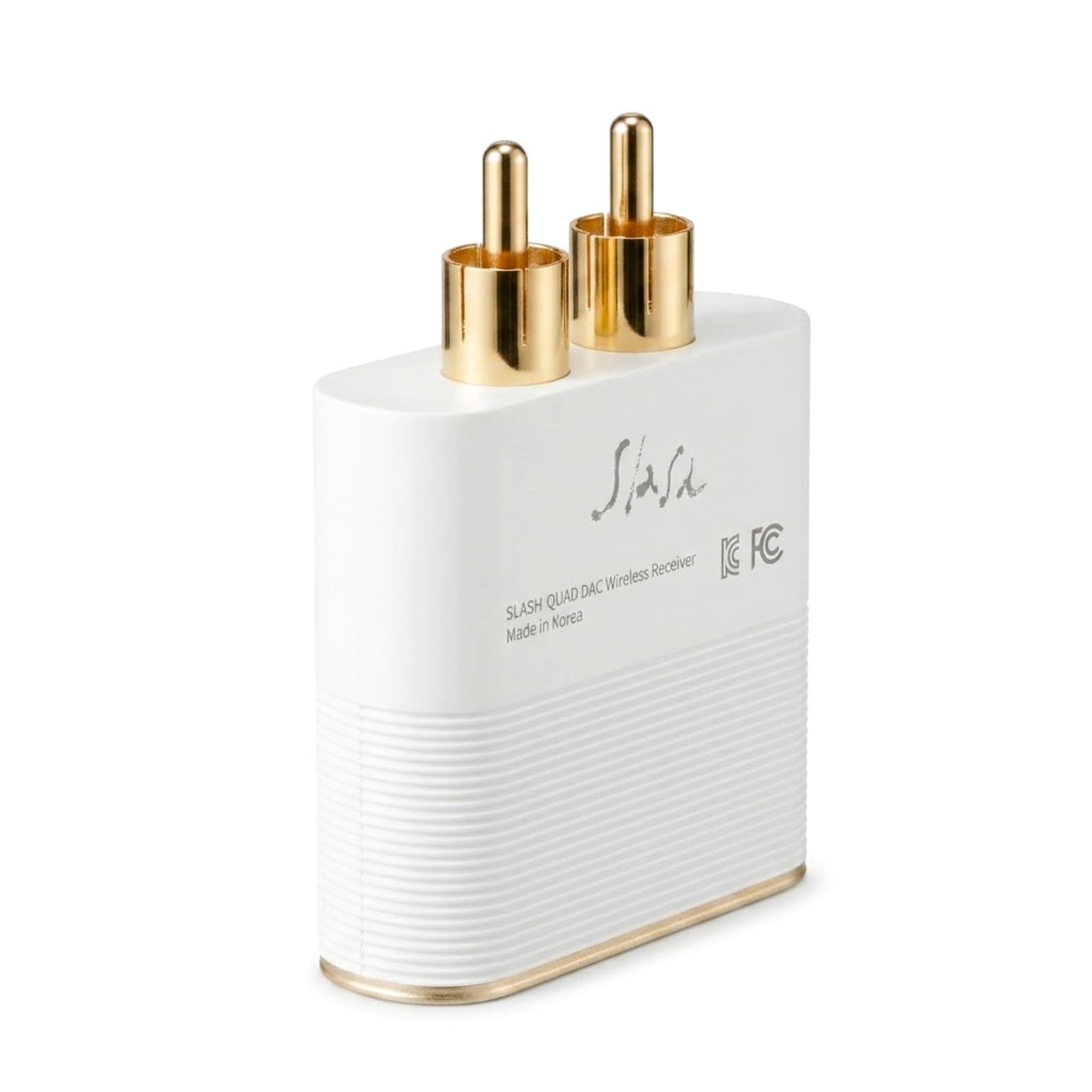
The SLASH 3 solves the cable clutter problem with a direct-plug RCA design that mates the adapter straight onto your amplifier’s input jacks. No dangling RCA cable means less mechanical strain on the jack barrel and one less point for RF ingress. The ESS ES9219 Quad DAC inside is the same silicon used in premium portable DACs, delivering a measured 130 dB SNR that is genuinely silent during silent passages.
Codec support is forward-looking: LDAC at 24-bit/96 kHz, aptX Adaptive, aptX HD, and AAC are all present. The Qualcomm QCC5125 chipset handles the RF side with auto-reconnection logic that links to the last paired device within seconds of power-up. The build quality is a cut above — a solid aluminum front panel and high-purity copper RCA connectors with gold plating ensure the signal path is corrosion-resistant for years.
The white minimalist housing stands out against black amplifier facias, which is a stylistic trade-off. The unit is not rechargeable; it requires constant USB-C power, and supplying a dedicated 5V linear power supply (rather than a phone charger) audibly improves the lower-frequency definition. Pair switching between devices can be slightly slower than with dedicated multi-point receivers.
Why it’s great
- Direct-plug RCA eliminates signal-degrading cables
- ESS ES9219 Quad DAC achieves near-reference SNR
- Full LDAC and aptX Adaptive support for hi-res streaming
Good to know
- Only RCA output — no optical, coax, or XLR
- Best performance requires a clean external power supply
4. YMOO DS200Plus Bluetooth 5.3 Receiver
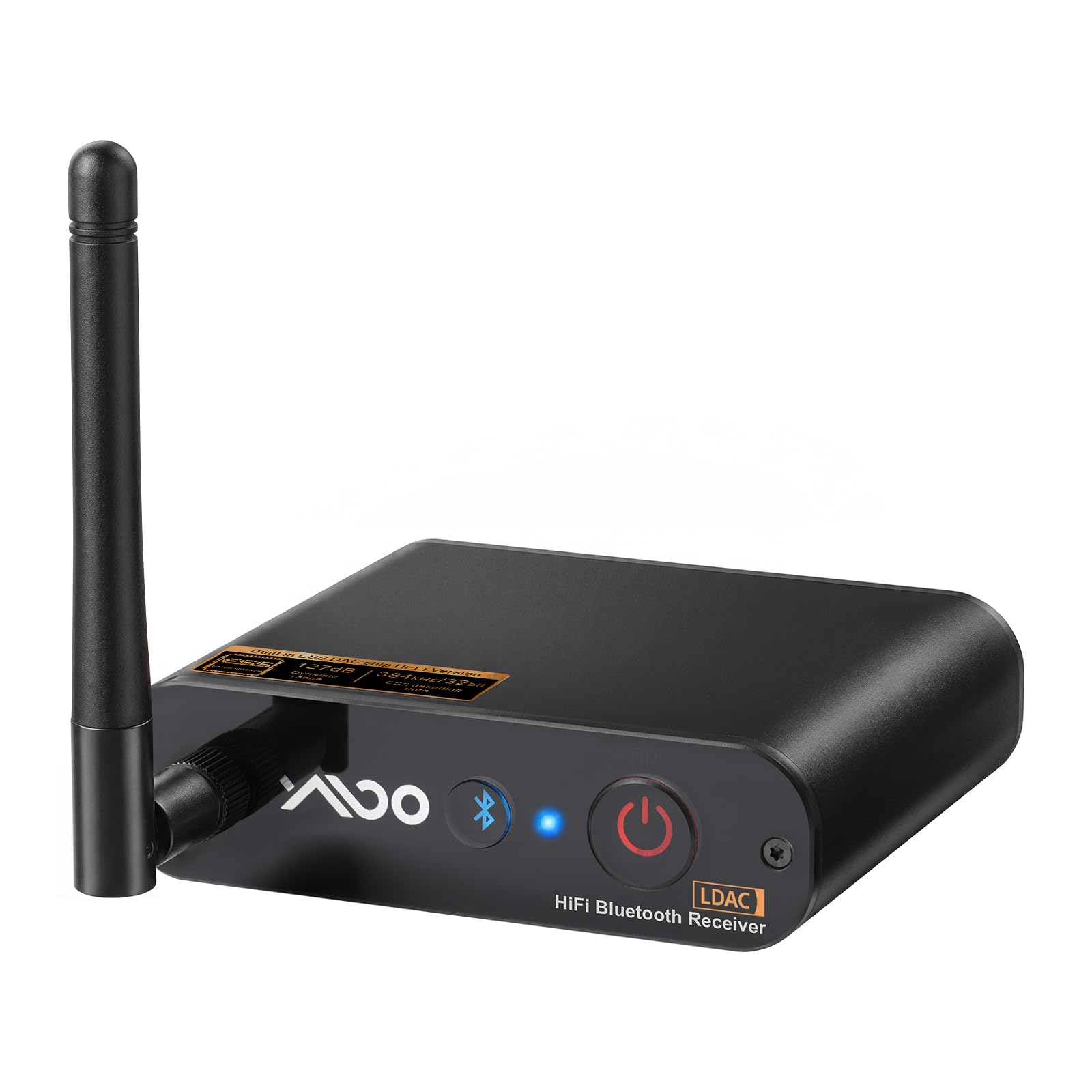
The YMOO DS200Plus focuses on what remote listeners need most: consistent range and flexible output options. Bluetooth 5.3 Adaptive extends the usable connection to about 100 feet line-of-sight, and the internal antenna does a solid job maintaining signal through one wall and a concrete floor. The output panel carries RCA, coaxial, and optical jacks, so you can feed a DAC-equipped amplifier via digital or connect directly to older gear through analog.
Codec support includes LDAC, aptX HD, aptX Low Latency, and aptX Adaptive — covering every major high-res streaming scenario. The built-in DAC is not a discrete flagship chip like the ESS line, but it resolves enough detail for critical listening on moderate systems. An interesting bonus is the ability to pair two source devices simultaneously, though only one streams at a time, making it practical for shared living spaces.
The unit runs on USB power and comes with all necessary cables in the box: optical, 3.5 mm to RCA, and RCA-to-RCA. The physical design is compact and plain — no display screen or status LEDs beyond a small indicator. For users who need to cover a large floor plan or who want the option to use a digital output with an outboard DAC, this adapter delivers the most wiring versatility at its price tier.
Why it’s great
- RCA, coaxial, and optical outputs for maximum system compatibility
- Reliable 100 ft range through walls
- Dual-device pairing simplifies shared listening
Good to know
- Analog sound quality slightly behind discrete DAC designs
- No screen or visual codec indicator
5. Fosi Audio BT20A Bluetooth Stereo Amplifier

The BT20A is not a pure adapter — it is a full Class D amplifier with Bluetooth built in, making it the right choice if you need to power passive speakers directly rather than feed a separate amplifier. The TPA3116 chipset delivers 100 watts per channel into 4 ohms, which is enough to drive most bookshelf speakers to room-filling levels in a living room or garage.
What makes this relevant as an adapter alternative is its dual input flexibility: you can run Bluetooth from your phone or connect a line-level RCA source from a TV or preamp. The front-panel bass and treble knobs give direct analog control over the tone, bypassing the digital EQ adjustments that often degrade headroom on software-dependent solutions. Signal-to-noise is clean for its class — users report no audible hiss or hum with efficient speakers.
The all-black metal chassis is small enough to slip behind a monitor or sit on a shelf without dominating the space. The included 24V/4.5A power supply is substantial and properly shielded, though the external brick is bulky. A common workaround is driving the amp via RCA from a TV’s headphone output, which triggers automatic power-on and gives you remote volume control through the TV remote.
Why it’s great
- Direct speaker output eliminates need for separate amplifier
- Analog bass and treble knobs for tone shaping
- Compact footprint fits tight shelves or desk setups
Good to know
- Bluetooth input overrides RCA input — no simultaneous mixing
- Power brick is large and may block adjacent outlets
6. Fosi Audio BT10A Bluetooth 5.0 Amplifier

The BT10A is the entry-level sibling of the BT20A, offering 50 watts per channel in a chassis that is barely larger than a smartphone. It is designed for users who want to add Bluetooth to a pair of passive bookshelf speakers without spending on a full-size receiver. The Texas Instruments TPA3116 chip provides the same protection circuitry found in larger units, and the implementation here is notably quiet — reviewers consistently mention the dead-silent background between tracks.
Sound quality is clear and linear for its power class. The BT10A has dedicated bass and treble pots on the front panel, giving you the ability to compensate for room acoustics without a separate equalizer. Bluetooth 5.0 delivers stable pairing up to about 50 feet, and the unit auto-connects to the last device on power-up. The 3.5 mm AUX input on the rear lets you hard-wire a TV or CD player when Bluetooth is not ideal.
The power supply is a compact external brick, a significant improvement over the bare DC plugs on ultra-cheap amps. The metal enclosure dissipates heat well during extended listening sessions. One caveat: the BT10A does not auto-switch between inputs; if you have Bluetooth and AUX connected simultaneously, it prioritizes Bluetooth, which may require unplugging the source to force a switch.
Why it’s great
- Ultra-compact form factor fits any desk or shelf
- Dead-silent background with no audible floor noise
- Analog bass and treble controls for quick tuning
Good to know
- 50W per channel may not fill large rooms with inefficient speakers
- Bluetooth input overrides AUX — no simultaneous mixing
7. Yamaha RX-V385 5.1-Channel AV Receiver

The Yamaha RX-V385 is a full 5.1-channel AV receiver with onboard Bluetooth, not a dedicated adapter. It belongs on this list because it answers a specific question: what do you buy when you want Bluetooth, but you also need HDMI switching, room correction, and surround sound processing in a single box. If your amplifier is actually a pre-pro or integrated amp without HDMI, the RX-V385 replaces it entirely.
Bluetooth performance is solid but not codec-obsessed — the RX-V385 supports SBC and AAC, which pairs perfectly with iPhones and Apple Music but skips LDAC and aptX HD. The real value here is the YPAO auto-calibration system, which measures your room’s acoustics and adjusts speaker levels, distances, and crossover frequencies automatically. That single feature often produces a larger audible improvement than switching from SBC to LDAC would on a lesser system.
HDMI 2.1 with HDCP 2.2 handles 4K HDR passthrough with HDR10, Dolby Vision, and Hybrid Log-Gamma. The amplifier section delivers clean power to 5.1 speaker configurations, and the binding posts accept banana plugs on all five channels — a practical detail for users who swap speakers frequently. The Bluetooth implementation lacks auto-reconnect, but the whole receiver is reliable enough that most users leave it powered on and let the HDMI CEC control handle input switching.
Why it’s great
- YPAO room calibration compensates for poor speaker placement
- Full 4K HDR passthrough with modern HDMI standards
- Binding posts on all channels accept banana plugs
Good to know
- No LDAC or aptX HD — limited to SBC and AAC Bluetooth codecs
- Only 4 HDMI inputs and no eARC support
FAQ
Will a Bluetooth adapter degrade the sound quality from my vintage tube amplifier?
Why do I hear a humming noise when my Bluetooth adapter is connected to the amplifier?
Can I leave a Bluetooth adapter powered on 24/7 with my amplifier?
Should I choose an adapter with RCA or optical output for my amplifier?
What Bluetooth version do I need for a stable connection with my amplifier setup?
Final Thoughts: The Verdict
For most users, the best bluetooth analog adapter for amplifier winner is the Audioengine B1 because its AKM DAC and optical output offer maximum flexibility at a price that matches the performance of much more expensive streamers. If you need balanced XLR connectivity for a studio mixer or pro amplifier, grab the blafili B3. And for a zero-cable direct-plug solution that prioritizes LDAC and absolute noise floor performance, nothing beats the SLASH 3.

Mo Maruf
I created WellFizz to bridge the gap between vague wellness advice and actionable solutions. My mission is simple: to decode the research and give you practical tools you can actually use.
Beyond the data, I am a passionate traveler. I believe that stepping away from the screen to explore new environments is essential for mental clarity and physical vitality.