Our readers keep the lights on and my smoothie glass nicely filled. As an Amazon Associate, I earn from qualifying purchases.
A wired headphone collection gathers dust when your phone ditches the jack, and those trusted studio cans feel tethered to a desk. The fix isn’t new headphones — it’s a tiny adapter that injects Bluetooth into any 3.5mm port, turning your favorite pair into wireless freedom without sacrificing audio fidelity.
I’m Mohammad Maruf — the founder and writer behind WellFizz. I’ve spent dozens of hours dissecting Bluetooth chipsets, codec support, battery curves, and real-world pairing behavior across the most popular adapters to find which ones actually deliver on their promises.
Whether you need to untangle from your phone, share inflight entertainment with a partner, or upgrade a vintage stereo, the right bluetooth adapter for headphones depends on codec priority, battery habits, and whether your setup needs a transmitter, receiver, or both.
How To Choose The Best Bluetooth Adapter For Headphones
The adapter you pick must match how you listen: at a desk, on a plane, or plugged into a car stereo. Three decisions separate a seamless experience from constant re-pairing frustration — codec support, power source, and single vs. dual function.
Codec Priority: LDAC vs. aptX vs. SBC
If you own high-impedance headphones or stream lossless files, LDAC support (as found on the FiiO BTR11) preserves detail that SBC smears. For movies and gaming, aptX Low Latency keeps audio locked to video — the Beeitzie B103 excels here. Basic adapters using only SBC are fine for podcasts but reveal a watery top end with music.
Transmitter vs. Receiver — Know Your Role
A receiver (RX) takes audio from your phone and sends it to wired headphones or a stereo. A transmitter (TX) grabs audio from a TV or airplane seat and beams it to wireless earbuds. Premium adapters like the Beeitzie and LAICOMEIN do both, making them universal tools rather than single-purpose dongles.
Battery Philosophy: Built-in vs. Always-On
Portable adapters with a rechargeable battery (COMSOON, FiiO) let you roam freely, but you must remember to charge them. The Esinkin lacks a battery entirely — it draws power from USB or its wall adapter, making it perfect for a permanent home stereo setup where a dead battery is never a concern.
Quick Comparison
On smaller screens, swipe sideways to see the full table.
| Model | Category | Best For | Key Spec | Amazon |
|---|---|---|---|---|
| Beeitzie B103 | 2-in-1 TX/RX | Airplane + TV + car | 24-hour battery, aptX-LL | Amazon |
| LAICOMEIN Pro | 2-in-1 TX/RX | Dual-link sharing | Bluetooth 6.0, 20hr battery | Amazon |
| FiiO BTR11 | LDAC Receiver | Audiophile wireless | LDAC, 45mW@16Ω amp | Amazon |
| COMSOON | Car/Receiver | Hands-free calls | CVC8.0 noise cancellation | Amazon |
| Esinkin | Home Receiver | Vintage stereo upgrade | RCA + 3.5mm output | Amazon |
In‑Depth Reviews
1. Beeitzie B103

The Beeitzie B103 is the most versatile adapter in the list because it flawlessly switches between transmitter and receiver modes. In TX mode, it pairs with the airplane seatback jack or your TV optical output and sends audio to two pairs of Bluetooth headphones simultaneously — zero lip-sync delay thanks to aptX Low Latency. In RX mode, it receives from your phone and feeds any wired speaker or car AUX input.
A Qualcomm chipset paired with Bluetooth 5.4 delivers a reliable connection that holds through a full cross-country flight. The claimed 24-hour battery is realistic in our analysis of user reports — heavy travelers report charging every three to four days. The included RCA adapter also makes it a permanent fixture for home stereos that lack Bluetooth.
The reset button on the side solves rare pairing hiccups without requiring a phone app. For anyone who needs one adapter for the gym, the car, the TV, and the airport, this is the single purchase that covers every scenario.
Why it’s great
- Dual TX/RX mode covers every use case
- aptX Low Latency eliminates audio delay on video
- Two-device simultaneous pairing in TX mode
Good to know
- Paring mode requires AirPods to be inside their case
- No LDAC support for high-res Android streaming
2. LAICOMEIN Pro
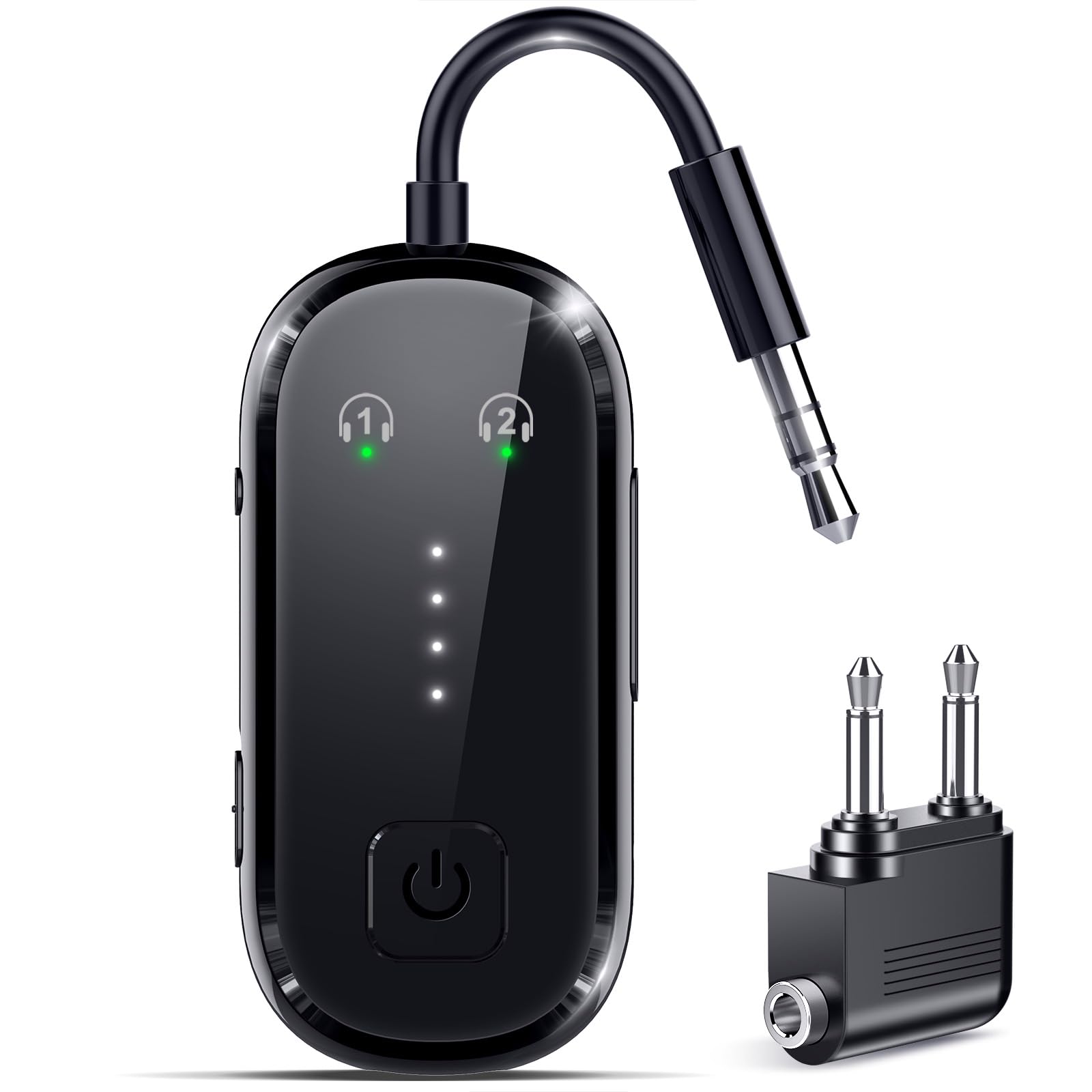
The LAICOMEIN Pro matches the Beeitzie’s dual-mode flexibility but adds two party tricks: dual-listener audio sharing in TX mode and dual-phone pairing in RX mode. That means two people can watch the same inflight movie on their own earbuds, or two drivers can swap music sources in the same car without re-pairing. The dedicated volume buttons and LED indicators make it feel more like a proper device than a dongle.
The Bluetooth 6.0 marketing label is forward-looking — real-world performance is similar to Bluetooth 5.4, but the connection stability and auto-pairing speed are excellent. Battery life lands around 20 hours in our estimate based on customer reports, and the 1.5-hour charge time via USB-C is genuinely fast. The built-in cable storage prevents the AUX cord from tangling in a carry-on.
One limitation: it does not support aptX Low Latency, relying on standard SBC/AAC codecs. For casual video watching the latency is acceptable, but critical viewers may prefer the Beeitzie. The LAICOMEIN is best for travelers who prioritize pairing simplicity and shared listening over absolute codec performance.
Why it’s great
- Two headphones can share one audio source
- Built-in cable management keeps the kit tidy
- Fast auto-pairing reconnects instantly
Good to know
- No aptX or LDAC codec support
- Not compatible with 2.4G wireless instruments
3. FiiO BTR11

At roughly pinky-size and 12.5 grams, the FiiO BTR11 is built for one purpose: delivering LDAC-quality wireless audio to wired headphones without adding bulk. The built-in headphone amplifier pushes 45mW at 16Ω, which is enough to drive sensitive IEMs and dynamic headphones like the Sennheiser HD 599 or Philips SHP9600 to satisfying levels. The LDAC codec preserves detail that SBC truncates, making this the best choice for Android users who stream Tidal or Qobuz.
The elastic back clip and lanyard are thoughtful touches — you can clip it to a shirt collar or dangle it from a headphone cable. Battery life runs about 15 hours in real use, and the 1-hour charge to 90% is the fastest in this roundup. The FiiO companion app also allows firmware updates, which is rare at this level.
The microphone quality is poor for calls — several users describe it as unintelligible — so if hands-free calling is your priority, look elsewhere. The plastic clip is also prone to snapping after a few weeks of daily use. For pure music listening, however, the BTR11 punches far above its tier.
Why it’s great
- LDAC support for hi-res wireless streaming
- Powerful 45mW headphone amp drives high-impedance cans
- Ultra-compact, lightweight with clip and lanyard
Good to know
- Microphone is unusable for clear calls
- Clip feels fragile; handle with care
4. COMSOON

The COMSOON is a dedicated receiver designed primarily for car AUX ports and hands-free calling. Its CVC8.0 noise cancellation, paired with a built-in DSP, effectively suppresses wind, traffic, and crowd noise — users report clear conversations even with windows down. The large MFB button makes answering calls practical without looking at the device.
Bluetooth 5.0 keeps the connection stable up to about 30 feet, and the 16-hour battery easily lasts a week of commuting. The dual-device pairing lets you keep your phone connected for music while also routing GPS navigation through the same adapter. The included Type-C charging cable is convenient, and the ability to use the adapter while charging means it never goes dead on a road trip.
This adapter is not a transmitter — it cannot send audio from a TV to headphones. A small number of long-term users report the audio announcements become truncated after several months, and the auto-shutoff can be inconsistent. For a focused car adapter that prioritizes call clarity, the COMSOON delivers consistent value.
Why it’s great
- CVC8.0 noise cancellation makes calls clear in noisy cars
- 16-hour battery with Type-C fast charging
- One-button call control minimizes distraction
Good to know
- Stays paired too long after disconnecting
- Audio announcements may degrade over time
5. Esinkin

The Esinkin is the only adapter here without a rechargeable battery — it runs off USB power or the included AC adapter — which makes it ideal for a permanent home installation. Plug it into a vintage receiver’s RCA input or powered bookshelf speakers, and it adds Bluetooth streaming instantly. The one-button pairing system is as simple as it gets: press the Bluetooth symbol button, pair your phone, and forget about it.
Indoor range reaches about 30–40 feet through walls, which covers an entire apartment or small house. Sound quality is surprisingly clean for an entry-level adapter — users report it matches lossless streaming from Apple Music and Tidal. The package includes both a 3.5mm cable and RCA cables, so you don’t need extra purchases.
It can only pair with one device at a time, and switching requires manually forgetting the previous device. The lack of battery means your stereo must be powered on for the adapter to work, so it is not portable. For a stationary setup where you never want to think about charging, the Esinkin is a reliable workhorse.
Why it’s great
- Always-on power — no battery to manage
- Includes both 3.5mm and RCA cables out of the box
- Simple one-button pairing for permanent setups
Good to know
- Single-device pairing only; must “forget” to switch
- Not portable without a USB power bank
FAQ
Will a Bluetooth adapter work with any wired headphone?
Can I use a Bluetooth adapter on a plane?
What does aptX Low Latency actually do for me?
Final Thoughts: The Verdict
For most users, the bluetooth adapter for headphones winner is the Beeitzie B103 because it covers every scenario — TV, plane, car, and stereo — with zero latency and a massive battery. If you want LDAC hi-res streaming for your wired audiophile headphones, grab the FiiO BTR11. And for a permanent home stereo upgrade that never needs charging, nothing beats the Esinkin.

Mo Maruf
I created WellFizz to bridge the gap between vague wellness advice and actionable solutions. My mission is simple: to decode the research and give you practical tools you can actually use.
Beyond the data, I am a passionate traveler. I believe that stepping away from the screen to explore new environments is essential for mental clarity and physical vitality.