Our readers keep the lights on and my smoothie glass nicely filled. As an Amazon Associate, I earn from qualifying purchases.
Tracking your blood pressure at home is a critical habit for managing cardiovascular health, but the market is flooded with monitors that trade accuracy for convenience or vice versa. An upper arm monitor is the gold standard for reliable readings, yet choosing the wrong model can lead to inconsistent data, uncomfortable cuffs, or features you never use, turning a simple health task into a daily frustration.
I’m Mohammad Maruf — the founder and writer behind WellFizz. My approach to this guide involved cross-referencing clinical validation claims against real user consistency data, analyzing the practical limits of cuff sizing and memory storage, and testing the Bluetooth connectivity and app ecosystems of each device to isolate the models that deliver genuinely useful health tracking without the headache.
This guide evaluates seven models across mid-range and premium tiers to find the ones that get the numbers right without complicating your routine, helping you identify the best blood pressure upper arm monitor for consistent, stress-free home monitoring.
How To Choose The Best Blood Pressure Upper Arm Monitor
An upper arm monitor is only as good as its consistency, and consistency depends on three factors: the cuff fit, the measurement algorithm, and the data management system. Many buyers focus on screen brightness or price, but the real differentiators are how well the device handles variable arm circumferences and how it stores or shares your reading history.
Cuff Size and Fit Precision
The most accurate monitor in the world gives false readings if the cuff is too loose or too tight. Look for a monitor that includes at least one wide-range D-ring cuff (typically 9 to 17 inches) or offers separate size options. Some models now include a second XL cuff for larger arms up to 21 inches, which significantly reduces the error margin for those users. A rigid cuff that twists during inflation will also produce unreliable data, so the materials and design of the cuff matter nearly as much as the electronics inside the monitor.
Memory Capacity and Multi-User Support
If you are monitoring blood pressure daily, you need a device that stores more than the last reading. The best upper arm monitors offer separate user profiles (usually two) with 100 to 500 readings each. This is crucial for households with multiple people tracking their health, or for caregivers managing a partner’s numbers alongside their own. Some monitors store timestamps and allow you to scroll through past results directly on the device, which is faster than opening an app every time.
Smart Connectivity vs. Standalone Reliability
Bluetooth and Wi-Fi sync capabilities let you export trends, share data with your doctor, and track long-term averages through companion apps. However, app-dependent monitors can be frustrating if the setup is finicky or if the app requires constant updates. A monitor that stores readings locally and syncs automatically in the background (ideally without needing the app open during measurement) offers the best balance. Standalone memory with a backlit screen is more than sufficient for users who simply want to log numbers by hand.
Quick Comparison
On smaller screens, swipe sideways to see the full table.
| Model | Category | Best For | Key Spec | Amazon |
|---|---|---|---|---|
| OMRON Gold | Premium | AFib screening & doctor-verified tracking | AFib detection, 9–17 inch cuff, Bluetooth | Amazon |
| Withings BPM Connect | Premium | Wi-Fi sync & polished mobile app | Wi-Fi + Bluetooth, rechargeable battery, 6-month life | Amazon |
| Greater Goods Bluetooth | Mid-Range | Balanced accuracy & app integration | 8.7–16.5 inch cuff, 60-read memory per user, Bluetooth | Amazon |
| FDA-Cleared (U80A) | Mid-Range | Large 4.5-inch LED for seniors | 4.5-inch LED, dual user 199-read memory, USB-C | Amazon |
| AQESO (2 Cuffs) | Mid-Range | Wide arm size compatibility | Two cuffs: 9–17 in & 13–21 in, USB-C, 1000-read memory | Amazon |
| A&D Medical UA-767PSAC | Budget | Smaller arms, petite frame users | Small cuff 6.3–9.4 inches, AC adapter included | Amazon |
| Acenis AOJ-30F | Budget | Simple three-user tracking with color screen | Large color screen, 3-user 2-read memory, 1.1 lbs | Amazon |
In‑Depth Reviews
1. OMRON Gold Blood Pressure Monitor
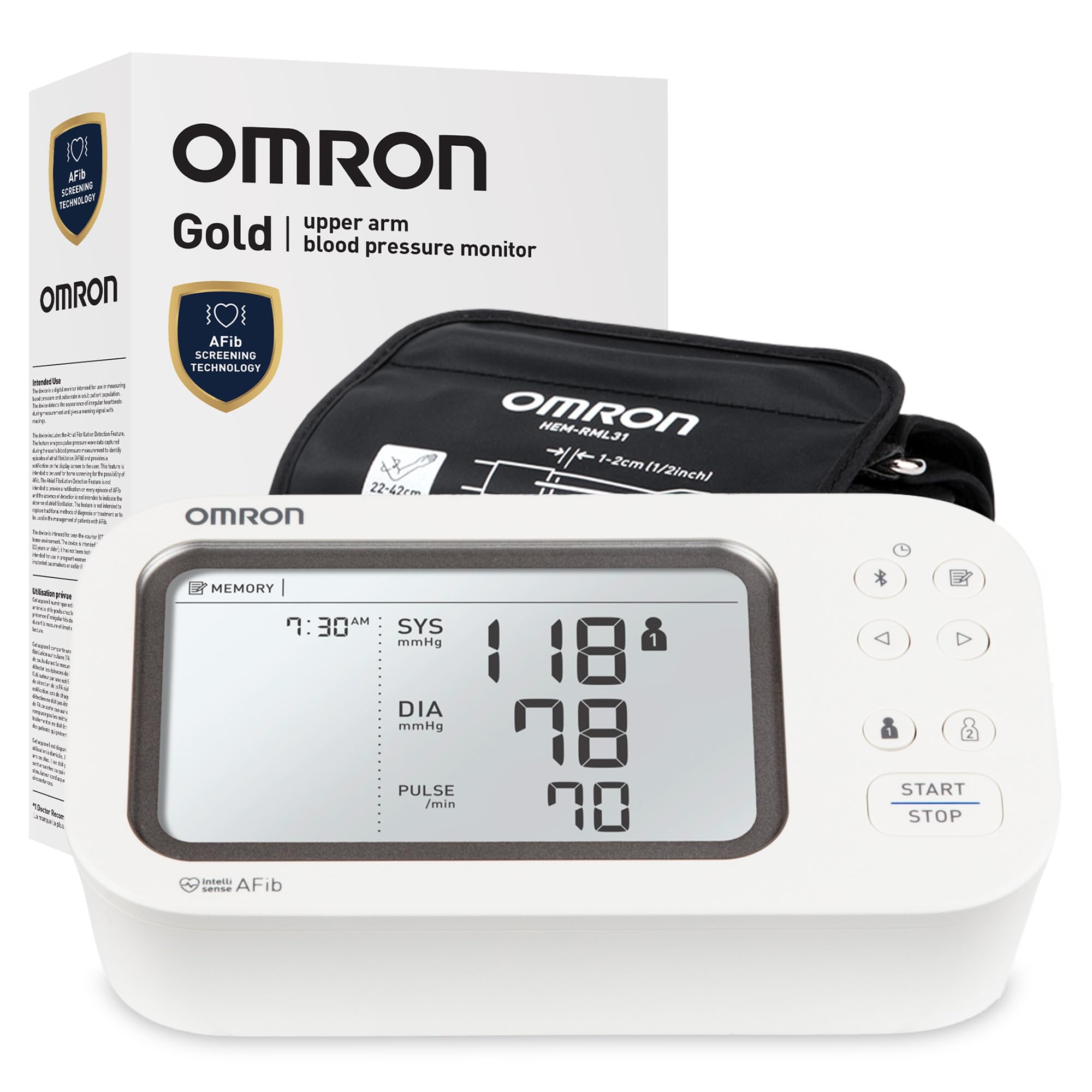
The OMRON Gold is the most clinically oriented monitor in this lineup, carrying the brand’s #1 doctor and pharmacist recommendation and adding exclusive Atrial Fibrillation (AFib) detection during each reading. This feature automatically screens for irregular heart rhythms and alerts you to potential issues before symptoms appear, making it a strong choice for users with known heart conditions or those over 60. The high morning average indicator further helps identify dangerous pre-hypertension spikes linked to cardiovascular risk.
Setup is straightforward out of the box: the wide-range D-ring cuff fits arms 9 to 17 inches, and the OMRON connect app stores unlimited readings across two user profiles, syncing via Bluetooth to Apple Health and Google Fit. Users report the pump is quieter than most models, and the screen is crisp, though it lacks a backlight, which some find harder to read in dim bedrooms. The device runs on four AA batteries and includes a storage case and manual, so everything you need to start monitoring is included.
A critical limitation: the AFib detection algorithm prevents the monitor from displaying a blood pressure reading if it detects an irregular heartbeat. This is by design, but multiple verified users with diagnosed atrial fibrillation found the device effectively unusable for their primary need — taking a reading. If you have confirmed AFib, this model may cause more frustration than reassurance, despite its otherwise premium build and feature set.
Why it’s great
- Clinically validated AFib detection adds a layer of proactive screening.
- High morning average indicator flags cardiovascular risk early.
- Quiet pump operation and reliable Bluetooth syncing for two users.
Good to know
- AFib detection prevents reading display; unsuitable for diagnosed AFib users.
- No backlight on the LCD, harder to read in low light.
- Runs on AA batteries only (AC adapter not included).
2. Withings BPM Connect

The Withings BPM Connect stands out for its polished industrial design and dual-sync capability — it connects via both Wi-Fi and Bluetooth, automatically uploading readings to the Health Mate app without needing your phone nearby during the measurement. The color-coded feedback on the LCD display (green, orange, red) gives immediate visual context for your systolic and diastolic numbers, making interpretation instant even without the app. The rechargeable battery is rated for six months of use, which is exceptional for a category dominated by replaceable cells.
Accuracy is solid: one user compared it to a professional clinical monitor and found systolic within 2 points and diastolic within 4–5 points, which is well within the acceptable threshold for home monitoring. The cuff fits 22 to 42 cm (roughly 8.7 to 16.5 inches), and the device weighs only 12.8 ounces, making it very portable. The stainless steel accents and compact footprint mean it doesn’t look like medical equipment, which helps with daily compliance — you’re more likely to use a device that doesn’t feel like a chore.
However, the app setup can be frustrating: pairing issues are common, and the device requires you to keep the app active during the first measurement. Some users report the light grey model has low-contrast LED digits that are hard to read without glasses. The cuff strap also lacks a stopper, which can cause it to fall out of the metal loop during storage. For the premium price, these small annoyances stand out, especially compared to simpler monitors that just work out of the box.
Why it’s great
- Wi-Fi auto-sync works without holding the phone during measurement.
- Rechargeable battery lasts up to six months.
- Color-coded feedback gives immediate understanding of readings.
Good to know
- Setup pairing can be finicky and requires active phone app.
- Light grey model has low-contrast LED display.
- Cuff strap lacks a stopper, falls out of loop during storage.
3. Greater Goods Bluetooth Smart Blood Pressure Monitor
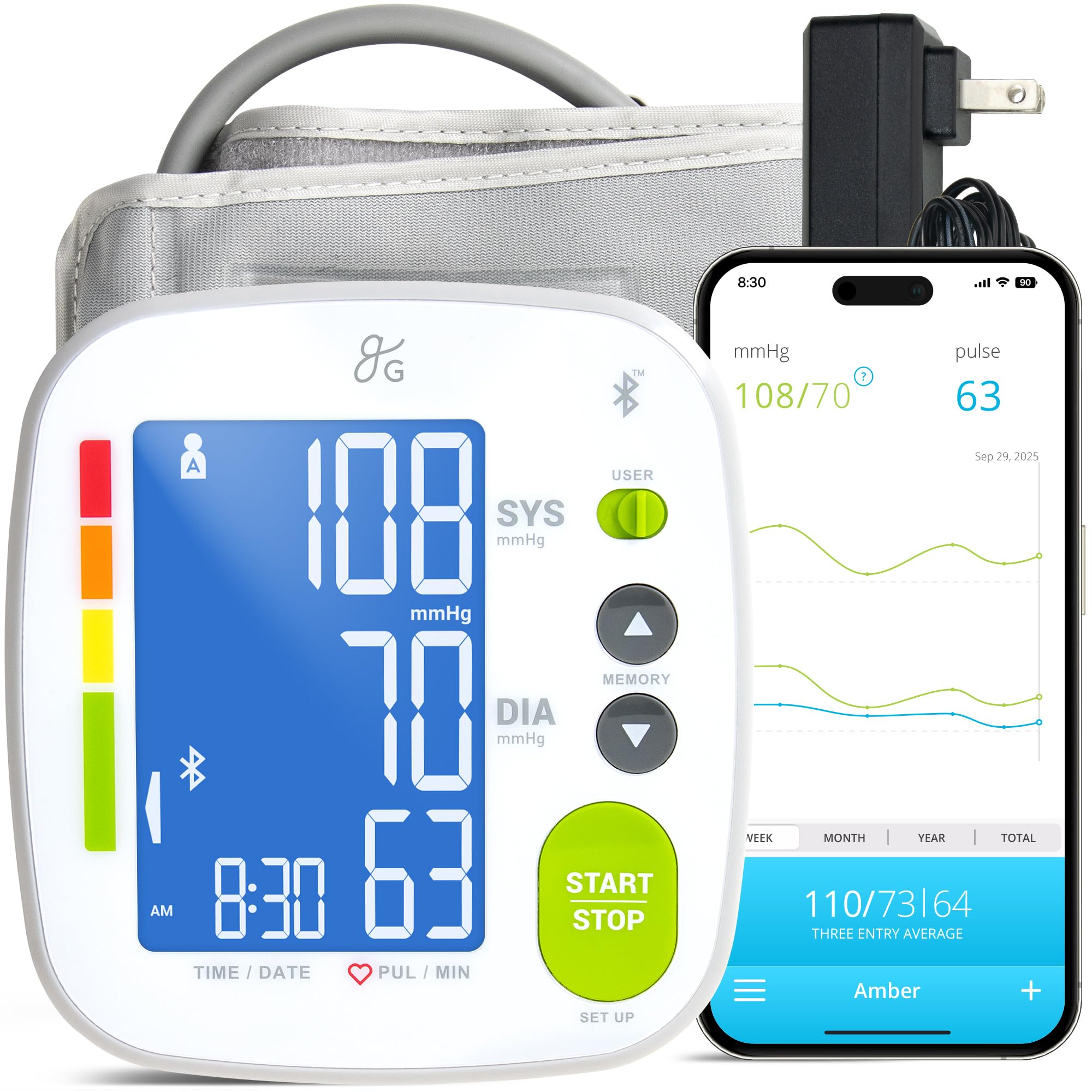
The Greater Goods Bluetooth monitor is a five-time Wirecutter Top Pick for good reason: it balances clinical accuracy with user-friendly design at a mid-range price point. The 8.7 to 16.5 inch cuff includes an artery alignment guide printed on the interior, which significantly reduces placement error — the most common source of inconsistent readings at home. The large backlit display with bold numbers is readable in any lighting condition, which is a clear advantage over the OMRON Gold’s unlit screen.
The Balance Health app for iOS and Android syncs via Bluetooth and stores unlimited readings, tracks averages and trends, and allows you to export reports to share with your doctor. The built-in memory stores 60 readings per user (120 total across two users) even without Bluetooth, ensuring you don’t lose data if your phone isn’t nearby. The monitor works with both the included AC adapter and four AAA batteries, giving you flexibility for travel or bedside use.
Some users mention that the cuff is difficult to tighten with one hand, especially if you have limited hand strength, and that the start button is easily bumped during storage, accidentally triggering inflation. The included travel case is also too small to fit the monitor with the AC adapter attached. While these are minor inconveniences, the core functionality — accurate, consistent readings with excellent app integration — is hard to beat at this tier, making it the most balanced choice for most households.
Why it’s great
- Wirecutter Top Pick with strong clinical validation.
- Artery alignment guide reduces placement errors.
- Large backlit display and dual power source (AC + batteries).
Good to know
- Cuff is difficult to tighten with one hand.
- Start button easily bumped during storage causes accidental inflation.
- Travel case is too small to fit with AC adapter.
4. FDA-Cleared Blood Pressure Monitor (U80A)
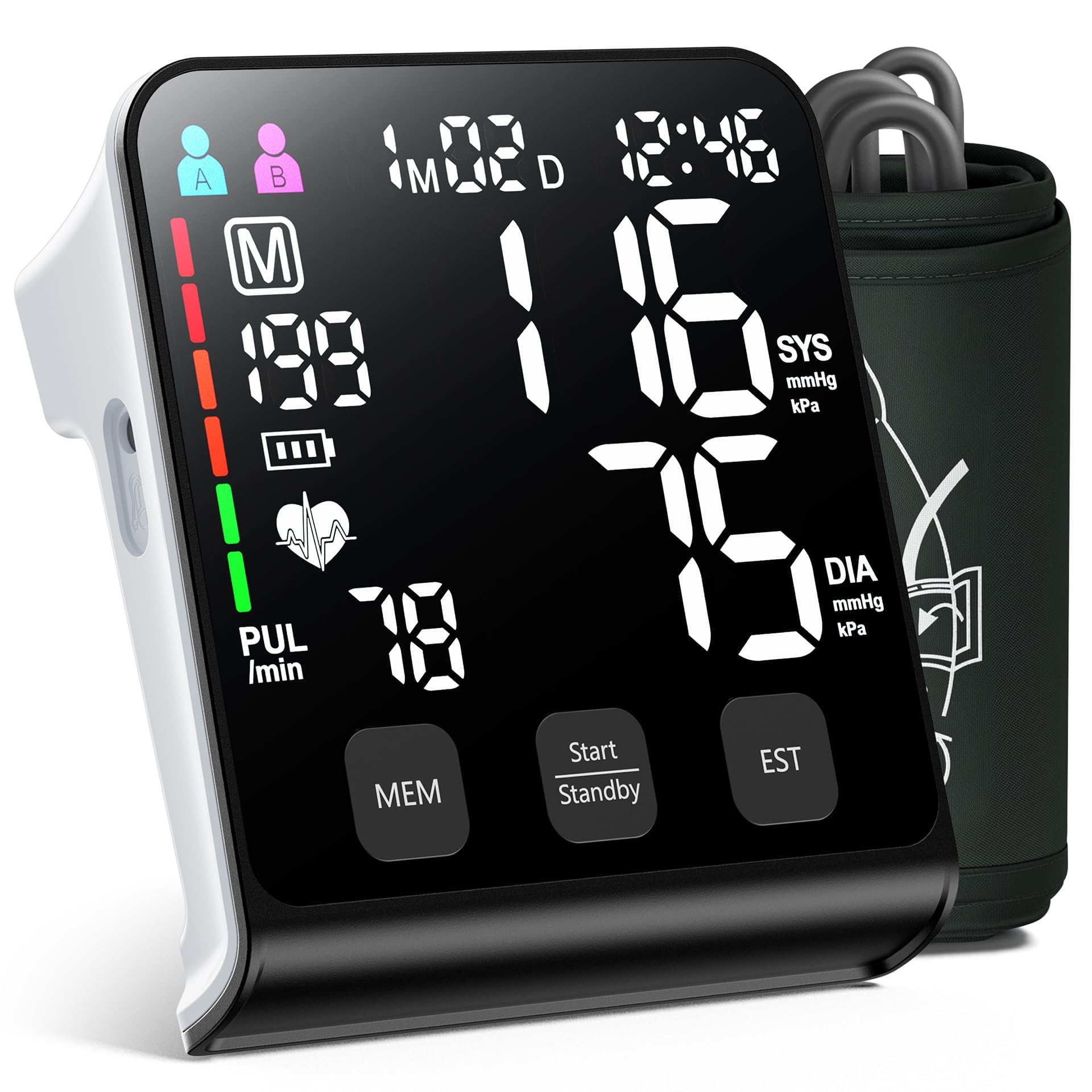
The U80A model is specifically designed with visibility and simplicity in mind, featuring a 4.5-inch backlit LED screen with oversized digits and color-coded blood pressure classification bars. Multiple verified users note they can read the display without glasses, which is a meaningful advantage for seniors or anyone with vision challenges. The one-touch operation is genuinely simple — wrap the cuff, press the single button, and results appear in seconds with an error margin of ≤±3mmHg according to the manufacturer.
Memory storage covers two users with 199 readings each, which is more than enough for daily tracking over several months. The monitor also includes a heart rate irregularity alert, though unlike the OMRON, it does not block the reading — it simply displays a warning symbol. The adjustable wide-range cuff is comfortable, and users with pregnancy-related monitoring found it accurate and easy to use. The device includes both a USB-C cable and four batteries, and it is FSA and HSA eligible.
A minor downside: the scratch-resistant acrylic panel is glossy and can show smudges quickly, and the monitor lacks Bluetooth connectivity, so all data must be viewed on the device itself. Users who want to share trends with a doctor will need to manually log or photograph the screen. For standalone home use where app integration is not a priority, the large display and simple operation make it one of the most accessible monitors on this list.
Why it’s great
- Oversized 4.5-inch backlit LED is readable without glasses.
- Color-coded classification bar gives instant visual context.
- Dual user memory with 199 readings each.
Good to know
- No Bluetooth or app integration for data sharing.
- Glossy acrylic panel shows fingerprints easily.
- USB-C power requires continuous connection; not rechargeable.
5. AQESO Blood Pressure Machine (2 Cuffs)

The AQESO monitor addresses one of the biggest pain points in the category: arm size variability. It includes two full cuffs — a Medium/Large cuff sized 9 to 17 inches and an Extra Large XL cuff sized 13 to 21 inches — both in the box at no extra cost. This eliminates the common scenario where a user with larger arms buys a standard monitor and gets consistently inflated readings because the cuff is too small. The oscillometric technology delivers consistent results, and the WHO classification bar on the display helps interpret readings without a manual.
The memory capacity is remarkable for the tier: 500 readings per user across two users, totaling 1,000 stored readings. This is more than enough for years of daily tracking. The large backlit LCD is clear in any light, and the one-touch button starts the 40-second measurement cycle with minimal hassle. Power options include four AAA batteries or USB Type-C (though the monitor is not rechargeable — USB requires a continuous connection).
Some users note that the setting up of date and time can be confusing, and the manual is not the clearest. The device is also slightly bulky at 1.54 pounds compared to lighter models like the Greater Goods. However, for households where arm sizes vary significantly, or for a single user with larger arms, the included XL cuff is a genuine differentiator that justifies the mid-range price point over cheaper single-cuff alternatives.
Why it’s great
- Two cuffs included (standard + XL) for wide arm size compatibility.
- 1,000 total reading memory across two users.
- Large backlit LCD with WHO classification bar.
Good to know
- Date and time setup is unintuitive.
- USB power requires constant connection; device is not rechargeable.
- Heavier than comparable models at 1.54 pounds.
6. A&D Medical UA-767PSAC

The key differentiator here is the small cuff, sized for arm circumferences of 6.3 to 9.4 inches, which is the most petite-friendly option in this entire guide. Multiple verified users with smaller frames (one reviewer at 4’10” and 84 lbs) report that this is the only monitor they have found that fits properly and delivers readings consistent with their doctor’s office.
The operation is refreshingly simple: one button inflates the cuff automatically, and the results appear on a clear LCD screen. The device works with four AA batteries or the included detachable AC adapter, and users note exceptionally long battery life compared to larger smart monitors. At 1.19 pounds and compact dimensions (4.3 x 2.5 x 5.6 inches), it is easy to store or travel with.
However, the display is not backlit, which makes it harder to read in low-light conditions. There is no Bluetooth or memory storage beyond the last reading — you must manually log your numbers. Some users report questionable accuracy compared to clinical machines, though the majority find it consistent. For users with standard or larger arm sizes, the small cuff is limiting, so this monitor is best reserved for those with genuinely petite arm measurements who prioritize fit over smart features.
Why it’s great
- Specialized small cuff (6.3–9.4 in) fits petite arms properly.
- Very long battery life with included AC adapter option.
- Simple one-button operation with automatic inflation.
Good to know
- No backlight; hard to read in dim rooms.
- No memory storage or Bluetooth connectivity.
- Small cuff limits usability for standard or larger arms.
7. Acenis Automatic Blood Pressure Monitor (AOJ-30F)
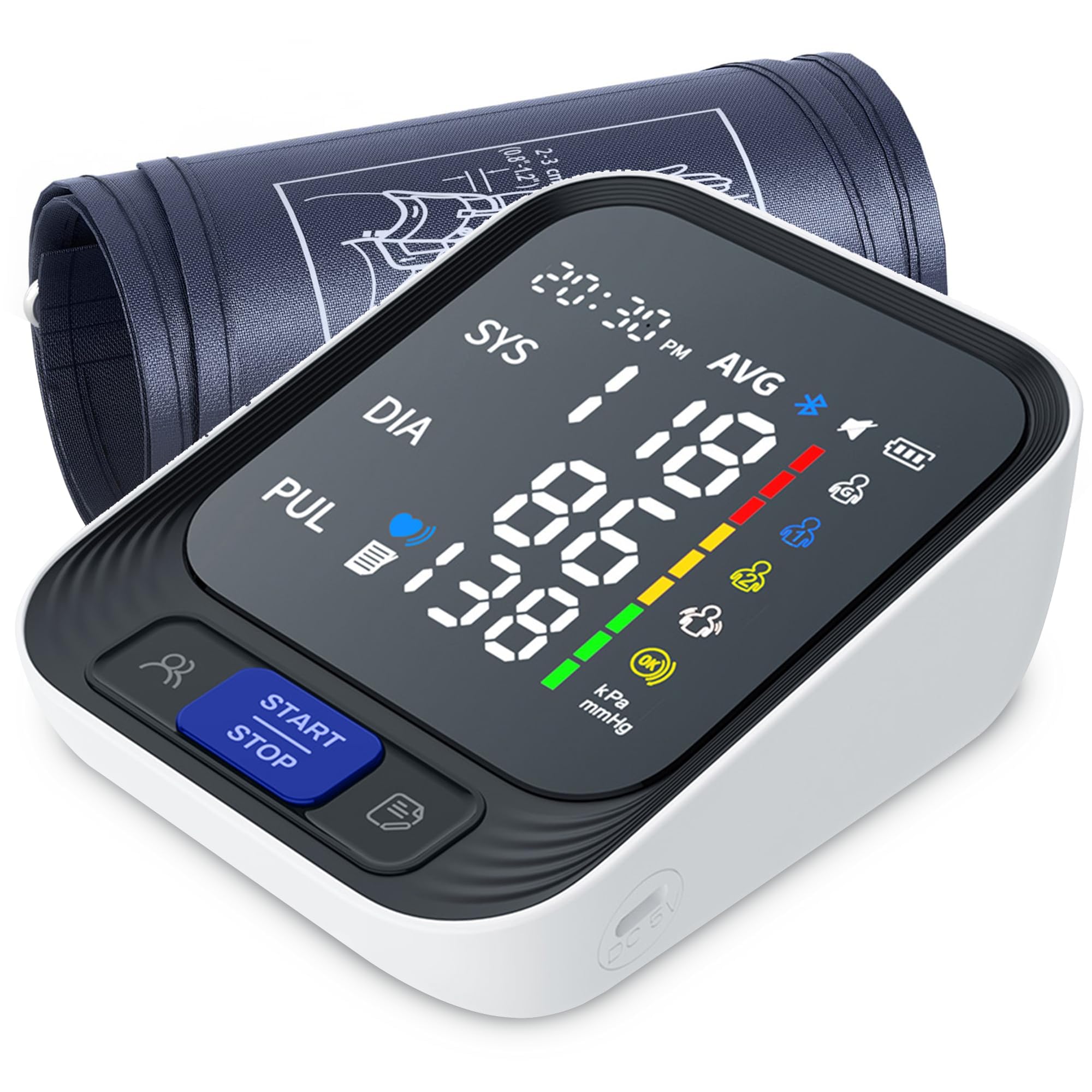
The Acenis AOJ-30F is a budget-friendly entry point that focuses on clarity and multi-user support. The large color screen is its defining feature — the display uses color coding to classify blood pressure readings, making it easy to interpret at a glance, even for users with poor eyesight. The one-touch operation measures systolic and diastolic pressure in about 40 seconds, and the large adjustable cuff fits a wide range of arm sizes comfortably.
It supports up to three users, though the memory is limited to two readings per user — a significant constraint if you monitor daily and want to track trends over time. The device comes with four AAA batteries included, and users note it is accurate for trending blood pressure values when used correctly (proper rest time, consistent cuff placement). The lightweight build at 1.1 pounds makes it easy to store in a drawer or take on trips.
The main trade-offs are the minimal memory and the lack of any app connectivity — you must write down your readings manually. Some users found setting up the date and time confusing, and the included batteries are reported to be low quality and short-lived. For someone who needs a simple, inexpensive monitor for occasional checks, the color screen is genuinely helpful. But for daily monitoring and trend analysis, one of the higher-capacity models above will serve you better.
Why it’s great
- Large color screen with reading classification, ideal for seniors.
- Three-user support for household tracking.
- Very lightweight and compact for travel.
Good to know
- Only stores 2 readings per user; no long-term memory.
- No Bluetooth or app integration.
- Included batteries are low quality; replace immediately.
FAQ
What size cuff do I need for an accurate reading?
Can I use a blood pressure monitor if I have atrial fibrillation?
How often should I replace the batteries or charge the monitor?
Why do my home readings differ from the doctor’s office?
Final Thoughts: The Verdict
For most users, the best blood pressure upper arm monitor winner is the Greater Goods Bluetooth Smart Blood Pressure Monitor because it delivers Wirecutter-validated accuracy, a comfortable artery-aligned cuff, and excellent app integration at a mid-range price that doesn’t require a major investment. If you need AFib screening and don’t have a confirmed arrhythmia, the OMRON Gold offers the most clinical oversight with its exclusive detection algorithm. And for households with multiple arm sizes, the AQESO (2 Cuffs) provides the best fit flexibility with its included standard and XL cuffs.

Mo Maruf
I created WellFizz to bridge the gap between vague wellness advice and actionable solutions. My mission is simple: to decode the research and give you practical tools you can actually use.
Beyond the data, I am a passionate traveler. I believe that stepping away from the screen to explore new environments is essential for mental clarity and physical vitality.