Our readers keep the lights on and my smoothie glass nicely filled. As an Amazon Associate, I earn from qualifying purchases.
An ill-fitting blood pressure cuff is the single most common source of inaccurate home readings. Too loose and you see falsely low numbers; too tight and you get a false spike that sends you racing to the clinic. The blood pressure cuff for home use you choose must match your arm circumference precisely, offer consistent oscillometric accuracy, and display results clearly enough for daily tracking. This guide breaks down seven models by cuff range, memory capacity, and real-world reliability so you can pick the one that actually reflects your cardiovascular health.
I’m Mohammad Maruf — the founder and writer behind WellFizz. I have spent years analyzing consumer health hardware, cross-referencing clinical accuracy claims with user-reported consistency, and identifying the design flaws that cause most home BP monitors to deliver misleading data.
From multi-cuff kits that fit the whole family to a flagship model with AFib detection, these are the monitors that earned a spot in a home health routine.
How To Choose The Best Blood Pressure Cuff For Home Use
Selecting a home BP monitor involves more than picking the cheapest model. Arm circumference, cuff construction, and data management all play a role in whether you get usable readings or frustrating error codes.
Cuff Size Range
The bladder inside the cuff must encircle 80–100% of your upper arm. If your arm circumference is 14 inches, a standard cuff (9–13 inches) will under-cuff you and produce artificially high readings. Look for a model that lists both the minimum and maximum arm circumference in inches or centimeters, and choose a unit that includes multiple cuffs if multiple household members will use it.
Memory and Multi-User Storage
A monitor that stores readings for multiple users saves you from keeping a paper log. Devices with 90, 199, or even 500 slots per user let you track systolic and diastolic trends over weeks or months. If Bluetooth syncing to a health app matters to you, confirm the app exports data (CSV or PDF) so you can share the record with your doctor.
Display Readability and Indicators
A backlit, high-contrast display with large digits reduces misreading, especially for seniors or in low-light rooms. Many monitors now include a color-coded WHO classification bar — green for normal, yellow for borderline, red for high — which gives you an immediate visual cue without interpreting the numbers.
Quick Comparison
On smaller screens, swipe sideways to see the full table.
| Model | Category | Best For | Key Spec | Amazon |
|---|---|---|---|---|
| Omron Gold BP5360 | Premium | AFib screening & app integration | AFib detection, 9–17 in cuff | Amazon |
| AQESO 3-Cuff Monitor | Premium | Households with varied arm sizes | Three cuffs 7–21 in, 1500 memory | Amazon |
| Andesfit Upper Arm Monitor | Mid-Range | Bluetooth syncing & large-arm users | Two cuffs up to 21 in, 199 memory | Amazon |
| Microlife BPM2 | Mid-Range | Clinically validated accuracy | AA rated by BIHS, 60 memory | Amazon |
| iHealth Track 550BT | Mid-Range | Smartphone tracking & large display | Bluetooth 4.0, 8.7–16.5 in cuff | Amazon |
| COCACIS Dual Cuff Monitor | Value | Two cuff sizes in one box | Two cuffs 9–21 in, 199 memory | Amazon |
| Medline MDS4001 | Budget | Simple, no-frills home monitoring | 8.5–12 in cuff, 90 memory | Amazon |
In‑Depth Reviews
1. Omron Gold Blood Pressure Monitor BP5360
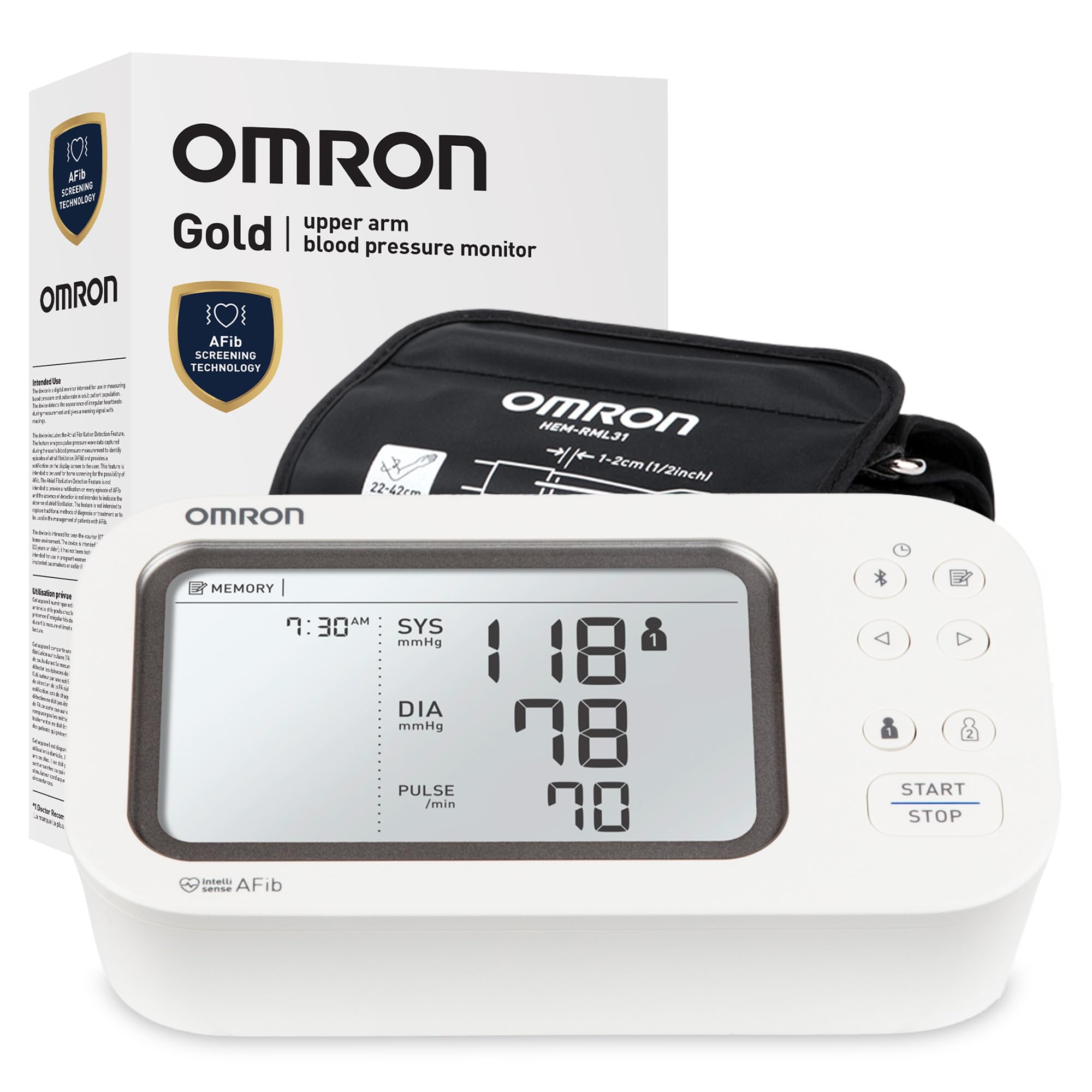
The Omron Gold delivers the most clinically advanced feature set of any monitor here: exclusive Atrial Fibrillation (AFib) detection and a High Morning Average Indicator that flags morning blood pressure spikes linked to stroke risk. The wide-range D-ring cuff fits arms 9 to 17 inches and pairs seamlessly with the Omron Connect app for unlimited data storage and trend sharing. In a category where accuracy defines value, this unit’s oscillometric algorithm is validated against clinical standards and recommended by the #1 doctor-trusted brand.
Two-user memory lets couples track separately without confusion, while the Bluetooth sync auto-logs each reading to Apple Health or Google Fit. The backlit display is crisp, and the one-touch operation is straightforward enough for elderly users after a brief setup. Several reviewers noted that readings consistently matched their doctor’s office equipment, reinforcing the reliability you expect at this tier.
The software subscription for PDF exports adds a hidden long-term cost, and a small number of users reported that the device refused to read blood pressure during AFib episodes — a limitation worth discussing with your cardiologist if you already have an arrhythmia diagnosis. For most households, however, the Omron Gold is the most comprehensive home cardiovascular monitor available today.
Why it’s great
- Clinically validated AFib detection and morning spike analysis
- Two-user mode with Bluetooth auto-sync to health apps
- Backlit display with large, readable digits
Good to know
- PDF sharing requires paid subscription after initial trial
- May not read during active AFib episodes
2. AQESO Blood Pressure Machine, 3 Cuff Sizes

The AQESO monitor solves the single biggest household pain point: one box contains three cuff sizes covering arm circumferences from 7 to 21 inches. Small (7–9 in), medium/large (9–17 in), and XL (13–21 in) cuffs mean a petite adult, an average-sized parent, and a large-framed teenager can all use the same base unit without sacrificing accuracy. The oscillometric chip delivers fast inflation and deflation, usually producing a reading in under 30 seconds.
Each of the three user slots holds 500 readings, giving the family a combined 1,500 measurement capacity that eliminates the need for external logs. The backlit LCD display is one of the largest in this price band, with oversized digits that seniors praise. USB Type-C power or AAA batteries keep it portable, and the included carry case makes travel simple.
A recurring note in customer feedback: the internal clock resets if you disconnect the USB power source or remove the batteries, which scrambles the date/time stamp on stored readings. It is not a dealbreaker if you power it consistently, but it is an annoyance for those who switch between battery and USB often.
Why it’s great
- Three cuff sizes in one kit for diverse arm circumferences
- 1,500 total memory slots across three users
- Large backlit LCD with one-touch operation
Good to know
- Time and date reset when unplugged or batteries removed
- No Bluetooth or app connectivity
3. Andesfit Upper Arm Blood Pressure Monitor
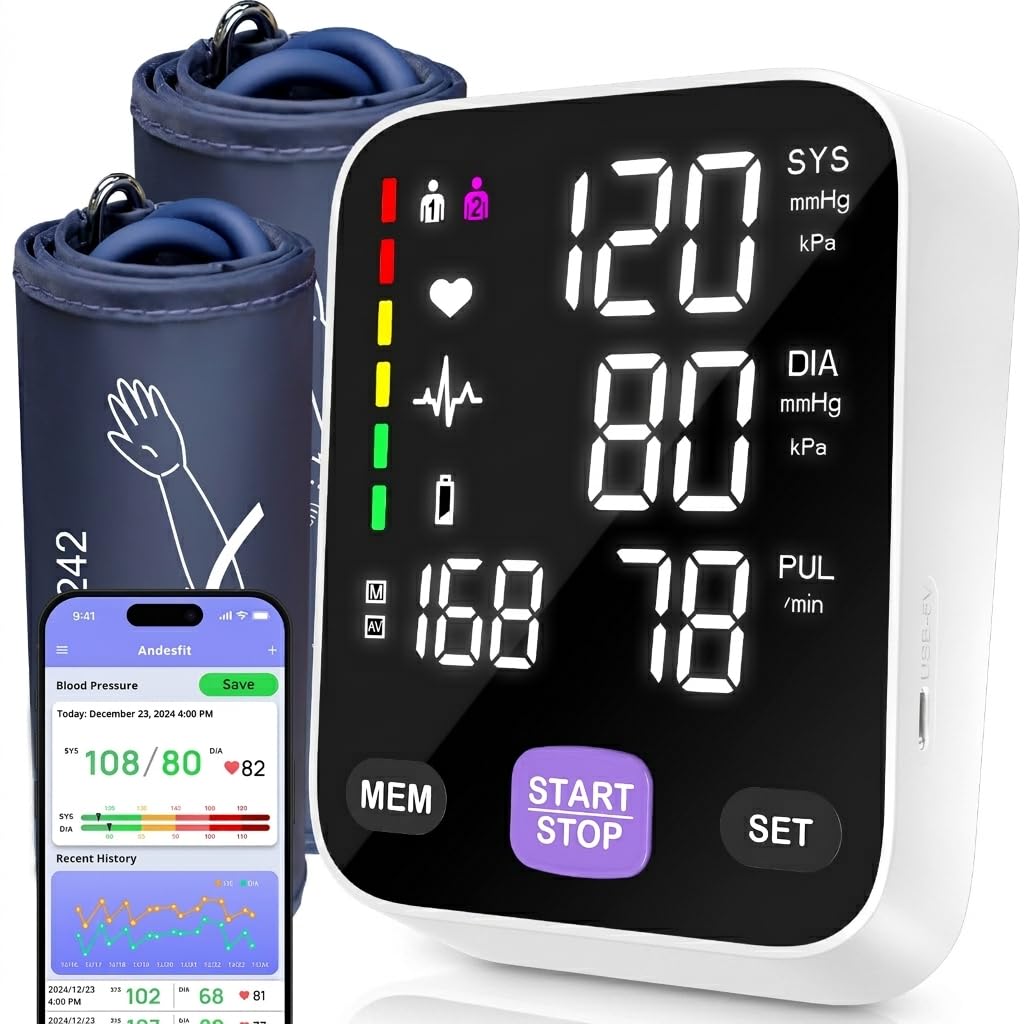
The Andesfit monitor earns its place with an extra-large cuff that extends to 21 inches, accommodating arm circumferences that many standard units cannot measure accurately. The kit includes a 17-inch standard cuff alongside the XL, covering the 9-to-17-inch range as well. FDA clearance and clinical validation back its oscillometric accuracy, and user reviews consistently note that readings match those taken at the doctor’s office — a strong indicator of reliability.
Bluetooth syncing with the free Andesfit app (compatible with Apple Health and Google Fit) is frictionless; no login or personal data is required, addressing a growing privacy concern among health tracker users. The 6-inch color LED screen is bright and legible, and dual power via USB Type-C or AA batteries adds flexibility for travel. The monitor logs 199 readings per user across two profiles, which is plenty for monthly trend reviews.
Some reviewers found the pulse sensor erratic, occasionally displaying a “HI” reading or an implausible 147 bpm. The app requires opening before each measurement if you want the Bluetooth sync to capture the data, which adds a step that some users found counterintuitive. For large-armed individuals who need a reliable cuff, however, the Andesfit delivers where others fall short.
Why it’s great
- Includes both 17 in and 21 in cuffs for larger arms
- Bluetooth sync without mandatory account login
- USB Type-C power for continuous home use
Good to know
- Pulse readings occasionally erratic
- App must be open before measurement for auto-sync
4. Microlife BPM2 Automatic Digital Monitor
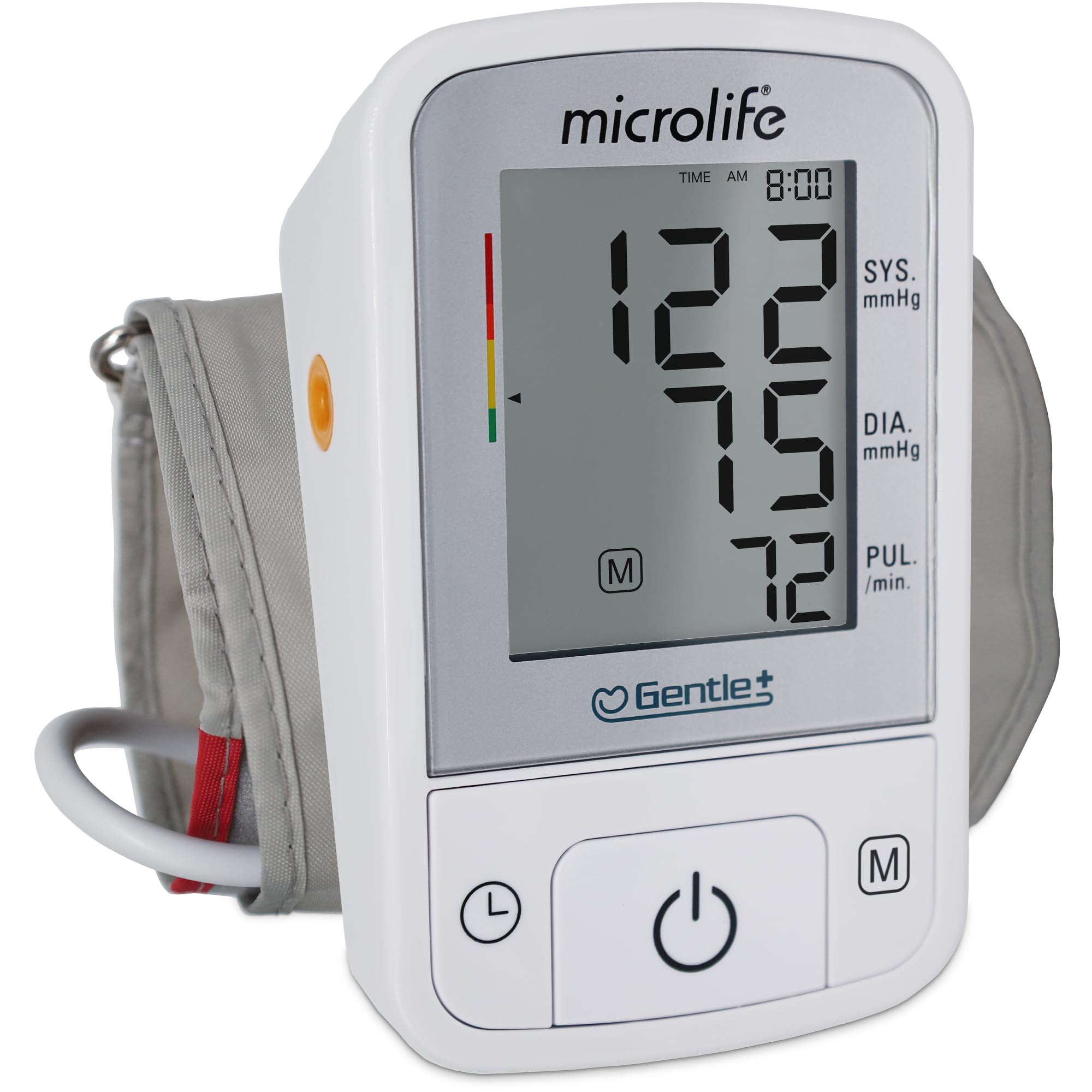
Microlife has been a fixture in clinical settings for years, and the BPM2 brings that lab-grade rigor home. It carries the highest accuracy rating — AA from the British and Irish Hypertension Society — which means its measurements are validated against a mercury sphygmomanometer within tight tolerance. The Gentle+ inflation technology uses less pressure to reach the reading, reducing the uncomfortable squeeze that some users find anxiety-inducing during measurement.
The wide-range contoured cuff fits arms 8.7 to 16.5 inches and is easier to self-apply than a standard D-ring cuff thanks to its pre-formed shape. An irregular heartbeat detector flags arrhythmic pulses during measurement, and the 60-reading memory includes an automatic average of all stored results. The one-touch start and large buttons make it genuinely simple to operate.
Customer reports on accuracy are overwhelmingly positive — users who compared it side-by-side with their doctor’s equipment saw systolic differences within 2–3 mmHg. The main trade-off is the lack of Bluetooth or app connectivity; you are managing your data on-device. If you want a straightforward, clinically bulletproof monitor without the smart features, the Microlife BPM2 is hard to beat.
Why it’s great
- BIHS AA-rated clinical accuracy
- Gentle+ inflation for less arm discomfort
- Contoured cuff is easier to self-apply than standard designs
Good to know
- No Bluetooth or smartphone app support
- AC adapter sold separately
5. iHealth Track Smart Upper Arm Monitor 550BT
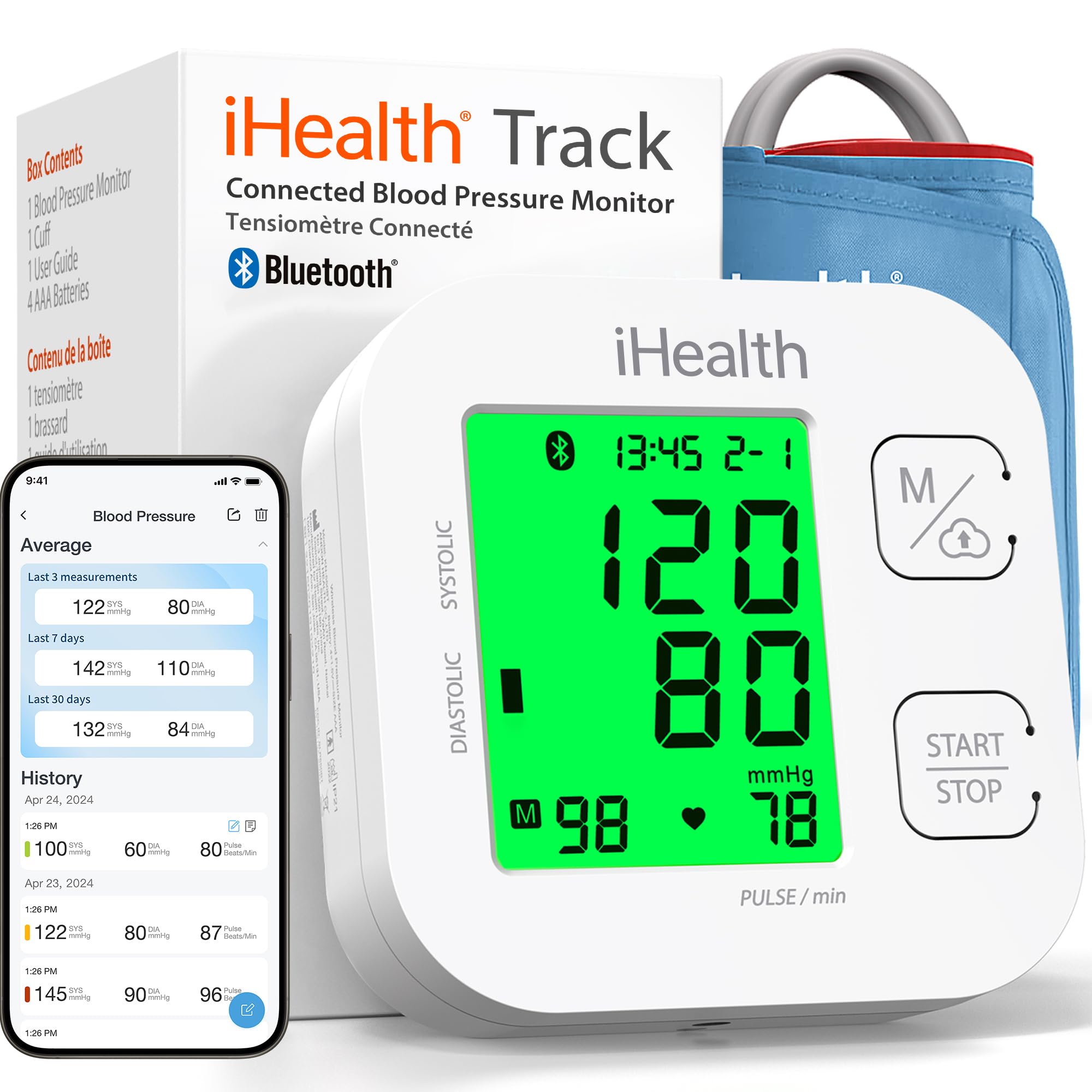
The iHealth Track remains one of the most popular Bluetooth-enabled monitors on the market, and for good reason: a large multi-color backlit display that uses green, yellow, and red to classify your reading against WHO standards at a single glance. The cuff fits arms 8.7 to 16.5 inches, and the oscillometric engine is calibrated to ESH 2010 standards for clinical accuracy. Two-button operation keeps the learning curve flat.
Bluetooth 4.0 syncs data to the free iHealth app, which stores unlimited readings and integrates with Apple Health for iOS users. The monitor also automatically detects irregular heart rhythms and displays a warning symbol after the measurement. At under 16 ounces, it is light enough to toss in a travel bag alongside the included AAA batteries.
The app has been criticized for persistent, hard-to-dismiss ads — a frustration that leads many users to log readings manually instead of using the app at all. A few customers reported that the unit lost Bluetooth pairing after several weeks, requiring a full reset. For buyers who want a clean display and are comfortable skipping the app, the iHealth Track is a dependable mid-range option.
Why it’s great
- Large color-coded display for instant WHO classification
- Bluetooth sync with Apple Health and Google Fit
- Irregular heartbeat detection as a built-in safety check
Good to know
- App includes persistent ads that frustrate users
- Bluetooth pairing may drop and require a reset
6. COCACIS Blood Pressure Monitor with Two Cuffs
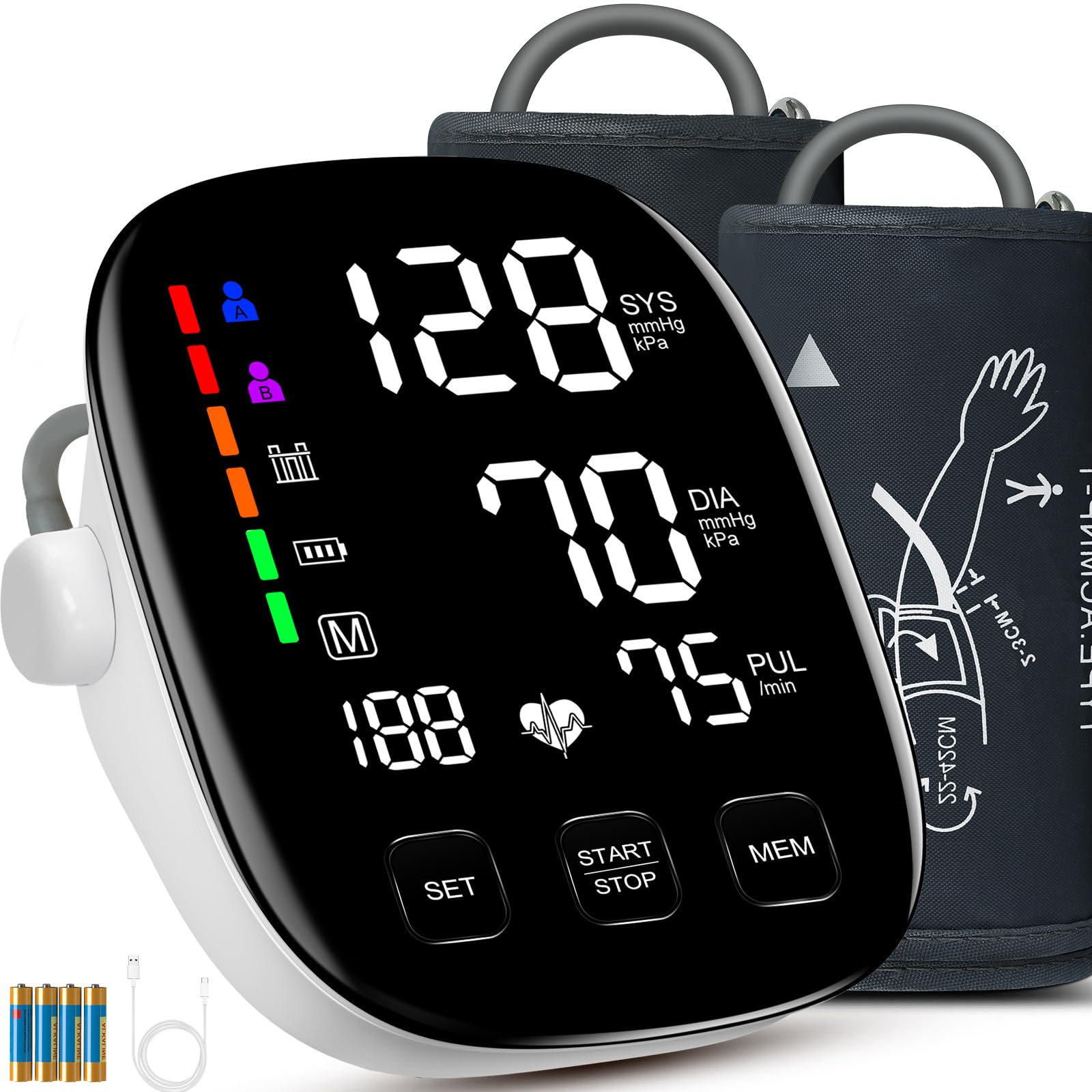
If you need two cuff sizes without paying extra, the COCACIS monitor is the answer. It ships with a medium/large cuff (9–17 in) and an extra-large cuff (13–21 in), plus a nylon carry case and Type-C cable, all at a price that undercuts most single-cuff competitors. The 6-inch backlit color screen is one of the largest in this review, and the three-color WHO indicator bar makes post-reading interpretation immediate.
Two user modes each store 199 readings, which is ample for a couple tracking weekly trends. The updated air socket valve design maintains airtight inflation, and the intelligent chip reportedly delivers readings that match clinical expectations — several users verified accuracy against a manual sphygmomanometer. Dual power via AAA batteries or USB Type-C offers true portability.
The primary trade-off is battery life: several reviews noted the unit drains AAAs faster than expected, especially when used multiple times per day. The on-device instructions could be clearer about cuff placement, leading to early error codes until the user figures out the proper angle. For the price, however, the dual-cuff kit is a generous package for households with one standard-arm and one large-arm user.
Why it’s great
- Two cuff sizes included for the whole family
- Large 6-inch backlit color display with WHO indicator
- USB Type-C and battery dual power options
Good to know
- Battery life is shorter than average
- Instructions could be more detailed on proper cuff positioning
7. Medline MDS4001 Digital Blood Pressure Monitor

Medline is a trusted name in medical supplies, and the MDS4001 offers a stripped-down, no-nonsense approach to home blood pressure monitoring. The adult upper arm cuff fits 8.5 to 12 inches, which limits its audience to average-sized arms, but within that range the proprietary inflation algorithm delivers consistent systolic and diastolic numbers. The digital LCD display is compact but legible, and a single button controls the entire measurement cycle.
The memory stores the 90 most recent readings, and the unit automatically detects errors — such as movement during measurement — and prompts a retake. Four AA batteries are included, and users consistently praise the long battery life compared to other low-cost monitors. Several customers reported that the readings matched their clinic’s equipment within 3 mmHg, which is excellent for this tier.
The cuff size cap at 12 inches means it will not fit larger arms, and the lack of a backlight makes nighttime reading difficult without a lamp. There is no Bluetooth, no color indicator, and no irregular heartbeat detection. For the user who wants a simple, accurate monitor for personal tracking without any frills, the Medline delivers on the fundamentals.
Why it’s great
- Consistent accuracy that matches clinical equipment
- Long battery life with included AA batteries
- Simple one-button operation
Good to know
- Cuff limited to 8.5–12 in arm circumference
- No backlight or color-coded risk indicator
FAQ
What arm circumference do I need for an accurate reading?
How often should I replace the cuff or the entire monitor?
Why does my monitor give a different reading every time I measure?
Is a Bluetooth monitor worth the extra cost for home use?
Final Thoughts: The Verdict
For most users, the blood pressure cuff for home use winner is the Omron Gold BP5360 because it combines AFib detection, morning spike analysis, and seamless Bluetooth app integration in a package validated by the most trusted brand in the category. If you want three cuff sizes to cover every arm circumference in your household, grab the AQESO 3-Cuff Monitor. And for a clinically bulletproof monitor without the smart features, nothing beats the Microlife BPM2.

Mo Maruf
I created WellFizz to bridge the gap between vague wellness advice and actionable solutions. My mission is simple: to decode the research and give you practical tools you can actually use.
Beyond the data, I am a passionate traveler. I believe that stepping away from the screen to explore new environments is essential for mental clarity and physical vitality.