Our readers keep the lights on and my smoothie glass nicely filled. As an Amazon Associate, I earn from qualifying purchases.
The wrong set, however, can frustrate small hands or introduce choking hazards that turn playtime into a safety concern.
I’m Mohammad Maruf — the founder and writer behind WellFizz. I have spent years analyzing toy safety regulations, wood hardness grades, and paint formulations to identify which block sets truly support early development without hidden risks.
After evaluating surface smoothness, block dimensions, material toxicity, and long-term durability across five distinct options, I have built this guide to help you find the best blocks for toddlers that balance education, safety, and lasting engagement.
How To Choose The Best Blocks For Toddlers
Toddler blocks look simple, but material quality, surface finish, dimension, and paint safety vary dramatically between sets. Here are the three most critical factors to evaluate before you buy.
Block Size and Choke-Proof Dimensions
The single most important safety metric for any toddler block is its smallest dimension. Blocks under 1.5 inches on any side pose a choking risk for children under three. Premium sets use cubes of 1.7 inches or larger, ensuring the block cannot fit entirely inside a child’s mouth even during unsupervised play. Larger blocks also stack more stably, reducing the frustration of constant toppling.
Wood Type and Paint Safety
Solid beech wood offers the best density-to-weight ratio for toddler blocks — it resists dents from drops yet remains light enough for small arms. Natural wood without a coating is safe but stains easily; water-based, non-toxic paint that meets ASTM F963 or CPSIA standards provides a durable, mouth-safe surface. Avoid blocks with solvent-based lacquers or unknown paint formulations that may chip or peel.
Educational Versatility Beyond Stacking
The best blocks for toddlers serve multiple developmental stages. A set that includes alphabet characters, number prints, shape patterns, or varied geometric forms (cubes, cylinders, arches, triangles) extends the toy’s useful life from simple grasping through preschool math and literacy games. Sets with storage bags teach organization habits and keep pieces from scattering across the floor.
Quick Comparison
On smaller screens, swipe sideways to see the full table.
| Model | Category | Best For | Key Spec | Amazon |
|---|---|---|---|---|
| Gemileo Wooden ABC Toy Building Blocks | Premium | Alphabet & number learning | 1.7-inch cubes, 36 pcs | Amazon |
| Migargle Large Wooden Building Blocks | Premium | Creative building & STEM play | 32 pcs, multiple geometric shapes | Amazon |
| BUNMO 40pcs Wooden Stacking Toys | Mid-Range | Montessori open-ended play | 40 pcs, muted colors, varied sizes | Amazon |
| Migargle Kids Wooden Blocks 80 Pcs | Mid-Range | Large piece count for group play | 80 pcs, solid beech wood, 1-inch cubes | Amazon |
| Qirptey Montessori Baby Toys 4-in-1 | Budget-Friendly | Infant sensory & teething play | Soft silicone blocks + stacking cups | Amazon |
In‑Depth Reviews
1. Gemileo Wooden ABC Toy Building Blocks

These 1.7-inch cubes are significantly larger than the typical 1-inch blocks found in most competitor sets, making them effectively choke-proof for toddlers under three. The generous size also means they stack with more stability, reducing the frustration of constant collapses during early building attempts. Each cube features uppercase on one side, lowercase on the reverse, plus colorful illustrations of animals, fruits, and vegetables — doubling as a vocabulary-building tool.
The thermal transfer printing process ensures high gloss and strong adhesion that resists scratching and peeling, even after repeated mouthing. Multiple parent reviewers explicitly note that these blocks outperform the popular Melissa & Doug 1-inch blocks in both size and print durability. The included sturdy carry bag keeps the set organized and teaches cleanup habits from the start.
One minor confusion point: the lowercase letter “l” closely resembles the number “1” on the counting blocks, which may briefly puzzle parents during alphabet games. Overall, the combination of safe dimensions, dual-sided literacy content, and durable construction makes this the most complete all-in-one block set for the toddler years.
Why it’s great
- Large 1.7-inch size eliminates choking risk
- Dual uppercase/lowercase letters plus pictures on each block
- Thermal transfer print stays intact through heavy use
Good to know
- Lowercase “l” can be mistaken for number “1”
- Only flat cubes — no arches or cylinders for varied building
2. Migargle Large Wooden Building Blocks (32 Pcs)

Unlike the uniform-cube approach of the Gemileo set, this Migargle collection introduces five distinct geometric shapes — cubes, cylinders, arches, triangles, and rectangular planks — that enable true architectural play. Toddlers can build towers with arch bridges, angled roofs, and cantilevered structures, which teaches balance and load distribution far earlier than standard stacking. The blocks are crafted from solid natural wood with smooth, rounded edges and non-toxic water-based paint.
The 32-piece count is intentionally modest to avoid overwhelming a young builder while still providing enough variety for complex creations. Several parent reviewers note that the blocks are large enough to avoid choking hazards yet small enough for a 1-year-old’s grip. The blocks produce a satisfying solid thud when knocked down, which toddlers find endlessly entertaining and which reinforces cause-and-effect learning.
The included storage bag has been noted as the weakest component — one reviewer reported the handle ripping within 48 hours. For long-term organization, consider transferring the blocks to a dedicated bin or shelf. Some users also purchased a second set to enable larger builds, suggesting that 32 pieces may feel limiting for advanced preschool builders.
Why it’s great
- Multiple geometric shapes encourage creative engineering
- Solid wood construction with smooth, safe edges
- Ideal size for toddler hands — not too big, not too small
Good to know
- Storage bag handle may fail with frequent use
- 32 blocks may be insufficient for older preschool builders
3. BUNMO 40pcs Wooden Stacking Toys
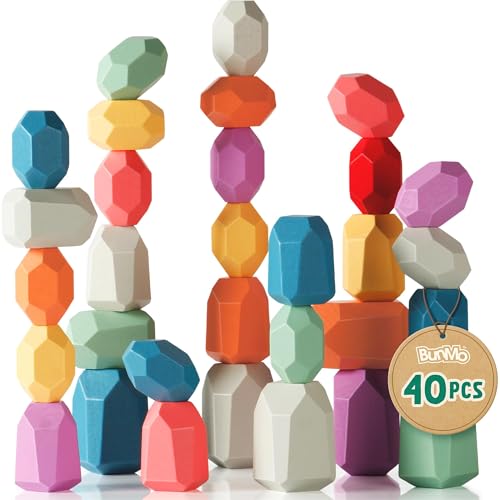
This BUNMO set breaks away from the primary-color norm with a palette of muted, earthy tones that feel more like a Waldorf classroom accessory than a typical toy bin filler. The 40 pieces come in varied sizes and organic shapes that are intentionally difficult to stack perfectly — which is the point. The challenge teaches patience, balance, and persistence as toddlers learn to adjust pressure and alignment to achieve a stable tower.
The blocks arrive well-packaged in a reusable box that also serves as storage. Multiple daycare and preschool reviewers have adopted these blocks for fine motor skill development exercises, noting that the varied difficulty levels keep children engaged across a wide age range. The paint shows excellent adhesion — no chipping reported even after extensive mouthing by teething toddlers.
The main limitation is that these blocks are less versatile for traditional building. Because they are not uniform cubes or standard geometric shapes, children more often use them for tossing, knocking over, or pretending they are individual objects (food, money, rocks) rather than constructing towers or walls. If your toddler primarily wants to build recognizable structures, the Migargle or Gemileo sets may be more satisfying.
Why it’s great
- Unique muted color scheme appeals to parents seeking aesthetic toys
- Varied stacking difficulty builds patience and fine motor control
- Paint stays intact through heavy mouthing
Good to know
- Not ideal for traditional tower or wall construction
- Smaller pieces may require supervision for children under 12 months
4. Migargle Kids Wooden Blocks 80 Pcs

With 80 solid beech wood cubes in a single set, this Migargle offering delivers the highest piece count-per-dollar in this review, making it ideal for daycare centers, playgroups, or households with multiple children. The natural beech wood construction is notably harder and denser than the pine or birch used in some budget sets, meaning these blocks resist denting and maintain their square edges through years of rough play. The water-based paint is non-toxic and meets toy safety regulations for mouthing.
The set includes a convenient carrying bag that makes cleanup straightforward, and the uniform cube shape encourages sorting, counting, and early math games in addition to stacking. Pre-K and early elementary teachers have adopted these blocks for lessons in balance, symmetry, and basic physics principles. The smooth, rounded edges have been praised for preventing scratches on little hands.
The one important caveat: at roughly 1-inch per cube, these blocks are smaller than the Gemileo 1.7-inch option. Multiple reviewers flagged that the smallest pieces could be a choking hazard for infants under 12 months. For children aged 1 to 3, these blocks are best used with supervision to ensure no single piece is mouthed. The 80-piece count also means more clutter on the floor — the storage bag helps, but regular tidying is essential.
Why it’s great
- Highest piece count at 80 blocks for group play
- Solid beech wood is exceptionally durable
- Smooth edges safe for small hands
Good to know
- 1-inch cubes may pose choking risk for children under 12 months
- Storage bag is adequate but not heavy-duty
5. Qirptey Montessori Baby Toys 4-in-1
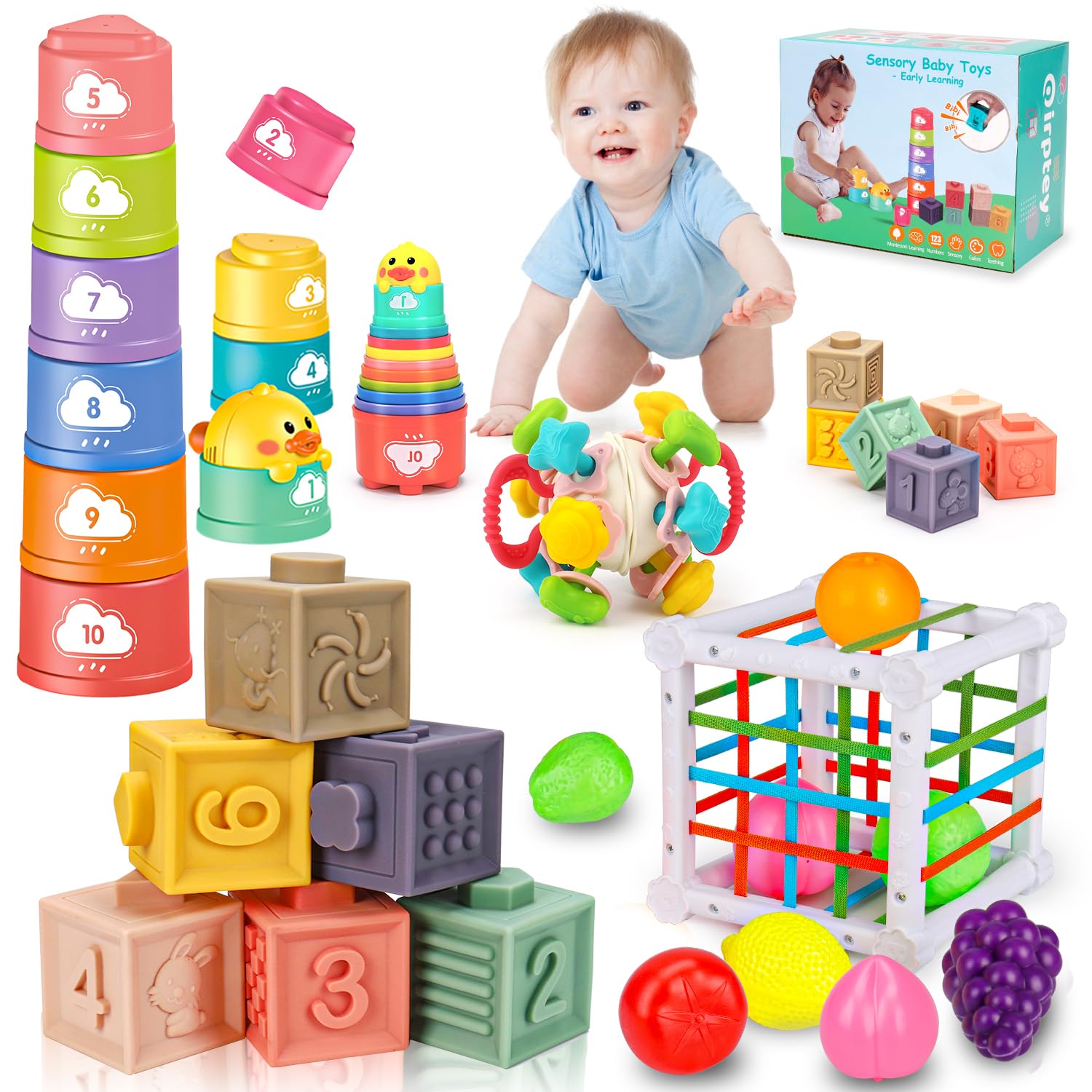
This is the only soft-block option in this review, and it serves a completely different age range than the wooden sets above. The Qirptey kit combines food-grade silicone stacking blocks (safe for teething), stacking cups with textured surfaces and number prints, a shape sorter bin with fruit-shaped pieces, and a sensory toy — all in one package. The silicone blocks can be squeezed, chewed, and thrown without any risk of injury, making this the ideal entry-point for babies 6 to 18 months old.
The stacking cups feature varying textures, colors, and numbers that introduce early math concepts through tactile play. The shape sorter bin uses fruit-shaped pieces (guava, orange, peach, lemon) that are lightweight and easy for small hands to grasp. Multiple reviewers praise the set’s ability to grow with the child — the cups and sorter engage a 6-month-old, while the stacking challenge remains relevant through the second birthday.
The primary durability concern is the shape sorter bin itself: several parents reported that the box holding the fruit pieces broke relatively easily when handled roughly. Additionally, the silicone blocks are not designed for architectural building in the same way wooden blocks are — they compress and wobble rather than stack precisely. For a child transitioning from mouthing to building, consider pairing this set with one of the wooden options above for a more complete developmental toolkit.
Why it’s great
- Food-grade silicone blocks safe for teething and mouthing
- Four-in-one design offers sensory, sorting, and stacking activities
- Lightweight pieces are easy for infants to grasp
Good to know
- Shape sorter bin can break if handled roughly
- Silicone blocks do not stack as precisely as wood
FAQ
What block size is safest for a 1-year-old?
Are silicone blocks better than wood for teething babies?
How many blocks does a toddler actually need?
Can I wash wooden blocks safely?
Final Thoughts: The Verdict
For most users, the blocks for toddlers winner is the Gemileo Wooden ABC Toy Building Blocks because the 1.7-inch cubes provide superior safety and the dual-sided alphabet/picture system supports literacy from the very first stacking session. If you want creative architectural play with multiple shapes, grab the Migargle Large Wooden Building Blocks. And for a teething infant transitioning into sensory play, nothing beats the Qirptey Montessori Baby Toys 4-in-1.

Mo Maruf
I created WellFizz to bridge the gap between vague wellness advice and actionable solutions. My mission is simple: to decode the research and give you practical tools you can actually use.
Beyond the data, I am a passionate traveler. I believe that stepping away from the screen to explore new environments is essential for mental clarity and physical vitality.