Our readers keep the lights on and my smoothie glass nicely filled. As an Amazon Associate, I earn from qualifying purchases.
Stripping old paint from wood without gouging the grain or inhaling toxic dust takes the right abrasive media, not just a powerful blaster. Choosing incorrectly — a grit that is too aggressive or too fine — can ruin hours of restoration work or leave you stuck with half-removed layers.
I’m Mohammad Maruf — the founder and writer behind WellFizz. After tracking dozens of abrasive formulations, grit ratings, and real-world results across restoration shops, I focus on which media actually preserves wood fibers while removing paint efficiently.
Whether you are refinishing a vintage chair or prepping a deck for stain, the best blasting media for removing paint from wood balances substrate safety with cutting speed to save both the project and the timeline.
How To Choose The Best Blasting Media For Removing Paint From Wood
Picking blasting media for wood is different from selecting media for steel or concrete. Wood is porous, fibrous, and easily dented by hard particles. The three factors that matter most are media hardness, particle shape, and grit size.
Hardness on the Mohs Scale
Media with a Mohs hardness above 6 — like aluminum oxide at 9 — cuts aggressively and works fast, but it can embed into soft woods and create a rough texture. Walnut shell media sits around 4.5 on the Mohs scale, making it ideal for softer woods because it shears paint without digging into the grain.
Grit Size and Surface Profile
Coarse grits (12/20 or 18/40) remove multiple paint layers quickly but leave a visible texture. Fine grits (80 or 100) deliver a smoother finish and are better for final passes or thin coatings. Matching the grit to the paint thickness prevents over-cutting the wood.
Recyclability and Dust
Media that fractures into smaller sharp particles on impact — like glass beads — can be reused fewer times than media that stays round or angular. Walnut shells compress rather than shatter, offering more cycles per pound. Low-dust media also keeps your visibility clear inside a blast cabinet.
Quick Comparison
On smaller screens, swipe sideways to see the full table.
| Model | Category | Best For | Key Spec | Amazon |
|---|---|---|---|---|
| Walnut Shell 18-40 Grit (10 lbs) | Premium | Fine wood restoration | Mohs 4.5, 18-40 Grit | Amazon |
| Glass Beads #8 Medium 70-80 Grit | Premium | Cleaning without etching | 70-100 Grit, 10 lbs | Amazon |
| Walnut Shell 18-40 Grit (8 lbs) | Mid-range | Gentle paint stripping | Mohs 4.5, 18-40 Grit | Amazon |
| Aluminum Oxide 100 Grit (14 lbs) | Mid-range | Fast stripping on hardwoods | Mohs 9, 100 Grit | Amazon |
| Aluminum Oxide #80 Grit (8 lbs) | Mid-range | Rust and paint on metal/wood | Mohs 9, 80 Grit | Amazon |
| Glass Beads #10 100-170 Mesh (8 lbs) | Budget-friendly | Fine finishing on soft metals | 100-170 Mesh, 8 lbs | Amazon |
| Walnut Shell 12/20 Grit (5 lbs) | Budget-friendly | Small projects and pincushions | 12/20 Grit, 5 lbs | Amazon |
In‑Depth Reviews
1. 18-40 Grit Ground Walnut Shell Media (10 lbs) by GRITSMITH
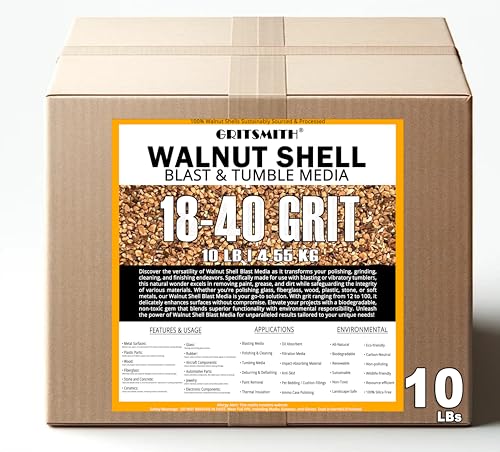
This 10-pound bucket of 18-40 grit walnut shells is the most balanced option for stripping paint from pine, oak, and other common restoration woods. The particles compress on impact — they shear paint layers without digging into the wood fibers — and the 10-pound quantity gives you enough media for multiple gun stock or furniture projects without running out mid-pass.
The Mohs hardness of 4.5 means it won’t etch glass or soft metals, but it handles paint removal on wood substrates extremely efficiently. Users running this in a blast cabinet report consistent stripping with minimal dust because the shells stay intact longer than harder media that shatters into fine powder.
Recyclability is strong: walnut shells can be cycled through a cabinet 5 to 8 times before they break down too small to strip effectively. That makes the per-project cost much lower than the initial price suggests, and the biodegradable material means disposal is simple.
Why it’s great
- Mohs 4.5 is safe for soft and hard wood grains
- 10 lbs provides good volume for multiple sessions
- Low dust compared to aluminum oxide
- Biodegradable and reusable 5-8 cycles
Good to know
- 18-40 grit is fine — slow on thick heavy paint layers
- Not designed for rust removal on steel
2. #8 Medium Glass Beads 70-80 Grit (10 lbs) by Roly Poly

Made in the USA, these #8 spec glass beads (70-100 grit) produce a smooth satin finish on wood after paint removal without leaving abrasive residue embedded in the surface. The round bead shape impacts at lower peak pressure than angular aluminum oxide, reducing the risk of warping thin wood panels or veneers.
Users highlight that this media works well with siphon-feed blast guns even on lower-CFM compressors. The glass beads are silica-free and inert, so they do not chemically react with the wood or leave contaminants that could affect stain adhesion later.
Volume-per-pound is the main trade-off: glass beads are denser than walnut shells, so 10 pounds looks smaller in the cabinet. For occasional wood stripping projects, the consistent finish and low etching risk make this a premium choice.
Why it’s great
- Round beads provide a smooth, satin finish
- Silica-free and inert for safe handling
- Works well with siphon and pressure blast systems
- Made in the USA
Good to know
- 10 lbs has low volume — may need multiple boxes
- Not ideal for aggressive stripping of thick paint
3. 18-40 Grit Walnut Shell Media (8 lbs) by INTERACTIVIA
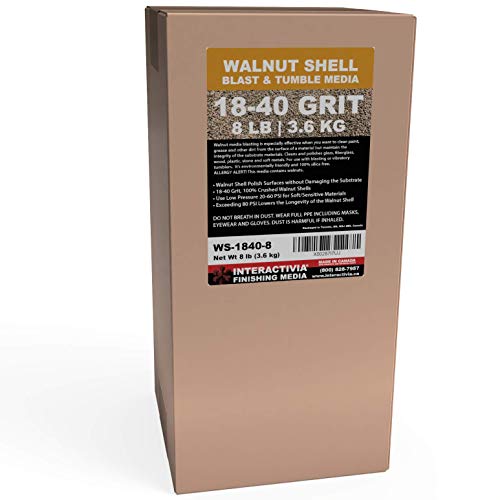
This 8-pound bag of fine 18-40 grit walnut shells is a straightforward entry point for wood paint stripping without the expense of larger bulk purchases. The organic media is silica-free and biodegradable, making cleanup easier than with mineral-based abrasives that leave sharp dust in the cabinet and on the shop floor.
Reviewers consistently note it removes paint and carbon buildup from intake valves and wood surfaces without damaging the substrate. The loose bulk density of about 40-50 lb/ft³ means this media carries well in a standard blast cabinet hopper without clogging the metering valve.
For projects on soft woods like cedar or poplar, the fine grit prevents the pitting that coarser media can cause. The 8-pound quantity suits smaller furniture pieces or sign work rather than full-house exteriors.
Why it’s great
- Fine grade preserves soft wood grain
- Biodegradable and silica-free
- Loose bulk density keeps hopper feed consistent
Good to know
- 8 lbs runs out quickly on large projects
- Not aggressive enough for multiple thick paint coats
4. Aluminum Oxide 100 Grit (14 lbs) by HDURCIR
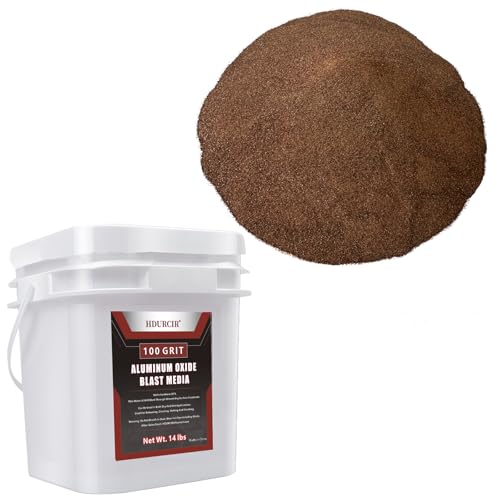
With a Mohs hardness of 9, this 100-grit aluminum oxide cuts paint layers faster than any organic media. The 14-pound bucket offers the best per-pound value among the harder media options, making it the choice for stripping paint from dense hardwoods like maple or teak where substrate marking is less of a concern.
Users report consistent cutting even after 10 hours of use in a blast cabinet. The media stays angular — it does not round off quickly like glass beads — so the stripping speed remains uniform through multiple recycles. The included sturdy plastic bucket prevents moisture contamination during storage.
On soft woods, 100-grit aluminum oxide can leave a visible etch if the blast pressure is not turned down. Keep the nozzle distance longer and PSI under 40 if you want to avoid grain damage on pine or fir.
Why it’s great
- Mohs 9 hardness strips paint very fast
- 14 lbs provides excellent value per pound
- Angular particles stay sharp through multiple cycles
Good to know
- Can etch soft wood if pressure is too high
- Not biodegradable — proper disposal required
5. #80 Grit Aluminum Oxide Blast Media (8 lbs) by TITGGI

If you are stripping paint from wood that has a metal component — like a cast-iron table base paired with a wood top — this 80-grit aluminum oxide handles both materials without requiring a media change. The Mohs 9 hardness cuts rust on steel and paint on wood with equal speed.
The manufacturer claims this media lasts ten times longer than silica sand per cycle. In practice, the angular brown fused aluminum oxide fractures into smaller cutting edges rather than rounding, so you get more usable media before it becomes too fine to strip effectively.
The 8-pound bucket is compact but the media is heavy, so the actual volume in the cabinet is low. For dedicated wood-only projects, walnut shells give better substrate protection, but for mixed-material restorations this is a strong contender.
Why it’s great
- Works on wood, metal, and glass in one pass
- Mohs 9 cuts fast and lasts many cycles
- Eco-friendly with no free silica
Good to know
- 8 lbs volume is small for large cabinets
- Overly aggressive for thin veneers or soft woods
6. #10 Glass Beads 100-170 Mesh (8 lbs) by INTERACTIVIA

These extra-fine glass beads (100-170 mesh) are the go-to media for cleaning paint residue from detailed wood carvings or moldings where you cannot tolerate any material removal from the original shape. The small bead size produces a peening action that dislodges paint without cutting the wood.
Users running this in a cabinet report consistent results on aluminum rims and car parts, and the same gentle action applies to wood. The beads leave a clean surface ready for primer without embedded grit that could telegraph through the new finish.
The main limitation is speed: extra-fine glass beads remove paint slowly compared to walnut shells or aluminum oxide. For a full furniture strip, this media requires more passes, but for delicate restoration work the safety margin is worth the extra time.
Why it’s great
- Extra-fine mesh is safe for carved and detailed wood
- Leaves no embedded residue on the surface
- Silica-free and inert
Good to know
- Strips paint slowly — needs multiple passes
- 8 lbs has very small cabinet volume
7. Premium Ground Walnut Shell 12/20 Grit (5 lbs) by Industrial Mineral Supply
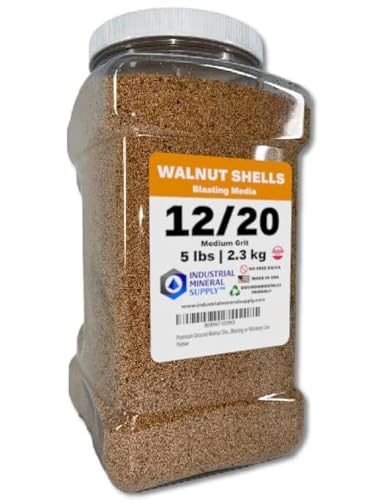
This 5-pound bag of 12/20 grit walnut shells is the most affordable entry into organic blasting media for small wood projects. The medium grit removes single layers of latex or oil-based paint effectively when used at low pressure (20-60 PSI) as recommended by the manufacturer.
The material is also marketed as a non-skid additive and pincushion filler, which hints at its gentle nature — it will not dull needles, so it certainly won’t gouge your wood. Users confirm the quality is consistent, though the 5-pound quantity is best suited for small workpieces like picture frames or trim pieces.
Some reviews note the media is dusty out of the bag. Pre-rinsing or running it through a sieve before loading the cabinet reduces airborne fines and improves flow through the blast gun.
Why it’s great
- Lowest cost option for small wood projects
- Safe on soft woods at recommended PSI
- Non-toxic and biodegradable
Good to know
- 5 lbs is only enough for small restoration tasks
- Some dust — may need sifting before use
FAQ
Can I use aluminum oxide on soft wood without damaging it?
How many times can walnut shell media be reused before replacement?
What PSI should I use for blasting paint off wood?
Final Thoughts: The Verdict
For most users, the blasting media for removing paint from wood winner is the GRITSMITH 18-40 Grit Walnut Shell Media (10 lbs) because it balances substrate safety, stripping speed, and per-project value for both soft and hard woods. If you want fast cutting on dense hardwoods, grab the HDURCIR Aluminum Oxide 100 Grit (14 lbs). And for delicate carved or detailed wood pieces, nothing beats the INTERACTIVIA #10 Glass Beads (8 lbs) for surface preservation.

Mo Maruf
I created WellFizz to bridge the gap between vague wellness advice and actionable solutions. My mission is simple: to decode the research and give you practical tools you can actually use.
Beyond the data, I am a passionate traveler. I believe that stepping away from the screen to explore new environments is essential for mental clarity and physical vitality.