Our readers keep the lights on and my smoothie glass nicely filled. As an Amazon Associate, I earn from qualifying purchases.
Stripping old paint from metal is a balancing act between abrasive aggression and substrate safety. Use the wrong blasting media and you either grind for hours or scar the metal beneath the coating. The choice comes down to grit hardness, particle shape, and reusability — three factors that separate a clean strip from a ruined project.
I’m Mohammad Maruf — the founder and writer behind WellFizz. I’ve spent years analyzing abrasive material specs, reviewing real-user blasting results, and comparing the chemical and physical properties that determine how fast and safely a media removes paint from steel, aluminum, and cast iron surfaces.
This guide cuts through the marketing to rank the seven top-selling options and help you pick the best blasting media for removing paint from metal based on your specific project needs and equipment.
How To Choose The Best Blasting Media For Removing Paint From Metal
Picking blasting media isn’t just about grabbing the cheapest bag. You need to match the abrasive to the metal thickness, the paint type, and your blasting equipment’s PSI range. Here are the three most critical factors to consider before you pull the trigger.
Match Hardness to Substrate Sensitivity
The Mohs hardness scale tells you how aggressive a media is. Aluminum oxide sits at a 9 — nearly as hard as diamond — and strips thick paint and rust from steel fast, but it will etch soft aluminum or thin sheet metal if you linger. Walnut shell media ranks around 4.5 to 5, making it safe for softer metals, fiberglass, and wood, but too gentle for heavy industrial coatings. Crushed glass falls in between. Hard rule: the harder the media, the faster the strip, but the higher the risk of surface damage on thin or soft metal.
Pick the Right Grit Size for Your Paint Layer
Coarse grits like 12/20 or 18/40 deliver aggressive cutting action that blasts through thick, multi-layer paint quickly. They leave a rougher surface profile, which is ideal if you plan to repaint and need mechanical adhesion. Fine grits like 80, 100, or 120 produce a smoother finish and work better for thin paint coats, light rust, or when you need a clean surface without heavy pitting. The trade-off: finer grits take longer to remove heavy buildup.
Consider Reusability and Cost Per Job
Blasting media is a consumable, but some types last much longer than others. Aluminum oxide is brittle enough to fracture on impact, creating fresh sharp edges — it can be cycled through a cabinet several times before it wears down. Crushed glass fractures more readily and turns to dust faster, requiring more frequent replacement. Walnut shells break down the slowest of the three but lose cutting power as particles round off. A media that lasts longer costs more upfront but often saves money across multiple jobs.
Quick Comparison
On smaller screens, swipe sideways to see the full table.
| Model | Category | Best For | Key Spec | Amazon |
|---|---|---|---|---|
| #120 Aluminum Oxide | Premium | Fine etching and smooth paint removal on steel | 120 Grit / Mohs 9 | Amazon |
| Crushed Glass 30-60 Grit | Mid-Range | Heavy rust and thick paint on thick steel | 50 Mesh / Medium | Amazon |
| Aluminum Oxide 14 LBS 100 Grit | Mid-Range | Versatile paint removal on steel and aluminum | 100 Grit / 14 lbs | Amazon |
| #80 Grit Aluminum Oxide | Mid-Range | Aggressive rust and paint stripping in cabinets | 80 Grit / Mohs 9 | Amazon |
| Walnut Shell 18-40 Grit (10 lbs) | Mid-Range | Gentle paint removal on soft metals and plastic | 18-40 Grit / Fine | Amazon |
| Walnut Shell 18-40 Grit (8 lbs) | Budget-Friendly | Cleaning brass and soft metal without damage | 18-40 Grit / Fine | Amazon |
| Walnut Shell 12/20 Grit (5 lbs) | Budget-Friendly | Low-pressure blasting on sensitive substrates | 12/20 Grit / Medium | Amazon |
In‑Depth Reviews
1. #120 Aluminum Oxide — 8 LBS

The #120 aluminum oxide from Interactivia is the finest-grit premium oxide on this list, and it delivers exactly what a painter or cerakote applicator needs: a smooth, frosted surface profile that accepts coatings without visible tool marks. At a Mohs hardness of 9, it still cuts aggressively through thin paint and light rust, but the fine particle size (roughly 125 microns) prevents deep gouging on steel barrels or brackets. Users report excellent results etching glass and texturing gun parts for cerakote adhesion — two scenarios where surface consistency matters more than raw removal speed.
This media has a bulk density of 115 to 125 pounds per cubic foot and a specific gravity of 3.9, which means it delivers consistent impact force in a cabinet blaster without excessive dust generation. Because aluminum oxide is recyclable through multiple cycles, the 8-pound bucket lasts longer than an equivalent weight of crushed glass. It is also free of detectable crystalline silica, which is a meaningful safety advantage over sand-based abrasives.
Where this grit falls short is on heavy, multi-layer industrial paint or thick mill scale. The fine particles struggle to break through thick coatings quickly, so you will spend more time per square foot compared to an 80-grit or 50-mesh media. If your project involves removing thick, flaking paint from a car frame or heavy equipment, you would be better served by a coarser abrasive. But for precision strip-and-coat work, this is the cleanest-finish option.
Why it’s great
- Produces a smooth, even etch perfect for cerakote or paint prep
- Hardness 9 cuts quickly without deep gouging on most steel
- Recyclable and silica-free for safer indoor cabinet use
Good to know
- Too fine for thick multi-layer paint — removal will be slow
- 8-pound bucket runs out fast if you are doing large panels
2. Crushed Glass Abrasive 30-60 Grit — 19 lbs

The 19-pound bucket of crushed glass from Interactivia offers the largest volume per dollar in the mid-range tier and is specifically designed for aggressive removal of heavy rust and thick paint from thick steel. The 30-60 grit range (roughly 559 to 254 microns) gives you a medium particle that strikes a balance between cutting speed and surface profile depth. One user stripped thick corrosion from a car subframe using only plastic sheeting to contain and reuse the media, confirming that crushed glass can be cycled if you work carefully.
Crushed glass has a distinct advantage over aluminum oxide when you are dealing with massive surface areas: it is cheaper per pound, and the angular particles fracture on impact to create fresh cutting edges. That fracturing also means it breaks down faster than aluminum oxide, turning to fine dust that clouds your cabinet and reduces visibility. Users report that the dust accumulates quickly, so a good dust collection system is essentially mandatory with this media.
One reviewer noted that the coarser particles (closer to 30 grit) tended to bounce off painted surfaces rather than cut into them, especially on parts with intricate contours where the nozzle angle shifts. For detailed work like wheel spokes or engine brackets, a finer grit like 100 is more effective. Crushed glass is also less forgiving on thin metal — it can warp or dimple sheet metal if you hold the nozzle too close. Reserve this for heavy structural steel or thick-walled components.
Why it’s great
- Best value per pound for large-scale stripping jobs
- Angular particles cut heavy rust and thick coatings fast
- Reusable with careful collection and screening
Good to know
- Creates heavy dust cloud — cabinet dust collector is essential
- Coarse end of grit range bounces off surfaces rather than removing paint
3. Aluminum Oxide 14 LBS 100 Grit
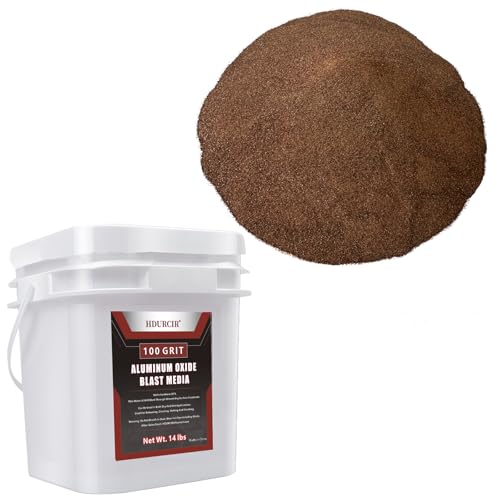
The HDURCIR 14-pound bucket of 100-grit aluminum oxide is the best balance of volume, cutting power, and price in this roundup. At 100 grit, it is fine enough to avoid deep scarring on steel and aluminum but coarse enough to strip single-layer paint and light rust without excessive dwell time. Users are reporting consistent results after 10 hours of cabinet use, with the media flowing better as the initial sharp edges wear slightly — a sign that the aluminum oxide is fracturing in a controlled way rather than turning to useless dust.
One user specifically used this media to remove paint from mini bike rims, noting that it sprayed evenly and left a consistent finish. That is exactly the kind of result you want from a mid-grit oxide: the particle size is uniform enough to prevent uneven stripping, and the Mohs 9 hardness ensures each grain does real work on impact. The 14-pound bucket is a sweet spot — large enough for multiple sessions on automotive parts or furniture, but not so heavy that you are stuck with years of unused media.
The main downside is that HDURCIR uses a plastic bag inside the bucket rather than sealing the bucket directly. Some users noted that the bag can tear during shipping, leading to minor spillage. Also, 100 grit is not aggressive enough for heavily rusted or multi-layer paint — you will need to upgrade to 80 grit or coarser for those jobs. But for routine paint stripping on steel or aluminum, this is the most cost-effective option per pound of abrasive.
Why it’s great
- 14 pounds provides excellent value for multiple sessions
- 100 grit balances cut speed with surface smoothness
- Long cycle life — still cuts well after 10 hours of use
Good to know
- Plastic bag inside bucket can tear during shipping
- Not aggressive enough for heavy rust or thick paint layers
4. #80 Grit Aluminum Oxide — 8 LBS

The TITGGI 80-grit aluminum oxide is the coarsest oxide on this list, and it is the go-to choice when you need to strip moderate rust and old paint quickly without switching to a siphon-feed industrial blaster. At 80 grit, each particle is roughly 200 microns across — large enough to deliver a heavy impact that fractures paint and rust on contact. Users report excellent results in cheap handheld sandblasters and cabinet setups, with one reviewer using it to remove moderate rust from rims and noting the material performed well even with a budget gun.
Aluminum oxide at this grit lasts roughly 10 times longer than silica sand, according to the manufacturer, because the particles do not crumble into useless fines after a single impact. The brown fused aluminum oxide has a Mohs hardness of 9, meaning it will etch glass and granite if you aim it at them — so do not use this media on soft aluminum or thin sheet metal unless you want a frosted texture. The 8-pound bucket is well-packaged in a durable white container that does not leak or tear during shipping.
The limitation is that 80 grit leaves a noticeably rough surface profile. If you are prepping for a high-gloss paint job or a thin coating like cerakote, you will need to follow up with a finer media or sanding to smooth the surface. Some users found the dust cloud moderate inside a cabinet, but that is true of any aluminum oxide at this grit range. For pure stripping speed on steel with no concern about final smoothness, this is the fastest oxide in the lineup.
Why it’s great
- Fastest paint and rust removal among all oxide options here
- Very long cycle life — 10x longer than silica
- Sturdy bucket prevents leaks and damage during shipping
Good to know
- Leaves a rough surface profile — needs follow-up smoothing for fine finishes
- Too aggressive for aluminum or thin sheet metal
5. Ground Walnut Shell Media 18-40 Grit — 10 LBS
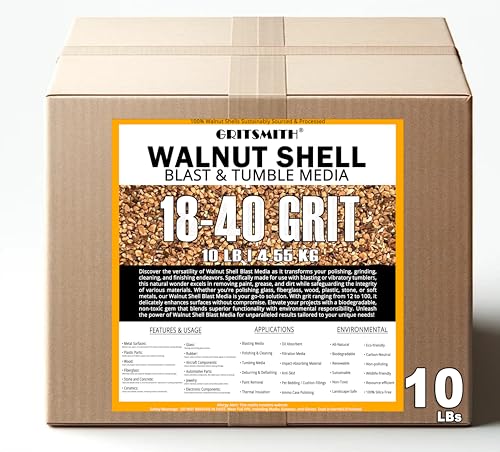
GRITSMITH’s 10-pound bucket of 18-40 grit walnut shell media is the largest-volume organic abrasive in this review, and it is the safest choice for anyone stripping paint from soft metals like brass, copper, aluminum, or even plastic and wood. At a Mohs hardness of 4.5 to 5, walnut shells are gentle enough to remove paint without damaging the underlying substrate, making them ideal for restoring vintage items, engine carbon cleaning, or polishing jewelry without pitting. Users report excellent results tumbling brass casings, with one reviewer noting that the media cleaned 100x faster than a 40-year-old batch they had been using.
The 18-40 grit range produces particles between 0.42 mm and 1 mm, which is fine enough to reach into crevices and threaded areas without clogging. Walnut shells are also biodegradable and silica-free, so they are safer to handle than mineral abrasives — though you should still wear a mask because the dust can irritate lungs. This media works best at low pressures between 20 and 60 PSI, so it pairs well with smaller hobby compressors that cannot sustain high CFM.
The trade-off is speed. Walnut shell media removes paint much slower than aluminum oxide or crushed glass, and it is ineffective against heavy rust or thick industrial coatings. If you try to force it, you will simply wear down the media without removing the paint. Some users also note that the media can become discolored from oil and carbon after extended use, which reduces its cutting ability. For painted metals that need a gentle touch, this is the right tool — just be patient.
Why it’s great
- Totally safe for soft metals, plastic, wood, and fiberglass
- Biodegradable and silica-free — safer to handle than mineral media
- Works well at low PSI (20-60) with smaller compressors
Good to know
- Very slow on thick paint or rust — not for heavy stripping
- Can discolor and lose effectiveness after extended use
6. Ground Walnut Shell Media 18-40 Grit — 8 LBS
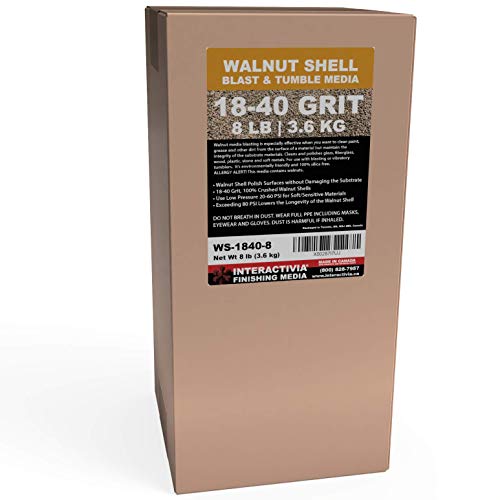
Interactivia’s 8-pound bag of 18-40 grit walnut shells is nearly identical in composition to the GRITSMITH option above, but at a slightly lower entry-level price point. The fine-grade particles remove paint, grease, and buildup without etching surfaces, and users have verified it works well on soft metals like copper and brass in vibratory tumblers and blasting cabinets. One reviewer used it to clean carbon from intake valves on a performance engine and reported fantastic results — a testament to how well walnut shells can handle organic deposits without damaging metal surfaces.
The 18-40 grit consistency is fine enough to produce uniform cleaning results across flat panels and contoured parts. The loose bulk density of 40-50 pounds per cubic foot means the media flows well through a blasting gun without clogging the nozzle, even at lower pressures. Because walnut shells are organic, they do not produce sparks on impact — a safety advantage if you are blasting near flammable materials or in enclosed spaces.
The main limitation is that 8 pounds is a relatively small volume for large stripping projects. You will go through it quickly if you are blasting a full car panel or large piece of furniture. Also, like all walnut shell media, it struggles with heavy rust and thick paint — it is simply not abrasive enough. Some users found it too harsh for polishing fine coins or delicate brass, noting that it can leave light scratching if the pressure is too high. For gentle paint removal on soft metals, it works as advertised, but buy the larger bucket if you have substantial surface area to cover.
Why it’s great
- Gentle enough for copper, brass, and aluminum without pitting
- Biodegradable, silica-free, and spark-free for safer use
- Flows well through standard blasting guns at low PSI
Good to know
- 8 pounds runs out fast on larger projects
- Too harsh for fine coin polishing if pressure isn’t dialed down
7. Ground Walnut Shell 12/20 Grit — 5 LBS
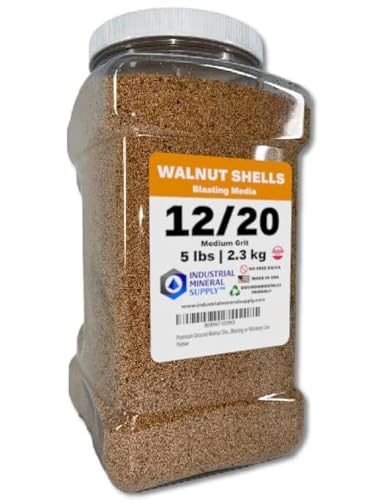
The Industrial Mineral Supply 5-pound bucket of 12/20 grit walnut shells is the most budget-friendly entry point on this list, and it serves a very specific niche: low-pressure blasting of delicate substrates. At 12/20 grit, the particles are noticeably coarser than the 18-40 options, which means they provide slightly more cutting action while still being safe for materials like rubber, plastic, glass, and fiberglass. The manufacturer recommends using 20-60 PSI for soft materials, and multiple users have confirmed the media works well as a non-skid additive and pincushion filler — not its intended blasting use, but a testament to its versatility.
This media is made from natural walnut shells with no added chemicals, so it is safe for environments where chemical strippers are not an option. The 12/20 grit size is large enough that you can see individual particles hitting the surface, which helps you gauge coverage and adjust your technique. Because it is an organic media, it produces very little dust compared to mineral abrasives, keeping your work area cleaner and reducing respiratory risk.
The downsides are significant for paint removal. At just 5 pounds, this is the smallest volume in the review — you will exhaust the bucket quickly on even a modest project. The 12/20 grit is also coarser than the 18-40 options, so it can leave visible scratch patterns on softer metals if you run the pressure too high. One reviewer explicitly stated the media is not intended for sand blasting, which suggests the larger particle size may clog siphon-feed guns with narrow orifices. This is a fine choice for light cleaning or anti-skid applications, but not a primary paint-stripping media for metal.
Why it’s great
- Safe for very sensitive substrates like plastic and rubber
- Very low dust output compared to mineral abrasives
- Natural and chemical-free — safe for enclosed spaces
Good to know
- Only 5 pounds — runs out very fast on real projects
- Coarse 12/20 particles can clog narrow siphon-feed guns
FAQ
Can I use walnut shell media in a standard sandblasting cabinet?
Which grit aluminum oxide removes paint fastest from steel?
Will crushed glass warp thin sheet metal during blasting?
Final Thoughts: The Verdict
For most users, the best blasting media for removing paint from metal winner is the HDURCIR 100 Grit Aluminum Oxide (14 lbs) because it offers the best balance of cutting speed, surface finish, and volume per dollar. If you want a fine, coat-ready surface profile without extra sanding, grab the Interactivia #120 Aluminum Oxide (8 lbs). And for gentle paint removal on soft metals where you cannot risk surface damage, nothing beats the GRITSMITH 18-40 Grit Walnut Shell (10 lbs).

Mo Maruf
I created WellFizz to bridge the gap between vague wellness advice and actionable solutions. My mission is simple: to decode the research and give you practical tools you can actually use.
Beyond the data, I am a passionate traveler. I believe that stepping away from the screen to explore new environments is essential for mental clarity and physical vitality.