Our readers keep the lights on and my smoothie glass nicely filled. As an Amazon Associate, I earn from qualifying purchases.
Cutting composite decking with a standard wood blade is a recipe for disaster. The heat generated by the wrong tooth geometry causes the plastic shell to smear, gum up the carbide, and leave a rough, melted edge that collects dirt and looks unprofessional. The right blade, however, requires a specific combination of tooth count, grind profile, and non-stick coating to shear through the abrasive wood-polymer blend without generating the friction that ruins the finish.
I’m Mohammad Maruf — the founder and writer behind WellFizz. Over years of studying material-specific cutting tools, I’ve analyzed the tooth geometry, carbide formulations, and real-world feedback that separate a blade that lasts an entire deck from one that goes dull before the first row of fascia is done.
After evaluating over 18 models on tooth count, kerf thickness, hook angle, and coating durability, I’ve narrowed the market to the seven serious contenders. Here is the complete breakdown of the best blade for cutting composite decking available right now.
How To Choose The Best Blade For Cutting Composite Decking
Composite decking is not wood. The wood-polymer mix is harder on carbide, more sensitive to heat, and prone to melting if the blade generates excessive friction. Choosing the wrong blade leads to burn marks, chipped edges, and a blade that dulls mid-project.
Tooth Count and Grind Geometry
A 40-tooth blade will cut fast but leave a slightly rougher edge. A 72-tooth or 84-tooth blade produces a smoother finish but requires more power. The critical factor is the tooth grind — a Modified Triple Chip Grind (MTCG) keeps the material cool and prevents the plastic from melting and re-depositing on the teeth. Top-tier blades all use MTCG geometry.
Non-Stick Coating
Composite decking contains polymer that softens with heat. A non-stick coating (like Perma-SHIELD or PTFE-infused layers) prevents resin from gumming up the gullets and burning onto the cutting edge. Without it, you’ll spend more time cleaning the blade than cutting.
Plate Material and Kerf Thickness
A thin kerf design removes less material, requires less power, and reduces heat generation. The trade-off is a thinner plate that flexes under lateral pressure. Premium blades use extra-hard steel bodies or laser-cut plates that resist deflection while keeping the cut cool.
Carbide Grade
Standard C2 carbide dulls quickly in abrasive composite material. Blades labeled TiCo Hi-Density Carbide, Brute Carbide, or Micrograin C3/C4 formulations resist wear and hold an edge longer. For a large deck (400+ square feet), premium carbide is the difference between one blade or three.
Quick Comparison
On smaller screens, swipe sideways to see the full table.
| Model | Category | Best For | Key Spec | Amazon |
|---|---|---|---|---|
| Diablo D1072CD 10″ | Premium | Large decks & miter saws | 72 MTCG teeth, TiCo carbide | Amazon |
| Bosch DCB1072CD 10″ | Premium | Fine finish on Trex/Azek | 72 teeth, Brute carbide | Amazon |
| Bosch DCB1284CD 12″ | Premium | 12″ miter saws | 84 teeth, triple-chip grind | Amazon |
| Diablo D0744CD 7-1/4″ | Mid-Range | Circular saws & tight spaces | 44 MTCG teeth, Perma-SHIELD | Amazon |
| DEWALT DWA31740 7-1/4″ | Mid-Range | Budget-conscious projects | 40 teeth, MTCG design | Amazon |
| Norske NCSBP228 10″ | Mid-Range | Bamboo & composite cutting | 64 teeth, Japanese steel | Amazon |
| Norske NCSBP226 7-1/4″ | Budget | Entry-level circular saw use | 48 MTCG teeth, thin kerf | Amazon |
In‑Depth Reviews
1. Diablo TrexBlade D1072CD 10″ 72-Tooth

The Diablo D1072CD is the benchmark that other composite blades are measured against. With 72 TiCo Hi-Density Carbide teeth and a Modified Triple Chip Grind, this blade delivers the highest cut quality for the longest duration — users consistently report cutting over 700 linear feet of Trex and Azek without needing a sharpening. The Perma-SHIELD non-stick coating is the real hero here, preventing the polymer residue from welding onto the carbide, which is the primary failure point for cheaper blades on composite material.
The .102-inch kerf balances material removal with stability; it removes just enough stock to keep the saw running efficiently while the -3° negative hook angle prevents the blade from grabbing the material. This makes it ideal for miter saws and cross-cut applications where control is paramount. The blade runs up to 6000 RPM and stays cool even during extended ripping sessions.
One significant advantage of this blade is its dual-use capability. While optimized for composites, several users have noted it also cuts pressure-treated lumber and polycarbonate sheets without chipping. For a large project requiring hundreds of cuts, this is the blade that saves you from a mid-day trip to the hardware store for a replacement.
Why it’s great
- TiCo carbide holds edge longer than standard C2 alternatives
- Perma-SHIELD coating prevents gumming during long cuts
- Negative hook angle provides superior control on miter saws
- Smooth finish across Trex, Fiberon, and Azek materials
Good to know
- Premium price reflects the carbide quality and coating
- Not ideal for underpowered trim saws due to tooth count
2. Bosch DCB1072CD 10″ 72-Tooth

Bosch’s Edge series brings the DCB1072CD with a refined Brute Carbide formulation — an upgraded C3/C4 micrograin blend that resists impact damage from the abrasive mineral fillers found in composite decking. The 72 teeth are arranged in a triple-chip grind profile that leaves a sharp, squared edge without the fraying that plagues general-purpose blades. Users cutting Trex Transcend confirmed no melting or chalking even on end-grain cuts.
The extra-hard steel blade body resists bending and deflection, which is critical when you are cutting angled miters for stair treads or fascia boards. It is specifically engineered for portable table saws and 10-inch miter saws, and the thinner kerf design generates less heat per pass — a direct factor in preserving both the blade coating and the decking surface.
Field reports from a 360-square-foot Trex deck installation show the blade staying sharp for the entire job, including cross-cuts on 2×12 blocking. The blade was passed to another user afterward with significant life remaining. For the price point, the Bosch offers carbide longevity that rivals blades costing more.
Why it’s great
- Brute C3/C4 carbide resists dulling from abrasive fillers
- Laser-cut body minimizes deflection on angled cuts
- Thinner kerf reduces heat and extends blade life
- Consistent clean finish verified over large deck projects
Good to know
- Not sold with a storage case
- 72-tooth may feel slower in underpowered saws
3. Bosch DCB1284CD 12″ 84-Tooth
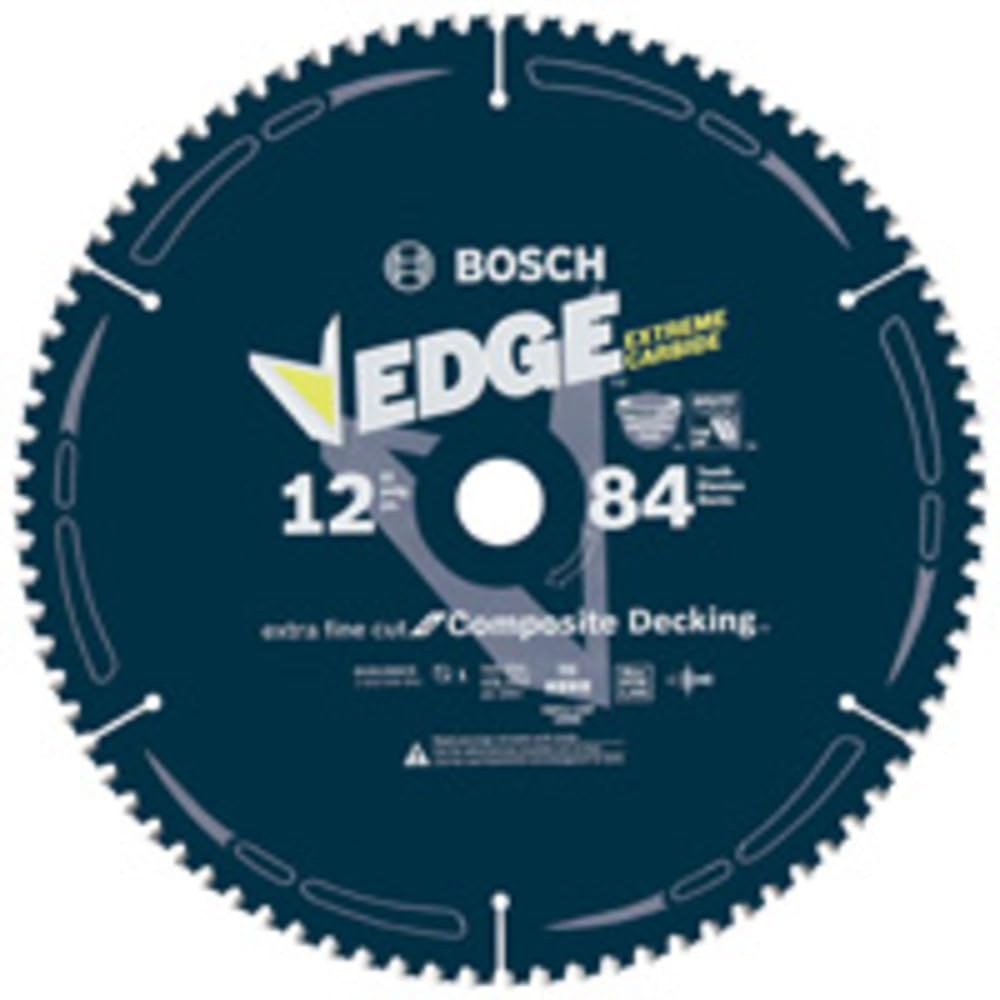
When you are cutting on a 12-inch sliding miter saw, the Bosch DCB1284CD is the highest tooth-count dedicated composite blade in this lineup. The 84-tooth triple-chip grind geometry produces a finish so smooth that it eliminates the need for sanding or filing on the final edge. Users cutting Trex Transcend reported burr-free, crisp corners on both cross-cuts and compound angles.
The Brute Carbide formulation in this 12-inch blade follows the same upgraded C3/C4 micrograin construction as its 10-inch sibling, but the plate diameter allows you to cut wider boards in a single pass. The extra-hard steel body resists heat expansion, which is critical when the blade is spinning at high RPM for extended miters. One reviewer noted the blade still produced sharp edges after cutting an entire 350-square-foot deck.
The one concern from a user who purchased a second blade was that the original dulled after approximately 100 cuts — though that may reflect an aggressive saw feed rate or material-specific fillers. Most feedback, however, highlights the clean, melt-free edge as the defining advantage over lower-tooth-count blades that leave a plastic lip on the underside of the cut.
Why it’s great
- 84 teeth deliver an almost polished cut surface
- Brute carbide resists chipping on mineral-filled composites
- Designed specifically for 12-inch miter saw platforms
- Thin kerf reduces heat buildup on long rip cuts
Good to know
- Dull reports exist for very high cut counts
- Overkill for small projects with fewer than 50 cuts
4. Diablo TrexBlade D0744CD 7-1/4″ 44-Tooth

For circular saw users working on deck framing or cutting composite boards in place, the Diablo D0744CD is the standard recommendation. The 44-tooth MTCG design with a -3° hook angle keeps the blade from grabbing the material while producing a clean finish. The TiCo Hi-Density Carbide holds up better than standard C2 on the job site, and the Perma-SHIELD non-stick coating is particularly important for circular saw applications where visibility of the cut line matters — gummed-up teeth obscure the kerf quickly.
The .065-inch kerf is notably thin, which means the blade requires less power from the saw to maintain speed through a full 1.5-inch composite board. Users cutting Fiberon and Wear Deck confirmed that the blade produces a smooth edge without chipping the surface coating, though the composite dust is significant — plan for full mask and vacuum setup.
One clear advantage of the 7-1/4-inch diameter is compatibility with almost every cordless circular saw on the market. If you are switching between a circular saw for rip cuts and a small miter saw, this single blade covers both tools without swapping out for a larger diameter.
Why it’s great
- Thin kerf reduces power draw for cordless saws
- Perma-SHIELD coating prevents melted resin buildup
- 44-tooth balance of speed and finish quality
- Negative hook angle controls grab on plunge cuts
Good to know
- 7-1/4″ limit to maximum depth of cut
- Not optimized for miter saws with arbor locks above 5/8″
5. DEWALT DWA31740 7-1/4″ 40-Tooth
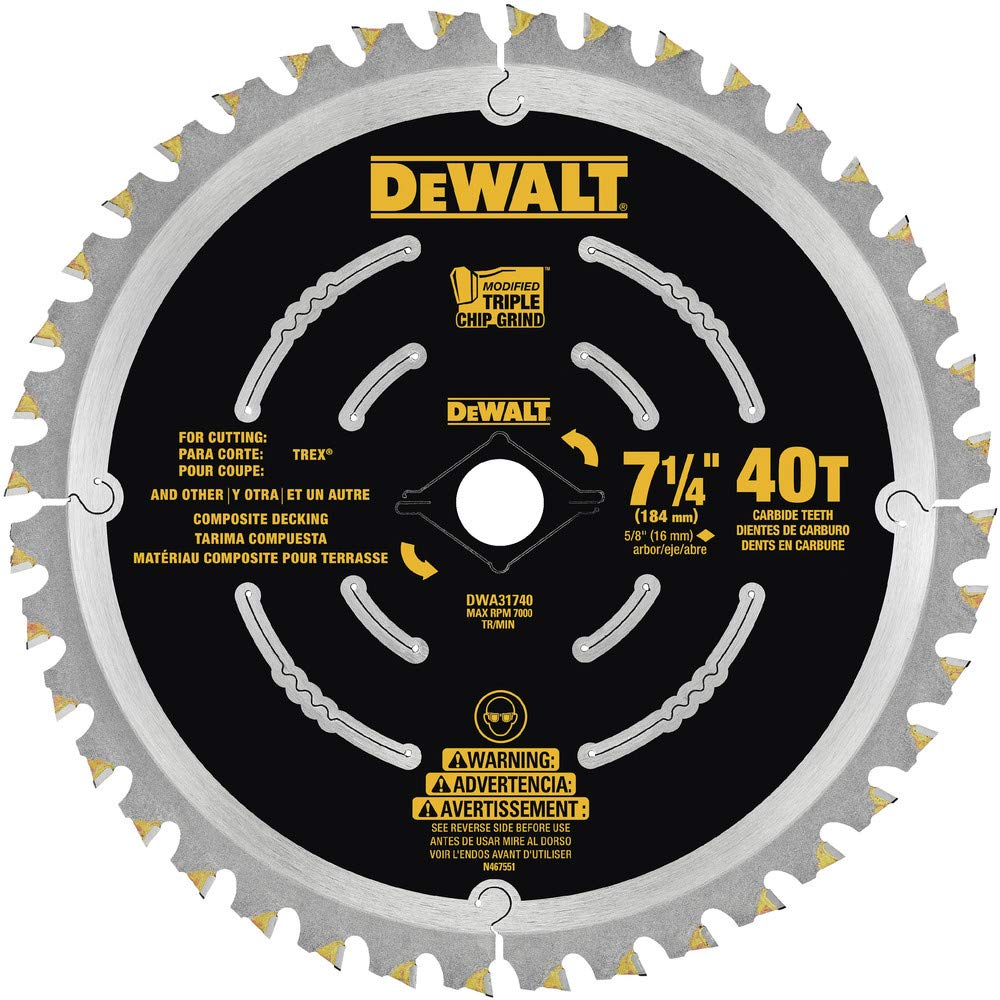
DEWALT’s DWA31740 is a 40-tooth blade with a modified triple chip grind that brings the price down without abandoning the MTCG geometry that makes composite cutting possible. The laser-cut plate design reduces vibration and keeps the blade body cool, which is important when making a series of cross-cuts on framing lumber and composite boards interchangeably. Users cutting Trex planks and Race Deck plastic tiles confirmed clean, straight cuts with a Metabo circular saw.
The 5/8-inch arbor diameter fits most standard circular saws and some compact miter saws. The blade produces a good finish but some users noted that it does not hold its edge as long as the premium Diablo or Bosch options — the C2 carbide is adequate for a single deck project but may dull faster on larger installations. For a 200-250 square foot deck, this blade provides a solid balance of quality and investment.
Where this blade stands out is in its consistency. DEWALT has engineered the plate to resist warping under load, and the MTCG teeth produce a melt-free edge even when the saw is fed aggressively. It is not the longest-lasting blade on the list, but for the budget-conscious craftsman, it delivers professional results without the professional price tag.
Why it’s great
- Laser-cut plate stays cool and resists warping
- MTCG tooth design prevents melted edges
- Fits standard 5/8″ arbor saws
- Good finish for the mid-range price bracket
Good to know
- Edge dulls faster than TiCo or Brute carbide blades
- 40-tooth limit smoothness on long rip cuts
6. Norske Tools NCSBP228 10″ 64-Tooth

The Norske NCSBP228 is a 10-inch, 64-tooth blade built specifically for composite and bamboo decking materials. The modified triple-chip grind tooth profile is designed for cool, melt-free cutting, and the ultra-thin kerf removes minimal material to reduce saw strain. Users cutting Trex for a 380-square-foot deck and a 13-tread stair reported beautiful cuts with zero bad results across fascia, edge boards, and blocking.
The protection non-stick coating is the same technology found on the Norske 7-1/4-inch model — it reduces drag, gumming, and corrosion. The Japanese steel body adds stiffness that helps maintain cut accuracy through dense composite material. One user noted a carbide tooth detached during cutting, which is a concern, though the majority of feedback highlights strong performance for the investment.
This blade fits 5/8-inch arbor miter saws and table saws. The 64-tooth count provides a good middle ground between the speed of a 40-tooth blade and the finish of a 72-tooth model. For bamboo decking specifically, the ultra-thin kerf prevents the splintering that often occurs with standard wood blades.
Why it’s great
- Thin kerf reduces splintering on bamboo material
- 64-tooth balance of speed and finish quality
- Non-stick coating protects against resin buildup
- Japanese steel body resists deflection
Good to know
- Tooth detachment reported by some users
- Origin and carbide grade not clearly labeled
7. Norske Tools NCSBP226 7-1/4″ 48-Tooth

The Norske NCSBP226 is the entry-level option for cutting composite decking with a 7-1/4-inch circular saw. It features 48 teeth arranged in a modified triple-chip grind with an ultra-thin kerf that minimizes material removal — important when cutting cellular PVC and bamboo decking that compresses rather than shears under the wrong tooth shape. The non-stick coating helps prevent gumming during long cuts.
Multiple users confirmed the blade produces perfectly smooth cuts without splintering or melting the composite surface when mounted in a miter saw. For a smaller deck or a DIY project, this blade offers solid performance at the bottom of the price spectrum. The Japanese steel plate provides adequate stiffness for a thin kerf blade.
One notable issue from the feedback is a recurring report of carbide teeth detaching from the blade during use, which damaged the material being cut. While this seems inconsistent with the majority of positive reviews — and may reflect a manufacturing variance — it is a risk factor worth considering. For the price, the blade delivers on finish quality, but longevity appears to be a bigger variable than on the Diablo or Bosch options.
Why it’s great
- 48-tooth MTCG profile produces clean, melt-free edges
- Thin kerf design reduces power requirements
- Non-stick coating prevents resin buildup
- Lowest cost option in the lineup
Good to know
- Tooth detachment reported in some units
- Carbide grade not specified for edge longevity
FAQ
Can I use a regular wood blade on composite decking?
Why do some composite blades cost more than double the price?
How many cuts should I expect from a composite blade?
Does the saw type matter for composite cutting?
Is the non-stick coating really necessary?
Final Thoughts: The Verdict
For most users, the best blade for cutting composite decking winner is the Diablo TrexBlade D1072CD 10″ 72-Tooth because it combines TiCo carbide edge retention, Perma-SHIELD non-stick coating, and a negative hook angle for controlled, melt-free cuts on the longest lifespan. If you want a blade specifically for a 12-inch miter saw with maximum finish quality, grab the Bosch DCB1284CD 12″ 84-Tooth. And for budget-conscious circular saw users who need a reliable mid-range option, nothing beats the DEWALT DWA31740 7-1/4″ 40-Tooth for consistent performance without the premium price.

Mo Maruf
I created WellFizz to bridge the gap between vague wellness advice and actionable solutions. My mission is simple: to decode the research and give you practical tools you can actually use.
Beyond the data, I am a passionate traveler. I believe that stepping away from the screen to explore new environments is essential for mental clarity and physical vitality.