Our readers keep the lights on and my smoothie glass nicely filled. As an Amazon Associate, I earn from qualifying purchases.
Specs are compiled from manufacturer listings and verified buyer reviews and can change over time — please confirm the key details on the product page before buying.
A dual-battery ebike delivers freedom from range anxiety. But not every black dual-battery bike delivers that freedom equally. Some pair two batteries for genuine 90-plus-mile days, others use the second pack to keep you running all week without a wall outlet, and a few push so hard they redefine what an ebike can do. The real question is which one fits your actual rides, not the spec sheet.
I’m Mohammad Maruf — the founder and writer behind WellFizz. This guide is built by comparing the manufacturers’ published specifications and the patterns across verified customer reviews, so you get each pick’s real strengths and trade-offs instead of marketing spin.
You want a black dual-battery ebike that matches your real riding needs — whether that is a 40 mph commute on forest roads or a street-legal cruiser for the bike lane. The right choice depends on how far, how fast, and how rugged you need your ride to be.
Our Picks at a Glance
How To Choose The Best Black Dual-Battery Ebike
A dual-battery ebike is a big investment, and the specs can look overwhelming. Focus on these three things and the right pick becomes clear.
Total battery capacity, not just the count
Two batteries sound twice as good, but the real number is total watt-hours (Wh). A 48V 45Ah system holds 2000Wh — enough for 200 miles at low assist. A setup with two 48V 18.4Ah packs gives you about 1913.6Wh. Compare the Wh, not the battery count, to understand real range.
Peak motor power and torque for your terrain
Motor power is often listed as peak watts — the brief maximum output under load. A 4000W peak motor with 160Nm of torque will climb a steep hill that would stop a 750W peak motor cold. If you ride flat pavement, lower peak power is fine. If you tackle hills or off-road, prioritize torque above 95 Nm.
Street legality and top speed
Class-2 ebikes are capped at 20 mph and require no license or registration. Faster bikes (40 mph) are effectively mopeds and may not be legal on bike paths or without a plate in your state. Know your local laws before you buy a high-speed model.
Quick Comparison
| Model | Best For | Battery Capacity | Peak Motor Power | Top Speed | Amazon |
|---|---|---|---|---|---|
| FREESKY Alaska Pro★ Best Overall | Long-range speed & off-road | 48V 45Ah (2000Wh) | 4000W | 40 mph | Amazon |
| Heybike Saturn | Comfortable all-terrain cruising | 956.8Wh / 1913.6Wh | 1800W | — | Amazon |
| MACFOX X1S | Street-legal daily commuting | Dual battery version | 750W | 20 mph | Amazon |
In‑Depth Reviews
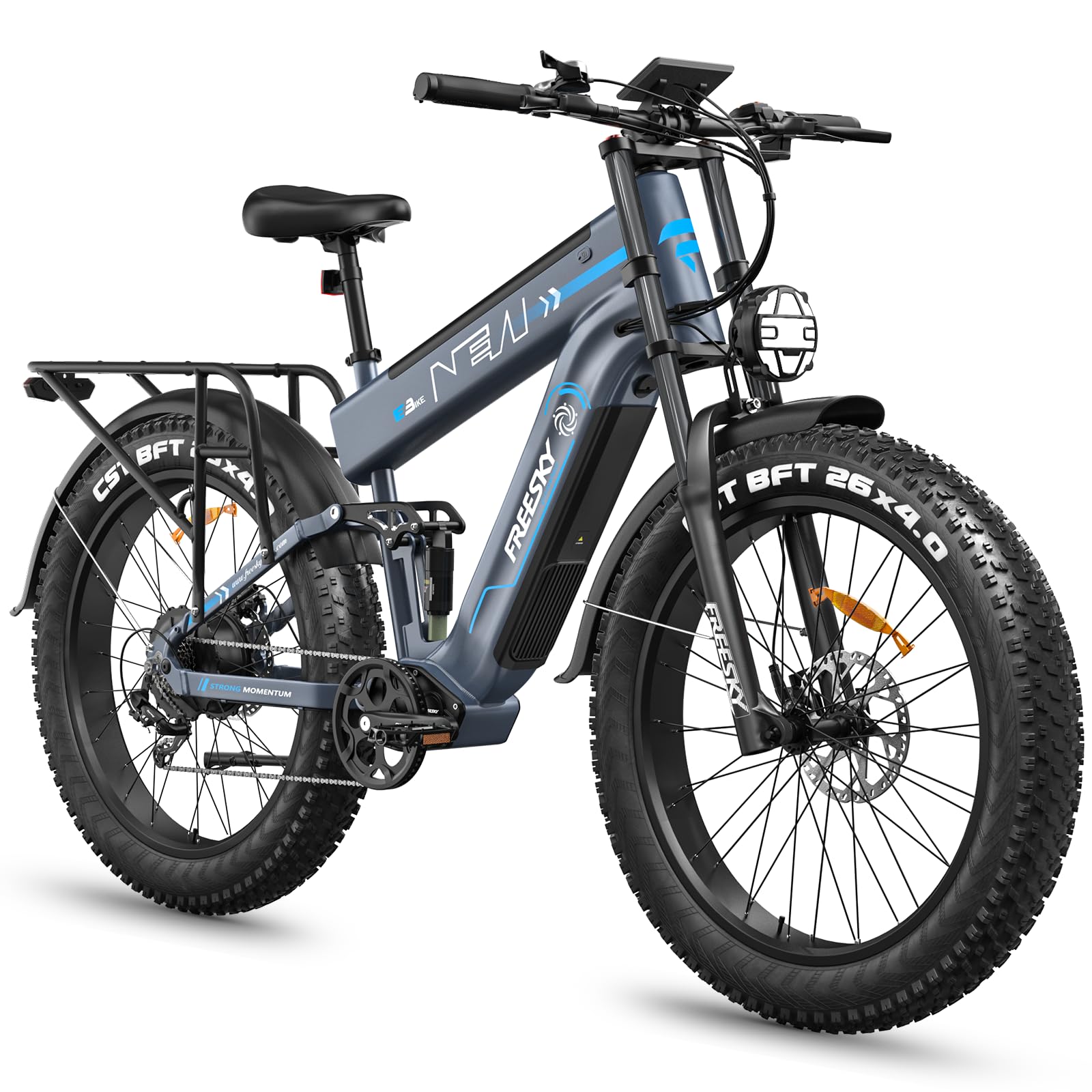
1. FREESKY 2026 Alaska Pro Dual Battery 48V 45AH
Our pick — over 4.5★ from 20+ verified ratings; the strongest balance of quality and price.
200 miles on a charge and a 40 mph top speed that flattens 45-degree hills.
This is the one that changes what you think an ebike can do. The FREESKY Alaska Pro packs a 48V 45Ah dual battery system — that is 2000Wh total, which owners confirm delivers 120 to 200 miles per charge in real riding. The 4000W peak motor and 160Nm of torque mean a 45-degree hill climb is not a struggle; it is just another part of the ride. At 40 mph on pedal assist (with a controller upgrade needed for full throttle at that speed), this bike keeps pace with city traffic rather than dodging it.
What wins people over is the ride quality. Dual hydraulic suspension combined with 26-inch fat tires smooths out rocky trails and potholed pavement into something you barely feel. The dual 4-piston hydraulic brakes deliver what the maker describes as a 50% shorter stopping distance versus mechanical disc brakes — confidence at high speed. The aluminum frame is built to hold up to 300 pounds, and the bike arrives 85% pre-assembled so you are riding in about 25 minutes. Owners consistently praise the customer service, noting that when a motor failed at 180 miles, a replacement was sent quickly and was easy to install. The bike is UL 2849 certified by TÜV, a real safety benchmark.
The trade-off is the frame size. At 92 pounds and with a high frame standover, shorter riders may find it a stretch — one owner at 5’11” called it snug. The rear rack connection points get a durability note from some owners, and the speed levels are limited to only five settings up to 20 mph in the lower range, which some riders feel restricts workout resistance. If you need a bike that fits a smaller frame or lighter build, this one asks for some leg length and muscle to handle it.
Where It Dominates
- 2000Wh dual battery delivers 120-200 miles of range — the best in this lineup
- 4000W peak motor with 160Nm torque climbs 45-degree hills without breaking a sweat
- Dual 4-piston hydraulic brakes provide controlled stops at 38 mph
- FOC sinewave controller runs quietly at 92% energy efficiency
What To Know Before Buying
- High frame geometry may feel tall for riders under about 5’10”
- At 92 pounds, it is heavy to lift onto a rack or carry up stairs
- Rear rack attachment points are noted as less sturdy by some owners
Reach for it when: you need 100-plus miles of range in a single ride, you ride hilly or off-road terrain, and you want a 40 mph top speed that keeps you with traffic.
Look elsewhere if: you are under about 5’9″, need a bike you can regularly lift, or only ride at street-legal 20 mph speeds on flat pavement.
2. Heybike Saturn Electric Bike with 1800W Peak
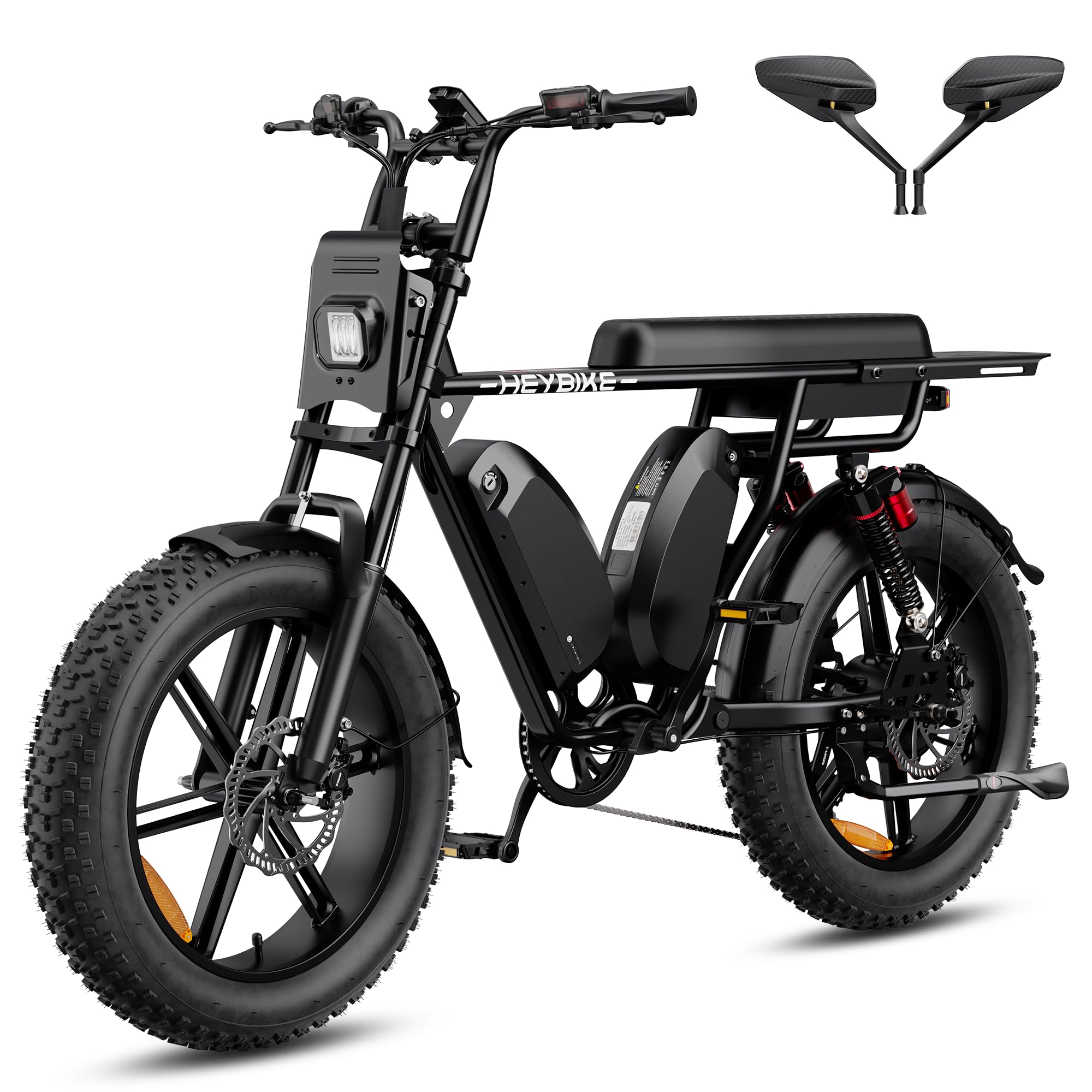
Moped-inspired comfort with a 956.8Wh battery that doubles for 90 miles of cruising.
The Heybike Saturn takes a different path than the speed-focused Alaska Pro — it is built for comfort and style over raw power. The dual battery setup gives you a removable 956.8Wh pack (1913.6Wh total with the second battery), good for up to 90 miles under pedal assist. That is enough for a full week of commuting on a single charge or a long weekend adventure without hunting for an outlet. The 1800W peak motor and 95 Nm of torque deliver responsive acceleration and climbing confidence that handles urban hills and gravel paths without feeling overbuilt.
What sets the Heybike Saturn apart is how it rides. Full suspension with 140mm of hydraulic front travel and 55mm of rear travel soaks up bumps that would rattle a rigid frame. The 20-inch by 4.0-inch fat tires add traction on pavement, gravel, dirt, and grass, so you are not limited to bike paths. The moped-style design with a long bench seat, integrated lighting, brake lights, turn signals, and a horn makes the Saturn feel more like a small motorcycle than a bicycle — owners call it sturdy and comfortable, with one 68-year-old noting how easy it is to mount and dismount. The maximum weight recommendation is 330 pounds, the highest in this group, and the carbon steel frame gives it a solid, planted feel. Assembly is straightforward, and the Heybike Smart App lets you switch between Class 2 and Class 3 modes via the TFT display.
The honest trade-off is that the Saturn does not push extreme speed or range like the Alaska Pro. At 1800W peak (less than half the Alaska Pro’s 4000W), it is not built for 40 mph runs or serious off-road hill climbing. The carbon steel frame is heavier than aluminum, and while the battery is removable, the dual-pack configuration means you have to manage two batteries if you want the full 1913.6Wh. If outright power and range records are your goal, the FREESKY beats it on both — 4000W vs 1800W and 200 miles vs 90 miles. But if you want a comfortable, stylish daily rider that handles mixed terrain with a cushioned suspension, the Saturn is the more pleasant bike to live with.
Comfort king: 140mm front and 55mm rear suspension paired with 20×4.0 fat tires make rough roads disappear, and the 330-pound weight limit accommodates heavier riders and cargo.
Speed trade-off: 1800W peak and 95 Nm are plenty for urban and light trail riding, but this is not a 40 mph hill bomber — if that matters, the Alaska Pro is the faster machine.
Your bike if: you prioritize a smooth, comfortable ride on mixed surfaces, want motorcycle-style road presence with lights and signals, and carry passengers or gear up to 330 pounds.
Not the one if: you need 40 mph speed, extreme hill-climbing torque, or a sub-90-pound frame you can lift onto a bus rack.
3. MACFOX X1S Electric Bike – 750W Peak
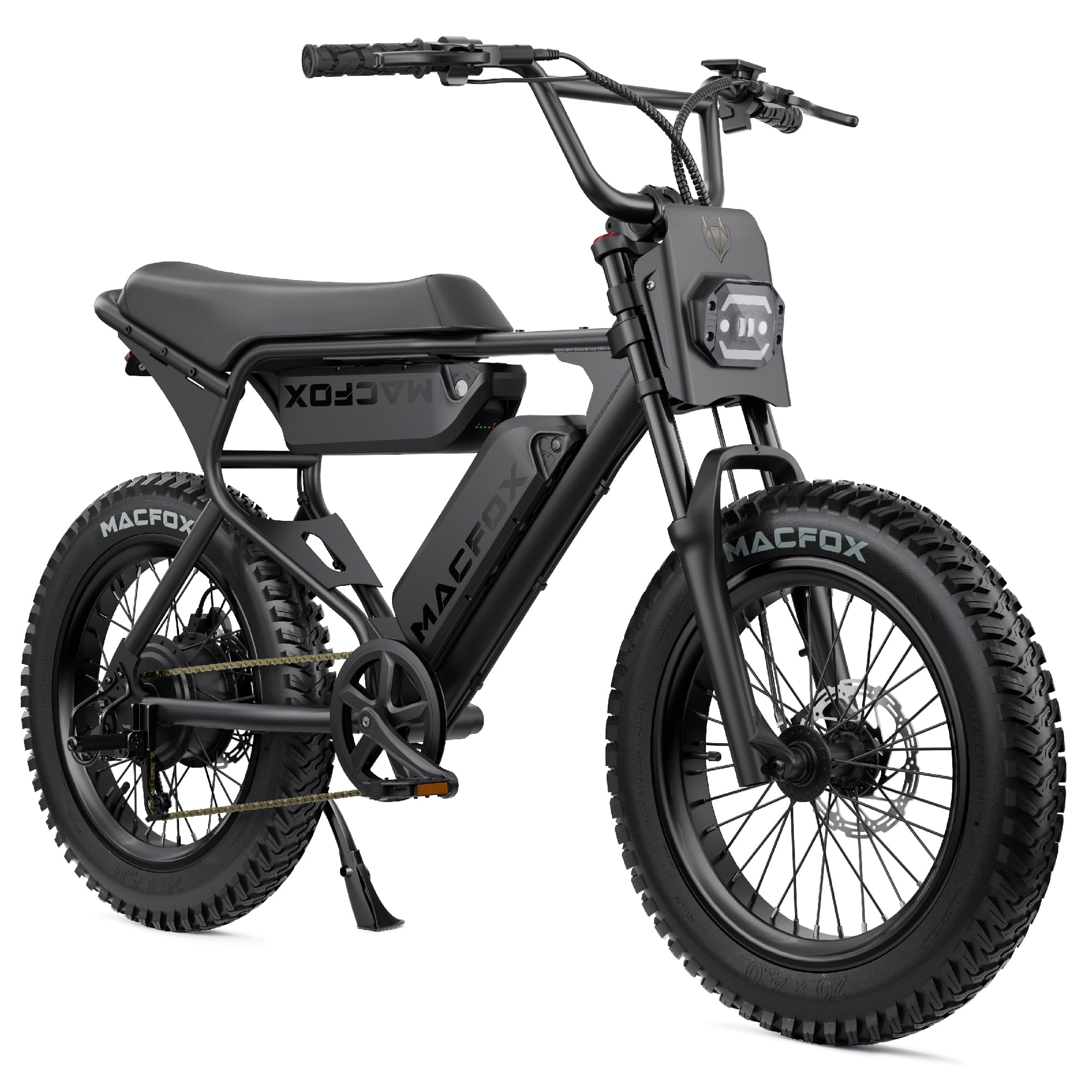
A no-license-needed class-2 bike with a 20 mph cap and fat tires for campus or neighborhood cruising.
The MACFOX X1S is the most accessible black dual-battery ebike here because it stays inside the legal boundary that matters most: no driver’s license required. As a class-2 model capped at 20 mph, it is street-legal on bike paths and roads without registration, so a teenager can ride it to school or an adult can commute without worrying about local enforcement. The 750W peak motor and 65Nm of torque deliver enough grunt for moderate hills and daily errands, though it takes a moment to reach top speed — buyers report you can adjust the settings for quicker acceleration.
The MACFOX X1S dual-battery version ships in two packages (the bike and the extra battery arrive separately due to shipping rules), and the high-carbon steel frame paired with 20-inch by 4.0-inch fat tires gives a stable, confidence-inspiring ride on pavement, dirt, or loose sand. The front shock absorber smooths out road chatter, and the dual hydraulic brakes provide controlled stops. Owners mention riding 300 miles with the bike holding up well, and the UL 2849 certification adds a safety layer. For a young rider or someone who just wants a dependable, no-hassle electric bike, the X1S fits the bill without legal complexity.
The Achilles’ heel here is tire durability. Multiple owner reports mention flat tires — one buyer says their son got three flats already. The tires and tubes are noted as thinner than expected for the price. If you ride on streets with debris, plan to swap the tires or add puncture-resistant liners. The bike is heavy for its size at the 20-inch wheel format, and the twist-grip shifter and rear derailleur feel entry-level. Compared to the other two picks, the 750W peak is a 5.3x gap from the FREESKY’s 4000W and less than half the Heybike Saturn’s 1800W peak. The 20 mph top speed also means it is half the Alaska Pro’s 40 mph. If you need real power or extreme range, this is not the bike — but if you need a legal, approachable dual-battery ride that requires no license, the X1S is the most straightforward option.
Legal simplicity: class-2 20 mph cap means no license, no registration — ride it straight from the start on bike paths and roads.
The catch: tire quality is the most common frustration — budget for aftermarket tires or sealant if you ride on debris-prone roads.
Ideal for: teens, campus riders, and anyone who wants a street-legal dual-battery bike without dealing with DMV paperwork or speed enforcement.
Pass if: you need more than 20 mph speed, extreme range (the Alaska Pro is the range king here), or you ride on sharp gravel and don’t want to upgrade tires immediately.
Understanding the Specs
Battery Watt-Hours (Wh)
Watt-hours tell you the total energy stored — higher Wh means longer range. A 2000Wh system (like the FREESKY Alaska Pro) can deliver 200 miles at low assist. A 956.8Wh system (like a single Heybike Saturn battery) is enough for about 50 miles. Dual batteries often double the Wh, but always check the total number, not the count of packs.
Peak Motor Power vs Continuous Power
Peak power (4000W, 1800W, 750W) is the brief maximum output for acceleration and climbing. Continuous power is the sustained output during normal riding. A high peak number helps you climb steep hills and accelerate quickly, but does not mean the motor runs at that level constantly — battery and controller limits prevent that.
Torque (Nm) and Climbing
Torque measures twisting force at the wheel. Higher Nm numbers mean better hill-climbing ability. 160Nm (FREESKY) will climb a 45-degree slope. 95Nm (Heybike Saturn) handles urban hills and gravel inclines. 65Nm (MACFOX X1S) is fine for moderate hills but will struggle on steep grades.
UL Certification
UL 2849 is a safety standard for ebike electrical systems — battery, charger, and motor controller. A UL-certified bike (all three picks have it) has passed testing for overcharge, short circuit, and overheating risks. It is the main safety credential to look for.
FAQ
Do I need a license to ride a black dual-battery ebike?
How far can I actually ride on a dual-battery ebike?
Can I ride a 40 mph ebike on bike paths?
Are dual-battery ebikes heavier to handle?
Can I charge both batteries at the same time?
How long do dual-battery ebike batteries last?
Is a 750W motor enough for hills?
What does UL 2849 certification mean?
Can I upgrade the tires on my dual-battery ebike?
Do dual-battery ebikes require more maintenance?
Final Thoughts: The Verdict
If you want one dependable pick, the best black dual-battery ebike winner is the FREESKY Alaska Pro because it delivers an class-leading combination of 200-mile range, 40 mph speed, and 45-degree hill-climbing ability — all at a price that beats the competition on specs. If you want a comfortable all-terrain cruiser with motorcycle-inspired styling and a 330-pound weight capacity, grab the Heybike Saturn. And for a street-legal no-license-needed class-2 ride for teens or campus commuting, the MACFOX X1S is the one to reach for.
How We Picked
We do not accept paid placement. Every pick is matched to a real buyer and a real use-case; we do not hands-on test units.
Sources & Methodology
Specifications: manufacturer listings and product documentation. Review insights: verified customer reviews, as of July 2026. Pricing: not shown on this page (it changes often); check the current price via the retailer link.
As an Amazon Associate, WellFizz earns from qualifying purchases. This does not affect which products we feature.
Related Guides

Mo Maruf
I created WellFizz to bridge the gap between vague wellness advice and actionable solutions. My mission is simple: to decode the research and give you practical tools you can actually use.
Beyond the data, I am a passionate traveler. I believe that stepping away from the screen to explore new environments is essential for mental clarity and physical vitality.