Our readers keep the lights on and my smoothie glass nicely filled. As an Amazon Associate, I earn from qualifying purchases.
Spotting a whale breach from a moving boat demands optics that cut through sea spray, handle unsteady hands, and deliver a crisp image across hundreds of yards. Standard binoculars often fog up, slip when wet, or tremble too much to follow the action, turning a once-in-a-lifetime moment into a blur.
I’m Mohammad Maruf — the founder and writer behind WellFizz. I’ve spent hundreds of hours analyzing marine-grade optics, comparing waterproof sealing standards, low-light performance, and image stabilization systems to build this guide for serious whale watchers.
After comparing nine of the most capable models, I’ve narrowed the field to the best binoculars for whale watching that balance rugged build, superior light transmission, and steady viewing in challenging conditions.
How To Choose The Best Binoculars For Whale Watching
Whale watching places unique demands on optics that birding or stadium use does not. Constant motion, saltwater spray, and the need to scan vast distances over open water make certain features non-negotiable. Here is what to prioritize.
Magnification and Objective Lens Size
8×42 and 7×50 are the two most common configurations for marine use. The 8x magnification provides a wide enough field of view to track a moving whale while the 42mm objective gathers ample light for overcast days. The 7×50 combination trades a little reach for a larger exit pupil (7.14mm), which keeps the image bright and steady even when the boat rocks. Higher magnifications like 10x or 12x benefit from image stabilization to reduce shake at sea.
Waterproofing and Fog Proofing
Saltwater exposure and rapid temperature shifts between cabin and deck can cause internal fogging in standard binoculars. Look for an IPX7 rating (submersible to 1 meter for 30 minutes) combined with nitrogen or argon purging. O-ring sealed construction is essential to keep moisture and salt particles out of the optical path over years of use.
Prism Type and Lens Coatings
BaK-4 glass prisms deliver higher refractive index and sharper edge-to-edge clarity compared to BK-7 prisms. Fully multi-coated lenses reduce light loss at each air-to-glass surface. Dielectric high-reflective coatings on the prism surfaces push light transmission above 90 percent, critical for low-light whale activity at dawn or dusk. Phase-correction coatings eliminate color fringing in roof prism designs.
Image Stabilization for High Magnification
If you prefer 10x or 12x magnification for spotting whales at extreme distances, image stabilization (IS) becomes a practical consideration. Canon’s Vari-Angle prism system compensates for hand and boat motion, turning a shaky 12x view into a tripod-like image. IS adds weight and battery dependency but dramatically improves usable viewing time from a moving platform.
Quick Comparison
On smaller screens, swipe sideways to see the full table.
| Model | Category | Best For | Key Spec | Amazon |
|---|---|---|---|---|
| Canon 12×36 IS III | Premium | Stabilized long-range spotting | 12x Mag / 36mm Obj / 3mm Exit Pupil | Amazon |
| Leupold BX-4 Pro Guide HD 12×50 | Premium | HD clarity for extreme distance | 12x Mag / 50mm Obj / 4.17mm Exit Pupil | Amazon |
| Steiner Military-Marine 7×50 | Premium | Extreme durability and low-light use | 7x Mag / 50mm Obj / 7.1mm Exit Pupil | Amazon |
| Steiner Marine 7×50 | Mid-Range | Entry-level marine performance | 7x Mag / 50mm Obj / 7.14mm Exit Pupil | Amazon |
| Nikon Monarch M5 8×42 | Premium | All-around wildlife viewing | 8x Mag / 42mm Obj / 5.3mm Exit Pupil | Amazon |
| Celestron TrailSeeker 8×42 | Mid-Range | Wide-field scanning on a budget | 8x Mag / 42mm Obj / 5.25mm Exit Pupil | Amazon |
| Nikon PROSTAFF P7 10×42 | Mid-Range | Brightness and reach for fading light | 10x Mag / 42mm Obj / 4.2mm Exit Pupil | Amazon |
| Bushnell H2O Xtreme 10×42 | Mid-Range | Budget-friendly waterproof performance | 10x Mag / 42mm Obj / 4.2mm Exit Pupil | Amazon |
| Nocs Provisions Standard Issue 10×25 | Budget | Ultra-portable backup binos | 10x Mag / 25mm Obj / 2.4mm Exit Pupil | Amazon |
In‑Depth Reviews
1. Canon 12×36 Image Stabilization III Binoculars

Canon’s Vari-Angle prism system is the defining technology here. At 12x magnification, hand shake and boat motion normally make whale identification at long range impossible. The IS engages via a button on top and delivers a tripod-stable view that stays locked on target even as the deck pitches. The Porro II prisms and doublet field-flattener lenses produce a distortion-free image edge-to-edge, which matters when scanning the horizon for blows and splashes.
The 36mm objective lenses are smaller than a typical 42mm marine optic, but the 12x reach compensates. Exit pupil sits at 3mm, which is workable in good light but slightly dim in overcast conditions. Battery life is strong — a single AA cell powers the IS for extended use — though you must hold the button continuously. The low-reflective exterior and compact profile make this a natural for long whale-watching sessions where weight matters.
Eyepiece caps are not tethered and objective lens caps are absent, so aftermarket protection is smart for saltwater environments. The lens coatings shed water better than older Canon models. For anyone who struggles with high-magnification shake from a moving boat, this model solves the problem electronically where glass alone cannot.
Why it’s great
- Image stabilization eliminates shake at 12x magnification.
- Doublet field-flattener lenses keep the entire image sharp.
- Compact and lightweight for a stabilized optic.
Good to know
- Requires holding the IS button continuously.
- Exit pupil of 3mm limits low-light performance.
- No tethered eyepiece or objective lens caps.
2. Leupold BX-4 Pro Guide HD Binoculars, 12x50mm Gen 2

Leupold’s Elite Optical System pairs premium ED glass with a hydrophobic Guard-ion coating that beads up salt spray rather than smearing it across the lens. The 12x magnification combined with 50mm objectives delivers an exit pupil of 4.17mm — bright enough for early-morning and late-afternoon whale watches when mammals are most active. The open-bridge, dual-hinge design keeps the weight manageable at 1.83 pounds, surprising for a 12×50 full-size binocular.
Color fidelity and contrast are outstanding. The dielectric prism coatings push light transmission to a level where you can resolve dorsal fin shapes and saddle markings at 400-plus yards. The individual focus system means you set each eyepiece once for your eyes and then the center wheel handles everything from 20 feet to infinity. That speed matters when a whale surfaces briefly before diving.
Build quality is Japanese-made with tight tolerances. The rubber armor provides a secure grip even when wet. Attached lens covers are tethered and functional, though the included neck strap is adequate rather than premium. If you want the most resolving power that still balances well in hand for a full day on the water without image stabilization, this is the top contender.
Why it’s great
- ED glass and dielectric coatings deliver exceptional low-light clarity.
- Guard-ion lens coating repels water and salt spray.
- Lightweight open-bridge design for a 12×50.
Good to know
- 12x without stabilization can show shake for some users.
- Neck strap feels cheaper than the binocular’s price tier.
- Large objective lenses add bulk compared to compact models.
3. Steiner Military-Marine 7x50mm Binoculars

The Military-Marine is built to withstand a 11-G impact shock and still hold zero collimation. The Makrolon polycarbonate chassis wrapped in NBR Long Life rubber handles saltwater, oil, and temperature extremes without degrading. The Sports-Auto-Focus system lets you dial each eyepiece to your vision once, then relies on individual focus to keep everything from 20 yards to infinity sharp without touching the focus wheel — ideal for tracking surfacing whales when you cannot divert attention.
The 7×50 configuration delivers a massive 7.1mm exit pupil. That is more than your dilated pupil can accept, meaning every photon of available light enters your eye. In heavy fog, gray skies, or the deep blue of twilight, this binocular shows detail that 8×42 and 10×42 models miss entirely. The floating prism system uses flexible silicone mounts that absorb drops and impacts that would knock lesser optics out of alignment.
The penalty is weight. At well over two pounds, this binocular is not something you want around your neck for a six-hour hike. On a boat with a padded harness or stowed in a dry bag between sightings, the heft actually steadies the view. The Heritage Warranty covers repair or replacement for life with no questions asked — a serious commitment for marine gear.
Why it’s great
- Massive 7.1mm exit pupil for extreme low-light clarity.
- Floating prism system survives heavy drops without alignment loss.
- Sports-Auto-Focus eliminates need to refocus for fast sightings.
Good to know
- Heavy — over two pounds, best worn with a harness.
- Individual focus takes time to calibrate initially.
- 7x magnification offers less reach than 10x or 12x models.
4. Steiner Marine Binoculars 7×50

This is the more accessible Steiner entry point that still carries the same core marine DNA. The 7×50 prism system produces bright, high-contrast images with very natural color reproduction. The Sports Auto Focus here works identically to the Military-Marine — set it once and stay sharp from 20 yards to infinity without ever touching a wheel. The 20mm of eye relief is generous enough for eyeglass wearers to see the full field without squinting.
The floating prism system is present in this model too, protecting the optical alignment from the knocks and bumps that come from riding in a boat console or gunwale. The rubber armoring provides a nonslip grip when your hands are wet with sea spray. The 356-foot field of view at 1000 yards is narrower than some competitors, but that actually helps minimize glare off the water by reducing the angle of scattered light entering the objective.
Weight is a consideration here as well — this is a solid, dense binocular. The included neck strap is thin and could stand an upgrade. The Heritage Warranty applies, which is a huge confidence booster for saltwater use where one dunk can ruin lesser optics. For boaters who want genuine German-engineered marine optics at a mid-range entry point, this delivers where budget alternatives cannot.
Why it’s great
- Steiner floating prism system at a more accessible price point.
- 20mm eye relief works well with glasses.
- Excellent contrast and color fidelity for marine use.
Good to know
- Heavier than many 8×42 options.
- Narrower field of view limits scanning speed.
- Neck strap feels thin and low quality.
5. Nikon Monarch M5 8×42 Binocular
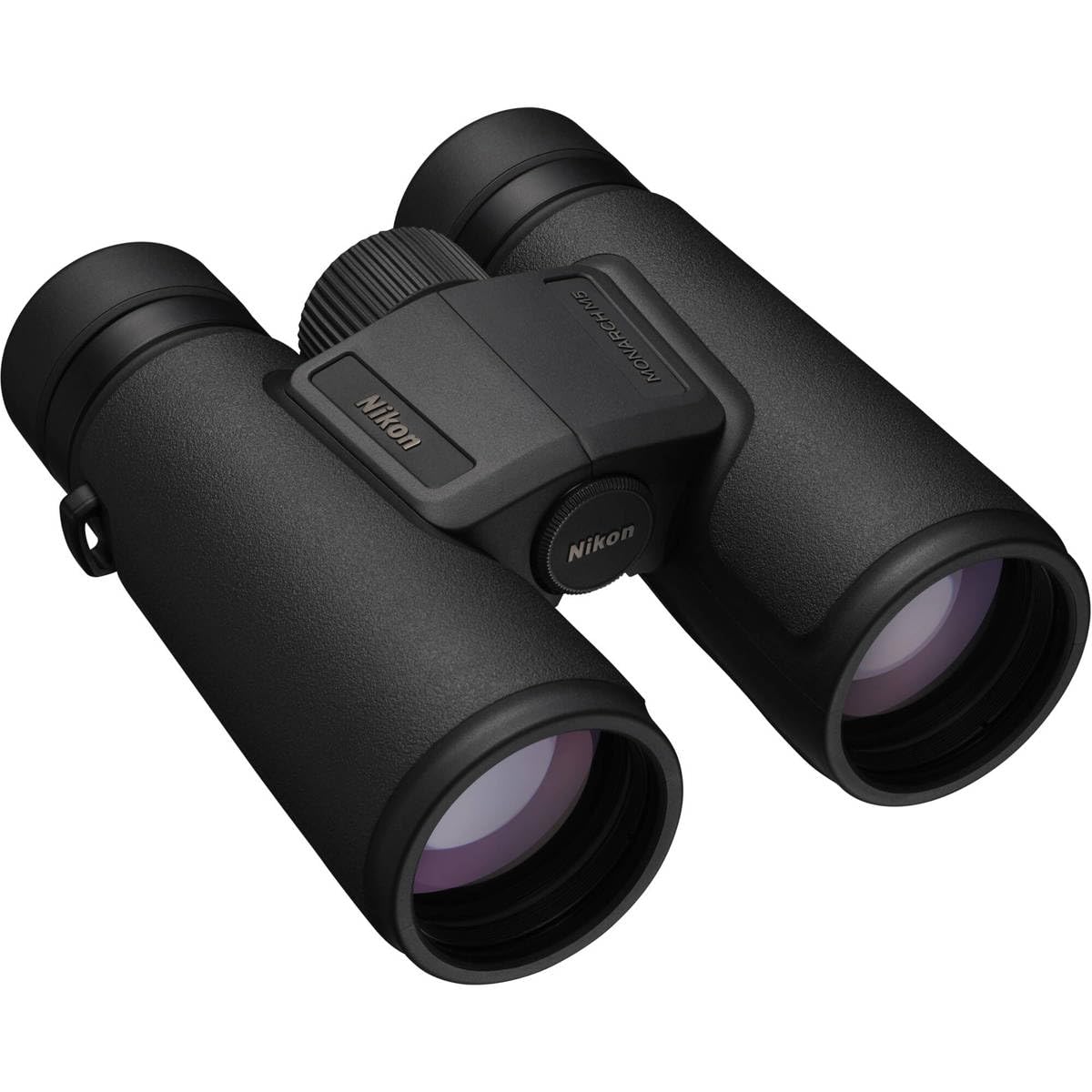
The Monarch M5 represents a serious step up in glass quality within the mid-premium tier. Nikon’s Extra-low Dispersion (ED) glass eliminates chromatic aberration almost entirely — the purple fringing that ruins the view on cheaper binoculars is gone. Dielectric high-reflective prism coatings push light transmission to the point where colors appear saturated without being artificial. The 5.3mm exit pupil is comfortable for extended viewing, reducing the need to constantly adjust eye position as the boat rocks.
Build quality matches the optics. The rubber-armored body is nitrogen-purged and O-ring sealed for full waterproof and fogproof performance. The turn-and-slide eyecups click into three positions for glasses users, and the 19.5mm of eye relief provides a generous viewing window. The close-focus capability of 8.2 feet is not relevant for whale watching but confirms the optical alignment is precise.
The 335-foot field of view at 1000 yards is narrower than the Celestron TrailSeeker, which can make tracking fast-moving whales harder. Some users report the focus wheel sits close to the body, requiring slight repositioning of the index finger. For someone who wants a premium all-around binocular that can go from boat to forest without compromise, the M5 is one of the sharpest options under premium pricing.
Why it’s great
- ED glass delivers near-zero chromatic aberration.
- Dielectric coatings produce bright, vivid colors.
- Excellent build quality with nitrogen purging.
Good to know
- Field of view is narrower than some rivals at 335 feet.
- Focus wheel placement may feel awkward for some hands.
- Slightly heavier than comparable 8×42 models.
6. Celestron TrailSeeker 8×42 Binoculars

The 426-foot field of view at 1000 yards is the widest in this lineup. Scanning for whale blows and splashes across a broad expanse of ocean is faster and less fatiguing with this binocular. The 8x magnification provides enough stability that even from a moving deck the image stays composed. BaK-4 prisms with both phase and dielectric coatings produce bright, sharp images with excellent edge-to-edge clarity and minimal color fringing.
The magnesium alloy frame is lighter than polycarbonate alternatives and fully waterproof. Metal multi-stop twist-up eyecups resist cracking better than plastic and stay put once extended. The included chest harness is a practical addition for boat use — distributing weight across both shoulders rather than the neck. The 6.5-foot close focus is overkill for whale watching but confirms the prism alignment is dialed in.
Some users note the focus wheel turns slightly looser than premium competitors, which can require careful adjustment to avoid overshooting. The multi-coated optics are not fully multi-coated on every surface the way some premium lenses are, but the image quality at this price point punches well above its weight. For budget-conscious watchers who want the widest possible view for tracking fast-moving whales, this is the top pick.
Why it’s great
- Widest field of view (426ft) for fast marine scanning.
- Magnesium alloy frame is lightweight and durable.
- Phase and dielectric coatings on BaK-4 prisms.
Good to know
- Focus wheel feels slightly loose.
- Not fully multi-coated on every surface.
- Chest harness included but strap quality is average.
7. Nikon 10×42 PROSTAFF P7 Waterproof Roof Prism Binocular

The PROSTAFF P7 sits as the flagship of Nikon’s PROSTAFF line and delivers serious low-light performance for a mid-range optic. The 10x magnification combined with phase-correction coated roof prisms and a dielectric high-reflective multilayer prism coating pushes light transmission to a level that can extend your effective viewing window by 15 to 20 minutes at dawn and dusk. The 42mm objectives gather sufficient light while keeping the overall size manageable.
The locking diopter ring is a standout feature. It prevents accidental adjustment when you are passing the binoculars between passengers or storing them in a dry bag — a common frustration on boat trips. The turn-and-slide eyecups with multiple stops accommodate glasses wearers well, and the oil- and water-repellent lens coatings make cleaning salt spray residue quick. The fiberglass-reinforced polycarbonate body wrapped in rubber armor provides a secure wet-grip.
At 10x magnification without image stabilization, you will notice some shake from boat motion, especially at longer ranges. The 367-foot field of view is decent but not exceptional. For someone who wants a reliable, bright mid-range binocular that handles low light without jumping to premium pricing, the P7 is a solid option that does not disappoint.
Why it’s great
- Dielectric prism coating for excellent low-light brightness.
- Locking diopter ring prevents accidental adjustment.
- Oil- and water-repellent lens coating for salt-spray cleaning.
Good to know
- 10x shake noticeable from a moving boat.
- Field of view is average at 367 feet.
- Plastic eyecups feel less durable than metal alternatives.
8. Bushnell H2O Xtreme 10×42 Binoculars

The H2O Xtreme is Bushnell’s direct answer to marine use at a mid-range price. The fully multi-coated glass surfaces maximize light transmission for a 10×42 at this price point, and BaK-4 prisms keep the resolution sharp across the field. The O-ring sealed, nitrogen-purged body is rated IPX7, meaning it can survive submersion up to 1 meter for 30 minutes — real peace of mind for boaters who risk an accidental drop over the side.
The rubber armor includes soft grip pads that remain secure even when drenched. The compact roof prism design makes this easier to stow in a boat console or backpack than the larger Porro prism alternatives. The included carry case, strap, and tethered objective covers are functional and protective. At 10x magnification, the image is bright enough for overcast days and the 17mm of eye relief works for most eyeglass wearers.
The biggest trade-off is the lack of a tripod adapter socket. If you want to mount these on a boat rail or tripod for extended viewing, you will need an aftermarket adapter. The 10x without stabilization can be challenging from a moving vessel. For a reliable, proven waterproof binocular that does not break the budget, the H2O Xtreme has been a favorite among boaters for years.
Why it’s great
- True IPX7 waterproofing with nitrogen purging.
- Compact roof prism design for easy storage.
- Non-slip rubber grip for wet conditions.
Good to know
- No tripod adapter socket for rail mounting.
- 10x magnification reveals shake on a boat.
- Neck strap pad could be more comfortable.
9. Nocs Provisions Standard Issue 10×25 Waterproof Binoculars

The Nocs Standard Issue is the only compact in this lineup, tipping the scales at just 11.85 ounces. The 10×25 configuration prioritizes portability over light-gathering ability. The 2.4mm exit pupil means you need good ambient light to get a bright image — overcast marine days will test its limits. But for a backup pair that slips into a jacket pocket or a daypack side pouch, it is remarkably capable for its size.
The fully multi-coated Bak4p prisms and anti-reflective lens coatings produce crisp images with good color clarity for a compact. The IPX7 waterproof rating and nitrogen purging mean this tiny binocular can survive a dunking just as well as its larger rivals. The multi-stop twist-up eyecups accommodate glasses wearers, and the patented Rugged Wave Grip design provides reassuring texture when your hands are wet. The “No-Matter-What” Lifetime Warranty covers damage and defects.
The 315-foot field of view is narrow compared to full-size binoculars, making it harder to track fast-moving whales at a distance. The small objective lenses collect significantly less light than a 42mm or 50mm optic, so early morning or late afternoon trips will produce dim views. This is best treated as a grab-and-go companion or a child-friendly option, not a primary whale-watching instrument. For its intended purpose as a lightweight companion, it delivers impressive clarity.
Why it’s great
- Ultra-lightweight at 11.85 ounces for pocketability.
- IPX7 waterproof and nitrogen purged like larger models.
- Lifetime warranty covers damage and defects.
Good to know
- 2.4mm exit pupil is dim in overcast marine conditions.
- Narrow 315-foot field of view limits tracking speed.
- Not a replacement for full-size marine optics.
FAQ
What does IPX7 waterproofing mean for whale watching binoculars?
Why is a large exit pupil important for marine use?
Is image stabilization worth the extra cost for boat use?
Final Thoughts: The Verdict
For most users, the binoculars for whale watching winner is the Steiner Military-Marine 7×50 because its massive 7.1mm exit pupil, floating prism shock protection, and Sports-Auto-Focus system provide the best combination of low-light performance and ruggedness for marine environments. If you want image stabilization for high-magnification viewing, grab the Canon 12×36 IS III. And for the sharpest HD glass at extreme distance, nothing beats the Leupold BX-4 Pro Guide HD 12×50.

Mo Maruf
I created WellFizz to bridge the gap between vague wellness advice and actionable solutions. My mission is simple: to decode the research and give you practical tools you can actually use.
Beyond the data, I am a passionate traveler. I believe that stepping away from the screen to explore new environments is essential for mental clarity and physical vitality.