Our readers keep the lights on and my smoothie glass nicely filled. As an Amazon Associate, I earn from qualifying purchases.
Spotting a leopard draped over a marula tree limb at dawn or a cheetah sprinting across the Serengeti demands optics that handle dust, glare, and motion. Staring through a fogged or dim lens a hundred yards from a lion kill is a safari moment you will not get back. Choosing from the ranks of roof prism and porro prism designs with various lens coatings, exit pupil diameters, and field of view ratings is the difference between a fleeting shadow and a vivid memory burned into your retina.
I’m Mohammad Maruf — the founder and writer behind WellFizz. My approach to finding the best binoculars for safari africa combines deep market research with a relentless focus on the optical specs that actually matter when the light is low and the target is moving across an open plain.
This guide walks through magnification ranges, objective lens sizes, prism types, and lens coatings you must understand before buying. Below, you will find the nine top-rated models sorted by performance tier so you can match glass to your destination, vehicle style, and personal vision needs.
How To Choose The Best Binoculars For Safari Africa
A safari vehicle bounces over rutted tracks while a pride of lions stirs a hundred yards away. You have seconds to bring the image to your eye and lock focus. Every spec on the box — from exit pupil to field of view — matters in that moment. Here are the five non-negotiable characteristics that separate safari-ready glass from a disappointing pair.
Magnification and Objective Lens Size
10×42 is the universal safari standard. 10x magnification brings distant animals close enough to see whisker twitches while keeping the field wide enough to track moving predators. A 42mm objective lens collects sufficient light for dawn and dusk game drives. For smaller birds or dense canopy viewing, 8x delivers a brighter, steadier image. 12x and above becomes hard to hold still on a moving vehicle without a monopod.
Prism Type and Glass Quality
Roof prism binoculars are slimmer, lighter, and easier to pack than porro prism models. BaK-4 glass, rather than BK-7, produces rounder, brighter exit pupils and better light transmission. Fully multi-coated lenses — where every air-to-glass surface receives an anti-reflective coating — prevent internal light scatter and deliver sharper contrast across the entire frame.
Weather Sealing and Durability
African mornings bring dew, dust, and sudden rain squalls. Nitrogen-purged, O-ring sealed construction prevents internal fogging when you move from an air-conditioned vehicle into humid savannah air. Rubber armor protects against knocks against vehicle roll bars and rocks. A minimum IPX7 waterproof rating ensures the optics survive an unexpected dunking during river crossings.
Exit Pupil and Eye Relief
Exit pupil is the diameter of light beam that reaches your eye — calculated by dividing objective lens size by magnification. 10×42 gives a 4.2mm exit pupil, enough for bright midday viewing. 7×50 delivers a 7.14mm exit pupil for spectacular low-light performance but adds weight. Eye relief of 15mm or more lets eyeglass wearers see the full field without vignetting or squinting.
Quick Comparison
On smaller screens, swipe sideways to see the full table.
| Model | Category | Best For | Key Spec | Amazon |
|---|---|---|---|---|
| Nikon PROSTAFF P7 10×42 | Mid-Range | Best Overall Safari Pick | Dielectric Prism Coating | Amazon |
| Vortex Copperhead HD 10×42 | Mid-Range | Great Value with VIP Warranty | HD Optical System | Amazon |
| Bushnell H2O Xtreme 10×42 | Mid-Range | Rugged Waterproof Option | IPX7 Waterproof | Amazon |
| Nikon TRAVELITE EX 8×25 | Mid-Range | Compact Daytime Backup | 11.1mm Eye Relief | Amazon |
| Bushnell Legacy WP 10×50 | Mid-Range | Best Low-Light Budget Choice | 5mm Exit Pupil | Amazon |
| Steiner Marine 7×50 | Premium | Extreme Low-Light Boat Safari | 7.14mm Exit Pupil | Amazon |
| ZEISS Terra ED 10×42 | Premium | High-End Optical Clarity | ED Glass + 88% Light Transmission | Amazon |
| Leupold BX-4 Pro Guide HD 12×50 | Premium | Extended Range Observation | 12x Magnification, Open-Bridge | Amazon |
| Steiner Safari ULTRASHARP 10×42 | Premium | Safari-Specific Model | NBR Rubber Armor | Amazon |
In‑Depth Reviews
1. Nikon PROSTAFF P7 10×42

The PROSTAFF P7 is a narrow-category standout because it pairs dielectric high-reflective multilayer prism coating with phase-correction coated roof prisms at a price point that undercuts most entry-level premium glass. Dielectric coatings boost light transmission to near-edging levels without the cost of ED glass, which matters when a herd of elephants appears in the orange light of sunset. The 42mm objectives gather enough light to extend your usable viewing window past the last golden minutes of the day.
A locking diopter ring is a rare sight at this tier. It prevents accidental drift when the binoculars bounce against the safari vehicle door, so your right-eye focus stays fixed through the whole drive. The fiberglass-reinforced polycarbonate body keeps weight at a manageable level — you can hold the unit steady for minutes while scanning a distant acacia line. Turn-and-slide eyecups click into intermediate positions, a feature eyeglass wearers appreciate during shared observations with a spotter.
The oil- and water-repellent outer lens coating makes cleaning easy when dust and sunscreen inevitably land on the glass. A quick breath and a wipe with the included microfiber cloth restores full clarity. Field of view at 367 feet per thousand yards is on par for a 10×42, enough to track a running cheetah without losing the frame.
Why it’s great
- Dielectric prism coating delivers exceptional brightness for the price
- Locking diopter stays secure on rough roads
- Lightweight fiberglass-reinforced body reduces arm fatigue on long drives
Good to know
- Neck strap is functional but not premium; swap for a harness on bumpy drives
- Focus knob is smooth but slightly small for gloved hands
2. Vortex Copperhead HD 10×42

The Copperhead HD borrows Vortex’s HD optical system — a lens formulation that reduces chromatic aberration — and wraps it in a full multi-coating package that improves light transmission across the visible spectrum. On a midday game drive, this translates to crisp edge-to-edge sharpness across the 334-foot field of view. The 17mm of eye relief gives eyeglass wearers a full view without black rings creeping in, a common complaint with entry-level binoculars.
Rubber armor covers the entire chassis with a texture that stays grippy even when your palms sweat in the mid-day heat. The included GlassPak binocular harness distributes weight across your shoulders rather than your neck, a meaningful upgrade for walk-in camps or mobile safaris where you carry glass for hours. Tripod adaptability via a standard 1/4-20 mount socket allows stable observation from a vehicle window mount during long waits at a waterhole.
Customer reviews consistently mention that the Copperhead HD handles rain and snow without internal fogging, a testament to the nitrogen-purged O-ring seal. The most compelling feature is the transferable VIP warranty — Vortex will repair or replace the unit regardless of how it was damaged, with no receipt or registration required. For a product used in dusty, jostling safari vehicles, that guarantee removes the anxiety of a single-drop catastrophe.
Why it’s great
- VIP warranty covers accidental damage, making it ideal for rough safari conditions
- HD glass reduces color fringing on high-contrast edges like bird wings against sky
- GlassPak harness included, saving a separate accessory purchase
Good to know
- Edge sharpness falls slightly behind premium models like the Zeiss Terra ED
- Low-light performance is adequate but not exceptional compared to 50mm objectives
3. Bushnell H2O Xtreme 10×42

The Bushnell H2O Xtreme carries an IPX7 rating, meaning it survives submersion in one meter of water for thirty minutes — a real advantage when crossing rivers in a small boat during a water-based safari. The chassis uses O-ring sealed optics with nitrogen purging to prevent internal condensation when moving between air-conditioned lodges and humid outdoor air. BaK-4 prisms paired with fully multi-coated glass produce a clean image suitable for both daytime game drives and extended wildlife observation.
Compact roof prism construction keeps the binoculars small enough to slip into a daypack pocket without adding noticeable bulk. The rubberized armor includes ergonomic ridges that help maintain grip when your hands are wet from a rain shower or sunscreen. The 6.8-degree angular field of view is wide enough for scanning open plains but not so wide that you lose subject detail at distance.
Some users note the absence of a tripod adapter socket on this model. If you plan to use a car window mount or monopod for extended observation, consider an alternative. The neck strap is the most common upgrade — replacing it with a padded harness improves comfort during full-day excursions. At this price tier, the IPX7 seal alone justifies the purchase for travelers who prioritize wet-weather reliability above all other features.
Why it’s great
- IPX7 waterproof rating exceeds standard O-ring seals for wet-condition confidence
- Compact roof prism body packs easily in carry-on luggage
- Fully multi-coated BaK-4 glass delivers bright midday images
Good to know
- No tripod adapter socket limits stable long-duration viewing
- Diopter adjustment lacks a locking mechanism, so it can shift during transit
4. Nikon TRAVELITE EX 8×25

The TRAVELITE EX 8×25 is designed as a secondary binocular for day trips, walking safaris, or canopy walks where full-size 42mm glass feels cumbersome. The 25mm objective lenses limit low-light performance — these are strictly for midday use when the sun is high and birds are active. However, the compact form factor paired with Nikon’s multilayer-coated optics and aspherical eyepiece lenses corrects edge distortion in a lens that measures smaller than a smartphone.
The die-cast aluminum body with rubber armoring adds durability without packing weight. Turn-and-slide eyecups accommodate eyeglass wearers, though the 11.1mm eye relief is shorter than ideal — users who wear thick frames may need to press closer to maintain the full field. Click-type diopter adjustment in one-degree increments allows precise calibration that stays locked during use.
Waterproof to two meters for five minutes and nitrogen-purged for fogproof performance, this tiny unit handles unexpected rain during a forest hike. The 8x magnification creates a steadier image at 25mm than a 10x would — hand shake is less amplified, making it easier to track birds flitting between branches. For travelers who already own a primary 10×42, the TRAVELITE EX fills the role of a grab-and-go pocket companion without sacrificing optical quality.
Why it’s great
- Extremely lightweight at under 10 ounces, ideal for walking safaris
- Aspherical eyepiece lenses eliminate edge blur common in compact binoculars
- Waterproof and fogproof despite the small frame size
Good to know
- 8×25 is too dim for dawn or dusk game drives
- Eye relief is shorter than ideal for some eyeglass frames
5. Bushnell Legacy WP 10×50

Moving from a 42mm to a 50mm objective lens increases light-gathering area by roughly 42 percent — a massive advantage during the early morning drive when the sun is still below the horizon. The Bushnell Legacy WP 10×50 uses a porro prism system with fully multi-coated optics and BaK-4 prisms, creating a 5mm exit pupil that delivers a bright, relaxed view even when pupils are fully dilated. The 18mm eye relief offers generous clearance for eyeglass wearers.
The porro prism design gives this model a classic bulbous shape and superior depth perception — the wider prism spacing creates a three-dimensional quality that roof prism designs sometimes flatten. Users consistently report stellar low-light performance for astronomy as well, able to resolve the Orion Nebula and Pleiades star cluster as distinct points. A built-in tripod adapter thread on the center hinge makes mounting easy for extended sky or distant landscape observation.
The trade-off is weight and bulk. At over 30 ounces, the Legacy WP feels substantial after an hour of handheld scanning. The rubber armor provides decent grip but the binoculars are large enough that they may not fit comfortably in standard daypack side pockets. For travelers taking a vehicle-based safari where glass stays in the car, the low-light advantage outweighs the size penalty. The limited lifetime warranty adds peace of mind for a binocular that will see heavy field use.
Why it’s great
- 50mm objectives gather significantly more light, extending the usable viewing window at dusk
- Tripod-ready design allows stable long-range observation from a vehicle mount
- Porro prism provides excellent depth perception for scanning layered landscapes
Good to know
- Porro prism design is bulkier and heavier than compact roof prism alternatives
- Handheld stability at 10x with a heavy body requires a steady rest or monopod
6. Steiner Marine 7×50

The 7×50 format delivers the largest exit pupil in this entire lineup — 7.14mm — which matches or exceeds the maximum dilation of the human pupil in complete darkness. On a nocturnal safari drive or a boat-based excursion on Lake Kariba, the Steiner Marine pulls in enough light to reveal hippo eyes glinting above the waterline when other binoculars show only black. The Sports Auto Focus system uses a fixed-focus design that keeps everything sharp from 20 yards to infinity without requiring refocusing — a genuine advantage when scanning rapidly between distant and nearby subjects.
The floating prism system mounts the glass prisms on flexible silicone cushions that absorb shock. If the binoculars slam against the vehicle door or drop onto a rocky shoreline, the prisms resist misalignment that would send the image out of collimation. Military-grade construction includes NBR long-life rubber armor that resists oil, acid, and prolonged UV exposure. The individual eyepiece focus means you set both barrels to your prescription once and never touch the diopter again.
The trade-off is a narrower field of view than 10x models, and the 7x magnification means subjects appear less magnified at distance — not ideal for spotting a lion at 400 yards. Weight approaches two pounds, making this a poor choice for walking safaris. The neck strap is universally described as cheap and uncomfortable; plan to replace it immediately. For the specific use case of dawn boat safaris or night drives, the Marine stands alone in raw light-gathering ability.
Why it’s great
- 7.14mm exit pupil provides unmatched low-light performance for pre-dawn viewing
- Sports Auto Focus eliminates refocusing between close and distant targets
- Floating prism system and military-grade rubber armor survive serious impacts
Good to know
- 7x magnification limits long-distance detail compared to 10x or 12x models
- Heavy at nearly two pounds, not suited for carry-all-day walking safaris
7. ZEISS Terra ED 10×42
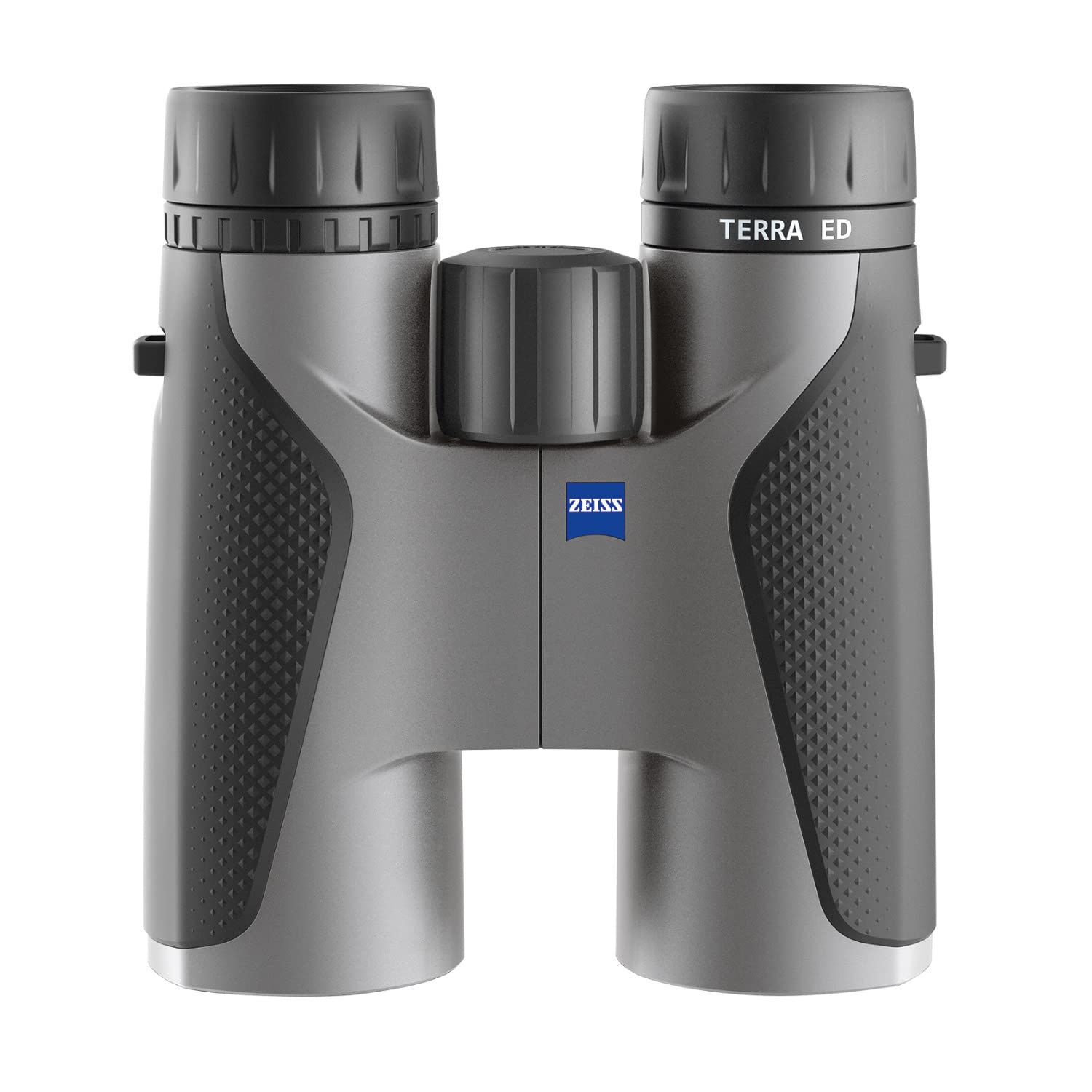
The ZEISS name carries weight in optical circles for a reason: extra-low dispersion (ED) glass in the Schmidt-Pechan prism system achieves 88 percent light transmission while eliminating chromatic aberration at the color fringing extremes. On a clear morning in the Ngorongoro Crater, the Terra ED reveals subtle feather textures on a lilac-breasted roller that lesser glass simply washes out. ZEISS’s hydrophobic multi-layer anti-reflective coating beads water instantly, so a passing mist does not ruin the view.
The large focus wheel sits under your index finger naturally—the entire ergonomic design prioritizes speed. When a leopard suddenly pads across the road, you pull the binoculars to your eyes and the wheel is already under your fingers. Fiberglass-reinforced casing with waterproof sealing handles the full temperature swing from air-conditioned vehicle to 40-degree savannah heat without a trace of internal fogging. The 18mm eye relief is generous enough for all-day comfort even with progressive lens glasses.
At under 25 ounces, the Terra ED weighs less than many mid-range 10×42 models while delivering noticeably superior contrast and color fidelity. The neoprene strap is comfortable out of the box. The hard case offers better protection than the soft pouches included with cheaper models. For travelers who want the closest thing to professional-grade optics without spending over a thousand dollars, the Terra ED is the threshold—everything above it is marginal gains, everything below is compromise.
Why it’s great
- ED glass eliminates chromatic aberration for true-to-life color rendering
- Hydrophobic coating sheds water instantly, maintaining clear views through rain
- Lightweight chassis with fast focus wheel excels in dynamic safari situations
Good to know
- Made in China rather than Germany, which matters to some brand purists
- Premium price may be overkill if you only plan occasional safari use
8. Leupold BX-4 Pro Guide HD 12×50

The BX-4 Pro Guide HD Gen 2 pushes magnification to 12x with 50mm objectives, creating a binocular that resolves detail at 400 yards that 10x binoculars leave fuzzy. This is the right choice for wide-open safari ecosystems like the Serengeti plains, where animals often appear as dark specks on the horizon. The open-bridge dual-hinge design reduces weight to 1.8 pounds, an engineering achievement for a 12×50. Guard-ion lens coating sheds dust, water, and fingerprints with a single wipe.
Leupold’s Elite Optical System delivers light transmission and glare reduction that matches pricier European glass. The 65.2-degree apparent angle of view creates a panoramic feel rare in a 12x model — you do not feel like you are looking through a straw. The diopter adjustment range covers most prescription differences, and the center focus knob is smooth with precise damping that prevents overshoot. Tripod compatibility via the standard mount thread is essential for this magnification; hand shake at 12x is noticeable without a stable rest.
Field tests from hunters and wildlife guides consistently report that the BX-4 holds collimation across years of rough transport. The rubber armor provides secure grip even when the binoculars are wet. Leupold’s legendary customer care backs the unit against defects for life, though the policy does not cover accidental damage as Vortex’s does. For dedicated wildlife watchers whose primary use case is scanning vast landscapes at magnification beyond standard safari glass, the BX-4 earns its place as the specialist tool in this collection.
Why it’s great
- 12x magnification resolves fine detail at distances where 10x binoculars fall short
- Open-bridge construction keeps weight manageable for the 50mm objective size
- Guard-ion coating protects against the dust and moisture endemic to safari environments
Good to know
- 12x hand shake requires a monopod or vehicle window rest for stable viewing
- Warranty covers defects only, not accidental damage like the Vortex VIP warranty
9. Steiner Safari ULTRASHARP 10×42

The Steiner Safari ULTRASHARP 10×42 is name-branded for the exact use case you are reading about — a binocular engineered for the dust, temperature variance, and vibration of African game drives. The NBR long-life rubber armor resists oil from sunscreen, acid from plant contact, and UV degradation that turns standard rubber sticky within a few seasons. High-Contrast Optics produce bright, 3D-like images with bold color separation that helps pick out animals camouflaged in tall grass. The central focusing wheel moves through its full range with minimal rotation for fast transitions.
The 16mm eye relief provides adequate space for eyeglass wearers, though users with thick frames may find it slightly snug compared to the 18mm offered by the Bushnell Legacy WP. The 52.78-degree field of view is narrower than some competitors — you sacrifice peripheral awareness for magnification stability. The tripod-ready 1/4-20 mount lets you adapt the unit for extended viewing sessions from a vehicle window clamp. The ClickLock strap system securely attaches the neck strap with push-button ease and prevents the binoculars from twisting face-down when hanging.
Customer feedback notes that the colors produced by the Safari ULTRASHARP appear slightly less vivid than a comparable Nikon, a deliberate trade-off for contrast that cuts through haze. The included neck strap is basic but functional; upgrading to a wider padded strap improves all-day wear. For travelers who want a binocular whose name matches the activity and whose construction anticipates the specific abuse of an African safari vehicle, the Steiner Safari is a purpose-built tool that skips compromises aimed at general outdoor users.
Why it’s great
- NBR armor resists UV, oil, and acid specific to safari field conditions
- High-Contrast Optics produce 3D pop that helps spot animals in deep grass
- Fast-close-focus wheel requires minimal rotation for quick target acquisition
Good to know
- Color reproduction is slightly warm and less saturated than competing Japanese glass
- 16mm eye relief is adequate but not generous for thick eyeglass frames
FAQ
Is 10×42 magnification the best choice for an African safari?
Should I choose roof prism or porro prism binoculars for safari?
How important is waterproofing for binoculars used on safari?
Final Thoughts: The Verdict
For most users, the best binoculars for safari africa winner is the Nikon PROSTAFF P7 10×42 because it pairs dielectric prism coating and a locking diopter at a price that leaves budget for a good harness and lens cleaning kit. If you want ultimate low-light reach in a vehicle-based safari, grab the Bushnell Legacy WP 10×50 for its massive exit pupil and tripod-ready design. And for the dedicated wildlife watcher who needs 12x magnification across vast plains, nothing beats the Leupold BX-4 Pro Guide HD 12×50.

Mo Maruf
I created WellFizz to bridge the gap between vague wellness advice and actionable solutions. My mission is simple: to decode the research and give you practical tools you can actually use.
Beyond the data, I am a passionate traveler. I believe that stepping away from the screen to explore new environments is essential for mental clarity and physical vitality.