Our readers keep the lights on and my smoothie glass nicely filled. As an Amazon Associate, I earn from qualifying purchases.
A pair of binoculars can make or break a hike. Lugging a heavy, fog-prone brick up a ridge line kills the joy of the summit view, while a crystal-clear, lightweight optic turns a rest stop into a backcountry wildlife show. The right choice hinges on nitrogen-purged seals, ED glass elements, and a total weight that won’t drag on your pack straps for eight hours.
I’m Mohammad Maruf — the founder and writer behind WellFizz. I’ve spent years analyzing optical coatings, prism geometries, and field-of-view specs to separate trail-ready binoculars from the hunting scopes and birding-only glass that dominate the market.
After evaluating seven models across a wide price spectrum, here is my definitive guide to the best binoculars for hiking.
How To Choose The Best Binoculars For Hiking
Hiking binoculars live in a specific performance pocket between pocket-sized compacts and full-size hunting glass. You need an optic that is light enough to carry all day, tough enough to survive a tumble on scree, and optically bright enough to resolve trail markers and wildlife at dawn or dusk. Here are the three specs that separate a great hiking companion from a regret.
Magnification & Objective Lens Size (8× vs 10×, 25mm vs 42mm)
8x magnification provides a wider field of view and steadier image than 10x, especially for handheld viewing on uneven terrain. Paired with a 25mm objective lens, an 8×25 configuration keeps total weight well under a pound — ideal for day hikes. A 42mm objective lets in more light for early-morning or late-afternoon viewing but adds significant weight. For most hikers, 8x or 10x with a 25-28mm objective is the sweet spot between optical performance and packability.
Waterproofing & Fogproofing (Nitrogen vs Argon Purging)
Rain, stream crossings, and temperature swings from the valley to the ridge line demand binoculars that will not fog internally. Nitrogen-purged and O-ring-sealed binoculars are the industry standard for fogproof and waterproof performance. A higher-end option uses argon purging (which is denser and resists fogging longer), but for hiking, a solid nitrogen-filled seal that meets waterproof standards (submersible to 1-3 meters) is more than sufficient. Avoid any binocular that only claims to be “water resistant” — on the trail, that is a liability.
Prism Type & Lens Coatings (Bak-4 vs BK-7, Fully Multi-Coated)
Bak-4 prisms produce a round, bright exit pupil with sharper edge-to-edge clarity, while BK-7 prisms often show a clipped or square exit pupil and less light transmission. For trail use, Bak-4 is the clear choice. Equally important is the lens coating: “fully multi-coated” means every air-to-glass surface has multiple anti-reflective layers, maximizing light transmission and contrast. This matters most when scanning shadowy forest floors or spotting birds against a bright sky.
Quick Comparison
On smaller screens, swipe sideways to see the full table.
| Model | Category | Best For | Key Spec | Amazon |
|---|---|---|---|---|
| Nikon Monarch M5 8×42 | Premium | All-day clarity in low light | ED glass, 19.5mm eye relief | Amazon |
| ZEISS Terra ED 10×42 | Premium | Brilliant optics for dedicated observers | Hydrophobic coating, 88% light trans. | Amazon |
| Vortex Diamondback HD 10×28 | Mid-Range | Compact size with dielectric coatings | Argon purged, 10.9 oz | Amazon |
| Vortex Crossfire HD 10×42 | Mid-Range | Durable all-rounder for rugged use | 24 oz, VIP warranty | Amazon |
| Nikon TRAVELITE EX 8×25 | Mid-Range | Ultra-light everyday carry | 10.6 oz, aspherical lenses | Amazon |
| Nocs Provisions Standard Issue 10×25 | Budget-Friendly | Stylish, packable secondary pair | IPX7, fully multi-coated | Amazon |
| Carson RD Series 8×26 | Entry-Level | Best value for casual trail use | 0.6 lbs, open-bridge design | Amazon |
In‑Depth Reviews
1. Nikon Monarch M5 8×42
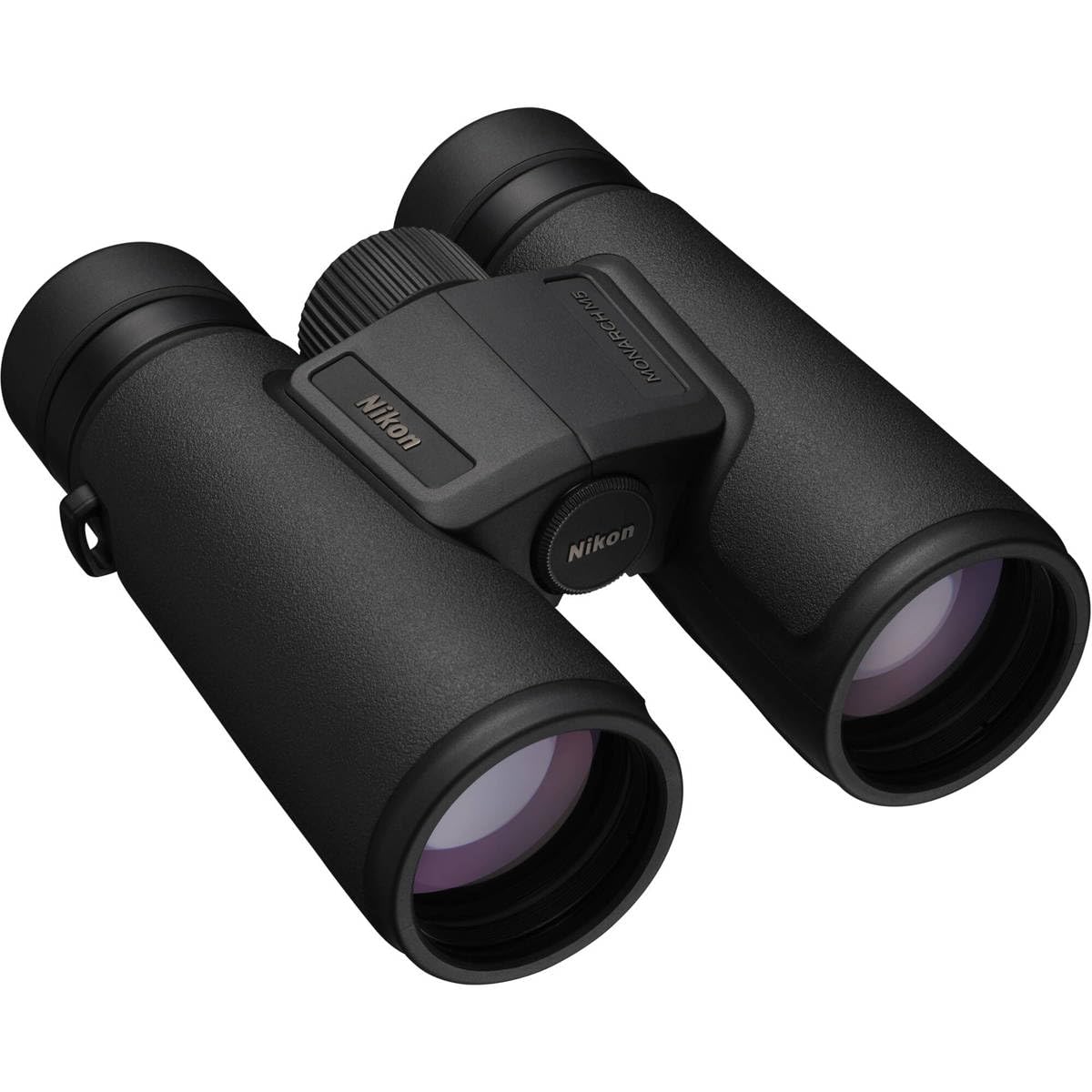
The Nikon Monarch M5 8×42 sits at the top of the hiking binocular stack because it balances a premium ED glass optical path with a substantial 42mm objective for exceptional low-light performance without crossing into true heavyweight territory. Extra-low Dispersion glass virtually eliminates chromatic aberration — you will see crisp leaf edges and clear fur textures even under a dense forest canopy at dusk. The dielectric high-reflective prism coatings push light transmission high enough that early-morning trail scouting feels effortless.
With 19.5mm of eye relief, this model accommodates eyeglass wearers better than most in its class. The turn-and-slide eyecups click into three distinct positions, and the large center focus knob is smooth enough to track a moving bird with one finger. The closed-bridge design feels solid, and the rubber-armored body absorbs shock from accidental drops on rocky terrain. At roughly 21.2 ounces, it is heavier than compact 25mm models, but the 335-foot field of view at 1,000 yards is noticeably wider than the 10x alternatives.
Downsides include a central focus wheel that sits slightly closer to the body than some users prefer, and the 8×42 configuration is overkill for day hikers who prioritize pack weight. Close focus at 8.2 feet is excellent for inspecting trailside flowers or insects. Backed by Nikon’s standard warranty, the Monarch M5 is the benchmark for serious hikers who refuse to compromise on image quality.
Why it’s great
- ED glass delivers near-zero chromatic aberration for sharp, color-true images even in low light.
- Generous 19.5mm eye relief makes it comfortable for eyeglass wearers during extended viewing sessions.
Good to know
- Heavier than compact 25mm trail binoculars at just over 21 ounces.
- Center focus wheel placement can feel awkward for users with larger hands.
2. ZEISS Terra ED 10×42
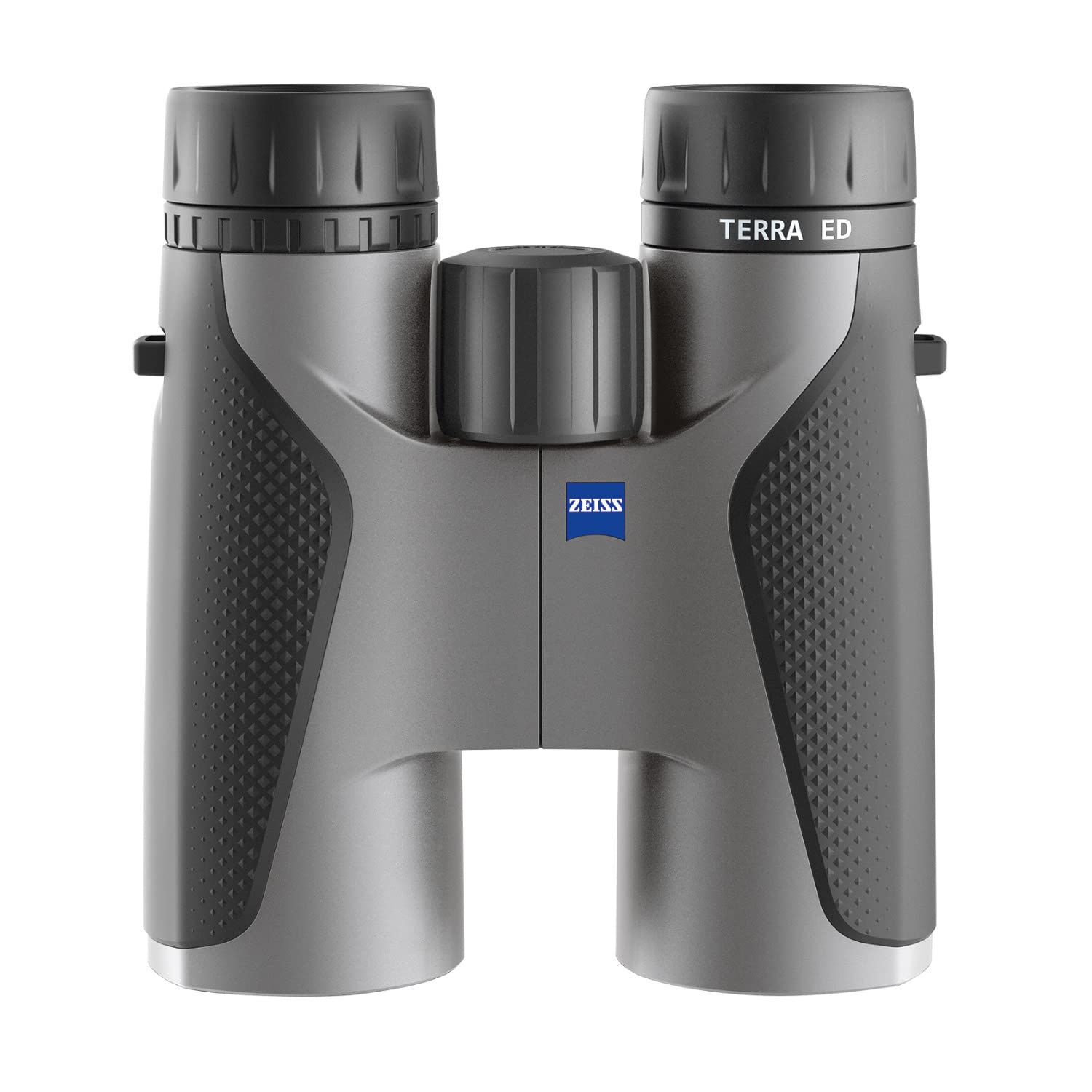
The ZEISS Terra ED 10×42 brings the legendary German optical pedigree into a hiking-friendly package that prioritizes pure image quality. The Schmidt-Pechan prism design with ED glass achieves 88% light transmission, producing images that reviewers consistently describe as “crystal clear” and “color-true” even against the Vortex Diamondback and Nikon Monarch lines at similar price tiers. The hydrophobic multi-layer anti-reflective coating sheds water droplets instantly, so a sudden rain shower won’t ruin your view of a distant ridge.
At roughly 24 ounces, it is not the lightest option for a long-distance thru-hike, but the fiberglass-reinforced casing makes it nearly indestructible — a real asset when you are scrambling up talus fields. The large focus wheel is deliberately designed so your index finger lands naturally on it, enabling quick one-handed adjustments when a bull elk steps into view. Eye relief measures 18mm, which keeps the full field of view accessible for glasses wearers, and the 60-degree apparent angle of view is wide enough to track fast-moving wildlife.
The main trade-off is the 10x magnification: on unsteady ground, the slightly narrower field of view (330 feet at 1,000 yards) and image shake require a steadier hand compared to an 8x model. The included hard case and harness strap add to the premium feel. If your priority is uncompromising optical fidelity on long observation stops, the Terra ED justifies its premium position.
Why it’s great
- Hydrophobic multi-layer coating repels water and maintains clear views in wet conditions.
- 88% light transmission produces bright, high-contrast images during dusk and dawn.
Good to know
- 10x magnification can be shaky for handheld use on uneven hiking terrain.
- Heavier than compact alternatives — better suited for day packs with dedicated gear space.
3. Vortex Diamondback HD 10×28

At just 10.9 ounces, it slips into a hip belt pocket or the brain of a day pack without a second thought, yet it packs dielectric coating and an HD optical system that deliver noticeably better color accuracy and brightness than the entry-level Crossfire series. The Armortek coating on exterior lenses resists scratches, oil, and dirt — a godsend when you are wiping dust off with a shirt sleeve.
With 16mm of eye relief, it comfortably accommodates glasses, and the twist-up eyecups offer multiple stop positions. The 28mm objective is the primary compromise — it gathers less light than a 42mm lens, so low-light performance at dawn or in thick tree cover is not as strong as the bigger Vortex models. The argon purging is a step above nitrogen in terms of long-term fogproof reliability, and the O-ring seals keep rain and stream splashes out completely. The center focus wheel is smooth and precise, built with the same quality as Vortex’s larger hunting glass.
Some users note that the 10×28 format demands a steady hand, and the smaller exit pupil (2.8mm) means precise eye alignment is necessary to avoid vignetting. The included soft case and tethered lens covers are well-designed for trail use. Paired with Vortex’s unlimited, unconditional VIP warranty, the Diamondback HD 10×28 is the smartest mid-range compromise between size and optical quality for weight-conscious hikers.
Why it’s great
- Weighs only 10.9 ounces, making it one of the lightest mid-range binoculars for hiking.
- Argon purging provides superior long-term fogproof protection compared to nitrogen-filled models.
Good to know
- 28mm objective limits low-light performance compared to 42mm models.
- 10x magnification with a small exit pupil is less forgiving for users with shaky hands.
4. Vortex Crossfire HD 10×42

The Vortex Crossfire HD 10×42 is the workhorse of this list — a fully featured 42mm optic that gives you HD optical performance and a rock-solid build at a mid-range price point. The select glass elements and fully multi-coated lenses cut chromatic aberration reasonably well, delivering resolution that reviewers rate as “excellent for the money.” The 10x magnification paired with a 4.2mm exit pupil provides a bright enough image for early morning hikes, though the Diamondback series edges ahead in low-light clarity.
Rubber armor wraps around an aluminum chassis that can take serious abuse, and the nitrogen-purging and O-ring seals make it equally waterproof and fogproof. The twist-up eyecups work well with glasses, and the 15mm eye relief is functional but less generous than the Monarch M5. At 24 ounces, this is undeniably a heavy hiking companion — best suited for shorter trips or pack rafting where the extra weight is balanced by the superior light-gathering of the 42mm objective. The focus wheel has minimal play, and the diopter ring clicks into precise positions.
The included GlassPak chest harness is a major plus for active hiking, keeping the binoculars secure against your chest while freeing up pack space. Some users find the edge-to-edge sharpness slightly soft compared to higher-tier Vortex models, but the difference is marginal for general trail use. The unlimited, unconditional VIP warranty means if you break them on a hike, Vortex repairs or replaces them — a critical safety net for any outdoor gear.
Why it’s great
- 42mm objective gathers excellent light for dawn and dusk viewing on the trail.
- VIP lifetime warranty covers any damage — repair or replacement with no questions asked.
Good to know
- Weighs 24 ounces, making it one of the heavier options for long-distance hiking.
- Edge-to-edge sharpness is slightly softer than the Diamondback HD series.
5. Nikon TRAVELITE EX 8×25

The Nikon TRAVELITE EX 8×25 is the gold standard for ultralight hiking binoculars — at just 10.6 ounces, it disappears into a jacket pocket or the top of a summit pack, yet it delivers the multilayer-coated optics and aspherical eyepiece lenses that make Nikon famous. The aspherical elements minimize image distortion at the edges of the field of view, which is a rare feature at this weight class. The 8x magnification is forgiving of hand shake on a windy ridgeline, and the 47.5-degree actual field of view feels spacious for a 25mm objective.
The die-cast aluminum body wrapped in rubber armor feels significantly more premium than the plastic-body alternatives in the sub- range. Nitrogen purging and O-ring seals make it waterproof to 2 meters and completely fogproof — you can cross a creek or get caught in a downpour without worrying about internal condensation. The turn-and-slide eyecups click into place, and the click-type diopter adjustment is precise enough for fine-tuning between different users. Eye relief is 11.1mm, which works for casual glasses use but will not be comfortable for all-day wear.
The primary compromise is the 25mm objective: in dense forest shade or twilight, the image dims noticeably compared to a 42mm glass. The close focus of roughly 8.2 feet is good for trailside inspections. Some users report that the neck strap attachment points feel narrow, and the included case is basic. For day hikers and thru-hikers who weigh every gram, the TRAVELITE EX 8×25 remains the benchmark for weight-to-optical performance.
Why it’s great
- Weighs only 10.6 ounces — one of the lightest fully waterproof binoculars available.
- Aspherical eyepiece lenses deliver edge-to-edge clarity rare at this weight class.
Good to know
- 25mm objective limits brightness in low-light conditions like dense forest or dusk.
- Eye relief is tight for eyeglass wearers, reducing the visible field of view.
6. Nocs Provisions Standard Issue 10×25

The Nocs Provisions Standard Issue 10×25 brings a fresh aesthetic and a compelling feature set to the budget-friendly hiking binocular category. The fully multi-coated optics with Swiss-designed Bak-4 prisms deliver a bright, crisp image with decent color fidelity for the price point, and the 315-foot field of view at 1,000 yards is competitive for a 10×25 configuration. The patented Rugged Wave Grip textured rubber casing provides excellent purchase even with wet or sweaty hands, and the IPX7 waterproof rating means it can survive full submersion in up to three feet of water for 30 minutes.
At 11.85 ounces, it is only slightly heavier than the Nikon TRAVELITE EX, but the 10x magnification gives you more reach for spotting trail markers or distant peaks. The multi-stop twist-up eyecup mechanism provides three distinct positions to dial in eye relief for glasses or bare eyes. The included soft case is functional, and the “No-Matter-What” Lifetime Warranty is a strong vote of confidence for a product in this tier. The design is intentionally modern, with colors like Pacific Blue II that stand out from the sea of black-and-green binoculars.
Image quality is good but not exceptional — some chromatic aberration appears on high-contrast edges, and the 10×25 format requires precise eye alignment to avoid blackouts. The neck strap attachment slots are narrow, making installation difficult with burn-sealed strap ends. This model is best suited as a secondary, packable pair for casual hikers or as an entry-level option for someone new to trail optics. It will not outperform the Nikon or Vortex options, but it offers reliable performance at a friendly price point.
Why it’s great
- IPX7 waterproof rating ensures full submersibility — a rare feature at this price.
- Lifetime warranty and stylish design make it a confident choice for casual hikers.
Good to know
- 10×25 configuration can show chromatic aberration on high-contrast edges.
- Narrow neck strap slots make installation difficult with some strap types.
7. Carson RD Series 8×26 RD-826
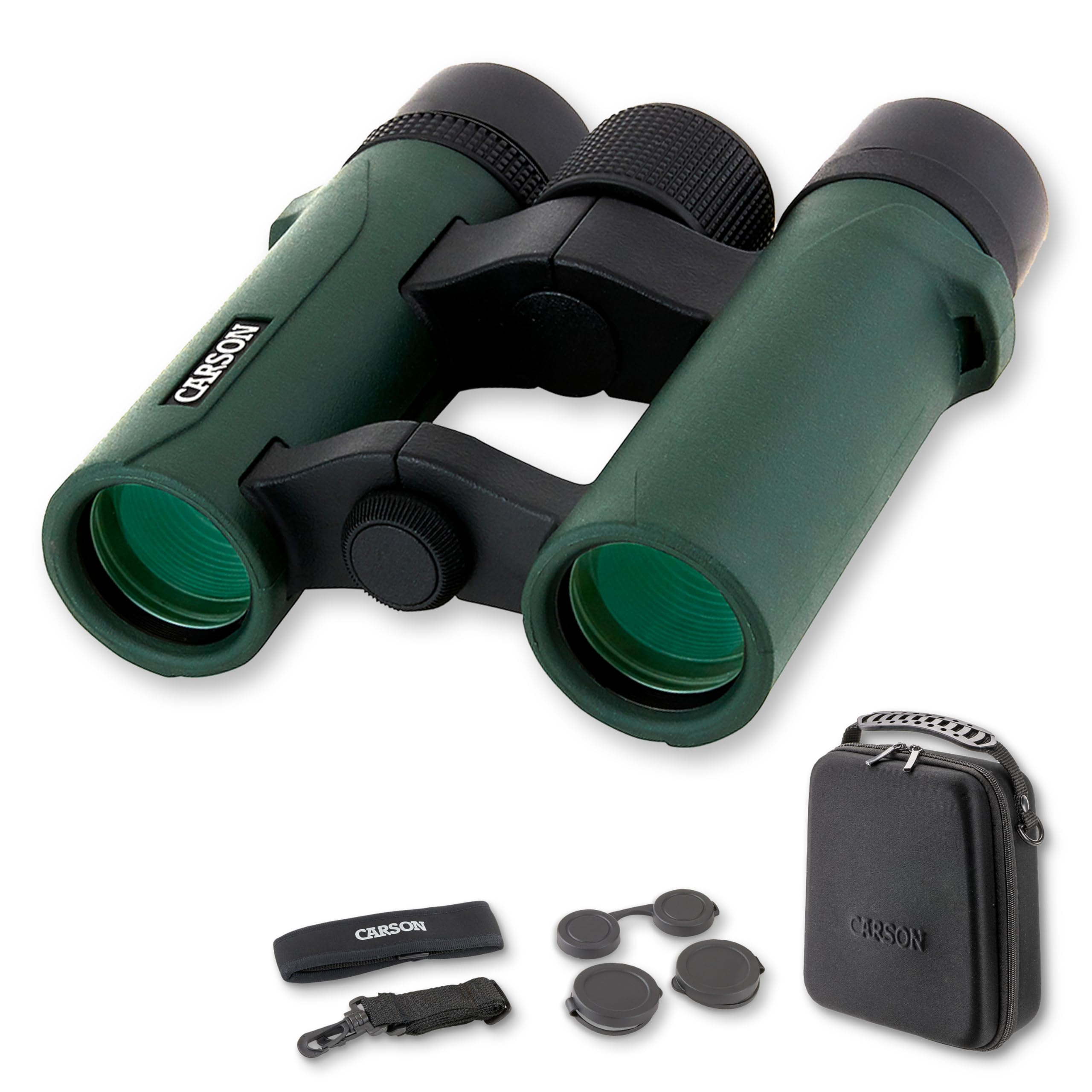
The Carson RD Series 8×26 RD-826 proves that entry-level hiking binoculars do not have to feel cheap. The open-bridge design reduces weight to just 0.6 pounds while also improving grip ergonomics — your thumb naturally wraps through the bridge gap for a more stable hold. Bak-4 prisms and multi-coated optics produce surprisingly bright, sharp images for the price, with reviewers consistently using phrases like “crystal clear” and “feather weight champion.” The 8×26 configuration is forgiving for handheld use, and the 356-foot field of view at 1,000 yards is genuinely wide for a compact pair.
Nitrogen filling and O-ring seals make the RD-826 both waterproof and fogproof, which is unexpected and welcome at this price level. The twist-down eyecups are extra-long and provide adequate eye relief for glasses wearers. The close focus of 13.1 feet is functional but not as impressive as the Monarch M5 or TRAVELITE EX. The included hard case is sturdy, though it lacks belt loops and the zipper pull is prone to breaking — a common complaint across multiple reviews.
Optically, the RD-826 punches well above its price, but the accessory quality is where corners are clearly cut. The neck strap is mediocre, and the lens cloth is basic. The focus knob is large and precise, a highlight of the design. For the day hiker who wants a lightweight, waterproof, optically solid pair of binoculars without spending more than necessary, the Carson RD Series is the definitive entry-level champion. It is an unbeatable value for casual trail use.
Why it’s great
- Open-bridge design improves grip stability while keeping weight to just 0.6 pounds.
- Nitrogen-filled and O-ring sealed waterproof/fogproof performance at an entry-level price.
Good to know
- Included carry case has a fragile zipper and lacks belt loops for trail attachment.
- Neck strap and lens cloth are low-quality accessories that may need replacement.
FAQ
Is 8x or 10x magnification better for hiking?
What does fully multi-coated mean on hiking binoculars?
How important is waterproofing for hiking binoculars?
Final Thoughts: The Verdict
For most users on the trail, the binoculars for hiking winner is the Nikon Monarch M5 8×42 because it balances ED glass, excellent low-light performance, and generous eye relief in a package that non-thru-hikers can comfortably carry. If you want a pack-friendly, sub-11-ounce optic that still delivers dielectric coating quality, grab the Vortex Diamondback HD 10×28. And for a budget-friendly entry point that does not compromise on waterproofing or Bak-4 prisms, nothing beats the Carson RD Series 8×26.

Mo Maruf
I created WellFizz to bridge the gap between vague wellness advice and actionable solutions. My mission is simple: to decode the research and give you practical tools you can actually use.
Beyond the data, I am a passionate traveler. I believe that stepping away from the screen to explore new environments is essential for mental clarity and physical vitality.