Our readers keep the lights on and my smoothie glass nicely filled. As an Amazon Associate, I earn from qualifying purchases.
Hitting the road or trail without accurate ride data leaves you guessing about distance, speed, and progress. A reliable handlebar computer transforms your ride by providing real-time metrics that keep you informed and motivated mile after mile.
I’m Mohammad Maruf — the founder and writer behind WellFizz. I’ve spent countless hours analyzing satellite positioning systems, battery endurance tests, and sensor compatibility across the most popular models to help cyclists find the right companion for their handlebars.
Whether you train for distance, commute daily, or explore new routes, the right best bicycle computer gives you the precise feedback you need to ride smarter and push further.
How To Choose The Best Bicycle Computer
Not all handlebar computers deliver the same experience. Choosing the right model depends on matching its core features to your riding style, from simple data logging to full route navigation.
Satellite Positioning and Accuracy
Basic models use single-band GPS, which works well on open roads. Multi-band GNSS support, seen in premium units, improves accuracy under heavy tree cover and urban canyons by locking onto multiple satellite constellations simultaneously.
Sensor Compatibility
To track cadence, heart rate, or power output, the computer must support ANT+ or Bluetooth connections. Entry-level units often rely on GPS alone for speed, while mid-range and premium models pair seamlessly with dedicated sensors for richer ride data.
Battery Life and Display
Battery endurance ranges from 17 to 60 hours depending on screen type, backlight usage, and GPS polling frequency. Larger color touchscreens consume more power, while monochrome LCD panels with manual backlight can run for days between charges.
Quick Comparison
On smaller screens, swipe sideways to see the full table.
| Model | Category | Best For | Key Spec | Amazon |
|---|---|---|---|---|
| Magene C606 V2 | Premium Color | Route navigation & training analysis | 2.8″ color touchscreen, 25 hr battery | Amazon |
| Garmin Edge 540 | Premium Button | Targeted adaptive coaching | 26 hr standard, 42 hr saver mode | Amazon |
| Wahoo ELEMNT ROAM V2 | Premium Navigation | Turn-by-turn directions & live segments | 2.7″ 64‑color display, 17 hr battery | Amazon |
| iGPSPORT BSC300T | Mid-Range Touch | Offline map navigation & real-time tracking | 2.4″ touchscreen, 20 hr battery | Amazon |
| iGPSPORT BSC100S | Mid-Range Value | Long distance with full sensor bundle | 2.6″ LCD, 40 hr battery, IPX7 | Amazon |
| CYCPLUS M1 | Budget Sensor Pack | Riders needing speed & cadence included | 2.9″ LCD, 60 hr battery | Amazon |
| COOSPO BC107 | Budget Essential | Low-cost entry to GPS tracking | 2.4″ LCD, IP67, GPS/Beidou | Amazon |
In‑Depth Reviews
1. Magene C606 V2
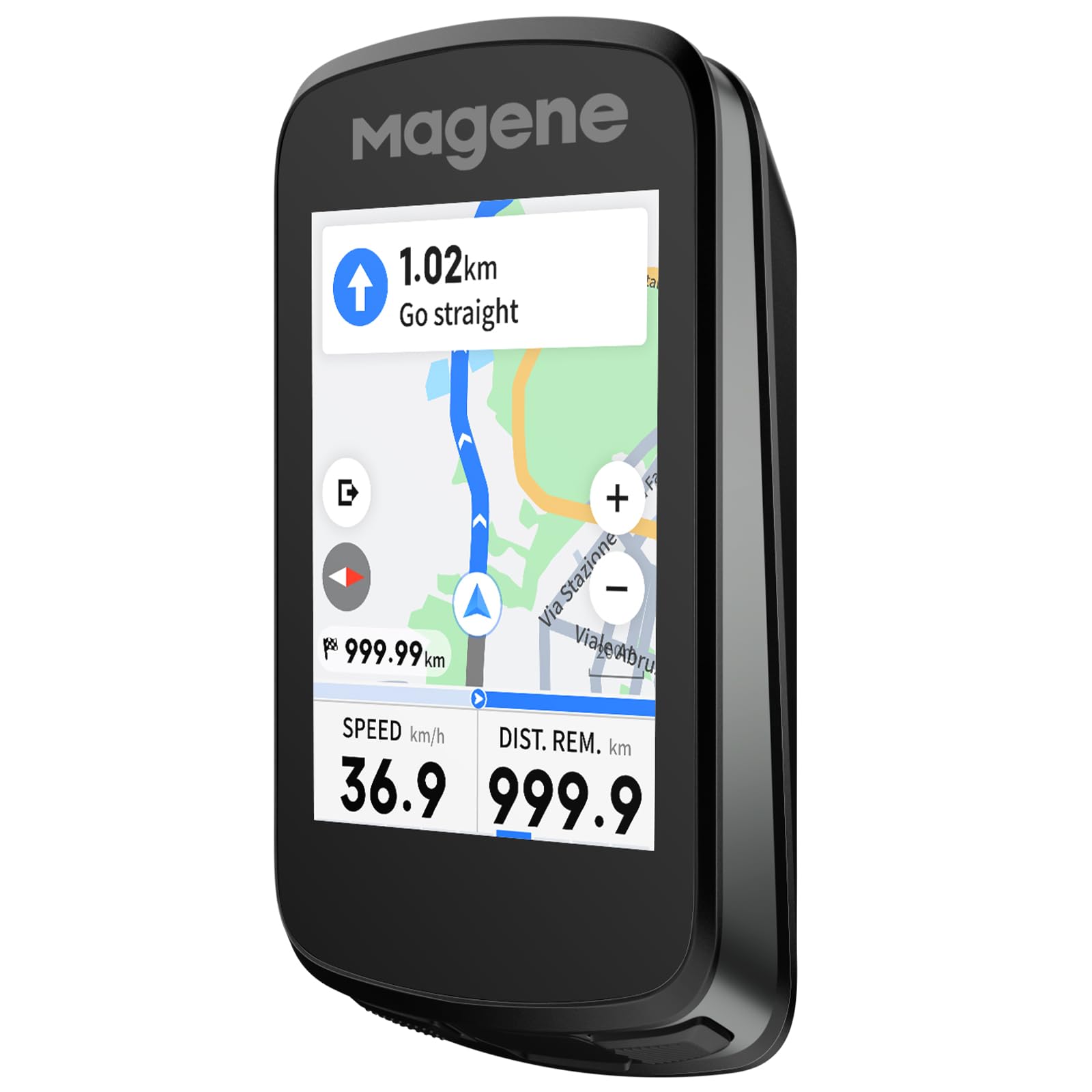
The Magene C606 V2 brings premium features usually reserved for high-end units to a more accessible price point. Its 2.8-inch color touchscreen provides vivid route previews, and the offline navigation with multi-source route planning eliminates the need to carry your phone for directions.
ClimbPro-style multi-scenario climbing detection shows real-time gradient, remaining elevation gain, and a route profile — helping you pace climbs before you even start the ascent. The unit also supports Strava Live Segments, power-phase cycling dynamics with a compatible power meter, and one-tap control for DJI Action and Insta360 cameras.
Wi-Fi and Bluetooth sync speeds are noticeably faster than Bluetooth-only units, and the IPX7 waterproof rating handles heavy downpours. Battery life reaches 25 hours, and the included tempered glass protector adds durability on rough rides.
Why it’s great
- Vivid 2.8″ color touchscreen with intuitive interface
- Offline navigation with automatic rerouting
- Strava Live Segments and ClimbPro-style alerts
Good to know
- Battery drops roughly 6% per hour with heavy use
- Radar integration less refined than Wahoo/Stages
2. Garmin Edge 540

Garmin’s Edge 540 uses targeted adaptive coaching to adjust daily workout suggestions based on your training load and recovery status. Paired with a compatible power meter and heart rate monitor, it provides on-screen prompts that help you hit specific fitness goals without overtraining.
The multi-band GNSS delivers exceptional positioning accuracy in challenging environments, and the ClimbPro ascent planner now works on every ride — even without a pre-loaded course. Power Guide recommends output targets throughout a route, and the stamina tracking shows your remaining push capacity in real time.
Battery life spans up to 26 hours in demanding use and extends to 42 hours in battery saver mode. Physical button controls remain tactile and responsive even with sweaty or gloved fingers, and USB-C charging simplifies cable management.
Why it’s great
- Adaptive coaching tailors training to your recovery
- Multi-band GNSS for accurate positioning
- Long 42-hour battery saver mode
Good to know
- No touchscreen; all functions via buttons
- Setup requires reading the online manual
3. Wahoo ELEMNT ROAM V2

The ELEMNT ROAM V2 from Wahoo prioritizes navigation accuracy. Dual-band GPS locks onto multiple satellite constellations including NavIC, maintaining signal in dense forests and urban corridors where single-band units lose tracking. The 2.7-inch 64-color screen is readable in direct sunlight, and ambient light sensing automatically adjusts brightness.
Turn-by-turn directions generate automatically from GPX, TCX, and platform routes from Strava, Ride With GPS, and Komoot. Summit Segments preview all upcoming climbs with color-coded difficulty, while the on-demand route creation lets you set a destination directly on the device map without needing a phone.
The integrated out-front mount includes a locking screw for security, and 32 GB of internal storage allows extensive offline map downloads. Customizable QuickLook LED indicators alert you to calls, messages, and performance thresholds at a glance.
Why it’s great
Superior map readability and turn-by-turn navigation
Automatic route downloads from multiple platforms
Customizable LED alerts for messages and data
Good to know
Battery life is 17 hours under normal use
Some USB-C chargers may not be compatible
4. iGPSPORT BSC300T

The BSC300T brings a responsive 2.4-inch touchscreen to iGPSPORT’s lineup, supplemented by six physical buttons for gloved operation. Its offline map download capability and route preview with turn prompts let you explore unfamiliar roads without cellular coverage, and the off-course warning nudges you back on track if you veer off the planned route.
Over 130 ride data fields cover everything from basic speed to power-phase analysis when paired with ANT+ sensors. Real-time tracking displays teammate positions during group rides, preventing wrong turns and dropped riders. The unit also supports eBike integration, displaying power levels and assist modes.
Battery endurance reaches 20 hours, and USB-C charging fills the unit quickly using a standard phone charger. The BSC300T pairs reliably with rear radar systems for traffic warnings, adding an extra layer of safety on busy roads.
Why it’s great
Responsive touchscreen with button backup
Offline maps with turn-by-turn guidance
eBike power level display supported
Good to know
Navigation lacks automatic recalculation on missed turns
Battery life moderate at 20 hours
5. iGPSPORT BSC100S
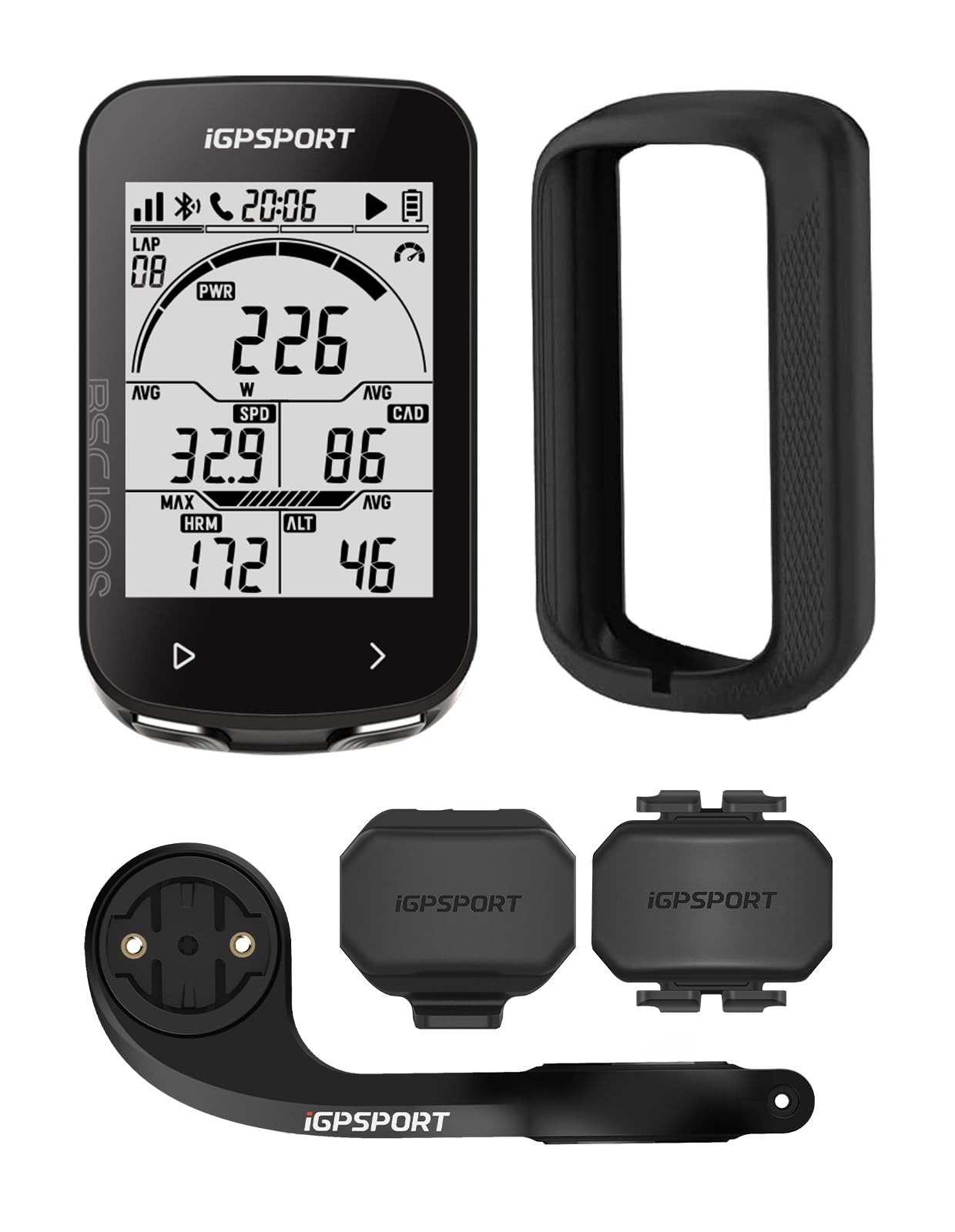
The BSC100S stands out because it includes both a cadence sensor and a speed sensor in the box, eliminating the need for separate purchases. This package integrates over 40 ride data metrics including grade, temperature, and elevation, with all data syncing easily to the iGPSPORT app and Strava.
Five-satellite positioning (GPS, Beidou, GLONASS, Galileo, QZSS) delivers quick lock and reliable tracking, while the IPX7 waterproof rating ensures operation through heavy downpours. The 2.6-inch anti-glare LCD remains readable in direct sunlight, and the USB-C port reduces charge time compared to older micro-USB designs.
The 600 mAh battery runs up to 40 hours, making this a strong companion for multi-day tours. Bluetooth 5.0 and ANT+ compatibility allows pairing with smart watches, heart rate monitors, and power meters, though the interface uses a simple two-button layout with limited customizability.
Why it’s great
Includes cadence and speed sensors out of the box
40-hour battery covers long endurance rides
Five-satellite positioning for quick lock
Good to know
Two-button interface limits page customization
No routing or turn-by-turn navigation
6. CYCPLUS M1

The CYCPLUS M1 offers one of the longest battery runtimes in its class with a 60-hour lithium polymer cell. The 2.9-inch FSTN LCD screen includes glare-free technology and auto-backlight that adjusts based on sunrise and sunset times, keeping data visible without draining power during daylight hours.
Included in the package are a combined speed and cadence sensor that switches between modes by toggling a switch. The unit supports ANT+ and Bluetooth connectivity for heart rate monitors and power meters, and data syncs through the CYCPLUSFit app with export options to Strava and Ride With GPS.
Setup takes under a minute with the included handlebar mount, though the mount only fits 31.8 mm handlebars. The Swiss GPS chipset acquires signals quickly, and the IPX6 water resistance handles rain without hesitation.
Why it’s great
60-hour battery life for multi-week commutes
Speed and cadence sensor included in box
Glare-free auto-backlit display
Good to know
Trip odometer resets on power-off; no total mileage
Temperature reading can be off by 15 degrees
7. COOSPO BC107

The COOSPO BC107 strips away unnecessary complexity to deliver core GPS tracking at a low entry cost. The 2.4-inch LCD display packs key metrics including speed, distance, heart rate, and grade percentage into a compact chassis, with GPS and Beidou dual-mode positioning for reliable global tracking.
ANT+ compatibility allows pairing with third-party heart rate monitors, cadence sensors, and power meters, though Bluetooth is reserved exclusively for the CoospoRide app. The app handles setup, data logging, .FIT file export, and Strava sync, though some users report occasional auto-sync gaps that require manual upload.
The IP67 rating provides dust and submersion resistance, and the 500 mAh lithium-ion battery holds charge well through multiple rides. The package includes a standard mount and rubber rings, but the extension front mount for longer stems must be purchased separately.
Why it’s great
Affordable entry point with accurate GPS/Beidou tracking
ANT+ support for external sensors
IP67 waterproof and dustproof rating
Good to know
Bluetooth only for app; no direct Bluetooth sensor pairing
App auto-sync to Strava can require manual intervention
FAQ
Do I need a speed sensor if my computer has GPS?
Can I use a bicycle computer without a smartphone?
How often should I charge my bike computer?
What does IPX7 mean for a cycling computer?
Final Thoughts: The Verdict
For most users, the best bicycle computer winner is the Magene C606 V2 because it combines a vivid color touchscreen, offline navigation, and advanced climb analytics at a price well below traditional premium offerings. If you want adaptive coaching that adjusts workouts based on recovery, grab the Garmin Edge 540. And for turn-by-turn navigation with unmatched map readability and easy multi-platform route syncing, nothing beats the Wahoo ELEMNT ROAM V2.

Mo Maruf
I created WellFizz to bridge the gap between vague wellness advice and actionable solutions. My mission is simple: to decode the research and give you practical tools you can actually use.
Beyond the data, I am a passionate traveler. I believe that stepping away from the screen to explore new environments is essential for mental clarity and physical vitality.