Our readers keep the lights on and my smoothie glass nicely filled. As an Amazon Associate, I earn from qualifying purchases.
Whether you’re rehabbing a lumbar injury, training around chronic back pain, or simply want to hammer your quads and glutes without compressing your spine, a dedicated belt squat attachment is the single most effective tool you can add to your home gym. These devices let you load the hips directly, bypassing the spinal column entirely, and the difference in recovery and session quality is immediate.
I’m Mohammad Maruf — the founder and writer behind WellFizz. I’ve spent years analyzing the structural engineering, material science, and real-world failure points of strength equipment to separate the cleverly marketed from the genuinely built.
If you want to squat with full intensity and zero spinal load, choosing the right hardware matters more than any single rep you’ll ever take. That’s exactly what this guide to the best belt squat attachment is designed to help you do.
How To Choose The Best Belt Squat Attachment
Not every belt squat attachment is the same. The difference between a fluid, deep squat and a clunky, limited-range experience comes down to a few measurable factors. Here’s what to scrutinize before you buy.
Rack compatibility
The most common mistake is buying an attachment that doesn’t physically fit your power rack. Check the upright dimension (2×2, 2×3, or 3×3 inches) and the hole diameter (typically 5/8-inch or 1-inch). Some units include adapters; others require modification. Measure your rack’s post width and hole size before ordering — there is no universal standard.
Pivot quality and bushing material
The single moving part on a lever-based attachment is the hinge. Cheap units use metal-on-metal friction points that squeak, bind, and wear quickly. Better models incorporate brass or UHMW (ultra-high-molecular-weight polyethylene) bushings that provide silky-smooth rotation without lubrication. If you see “bushings on pivot points” in the spec, that’s a strong indicator of long-term smoothness.
Belt design and hip contact
The belt is where your body meets the load. A stiff, unpadded nylon web will dig into your anterior hip and cause discomfort on heavy sets — this is the “hip pinch” complaint you see in reviews. Look for a wide, padded belt (5 inches or more) with a chain attachment that doesn’t create a hard point at the buckle. The best belts are made of layered neoprene or thick leather with a smooth inner face.
Kickstand or floor support
Loading and unloading plates while balancing a lever arm is awkward without a kickstand. Some premium attachments include a fold-down support that holds the arm at the right height. If your chosen model lacks this feature, plan to build a small wooden platform or buy aftermarket support — it dramatically improves daily usability.
Quick Comparison
On smaller screens, swipe sideways to see the full table.
| Model | Category | Best For | Key Spec | Amazon |
|---|---|---|---|---|
| Betollo Belt Squat System | Rack-attached | High-load squats | 1100 lb capacity / 9mm steel | Amazon |
| Fringe Sport Mammoth | Rack-attached | Versatility & comfort | 9.84 lb arm / 39”-48.75” length | Amazon |
| Bells of Steel Belt Squat 2.0 | Standalone machine | No-rack needed | 700 lb / 11-gauge steel frame | Amazon |
| IronMind Super Squats Belt | Standalone belt | Portability & multi-use | 3500 lb tensile strength | Amazon |
| Spud Inc Black Belt | Standalone belt | Budget-friendly belt | 5.5” thick woven nylon | Amazon |
| FAGUS H Multi-Use Attachment | Rack-attached | Adjustability & value | 28”-46.5” adjustable arm | Amazon |
| FitForge Belt Squat | Rack-attached | Entry-level rack add-on | 495 lb capacity / 22 lb unit | Amazon |
In‑Depth Reviews
1. Betollo Belt Squat System

The Betollo system sets itself apart with a 9mm steel plate frame and an 1100-pound capacity that puts it in a different class from the typical 400-500 lb attachments. The adjustable lever arms range from 31.2 inches to 45 inches, giving tall lifters the reach they need without sacrificing stability. No assembly is required — pull it out of the box, slide it onto your rack, and start loading.
The padded universal squat belt is noticeably wider and softer than the nylon web belts found on cheaper units, which directly addresses the hip-pinch complaint. Multiple users with hip replacements reported zero discomfort during deep sets. The chain attachment design allows for natural sway without creating a hard pressure point at the buckle.
Two caveats: the hinge pins are sized for 5/8-inch or 1-inch holes, so owners of 3/8-inch-hole racks will need spacers and a modified weight pin. The unit also lacks a built-in kickstand, meaning you’ll want to build a small platform or purchase an aftermarket support for easy plate loading. For anyone who trains over 400 pounds consistently, the Betollo delivers the most headroom.
Why it’s great
- 9mm steel plate frame resists flex under extreme loads
- 1100-pound capacity is unmatched in its price tier
- Padded belt eliminates anterior hip digging
- Zero assembly required
Good to know
- Hinge pins may require spacers for 3/8-inch hole racks
- No kickstand included — plan a loading platform
- Missing parts reported in isolated cases
2. Fringe Sport Mammoth Belt Squat Attachment
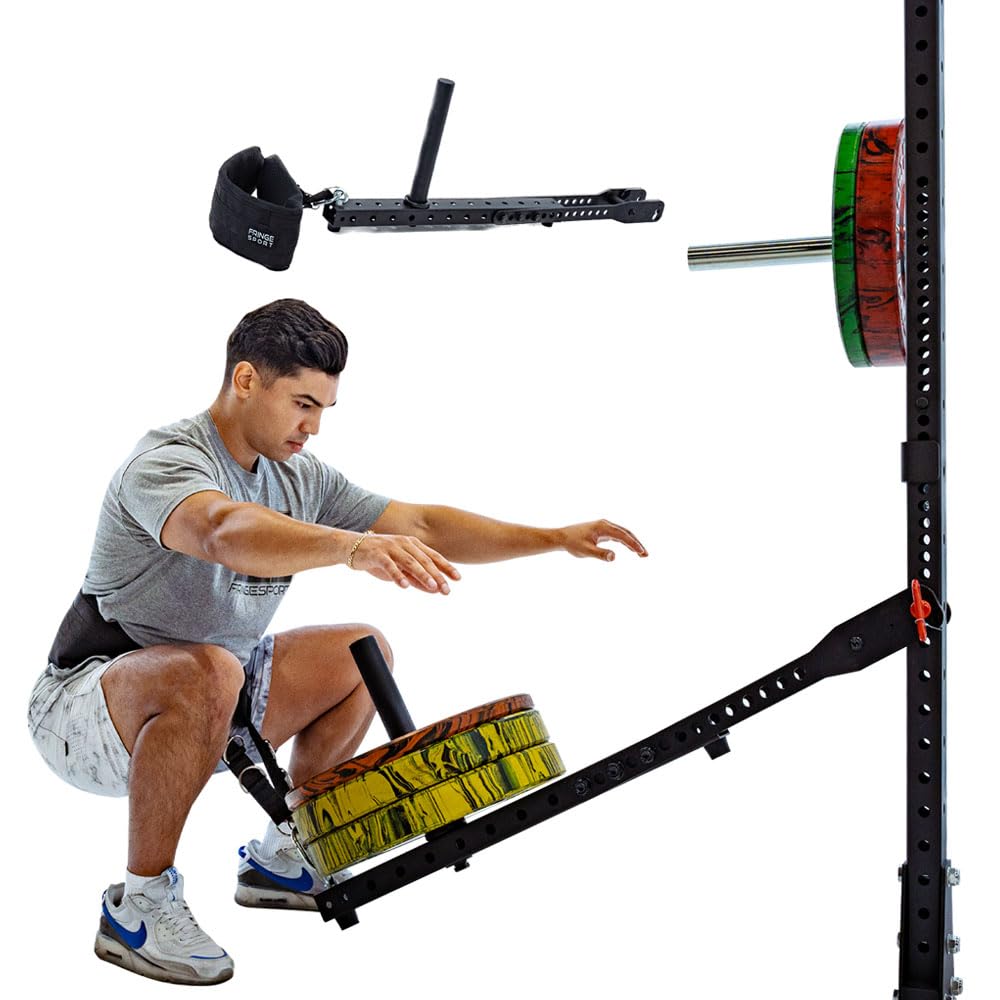
The Mammoth from Fringe Sport is a mid-range unit that punches above its weight in two areas: adjustability and belt comfort. The lever arm spans 39 to 48.75 inches, and the included squat belt adjusts to fit waists from 28 to 48 inches — accommodating a wider range of body types than most competitors. The steel frame carries a black powder coat finish, and the hardware is zinc-plated with UHMW bushings at the pivot point for smooth, silent rotation.
Users consistently praise the belt for its even weight distribution and lack of hip pinch. The loadable pin is 14 inches tall, which allows for full plate stacks without bottoming out. Beyond belt squats, the attachment works well for donkey calf raises, one-arm rows, and Romanian deadlifts, making it a truly multi-use rack addition.
The major frustration is the missing kickstand — the product photos show one, but it is sold separately. Without it, loading plates requires crouching under the arm or balancing the lever while sliding plates on. Budget for the kickstand at checkout. One isolated failure of the belt attachment bolt was reported, though the majority of users describe the build as “thick” and “overbuilt.”
Why it’s great
- Wide 28-48 inch belt adjustment range
- UHMW pivot bushings for smooth operation
- Multi-use — squats, rows, calf raises, deadlifts
- 14-inch loadable pin fits full plate stacks
Good to know
- Kickstand sold separately and essentially required
- Single failure report of belt attachment bolt
3. Bells of Steel Belt Squat Machine 2.0

The Bells of Steel Belt Squat Machine 2.0 is a freestanding machine, not a rack attachment — a crucial distinction. It requires no power rack at all, making it ideal for garage gyms where the rack is occupied or nonexistent. The 11-gauge steel frame supports 700 pounds, and the linear bearing straps provide a frictionless vertical path that no lever-based attachment can replicate. The included weightlifting belt comes with 2 feet of chain and two carabiners, and the machine includes top and bottom band pegs for accommodating bands.
The free-standing design eliminates the rack-compatibility headache entirely. The machine footprint is roughly 51 by 81 inches, which is comparable to a compact leg press. Assembly is straightforward — most users report being under 30 minutes — and the bushings on the pivot points keep the movement fluid. The dual j-cup system allows for easy bar placement and removal.
The cost is significantly higher than rack-mounted alternatives, reflecting the frame material and the standalone nature. Shipping can be inconsistent — some units arrive in two boxes without notice, and one user reported a cracked cap in transit. Bells of Steel’s customer service is widely praised for resolving issues quickly. If you lack a compatible rack, this is the simplest path to zero-spine-load squatting.
Why it’s great
- Freestanding — no rack required
- Linear bearing straps for frictionless movement
- 11-gauge steel frame with 700-lb capacity
- Band pegs for accommodating resistance
Good to know
- Takes up 51×81 inches of floor space
- Significantly higher price than rack attachments
- Shipping can arrive in split boxes
4. IronMind Super Squats Hip Belt

The IronMind Super Squats Hip Belt is not a rack attachment — it is a standalone belt designed for use with a loading pin, chain, or barbell setup. With a tensile strength of 3,500 pounds, this belt is overbuilt to an absurd degree. The medium size fits a 35-inch waist, and the closure is a heavy-duty buckle system that will not slip under load. It is as portable as it gets — toss it in a gym bag and use it on a pull-up bar for weighted dips and chins, or attach it to a sled for dragging work.
The versatility is the standout feature. Users report using it for squats, hip lifts, calf raises, weighted pull-ups, and sled pulls. The belt distributes load across the hips without compressing the spine, and the included booklet provides programming guidance. When paired with a loading pin, the setup becomes a compact belt squat station that takes up almost no floor space.
The trade-off is learning curve. Without the stability of a lever arm or dedicated machine, balance becomes a factor — users describe the movement as wobbly at first, especially under heavy loads. Some lifters experienced hip joint pain at higher weights and had to reduce load and slow reps. This is not a set-and-forget tool; it rewards deliberate movement patterns. For the lifter who wants maximum portability and multi-function, it is the best available.
Why it’s great
- 3,500-pound tensile strength — will never fail
- Extremely portable — fits in a gym bag
- Works for squats, dips, chins, pulls, and sleds
- Zero stress on the lumbar spine
Good to know
- Balance can be awkward, especially with barbell
- Requires loading pin or chain setup (sold separately)
- Some users report hip joint pain at heavy loads
5. Spud Inc Black Belt Squat Large Belt

The Spud Inc Black Belt is a woven nylon belt designed exclusively for belt squatting — no lever arms, no rack attachment, just a high-durability belt and a pair of rings. The belt measures 54 inches long (57 inches including the rings) and is 5.5 inches thick (the width dimension, not thickness). The material is a heavy woven nylon webbing that has proven to survive decades of abuse according to long-term users.
This is a pure belt squat belt: you load it with plates using chain and spring clips (not included), step up onto two benches of equal height, and squat. The design eliminates any possibility of a lever arm failing because there is no lever arm. Users consistently rate it 5/5 for durability and note that it is significantly more comfortable than old-style chain belts. The thick back support distributes load across a wider surface area than typical nylon belts.
The drawbacks are specific to body dimensions. Lifters with smaller waists report the belt is too long — the plates may bottom out on the floor before reaching full depth. The wide nylon edges can be abrasive on the inner thighs, and the anterior hip can still pinch under heavy loads, though users describe a 90 percent improvement over chain belts. It is an excellent entry-level belt for lifters who already own a chain and spring clips.
Why it’s great
- Extremely durable woven nylon construction
- Wide 5.5-inch back distributes load well
- Much more comfortable than chain belts
- Proven decades-long lifespan
Good to know
- Chain and spring clips not included
- Too long for short-waisted lifters — plates may hit floor
- Nylon edges can be abrasive on thighs
6. FAGUS H Multi-Use Belt Squat Attachment

FAGUS H’s attachment is a compact, adjustable lever arm that flips orientation to fit both 2×2-inch and 3×3-inch racks with either 1-inch or 5/8-inch holes — a genuine dual-compatibility feature that few competitors offer. The arm length adjusts from 28 to 46.5 inches, which is the widest range in the mid-tier category. The steel construction feels solid despite the relatively light 16.5-pound package weight, and the 2-year warranty provides confidence.
Users on Rogue Monster Lite racks (3-inch uprights) report a perfect fit with no modification needed. The attachment works for belt squats, curls, rows, and guided deadlifts. The mechanism for changing arm length uses multiple pin positions, allowing for precise depth adjustment. The ability to bail out simply by sitting down and unclipping the belt is a safety feature praised by lifters with lumbar issues.
The belt included with the unit has been critiqued as lacking sufficient padding — the anterior hip can become uncomfortable at higher loads. The attachment also lacks a kickstand feature, so loading requires either a partner or a well-placed bench. The pivot is smooth but the bushing material is not specified, and a few users noted minor finish imperfections. For the price, it offers impressive rack compatibility and adjustment range.
Why it’s great
- Fits both 2×2 and 3×3 racks with two hole sizes
- 28 to 46.5 inch adjustable arm range
- Multi-use — squats, curls, rows, deadlifts
- 2-year warranty included
Good to know
- Belt padding is minimal — may cause hip discomfort
- No kickstand for easy loading
- Pivot bushing material not specified
7. FitForge Belt Squat Attachment

FitForge’s rack attachment is the most accessible entry point into lever-style belt squatting. It fits 3×2 or 3×3-inch racks with 5/8-inch holes and includes the squat belt in the box. The frame is metal and supports up to 495 pounds — sufficient for most intermediate lifters. The 22-pound unit is relatively lightweight and easy to move in and out of the rack when you need the space back for other exercises.
Users praise the build quality relative to the cost, noting that it feels solid and handles significant weight without wobble. The belt squat movement itself is smooth, and the ability to switch between belt squats, curls, rows, and guided deadlifts adds versatility. The attachment is simple to install and remove, making it a practical addition to a shared home gym.
Two recurring frustrations: the product ships without a chain, so you will need to purchase a length of chain and spring clips separately before you can use it. Some units arrived with small metal debris inside the packaging — likely remnants from the manufacturing process — and one user reported a broken unit on arrival. The lack of a kickstand is also noted, though users say it is not strictly necessary. For the price, it is a functional if unrefined starting point.
Why it’s great
- Budget-friendly entry into lever belt squatting
- Squat belt included in the package
- Easy to install, remove, and store
- 495-pound capacity suitable for most lifters
Good to know
- Chain and spring clips not included
- Some units arrived with metal debris inside
- No kickstand option available
FAQ
Can a belt squat attachment replace a barbell back squat?
Will a belt squat attachment fit my Rogue or REP rack?
How much weight can I realistically load on a belt squat?
Do I need a kickstand for a belt squat attachment?
Final Thoughts: The Verdict
For most users, the best belt squat attachment winner is the Betollo Belt Squat System because it combines a 9mm steel frame, a forgiving padded belt, and an 1100-pound rating at a price that undercuts premium alternatives. If you value multi-use freedom and comfort over pure capacity, grab the Fringe Sport Mammoth. And for a standalone machine that needs no rack at all, nothing beats the Bells of Steel Belt Squat 2.0.

Mo Maruf
I created WellFizz to bridge the gap between vague wellness advice and actionable solutions. My mission is simple: to decode the research and give you practical tools you can actually use.
Beyond the data, I am a passionate traveler. I believe that stepping away from the screen to explore new environments is essential for mental clarity and physical vitality.