Our readers keep the lights on and my smoothie glass nicely filled. As an Amazon Associate, I earn from qualifying purchases.
Living with a hernia means every cough, sneeze, or sudden twist sends a sharp reminder that your core isn’t holding. The daily trade-off between staying active and managing the bulge is exhausting. A well-designed belt changes that equation by providing external reinforcement exactly where the connective tissue has weakened, letting you move without that constant fear of protrusion.
I’m Mohammad Maruf — the founder and writer behind WellFizz. Every belt in this guide has been evaluated through the lens of real-world biomechanics: how the pad geometry interacts with inguinal and umbilical anatomy, whether the compression stays consistent through a full day of bending and walking, and how discreetly the whole system vanishes under a shirt.
After comparing the market’s leading models on pad retention, breathability, strap adjustability, and post-surgery suitability, we built this guide to help you find your ideal belt for hernia without wasting money on gear that shifts, rolls, or fails when you need it most.
How To Choose The Best Belt For Hernia
Selecting the right hernia belt isn’t about brand loyalty; it’s about matching the belt’s mechanical design to your specific hernia type (inguinal, umbilical, incisional, or femoral) and your daily activity level. A belt that works beautifully for a desk worker with a small inguinal bulge may slide off in minutes for someone doing physical labor. Here are the critical factors to weigh before buying.
Hernia Type And Pad Configuration
Inguinal hernias need a belt with a groin strap system and a contoured pad that sits over the inguinal canal. Umbilical hernias demand a wider abdominal binder with a dome-shaped pad centered on the navel. Bilateral hernias require belts that hold two pads securely on both sides. If you buy a single-side belt for a bilateral condition, you’ll end up with one side unsupported and the belt twisting.
Material Breathability And Durability
Neoprene offers strong compression and durability but can trap heat during summer wear. Nylon-spandex blends breathe better and stretch more naturally, but they may lose elasticity faster. Cotton-elastic mixes are softest against sensitive post-surgery skin but need more careful washing. For all-day wear in warm climates, prioritize belts with breathable mesh panels or cotton layers over full neoprene construction.
Adjustability And Pad Retention
A belt that shifts is worse than no belt at all. Look for wide hook-and-loop closures (Velcro) across the main waist band and separate adjustable groin straps. The compression pad must stay fixed in a pocket or via a secure attachment system — loose pads that migrate away from the hernia site defeat the entire purpose. Check user feedback on whether the pad “stays put” during bending and walking.
Quick Comparison
On smaller screens, swipe sideways to see the full table.
| Model | Category | Best For | Key Spec | Amazon |
|---|---|---|---|---|
| Underworks Inguinal Support Brace | Inguinal Truss | Active users needing all-day pad stability | Nylon/spandex washable pads | Amazon |
| FlexaMed Inguinal Support Belt | Inguinal Truss | Precision pad placement over the canal | Cotton/elastic over-brief design | Amazon |
| BLITZU Bilateral Belt (S-M) | Bilateral Support | Double inguinal hernia management | Two removable neoprene compression pads | Amazon |
| BLITZU Single-Side Belt (S-M) | Inguinal Support | Left or right inguinal hernia relief | Anti-slip silicone strips on waist | Amazon |
| Fitomo Umbilical Hernia Belt | Umbilical Binder | Umbilical hernia with dome-shaped pad | 3D dome pad with extra lumbar strap | Amazon |
| ARMSTRONG AMERICA Plus Size Binder | Abdominal Binder | Post-surgery and plus-size umbilical support | 9.5-inch wide nylon blend belt | Amazon |
| ARMSTRONG AMERICA Belly Band | Post-Surgery Binder | Post-op recovery and postpartum compression | Polyester/spandex blend with wide bands | Amazon |
In‑Depth Reviews
1. Underworks Inguinal Hernia Support Brace (Medium)

The Underworks 948 is the belt that keeps showing up in conversations among people who have tried six or seven other trusses and finally found one that works. The pad geometry is specifically contoured for the inguinal region, with a firm but flexible shape that stays locked over the canal during bending, lifting, and walking. Many users report that this is the only belt that held their incarcerated hernia in place while they waited for surgery.
The construction uses a nylon and spandex blend that breathes better than full neoprene wraps, and the entire garment survives machine washing and low-heat drying without losing elasticity. The adjustable Velcro straps on both the waist and the leg loops allow fine-tuned compression on either the left or right side, and the removable pads can be washed separately or swapped with hot/cold gel packs available from the manufacturer.
Fit is the one area that demands careful attention — the sizing runs slightly small for some body types, and several users advise ordering one size larger than your measured waist. Once you get the right size, the belt provides consistent support that doesn’t ride up or require constant readjustment during a full workday. For anyone managing a reducible inguinal hernia, this is the benchmark.
Why it’s great
- Pads are anatomically shaped for the inguinal canal and stay in place during physical activity
- Machine-washable construction holds up to repeated cleaning cycles without coming apart
- Compatible with optional hot/cold gel pads for additional symptom management
Good to know
- Runs small; most users need to order one size larger than their waist measurement
- Leg straps can be tricky to position correctly on the first few wears
2. FlexaMed Right Side Inguinal Hernia Support Belt (Medium)
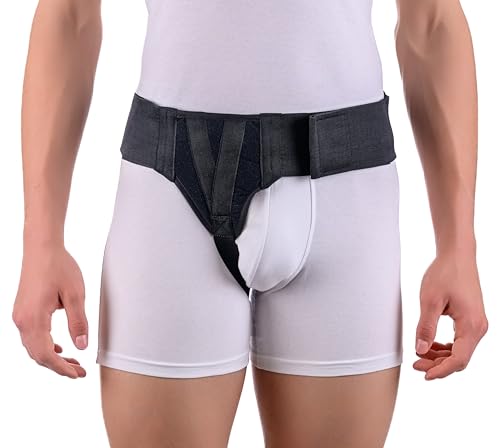
The FlexaMed distinguishes itself with an over-the-brief design that eliminates the need for a bulky waist belt digging into your ribs. The cotton-elastic material is significantly softer against the skin than neoprene alternatives, making it a strong choice for users who need to wear support all day in warm environments or under dress shirts. The compression pad is positioned on the inside of the belt, applying direct pressure exactly over the inguinal canal without an intervening plastic ring.
Users consistently praise the way the pad applies consistent pressure that eliminates protrusion during exercise, walking, and even light running. The leg strap is fully adjustable via Velcro, and the design allows the belt to be worn while swimming or bathing since the materials handle water exposure without degrading. The right-side version shown here is mirrored by a left-side model, and a double-sided version covers bilateral hernias.
Sizing is measured around the hips rather than the natural waist, which catches some buyers off guard. If your hip measurement falls exactly on the boundary between two sizes, the general consensus is to size up for comfort unless you want maximum compressive force. A few users with smaller leg circumferences report that the leg strap can feel slightly loose, but this is easily managed by folding a small cloth under the pad for added pressure.
Why it’s great
- Soft cotton-elastic construction breathes well and feels comfortable against bare skin all day
- Pad applies direct pressure without a hard plastic ring, reducing irritation during movement
- Wearable during swimming and showering without damage to the belt
Good to know
- Leg strap can feel loose on individuals with smaller leg circumference
- Only available in single-side configurations; bilateral version uses two separate pads
3. BLITZU Hernia Belt for Bilateral Support (S-M)
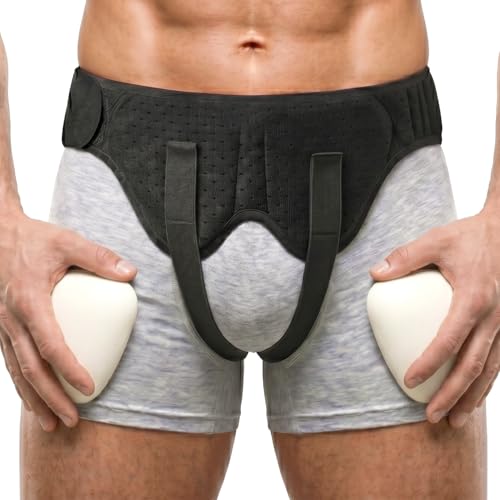
This BLITZU belt solves a specific problem that many hernia sufferers face: bilateral hernias that need equal compression on both sides. The belt comes with two removable medical-grade compression pads that sit in fabric pockets, and you can use one, both, or none depending on your condition. The pads are made from a firm foam that maintains its shape against the body — they don’t flatten out after a week of wear.
The neoprene main body provides uniform compression across the entire abdomen, which helps with incisional and umbilical hernias in addition to inguinal ones. Users report that the belt stays in place during golf, weightlifting, and running, which makes it a viable option for active individuals who need support during sports. The hook-and-loop closure is wide enough to distribute pressure evenly without pinching at the edges.
Size selection is the primary gotcha here. The S-M size is intended for hip circumferences up to 45 inches, but some users find the fit runs generous. If you’re between sizes or prefer a snugger compression, sizing down one step improves pad-to-body contact. The pads are thick enough to be visible under thin clothing, but the belt itself lies flat enough to wear under loose jeans or work pants.
Why it’s great
- Two removable compression pads allow customized support for single, double, or mixed hernia types
- Firm foam pads maintain structural integrity over months of daily wear without flattening
- Neoprene construction provides uniform abdominal compression suitable for active sports use
Good to know
- Runs slightly large; users on the smaller end of the size range may need to order down
- Thick pads can create a visible bulge under tight or thin clothing
4. BLITZU Inguinal Hernia Support Belt for Men & Women (S-M)
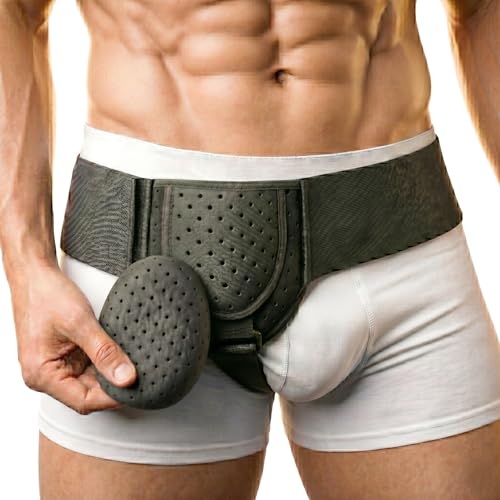
For people who need inguinal support on one side only, this BLITZU belt offers a refined approach. The waist band uses a cotton-spandex blend with anti-slip silicone strips printed on the inside, which dramatically reduces the belt’s tendency to ride up over the course of a workday. The single compression pad is mounted on the outside of the belt — a design choice that allows the pad to press inward more effectively than pads sewn into interior pockets.
The adjustable groin strap has a removable loop that can be detached if you find the leg loop uncomfortable. This flexibility is helpful for users who want the option of lighter support during sedentary periods and full compression when moving around. The pad itself is low-profile enough to disappear under jeans, and the belt can be worn with the pad on either the left or right side by simply repositioning the groin strap.
Some users note that the included separate pad is thicker than the built-in one, which can create uneven pressure if you try to stack them. The solution is to use either the built-in pad or the separate one, not both. Overall fit runs true to the hip measurement chart, though users with a very narrow waist relative to their hips may find the belt sits looser at the top edge.
Why it’s great
- Anti-slip silicone strips on the waist band keep the belt from migrating upward during movement
- Removable groin strap gives users the option of lighter support when sitting for long periods
- Cotton-spandex blend breathes better than neoprene for all-day wear in warm conditions
Good to know
- The two pads (built-in and separate) are different thicknesses, so stacking them creates uneven pressure
- Users with narrow waists may experience some looseness at the top edge of the belt
5. Fitomo Front-Wearing Umbilical Hernia Belt (L/XL)

Umbilical hernias require a fundamentally different support shape than inguinal hernias. The Fitomo belt addresses this with a 3D dome-shaped pad that creates a concave space over the navel, applying even circumferential pressure rather than the flat, point-pressure approach of standard pads. Users who have tried multiple umbilical belts consistently rank this one as the most effective at eliminating the protrusion sensation during walking and sitting.
The belt includes an extra adjustable strap that doubles as lumbar support when the hernia pad is removed, adding versatility for users who want one product that serves both abdominal and lower back needs. The front-wearing design means you can adjust the tension without having to reach behind your back, which is especially valuable for post-surgery recovery when bending is painful. The nylon construction is smooth against clothing and the overall profile is slim enough to remain invisible under a polo shirt or sweater.
The main trade-off is that the belt can slip over time during vigorous movement. The hook-and-loop closure is strong, but the elastic nature of the band means that repeated bending may gradually shift the pad away from the navel center. A few users recommend tightening the belt one extra notch after an hour of wear to compensate for this creep. The dome pad itself is slightly bulky — it won’t disappear under a tight t-shirt — but for umbilical hernia sufferers, the trade-off in visible outline is worth the mechanical advantage.
Why it’s great
- 3D dome pad provides targeted circumferential pressure around the navel, superior to flat pads for umbilical hernias
- Dual-purpose design works as a hernia belt with the pad and as a lumbar support belt without it
- Front-wearing closure allows easy tension adjustment without reaching behind the back
Good to know
- Pad can shift slightly away from the navel during prolonged bending or twisting motions
- Dome pad creates a visible contour under tight-fitting shirts
6. ARMSTRONG AMERICA Plus Size Hernia Belt (XXXL)
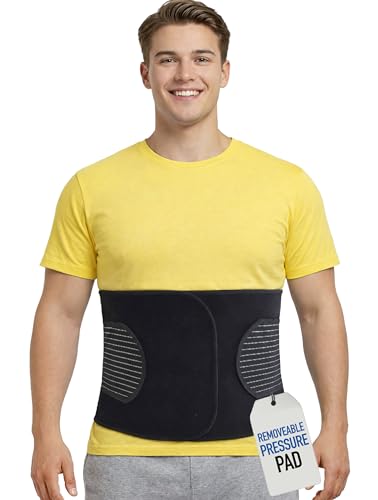
The ARMSTRONG AMERICA belt carves out a specific niche: it’s one of the few hernia belts that genuinely accommodates plus-size torsos without skimping on support width. At 9.5 inches tall, the abdominal binder covers a much larger surface area than standard belts, which distributes compression over a wider zone and reduces the risk of the belt rolling at the top or bottom edges. This makes it particularly effective for umbilical, incisional, and ventral hernias that sit above the belt line of narrower supports.
The belt features a removable pressure pad that can be positioned over the specific hernia site, plus adjustable tightening straps that let you dial in the exact compression level. Users recovering from hernia surgery appreciate that the belt can be worn over a light gauze or bandage without adding friction directly on the incision. The hook-and-loop closure is robust enough to maintain tension through a full day of bending and driving.
The most common complaint is that the top and bottom edges can curl inward over time, especially if the belt is machine-dried on high heat. Air drying resolves this issue entirely. Some users also note that the included circular pad doesn’t fully cover the umbilical area for larger torsos, but the belt’s wide surface area still provides effective compression even if the pad isn’t perfectly centered. The initial chemical smell from the packaging dissipates after the first hand wash.
Why it’s great
- Wide 9.5-inch profile distributes compression across a large area, reducing edge curling and rolling
- Removable pad and adjustable straps allow personalized positioning for different hernia types
- Strong hook-and-loop closure maintains tension through a full day of physical activity
Good to know
- Edges can curl inward if the belt is dried on high heat; air drying is essential
- Circular pad may not fully cover the umbilical area for larger torso sizes
7. ARMSTRONG AMERICA Abdominal Binder (XXL)
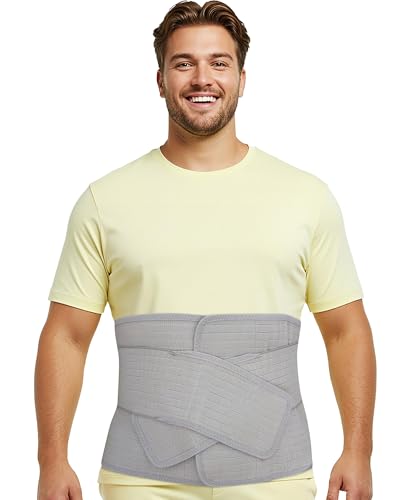
While this ARMSTRONG AMERICA product is marketed as a postpartum belly band and tummy tuck binder, its construction makes it an excellent post-operative abdominal binder for hernia repair recovery. The blend of polyester, spandex, and nylon creates a fabric that is simultaneously firm enough to provide genuine compression and stretchy enough to conform to female curves without gaping. This is the belt that multiple-time abdominal surgery patients reach for over hospital-issue binders.
The design uses wide compression bands rather than a single strap, which distributes pressure evenly across the abdomen and prevents the binder from rolling or stretching out of shape. Users who have used it for pre- and post-op incisional hernia management report that the Velcro grip is strong enough to hold a tight compressive setting even during sneezing, coughing, or sudden movement — the exact moments when hernia pain is most acute. The light grey color is less clinical-looking than white binders and shows less visible wear.
The sizing chart is the weak link here. Multiple users report that the product runs significantly shorter in length than advertised — one measurement showed a 10-inch discrepancy from the size chart. The advice from the community is to order at least one size larger than the chart suggests, or ideally to measure the actual product upon arrival and exchange if needed. The customer service team has a strong track record of processing refunds for sizing issues, which mitigates some of the risk.
Why it’s great
- Polyester-spandex-nylon construction provides firm compression without rolling or losing shape
- Wide compression bands distribute pressure evenly, reducing the risk of the binder migrating
- Velcro closure holds tight compressive settings during sneezes, coughs, and sudden movements
Good to know
- Sizing chart is unreliable; the belt often measures significantly shorter than the chart indicates
- Order at least one size larger than chart recommendation to ensure adequate coverage
FAQ
Can I wear a hernia belt while sleeping?
How tight should my hernia belt feel?
Can a hernia belt cure a hernia without surgery?
Final Thoughts: The Verdict
For most users, the belt for hernia winner is the Underworks Inguinal Support Brace because its nylon-spandex construction, washable pads, and proven pad retention make it the most reliable companion for daily hernia management across all activity levels. If you need precision pad placement for an inguinal hernia, grab the FlexaMed Support Belt. And for umbilical hernia relief with a dome-shaped pad that actually stays centered, nothing beats the Fitomo Front-Wearing Belt.

Mo Maruf
I created WellFizz to bridge the gap between vague wellness advice and actionable solutions. My mission is simple: to decode the research and give you practical tools you can actually use.
Beyond the data, I am a passionate traveler. I believe that stepping away from the screen to explore new environments is essential for mental clarity and physical vitality.