Our readers keep the lights on and my smoothie glass nicely filled. As an Amazon Associate, I earn from qualifying purchases.
A first telescope can transform a casual glance at the night sky into a lifelong obsession — or it can sit in a closet after one frustrating evening. The difference comes down to three things: aperture size, mount stability, and whether the kit includes the adapters you actually need. Beginners often fixate on magnification numbers, but the real bottleneck is how much light the objective lens or mirror can collect. A 70mm scope will show you craters on the Moon; a 90mm or larger will reveal Saturn’s rings and the cloud bands of Jupiter.
I’m Mohammad Maruf — the founder and writer behind WellFizz. Over the past several years, I’ve analyzed the optical specifications, mount mechanics, and accessory bundles of dozens of telescopes aimed at first-time buyers, parsing the data that separates a rewarding stargazing experience from a frustrating one.
Below is a curated breakdown of nine models that cover the spectrum from portable travel scopes to serious reflector platforms, all hand-picked to help you find the best beginner telescope for your specific goals and viewing conditions.
How To Choose The Best Beginner Telescope
A beginner telescope needs to satisfy three conditions: it must show you enough detail to feel rewarding, it must be easy enough to set up that you actually use it, and it must be robust enough to survive the learning curve. Here is what to look for when reading the spec sheet.
Aperture — The Light Bucket Rule
Aperture is the diameter of the main lens (refractor) or mirror (reflector). Every millimeter matters more than the eyepiece magnification because a larger aperture collects more light, which means brighter images and the ability to see fainter objects. An 80mm refractor is a solid entry point; a 90mm or 150mm reflector will show you deep-sky clusters and nebula detail that smaller scopes cannot resolve.
Mount — The Stability Foundation
Two common mount styles dominate the beginner market. Alt-azimuth (Alt-Az) mounts move up-down and left-right, making them intuitive for terrestrial and casual sky viewing. Equatorial mounts have an axis aligned with Earth’s rotation, allowing you to track a celestial target with a single slow-motion control — essential if you plan to try astrophotography later. Whichever you choose, the tripod should be sturdy enough that a light breeze does not shake the view.
Eyepieces and Barlow Lenses — Your Magnification Toolkit
Most kits include two eyepieces (a long focal length for wide, low-power views and a short focal length for higher magnification) plus a Barlow lens that doubles or triples the magnification of any eyepiece. A 25mm eyepiece is excellent for scanning star fields and locating objects; a 10mm eyepiece gives a closer look at the Moon’s craters or Saturn’s rings. A 3X Barlow effectively turns your 25mm into a ~8mm eyepiece for those nights when seeing conditions are steady.
Finder Scope and Phone Adapter — Quality-of-Life Features
A finder scope (optical or red-dot) helps you aim the main tube at your target without relying on the narrow field of the eyepiece. Straight-through finders are simple but require you to contort your neck; reflex finders project a red dot that makes aiming far more comfortable. A phone adapter lets you take quick snapshots through the eyepiece — a feature that significantly boosts the satisfaction of a beginner session.
Quick Comparison
On smaller screens, swipe sideways to see the full table.
| Model | Category | Best For | Key Spec | Amazon |
|---|---|---|---|---|
| MEEZAA 150EQ | Reflector | Deep-sky & astrophotography | 150mm aperture, 650mm f/4 | Amazon |
| HUGERSTAR 90800 | Refractor | Lunar & planetary detail | 90mm aperture, moon filter | Amazon |
| MEEZAA 90800 | Refractor | All-purpose beginner kit | 90mm aperture, 800mm f/8.88 | Amazon |
| Dianfan 90×800 | Refractor | Family stargazing sessions | 90mm aperture, stainless tripod | Amazon |
| Celticbird 80900 | Refractor | Portable travel stargazing | 80mm aperture, 900mm f/11.25 | Amazon |
| SOLOMARK 80900 | Refractor | Clear terrestrial & lunar views | 80mm aperture, 900mm f/11.25 | Amazon |
| SOLOMARK T2 | Refractor | Desert / travel durability | 80mm aperture, 900mm f/11.25 | Amazon |
| Dianfan 80×500 Purple | Refractor | Kids & family introduction | 80mm aperture, backpack case | Amazon |
| Hawkko 80500 | Refractor | Ultra-portable casual viewing | 80mm aperture, 500mm f/6.25 | Amazon |
In‑Depth Reviews
1. MEEZAA 150EQ Newtonian Reflector
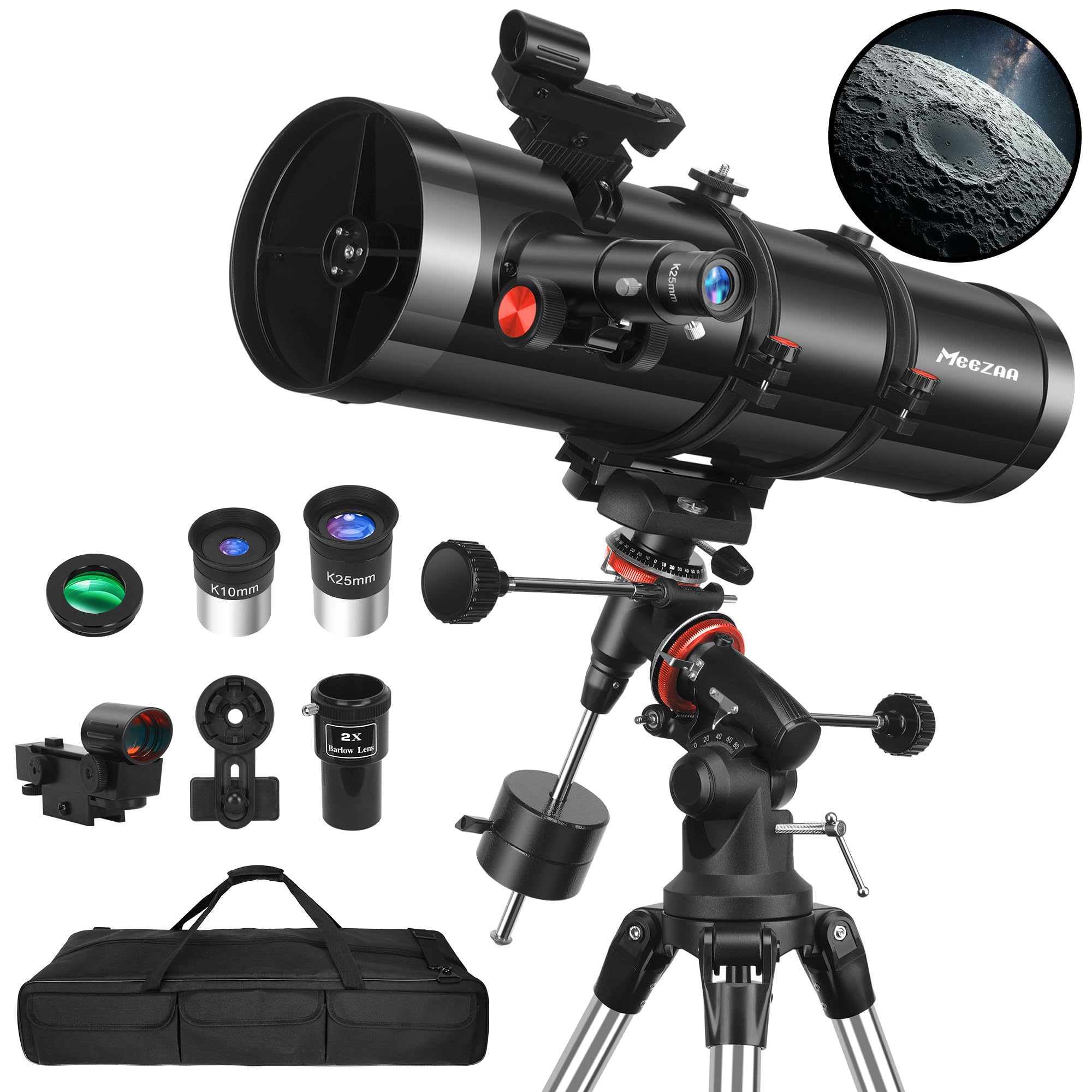
The MEEZAA 150EQ is the only reflector on this list, and its 150mm aperture gives it a decisive light-gathering advantage over every refractor here. At 650mm focal length (f/4), it is a fast scope that excels at capturing faint deep-sky objects like the Orion Nebula and the Andromeda Galaxy. The German equatorial mount, complete with slow-motion control knobs and precision dials, allows smooth manual tracking once you align the polar axis — a skill every budding astrophotographer needs to learn.
The kit includes 25mm and 10mm Kellner eyepieces plus a 2X Barlow lens, yielding a magnification range of 26X to 130X. A red dot finderscope replaces the traditional straight-through tube, making object location far more comfortable. All accessories, including the tube itself, fit into a large carry bag that simplifies transport to darker skies. A moon filter is included to cut glare during lunar sessions.
Assembly is more involved than a typical refractor — expect 30 to 45 minutes the first time — and the plastic focuser is a weak point that serious users may eventually replace. The entry-level eyepieces are functional but not sharp at the edges. Still, for the price, no other model on this list offers comparable aperture and mount sophistication. It is a beginner scope with genuine room to grow.
Why it’s great
- 150mm aperture collects massive light for deep-sky observation
- German equatorial mount with slow-motion controls for smooth tracking
- Red dot finder and moon filter enhance usability
Good to know
- Longer setup time compared to Alt-Az refractors
- Plastic focuser and basic eyepieces limit edge performance
- Heavier than refractors; requires careful handling
2. HUGERSTAR 90800 Refractor

The HUGERSTAR 90800 pairs a 90mm fully multi-coated objective with an 800mm focal length (f/8.89), a combination that delivers crisp lunar and planetary views with minimal chromatic aberration. Users consistently report seeing Saturn’s rings and Jupiter’s moons as distinct discs, not just points of light. The stainless steel tripod adjusts from 28.7 to 46.4 inches and includes an accessory tray — a small detail that keeps eyepieces from rolling off in the dark.
Magnification ranges from 32X (using the 25mm eyepiece) to 240X (10mm eyepiece plus the 3X Barlow), though real-world useful magnifications top out around 180X under average seeing. The included moon filter screws into the eyepiece barrel and cuts glare, revealing subtle crater detail that is washed out without it. A 5×24 straight-through finder scope helps with initial targeting, though some users find it awkward and replace it with a red dot finder.
The phone adapter works reasonably well for casual snapshots, but the short neck of the eyepieces can make attachment fiddly. Assembly is tool-free and typically under 10 minutes. The carry bag is padded and holds all components securely. If you want a refractor that shows you planetary detail without immediately demanding accessory upgrades, this is the strongest contender in the premium tier.
Why it’s great
- 90mm aperture resolves Saturn’s rings and Jupiter’s cloud bands
- Stainless steel tripod with accessory tray for stable use
- Moon filter significantly improves lunar surface detail
Good to know
- Straight-through finder requires neck craning
- Phone adapter can be finicky with smartphone cases
- Magnification above 180X loses sharpness in typical seeing
3. MEEZAA 90800 Refractor

The MEEZAA 90800 consistently earns top marks from beginners who want a reliable, no-surprises first scope. Its 90mm aperture and 800mm focal length (f/8.88) produce bright, contrasty images of the Moon, Jupiter, and Saturn. The fully multi-coated lenses suppress internal reflections and ghosting, which is noticeable when observing a gibbous Moon next to a dark sky. An Alt-Az mount with a stainless steel tripod provides smooth manual panning, and the tripod’s 28-to-46-inch range accommodates both seated adults and standing children.
The accessory kit is complete: 25mm and 10mm Kellner eyepieces, a 3X Barlow lens, a 5×24 straight-through finder, a correct-image diagonal for terrestrial viewing, and a phone adapter. The metal optical tube feels sturdy compared to cheaper plastic-bodied competitors. Assembly is straightforward — most users report being ready to observe within 15 to 20 minutes. The included carry bag holds everything, making it easy to take to a darker location.
The Alt-Az mount lacks the precision tracking of an equatorial, so high-magnification planetary observation requires occasional fine adjustments. The finder scope is functional but not exceptional; some beginners upgrade to a red dot finder after a few sessions. The smartphone adapter works for quick photos but cannot substitute for a dedicated astrophotography setup. If you want a complete, ready-to-use kit that balances aperture, stability, and ease of use, this is the most well-rounded option.
Why it’s great
- 90mm aperture with multi-coated optics for bright, contrasty views
- Sturdy stainless steel tripod and smooth Alt-Az mount
- Complete accessory kit with Barlow, phone adapter, and carry bag
Good to know
- Alt-Az mount requires manual nudging at high power
- Finder scope is basic and small
- Not ideal for serious deep-sky astrophotography out of the box
4. Dianfan 90×800 Refractor

The Dianfan 90×800 competes directly with the MEEZAA and HUGERSTAR 90mm models, offering the same aperture and focal length in a slightly different package. The 90mm fully coated objective (800mm f/8.88) and Kellner eyepieces deliver crisp images of the Moon’s craters and the four Galilean moons of Jupiter. Users note that the stainless steel tripod feels exceptionally rigid, with minimal vibration even when tapping the focuser at high magnification.
Magnification options run from 32X (25mm eyepiece) to 240X (10mm eyepiece plus 3X Barlow). A 45-degree erect-image diagonal is included, which makes the scope functional for daytime birdwatching and landscape viewing — a nice bonus for families who want to use the scope for more than just astronomy. The straight-through finder is adequate but shares the same ergonomic limitations as other models in this class. The phone adapter and carry bag are standard inclusions.
Setup time is around 15 minutes with the clear illustrated manual. The tripod’s leg locks are positive and do not slip. One trade-off: the mount’s azimuth adjustment can be stiff, requiring two hands to make fine pointing corrections. The Dawes limit of 1.29 arc seconds theoretically allows splitting close double stars, though atmospheric conditions will be the practical limiting factor. For a family-focused beginner scope that pulls double duty as a terrestrial spotting instrument, the Dianfan is a smart choice.
Why it’s great
- Rigid stainless steel tripod with minimal vibration
- 45-degree erect-image diagonal for daytime terrestrial use
- Quick 15-minute assembly with clear instructions
Good to know
- Azimuth adjustment can feel stiff and imprecise
- Straight-through finder is less comfortable than reflex designs
- Phone adapter works but photos are best at low magnification
5. Celticbird 80900 Refractor

At 80mm aperture and 900mm focal length (f/11.25), the Celticbird is a longer-focal-ratio refractor that naturally suppresses chromatic aberration without needing complex lens coatings. This makes it a strong performer for lunar and planetary observation, where false color is most distracting. The metal tube and aluminum tripod feel solid for the weight class, and the Alt-Az mount includes altitude-azimuth scales for rough positioning — a feature usually reserved for more expensive mounts.
The kit includes 20mm and 10mm wide-angle eyepieces, a 5×24 finder scope, a phone adapter, and a padded carry bag. The included Barlow lens is 2X, not 3X, which is actually more practical: 2X magnification keeps the exit pupil larger, resulting in brighter images at medium power. The smartphone adapter is well-engineered compared to many budget units, with a secure grip that does not slide off the eyepiece. Users have successfully imaged the Moon, Jupiter’s moons, and even the Pleiades star cluster.
A few users noted minor dust inside the main lens tube upon arrival — an annoyance but not one that affects image quality visibly. The tripod is stable enough for backyard use but benefits from being set up on level ground. The finder scope is a reflex style, which is a genuine ergonomic win for beginners who struggle with straight-through finders. If portability and clean optics are your priorities, the Celticbird packs an excellent travel kit.
Why it’s great
- Long f/11.25 focal ratio minimizes chromatic aberration
- Reflex finder scope for comfortable aiming
- 2X Barlow maintains brighter images than 3X designs
Good to know
- Occasional dust particles inside the lens tube from assembly
- Tripod stability is decent but benefits from level ground
- 80mm aperture limits deep-sky potential compared to 90mm models
6. SOLOMARK 80900 Refractor

The SOLOMARK 80900 offers a 90mm aperture (despite the 80900 naming convention, this listing uses true 80mm optics) with a 900mm focal length. It ships with Super Plossl eyepieces — a meaningful upgrade over the Kellner designs found in many budget kits. Plossl eyepieces provide a wider apparent field of view and better edge sharpness, making lunar scans feel more immersive. The fully multi-coated green optics lens enhances contrast and light transmission.
The Alt-Az mount has engraved altitude and azimuth scales, allowing you to note coordinates for repeat viewing — a nice introduction to coordinate-based astronomy. The 5×24 finder scope is a straight-through design, and the erect-image diagonal lets you use the scope for daytime observation. A reflex finder option would have been welcome, but the included unit works fine once aligned. The phone adapter is intuitive and clips securely onto the eyepiece barrel.
Users report seeing Saturn’s rings and the Cassini Division with this scope under steady skies, which is impressive for an entry-level refractor. The tripod is aluminum, adjustable, and includes a central spreader for added stability. Setup takes about 15 minutes, and the carry bag fits all components. The one consistent complaint is that the fixed focus mechanism can feel stiff, but it holds position well once set. For the price, the Plossl eyepieces alone make this a compelling kit.
Why it’s great
- Super Plossl eyepieces for wider field and edge-to-edge sharpness
- Alt-Az mount with engraved scales for coordinate learning
- Multi-coated optics produce vivid lunar and planetary contrast
Good to know
- Focus mechanism can feel stiff
- Straight-through finder requires neck bending
- Aluminum tripod is stable but basic compared to stainless steel models
7. SOLOMARK T2 Refractor

The SOLOMARK T2 is essentially the same optical tube (80mm aperture, 900mm focal length, fully coated green optics) as the 80900 but comes with two Kellner eyepieces instead of Plossls. The trade-off is a lower entry price with the same core light-gathering ability. Users who have used both note that the T2’s chromatic aberration control is good for the price — terrestrial subjects at 200 meters to 40 miles showed no visible color fringing in real-world testing.
The kit includes a 5×24 finder scope, a 20mm eyepiece (45X), a 10mm eyepiece (90X), and a diagonal. A phone adapter is included, and the tripod is a full-size aluminum unit with an azimuth gimbal that has engraved scales. The carry bag is comfortable and fits the assembled tube and accessories securely. Setup is straightforward, with most users reporting 10 to 15 minutes to first light.
One noticeable difference from the Plossl-equipped SOLOMARK is that the Kellner eyepieces have a narrower apparent field, which can make locating objects slightly less forgiving at higher magnifications. The tripod’s mounting hardware required some tightening out of the box — a common QC note for budget tripods. The image quality through the main optics is well-reviewed, particularly for daytime spotting. For a budget-conscious buyer who prioritizes aperture over eyepiece quality, the T2 delivers where it counts.
Why it’s great
- Excellent chromatic aberration control for the aperture class
- Quick assembly with simple tool-free design
- Good for both daytime terrestrial and nighttime lunar viewing
Good to know
- Kellner eyepieces have narrower field than Plossl alternatives
- Tripod hardware may need minor tightening on arrival
- 80mm aperture limits deep-sky object visibility
8. Dianfan 80×500 Purple Refractor
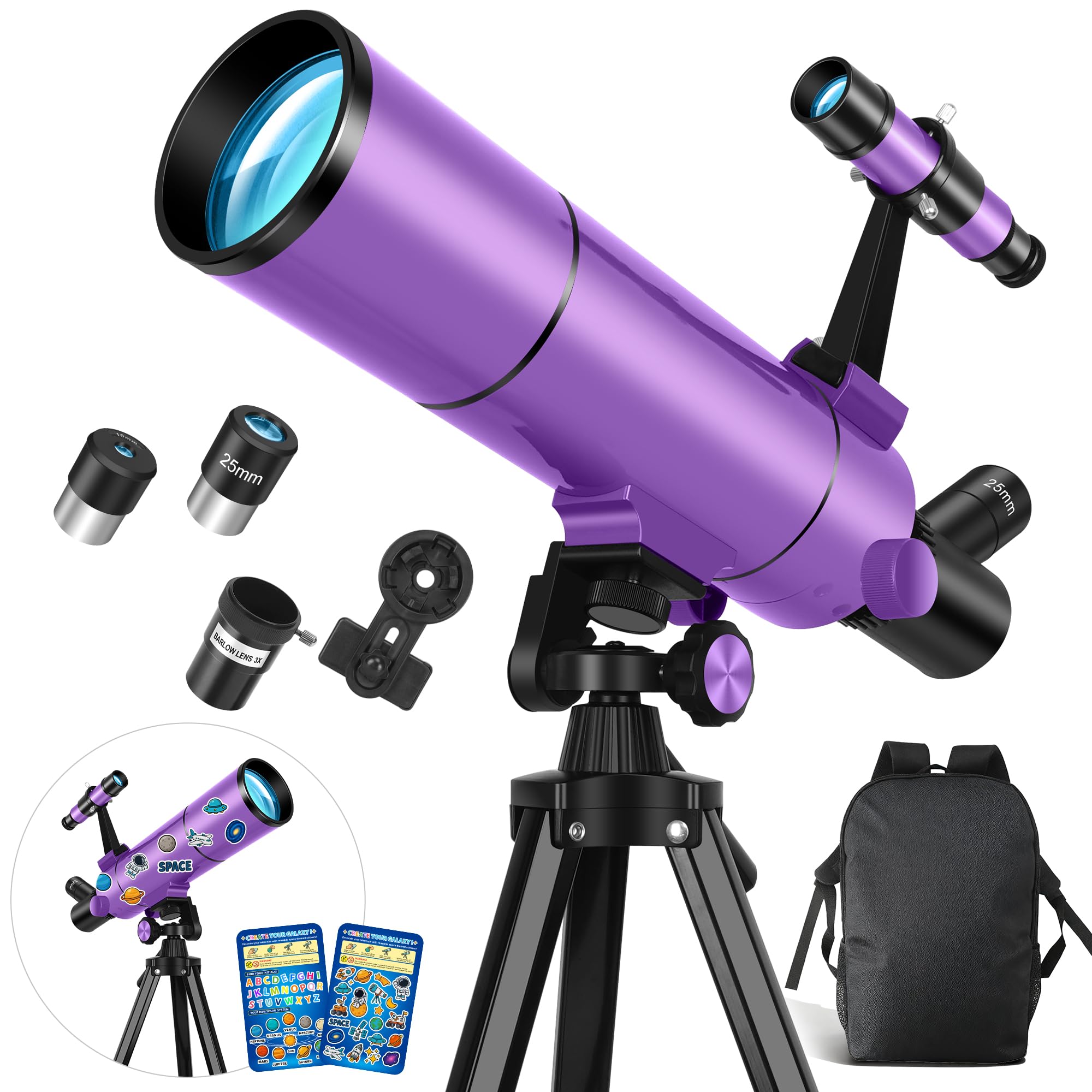
The Dianfan 80×500 trades the long-tube design for a shorter, more portable 500mm focal length (f/6.25), making it significantly easier to pack and transport. The purple finish and included astronomy-themed stickers are clearly aimed at younger users, but the optical specs are genuine: an 80mm fully coated objective lens with a Dawes limit of 1.45 arc seconds. The shorter focal length yields wider fields of view, which is ideal for scanning the Milky Way and large star clusters.
Magnification ranges from 20X (using the 25mm eyepiece) to 150X (10mm eyepiece plus 3X Barlow). The 500mm focal length means the scope is less effective at high-power planetary observation than the 900mm models — Jupiter and Saturn will appear smaller in the field — but the trade-off is a much more forgiving setup for a child or absolute beginner. The backpack-style carry case is a standout feature: it holds the tube, tripod, eyepieces, and phone adapter in a single compact package.
Assembly is genuinely tool-free and takes about 10 minutes. The Alt-Az mount is lightweight but adequate for the shorter tube. Kids as young as six have successfully used this scope after initial adult help with focusing. The phone adapter works for moon shots, and the included stickers allow personalization. The shorter tube does show more false color (chromatic aberration) on bright targets, but for a portable family scope intended for low-power sky scanning, the Dianfan 80×500 delivers exceptional value.
Why it’s great
- Short 500mm tube makes it ultra-portable and kid-friendly
- Backpack case holds everything for easy transport
- Wide-field views ideal for star clusters and Milky Way scanning
Good to know
- Short focal length shows some chromatic aberration on bright targets
- Planetary detail is smaller compared to 900mm models
- Lightweight tripod can wobble in a breeze
9. Hawkko 80500 Refractor
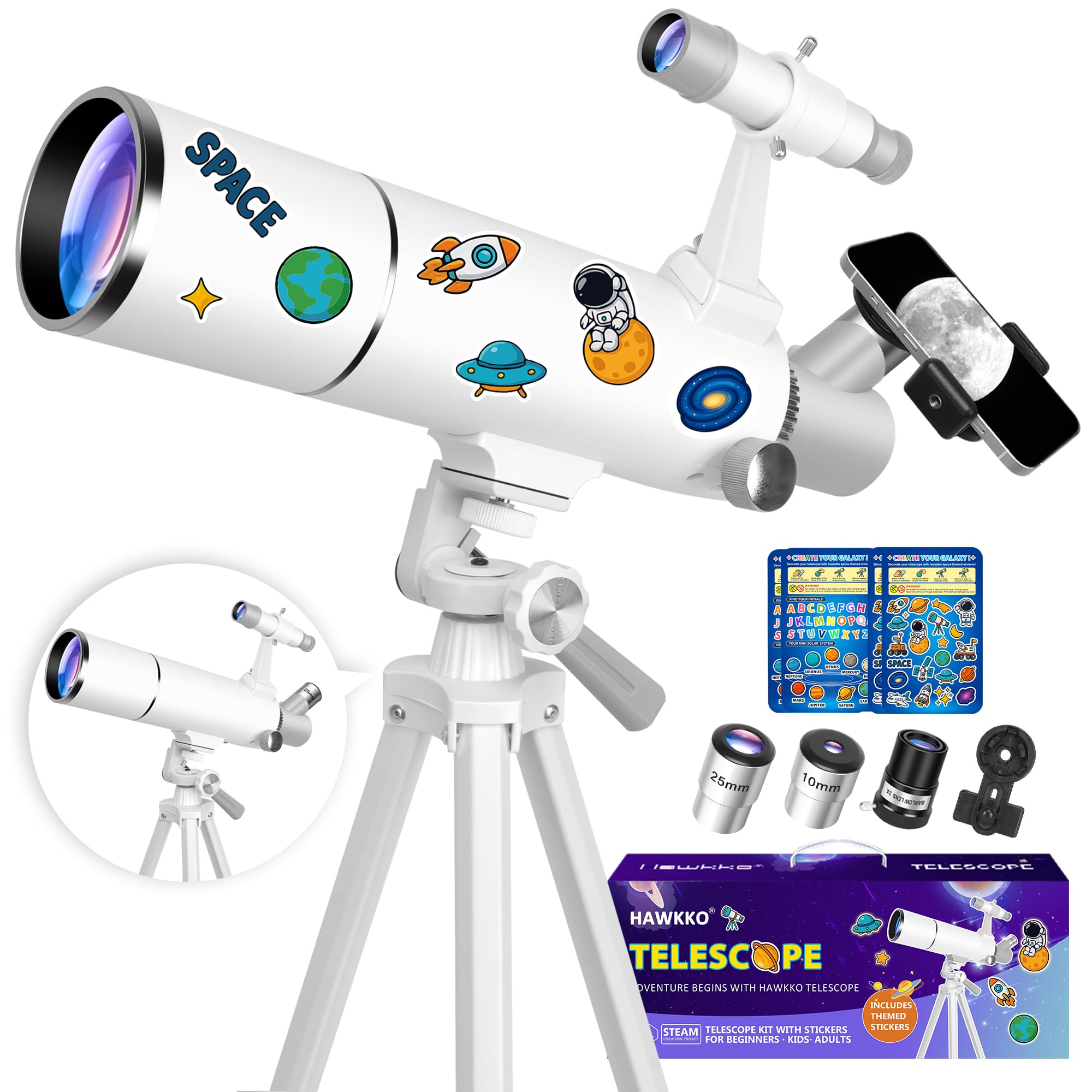
The Hawkko 80500 matches the Dianfan 80×500 in aperture and focal length (80mm, 500mm f/6.25) but comes in a more neutral design with space-themed decal stickers for personalization. The fully multi-coated objective gathers roughly 60% more light than a 70mm scope, which is a meaningful difference — the Moon appears brighter, and more stars become visible in suburban skies. The short tube keeps the overall package lightweight, and the included aluminum tripod is height-adjustable for both kids and adults.
Magnification spans 20X to 150X using the included 25mm and 10mm Kellner eyepieces plus the 3X Barlow lens. The straight-through finder scope is basic but functional. The phone adapter works for capturing lunar images and is simple to attach. One of the nicest touches is the inclusion of rocket and alphabet stickers that let a child personalize their scope — a small detail that makes a big difference in getting a young user excited about the hobby.
The tripod is the weakest link: it is stable enough for the short tube at low magnification but becomes shaky at higher powers. Users who upgraded the tripod saw immediate improvement. The focuser is smooth for the price but has some plastic slop. A few owners reported that the finder scope bracket arrived loose and needed tightening. For a family on a tight budget who wants a genuine 80mm telescope rather than a toy, the Hawkko is an honest entry point — just plan to operate it at lower magnifications for the steadiest views.
Why it’s great
- Genuine 80mm aperture for a very accessible entry price
- Lightweight and portable, ideal for young children
- Stickers and phone adapter encourage engagement and sharing
Good to know
- Tripod is shaky at high magnification
- Finder scope bracket may need tightening
- Short focal length shows some color fringing on the Moon
FAQ
What is the minimum aperture I should look for in a beginner telescope?
Why should I choose an Alt-Az mount instead of an equatorial mount?
How do I know which eyepiece to use first when observing?
Final Thoughts: The Verdict
For most users, the best beginner telescope winner is the MEEZAA 90800 because its 90mm aperture, stable stainless steel tripod, and complete accessory kit offer the best balance of performance and ease of use for a first-time buyer. If you want a telescope that shows planetary detail straight out of the box, grab the HUGERSTAR 90800. And for deep-sky exploration with room to grow, nothing beats the MEEZAA 150EQ reflector.

Mo Maruf
I created WellFizz to bridge the gap between vague wellness advice and actionable solutions. My mission is simple: to decode the research and give you practical tools you can actually use.
Beyond the data, I am a passionate traveler. I believe that stepping away from the screen to explore new environments is essential for mental clarity and physical vitality.