Our readers keep the lights on and my smoothie glass nicely filled. As an Amazon Associate, I earn from qualifying purchases.
The night sky is vast, but finding the telescope that helps you actually see it shouldn’t feel like rocket science. Many beginners get stuck with a wobbly tripod or an optic that leaves Saturn looking like a fuzzy star, killing the hobby before it starts. The right instrument delivers that first jaw-dropping view of Jupiter’s moons and keeps you coming back for more.
I’m Mohammad Maruf — the founder and writer behind WellFizz. After spending dozens of hours studying optical specifications, mount stability, and real user experiences across the most popular entry-level models, this guide isolates the telescopes that actually deliver on their promise for a new astronomer.
Whether you need a portable grab-and-go refractor or a fully computerized GoTo system, this guide to the best beginner telescope for adults covers nine models that balance aperture, optics, and ease of use for your first season of stargazing.
How To Choose The Best Beginner Telescope For Adults
Walking into the telescope market without a plan leads to the classic mistake: buying on magnification alone. A scope claiming 600X is useless if its aperture can’t gather enough light to form a usable image above 200X. For a beginner, three core decisions matter more than any other spec — aperture, mount type, and optical quality.
Aperture Is Everything
The objective lens diameter (aperture) determines how much light the telescope collects. A larger aperture means brighter images and the ability to resolve finer details on planets or faint deep-sky objects. For adults starting out, 80mm is the absolute floor — 90mm is the sweet spot for budget-conscious buyers, and 102mm or 114mm offers a noticeable jump in lunar and planetary clarity without a huge price leap.
Alt-Azimuth vs GoTo Mounts
An alt-azimuth mount moves the telescope up-down and left-right, mimicking the way your head turns. It is intuitive and requires zero setup time — ideal for a quick session in the backyard. Computerized GoTo mounts, like the one on the Celestron 114LCM, will automatically find and track thousands of celestial objects after a simple alignment. GoTo adds cost and complexity but removes the frustration of manual star-hopping for beginners who live under light-polluted skies.
Optical Coatings Make the Image
Uncoated glass reflects away a significant percentage of incoming light, leaving the image dim and washed out. Fully coated optics (a layer on all air-to-glass surfaces) improve transmission noticeably. Fully multi-coated (FMC) optics stack multiple layers on each surface, boosting light throughput by 20-30% over single-layer coatings. Any scope labeled “fully coated” is acceptable for a beginner; “fully multi-coated” is better, especially when observing subtle cloud bands on Jupiter.
Quick Comparison
On smaller screens, swipe sideways to see the full table.
| Model | Category | Best For | Key Spec | Amazon |
|---|---|---|---|---|
| Celestron AstroMaster 102AZ | Refractor | Best all-around beginner refractor | 102mm aperture / 380mm FL | Amazon |
| Celestron 114LCM | Reflector | Computerized auto-location | 114mm aperture / GoTo mount | Amazon |
| Gskyer 600x90mm | Refractor | Solid mid-range optics | 90mm aperture / 600mm FL | Amazon |
| Hawkko 90mm 900mm | Refractor | Sharp FMC optics in a complete kit | 90mm aperture / FMC lens | Amazon |
| Koolpte 90mm 900mm | Refractor | Wireless remote and digital eyepiece | 90mm aperture / 900mm FL | Amazon |
| MEEZAA 90mm 800mm | Refractor | Value-packed beginner kit | 90mm aperture / 800mm FL | Amazon |
| Dianfan 90mm 800mm | Refractor | Versatile daytime and night use | 90mm aperture / 800mm FL | Amazon |
| Celticbird 80mm 900mm | Refractor | Compact for travel and storage | 80mm aperture / 900mm FL | Amazon |
| Gskyer 80mm 400mm | Refractor | Entry-level with wide field of view | 80mm aperture / 400mm FL | Amazon |
In‑Depth Reviews
1. Celestron AstroMaster 102AZ

The 102mm (4-inch) short-tube refractor from Celestron is the closest thing to a universally recommended beginner scope. Its 102mm aperture gathers significantly more light than the typical 80mm starter, making lunar details, Saturn’s rings, and Jupiter’s cloud bands instantly visible even under suburban skies. The fully coated all-glass optics produce crisp, high-contrast images without the chromatic aberration that plagues cheaper long-tube refractors.
The alt-azimuth mount with the panhandle control moves the tube smoothly in two axes, and setup from box to first light takes about five minutes with zero tools required. The included StarPointer red dot finder makes aligning on a target straightforward — no squinting through a narrow finderscope. The 20mm and 10mm eyepieces give 19x and 38x magnification respectively, a good starting range for lunar and planetary observation.
While the 380mm focal length limits high-magnification deep-sky work, this short-tube design also doubles as an excellent terrestrial spotting scope with the erect-image diagonal. The tripod is adequate but benefits from a sandbag hook for added stability in breezy conditions. The red dot finder is the one component some users choose to upgrade straight away.
Why it’s great
- Generous 102mm aperture reveals Saturn’s rings immediately
- Zero-tool assembly in under five minutes
- Works equally well for daytime bird watching and night sky
Good to know
- Red dot finder feels cheap and can detach over time
- 380mm focal length limits high-power planetary detail
- Basic tripod can be shaky in wind without extra weight
2. Celestron 114LCM Computerized Newtonian
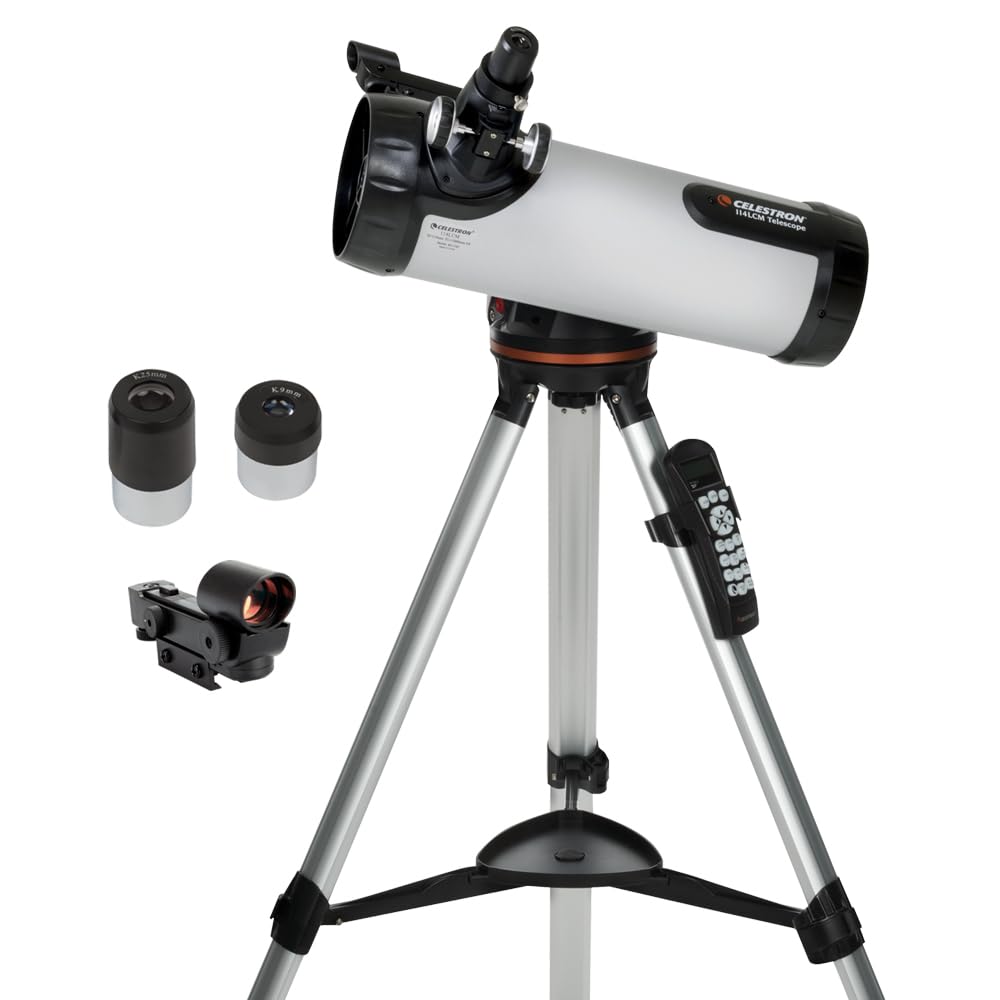
The 114LCM introduces the beginner to a completely different experience: a computerized GoTo mount that automatically locates and tracks 4,000 celestial objects. After a simple two-star alignment, pressing the Sky Tour button generates a list of the best objects currently visible in your sky — ideal for anyone who owns the scope purely for observational fun and doesn’t want to memorize star charts.
The 114mm Newtonian reflector collects more light than any refractor in this guide at a similar price point. The 25mm and 9mm eyepieces yield 45x and 126x magnification respectively, giving the user enough reach to see Saturn’s rings, Jupiter’s four largest moons, and the brighter Messier objects like the Orion Nebula. The full-height tripod is adjustable for uneven ground, a thoughtful detail for field use.
This is not a grab-and-go scope — the GoTo mount requires batteries (eight AA cells drain fast; rechargeable lithium packs are a smart investment), and the optical tube needs collimation adjustment out of the box and periodically. The Bird-Jones design means an extra permanent Barlow lens is built into the tube, which limits the ability to use additional Barlows for extreme magnification without degrading image quality.
Why it’s great
- Computerized GoTo finds objects automatically — no star-hopping
- Sky Tour button prevents analysis paralysis at dusk
- 114mm aperture resolves planetary detail well for the price
Good to know
- Battery life is poor; plan for rechargeable AA packs
- Newtonian collimation is a learning curve for total beginners
- Bird-Jones design complicates adding a Barlow lens
3. Gskyer 600x90mm AZ Refractor

Gskyer’s 600x90mm refractor sits in a comfortable sweet spot: the 90mm aperture with a 600mm focal length (f/6.7) delivers bright, fully corrected views at low-to-medium power, ideal for sweeping the Milky Way or studying the lunar surface. The fully coated all-glass optics and three eyepieces (24x, 60x, and 120x) give a range of magnifications right in the box, and the 3X Barlow lens effectively doubles the count of available eyepiece combinations.
The adjustable aluminum tripod extends from 31.5 inches to 49 inches, accommodating both seated and standing viewing positions. The alt-azimuth mount has a basic friction control, and while it’s not as smooth as a premium mount, it holds the tube steady enough for casual observing. The included phone adapter works reliably for snapping handheld shots of the moon.
The biggest variable on this unit is the mount — some units have noticeable azimuth backlash, and the focuser thumbscrew can develop slack. Several owners report the aluminum tripod legs feel sturdy but the head assembly requires occasional tightening. This is a capable optical tube matched to an adequate mount; upgrading the mount later is a common path for owners who catch the astronomy bug.
Why it’s great
- 90mm aperture and 600mm FL offer excellent lunar and planetary views
- Three eyepieces plus 3X Barlow cover a wide magnification range
- Tall tripod range works for both seating and standing
Good to know
- Alt-azimuth mount can suffer from azimuth backlash
- Focuser thumbscrew may loosen during use
- No carry bag included for storage
4. Hawkko 90mm 900mm Refractor

The Hawkko 90mm 900mm refractor stands out because it uses professional-grade full multi-layer coating (FMC) on the objective lens, which the manufacturer claims improves light transmittance by approximately 73 percent compared to uncoated glass. In practical terms, this means noticeably brighter and sharper images of the moon’s terminator region and Jupiter’s equatorial bands than a standard fully coated scope at the same aperture.
The stainless steel AZ mount tripod rotates 360 degrees with smooth damping, and the height adjusts from 28 to 46 inches — enough to clear a fence line for a horizon view. The complete kit includes a finderscope, zenith mirror, 25mm and 10mm Kellner eyepieces, a 3X Barlow lens, and a smartphone adapter in a padded carry bag. Assembly is consistently reported at under 15 minutes following the paper manual.
At 5 kilograms (about 11 pounds) total weight, this is one of the heavier kits in the mid-range group, but the stainless steel legs justify the mass with genuine stability. The straight-through finderscope is a standard 6×30 design — functional but with a narrow field of view compared to a red dot finder. The phone adapter requires some adjustment to center the phone’s camera precisely over the eyepiece.
Why it’s great
- Full multi-coating (FMC) delivers noticeably brighter images
- Stainless steel tripod provides solid, stable support
- Complete kit with carry bag — no extra purchases needed
Good to know
- Heavier than many 90mm competitors at 11 pounds
- Straight-through finderscope has a narrow field of view
- Phone adapter may need careful alignment to work well
5. Koolpte 90mm 900mm Refractor

The Koolpte 90mm 900mm refractor brings a unique feature to the beginner table: a digital eyepiece and a wireless remote that allows you to capture and share images and videos on your phone without physically touching the telescope. This is a significant advantage for anyone who wants to avoid vibration-induced blur when recording lunar or planetary observations. The remote trigger eliminates the shake that normally comes from tapping a phone screen while it’s mounted at prime focus.
Optically, the fully coated 90mm objective with the 900mm focal length (f/10) produces good contrast with minimal chromatic aberration, typical of a slower focal ratio. The included Plossl eyepieces (25mm and 10mm) provide 36x and 90x magnification respectively, and the 3X Barlow pushes up to 270x. The Vertisteel alt-azimuth mount uses a sub-black finish that dampens vibration quickly and moves with fine-motion control for tracking a planet across the sky.
The digital eyepiece is a low-resolution CMOS sensor — fine for sharing on social media but not a substitute for a dedicated astronomy camera. The phone adapter holder is reported as finicky by some users, requiring careful adjustment to hold the phone securely. The Barlow lens on this particular unit is sometimes noted as unusable due to poor alignment, though the base magnifications are sufficient for most beginners.
Why it’s great
- Digital eyepiece and wireless remote for steady phone imaging
- 90mm f/10 refractor produces high-contrast, low-CA views
- Vertisteel mount is sturdy and dampens vibrations quickly
Good to know
- Digital eyepiece is low-resolution — not for serious astrophotography
- Phone holder can be finicky to secure properly
- The included Barlow lens may have alignment issues
6. MEEZAA 90mm 800mm Refractor

The MEEZAA 90mm 800mm refractor delivers the same core aperture and focal ratio (f/8.88) as many mid-range competitors but at a noticeably lower entry point. The fully multi-coated optical glass lenses reduce internal reflections and improve light transmission, producing images that one reviewer described as “crisp” and “exceeding expectations.” The 10mm and 25mm Kellner eyepieces combined with the 3X Barlow provide a magnification range from 32X up to 240X.
The stainless steel tripod adjusts from 28 to 46 inches and is cited across multiple reviews as being remarkably stable for the price point — a common failure area on budget telescopes. Assembly is reported at around 10 to 20 minutes, and the paper manual is considered clear enough that 90 percent of users get it right on the first try. All accessories fit into the included carry bag, making this genuinely portable for camping trips or dark-sky excursions.
Several experienced buyers note that the finderscope is a basic straight-through design that can be tricky for a true beginner to align with the main tube. The alt-azimuth mount works smoothly but can require periodic re-tightening of the altitude tension knob, especially after several hours of use. The phone adapter works but may not center every phone model perfectly without manual shimming.
Why it’s great
- 90mm FMC optics at a very competitive price point
- Stainless steel tripod delivers surprising stability
- Complete carry bag makes it genuinely portable
Good to know
- Straight-through finderscope has a limited field of view
- Alt-azimuth mount may need occasional re-tightening
- Phone adapter may not center all models without adjustment
7. Dianfan 90mm 800mm Refractor

The Dianfan 90mm 800mm refractor includes a 45° erect image zenith mirror in the kit, making it one of the few beginner scopes optimized for both astronomical and terrestrial use. This is a genuine advantage for anyone who also wants to use the telescope for bird watching, wildlife observation, or scanning cityscapes. The fully coated 90mm objective delivers bright images; the Dawes limit of 1.29 arc seconds is enough to split many double stars and resolve lunar features clearly.
The stainless steel tripod is lightweight enough to carry in the included bag yet stiff enough to keep vibrations minimal during focusing. Setup is reported as reliable at around 15 minutes, and the smooth focusing mechanism helps beginners quickly locate targets without overshooting. The 10mm and 25mm Kellner eyepieces with the 3X Barlow deliver 32x to 240x magnification, and the phone adapter comes with a universal holder that fits most smartphone sizes.
The straight-through finderscope has the same narrow field as others in this price range, and the altitude tension screws can loosen during extended sessions. Some users report that the Barlow lens adds noticeable chromatic aberration at the highest magnification setting, so sticking to the native eyepieces produces the cleanest views. The tripod leg locks are plastic and may wear over time with frequent assembly and disassembly.
Why it’s great
- 45° erect diagonal enables daytime terrestrial viewing
- Dawes limit of 1.29 arc seconds can split double stars
- Stainless steel tripod is stiff yet portable
Good to know
- Barlow can introduce chromatic aberration at maximum zoom
- Plastic tripod leg locks may wear over time
- Altitude tension screws require occasional attention
8. Celticbird 80mm 900mm Refractor

The Celticbird 80mm 900mm refractor proves that a smaller aperture package can still offer a worthwhile first telescope, especially when the travel-friendly form factor is the priority. The 900mm focal length (f/11.25) in a metal tube gives relatively high native magnification per eyepiece — the 20mm eyepiece delivers 45x, and the 10mm yields 90x — while the slow focal ratio reduces chromatic aberration compared to shorter tubes. The 5×24 finderscope with a reflex sight is easy to align and use.
The aluminum tripod adjusts from 20 to 45 inches, and the entire system packs down into a compact carry bag measuring about 29 by 10 by 6 inches. Multiple reviewers confirm they can set it up from packed to observing in about five minutes without tools. The phone adapter is a universal clamp-style unit that works with the majority of modern smartphones for quick snapshot imaging of the moon.
The obvious trade-off is light gathering: at 80mm, the image of a faint galaxy will be dimmer than on a 90mm or 102mm scope. The tripod, while portable, is the weak point — several users caution that the legs are a bit flimsy and the tube can tip if the tripod is moved while the mount screw is not fully tightened. The included eyepieces are adequate but upgrading to a quality Plossl set later is a worthwhile investment.
Why it’s great
- Long 900mm focal length reduces chromatic aberration
- Packs into a compact carry bag for true portability
- Five-minute setup time from box to observing
Good to know
- 80mm aperture limits faint deep-sky object visibility
- Aluminum tripod legs are not the most sturdy
- Tube can tip if mount screw is not fully tightened
9. Gskyer 80mm 400mm Refractor

The Gskyer 80mm 400mm refractor is the most affordable scope in this guide, and its short 400mm focal length (f/5) provides a noticeably wider true field of view than any other optic listed. This makes it a solid choice for large-area targets like the Andromeda Galaxy, star clusters, and sweeping the Milky Way. The fully coated optical glass reduces reflections, while the three eyepieces (16X, 40X, and 80X) combined with the 3X Barlow offer magnification up to 240X.
The alt-azimuth mount uses a dovetail attachment, which allows the tube to be removed easily for storage or for mounting on a different tripod later. The 6×30 finderscope has an erect-image diagonal, making terrestrial object location during daytime easier. At 7.9 pounds total weight, this is one of the lightest complete setups, and the large base footprint of the tripod provides decent stability for the short tube.
The short focal ratio (f/5) is inherently more prone to chromatic aberration — some blue fringing around bright objects like the moon is expected. The Barlow lens included is a plastic-body unit that can degrade image quality at higher magnifications. The finderscope bracket has been reported as loose on some units, with the spring-loaded pin not fully engaging the groove, requiring a simple mechanical fix.
Why it’s great
- Wide-field f/5 ratio is excellent for star clusters and Milky Way
- Very lightweight at under 8 pounds for easy transport
- Erect-image diagonal works well for daytime spotting
Good to know
- Short f/5 ratio shows noticeable blue fringing on the moon
- Plastic Barlow lens degrades image at high magnification
- Finderscope bracket may need a minor adjustment out of the box
FAQ
Is a 90mm aperture good enough for a beginner to see Saturn’s rings?
Should I choose a refractor or a Newtonian reflector as my first telescope?
What magnification can I realistically expect from a beginner telescope?
Final Thoughts: The Verdict
For most users, the best beginner telescope for adults winner is the Celestron AstroMaster 102AZ because its 102mm aperture delivers that first unforgettable view of Saturn’s rings with minimal setup time and zero maintenance. If you want computerized auto-location to take the guesswork out of finding objects, grab the Celestron 114LCM. And for a complete, portable kit that punches above its price with FMC optics, the Hawkko 90mm 900mm is a strong contender that leaves room to grow into the hobby.

Mo Maruf
I created WellFizz to bridge the gap between vague wellness advice and actionable solutions. My mission is simple: to decode the research and give you practical tools you can actually use.
Beyond the data, I am a passionate traveler. I believe that stepping away from the screen to explore new environments is essential for mental clarity and physical vitality.