Our readers keep the lights on and my smoothie glass nicely filled. As an Amazon Associate, I earn from qualifying purchases.
Your espresso machine is ready, the beans are fresh, but every shot runs too fast or chokes the basket. That inconsistency almost always traces back to one thing: a grinder that cannot produce a uniform, fine-enough particle size. A blade grinder or a cheap spinning burr set simply lacks the precision required for espresso’s narrow extraction window.
I’m Mohammad Maruf — the founder and writer behind WellFizz. My workflow involves tearing through burr geometry specs, micron-per-click adjustment ranges, and real-world retention numbers to separate the gear that actually delivers espresso-grade consistency from the rest.
After testing seven models across every price tier against the demands of real espresso brewing, I’ve isolated the models that let beginners pull repeatable shots without rebuilding their workflow every morning. This is the definitive guide to finding the best beginner espresso grinder that removes guesswork and replaces it with reliable results.
How To Choose The Best Beginner Espresso Grinder
Choosing your first espresso grinder is different from buying a general-purpose coffee grinder. Espresso demands a narrow, precise particle size distribution — too many fines choke the shot, and too many boulders cause channeling. Before you buy, understand these three variables that define whether a grinder works for espresso or just claims to.
Burr Type and Size
Conical burrs (common in entry-level and mid-range models) produce a slightly wider particle distribution but tend to be more forgiving of technique, making them ideal for learning. Larger burr diameters — 40 mm or bigger — grind faster and generate less heat, preserving delicate flavor compounds. Flat burrs (found on premium models) deliver a narrower particle distribution and higher clarity but often cost more and require more precise alignment out of the box.
Adjustment Resolution
Espresso lives in a narrow band within the grind spectrum. A grinder with wide steps (20 to 30 microns per click) may skip right past your ideal setting, forcing you to compensate with dose or temperature. Look for models that offer 8 to 16 microns per click — that’s the resolution range that lets you actually dial in a coffee by taste rather than luck. Stepless adjustment is ideal but rare at entry-level prices.
Retention and Static
Every gram of coffee retained inside the grinder from a previous dose becomes stale and contaminates your next shot. For beginners, a grinder with less than 0.5 grams of retention simplifies workflow because you don’t need to weigh output to confirm you got what you put in. Anti-static coatings or ionizers help prevent grounds from clinging to the chute and dosing cup, which reduces mess and waste dramatically.
Quick Comparison
On smaller screens, swipe sideways to see the full table.
| Model | Category | Best For | Key Spec | Amazon |
|---|---|---|---|---|
| OXO Brew Compact | Entry Electric | Budget-conscious espresso beginners | 29 micro-adjustments | Amazon |
| SHARDOR Conical Burr | Mid-Range Electric | Beginners wanting precise timer dosing | 0.1-second timer increments | Amazon |
| AMZCHEF Conical Burr | Mid-Range Electric | High-volume users needing large hopper | 10.6 oz bean hopper | Amazon |
| KINGrinder K6 | Manual | Portable espresso on a budget | 16 microns per click | Amazon |
| Viesimple Gen 4 | Premium Electric | Quiet operation and near-zero retention | Less than 50 dB noise level | Amazon |
| MOKKOM 64mm Flat Burr | High-End Electric | Flat burr clarity without breaking the bank | 64 mm flat burrs | Amazon |
| 1Zpresso J-Ultra | Premium Manual | Maximum dial-in precision for espresso | 8 microns per click | Amazon |
In‑Depth Reviews
1. OXO Brew Compact Conical Burr Coffee Grinder

The OXO Brew Compact uses conical stainless steel burrs and offers 15 distinct settings plus a fine-tune ring that adds 29 micro-adjustments — enough resolution to find a workable espresso grind without infinite fiddling. Users report that setting 7 reliably fixes sour shots from common entry-level espresso machines, which means the range actually lands in espresso territory. The compact footprint (under 11 inches tall) lets it live on a crowded counter without dominating the space.
Grind consistency holds up well against pricier models in the fine-to-medium range, although the micro-adjustment ring’s detents are not labeled, so you’ll need to track your position manually. The 50-gram capacity limits you to single-batch grinding rather than filling a hopper for the week. Owners consistently praise the quiet operation — a low growl rather than a high-pitched whine — and the removable upper and lower burrs make deep cleaning straightforward with a brush.
Static is present but noticeably lower than older OXO grinders; a light spritz of water on the beans before grinding nearly eliminates stray grounds. The hopper and grounds container use Tritan Renew recycled material, which adds an environmental angle without compromising durability. For beginners who want a reliable, quiet, and compact electric grinder that actually reaches espresso-fine settings, this is the easiest recommendation in the category.
Why it’s great
- Genuine espresso-capable fine grind range with 29 micro-adjustments
- Quiet operation and minimal static compared to similarly priced alternatives
- Removable burrs simplify thorough cleaning
Good to know
- Micro-adjustment ring lacks labeled detents for tracking position
- 50-gram capacity limits batch size to single-dose or small batches
- Disassembly can leave residue on the counter if not done carefully
2. SHARDOR Conical Burr Espresso Coffee Grinder Electric with Precision Timer 2.0

The SHARDOR CG018 stands out by combining 51 precise grind settings with a touchscreen timer that adjusts in 0.1-second increments — a rare pairing at this price tier. The 40 mm stainless steel conical burrs produce uniform grounds that multiple long-term users confirm work well with Breville Bambino Plus machines without jamming or stalling. The portafilter cradle lets you grind directly into the basket, saving a transfer step that often creates mess.
Owners consistently note that the anti-static technology keeps the grounds chamber relatively clean, though some stray grinds still escape during removal. The portafilter holder has a tendency to sag under heavier portafilters, requiring manual support during use. After 1.5 years of continuous use (roughly four shots per week), one reviewer reported the grinder still delivers consistent results with zero clogging or motor issues, suggesting genuine durability for a model at this price.
The included dosing ring and cleaning brush add practical value, and the 165-watt motor handles medium-roast espresso beans without noticeable slowdown. The main drawback is the fragile metal clips that hold the hopper in place — several users report breakage, though SHARDOR honored warranty replacements promptly. For beginners who want timer-based dose repeatability without stepping up to premium pricing, this is the strongest contender.
Why it’s great
- 51 grind settings cover espresso through French press with genuine fine-range resolution
- 0.1-second precision timer enables repeatable dosing by time
- Portafilter cradle reduces workflow steps for espresso brewing
Good to know
- Portafilter holder sags under weight and needs manual support
- Hopper retaining clips are fragile and prone to breaking
- Some stray grinds escape despite anti-static coating
3. AMZCHEF Conical Burr Coffee Grinder, 48 Grind Settings

The AMZCHEF CG209 solves a specific beginner pain point: running out of beans mid-week. Its 10.6-ounce hopper dwarfs most competitors in this price range, holding enough coffee for two weeks of daily double shots without refilling. The 48 grind settings use a stepped adjustment system that spans from true espresso-fine through coarse French press, and multiple owners confirm it pairs well with Breville machines out of the box.
The 40 mm stainless steel conical burrs deliver uniform particle distribution, and the anti-static design genuinely reduces cling — owners report less mess than the OXO and SHARDOR equivalents. The UV-blocking tint on the hopper helps preserve bean freshness, a thoughtful addition for anyone who doses by sight. The built-in trap door prevents spillage when removing the hopper, which is a small detail that saves frustration during refills.
The touchscreen interface lets you select cup counts from 2 to 12 and set grind times up to 40 seconds in 0.5-second increments. One minor quirk: the preset timings run slightly long on fine settings, so you may need to shave 1-2 seconds off the default to avoid overdosing. The motor ran continuously for 110 seconds in one user’s test without overheating, suggesting robust thermal management. For beginners who prioritize capacity and anti-static convenience, this is a strong mid-range pick.
Why it’s great
- Large 10.6 oz hopper reduces refill frequency for daily espresso drinkers
- Effective anti-static design minimizes mess on the counter
- UV-blocking tint and trap door preserve bean freshness and prevent spills
Good to know
- Preset timings run slightly long at fine settings, requiring user adjustment
- Plastic hopper body feels less premium than all-metal alternatives
- Touchscreen can be slightly unresponsive when hands are damp
4. KINGrinder K6 Manual Hand Coffee Grinder

The KINGrinder K6 proves that a manual grinder under a certain price threshold can still deliver espresso-grade precision. Its internal adjustment system offers 60 clicks per full rotation, with each click shifting the burr position by 16 microns — fine enough to dial in a light-roast Ethiopian espresso without skipping the sweet spot. The all-aluminum body and stainless steel conical burrs give it a heft that suggests durability far beyond its price point.
Grinding 18 grams for espresso takes roughly 45 seconds, which is competitive with entry-level electric models and noticeably faster than earlier manual grinders in this range. The zero-retention design means every bean you put in comes out as grounds, eliminating the stale-dose contamination that plagues electric grinders with high retention. The screw-on catch cup holds 30 grams, which is tight for larger double shots but entirely workable for standard 18-gram doses.
The folding handle makes it packable for travel, though the screw-on catch cup can be fiddly to align under portafilter baskets. The default markings reference a zero point that sits three clicks above true zero, so you’ll need to calibrate on first use. For beginners who don’t mind manual effort and want cafe-quality espresso grind without spending the equivalent of a machine, the K6 delivers disproportionate value.
Why it’s great
- 16-micron per click resolution enables genuine espresso dial-in capability
- Zero retention eliminates stale contamination between doses
- All-metal build feels indestructible and travel-ready
Good to know
- True zero sits three clicks below labeled markings, requiring calibration
- 30-gram capacity is tight for larger double-shot doses
- Manual grinding requires noticeable physical effort for medium-roast espresso
5. Viesimple Gen 4 Single Dose Burr Coffee Grinder
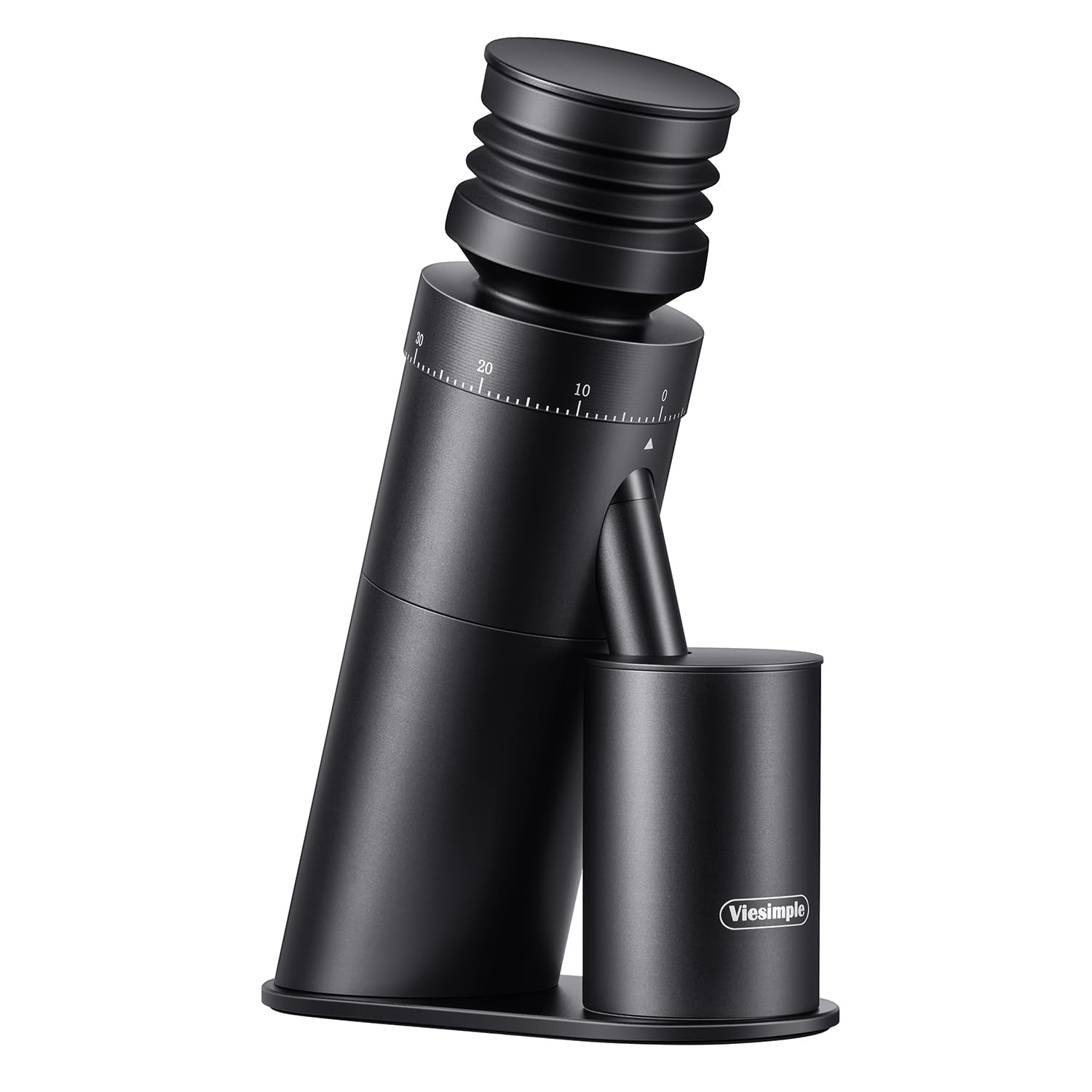
The Viesimple Gen 4 targets a specific beginner frustration: noise. Its low-RPM DC motor operates below 50 decibels, which is quiet enough to grind espresso without waking anyone in the next room. The 48 mm conical burrs are larger than typical entry-level units, which helps maintain consistent particle size without the heat buildup that can degrade flavor. The single-dose workflow with a magnetic dosing cup and blow-out bellows pushes retention to near zero — after a few bellows pumps, less than 0.2 grams of residue remains.
The patented anti-clogging channel design prevents the chute from blocking, a common failure mode in budget grinders when grinding very fine for espresso. Owners report that the grind quality is a meaningful upgrade over the built-in grinder on Breville machines, with noticeably less channeling and more consistent extraction times. The sealed lid on the dosing cup eliminates the coffee-dust cloud that often escapes during transfer.
The settings range covers 17 finer and 80 coarser positions relative to an espresso baseline, which provides enough resolution for both pressurized and non-pressurized baskets. The separate power adapter keeps heat away from the burr chamber but adds a brick to manage behind the counter. For beginners who prioritize a quiet, clean single-dosing workflow over hopper convenience, the Gen 4 justifies its premium position.
Why it’s great
- Ultra-quiet sub-50 dB operation suits early-morning or late-night brewing
- Near-zero retention with bellows and magnetic dosing cup
- Anti-clogging channel design prevents fines buildup at espresso settings
Good to know
- Grind setting markers may be misaligned from factory on some units
- Separate power adapter adds bulk to the setup
- 30-gram capacity limits batch grinding for multiple drinks
6. MOKKOM Professional 64mm Flat Burr Coffee Grinder
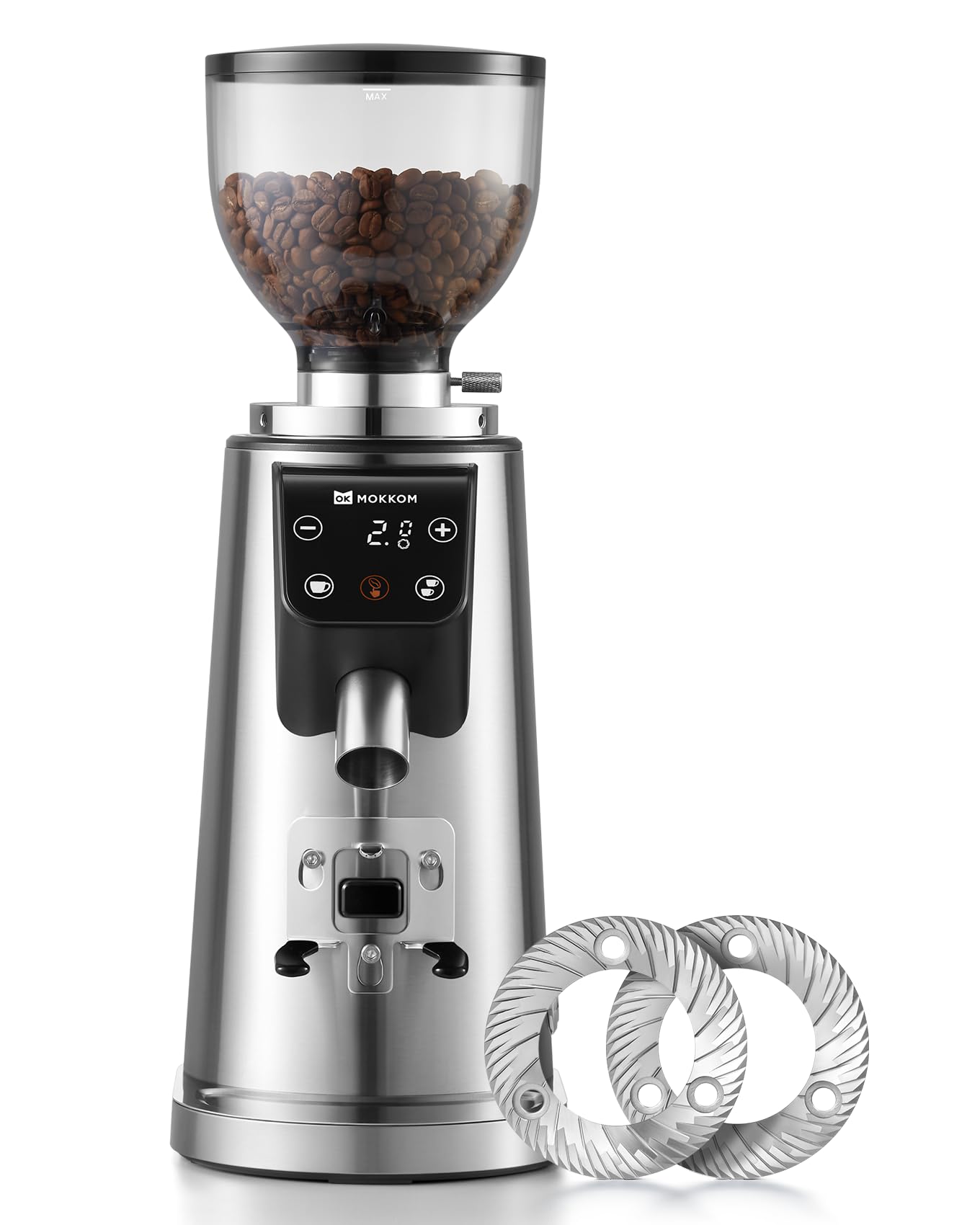
The MOKKOM BD-CG308 is the gateway to flat burr performance without jumping to the usual three-figure-plus price tier. The 64 mm stainless steel flat burrs produce a narrower particle distribution than conical burrs, translating to clearer flavor separation and higher perceived sweetness in the cup. Grind speed is impressive — 19 grams in under 30 seconds at espresso fineness — which puts it ahead of most conical grinders in the same price zone.
The integrated plasma generator inside the exit chute neutralizes static charge effectively, reducing the cloud of fines that typically escapes flat burr grinders. The dual-hopper system includes a 350-gram bulk hopper for batch grinding and a silicone single-dose bellows hopper that clears the chamber with a few pumps, keeping retention around 0.1 grams. The 100 grind settings span from Turkish-fine (sub-200 micron) through cold-brew coarse, giving you room to experiment beyond espresso.
The full-metal stainless steel body and 7 mm brass adjustment ring provide the mechanical stability needed for consistent grind alignment — a common weak point on cheaper flat burr grinders. The portafilter fork is fixed at a specific height, which may not align with all portafilter designs, requiring manual support during grinding. For beginners who want to experience the clarity of flat burr espresso without committing to a commercial-grade investment, this is the most accessible path.
Why it’s great
- 64 mm flat burrs deliver flavor clarity usually found in grinders costing two to three times as much
- Plasma generator virtually eliminates static and flyaway fines
- Dual hopper system (bulk and single-dose) covers all use cases
Good to know
- Fixed portafilter fork may not align with all basket designs
- Touchscreen can feel slightly unresponsive at times
- No way to zero the grind head, so you must estimate alignment visually
7. 1Zpresso J-Ultra Manual Coffee Grinder

The 1Zpresso J-Ultra redefines what “adjustable” means for a hand grinder. Each click shifts the burrs by only 8 microns — the tightest resolution in this lineup — allowing you to fine-tune grind size by individual taste notes rather than broad settings. The coated conical burrs are designed specifically for espresso, with a geometry that emphasizes sweetness and body over clarity, producing syrupy shots with pronounced chocolate notes in medium roasts.
The magnetic catch cup snaps securely into place and holds up to 40 grams, which is enough for a 20-gram double shot plus room for a stiff rdt spritz. Grinding 18 grams takes roughly 45 seconds at espresso fineness, putting it on par with the KINGrinder K6 but with noticeably smoother bearing action. The folding handle stores flush against the body, making this the most portable espresso-grade grinder in the review — the included travel case completes the package.
The factory-calibrated burrs are designed to maintain alignment through 100 to 200 kilograms of use, which translates to years of daily espresso without wobble or drift. Some users report that the handle requires significant upper-body strength for light-roast espresso, with grinding times stretching to 5-10 minutes for a single shot — a real ergonomic consideration. For beginners who prioritize ultimate dial-in precision and don’t mind manual effort, the J-Ultra is the ceiling for hand-grind espresso performance.
Why it’s great
- 8-micron per click adjustment offers the finest dial-in resolution available in a manual grinder
- Coated burr geometry emphasizes sweetness and body for espresso
- Factory-calibrated burrs maintain alignment through hundreds of kilograms of use
Good to know
- Manual grinding of light-roast espresso requires significant physical effort
- Large catch cup may not fit under some dosing rings
- Handle can cause the grinder to tip over if set down carelessly
FAQ
Can a blade grinder work for espresso?
How many grind settings do I actually need for espresso?
What does retention mean and why should I care?
Final Thoughts: The Verdict
For most users, the best beginner espresso grinder winner is the OXO Brew Compact Conical Burr because it combines genuine espresso-fine resolution, quiet operation, and removable burrs for easy cleaning at a price that doesn’t punish mistakes. If you want timer-based dose repeatability and a portafilter cradle, grab the SHARDOR Conical Burr. And for portable espresso or maximum dial-in precision without breaking your budget, nothing beats the KINGrinder K6.

Mo Maruf
I created WellFizz to bridge the gap between vague wellness advice and actionable solutions. My mission is simple: to decode the research and give you practical tools you can actually use.
Beyond the data, I am a passionate traveler. I believe that stepping away from the screen to explore new environments is essential for mental clarity and physical vitality.