Our readers keep the lights on and my smoothie glass nicely filled. As an Amazon Associate, I earn from qualifying purchases.
The leap from shooting on a smartphone to owning a dedicated filmmaking camera is the single biggest upgrade you can make to your video quality, but the sheer number of specs, sensor sizes, and lens mounts can paralyze a new buyer. You need a camera that delivers usable footage out of the box, offers a clear path for learning manual exposure and focus, and won’t leave you frustrated with missing ports or shaky stabilization.
I’m Mohammad Maruf — the founder and writer behind WellFizz. I spend my time cross-referencing sensor data, codec support, and real-world user feedback to help creators find the gear that actually matches their workflow.
After weeks of combing through technical specifications and user experiences, I’ve found the top options that balance image quality, usability, and long-term growth potential to define the beginner cameras for filmmaking market.
How To Choose The Best Beginner Cameras For Filmmaking
Choosing a camera for filmmaking as a beginner means ignoring the marketing hype around megapixels and focusing on what actually makes footage look cinematic: color depth, dynamic range, and stability. Every camera here can shoot 4K, but the ones with log profiles, external mic jacks, and good stabilization will serve you better as you learn to edit and color grade.
Sensor Size and Lens Ecosystem
Full-frame sensors offer better low-light performance and shallower depth of field, but they cost more and require expensive glass. APS-C and Micro Four Thirds sensors are more forgiving for beginners, have cheaper lenses, and still produce stunning video. Look for a lens mount with a strong third-party ecosystem (like Sony E, Canon RF, or L-Mount) so you can grow without breaking the bank.
Stabilization and Audio Inputs
In-body image stabilization (IBIS) makes handheld footage watchable and saves you the cost of a gimbal early on. A headphone jack for monitoring audio and a microphone input (3.5mm or XLR) are non-negotiable for filmmaking — bad audio ruins good video. Skip cameras that lack these ports, no matter how good the sensor looks on paper.
Quick Comparison
On smaller screens, swipe sideways to see the full table.
| Model | Category | Best For | Key Spec | Amazon |
|---|---|---|---|---|
| Sony FX30 | Cinema APS-C | Cinematic image from the start | 6K oversampled 4K, S-Cinetone | Amazon |
| Panasonic S5II | Full-Frame Hybrid | Hybrid photo/video growth | Phase Hybrid AF, unlimited 10-bit | Amazon |
| Blackmagic Pocket 4K | Dedicated Cinema | Learning professional color grading | 13 stops DR, Blackmagic RAW | Amazon |
| Canon EOS RP | Full-Frame Entry | Affordable full-frame look | 24-105mm kit lens, 5-stop IS | Amazon |
| Sony A6100 | Compact APS-C | Ultra-portable vlogging | 425 phase-detect AF points | Amazon |
| DJI Osmo Pocket 3 | Gimbal Integrated | Ultra-portable gimbal video | 1″ CMOS, 3-axis stabilization | Amazon |
| Panasonic G85 | Micro 4/3 Hybrid | Best value IBIS bundle | 5-axis Dual I.S. 2, 4K | Amazon |
| Canon EOS R100 | Entry Mirrorless | Simplest mirrorless start | 4K 24p, 143 AF zones | Amazon |
| GoPro MAX2 | 360 Action | Unique 360 reframing | True 8K 360 video | Amazon |
| Nikon D7500 | DSLR Bundle | All-in-one kit with two lenses | 51-point AF, 8 fps | Amazon |
| Canon Rebel T7 | Budget DSLR | Cheapest entry to DSLR video | 9-point AF, 18-55mm lens | Amazon |
In‑Depth Reviews
1. Sony FX30

The Sony FX30 brings the Cinema Line’s DNA—S-Cinetone, dual base ISO, and 14+ stops of dynamic range—into the APS-C format at a price point that challenges full-frame hybrids. It oversamples 6K to deliver a crisp 4K image that handles highlights and shadows with the kind of latitude you’d expect from a professional camera, not a beginner body.
The 495 phase-detect AF points with Real-time Eye Tracking for humans and animals make it nearly impossible to miss focus, even when you’re shooting handheld or moving subjects. The compact body includes a full-size HDMI port, dual SD card slots, and a flip-out screen that makes it easy to compose from awkward angles.
Battery life hovers around 90 minutes of continuous recording, which is typical for this class, but the USB-C PD port lets you power it from a battery bank during long interviews or B-roll sessions. The S-Log3 and S-Cinetone profiles give you a polished look straight out of camera or plenty of headroom for color grading in DaVinci Resolve.
Why it’s great
- Cinematic 6K oversampled 4K with S-Cinetone for instant film look
- Fast, reliable phase-detect AF with real-time eye tracking
- Full-size HDMI and dual SD slots for professional workflow
Good to know
- APS-C crop means less shallow depth of field than full-frame
- Battery lasts around 90 minutes; carry spares or use external power
2. Panasonic LUMIX S5II
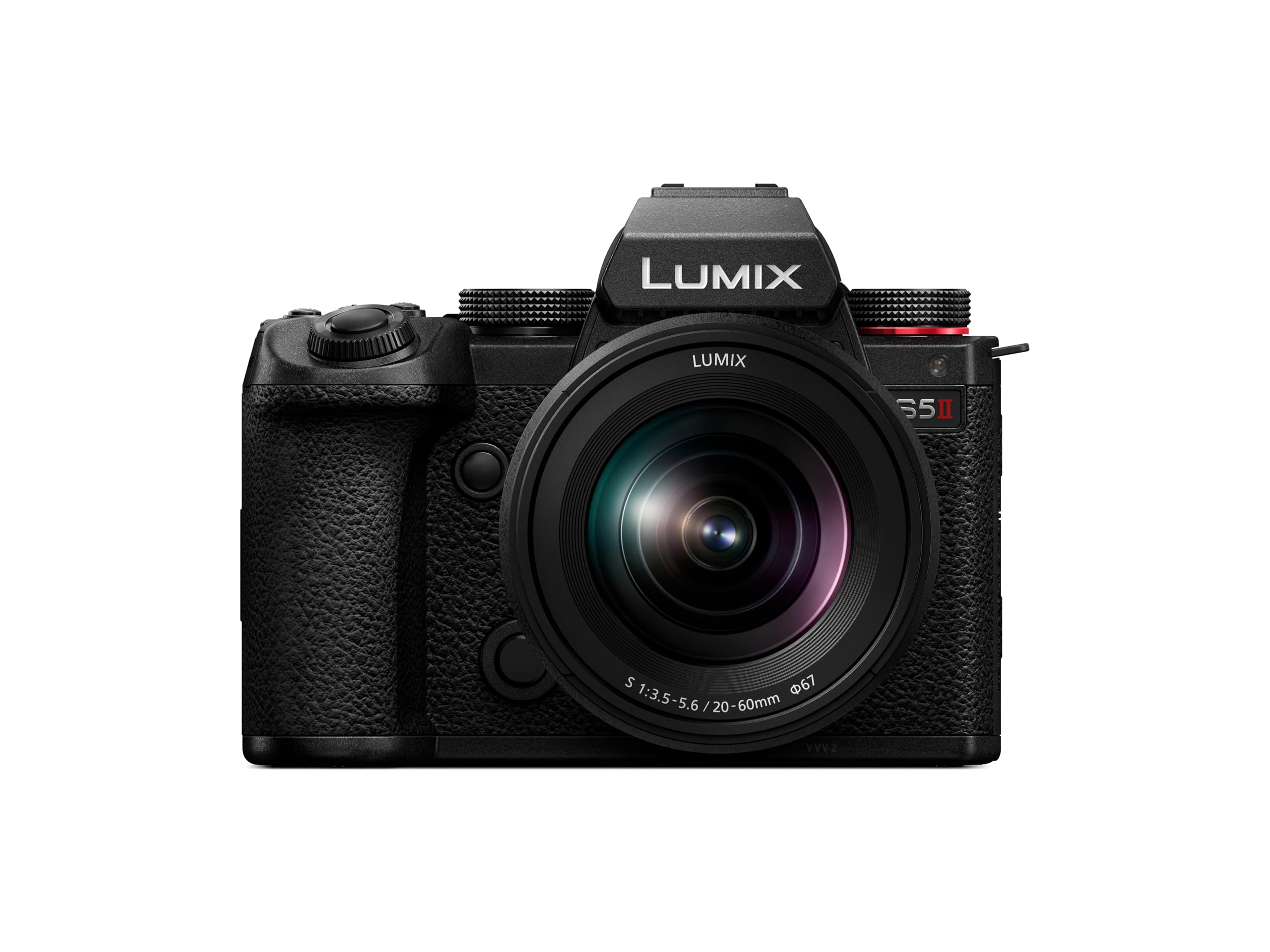
The S5II marks Panasonic’s arrival in the phase-detect autofocus era, solving the legacy issue of contrast-detect hunting that held back earlier Lumix cameras. With a 24.2MP full-frame CMOS sensor and a new heat-dissipation fan, it records unlimited 4:2:2 10-bit video internally—no record limits, no overheating, just non-stop 4K.
The 20-60mm f/3.5-5.6 kit lens provides a wide starting focal length that’s perfect for interviews, gimbal work, and establishing shots. Active I.S. delivers such smooth handheld footage that many users skip the gimbal for walking shoots. The V-Log/V-Gamut profile offers 14+ stops of dynamic range, giving you a professional grade for color grading.
The body uses the L-Mount alliance, so you can pair it with Sigma, Leica, and Panasonic glass without an adapter. The dual SD card slots, full-size HDMI, and headphone jack make it ready for serious production work. The only real hit is battery life, which falls short of Sony’s latest bodies in heavy recording sessions.
Why it’s great
- Unlimited 4:2:2 10-bit recording with internal fan cooling
- Phase Hybrid AF finally delivers reliable continuous focus
- Active I.S. gives gimbal-like stabilization for handheld walking shots
Good to know
- Battery life is below average; plan for multiple spares
- High ISO above 51,200 shows noticeable noise
3. Blackmagic Design Pocket Cinema Camera 4K

The Blackmagic Pocket Cinema Camera 4K is not a hybrid; it is a pure cinema tool designed to teach you the fundamentals of exposure, focus, and color science without interference from auto-everything modes. It records in Blackmagic RAW and Apple ProRes up to 4K at 60fps, with a 5-inch touchscreen that serves as both viewfinder and menu system.
The MFT lens mount gives you access to a massive library of affordable lenses, including vintage glass with adapters, and the dual native ISO up to 25,600 keeps noise under control in low light. It includes mini XLR inputs with phantom power, so you can connect professional microphones without an external audio recorder.
The lack of in-body stabilization and continuous autofocus pushes you toward tripod, slider, or gimbal use—which is exactly how most professional narrative and documentary work is shot. The included DaVinci Resolve Studio license means you start with industry-standard color grading software from day one.
Why it’s great
- Records 12-bit Blackmagic RAW and ProRes for maximum grading flexibility
- Mini XLR inputs with phantom power for clean audio
- Includes full DaVinci Resolve Studio license
Good to know
- No IBIS or continuous autofocus—requires tripod/gimbal
- Battery lasts only 30 minutes; external power is essential for long shoots
4. Canon EOS RP

The Canon EOS RP packs a full-frame 26.2MP sensor into one of the lightest mirrorless bodies on the market, making it the most affordable path to full-frame shallow depth of field for beginner filmmakers. The RF 24-105mm kit lens covers a versatile range with up to 5 stops of optical image stabilization.
The dual-pixel CMOS AF with face and eye detection keeps focus smooth during video, and the 180-degree flip-out screen is built for vlogging and self-recording. 4K video is available, but it comes with a noticeable crop and a 30-minute recording limit—issues that disappear when shooting 1080p, which is still excellent quality for learning.
You gain access to Canon’s RF lens ecosystem and can adapt older EF glass cheaply, which is a major long-term advantage. Low-light performance is strong thanks to the full-frame sensor, and the menu system is beginner-friendly. The lack of headphone jack during 4K and the recording limit make it less ideal for long-form narrative work.
Why it’s great
- Most affordable entry to full-frame sensor and shallow depth of field
- Excellent dual-pixel AF with eye tracking for video
- Compact and lightweight design great for travel and vlogging
Good to know
- 4K has a heavy crop and 30-minute recording limit
- No headphone jack available in 4K mode
5. Sony A6100

The Sony A6100 packs the same 24.2MP APS-C Exmor sensor found in higher-end Alpha bodies, delivering 4K video oversampled from a full pixel readout without binning. The 425-phase detection AF points with Real-time Eye Tracking for humans and animals lock focus in 0.02 seconds, making it one of the fastest focusing cameras for moving subjects.
The 180-degree tiltable touchscreen is useful for vlogging, and the built-in flash helps in dim environments when you don’t want to carry extra lighting. It records 4K at 30fps with no crop in the standard mode, retaining the full field of view of your lens. The E PZ 16-50mm power zoom kit lens is compact but optically modest; budget for a prime lens upgrade.
The body is remarkably small, which is great for packing light but means less physical room for external monitor rigging. It lacks in-body stabilization, so you’ll rely on lens OIS or a gimbal for smooth handheld footage. The battery life is decent for a camera this size, and the micro HDMI port works with external recorders.
Why it’s great
- Blazing fast 0.02 sec phase-detect AF with Real-time Tracking
- 4K oversampled from full pixel readout with no crop
- Compact and lightweight, ideal for travel and vlogging kits
Good to know
- No in-body stabilization; requires gimbal or OIS lens
- Small body makes rigging external monitors or audio awkward
6. DJI Osmo Pocket 3
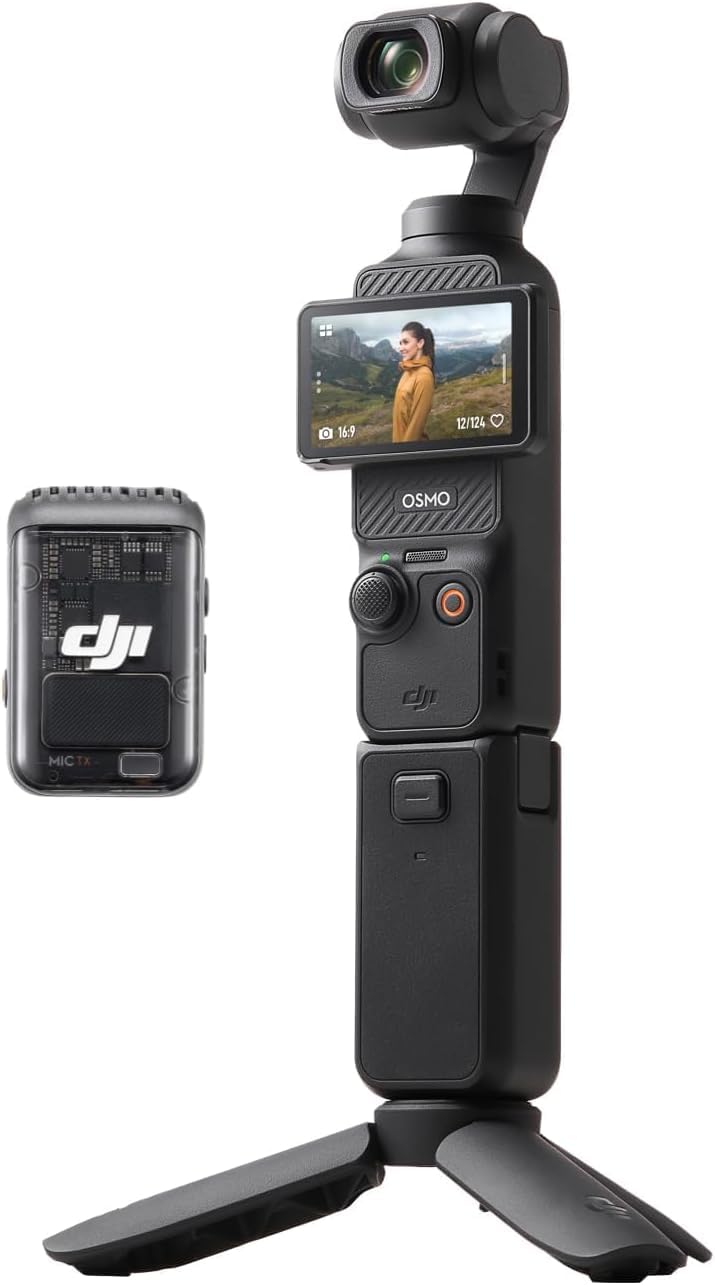
The DJI Osmo Pocket 3 uses a 1-inch CMOS sensor combined with a built-in 3-axis mechanical gimbal to deliver impossibly smooth 4K up to 120fps without any post-processing stabilization. The 2-inch rotatable touchscreen flips between horizontal and vertical shooting, making it a dual-purpose camera for YouTube and TikTok creators.
ActiveTrack 6.0 locks onto a subject and keeps them centered even during fast movement, while D-Log M 10-bit color gives you room to grade in post. The Creator Combo includes the DJI Mic 2 transmitter with excellent wireless audio, a wide-angle lens, a mini tripod, and a battery handle that extends runtime to over two hours.
The all-in-one design means you can’t swap lenses or upgrade the sensor, so you’ll eventually outgrow it for narrative work. The 1-inch sensor, while impressive for its size, doesn’t match the shallow depth of field and low-light performance of APS-C or full-frame systems. It excels as a B-roll camera or travel companion.
Why it’s great
- Built-in 3-axis gimbal delivers professional-level stabilization
- 1-inch sensor with 10-bit D-Log M color profile for grading
- ActiveTrack 6.0 tracks subjects reliably even during fast movement
Good to know
- Non-interchangeable lens limits creative growth
- 1-inch sensor can’t match shallow depth of field of larger formats
7. Panasonic G85

The Panasonic G85 offers class-leading 5-axis Dual Image Stabilization that works with both the lens OIS and the body IBIS together, allowing you to shoot handheld 4K footage that looks like it came from a tripod. The 16MP Micro Four Thirds sensor has no low-pass filter, resulting in sharper fine detail than standard 16MP sensors.
The weather-sealed magnesium alloy body is built to handle outdoor shoots, and the OLED live viewfinder and articulating touchscreen give you flexible framing options. It records 4K at 30fps with Panasonic’s excellent color science, and the 4K Photo mode lets you pull 8MP stills from video—handy for documentary work.
The autofocus uses contrast detection, which is reliable in good light but can hunt in low-contrast or dim scenes. Battery life is average, and there’s no headphone jack for audio monitoring. The 12-60mm kit lens provides a versatile 24-120mm equivalent range with optical stabilization that pairs perfectly with the IBIS.
Why it’s great
- Outstanding 5-axis Dual I.S. 2 for gimbal-like handheld video
- Weather-sealed magnesium body ready for outdoor conditions
- No low-pass filter produces sharper, more detailed images
Good to know
- Contrast-detect AF struggles in low-contrast or dim lighting
- No headphone jack for in-camera audio monitoring
8. Canon EOS R100

It records 4K video at 24fps and full HD at 60fps, making it a solid starter for filmmakers who want a mirrorless system without the bulk.
The Dual Pixel CMOS AF covers 143 zones with face and eye detection for both humans and animals, and continuous shooting hits 6.5fps. The RF-S 18-45mm kit lens is compact but has a slow aperture range; you’ll want to upgrade to a faster prime lens for better low-light performance and shallower depth of field.
The menu system uses Canon’s beginner-friendly GUI with a guided interface, and the built-in Wi-Fi and Bluetooth let you transfer clips to your phone easily. It lacks a microphone input, which is a significant limitation for serious filmmaking. For learning basics on a mirrorless platform at the lowest possible price, it’s a viable starting point.
Why it’s great
- Smallest and lightest EOS R body, incredibly portable
- Dual Pixel CMOS AF with face/eye detection works reliably
- Beginner-friendly menu system with quick custom menus
Good to know
- No external microphone input limits audio quality
- Kit lens has slow aperture; plan to upgrade for low light
9. GoPro MAX2
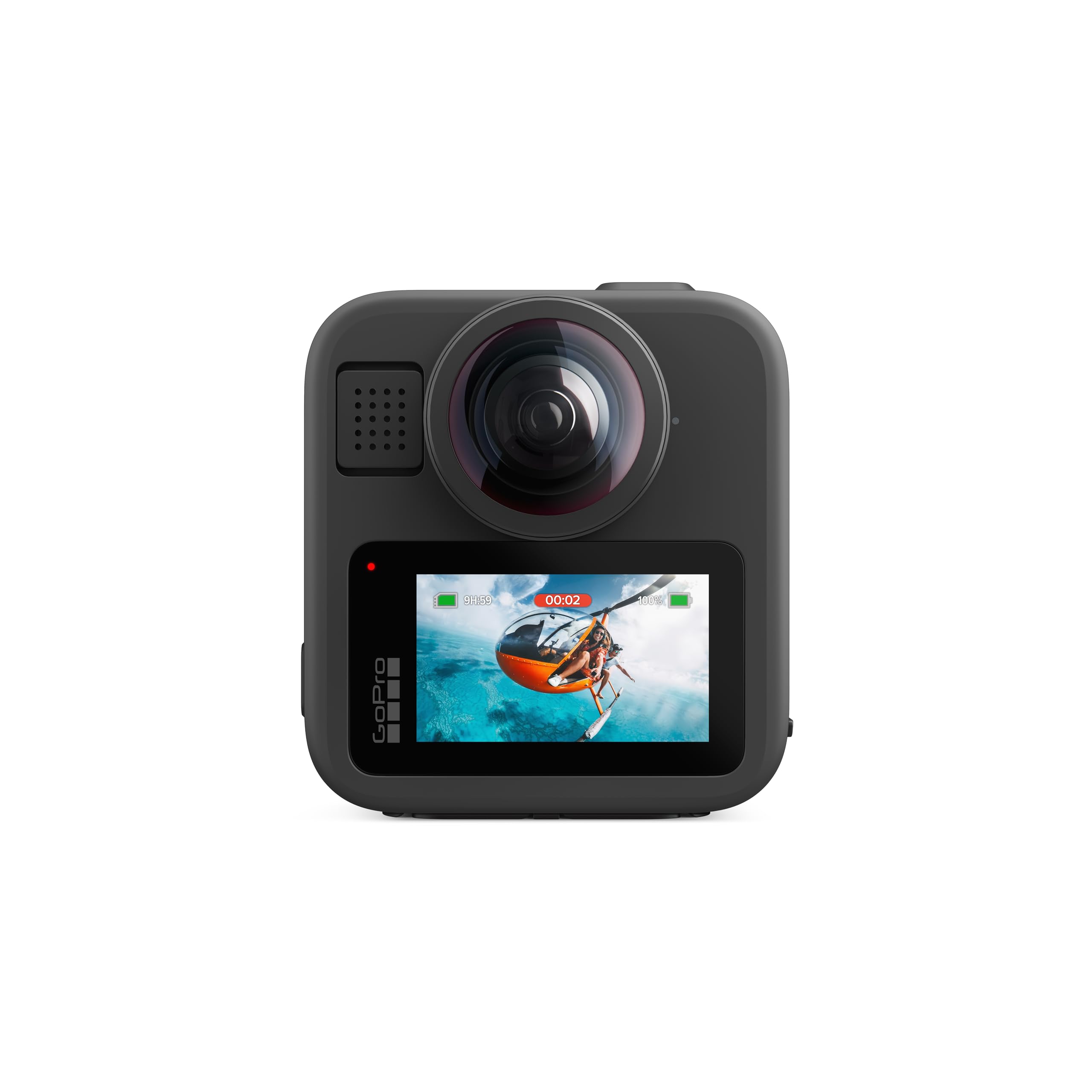
The GoPro MAX2 shoots True 8K 360 spherical video and 29MP 360 photos, letting you capture everything around you and reframe into traditional 4K shots in post-production. The invisible mounting feature makes selfie sticks disappear from the frame, creating drone-like or third-person perspectives.
The replaceable glass lenses and waterproof build without a housing make it durable for extreme conditions, and HyperSmooth stabilization with Horizon Lock keeps the horizon level during 360 spins. The 1960mAh Enduro battery handles a heavy morning of 8K shooting, and the 6-mic ambisonic audio system shifts sound perspective with the reframed video.
File sizes are enormous in 8K 360 mode, so budget for high-capacity SD cards or cloud storage. The 1-inch sensor size limits dynamic range compared to dedicated cinema cameras, and the learning curve for 360 reframing in the Quik app can feel frustrating. It’s a specialty tool best used as a unique perspective camera, not a primary filmmaking rig.
Why it’s great
- True 8K 360 video with invisible mounting for unique perspectives
- Replaceable glass lenses and waterproof without housing
- 6-mic ambisonic audio tracks sound to match reframed video
Good to know
- Huge file sizes require fast, high-capacity storage
- 360 reframing workflow has a learning curve in the Quik app
10. Nikon D7500

The Nikon D7500 uses a 20.9MP DX-format sensor with the EXPEED 5 processor and the Multi-CAM 3500FX II 51-point AF system, giving you reliable focus for video and high-speed 8fps burst for photo. This bundle includes two lenses—the 18-55mm VR and the 70-300mm—plus accessories like a microphone, LED light, and tripod, making it an all-in-one starter package.
The 4K video at 30fps uses the full width of the sensor for wide-angle shots with shallow depth of field, and the 3.2-inch tilting touchscreen helps with odd-angle composition. The SnapBridge Bluetooth and Wi-Fi enable easy clip transfer to a smartphone for quick social media posting.
The DSLR form factor is larger and heavier than mirrorless alternatives, and the contrast-detect AF during video can be slower than phase-detect systems. The 18-55mm VR kit lens is optically decent but not exceptional—the real value in this bundle is getting both a wide and telephoto lens plus a mic and lighting in one purchase.
Why it’s great
- Comprehensive bundle with both wide and telephoto zoom lenses
- 51-point AF system and 8fps burst for action videos and photos
- SnapBridge offers convenient wireless file transfer
Good to know
- Larger DSLR body compared to mirrorless alternatives
- Video autofocus uses contrast detection, not phase detection
11. Canon EOS 2000D / Rebel T7

The Canon Rebel T7 (2000D) is a 24.1MP APS-C DSLR with a 9-point autofocus system and the classic Canon color science that has made the Rebel line a favorite for first-time videographers. This 20-piece bundle includes the 18-55mm lens, a SanDisk 32GB card, tripod, case, and wide-angle and telephoto accessory lenses, giving you nearly everything you need to start shooting at the lowest possible budget.
Built-in Wi-Fi and NFC let you pair with your smartphone via the Canon Camera Connect app for remote control and quick file sharing. The optical viewfinder provides a zero-lag viewing experience that mirrorless cameras can’t match, and the battery life is excellent by modern standards—you can shoot for hours before needing a recharge.
The 9-point AF system is basic and the video is limited to 1080p at 30fps with no 4K option, making it the least capable video camera on this list. The more critical missing feature is the external microphone input, which means you cannot use a dedicated mic for clean audio. It’s a viable learning platform, but only if your budget absolutely cannot be stretched.
Why it’s great
- Lowest price entry point with full accessory bundle included
- Excellent optical viewfinder and great battery life for long shoots
- Canon’s intuitive menu system and proven color science
Good to know
- No 4K video recording, limited to 1080p 30fps
- No external mic input for clean audio capture
FAQ
Do I need a gimbal for a beginner filmmaking camera?
Is 4K video necessary for learning filmmaking?
What does a log profile do for beginner videographers?
Should I buy an older high-end DSLR or a new entry-level mirrorless?
Final Thoughts: The Verdict
For most users, the beginner cameras for filmmaking winner is the Sony FX30 because it delivers cinema-grade S-Cinetone color science, reliable phase-detect autofocus, and professional recording features at a price that leaves room for lenses and accessories. If you want unlimited 10-bit recording with class-leading stabilization and a full-frame sensor, grab the Panasonic S5II. And for learning the hardbody craft of manual exposure, focus, and color grading with professional codec support, nothing beats the Blackmagic Pocket Cinema Camera 4K.

Mo Maruf
I created WellFizz to bridge the gap between vague wellness advice and actionable solutions. My mission is simple: to decode the research and give you practical tools you can actually use.
Beyond the data, I am a passionate traveler. I believe that stepping away from the screen to explore new environments is essential for mental clarity and physical vitality.