Our readers keep the lights on and my smoothie glass nicely filled. As an Amazon Associate, I earn from qualifying purchases.
Stepping up from a smartphone to a dedicated camera means confronting a wall of specs—megapixels, sensor sizes, autofocus points, crop factors—that can stall any beginner before they take a single shot. The gap between what your phone delivers and what a proper interchangeable-lens camera can capture is defined by sensor area and lens flexibility, not just pixel count. A beginner camera for photography and video must bridge technical capability with forgiving controls, letting you grow without punishing mistakes.
I’m Mohammad Maruf — the founder and writer behind WellFizz. My research focuses on how entry-level imaging hardware balances sensor performance, autofocus speed, and video codecs to serve the first-time buyer moving beyond computational photography.
This guide covers eleven models that each take a distinct approach to solving that transition. Whether you prioritize video features, portability, or lens ecosystem depth, the right beginner camera for photography and video depends on matching your creative goals to the hardware’s specific strengths.
How To Choose The Best Beginner Camera For Photography And Video
Entry-level cameras vary dramatically in their emphasis. Some prioritize still-image color science and battery life, while others focus on video codec support and stabilization. Understanding your primary use case—whether that’s portraits, travel vlogging, or family documentation—will steer you toward the sensor format and autofocus system that serves you best. Below are the three most critical decision points for a first-time hybrid shooter.
Sensor Format and Crop Factor
The sensor’s physical size determines how much light it collects, which directly impacts low-light noise levels and the ability to blur backgrounds. APS-C sensors (used by Canon, Nikon, Sony, and Fujifilm) offer a 1.5x–1.6x crop factor, while Micro Four Thirds (used by Panasonic and OM System) has a 2x crop. The larger APS-C area gives roughly one stop better low-light performance and shallower depth of field at the same aperture. Micro Four Thirds bodies, however, are often more compact and offer deeper depth of field for macro or product work.
Autofocus System Coverage
Phase-detection autofocus (PDAF) points cover a much larger portion of the frame than contrast-detection systems, and they allow the camera to track moving subjects without hunting. Cameras with 143 or more PDAF points—like the Canon EOS R100 or Sony a6400—deliver reliable eye and face tracking for portraits and video. Older DSLR designs like the Canon Rebel T7 use only 9 AF points, which limits tracking accuracy in Live View and video mode.
Video Specifications and Crop Factors
4K video recording at 24 or 30 fps is now standard on entry-level mirrorless bodies, but the implementation varies. Some cameras apply a heavy crop factor (1.5x–2.5x) when recording 4K, making wide-angle photography difficult with kit lenses. Bit rate—typically 100 Mbps or 150 Mbps—affects how much detail is retained in motion. Frame rate options like 60 fps in 1080p allow smooth slow-motion playback, while 120 fps at 1080p gives greater flexibility for dramatic slo-mo sequences.
Quick Comparison
On smaller screens, swipe sideways to see the full table.
| Model | Category | Best For | Key Spec | Amazon |
|---|---|---|---|---|
| Canon EOS M50 (Renewed) | Mirrorless | Hybrid beginners wanting 4K and slow-mo | 143 AF points, 4K 24p (cropped) | Amazon |
| Panasonic LUMIX G85 | Mirrorless | Video-focused shooters needing IBIS | 5-axis IBIS, 16MP M4/3 sensor | Amazon |
| Sony Alpha ZV-E10 | Mirrorless | Vloggers and content creators | 425 AF points, 6K oversampled 4K | Amazon |
| Nikon Z50 II (2-Lens Kit) | Mirrorless | All-around family/travel with two zooms | 20.9MP APS-C, 231 AF points | Amazon |
| Nikon Z 30 | Mirrorless | Compact vlogging and streaming | 209 AF points, flip-out selfie screen | Amazon |
| Sony Alpha a6400 | Mirrorless | Fast action and subject tracking | 425 AF points, 11fps burst | Amazon |
| Canon EOS Rebel T7 (Kit) | DSLR | Budget stills learning with optical viewfinder | 9 AF points, 24.1MP APS-C | Amazon |
| OM SYSTEM E-M10 Mark IV | Mirrorless | Compact travel with built-in stabilization | 4.5-stop IBIS, 20MP M4/3 | Amazon |
| Canon EOS R100 (Renewed) | Mirrorless | Entry-level mirrorless at a low cost | 24.1MP APS-C, Dual Pixel CMOS AF | Amazon |
| Panasonic LUMIX FZ80D | Bridge | Long zoom reach without changing lenses | 60x optical zoom (20-1200mm) | Amazon |
| Canon EOS Rebel T7 (Body Only) | DSLR | Simplest DSLR entry point | 9 AF points, 3fps continuous | Amazon |
In‑Depth Reviews
1. Sony Alpha ZV-E10
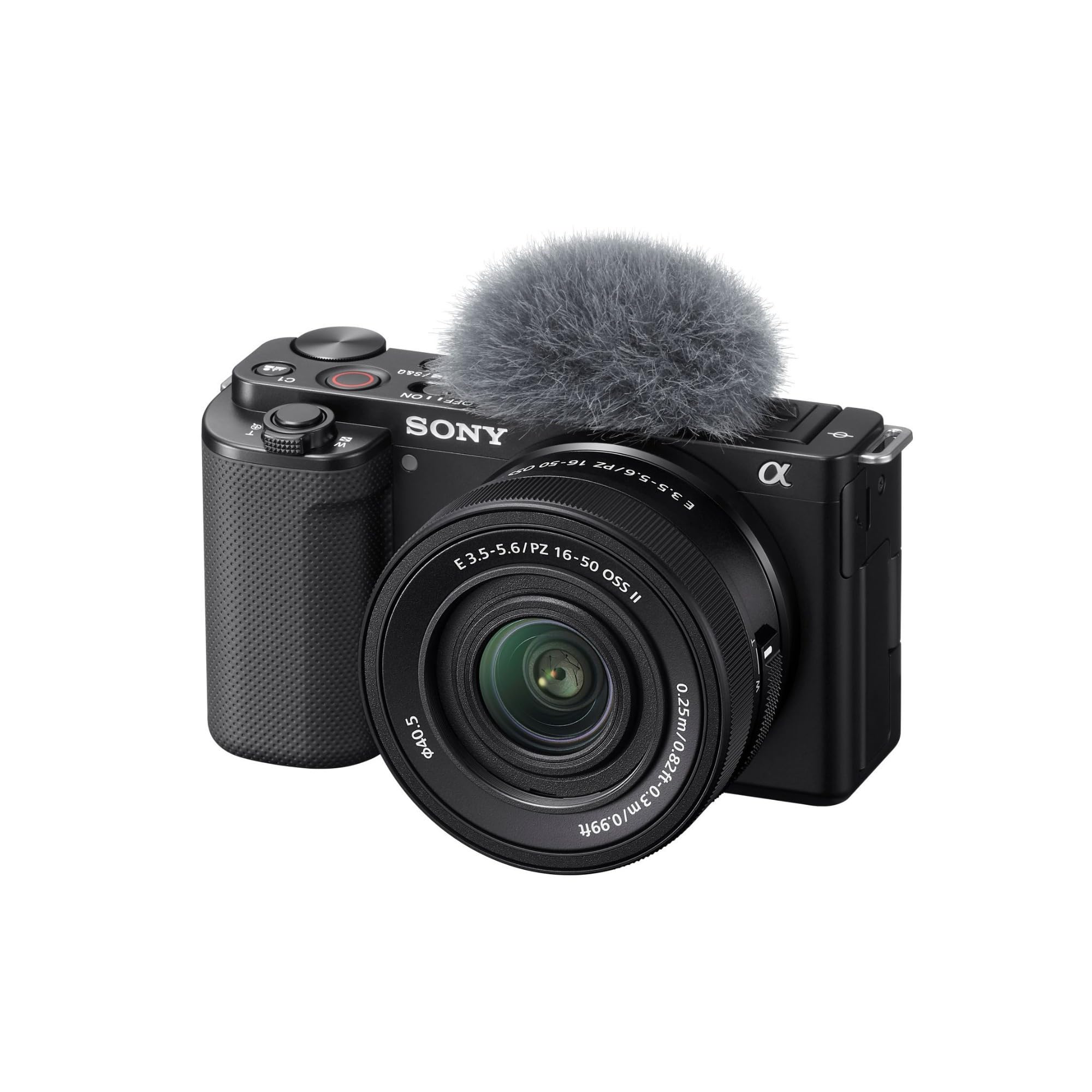
The Sony ZV-E10 packs a 24.2MP APS-C Exmor CMOS sensor paired with the BIONZ X processor, enabling 4K video oversampled from a 6K readout for exceptional sharpness. Its 425 phase-detection autofocus points cover nearly the entire frame, delivering real-time eye tracking for both humans and animals—a critical advantage for beginners who want reliable focus during candid portraits or vlogging. The Product Showcase Setting instantly shifts focus from your face to an object held up to the lens, making product reviews seamless without manual override.
The kit lens (Sony E PZ 16-50mm F3.5-5.6 OSS II) is a power-zoom design that retracts for storage, keeping the body pocketable enough for daily carry. Background Defocus is a single-button toggle that opens the aperture fully for blurred backgrounds or stops it down for group shots. The 3-inch vari-angle touchscreen flips out to the side, avoiding the hotshoe mic block when recording selfie-style footage.
Battery life is rated at about 440 shots per charge with the NP-FW50, which is average for the class. No in-body image stabilization is present, so lens-based OSS or a tripod is necessary for smooth handheld video. The single SD card slot supports UHS-I speeds, and the USB-C port allows live streaming directly to a computer without a capture card. For hybrid beginners who prioritize video quality and autofocus reliability in one compact body, this is the current benchmark.
Why it’s great
- 6K oversampled 4K provides noticeably sharper video than rivals at this tier.
- 425-point phase-detection AF with real-time eye tracking is best-in-class for subject reliability.
- Product Showcase Setting and Background Defocus button simplify hybrid content creation.
Good to know
- No in-body image stabilization; relies on lens OSS or external support for stable footage.
- Kit lens power-zoom is optically average; upgrading to a prime lens improves low-light results.
- Battery life is modest; carrying a spare NP-FW50 is recommended for all-day shoots.
2. Panasonic LUMIX G85

The G85 uses a 16MP Micro Four Thirds sensor with no optical low-pass filter, resulting in slightly sharper fine detail capture than previous 16MP M4/3 sensors. Its defining feature is the 5-axis in-body image stabilization (IBIS), which works in both photo and video modes to cancel handheld shake—rated at roughly 4 stops of compensation. This makes 4K QFHD (3840×2160) video noticeably smoother without a gimbal compared to unstabilized competitors at the same price point.
The bundled 12-60mm Power O.I.S. lens (24-120mm equivalent) offers a useful range from moderate wide-angle to portrait-length telephoto, with Panasonic’s lens-based stabilization syncing with the IBIS for dual-effect suppression. The OLED live viewfinder (2360K dots) and 3-inch tiltable touchscreen give clear framing in bright sun. Weather-sealed magnesium-alloy construction is rare at this price tier, adding durability for outdoor shoots.
Video autofocus is contrast-detect with DFD (Depth from Defocus) technology, which works well in good light but can hunt in low-light or low-contrast scenes. The Post Focus feature lets you select the focus point after capturing a burst of images, useful for macro or product work. Battery life is about 330 shots per charge, and there is no headphone jack for audio monitoring during video recording.
Why it’s great
- 5-axis IBIS delivers gimbal-like stabilization for handheld 4K video, unmatched at this price.
- Weather-sealed magnesium-alloy body adds durability for outdoor and travel photography.
- Kit lens 12-60mm range (24-120mm equivalent) is versatile for landscapes to portraits.
Good to know
- Contrast-detect AF with DFD can struggle in low light compared to phase-detect systems.
- 16MP sensor resolution limits cropping flexibility versus 24MP APS-C competitors.
- No headphone jack for real-time audio monitoring during video recording.
3. Nikon Z50 II (2-Lens Kit)

The Nikon Z50 II features a 20.9MP DX-format APS-C sensor paired with the EXPEED image processor, offering 4K UHD/60p video with full pixel readout and no crop in 4K/30p mode. Its 231 phase-detection autofocus points cover about 90% of the frame, with subject detection for people, dogs, cats, birds, and vehicles—a robust tracking suite for a beginner body. The Picture Control button provides 31 preset color profiles, and you can download custom presets from the Nikon Imaging Cloud to match your aesthetic without editing later.
The two-lens kit is the standout value proposition here. The NIKKOR Z DX 16-50mm f/3.5-6.3 VR covers wide to short telephoto, while the 50-250mm f/4.5-6.3 VR extends reach for wildlife and sports. Both lenses feature Vibration Reduction (VR) for handheld sharpness. The built-in flash adds versatility for low-light snapshots, and the Night Portrait mode automates slow-sync flash for natural-looking indoor portraits. The SnapBridge app transfers images wirelessly in seconds without entering menus.
The 3.2-inch tilting touchscreen is bright but not fully articulating, which limits selfie framing compared to flip-out designs. Battery life is rated at about 320 shots per charge (CIPA), and the EN-EL25 battery is shared across the Z30 and Zfc. The kit lenses are optically adequate but benefit from stopping down one stop for edge-to-edge sharpness. This is the strongest two-lens package for a beginner who wants immediate versatility without buying additional glass.
Why it’s great
- Two-lens kit (16-50mm + 50-250mm VR) covers wide-angle to telephoto without extra purchases.
- 231 phase-detect AF points with subject detection for people, pets, birds, and vehicles.
- 31 built-in Picture Control presets plus downloadable cloud profiles simplify creative color grading.
Good to know
- Tilting screen does not flip forward for selfie framing, limiting vlogging convenience.
- Kit lenses require stopping down for optimal sharpness at edges and corners.
- Battery life is below average for the class; a spare battery is recommended for full-day use.
4. Sony Alpha a6400

The Sony a6400 uses the same 24.2MP APS-C Exmor sensor found in the ZV-E10 but adds a front-end LSI for faster readout speeds, enabling 11fps continuous shooting with AF/AE tracking. Its 425 phase-detection points cover 84% of the sensor area, and the Real-Time Eye AF for humans and animals locks focus in 0.02 seconds—fast enough to track a running child or a pet mid-jump. The 180-degree tiltable 3-inch touchscreen flips up for selfie framing, though it blocks the hotshoe if a microphone is attached.
4K video is oversampled from a 2.4x readout, producing detailed footage with full pixel readout and no pixel binning, but with a slight crop factor at 4K 24/30p. The E PZ 16-50mm f/3.5-5.6 OSS II power-zoom lens is compact but optically uninspiring; many users upgrade to the Sigma 16mm f/1.4 or Sony 35mm f/1.8 OSS for better low-light performance. The camera supports uncompressed 4:2:2 8-bit output over HDMI, which is useful for external recording.
The menu system is the older Sony tabbed interface, which has a learning curve compared to the newer ZV-E10’s streamlined touch menu. Battery life is approximately 410 shots per charge, and the single UHS-I SD card slot is adequate for 11fps bursts but may buffer during long sequences. The lack of IBIS means that handheld video requires steady technique or a gimbal. For beginners who prioritize lightning-fast autofocus and burst speeds for action, this is the choice.
Why it’s great
- 0.02-second AF lock with 425 phase-detection points is the fastest tracking in this class.
- 11fps continuous shooting with AF/AE tracking captures fast-moving subjects reliably.
- 4K oversampled from full pixel readout delivers sharp video with minimal artifacts.
Good to know
- No in-body stabilization; smooth handheld video requires lens OSS or a gimbal.
- Old Sony menu system is less intuitive than the ZV-E10’s touch-centric interface.
- 4K recording applies a crop factor, widening the effective focal length of kit lenses.
5. Nikon Z 30

The Nikon Z 30 is designed specifically for creators who prioritize video over stills, featuring a 20.9MP DX-format APS-C sensor that records 4K UHD at 30p with full pixel readout and no crop. Its 209 phase-detection autofocus points include eye tracking for people and pets, and the flip-out 3-inch touchscreen fully articulates forward for selfie monitoring. The built-in stereo microphone has adjustable sensitivity, and a red REC light on the front confirms recording without checking the display.
Streaming is plug-and-play: USB-C delivers Full HD 60p video directly to a computer without capture card or driver installation, and 4K 30p streaming is possible over HDMI. The camera can run continuously on USB-C power, making it suitable for long live sessions. The NIKKOR Z DX 16-50mm f/3.5-6.3 VR lens provides optical stabilization and a versatile zoom range in a compact package. The EN-EL25 battery is rated for about 360 shots or 75 minutes of video recording per charge.
The Z 30 lacks a built-in electronic viewfinder (EVF), requiring you to rely on the LCD for framing in bright conditions—a compromise for still photographers but acceptable for video-first users. The single SD slot is UHS-I only, and there is no headphone jack for audio monitoring during recording. The kit lens’s f/3.5 maximum aperture limits low-light performance compared to faster prime options. For a beginner who wants a dedicated, compact vlogging and streaming tool without breaking the bank, the Z 30 is the most purpose-built option.
Why it’s great
- Flip-out selfie screen with red REC light makes vlogging and streaming frame-check effortless.
- Plug-and-play USB-C 4K/60p streaming without extra hardware or software.
- Compact body with 209 phase-detect AF points and reliable subject tracking for video.
Good to know
- No electronic viewfinder; must use rear LCD for stills framing in bright sunlight.
- Lacks headphone jack for real-time audio monitoring during video recording.
- Kit lens aperture is slow (f/3.5-6.3), limiting low-light video quality without a faster prime.
6. Canon EOS M50 (Renewed)

The Canon EOS M50 (renewed) uses a 24.1MP APS-C CMOS sensor with the DIGIC 8 processor, offering Dual Pixel CMOS AF with 143 phase-detection points spread across 88% of the frame. This provides smooth, accurate continuous autofocus during both stills and 4K video, with Eye Detection AF for portraits. The camera records 4K UHD at 24p, though with a significant 1.6x crop factor that effectively turns a 15mm lens into a 24mm equivalent—limiting wide-angle coverage.
The OLED electronic viewfinder (2360K dots) has Touch and Drag AF, allowing you to move the focus point by dragging your thumb on the rear screen while looking through the viewfinder—a feature usually found in higher-tier cameras. The 3-inch vari-angle touchscreen flips out to the side, making it compatible with external microphones mounted in the hotshoe. HD 120p recording at 720p enables 4x slow-motion playback. The EF-M lens mount offers a modest native lens selection, but an adapter (sold separately) unlocks Canon’s vast EF/EF-S lens library.
The M50’s 4K video is limited to 24fps with the aforementioned crop, and autofocus in 4K mode switches to contrast-detect, which is slower and less reliable than the Dual Pixel system used in 1080p. The battery life is rated at about 235 shots per charge—below average—so a spare LP-E12 is essential for day trips. The renewed status means factory restoration, but cosmetic wear may vary. For beginners who want a compact mirrorless with excellent 1080p video and a viewfinder at a budget-friendly price, the M50 remains a strong contender.
Why it’s great
- Dual Pixel CMOS AF with 143 points delivers smooth, reliable autofocus for 1080p video and photos.
- Touch and Drag AF on the EVF allows intuitive focus point adjustment without looking away.
- Vari-angle touchscreen flips to the side, avoiding hotshoe mic blockage for vlogging.
Good to know
- 4K recording requires a heavy 1.6x crop and switches to slower contrast-detect AF.
- EF-M lens mount has limited native options; an adapter is needed for Canon EF/EF-S lenses.
- Battery life is low (235 shots); carrying a spare LP-E12 is necessary for extended use.
7. OM SYSTEM E-M10 Mark IV

The OM SYSTEM (formerly Olympus) E-M10 Mark IV uses a 20MP Live MOS Micro Four Thirds sensor with 5-axis in-body image stabilization rated for up to 4.5 stops of compensation. This allows handheld exposure times as long as 1 second with the kit lens, enabling sharp low-light shots without a tripod. The 14-42mm F3.5-5.6 EZ (power-zoom) pancake lens collapses to a nearly flat profile, making the camera jacket-pocketable—a rare combination for an interchangeable-lens system with built-in stabilization.
The flip-down monitor triggers a dedicated selfie mode that automatically switches to touch-shutter and applies skin-smoothing effects. The 2.36M-dot OLED electronic viewfinder is compact but clear, and the 121 contrast-detection autofocus points provide quick accuracy in good light, though not the tracking performance of phase-detect systems. The camera includes 16 Art Filters (31 total variations), including Instant Film, which gives JPEGs a nostalgic look without post-processing.
The Micro Four Thirds system offers a vast, mature lens library—from tiny pancake primes to high-end f/1.2 PRO lenses—giving beginners a clear upgrade path. The OM Workspace app allows wireless image transfer and remote shooting, though connectivity speeds are slower than modern standards. 4K video is limited to 30p with a 100 Mbps bitrate, and the lack of a headphone jack restricts audio monitoring. For travelers and street photographers who value portability and stabilization over raw speed, the E-M10 Mark IV is a compelling package.
Why it’s great
- 4.5-stop 5-axis IBIS permits sharp handheld shots at shutter speeds as low as 1 second.
- Pancake kit lens collapses for jacket-pocket portability rare in interchangeable-lens cameras.
- Flip-down selfie monitor and Art Filters simplify creative shooting without editing software.
Good to know
- Contrast-detect AF system struggles with tracking fast-moving subjects compared to phase-detect rivals.
- No headphone jack for audio monitoring during video recording.
- Smartphone app and Wi-Fi connectivity are slower and less reliable than modern competitors.
8. Canon EOS Rebel T7 (Kit with Bag & Card)
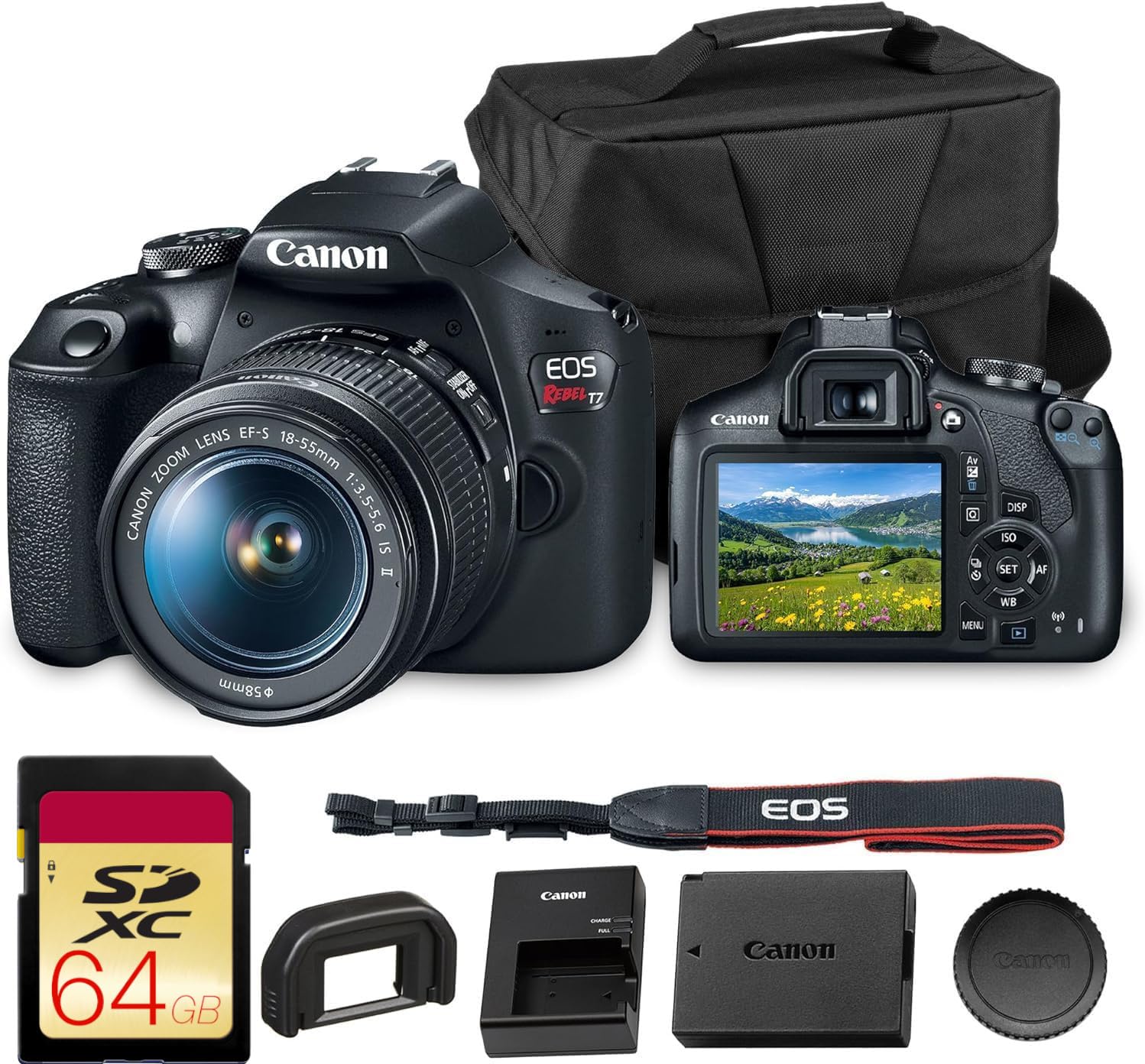
This version of the Canon EOS Rebel T7 includes the camera body with the EF-S 18-55mm f/3.5-5.6 IS II lens, a shoulder bag, and a 64GB SD card—everything needed to shoot immediately. The 24.1MP APS-C CMOS sensor with DIGIC 4+ processor delivers the same crisp still-image quality as more expensive Canon bodies, with ISO 100-6400 (expandable to 12800). The optical viewfinder provides a clear, lag-free framing experience, and the 9-point AF system with AI Servo tracking works reliably for stationary subjects in good light.
Built-in Wi-Fi and NFC connect to the Canon Camera Connect app for wireless photo transfer and remote live view shooting. The Guide Mode offers on-screen assistance for adjusting aperture, shutter speed, and ISO, helping beginners learn the exposure triangle without feeling lost. The 3fps continuous shooting speed is modest but sufficient for portraits and landscapes, while Full HD 1080p video at 30fps covers basic home movies and social media content.
The Rebel T7 lacks 4K video, a touchscreen, and an articulating LCD—significant missing features for a beginner in 2025. Live View autofocus is slow because it relies on contrast detection, making video composition cumbersome. The bundled 64GB card is a Class 10 UHS-I card suitable for Full HD recording but not for burst stills. The bag is basic padding; upgrading to a proper camera bag is recommended for long-term protection. This kit is best for budget-focused stills learners who prefer an optical viewfinder and do not need modern video features.
Why it’s great
- Full kit includes body, lens, bag, and 64GB card for immediate out-of-box shooting.
- Guide Mode teaches exposure and composition fundamentals through on-screen assistance.
- Optical viewfinder offers lag-free framing and long battery life (approximately 500 shots).
Good to know
- No 4K video, no touchscreen, and no articulating LCD—features common in mirrorless alternatives.
- Live View autofocus is contrast-detect and slow, reducing video usability.
- 9-point AF system is outdated for tracking moving subjects in action or sports scenarios.
9. Canon EOS R100 (Renewed)

The Canon EOS R100 (renewed) is a refurbished version of Canon’s most affordable RF-mount mirrorless camera, featuring a 24.1MP APS-C CMOS sensor with the DIGIC 8 processor. The Dual Pixel CMOS AF system provides 143 phase-detection points with eye and face detection, delivering fast, accurate autofocus in both stills and video modes. The RF-S 18-45mm f/4.5-6.3 IS STM kit lens is compact and includes image stabilization, but its f/4.5-6.3 aperture is slow, requiring good light or higher ISO for sharp results indoors.
4K video is recorded at 24fps with a severe crop factor of approximately 1.6x, which turns the wide-angle end into a tight standard view. Full HD 1080p at 60fps offers better field of view and smoother motion for casual clips. The 3-inch fixed LCD (not touchscreen) has 1.04 million dots, which is usable but lacks the flexibility of vari-angle or touch interfaces. Built-in Wi-Fi and Bluetooth transfer images wirelessly to a smartphone for sharing.
The lack of a touchscreen and articulating screen makes selfie framing and menu navigation less intuitive than competitors. The electronic viewfinder (2400K dots) provides a clear, if compact, EVF experience for composing in bright conditions. The R100’s slow kit lens aperture and cropped 4K make it more suitable for stills-oriented beginners who want the latest RF mount compatibility at a low entry point. Renewed status means it has been factory-restored by Canon, often with minor cosmetic signs.
Why it’s great
- Dual Pixel CMOS AF with 143 points provides smooth, reliable autofocus for photos and 1080p video.
- RF mount compatibility offers a modern upgrade path to Canon’s R-series lenses and accessories.
- Compact and lightweight design with built-in Wi-Fi/Bluetooth for easy photo sharing.
Good to know
- 4K video is heavily cropped (1.6x) and limited to 24fps, reducing wide-angle usability.
- No touchscreen and no articulating LCD limit selfie framing and menu navigation speed.
- Kit lens aperture (f/4.5-6.3) is slow; low-light performance requires a faster prime.
10. Panasonic LUMIX FZ80D

The Panasonic LUMIX FZ80D is a bridge camera—a fixed-lens superzoom—that packs a 60x optical zoom lens reaching an equivalent of 20-1200mm in a single, non-interchangeable body. This eliminates the need to carry multiple lenses, making it ideal for beginners who want to photograph distant wildlife, sports from the bleachers, or moon detail without spending on telephoto glass. The 18.1MP 1/2.3-inch sensor is much smaller than APS-C or M4/3, resulting in more noise in low light and less dynamic range.
4K QFHD (3840×2160) video at 30p uses the entire sensor width, and the 4K Photo mode extracts 8MP stills from video bursts at 30fps. Post Focus lets you select the focus point after capture, while the 39 contrast-detect autofocus points provide adequate speed in good light. The 0.39-inch OLED live viewfinder (2360K dots) and 3-inch fixed LCD provide framing options, and POWER O.I.S. (Optical Image Stabilizer) helps keep telephoto shots steady.
Low-light performance is the FZ80D’s main weakness: the small sensor produces noticeable noise above ISO 800, and the maximum aperture narrows to f/8.0 at full zoom, drastically reducing available light. The interface is less intuitive than Panasonic’s mirrorless line, and there is no Wi-Fi connectivity, so image transfer requires a USB cable or SD card reader. Battery life is modest, with rapid drain when actively zooming to 60x. For beginners whose primary need is extreme reach on a budget, the FZ80D offers unmatched value, but its video and low-light quality are limited.
Why it’s great
- 60x optical zoom (20-1200mm equivalent) provides extreme reach without carrying multiple lenses.
- 4K Photo mode and Post Focus offer creative flexibility at a low price point.
- POWER O.I.S. stabilization helps produce sharp telephoto images and video.
Good to know
- Small 1/2.3-inch sensor produces significant noise at ISO 800 and above, limiting low-light use.
- No Wi-Fi or Bluetooth; image transfer requires a cable or SD card reader.
- Maximum aperture narrows to f/8.0 at full zoom, requiring bright light for fast shutter speeds.
11. Canon EOS Rebel T7 (Body Only)

This is the standard body-and-lens kit of the Canon EOS Rebel T7, featuring the 24.1MP APS-C CMOS sensor with DIGIC 4+ processor and the EF-S 18-55mm f/3.5-5.6 IS II lens. The same 9-point AF system and optical viewfinder as the kit version above, this package provides the classic DSLR experience: an optical finder that never lags, a comfortable grip, and excellent battery life (approximately 500 shots per charge). The sensor produces the same crisp, vibrant JPEG colors Canon is known for, with good detail at base ISO.
The built-in Wi-Fi and NFC enable wireless photo transfer to a smartphone, and the EOS Utility Webcam Beta Software lets you use the Rebel T7 as a 1080p webcam via USB for streaming or video calls—a functional workaround for budget streamers. The ISO range of 100-6400 (expandable to 12800) is usable up to 1600 for social media, but noise becomes apparent at higher settings. Full HD 1080p video at 30fps is present but limited by slow Live View contrast-detect autofocus.
No 4K, no touchscreen, no articulating LCD, and a 3fps burst rate make this camera feel dated compared to similarly priced mirrorless options. The 9-point AF system is cross-type in the center only, making off-center subject tracking less reliable. The 18-55mm kit lens is optically average, with softness in the corners at wide apertures. This option is for the absolute beginner who wants to learn on a classic DSLR with minimal bells and a low total investment, understanding that video and modern convenience features are absent.
Why it’s great
- Optical viewfinder provides lag-free framing and excellent battery life (approximately 500 shots).
- 24.1MP sensor produces sharp, vibrant JPEG images with Canon’s well-regarded color science.
- Wi-Fi/NFC connectivity enables wireless photo sharing and remote control via smartphone app.
Good to know
- No 4K video, no touchscreen, and no articulating LCD limit modern usability.
- 9-point AF system is slow in Live View and struggles with moving subjects.
- 3fps burst rate is too slow for action, sports, or fast-moving pets and children.
FAQ
What is the most important spec for a beginner hybrid camera?
Should I buy a DSLR or mirrorless as a beginner in 2025?
Is 4K video necessary on a beginner camera?
How important is in-body image stabilization for beginners?
Final Thoughts: The Verdict
For most users, the beginner camera for photography and video winner is the Sony Alpha ZV-E10 because its 425-point phase-detection autofocus, 6K-oversampled 4K video, and dedicated vlogging features offer the best hybrid value in this list. If you want image stabilization in a weather-sealed body that excels at handheld video, grab the Panasonic LUMIX G85. And for maximum versatility straight out of the box with two zoom lenses covering wide to telephoto reach, nothing beats the Nikon Z50 II 2-Lens Kit.

Mo Maruf
I created WellFizz to bridge the gap between vague wellness advice and actionable solutions. My mission is simple: to decode the research and give you practical tools you can actually use.
Beyond the data, I am a passionate traveler. I believe that stepping away from the screen to explore new environments is essential for mental clarity and physical vitality.