Our readers keep the lights on and my smoothie glass nicely filled. As an Amazon Associate, I earn from qualifying purchases.
Every parent of a deep-sleeping child knows the nightly ritual: the 2 a.m. check, the damp sheets, the mountain of laundry, and the quiet worry that it will never end. Bedwetting alarms offer a clinically proven way to break this cycle by training the brain to respond to bladder signals during sleep — a method far more effective than pull-ups or waking the child manually every few hours.
I’m Mohammad Maruf — the founder and writer behind WellFizz. I’ve spent hundreds of hours analyzing sensor sensitivity, alarm loudness, attachment mechanisms, and battery systems across dozens of bedwetting alarm models to understand exactly what separates a system that actually builds dry-night habits from one that just adds noise to the night.
This guide cuts through the marketing to compare seven leading options, focusing on the real-world differences in sensor design, alert configurability, and comfort that determine whether a bedwetting alarm for kids will deliver lasting results for your family.
How To Choose The Best Bedwetting Alarm For Kids
A bedwetting alarm is a simple behavioral conditioning device: a moisture sensor clips to the child’s underwear and triggers an alert when it detects urine. The goal is to wake the child mid-event so the brain learns to associate full-bladder sensation with waking up. But not all alarms are equally effective. The sensor design, alert strength, and wearing comfort directly determine whether the child — especially a deep sleeper — actually wakes up and forms the neural pathway to dryness.
Sensor technology and attachment method
The sensor is the heart of the system. Clip-on sensors with exposed metal contacts are common and affordable, but they can cause false alarms from sweat or static if the sensor shifts against damp pajamas. Premium models use soft silicone sensors with larger detection areas that resist corrosion and stay comfortable against the skin. Attachment also matters: traditional wired sensors use a cord that runs from underwear to the alarm unit on the wrist or collar — this can tangle during active sleep. Wireless transmitters clip directly to the underwear and send a signal to a separate receiver, eliminating the cord but adding a small component that can be misplaced.
Alert configurability for different sleep depths
Deep sleepers — the children most likely to wet the bed — need more than a single beep. The best alarms offer multiple tones, a strong vibration mode, and a bright flashing light. The ability to cycle through different sounds over successive nights prevents the brain from tuning out a familiar noise. Volume control is equally important: parents need the alarm loud enough to wake the child but not the entire household.
Battery system and daily maintenance
Daily use over weeks or months means battery changes become a hidden cost. Disposable AAA or AA batteries in the alarm unit and sensor add ongoing expense and the risk of a dead unit mid-night. USB-C rechargeable systems simplify this: a single two-hour charge can power the system for two weeks or more. Wireless transmitters with magnetic charging docks are especially convenient because they eliminate separate battery compartments and are easy to store.
Progress tracking and motivational tools
Motivation matters, especially for older children who already feel self-conscious about bedwetting. Alarms that include a progress chart with star or sticker rewards give the child a visible record of success, reinforcing their effort. Digital progress tracking, built into the device itself, is even better — it eliminates lost paper charts and allows parents and children to celebrate milestones together.
Quick Comparison
On smaller screens, swipe sideways to see the full table.
| Model | Category | Best For | Key Spec | Amazon |
|---|---|---|---|---|
| Malem Ultimate | Premium Wired | Deep sleepers needing maximum wake-up power | Combined light, sound, and vibration alert | Amazon |
| Chummie Premium | Premium Silicone | Comfort-sensitive children | Soft silicone sensor with large detection area | Amazon |
| ovevve 2026 Wireless | Premium Wireless | Active sleepers needing cord-free comfort | Magnetic charging transmitter, 7 ringtones | Amazon |
| DryEasy Pro Wireless | Mid-Range Wireless | Tech-friendly families wanting rechargeable wireless | 6 selectable sounds, 6 volume levels, 3 modes | Amazon |
| Zexyvor Wireless USB-C | Mid-Range Wireless | Multi-child families or heavy deep sleepers | IPX8 waterproof sensor, 14-day battery life | Amazon |
| Wet-Stop3 Kit w/ Bed Pad | Mid-Range Wired Kit | Parents wanting a complete kit with mattress protection | Includes washable waterproof bed pad | Amazon |
| Wet-Stop 3 Blue | Budget Wired | First-time buyers on a tight budget | 6 alarm tones, vibration, compact 1.5-inch unit | Amazon |
In‑Depth Reviews
1. Malem Ultimate Bedwetting Alarm (Blue)

The Malem Ultimate is the alarm that pediatricians and clinical trials consistently point to as the most reliable system for deep sleepers. Its three-alert approach — a loud sound, a strong vibration, and a bright flashing light — ensures that even children who sleep through a single tone get jolted awake by at least one of the stimuli. The Secure Grip clip-on sensor uses Quick Detect technology that senses the first drop of urine, so the alarm sounds before the bed is fully wet, reinforcing the association between bladder pressure and waking.
The 2-inch square, 1-ounce unit clips to the collar or wrist via a connected cord and runs on two included AA batteries. Real-world feedback from parents of 7 to 9-year-old deep sleepers shows most children achieve consistent dry nights within 2 to 6 weeks of consistent use. The clip-on design eliminates the need for sticky tape or pins, which avoids skin irritation and keeps the sensor securely positioned through the night. A one-year warranty backs the unit against defects.
The primary tradeoff is the wired design — the cord runs from the underwear sensor up to the alarm unit on the clothing, which can tangle for extremely active sleepers. Some parents also report that the alarm is loud enough to wake other family members, though for deep sleepers that is often a necessary feature rather than a flaw. The lack of rechargeable batteries means you will need to replace AAs periodically, but one set lasts many weeks with nightly use.
Why it’s great
- Triple alert (sound, vibration, flashing light) reaches deepest sleepers
- Quick-Detect sensor catches first drop, reducing full wetting events
- Secure clip-on sensor stays positioned without tape or pins
- Backed by a 1-year warranty and clinical trial evidence
Good to know
- Wired design can tangle during active sleep
- Uses disposable AA batteries rather than rechargeable
- Alarm volume may disturb other household members
2. Chummie Premium Bedwetting Alarm

The Chummie stands apart because of its sensor material. Instead of the rigid plastic or metal clip found on most alarms, Chummie uses a soft, non-corrosive silicone sensor called IntelliFlex that conforms to the child’s body shape and covers a significantly larger detection area. This design reduces the risk of false alarms from moisture in the air or sweat against the sensor, and it eliminates the poking or pinching that some children find uncomfortable with clip-style sensors. The alarm unit itself weighs just 1 ounce and offers 8 different selectable tones with volume control, an adjustable vibration setting, and two bright LED lights.
Parents of deep-sleeping children between 7 and 9 years old report success timelines of 6 to 12 weeks to achieve consistent dry nights. The alarm’s two-step shut-off — requiring the sensor to be dried and the button held simultaneously — prevents the child from accidentally turning the alarm off and going back to sleep without finishing the waking routine. Chummie also includes a free mobile app with instructional videos and live customer support, plus a progress diary and certificate of achievement to keep the child motivated.
The sensor uses an L-shaped plug connection that some families find prone to popping out if the cord is yanked during sleep. Several reviewers solved this by securing the plug with a rubber band or small piece of tape. The alarm unit runs on 2 AAA batteries, which is acceptable but not as convenient as a rechargeable system. The smooth sensor surface also makes it difficult for tape to adhere, so parents of boys often use a binder clip attached to the underwear flap as an alternative attachment method.
Why it’s great
- Soft silicone IntelliFlex sensor is comfortable and corrosion-resistant
- 8 different tones with adjustable volume prevent desensitization
- Two bright LED lights aid wake-up for deep sleepers
- Free mobile app with live support and progress tracking
Good to know
- L-shaped sensor plug can disconnect during active sleep
- Sensor’s smooth surface resists tape for alternative attachment
- Uses disposable AAA batteries, not rechargeable
3. ovevve 2026 Wireless Bedwetting Alarm
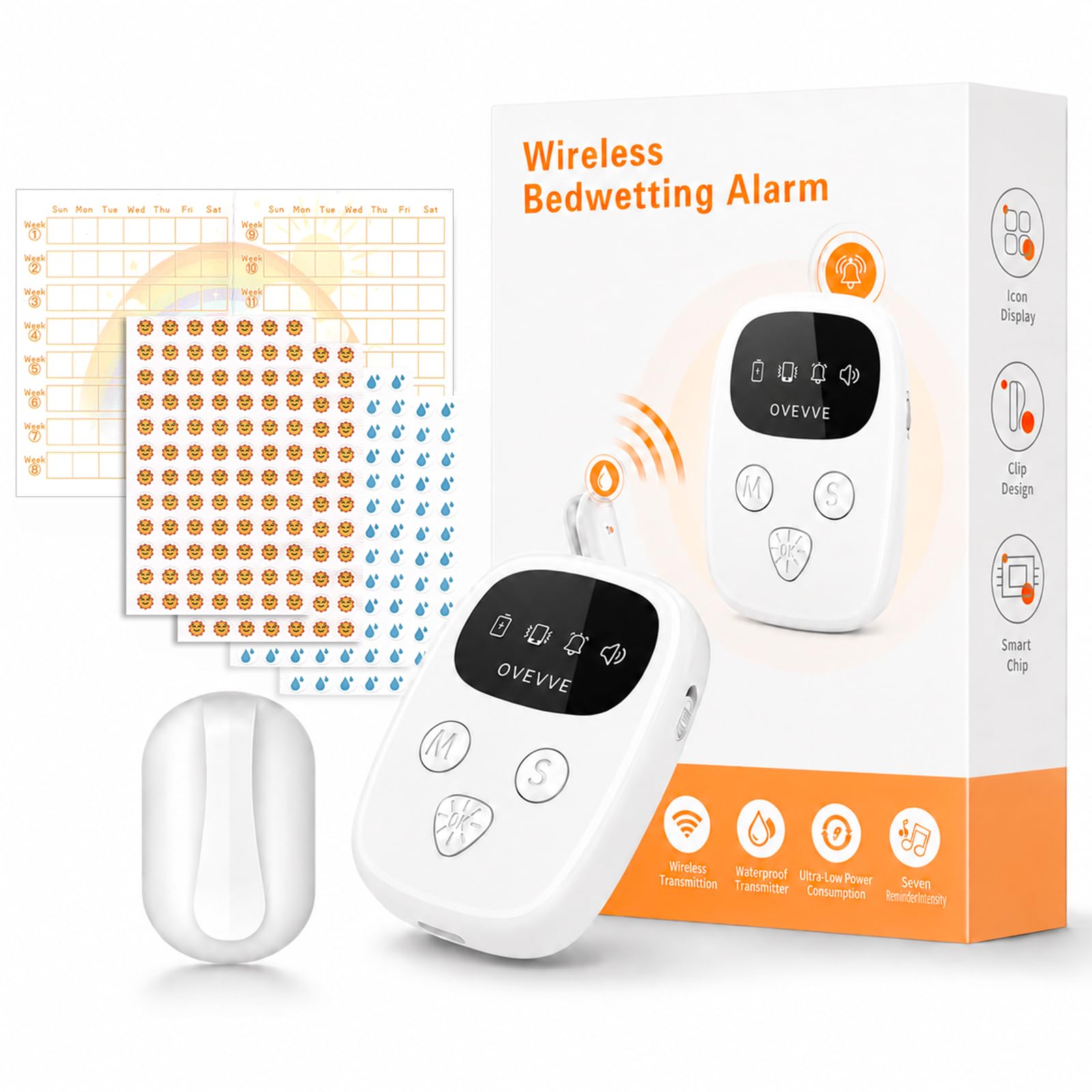
The ovevve alarm eliminates the cord entirely. A fully waterproof transmitter clips directly to the moisture-prone area of the child’s underwear and sends a wireless signal to a separate receiver that sits on the bedside table or near the pillow. This cord-free design is especially appealing for children who toss and turn, because there is no wire to tangle around limbs or pull the sensor out of position. The receiver itself offers 7 different ringtones, three alert modes (sound, vibration, or sound plus vibration), and adjustable volume to match the child’s sleep depth.
The transmitter charges via a magnetic dock that attaches to the back of the receiver when not in use, which also serves as a storage solution that prevents the small transmitter from getting lost. The receiver charges via USB-C and works with any standard 5V adapter. A full charge on the receiver covers several nights of use, while the transmitter’s battery is built-in and recharges each time it docks. The kit also includes a progress card with star and sticker rewards, which adds a motivational layer for younger children.
Some users report that the wireless signal can occasionally trigger false alarms if the sensor is clean and dry but exposed to high humidity. The transmitter is compact and discreet — suitable for use at home or during travel to summer camps — but its small size also makes it easy to misplace when detaching it from underwear in the morning. The receiver uses a toggle switch for on/off control, which is simpler than a button-based interface but can be accidentally toggled if the unit is bumped during sleep.
Why it’s great
- Fully wireless design eliminates cord tangles during active sleep
- Magnetic charging dock doubles as a storage station for the transmitter
- 7 different ringtones prevent habituation to a single tone
- Includes progress card and stickers for child motivation
Good to know
- Wireless signal may trigger false alarms in high humidity
- Small transmitter is easy to misplace when not docked
- Toggle switch can be accidentally turned off during sleep
4. DryEasy Pro Wireless Bedwetting Alarm
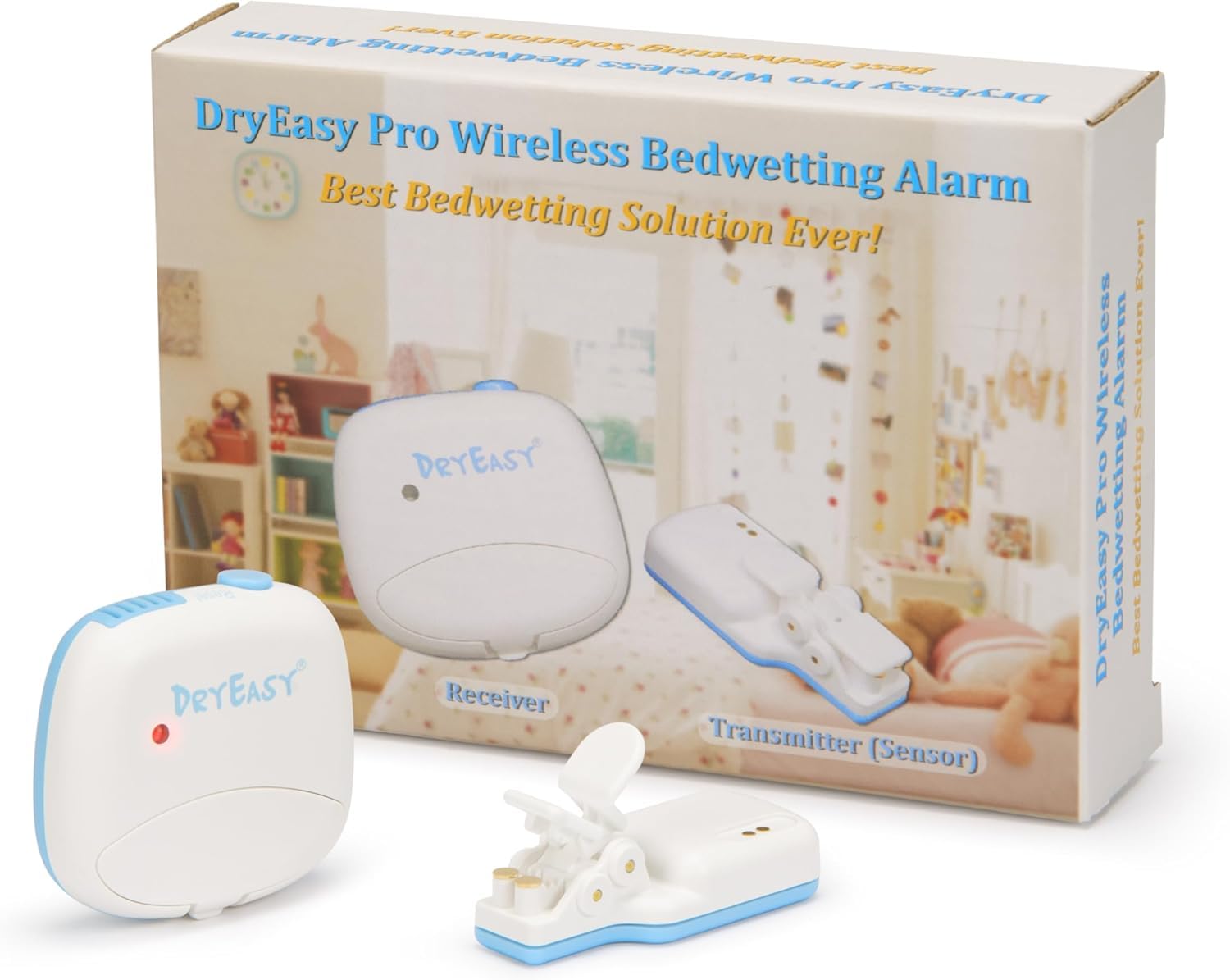
The DryEasy Pro positions itself as a wireless system that does not compromise on alert customization. It offers 6 different selectable sounds, 6 levels of digital volume control, and 3 operation modes — sound only, vibration only, or sound plus vibration. The random-play setting cycles through all 6 sounds unpredictably, which is a clever feature to prevent the child from becoming desensitized to a single alarm tone over weeks of use. The receiver can be placed on the bedside table or attached to the child’s arm, giving you flexibility in how the alert reaches the sleeper.
The transmitter uses a new toggle clamp that attaches securely to the child’s underpants and features an improved sensor that detects the first drops of urine. Parents of children with ADHD and autism report particularly strong results with this model: one review noted consistent dry nights after 10 days for an 11-year-old with special needs. The battery life is exceptional — lasting over a month on a single charge, according to multiple user reports. The wireless design means no cord running from the pajama top to the underpants, which improves comfort and reduces false alarms from cord pull.
The small, lightweight transmitter is easy to overlook during morning laundry — multiple parents report accidentally throwing it away or losing it in the bedding. The receiver is also compact, and its armband attachment can slip off during sleep if not secured tightly. The initial pairing between the transmitter and receiver is straightforward, but the toggle clamp, while secure, can be tricky for small fingers to operate during the nighttime waking routine.
Why it’s great
- 6 sounds with random-play mode prevents desensitization
- 6 levels of digital volume control for precise alert tuning
- Exceptional battery life — over a month per charge
- Wireless design eliminates cord-related false alarms
Good to know
- Small transmitter is easy to lose in laundry or bedding
- Toggle clamp can be difficult for small children to operate
- Armband attachment may slip off during active sleep
5. Zexyvor Wireless Bedwetting Alarm USB-C
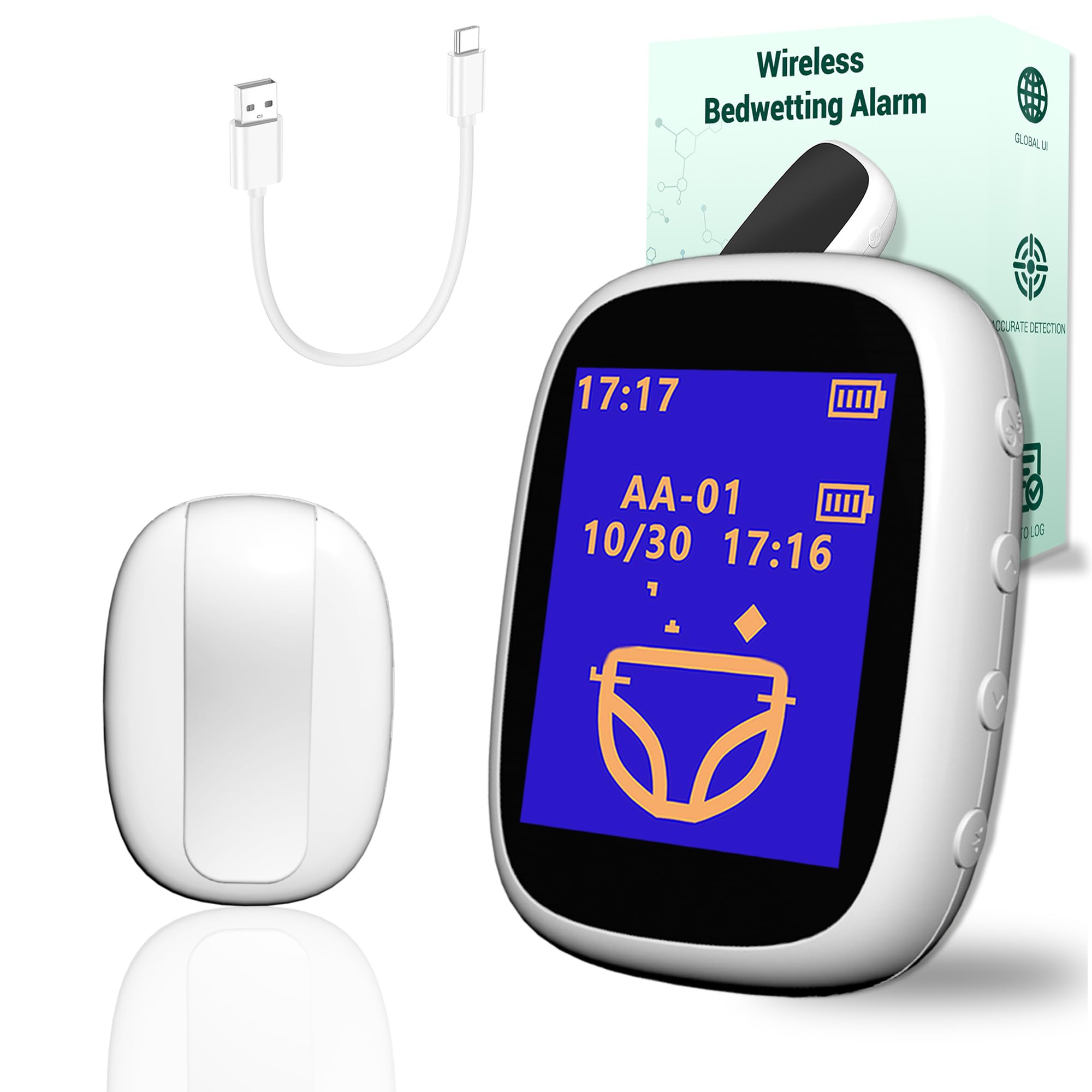
The Zexyvor alarm stands out for its multi-child compatibility and robust waterproofing. One receiver pairs with unlimited transmitters, meaning a single base unit can be used for two or more children in the same household — just add extra transmitters instead of buying separate complete systems. Each transmitter works independently, so the progress and alarm settings for one child do not interfere with the other. This alone can save a family significant expense if multiple children need training simultaneously.
The transmitter carries an IPX8 waterproof rating, meaning it can be submerged in 1 meter of water for 30 minutes without damage. This makes it safe to rinse directly under running water after each use, solving the hygiene issue that arises when a sensor is clipped to urine-soaked underwear. The detection speed is rated at 1 second, which is among the fastest in this category. The receiver features a bright backlit display for easy configuration in the dark, and the USB-C rechargeable battery lasts up to 14 full nights on a single 2-hour charge. The triple-alert system combines 3 alarm tones, strong vibration, and a flashing light — engineered specifically for deep sleepers and older children.
The sensor clip is made from a hard plastic rather than the soft silicone offered by premium brands. Some users note that the menu screen contains spelling errors, which may indicate lower overall build quality. The dual attachment — a clip plus a magnetic backup — is intended to keep the sensor secure, but some reviewers report that the clip is difficult to attach to thin pajama fabric. The receiver is larger than some competing models, which could be a factor if space on the bedside table is limited.
Why it’s great
- One receiver works with unlimited transmitters for multi-child use
- IPX8 waterproof transmitter is safe to rinse under running water
- 1-second rapid detection catches the first drop immediately
- 14-day battery life on a single 2-hour USB-C charge
Good to know
- Sensor is hard plastic, not medical-grade silicone as advertised
- Clip attachment can be difficult on thin or slippery pajama fabric
- Menu interface contains spelling errors in some units
6. Wet-Stop3 Kit with Waterproof Bed Pad

The Wet-Stop3 Kit bundles the same proven alarm unit from the standalone Wet-Stop 3 with a waterproof, washable, reusable mattress pad. This is a practical pairing because the alarm works best when the child sleeps on a protected mattress — the pad absorbs urine quickly, reducing the wet feeling that can disrupt sleep, and simplifies middle-of-the-night sheet changes. The alarm itself offers 6 varying alarm tones plus a vibration alert, and uses a two-step shut-off method (holding the button while drying the sensor) to prevent the child from accidentally turning it off and going back to sleep.
Parents of children aged 7 to 8 report success within 8 weeks, with many noting that the alarm is very loud and effective at waking deep sleepers. The included waterproof pad is made from a cotton/polyester blend that is machine washable and can be tumble dried on low heat. The kit also includes a reward chart and star stickers, plus a link to download “The Complete Bedwetting Book,” which provides a structured training protocol. The sensor clips to the underwear via a cord that connects to the alarm unit on the child’s collar or wrist.
The wired design means the cord can be a strangling risk for younger toddlers, and parents of very active sleepers report the clip detaching during the night. Some users also report false alarms triggered by sweat or static electricity when the sensor shifts against damp fabric. The mattress pad is functional but thin — it will protect the mattress from soak-through but does not add significant cushioning. The alarm unit runs on 2 AAA batteries, which are included with the kit.
Why it’s great
- Includes a waterproof, washable, reusable mattress pad
- 6 alarm tones plus vibration for adjustable wake-up power
- Two-step shut-off prevents accidental turning off
- Reward chart, stickers, and free bedwetting book download included
Good to know
- Wired cord design is a potential safety concern for toddlers
- Sensor can trigger false alarms from sweat or static
- Mattress pad is functional but offers minimal cushioning
7. Wet-Stop 3 Blue Bedwetting Alarm

The standalone Wet-Stop 3 is the budget entry point for the Wet-Stop family, offering the same alarm unit as the kit version but without the mattress pad. Despite its lower cost, it includes the same 6 varying alarm tones and vibration alert, the patented easy-clean sensor, and the two-step shut-off mechanism. The compact 1.5-inch by 0.5-inch by 2.5-inch alarm unit runs on 2 AAA batteries and is lightweight enough to clip to a collar without pulling on the child’s clothing. A link to download “The Complete Bedwetting Book” and a reward chart with star stickers are included.
Real-world results from parents show it works particularly well for children aged 4 to 6. One parent of a 5-year-old reported the first dry night after 10 days of use, with zero wet nights after a year. Another family trained two boys simultaneously — a 4-year-10-month-old and a 6-year-9-month-old — and achieved complete dryness in 2 months for the older child and occasional accidents for the younger. The alarm is loud, registering at 80 decibels, which is enough to wake the child but also potentially disturbing to siblings or parents in adjacent rooms.
The sensor cord runs from the underwear to the alarm unit, which is the most common complaint: the cord can be uncomfortable during sleep, and active children may have the clip detach from the underwear. False alarms from sweat are another recurring issue, though parents report this can be mitigated by wrapping the sensor in a paper towel before attaching. The alarm is very loud with no volume control, which some parents find traumatizing for especially sensitive children — one reviewer described it as “scaring the hell out of” their child and recommended using only the vibration mode.
Why it’s great
- Lowest entry cost for the proven Wet-Stop platform
- 6 alarm tones plus vibration to prevent habituation
- Two-step shut-off prevents accidental reset during waking
- Includes reward chart, stickers, and free book download
Good to know
- Wired sensor cord can be uncomfortable and prone to detachment
- No volume control — 80 dB alarm may be too loud for some children
- Sensor can produce false alarms from sweat without a paper towel wrap
FAQ
At what age is a bedwetting alarm appropriate for a child?
How long does it take for a bedwetting alarm to work?
Should I choose a wired or wireless bedwetting alarm for my child?
What is the two-step shut-off and why does it matter?
Can a bedwetting alarm work for children with special needs like autism or ADHD?
Final Thoughts: The Verdict
For most families, the bedwetting alarm for kids winner is the Malem Ultimate because its triple-alert system (sound, vibration, light) and clinically proven Quick-Detect sensor provide the highest success rate for deep sleepers within a reasonable training timeline. If you want a wireless design that eliminates cord tangles and works for multiple children simultaneously, grab the Zexyvor Wireless USB-C Alarm. And for a complete overnight system that includes a waterproof mattress pad and a structured training protocol at a mid-range price, nothing beats the Wet-Stop3 Kit with Bed Pad.

Mo Maruf
I created WellFizz to bridge the gap between vague wellness advice and actionable solutions. My mission is simple: to decode the research and give you practical tools you can actually use.
Beyond the data, I am a passionate traveler. I believe that stepping away from the screen to explore new environments is essential for mental clarity and physical vitality.