Our readers keep the lights on and my smoothie glass nicely filled. As an Amazon Associate, I earn from qualifying purchases.
Nothing ruins a sunrise hike like four hours of shivering on a lumpy, damp sleeping pad. The difference between a restorative night under the stars and a restless battle with cold spots and backaches comes down to one decision: the insulation system you trust to separate your body from the hard, unpredictable ground.
I’m Mohammad Maruf — the founder and writer behind WellFizz. I analyze camp bedding through the lens of thermal efficiency, material density, and ground-contact R-values so you don’t have to decode spec sheets in the dark.
Whether you car-camp with a thick foam pad, backpack with a folded closed-cell mat, or need a flannel-lined bag for cabin trips, this guide to the best bedding for campers breaks down seven real-world options built for different sleep styles and trip lengths.
How To Choose The Best Bedding For Campers
Camp bedding isn’t just a sleeping bag. It includes sleeping pads, cots, and the insulation between you and the ground. Your choice depends on your camping style — car camping, backpacking, or cabin use — and your personal sleep needs.
R-Value and Ground Insulation
R-value measures thermal resistance. For three-season camping, look for an R-value of 4 or higher. Winter camping demands 5.5 or above. A pad with low R-value will let the cold ground steal your body heat regardless of how thick your bag is. Many campers underestimate this spec and pay for it with a cold night.
Sleeping Bag Temperature Ratings
Manufacturers provide three numbers: comfort, limit, and extreme. The comfort rating is what most women need for a good sleep. The limit is the lowest temperature a standard man can manage without shivering. The extreme rating is survival only — you will not sleep. Always buy a bag rated 10–15 degrees lower than the coldest temperature you anticipate.
Foam vs. Air vs. Self-Inflating Pads
Closed-cell foam pads like the NEMO Switchback are lightweight, indestructible, and cheap but thin. Air pads offer plush comfort but risk punctures. Self-inflating pads combine foam core with air chambers for the best mix of cushion and insulation. Your choice between the three depends entirely on how much pack weight you are willing to carry versus how much comfort you need.
Quick Comparison
On smaller screens, swipe sideways to see the full table.
| Model | Category | Best For | Key Spec | Amazon |
|---|---|---|---|---|
| Therm-a-Rest MondoKing 3D | Self-Inflating Pad | Car camping luxury sleep | 4.25″ thick & 7.0 R-value | Amazon |
| Sportneer Camping Cot | Camping Cot | Elevated sleep off the ground | 330-pound weight capacity | Amazon |
| KingCamp Cold Weather Sleeping Bag | Flannel Sleeping Bag | Big & tall campers needing warmth | 5°F extreme rating | Amazon |
| CYMULA Memory Foam Camping Pad | Foam Topper Pad | Adding cushion on a cot or tent floor | 3 inches of memory foam | Amazon |
| NEMO Switchback Foam Pad | Closed-Cell Foam Pad | Lightweight backpacking | 2.0 R-value & 14 oz weight | Amazon |
| Coleman Brazos Sleeping Bag | Sleeping Bag | Reliable cool-weather camping | 30°F temperature limit | Amazon |
| Kanyak 32°F Sleeping Bag | Sleeping Bag | Budget family camping | 4.2 lbs & 86.6″ length | Amazon |
In‑Depth Reviews
1. Therm-a-Rest MondoKing 3D Self-Inflating Camping Sleeping Pad

The Therm-a-Rest MondoKing 3D redefines car camping sleep. At 4.25 inches thick with a 7.0 R-value, this pad eliminates ground cold entirely — even on frozen soil. The StrataCore construction uses a continuous layer of thermal foam between alternating ridges of air and foam, so you never hit the ground when fully inflated. The stretch knit fabric cover feels soft against skin and stays quiet when you shift positions, a major advantage over crinkly air pads.
The TwinLock valve system separates the inflation and deflation ports, making setup fast and tear-down even faster. The included pump sack lets you top off the self-inflating foam without blowing moisture into the core. Weighing 5.5 pounds and packing to 26 x 10.3 inches, this is strictly a car-camping or cabin-use pad — you won’t backpack with it. But for basecamp sleep quality, nothing else in this lineup rivals the combination of thickness, R-value, and stability.
Side sleepers with hip pain will appreciate the vertical sidewalls that maximize usable surface area at 80 x 30 inches. The XXL size accommodates tall and broad frames without hanging off the edge. A limited lifetime warranty backs the US-made construction, and the PFAS-free storage sack adds an eco-friendly touch.
Why it’s great
- 7.0 R-value insulates through extreme cold without additional pads
- Self-inflating foam core eliminates the need for manual inflation effort
- Thick 4.25 inches of cushion supports side sleepers and heavy users comfortably
Good to know
- Too heavy and bulky for backpacking more than a mile from the car
- Valve can fail on used units; buy new and test before a trip
2. Sportneer Camping Cot
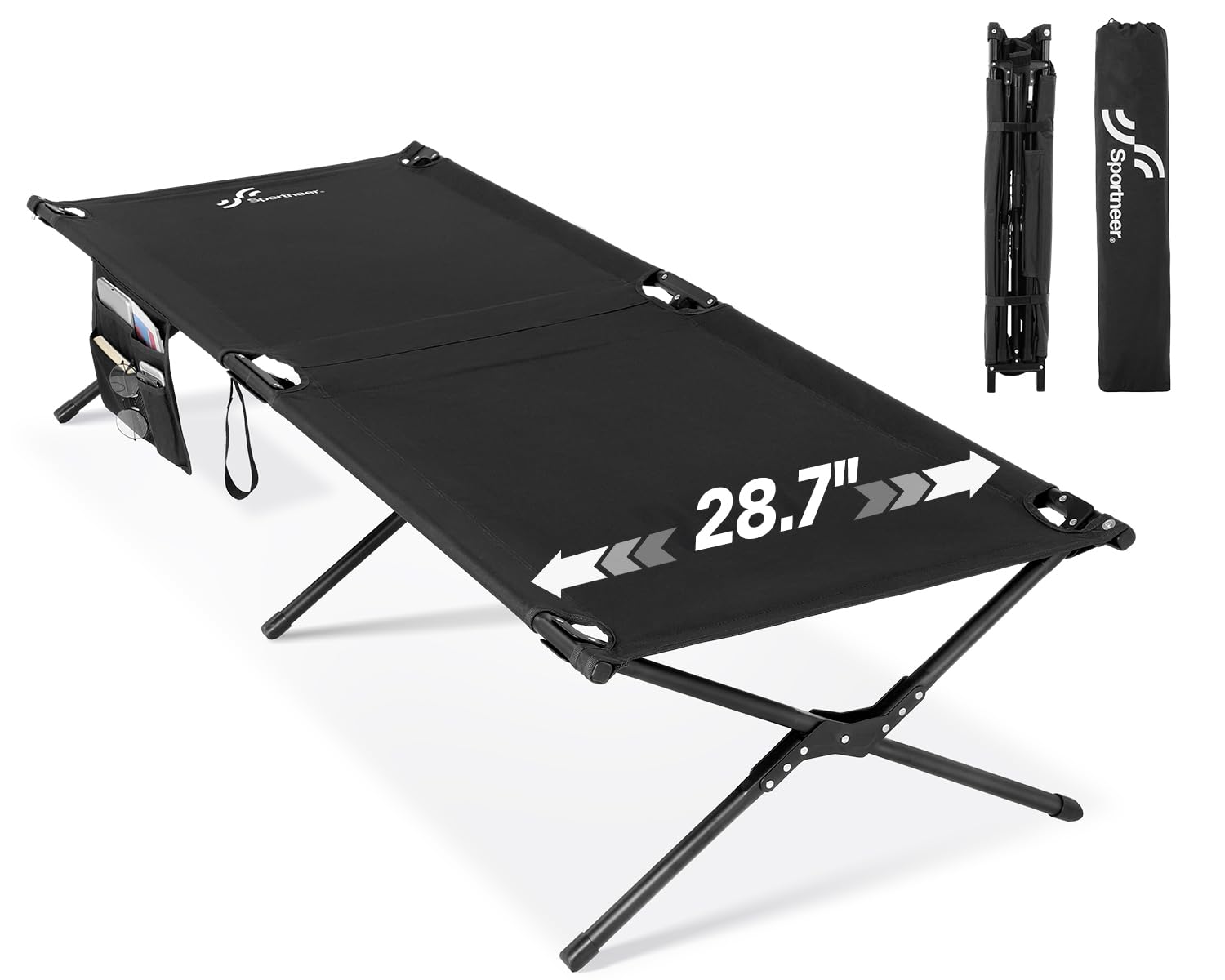
The Sportneer Camping Cot solves the biggest complaint about ground sleeping: rocks, roots, and uneven terrain. With a 15-inch rise off the ground, you avoid cold seeping through the tent floor and get a true bed-like height that makes getting in and out easy for older campers or those with mobility concerns. The unfolded dimensions of 78.3 x 28.7 inches fit most adults up to 6’2″ without feet hanging off the edge.
The X-shaped leg bracket and stainless steel brackets support up to 330 pounds with no wobble. Assembly takes under a minute — the frame snaps into place with a leg rotation lock that prevents accidental collapse. The included 3-in-1 storage bag attaches to the side of the cot, keeping your phone, glasses, and water bottle within reach during the night. The 600D Oxford cloth bed surface is taut and supportive, though some users find it too firm without additional padding.
Folded size is 40.2 x 7.9 inches, compact enough for most car trunks. At 13.8 pounds, it is not a backpacking item but excels for car camping, guest overflow, or lake-house bunks. Pair it with the CYMULA memory foam pad below for a combination that rivals a home mattress.
Why it’s great
- Elevated design avoids cold ground and uneven terrain entirely
- 30-second tool-free assembly with locking leg mechanism
- Wide enough for broad shoulders and side sleepers
Good to know
- Included sleeping mat is thin and low quality; plan to buy a separate topper
- Too heavy for backpacking — strictly for car or cabin use
3. KingCamp Sleeping Bag for Adults
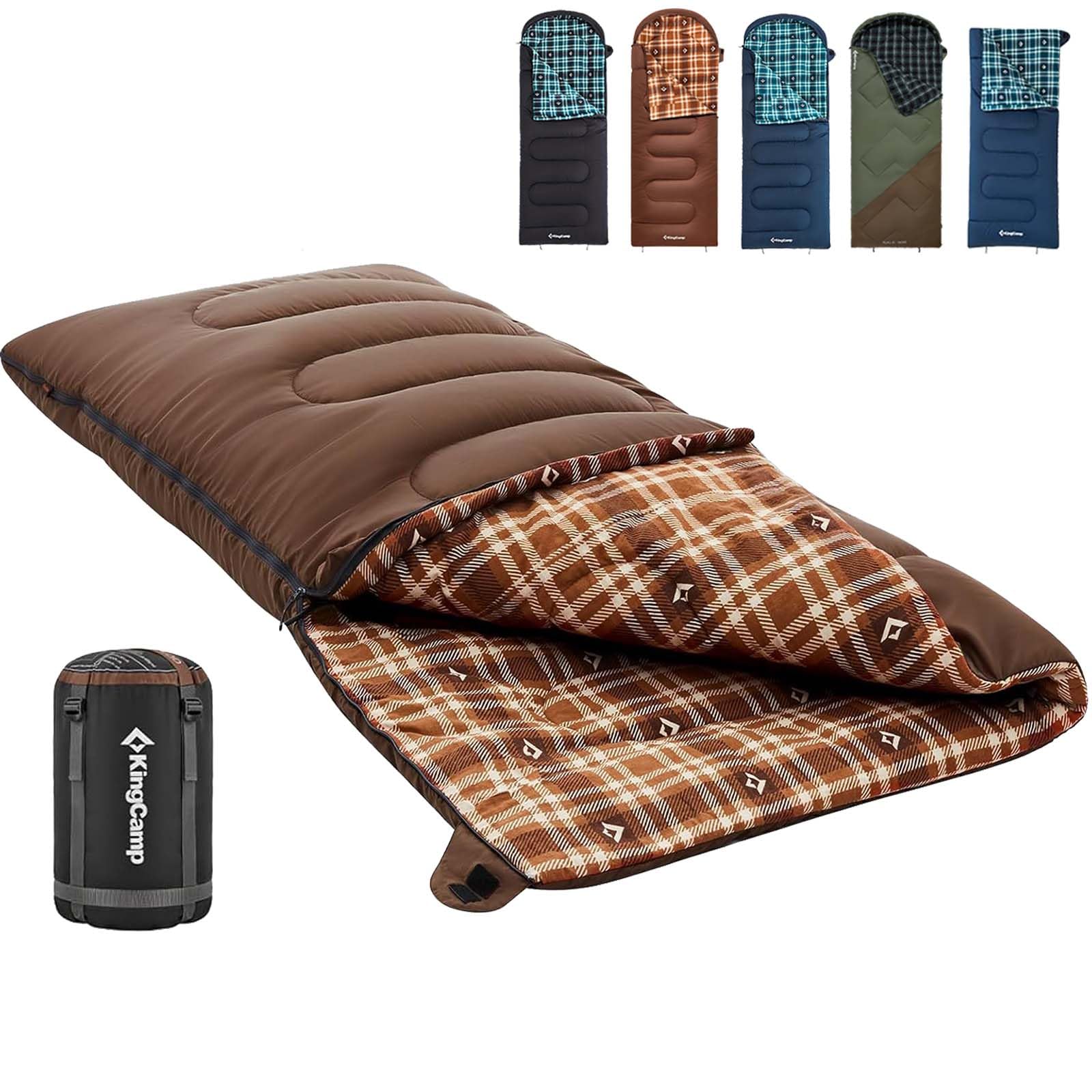
The KingCamp Sleeping Bag is purpose-built for larger campers who feel cramped in standard mummy bags. At 74.8 x 33.1 inches, it comfortably fits users up to 6’6″ with room to bend knees or roll to the side. The flannel lining feels like a soft sheet against the skin, a major upgrade from slippery polyester interiors that cause sleepers to slide around. The double-layer cotton hollow fiber insulation (400g/m²) delivers a comfort rating of 39°F, a limit of 32°F, and an extreme survival rating of 5°F.
The two-way zippers allow you to connect two KingCamp bags into a double-wide blanket for couples. The Velcro collar at the neck prevents the zipper from sliding open overnight, a small detail that makes a big difference in warmth retention. Unlike many budget bags, this one is machine washable without the insulation clumping — the internal baffles keep the fill evenly distributed through multiple wash cycles.
Packed size is 17.3 x 9.8 inches at 5.1 pounds, making it suitable for car camping or cabin use. The compression sack helps reduce bulk, but the bag is not compact enough for backpacking. The trade-off for the plush flannel and spacious interior is a heavier pack weight and a longer rolling process — expect about 20 minutes to get it back into the stuff sack.
Why it’s great
- Generous 33-inch width accommodates broad shoulders and restless sleepers
- Flannel lining is soft, quiet, and breathable for year-round comfort
- Machine washable without insulation shifting or bunching
Good to know
- Heavy and bulky for backpacking; optimized for car or cabin camping
- Difficult to repack into the compression sack; allow extra time
4. CYMULA 3 Inch Memory Foam Camping Pad
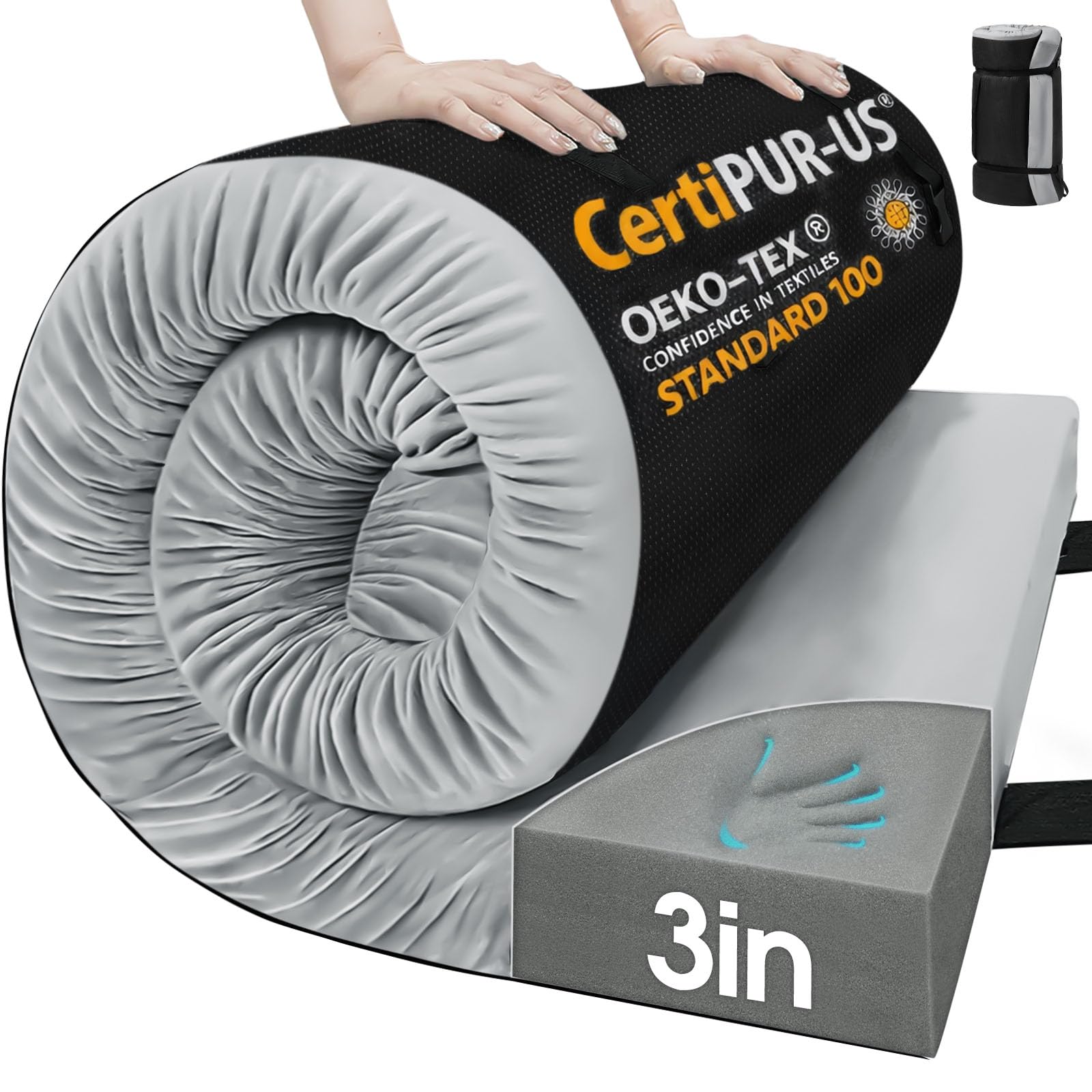
The CYMULA Memory Foam Camping Pad brings home-bed comfort to the campsite without the cost of premium self-inflating pads. Constructed with a carbon-fiber high-elasticity memory foam layer bonded to a high-density base foam, this pad measures 72 x 24 x 3 inches when fully laid out. The dual-layer construction provides pressure relief for hips and shoulders while the denser base prevents you from bottoming out on rough ground or cot webbing.
The removable cover is machine washable, a critical feature for camp bedding that accumulates dirt, sweat, and campfire smell. The waterproof bottom with rubberized anti-slip dots keeps the pad from sliding on tent floors or cot surfaces, even when you shift weight during the night. At 6.4 pounds, it rolls up with integrated straps into a manageable cylinder that fits in most car trunks, though it is too large for backpacking.
Multiple users report that this pad transformed their cot setup from tolerable to genuinely comfortable. On a wooden cabin platform or tent floor, the 3-inch thickness provides enough insulation to block cold ground. The main drawback is the initial strong odor from the vacuum-sealed foam, which requires a day to air out before first use. The included straps are functional but some users replace them with tension straps for a tighter roll.
Why it’s great
- Thick memory foam layer relieves pressure points for side sleepers
- Waterproof base prevents moisture wicking from damp ground
- Removable, machine-washable cover keeps gear fresh between trips
Good to know
- Bulky when rolled; not suitable for backpacking or small tents
- Strong initial chemical odor requires airing out before use
5. NEMO Equipment Switchback Foam Sleeping Pad
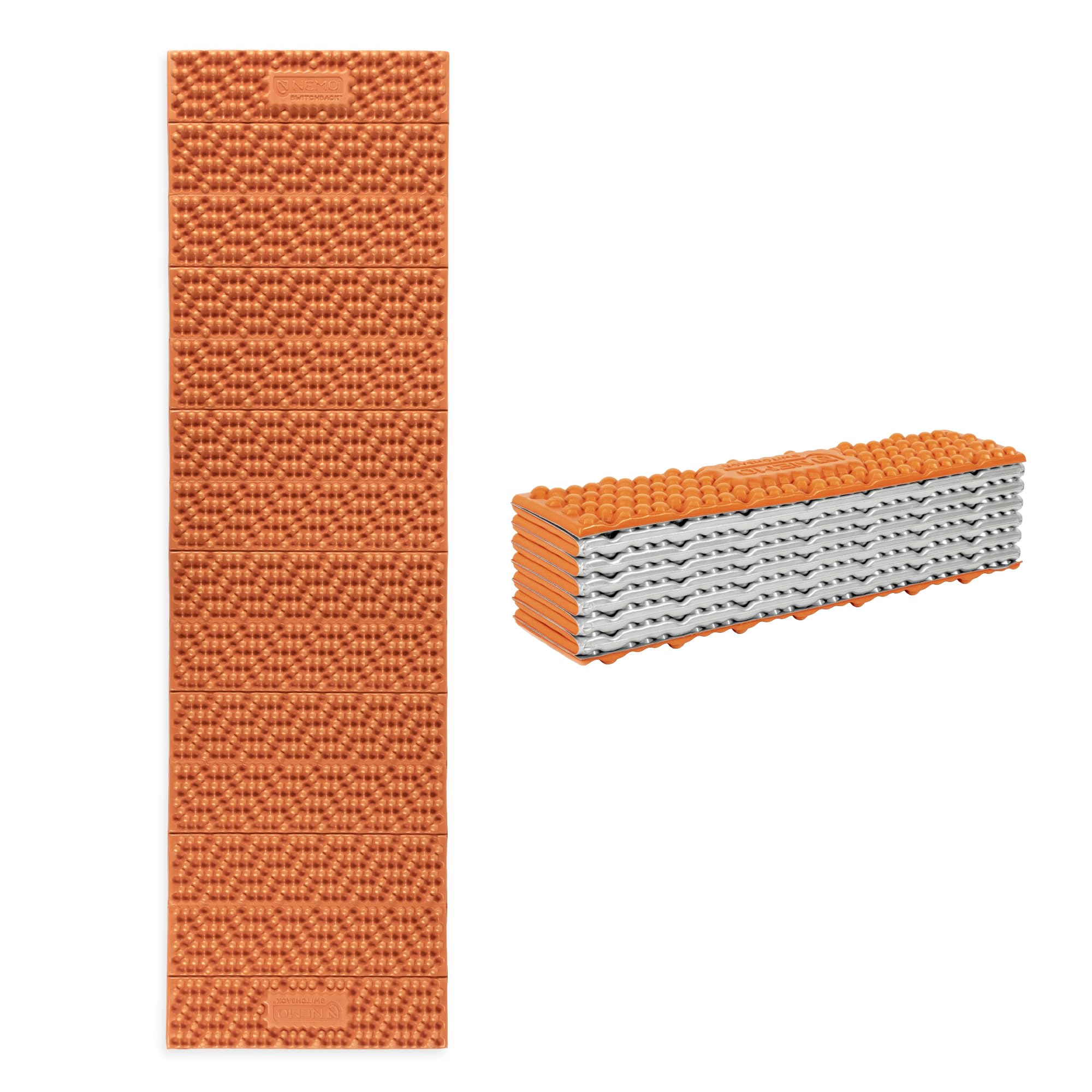
The NEMO Switchback is the definitive closed-cell foam pad for weight-conscious backpackers. Weighing just 14 ounces, it folds into a compact 20 x 5 x 5.5 inch package that straps easily to the outside of a backpack. The hexagonal nesting pattern creates taller, wider nodes that provide significantly more plushness than traditional egg-crate foam pads. The premium dual-density Axiotomic foam combines a supple top layer for comfort with a resilient bottom layer for structural support.
A metallized thermal reflective film is bonded to the foam surface, reflecting body heat back toward you and raising the effective warmth. The R-value of 2.0 is modest — this is a three-season pad for summer and mild fall use, not for sleeping on snow. The trade-off is bulletproof durability: unlike air pads, this foam cannot puncture, leak, or fail. You can sit on it, kneel on it, or use it as a camp seat without worrying about damage.
Many users cut the Switchback down to a torso-length pad to save additional weight and use the offcut as a sit pad or dog bed. Pair it with an inflatable pad in winter for an R-value boost. The foam does not compress small like an air pad, so it takes up external pack space, but the weight savings and reliability make it the go-to for hikers who prioritize function over luxury.
Why it’s great
- Ultralight at 14 ounces — ideal for long-distance backpacking
- Indestructible closed-cell foam with no risk of punctures or leaks
- Reflective film adds usable warmth without added weight
Good to know
- Thin and firm compared to air or memory foam pads
- R-value of 2.0 is insufficient for cold-weather camping below freezing
6. Coleman Brazos 20/30°F Adult Cool-Weather Sleeping Bag

The Coleman Brazos continues the brand’s reputation for reliable, no-fuss sleeping bags at a fair price point. Rated with a comfort temperature near 30°F, this bag uses Fiberlock construction to prevent insulation from shifting into cold spots during the night. The Thermolock draft tube runs the full length of the zipper, blocking heat escape through the zipper track — a common failure point on cheaper bags.
The no-snag zipper design is a practical improvement over older Coleman models: the zipper track is recessed so fabric never catches in the slider. Two bags can zip together to create a double-wide sleeping area for couples. The polyester fill and shell are machine washable, though the 5.2-pound weight and 75 x 33-inch dimensions mean it takes up significant space in the trunk. The stuff sack includes fastener straps that lock the bag in place as you roll, reducing the frustration of compressing the bag.
The interior fabric is soft but not plush — some users find the lining less cozy than flannel options. At 30°F the bag keeps you warm; at 20°F it becomes chilly even with thermal layers. Below 20°F, you will need a heated pad or a liner. The roll-up process remains tricky even with the fastener system, and the bag is too short for campers over 5’11”.
Why it’s great
- Thermolock draft tube eliminates heat loss along the zipper line
- No-snag zipper glides smoothly and does not catch fabric
- Durable Fiberlock construction prevents insulation from shifting
Good to know
- Lining fabric feels less soft than flannel or brushed interiors
- Short for taller campers — maximum recommended height is 5’11”
7. Kanyak 32℉ Sleeping Bag for Adults

The Kanyak sleeping bag offers a generous 86.6-inch length and 32.48-inch width, making it one of the most spacious entries in this list. Tall campers over six feet will appreciate the extra legroom that standard bags lack. The polyester pongee lining is soft against the skin and the 210T anti-tearing polyester shell resists snags from tent poles and zipper tracks.
The temperature ratings are clearly defined: comfort at 41°F, limit at 32°F, and extreme survival at 23°F. These numbers are honest for a budget bag — you will stay warm in typical spring and fall conditions but should not push this bag into freezing temperatures without extra layers. The separate zipper at the foot allows you to vent heat on warmer nights, a feature usually found on more expensive bags. The side zippers also let you connect two bags of the same color into a double bag for couples.
At 4.2 pounds with a compressed size of 11 to 14.2 inches, this bag packs smaller than many competitors in the same price tier. The three-zipper system includes a high-quality main zipper that does not snag on the draft tube. Some users report the bag is warm enough for indoor work travel or couch surfing, not just camping. The main limitation is the polyester fill, which cannot match the warmth-to-weight ratio of synthetic hollow-fiber or down bags in colder conditions.
Why it’s great
- Extra-long 86.6-inch length fits tall campers comfortably
- Separate foot zipper allows temperature regulation on mild nights
- Packs down smaller than comparable budget sleeping bags
Good to know
- Polyester fill lacks the warmth retention of hollow-fiber insulation
- Extreme rating of 23°F is survival only — not for comfortable sleep
FAQ
Can I use a regular mattress pad instead of a camping pad?
How do I clean a sleeping bag after a camping trip?
What does the Thermolock draft tube do in a sleeping bag?
Final Thoughts: The Verdict
For most users, the best bedding for campers winner is the Therm-a-Rest MondoKing 3D because it combines a 7.0 R-value with 4.25 inches of self-inflating foam — the closest thing to a home mattress you can pack in a car. If you want to get off the ground entirely, grab the Sportneer Camping Cot and top it with the CYMULA memory foam pad. And for lightweight backpacking, nothing beats the NEMO Switchback for reliability and weight savings.

Mo Maruf
I created WellFizz to bridge the gap between vague wellness advice and actionable solutions. My mission is simple: to decode the research and give you practical tools you can actually use.
Beyond the data, I am a passionate traveler. I believe that stepping away from the screen to explore new environments is essential for mental clarity and physical vitality.