Our readers keep the lights on and my smoothie glass nicely filled. As an Amazon Associate, I earn from qualifying purchases.
Losing your balance when getting out of bed—or rolling too close to the edge during the night—is a constant risk for anyone recovering from surgery, managing a chronic condition, or simply dealing with mobility limitations. The right bed rail transforms that risk into reliable, everyday stability.
I’m Mohammad Maruf — the founder and writer behind WellFizz. I’ve spent years analyzing the hardware specifications and real-world safety data on mobility aids like hospital-grade grab bars, adjustable bed canes, and floor-standing rails to identify which designs actually deliver on their stability promises.
Whether you are supporting an elderly parent or recovering from a hip replacement, finding a secure, non-skid grab bar that fits your specific mattress height and bed frame is critical. This guide breaks down the key specs, materials, and real-user performance data you need to find the safest bed rails for adults.
How To Choose The Best Bed Rails For Adults
Choosing the wrong bed rail can create a false sense of safety—or worse, a tripping hazard. The three decisions that matter most are the support leg configuration, the weight capacity relative to the user’s body weight, and the adjustability range for your specific bed height. A rail that is too short offers no leverage; one with an unstable base tilts under pressure.
Floor-Standing Legs vs. Mattress-Tucked Designs
A rail that rests its weight entirely on the floor via dedicated legs is the gold standard for stability. Models that tuck entirely under the mattress rely on mattress compression and a single strap—if the mattress shifts, the rail shifts. Floor-standing legs with anti-wobble feet transfer load directly to the ground, eliminating the tipping risk that causes most bed rail injuries.
Adjustability Range and Ergonomic Handle Curvature
Look for a handle height adjustment range of at least 5 inches (typically 15–21 inches above the mattress) and a base length that extends 18–27 inches under the bed. A 30-degree angled handle reduces wrist strain during the push-up motion far better than a flat or 90-degree bar. Non-slip foam wrapping on the handle prevents hand slippage when the user has limited grip strength.
Weight Capacity and ASTM Safety Certification
Rails rated for 350–400 lbs use reinforced steel crossbars that resist bending under heavy leaning. ASTM F3186-17 certification means the rail has passed U.S. safety standards for static load, tip-over resistance, and entrapment gaps. A 250-lb rail may suffice for a lighter individual, but the frame itself will feel less rigid under lateral force.
Quick Comparison
On smaller screens, swipe sideways to see the full table.
| Model | Category | Best For | Key Spec | Amazon |
|---|---|---|---|---|
| KingPavonini GS04 | Floor-Standing | Maximum stability & high weight capacity | 400 lbs cap / 11 leg heights (10–20.4″) | Amazon |
| Sunisife HC033 | Extended Base | Fall prevention + side barrier coverage | 350 lbs / base extends to 29″ | Amazon |
| ONTHEWEI 417(2.0) | Dual-Handle | Two-handed push-up assistance | 300 lbs / base 20.5″ x 12.2″ | Amazon |
| NIMOOD C5 Pro | Foldable Premium | Fold-down access + motion-activated light | 350 lbs / foldable with LED light | Amazon |
| Panta FH-ZLK-BK | ASTM Certified | Mid-range value with safety certification | 350 lbs / flat tube anti-deformation design | Amazon |
| LandTale EBR001 | Compact Rail | Compact footprint & lightweight install | 250 lbs / three-direction adjustability | Amazon |
| KAAMOS KA-002 | Portable Cane | Multi-surface use (bed, sofa, chair, toilet) | Lightweight aluminum / 34.5–40.5″ height | Amazon |
In‑Depth Reviews
1. KingPavonini GS04
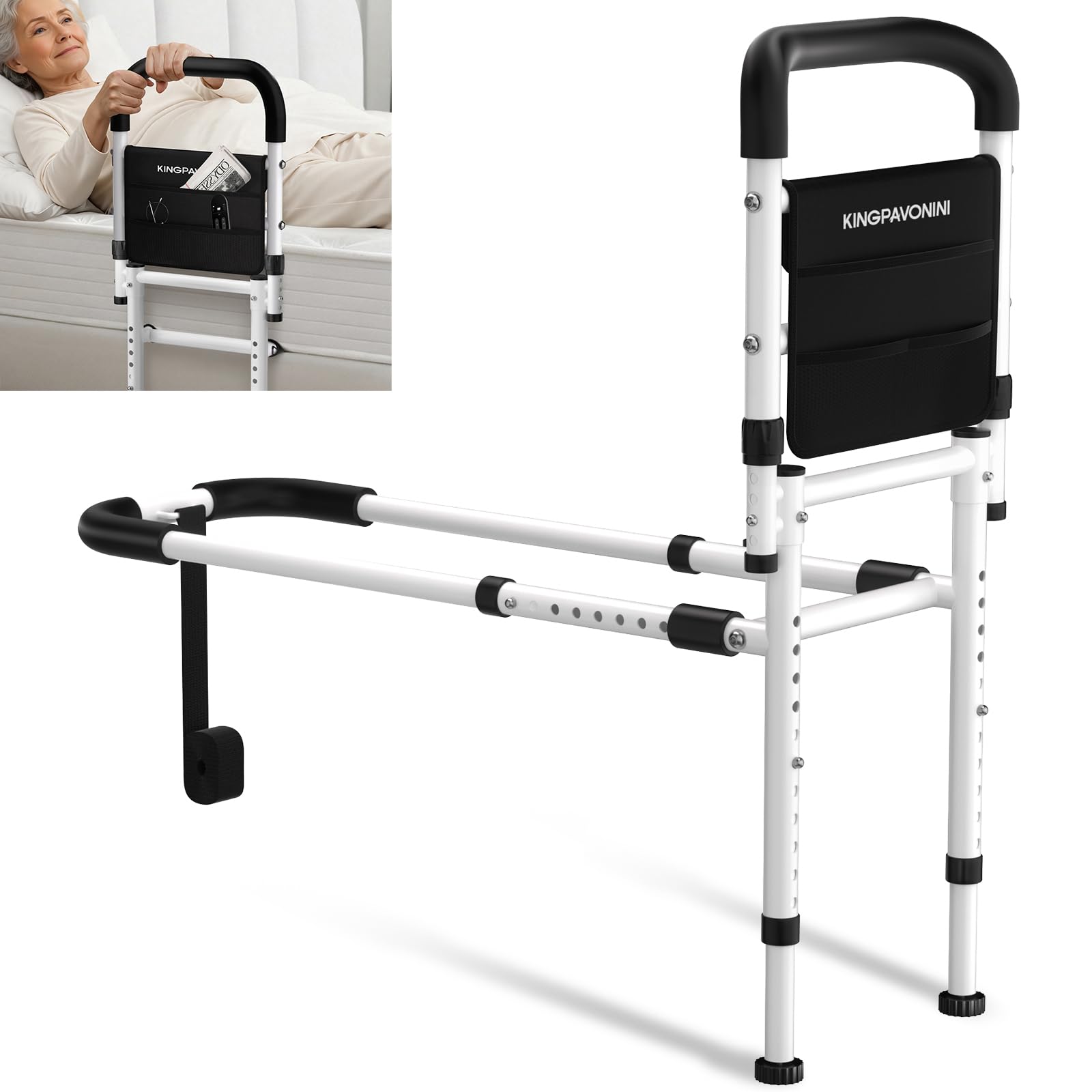
The KingPavonini GS04 earned our top spot because it solves the two biggest failure points of budget bed rails: wobble and limited adjustability. Reinforced dual crossbars and an extra safety belt deliver a rated 400-lb capacity with no frame bending, and the 30-degree ergonomic handle is angled specifically to reduce wrist pressure during the push-up motion. Real users with MS and post-abdominal surgery consistently report that the floor-leg design eliminated the tipping sensation they experienced with previous models.
This rail offers industry-leading adjustability: 4 handle heights (15.5–21.1″), 11 leg heights (10–20.4″), and 8 base lengths (18.8–26.7″). That range fits everything from a low-profile platform bed to a thick pillow-top mattress on a King frame. The anti-wobble feet thread into the base to fine-tune leveling on uneven floors, which is a feature typically found only on premium hospital-grade hardware.
Assembly requires no tools and takes roughly 10 minutes—users note that lifting the mattress to slide the base under may require a second person on heavier beds. The detachable storage bag keeps remotes and glasses within reach, and the stainless steel frame resists corrosion. Note that it is not suitable for adjustable beds with moving frames.
Why it’s great
- Highest weight capacity in this roundup at 400 lbs
- Extreme adjustability (handle, leg, and base length all independently configurable)
- Threaded anti-wobble feet stabilize on uneven floors
- ASTM F3186-17 certified for U.S. safety standards
Good to know
- Not compatible with adjustable/articulating bed frames
- Lifting the mattress to install the base can be awkward solo
- Medium size may feel narrow for very wide mattresses
2. Sunisife HC033

The Sunisife HC033 differentiates itself by extending its base length to 29 inches—significantly longer than the typical 18–22 inches. This extra reach under the mattress provides better leverage against tipping when a user leans laterally to get out of bed. The L-shaped steel frame supports up to 350 lbs and comes with multiple non-slip EVA gaskets that grip the mattress underside to prevent lateral shifting.
Handle height adjusts from 16.9–20.8″, and the 196.8-inch safety strap wraps around the entire bed frame for models without a solid base. Multiple real-user reviewers specifically mention that the rail prevented rolling out of bed during sleep, which is a distinct use case compared to purely sit-to-stand rails. The storage pouch is reversible, and users report the rail stays secure even when the mattress is rotated.
Installation is tool-free, though the long base requires sliding it fully under a lifted mattress. It fits mattresses 11.5–15.5″ thick—a tighter spec range than the KingPavonini, so measure your mattress depth before ordering. The black powder-coated finish hides scuffs well.
Why it’s great
- Extended 29-inch base provides exceptional anti-tip leverage
- Safety strap long enough to secure to almost any bed frame
- EVA gaskets prevent the rail from shifting laterally
- Reversible storage pouch for phone and glasses
Good to know
- Mattress thickness range is narrower (11.5–15.5″)
- Long base can be cumbersome to position on smaller beds
- No floor-leveling feet for uneven surfaces
3. ONTHEWEI 417(2.0)
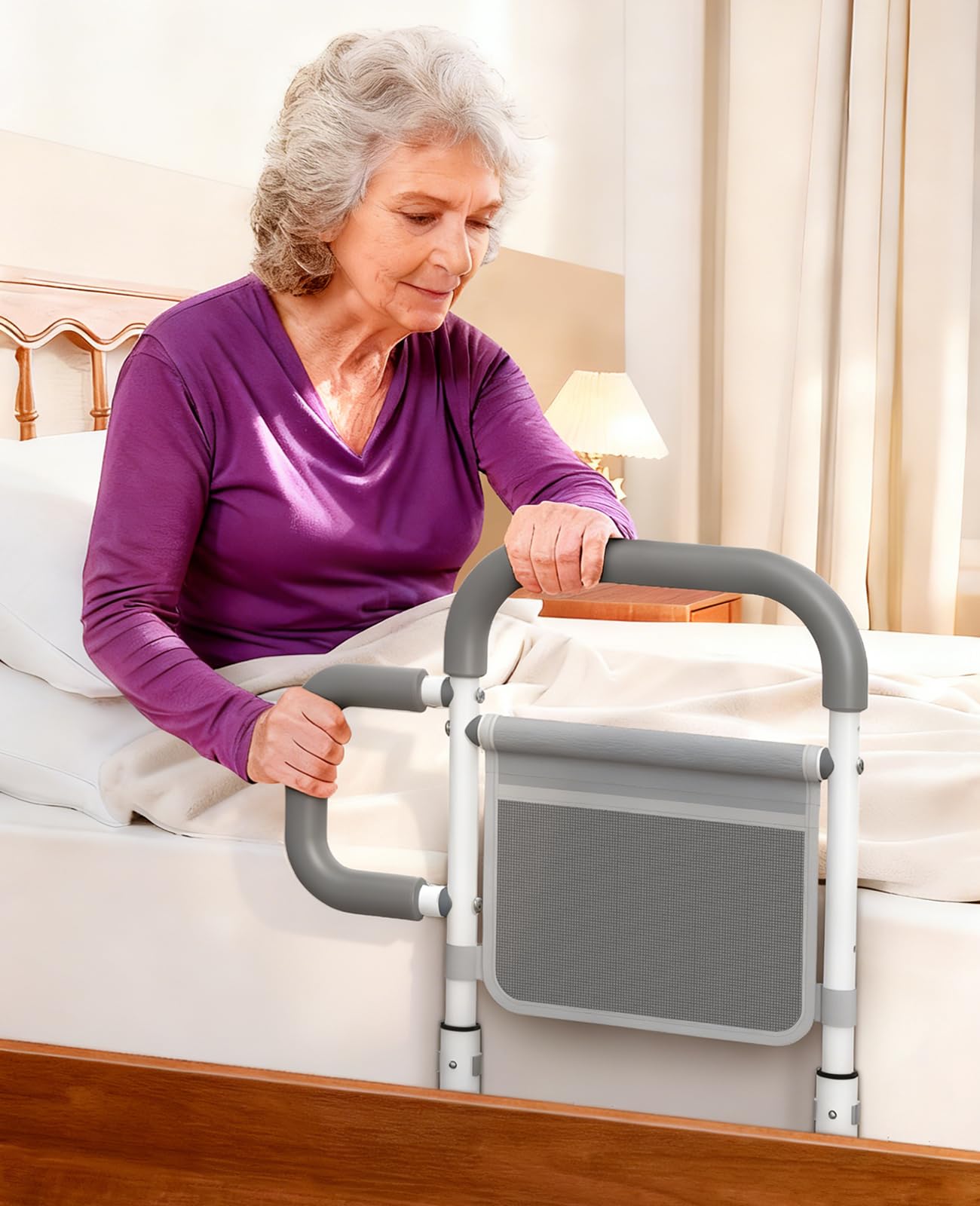
The ONTHEWEI 417(2.0) is built around a dual-handle concept: one ergonomic grip at the top for pulling yourself upright and an extended side handle that provides a lower second grip point for the final push to standing. This two-point support system distributes body weight more evenly than a single handle rail, making it especially useful for users with weak upper body strength recovering from knee or hip surgery.
Carbonized steel construction and an enlarged base (20.5″ x 12.2″) give the frame a very stable feel—users describe it as “heavy, not flimsy.” The L-shape design positions the rail close to the mattress edge to minimize the reach gap, and the included adjustable strap secures the rail to any box spring, slat, or platform base. The storage pouch is stitched into the side frame, so it stays attached even when you move the rail.
Installation is tool-free and takes roughly 5 minutes. A few users on adjustable bed frames noted the rail did not fit because the base interferes with the articulation mechanism—confirm your frame type before purchase. The 300-lb rating is slightly lower than the top two picks, but the dual-handle geometry compensates by allowing the user to push with both arms simultaneously.
Why it’s great
- Dual-handle system allows two-arm push-up for better leverage
- Extra-wide base (20.5″ x 12.2″) resists lateral shifting
- Carbonized steel frame feels dense and solid
- Very quick tool-free assembly in under 5 minutes
Good to know
- Not compatible with adjustable/articulating bed frames
- 300-lb capacity is lower than floor-standing competitors
- Pouch is not removable for washing
4. NIMOOD C5 Pro
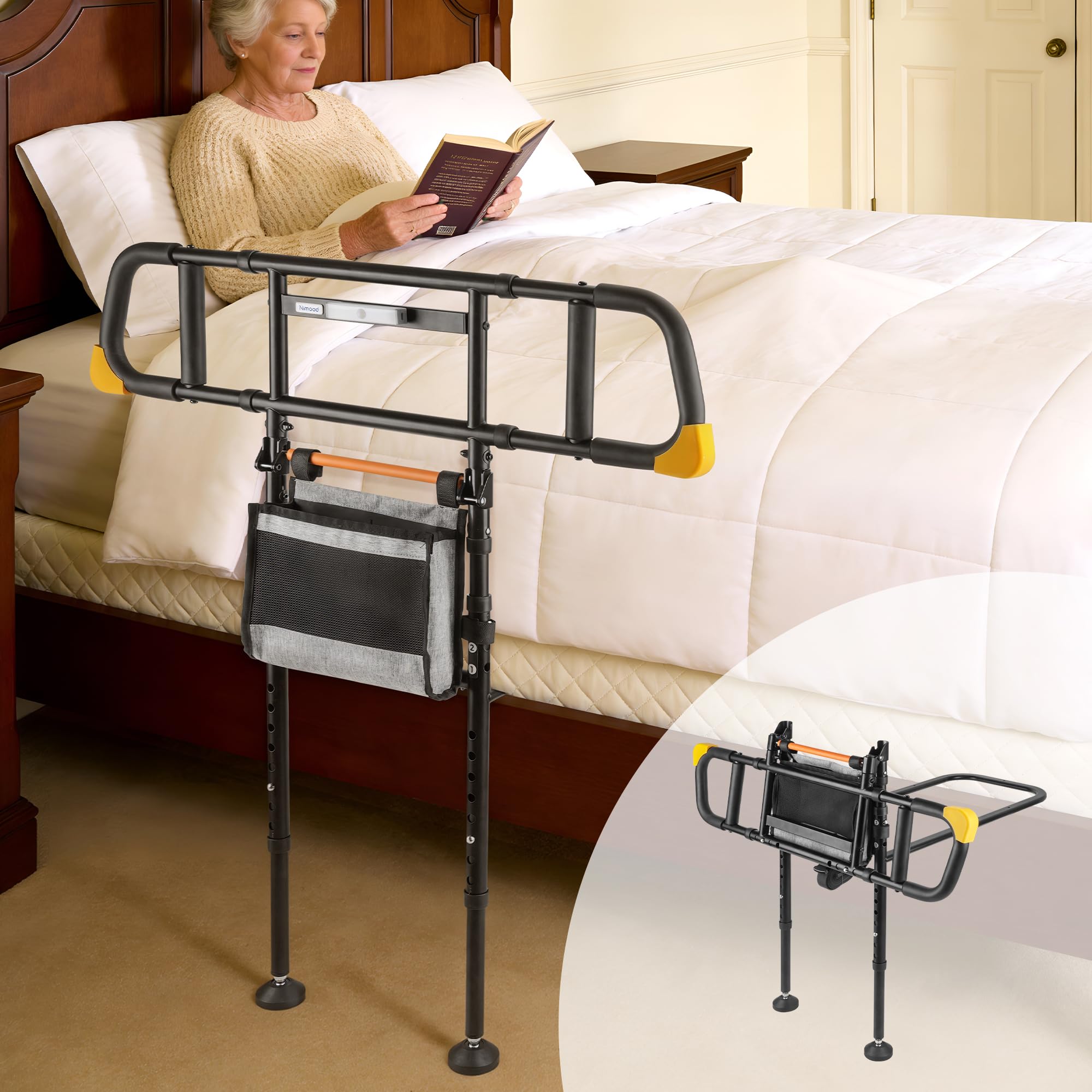
The NIMOOD C5 Pro is the only foldable bed rail on this list, and that folding capability solves a real bedside problem: clearance. When the rail is not needed during daytime caregiving or bed-making, you pull the orange release bar and the entire rail folds flat against the bed frame—no tools, no disassembly. The reinforced steel frame still supports 350 lbs, and the dual floor legs with adjustable feet keep the rail planted during use.
A 360-degree rotating LED light with motion activation is integrated into the frame. It detaches for handheld use, which is a genuinely helpful feature for nighttime bathroom trips—the user can grab the rail, pull the light, and move without fumbling for a wall switch. The side storage bag keeps essentials within arm’s reach, and the T-shape design provides a wide grip area for both hands.
The C5 Pro fits standard mattresses between 8–13 inches thick—a narrower range than many competitors, so it will not work with thick pillow-top mattresses or adjustable bed frames. The fold-down mechanism is simple but adds some weight (the metal parts are thicker than a basic rail), and the price reflects the added engineering. For users who need daytime bedside clearance, this is the only real option.
Why it’s great
- Fold-down design creates full bedside access during the day
- Detachable motion-activated LED light for nighttime safety
- Floor legs with adjustable feet for uneven surfaces
- 350-lb capacity with reinforced steel frame
Good to know
- Only fits 8–13″ mattresses—check thickness
- Not compatible with adjustable or platform beds with raised edges
- Premium foldable design carries a higher price
5. Panta FH-ZLK-BK
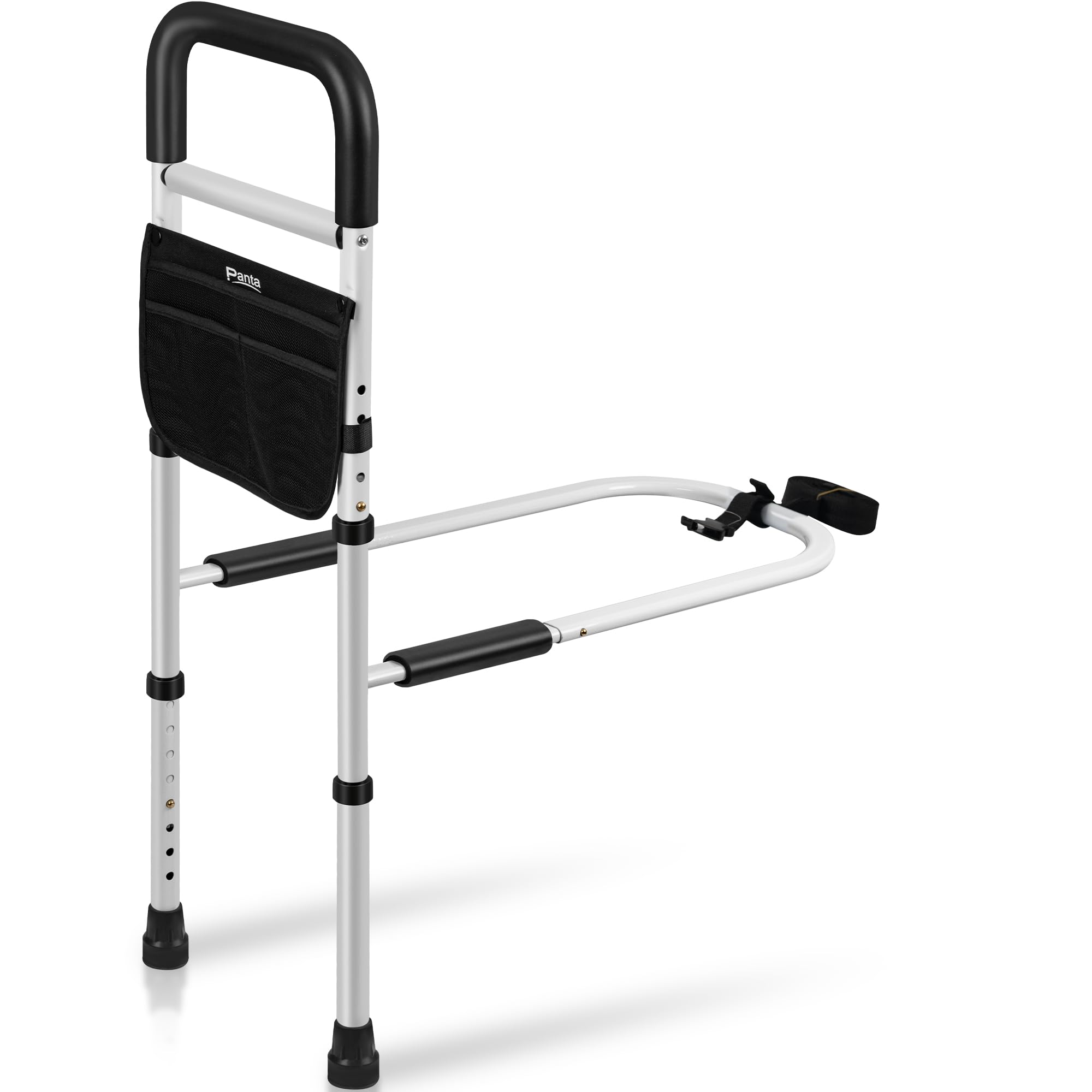
The Panta FH-ZLK-BK hits the sweet spot between price and safety certification. It passes ASTM F3186-17 standards—the same U.S. safety benchmark that governs entrapment gaps, static load, and tip-over resistance—at a price point well below the premium tier. The flat tube under-mattress design prevents the rail from deforming the mattress foam, which is a common complaint with round-bar rails that create pressure points.
Handle height adjusts from 17–21 inches, and the support leg height ranges from 12.6–19.69 inches, which covers most standard bed frame heights. The non-slip foam wrapping on the handle is dense and contours well to the palm. The included safety strap loops around the bed frame, and the removable storage bag clips on and off without tools.
Assembly takes about 10 minutes with clear instructions—no special skills required. The black modern finish hides dust and scuffs, and the rail weighs about 6 lbs, making it easy to reposition if you move it between rooms. Users with dementia, post-surgery recovery, and general elderly weakness all report feeling secure when using this rail. The main trade-off is that the floor-leg height adjustment uses push-button pins rather than threaded feet, offering less precision on very uneven floors.
Why it’s great
- ASTM F3186-17 certified for entrapment and tip-over safety
- Flat tube design prevents mattress deformation
- Dense non-slip foam handle contours to the palm
- Tool-free assembly in under 10 minutes
Good to know
- Push-button leg adjustment is less precise than threaded feet
- Mattress may lift slightly if the base is too tight
- Storage bag clips can detach if bumped
6. LandTale EBR001

The LandTale EBR001 is the most compact rail in this roundup—its footprint is smaller than the competition, which makes it ideal for tight bedside spaces or narrow twin beds in assisted living rooms. The iron frame supports 250 lbs, and the three-direction adjustability (handle height, leg height, and landing bar length) allows a decent fit range for most standard bed heights between 12–19 inches (floor to frame).
Real-user feedback consistently highlights how easy this rail is to install: one reviewer noted that their elderly mother assembled and installed it herself in about 10 minutes without help. The padded non-slip foam handle is comfortable for both pulling and pushing, and the white finish blends into most bedroom decor without looking clinical. The middle crossbar was added in a design upgrade specifically to increase lateral stiffness.
At 8 pounds, the LandTale is heavier than it looks due to the iron construction, but that weight contributes to a planted feel. The main limitation is the 250-lb capacity—users above that threshold may feel the frame flex under heavy leaning. It also lacks the storage pouch found on almost every other model here, so you will need a separate bedside organizer for your phone and glasses.
Why it’s great
- Compact footprint fits narrow twin beds and tight spaces
- Iron frame provides a solid, planted feel despite the smaller size
- Very simple assembly suitable for elderly users to do solo
- Three-direction adjustability covers most standard bed heights
Good to know
- 250-lb capacity may feel flexed under heavy leaning
- No storage pouch for phone, glasses, or remotes
- Requires mattress depth > 5 inches to function correctly
7. KAAMOS KA-002

The KAAMOS KA-002 is fundamentally different from the other products here—it is a portable stand-assist cane, not a fixed bed rail. Made from lightweight aluminum (3.75 lbs), it has a U-shaped wide base and a Y-shaped support leg that distributes pressure, and it adjusts from 34.5–40.5 inches in height across 8 settings. Its primary strength is portability: you can move it between the bed, sofa, recliner, and even the toilet, making it a versatile mobility aid for someone who needs support in multiple rooms.
The three foam-covered handles at different heights let the user choose the most comfortable grip position, and the rubber base covers protect flooring. For post-surgery users who struggle with sit-to-stand transitions on chairs and couches, this is a far more practical solution than a dedicated bed rail. Multiple reviewers confirmed it helped them stand after hip and knee replacements.
However, the lightweight design draws a trade-off in stability. Several users reported that the cane feels “not totally stable” under heavy leaning—the aluminum frame is not as rigid as a steel bed rail, and the Y-shaped base can rock slightly on carpet. It is best used as a balance assist for standing rather than as a primary device for pulling yourself up from a lying position. Assembly requires tools (included) and is more complex than a bed rail.
Why it’s great
- Lightweight (3.75 lbs) and portable for use at bed, sofa, or toilet
- Three foam handles at different heights for ergonomic grip choice
- Rubber base protectors prevent floor damage
- 8-level height adjustment from 34.5–40.5″
Good to know
- Less stable than steel bed rails under heavy leaning
- Assembly is more complex and requires tools
- Not designed for pulling up from a lying position—balance assist only
- Y-shaped base can rock slightly on thick carpet
FAQ
Will a bed rail work on an adjustable bed frame?
How do I measure my mattress and frame for the right rail fit?
What does ASTM F3186-17 certification mean for a bed rail?
Final Thoughts: The Verdict
For most users, the bed rails for adults winner is the KingPavonini GS04 because its floor-standing legs, 400-lb capacity, and 11-level leg adjustment deliver the most stable and customizable support in this roundup. If you want a fold-down design with a built-in motion-activated light, grab the NIMOOD C5 Pro. And for a versatile, portable stand-assist that moves between bed, sofa, and chair, nothing beats the KAAMOS KA-002.

Mo Maruf
I created WellFizz to bridge the gap between vague wellness advice and actionable solutions. My mission is simple: to decode the research and give you practical tools you can actually use.
Beyond the data, I am a passionate traveler. I believe that stepping away from the screen to explore new environments is essential for mental clarity and physical vitality.