Our readers keep the lights on and my smoothie glass nicely filled. As an Amazon Associate, I earn from qualifying purchases.
Maintaining a steady 225°F for a twelve-hour brisket cook usually means waking up every hour to check the pit gauge and adjust the intake vent. A dedicated temperature controller automates that entire workflow by linking a variable-speed fan or robotic damper to a digital thermometer, turning an unpredictable charcoal fire into a set-and-forget heat source.
I’m Mohammad Maruf — the founder and writer behind WellFizz. My research focuses on comparing the signal reliability, probe accuracy, and fan efficiency of modern BBQ controllers so you can skip the trial-and-error phase.
After evaluating seven different models across wired, Bluetooth, and WiFi categories, this guide breaks down the real-world performance data for the best bbq temperature controller to match your specific grill setup and cooking style.
How To Choose The Best BBQ Temperature Controller
Picking the right controller comes down to three factors: your grill type, the fan system it uses, and how you want to monitor the cook. A ceramic Kamado owner needs a different solution than someone running a Weber Kettle offset, and a dedicated weekend smoker cares about probe longevity more than a twice-a-year burger cook.
Fan-Based vs. Robotic Damper Systems
Most controllers use a variable-speed fan that pushes air into the charcoal bed to raise the temperature. This works great on steel drum smokers and Weber Smokey Mountains where airflow pathways are straightforward. Ceramic Kamado grills, however, often overheat with forced air because their sealed design traps heat too efficiently. Robotic damper controllers like the SMOBOT physically open and close the top vent, mimicking what your hand does, which prevents temperature overshoot and reduces ash buildup.
Connectivity and Probe Accuracy
Bluetooth-only controllers limit your range to about thirty feet, while WiFi models let you check pit temps from a grocery store parking lot. Sub-1 GHz wireless, found in the Typhur Sync Gold series, punches through thick ceramic walls more reliably than standard 2.4 GHz WiFi. Probe accuracy matters at the margins — ±0.5°F versus ±0.9°F makes little difference for pulled pork but matters for a medium-rare tri-tip where carryover cooking adds another five degrees.
Probe Quantity and Build Quality
A two-probe setup covers pit temp and one piece of meat. Four probes let you track two different meats plus ambient temperature, which is essential for brisket-and-ribs combo cooks. Food-grade stainless steel probes with IPX8 waterproofing survive dishwasher cleaning and repeated high-heat exposure, while cheaper probes often drift after a dozen uses and report readings that are off by twenty degrees.
Quick Comparison
On smaller screens, swipe sideways to see the full table.
| Model | Category | Best For | Key Spec | Amazon |
|---|---|---|---|---|
| Inkbird 027BW-4 | Mid-Range | Kamado & Ceramic Grills | 4 Food Probes, 5.0 m/s Fan | Amazon |
| Pitmaster IQ IQ110 | Mid-Range | Weber Kettle & WSM | 12V DC, Fits <5″ Damper | Amazon |
| Typhur Sync Gold (2-Probe) | Premium | Kamado & Pellet Grills | Sub-1 GHz, ±0.5°F, 932°F Max | Amazon |
| Typhur Sync Gold (4-Probe) | Premium | Multi-Protein Cooks | 6 Sensors Per Probe, IPX8 Waterproof | Amazon |
| Flame Boss 400 | Premium | Offset & Drum Smokers | Integrated WiFi, Variable Speed | Amazon |
| Spider Grills Venom | Premium | Weber Kettle (22″) | Built-in Fan, 150°–550°F Range | Amazon |
| SMOBOT WiFi | Premium | Kamado Daisy Wheel | Robotic Damper, No Forced Air | Amazon |
In‑Depth Reviews
1. Inkbird 027BW-4
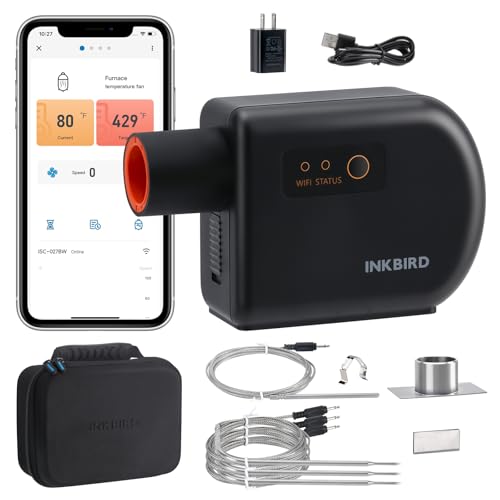
The Inkbird 027BW-4 balances four food-grade probes with a 5.0 m/s fan and dual connectivity at a price that undercuts most premium rivals. The grill lid detector automatically pauses the fan when you open the cook chamber, which prevents temperature spikes during basting or wrapping. USB power input means you can run the whole setup from a battery bank during tailgates or camping trips — no AC outlet required.
Each probe delivers ±0.9°F accuracy with a ±12°F calibration offset you can dial in through the app. The WiFi radio operates on 2.4 GHz and maintains a stable connection through a closed Kamado lid, though some users reported connection drops when the router sat more than fifty feet away. The app interface supports multiple controllers on one phone, which is helpful if you run two grills simultaneously.
Several long-term reviewers noted probe drift after heavy use, with one user reporting replacement costs rivaling a new probe pack. The included carrying case keeps the fan, adapters, and cables organized, which matters for anyone who transports their setup between home and a competition site. For most home pitmasters, this controller delivers the best price-to-performance ratio on the market.
Why it’s great
- Four probes allow pit temp plus three meat zones.
- Lid detection prevents fan runaway during opening.
- USB power works with any portable battery bank.
Good to know
- Probe longevity varies; some fail after several cooks.
- App layout differs between firmware versions.
2. Pitmaster IQ IQ110
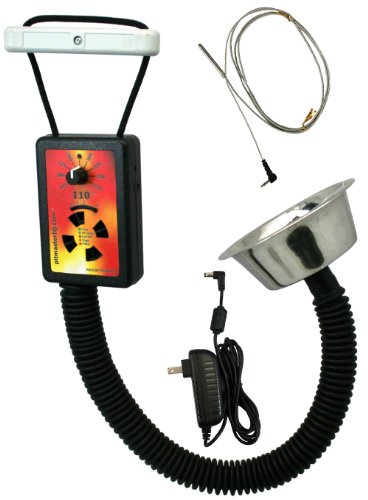
The IQ110 is the simplest reliable controller in this roundup — no WiFi, no app, no Bluetooth pairing. It uses a wired digital display connected to a fan box that plugs into a standard AC outlet or an optional 12V cigarette lighter adapter. Alton Brown featured this unit on Good Eats, calling it the smartest way to hold a Weber Kettle at 225°F for eight hours on a single load of charcoal.
The included standard pit adapter fits any cooker with a fire vent damper smaller than five inches in diameter, which covers Weber Smokey Mountains, Char-Broil offsets, and Brinkmann verticals. Temperature stability falls within ±10°F of the setpoint, and the Minion method with Kingsford briquets extends burn time past ten hours before refueling. The lack of food probes means you still need a separate meat thermometer for internal doneness.
Because the system runs on wired AC power, you cannot monitor the cook from inside your house without running an extension cord. The probe is delicate — several users reported error codes when the pit temperature exceeded 500°F, and replacement probes must be ordered directly from Pitmaster IQ rather than through Amazon.
Why it’s great
- Rock-solid ±10°F stability without any wireless complexity.
- Fits nearly every charcoal cooker with a sub-5″ damper.
- Set-and-forget operation for overnight brisket cooks.
Good to know
- No meat probes included; requires separate thermometer.
- Probe fails above 500°F and replacements are hard to source.
3. Typhur Sync Gold (2-Probe)

The Typhur Sync Gold series uses Sub-1 GHz wireless technology, which delivers roughly ten times the signal penetration of standard Bluetooth. In real-world testing, the connection remained rock-solid through a closed Kamado Joe lid and a brick wall roughly twenty-five feet away — something that Bluetooth-only probes routinely fail at. Each probe houses five internal sensors plus one ambient tip sensor, feeding data into an algorithm that predicts finish time based on current temperature rise rate.
The standalone base unit displays real-time readings and target temperatures without requiring a smartphone, though the companion app adds graphing and remote monitoring via WiFi. The probes are rated to withstand 932°F at the handle and 221°F at the tip, with IPX8 waterproofing that allows dishwasher cleaning. Response time clocks in at 0.5 seconds, which is fast enough to catch the moment a steak passes through the carryover zone.
Two probes limit you to one meat temperature and one pit temperature simultaneously. Inserting the probe to the marked three-inch line is mandatory — going shallower overheats the tip sensor and produces erratic readings. The app interface feels less polished than ThermoWorks’ offering, with some users finding the graph navigation clunky. For the serious home cook who values wireless range above raw probe count, this is the most reliable monitor available.
Why it’s great
- Sub-1 GHz signal penetrates Kamado walls and Dutch ovens easily.
- ±0.5°F accuracy beats most competing wireless probes.
- Base station works independently of the smartphone app.
Good to know
- Only two probes — insufficient for brisket-plus-ribs cooks.
- App navigation needs refinement for multi-session graphing.
4. Typhur Sync Gold (4-Probe)
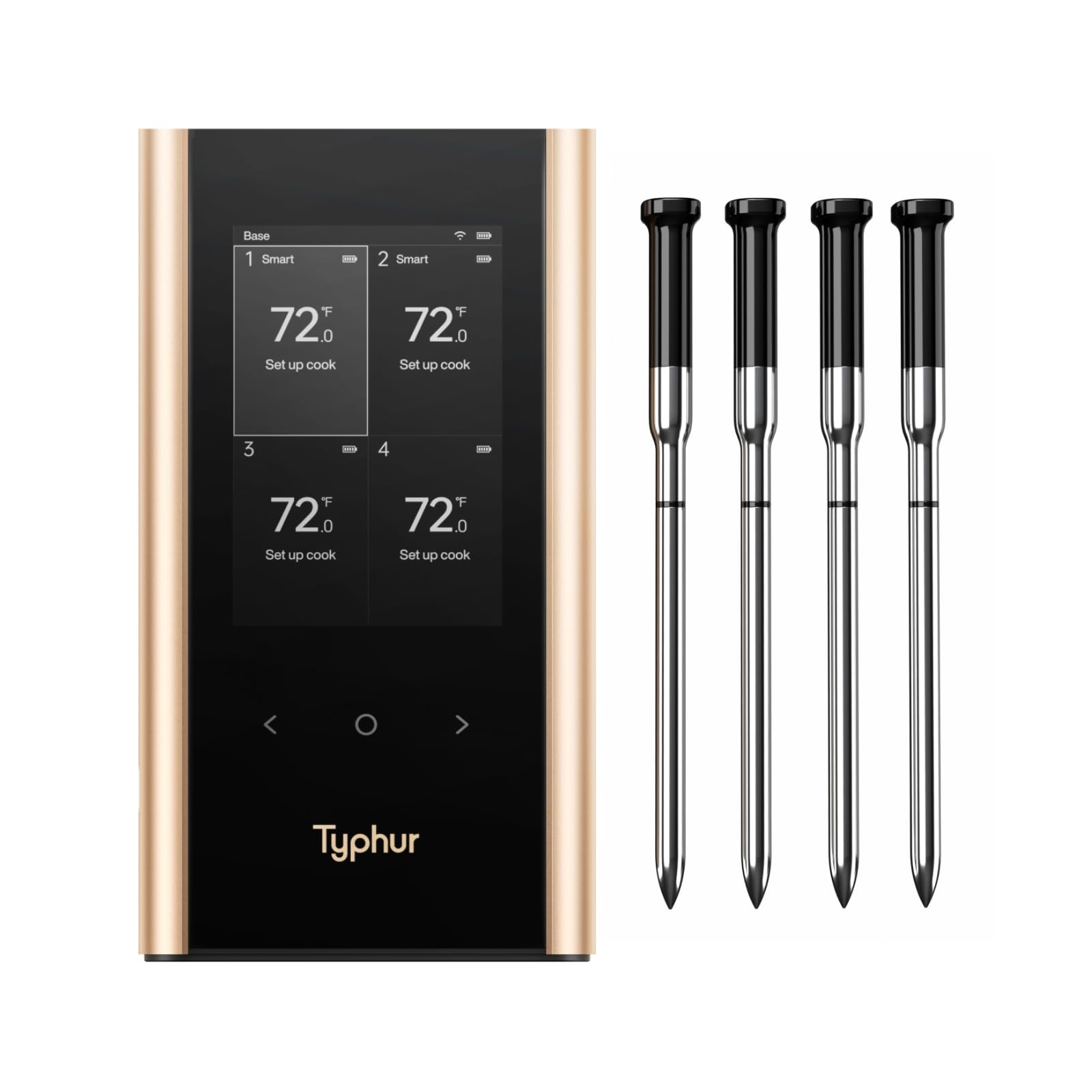
This four-probe variant of the Typhur Sync Gold essentially doubles the monitoring capacity of the two-probe model while keeping the same Sub-1 GHz radio and ±0.5°F accuracy. Numbered probes let you track ambient grate temperature, one brisket flat, one brisket point, and a rack of ribs simultaneously — all from a single base station. The IPX8 waterproof rating means you can submerge the probes completely during cleanup without worrying about sensor failure.
The companion app supports customizable alarms for each probe, and the smart algorithm estimates cook completion with surprising accuracy, adjusting the predicted time as the cook progresses. Multi-point readings per probe (five internal sensors plus one ambient tip) provide granular data that helps identify hot spots inside the cook chamber. Professional mode reveals additional insights like temperature differential across the probe length, which matters for assessing carryover cooking potential.
Four probes at this price bracket compete directly with dedicated WiFi thermometer kits that lack the Sub-1 GHz radio advantage. The base unit does not have an auto-shutoff feature, which means it drains the C batteries if you forget to power it down after the cook. Cleaning smoke residue off the gold coating requires a soft cloth rather than abrasive pads. For weekend competition cooks or families that serve multiple proteins, this premium setup justifies the investment through probe longevity and connection reliability.
Why it’s great
- Four probes cover pit temp plus three separate meat zones.
- Sub-1 GHz range works through thick ceramic and steel.
- Probes survive dishwasher cleaning without accuracy drift.
Good to know
- Base unit lacks auto shutoff — batteries drain if left on.
- Gold coating shows smoke residue and requires gentle cleaning.
5. Flame Boss 400

The Flame Boss 400 integrates the WiFi radio directly into the blower unit, eliminating the external bridge module that some competitors require. The patented variable-speed fan adjusts its RPM based on the difference between current pit temperature and your setpoint, which prevents the overshoot-and-correct cycle that plagues simpler on/off fan designs. Users report holding 225°F within ±3°F for ten continuous hours on a Weber Smokey Mountain 18.5-inch.
The app provides pinch-to-zoom temperature graphing, text message alerts when the meat stall begins, and an automatic pit-temperature adjustment feature that lowers the fan speed when the meat probe hits a target temperature — perfect for finishing brisket without burning the bark. Voice assistant compatibility through Alexa or Google Home allows hands-free temperature checks while your hands are covered in rub and fat. The two included probes cover pit temperature and one meat zone.
This controller explicitly does not fit ceramic or Kamado-style smokers — the fan design assumes a steel or drum body with standard airflow patterns. The initial setup instructions are sparse, and most users rely on YouTube walkthroughs to configure the WiFi hotspot placement. The fan failed after roughly two years of heavy use for one reviewer, though the replacement unit is still running strong. For offset, drum, and WSM owners who want full remote control and data logging, the Flame Boss 400 is the industry benchmark.
Why it’s great
- Variable-speed fan maintains ±3°F for marathon cooks.
- Integrated WiFi eliminates separate bridge modules.
- Voice assistant support for hands-free temperature checks.
Good to know
- Does not fit Big Green Egg or Kamado-style grills.
- Fan unit may fail after extended use; keep warranty info.
6. Spider Grills Venom

The Spider Grills Venom clips directly onto a Weber 22-inch Kettle’s one-touch cleaning system, replacing the bottom damper plate with an integrated fan housing. This design eliminates the need for drilling holes or using adapter plates — installation takes under sixty seconds with no tools required. The temperature range spans from 150°F for cold-smoking cheese up to 550°F for searing steaks, making it equally useful for low-and-slow and high-heat cooks.
The built-in fan actively regulates airflow based on the real-time pit temperature, and the Spider Grills app allows remote setpoint adjustment from anywhere with an internet connection. A lid-pause feature automatically stops the fan when the kettle lid opens, then resumes once closed, preventing temperature spikes during food flipping or basting. For 26-inch kettles, conversion clips are sold separately and must be purchased at the same time to avoid shipping delays.
Several users reported ±15–20°F temperature swings during high-temperature grilling sessions, particularly when using fire bricks for indirect cooking. The power cord is only four feet long, which limits placement near an outdoor outlet unless you add an extension. The fan produces noticeable noise at higher speeds — audible from roughly ten feet away — which some users find distracting during backyard gatherings. For Weber Kettle owners who want a permanent, no-drill temperature control solution, the Venom delivers convenience with minor temperature stability trade-offs.
Why it’s great
- Tool-free installation clips directly onto Weber Kettle dampers.
- Covers 150°F cold smoke through 550°F sear temperatures.
- Lid-pause feature prevents heat spikes during open-lid work.
Good to know
- ±15–20°F swings at high heat with indirect cooking setups.
- Power cord is only four feet; fan is loud at top speeds.
7. SMOBOT WiFi

The SMOBOT is the only temperature controller in this roundup that uses a robotic damper instead of a fan. It physically opens and closes the top daisy wheel on a Kamado grill, mimicking the precise vent adjustments a pitmaster makes by hand. This approach avoids the forced-air roller coaster that fan-based controllers create in ceramic cookers, where excess oxygen causes runaway temperatures and produces sooty smoke.
The unit includes a pit thermocouple probe that clips to the grate with an alligator clamp, plus two food probes for monitoring multiple meats. The mySMOBOT web interface lets you monitor the cook and change the setpoint from any device with a browser — no dedicated app required. Power comes from a USB battery pack, which makes it completely portable and safe from outdoor power outlet limitations. The cloud-based logging records every temperature fluctuation for later analysis.
Set-up instructions initially omit the crucial step of plugging the robot arm cable into the controller board, which caused a two-hour frustration delay for several first-time users. The thermocouple probes may need replacement after a year of heavy use, though the main unit itself has a track record of five years of reliable service in outdoor environments. If you own a ceramic Kamado and have struggled with fan-type controllers that overshoot your setpoint by thirty degrees, the SMOBOT’s natural airflow approach is the most effective solution available.
Why it’s great
- Robotic damper prevents overshoot and soot in Kamado grills.
- USB battery powered for full portability without AC outlets.
- Web interface works on any device without installing an app.
Good to know
- Initial setup requires a hidden cable connection step.
- Thermocouple probes may need yearly replacement under heavy use.
FAQ
Can a fan-based controller work on a ceramic Kamado grill?
What is the difference between a 2.4 GHz controller and a Sub-1 GHz controller?
How many probes do I really need for a typical barbecue session?
Will a temperature controller work with a gas or pellet grill?
How do I clean probes without damaging them?
Final Thoughts: The Verdict
For most users, the best bbq temperature controller winner is the Inkbird 027BW-4 because it combines four probes, dual WiFi/Bluetooth connectivity, and a powerful 5.0 m/s fan at a price that undercuts premium models while still delivering Kamado-compatible lid detection. If you want zero-compromise wireless range and professional-grade probe accuracy, grab the Typhur Sync Gold 4-Probe. And for ceramic Kamado owners who have struggled with fan-based controllers, nothing beats the SMOBOT WiFi’s robotic damper for natural, soot-free temperature regulation.

Mo Maruf
I created WellFizz to bridge the gap between vague wellness advice and actionable solutions. My mission is simple: to decode the research and give you practical tools you can actually use.
Beyond the data, I am a passionate traveler. I believe that stepping away from the screen to explore new environments is essential for mental clarity and physical vitality.