Our readers keep the lights on and my smoothie glass nicely filled. As an Amazon Associate, I earn from qualifying purchases.
Every junk drawer holds a graveyard of mystery batteries—some dead, some full of life. Without a reliable tester, you toss perfectly good cells and hoard dead ones, wasting money and creating unnecessary waste.
I’m Mohammad Maruf — the founder and writer behind WellFizz. I’ve spent years analyzing the hardware specs of home diagnostic tools, separating the accurate voltage testers from the gimmicks that just light up.
After digging through the specs and real user experiences, I’ve narrowed down the market to the most reliable models. Here is my complete guide to finding the best battery tester for aa and aaa batteries that will end the guessing game for good.
How To Choose The Best Battery Tester For AA And AAA Batteries
The difference between a worthless plastic indicator and a genuinely useful diagnostic tool comes down to three specific factors. Here’s what actually matters when you’re shopping for a battery tester.
Load Testing vs. No-Load Voltage
A simple voltmeter that reads open-circuit voltage will tell you a cell has 1.5V even when it’s completely dead under load. A quality tester applies a fixed resistance—typically around 4 to 5.5 ohms for AA/AAA cells—to simulate real-world drain. This load test reveals the battery’s true usable capacity. For high-drain devices like digital cameras, a battery reading “good” on an unloaded tester might still fail in actual use. Look for testers that explicitly apply a load.
Display and Readability
Analog gauges with color-coded “Good/Low/Replace” zones are simple and never need batteries, but they lack precision and can be hard to read in dim light. LCD digital displays offer exact voltage readouts and clearer condition indicators, but many budget models suffer from narrow viewing angles and dim backlighting. If you test batteries in a workshop or basement with poor lighting, prioritize a tester with a crisp, wide-angle LCD or an analog meter with bold markings.
Compatibility Beyond AA and AAA
While AA and AAA are the most common household cells, a truly useful tester handles C, D, 9V, and button cells (CR2032, LR44, CR123A). Some testers also accommodate rechargeable Ni-MH cells at 1.2V, which behave differently than alkaline cells. If you own a multimeter, you might skip a single-purpose tester—but for quick, no-thinking-needed checks, a dedicated battery tester with broad compatibility is far more convenient for the average household.
Quick Comparison
On smaller screens, swipe sideways to see the full table.
| Model | Category | Best For | Key Spec | Amazon |
|---|---|---|---|---|
| Amprobe BAT-250 | Analog Load Tester | Accurate load-testing without batteries | 5.5 ohm load for AA/AAA | Amazon |
| Dlypow DB2 | Digital Magnetic | One-handed testing with magnetic hold | 1.41 oz weight | Amazon |
| Tenergy T-333 | Universal Digital | Broadest battery compatibility | LCD metered display | Amazon |
| Dlyfull B2 | Pocket Compact | Ultra-portable daily carry | 115 grams weight | Amazon |
| Dlyfull Blue | Compact Digital | Budget-friendly household-checking | Anti-slip finish | Amazon |
In‑Depth Reviews
1. Amprobe BAT-250 Battery Tester

The Amprobe BAT-250 is the only tester on this list that applies a real load to your batteries without needing any internal power source of its own. It uses a 5.5 ohm resistor for AA/AAA/C/D/coin cells and a 215 ohm resistor for 9V batteries, giving you an honest reading of how a battery performs under the stress it experiences in actual devices. The color-coded analog gauge—green for “Good,” yellow for “Low,” red for “Replace”—is dead simple to read at a glance, even in dim light.
Build quality feels reassuringly solid compared to lightweight plastic testers. The red casing makes it easy to spot in a cluttered drawer, and the vertical V-shaped slot grips each battery firmly for a stable test. It handles standard alkaline, Ni-MH rechargeable, and button cells without fuss. The lack of a digital readout means you won’t get exact voltage numbers, but for 99% of household needs, the color band tells you everything you need to know.
One clever design detail: reverse-polarity insertion doesn’t damage the unit. That’s a welcome safety net for kids or anyone in a hurry. The gauge is slightly easier to read for left-handed users, though right-handed folks adapt quickly. This is the tester that serious households and DIYers reach for first when they want accurate, battery-independent results.
Why it’s great
- Applies a real 5.5 ohm load for accurate in-use readings
- Operates without any internal batteries
- Reverse-polarity protected design
Good to know
- Analog gauge provides no exact voltage number
- Lightweight plastic feel may seem cheap at first
2. Dlypow Digital Battery Tester DB2
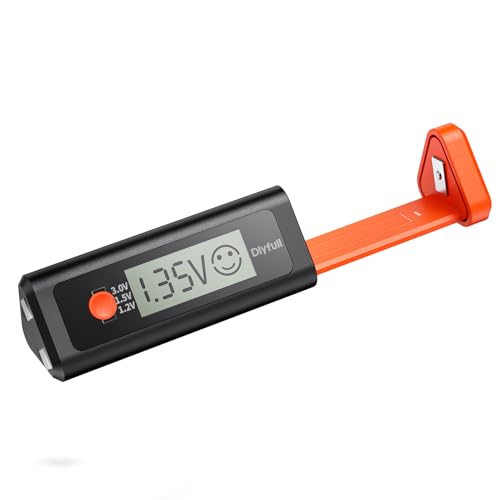
The Dlypow DB2 stands out with a sliding tray that uses a magnetic contact to hold the battery steady during testing. This magnetic fixation enables one-handed operation—you can slide a cell in and read the result without needing a second hand to press or hold anything. The clear LCD display shows both the exact voltage and a three-tier icon (“Good,” “Weak,” “Poor”), giving you the precision of a digital readout without guesswork.
It powers itself entirely from the battery under test, meaning no extra AAA or button cell is needed to run the tester. The compact chassis measures just 3.77 inches long and weighs 1.41 ounces, making it one of the most pocket-friendly options available. Compatibility spans AA, AAA, C, D, 9V, CR123A, CR2, and common button cells, plus it handles 1.2V Ni-MH rechargeable AA and AAA cells without issue.
The only real drawback is the LCD viewing angle. Several users report the display appears dim unless you look at it straight on. The design feels plasticky, but the magnetic slot and sliding mechanism suggest thoughtful engineering beneath the lightweight shell. For anyone who tests batteries frequently and values one-handed convenience, this is a genuinely clever tool.
Why it’s great
- Magnetic hold allows one-handed battery testing
- Self-powered by the battery under test
- Supports 1.2V Ni-MH rechargeable cells
Good to know
- LCD display has a narrow viewing angle
- Dead batteries won’t power the tester at all
3. Tenergy T-333 Universal Battery Tester

The Tenergy T-333 is a veteran in the battery tester space, with owners reporting five years of reliable service on a single internal AAA battery. That internal battery powers the LCD metering circuit, while the tester itself applies a modest load to the cell under test. The result is a clear digital readout that sorts batteries into “Poor,” “Weak,” or “Good” categories—no exact voltage numbers, but plenty of resolution for household sorting.
What sets the T-333 apart is its exceptional compatibility range. It handles AA, AAA, C, D, 9V, CR123A, CR2, CRV3, 2CR5, CR-P2, and a wide variety of button cells. That breadth of support makes it the best choice if you have a mix of odd-sized camera batteries, coin cells, and standard household alkaline. The lead-free construction and sturdy plastic build feel durable enough for regular drawer-duty.
There is no backlight on the LCD, so reading it in low-light conditions requires a nearby light source. The tester also requires its own AAA battery (included) to operate, unlike the self-powered Amprobe or Dlypow DB2. But for sheer versatility and proven longevity, the T-333 has earned its reputation as a reliable workhorse that families borrow from each other.
Why it’s great
- Tests an unusually wide range including CRV3 and 2CR5
- Proven five-year lifespan with consistent accuracy
- Compact, lead-free design for easy storage
Good to know
- Requires an internal AAA battery to operate
- LCD screen has no backlight
4. Dlyfull B2 Universal Battery Checker

The Dlyfull B2 is designed for portability, weighing in at just 115 grams with an anti-slip finish that makes it easy to grip with one hand. It supports AA, AAA, C, D, 9V, N, CR123A, CR2, CRV3, 2CR5, CR-P2, and a wide range of button cells. The LCD display uses bar segments to show “Poor,” “Weak,” or “Good” condition, giving you a quick visual verdict without interpreting a voltage number.
This tester comes with one AAA alkaline battery included, so it works right out of the box. Its small footprint fits easily into a tool pouch or the front pocket of a backpack. Reviewers consistently mention how much easier it is to use than the simple testers found at big-box stores, and the accuracy is reliable for sorting dead cells from usable ones.
One limitation is that the battery fit is not perfectly snug for all sizes. Some users note that dead AA or AAA batteries may require a slight jiggle to make proper contact. Additionally, the manufacturer warns against testing rechargeable batteries with this model, so if you use Ni-MH cells regularly, you will want a tester like the Dlypow DB2 or Amprobe BAT-250 instead.
Why it’s great
- Ultra-light and pocket-friendly design
- Includes AAA battery for immediate use
- Clear bar-graph display for quick decisions
Good to know
- Fit can be loose for some battery sizes
- Not compatible with rechargeable Ni-MH cells
5. Dlyfull Blue Universal Battery Checker

The Dlyfull Blue shares the same core design philosophy as the B2 model but comes in a blue color variant with an anti-slip finish that provides a secure grip during testing. It supports the full range of cylindrical batteries—AA, AAA, C, D, 9V, CR123A, CR2, CRV3, 2CR5, CR-P2—plus a wide variety of button cells. The LCD screen uses bar segments to indicate “Poor,” “Weak,” or “Good” condition, offering the same quick-read convenience.
Like the B2, it requires one AAA battery (included) to operate. The compact chassis is lightweight and easy to store, making it a solid choice for a dedicated junk-drawer tool. Users consistently praise how intuitive the interface is—you insert the battery, and the meter immediately responds with a condition readout. No buttons, no modes, no confusion.
The same caveats apply as the B2: rechargeable batteries should not be tested with this unit, and the fit for AA cells can be slightly tricky to remove after testing. Some users note that the plastic build feels less substantial than the Tenergy or Amprobe units. But for the price-conscious buyer who just needs to sort alkaline AA and AAA batteries from dead ones, this is a perfectly functional, no-frills tool.
Why it’s great
- Intuitive one-step operation with instant results
- Anti-slip finish provides secure handling
- Includes AAA battery for immediate use
Good to know
- Not compatible with rechargeable batteries
- AA cells can be difficult to remove
FAQ
Can a battery tester check rechargeable Ni-MH batteries?
What does it mean when a tester applies a “load” to a battery?
Why does my battery tester show “Good” but the device still doesn’t work?
Final Thoughts: The Verdict
For most users, the battery tester for aa and aaa batteries winner is the Amprobe BAT-250 because its load-testing design and battery-independent operation deliver reliable, honest results every time. If you want the convenience of a magnetic hold and exact digital voltage readouts, grab the Dlypow DB2. And for the broadest battery compatibility that covers odd sizes like CRV3 and 2CR5, nothing beats the Tenergy T-333.

Mo Maruf
I created WellFizz to bridge the gap between vague wellness advice and actionable solutions. My mission is simple: to decode the research and give you practical tools you can actually use.
Beyond the data, I am a passionate traveler. I believe that stepping away from the screen to explore new environments is essential for mental clarity and physical vitality.