Our readers keep the lights on and my smoothie glass nicely filled. As an Amazon Associate, I earn from qualifying purchases.
When the lights go out, the question isn’t whether you need backup power — it’s whether your backup can handle the load. A battery power station has become the essential bridge between a brief inconvenience and a full-blown disruption, offering silent, fume-free energy for everything from medical devices to refrigerators. But not all stations deliver what their spec sheets promise: some falter under high-draw appliances, others recharge too slowly to be useful in a multi-day outage, and many hide their true cycle life behind marketing language. This guide cuts through the noise to match real-world performance with your specific runtime needs.
I’m Mohammad Maruf — the founder and writer behind WellFizz. I’ve spent countless hours cross-referencing inverter efficiency curves, LiFePO4 cycle ratings, and real-world customer usage patterns to build a comparison that actually translates to confident buying.
Whether you need backup for a CPAP machine, off-grid power for a weekend camping trip, or whole-fridge protection during storm season, this guide to the best battery power station breaks down the critical specs that separate a reliable investment from an expensive paperweight.
How To Choose The Best Battery Power Station
Choosing a battery power station starts with two numbers: capacity (watt-hours) and inverter output (watts). Your capacity determines how long your gear runs, while the inverter rating determines what you can plug in at all. A 2000Wh station with a 300W inverter can’t start a refrigerator compressor, and a 2400W inverter with a 500Wh battery will drain in under 30 minutes under load. Balance both against your actual runtime target and the surge current of your largest appliance.
Battery Chemistry: Why LiFePO4 Dominates
Lithium Iron Phosphate (LiFePO4 or LFP) batteries have become the standard for portable power stations because they deliver 3000 to 4000+ full charge cycles before degrading to 80% capacity — roughly 8 to 10 years of daily use. Older lithium-ion chemistries (NMC) typically cap out around 500 cycles and carry a higher thermal runaway risk. LFP cells handle wider temperature ranges and don’t degrade as quickly when stored at partial charge, making them the safer, longer-lasting choice for emergency backup gear that might sit idle for months.
Inverter Type: Pure Sine Wave Is Non-Negotiable
A pure sine wave inverter mimics the clean, smooth power from your wall outlet. Sensitive electronics — CPAP machines, laptop power bricks, medical devices, and variable-speed refrigerators — can buzz, overheat, or fail entirely when powered by a modified sine wave inverter. Every station on this list uses pure sine wave output, but the efficiency of the inverter (how much DC battery power converts to usable AC power) varies by brand. Higher efficiency means more runtime per watt-hour, which is why two stations with identical capacity can deliver very different real-world runtimes.
Charging Speed and Input Flexibility
Fast AC recharge is the single most underrated feature in an emergency power station. A unit that takes 10+ hours to refill is effectively a one-shot battery; a station that recharges in 60-90 minutes can be cycled multiple times per day during extended outages. Solar input wattage also matters — look for MPPT charge controllers and at least 200W-500W solar input capacity if you plan to pair with panels. Multi-input hybrid charging (AC + solar simultaneously) can cut recharge time nearly in half for heavy users.
Quick Comparison
On smaller screens, swipe sideways to see the full table.
| Model | Category | Best For | Key Spec | Amazon |
|---|---|---|---|---|
| EF ECOFLOW RIVER 3 | Mid-Range | Compact UPS & daily use | 245Wh / 300W (600W surge) | Amazon |
| LIBRIDS C600 | Mid-Range | Home backup & camping | 640Wh / 600W (1200W surge) | Amazon |
| BLUETTI AC70 | Mid-Range | Off-grid essentials | 768Wh / 1000W (2000W lift) | Amazon |
| BLUETTI Elite 100 V2 | Premium | Mobile work & mid-range backup | 1024Wh / 1800W (3600W surge) | Amazon |
| Jackery Explorer 2000 v2 | Premium | Whole-home essentials & RV | 2042Wh / 2200W | Amazon |
| Anker SOLIX C2000 Gen 2 | Premium | High-draw appliances + fast recharge | 2048Wh / 2400W (4000W peak) | Amazon |
| AFERIY P210 | Premium | Heavy-duty home backup | 2048Wh / 2400W (4800W surge) | Amazon |
| DABBSSON 2000L | Premium | Lightweight high-capacity camping | 2048Wh / 2200W (3300W boost) | Amazon |
| VTOMAN Jump 600X | Budget | Car jump start + CPAP backup | 299Wh / 600W (1200W surge) | Amazon |
In‑Depth Reviews
1. BLUETTI Elite 100 V2
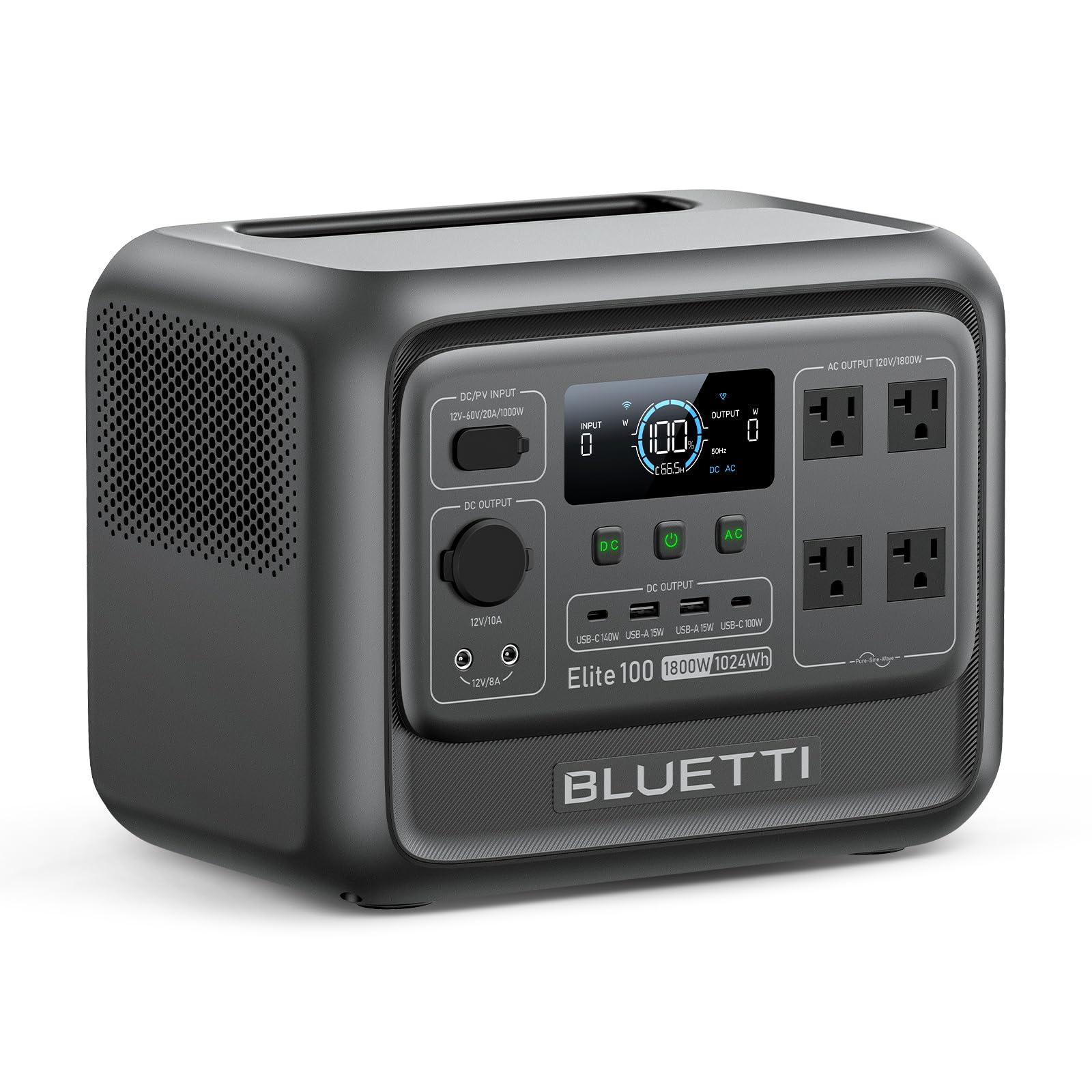
The BLUETTI Elite 100 V2 hits the sweet spot of the entire category: 1024Wh of LiFePO4 capacity paired with a 1800W inverter (3600W surge) in a chassis that’s 35% smaller than its predecessor. The 70-minute full recharge via 1200W TurboBoost AC input means you can drain this station in the morning and have it fully topped off before dinner — a critical advantage during multi-day outages. Four AC outlets give you real appliance flexibility without needing a power strip.
At 25 pounds with a hidden carry handle, it’s light enough to move between rooms or toss in a car for camping, yet robust enough to run a full-size refrigerator, multiple CPAP machines, or a mobile office setup for hours. The <10ms UPS transfer keeps networking equipment and computers online seamlessly during grid flickers, and the 30dB noise floor means it won’t disturb sleep or conversation.
Bluetooth and WiFi app control add convenience for remote monitoring, though the app interface feels slightly clunky for toggling settings. The absence of a built-in flashlight or wireless charging pad is noticeable given the premium price point, but the core power delivery and build quality justify the investment for anyone needing reliable mid-capacity backup.
Why it’s great
- Blazing 70-minute full recharge via AC TurboBoost
- True 1800W continuous output with 3600W surge handles large appliances
- 35% smaller footprint than previous generation — easier to store
- 4000+ cycle LFP battery rated for a decade of use
Good to know
- No built-in flashlight or wireless charging pad
- App control requires WiFi/BT — can’t turn on unit remotely
- Heavier than some similarly sized competitors at 25 lbs
2. Anker SOLIX C2000 Gen 2

The Anker SOLIX C2000 Gen 2 redefines what a 2kWh-class station can do with a 2400W rated inverter that peaks at 4000W — enough to start most window and RV air conditioners that would stall lesser units. The 2048Wh LiFePO4 core recharges to full in just 58 minutes via AC, and the 800W alternator charging option (sold separately) refills the station from your vehicle in about 3 hours. Standby power draw is an industry-leading 9W, meaning it wastes almost nothing while sitting idle on your shelf.
At 41.7 pounds and 29% smaller than comparable 2kWh stations, the C2000 Gen 2 is genuinely portable despite its capacity. Real-world reports show it running a 30-quart fridge for 5-7 days continuously, and a dual-door fridge for up to 32 hours on a single charge. Expandability to 4kWh with an add-on battery makes this a scalable investment for growing power needs.
The companion app provides clear usage tracking and charge-speed adjustment, though the lack of a printed manual is a minor frustration for first-time setup. The metal and plastic hybrid chassis feels premium but weighs slightly more than some semi-solid competitors. Still, for anyone who needs to power high-draw appliances with confidence, this station sets the benchmark.
Why it’s great
- 58-minute full AC recharge — fastest in its class
- 2400W continuous / 4000W peak inverter handles window AC units
- 800W alternator charging for vehicle-based refueling on the go
- Expandable to 4kWh with add-on battery
Good to know
- No printed manual included — all documentation is digital
- Heavier than semi-solid LFP competitors at 41.7 lbs
- Premium pricing places it at the top of the 2kWh range
3. EF ECOFLOW RIVER 3

The EF ECOFLOW RIVER 3 proves that small stations can be seriously capable. At just 7.8 pounds with a built-in handle, this 245Wh unit fits in a backpack or closet corner, yet delivers a 300W inverter with X-Boost pushing up to 600W surge for resistive loads. The GaN-based charging architecture refills the battery from 0-100% in exactly one hour via AC, and the <20ms UPS switch keeps network gear online through grid blips without a hiccup.
What sets the RIVER 3 apart is its whisper-quiet operation: less than 30dB at 1.5 feet, making it ideal for indoor use during overnight outages or in a bedroom. The IP54 rating means it shrugs off moisture and dust, and the 3000-cycle LFP battery delivers roughly 10 years of daily use. X-Guard cloud-based battery monitoring adds a layer of safety with 40+ protections against voltage, temperature, and current anomalies.
The main limitation is raw capacity: 245Wh is enough for phones, a WiFi router, and a laptop for a day, but will struggle with anything requiring sustained 300W draw for more than 45 minutes. It’s not a whole-home solution — it’s a daily UPS with camping flexibility, and it excels in that narrow role.
Why it’s great
- Under 8 lbs with built-in handle — genuinely portable
- 1-hour AC recharge is best-in-class for sub-300Wh stations
- IP54 water and dust resistance for outdoor use
- Silent <30dB operation and 20ms UPS transfer
Good to know
- 245Wh capacity limits runtime for high-draw devices
- No wireless charging pad despite premium positioning
- X-Boost does not increase continuous AC wattage rating
4. AFERIY P210

The AFERIY P210 is a brute-force power station built for extended home backup and off-grid food truck or RV operation. Its 2048Wh LiFePO4 battery feeds a 2400W pure sine wave inverter with a 4800W surge capacity, supported by six AC outlets and a dedicated XT60 12V/25A DC output port. The <10ms UPS response is server-grade — fast enough to keep NAS drives and sensitive lab equipment from crashing during power transitions.
Charging speed is competitive for its class: a full AC recharge takes roughly two hours, and the MPPT solar controller accepts up to an unspecified high wattage that pairs well with two 200W panels in real-world testing. The 16 total output ports include four USB-C (one at 100W) and two USB-A, covering everything from power tools to smart devices simultaneously. Noise levels are remarkably low — 16dB under normal load and under 30dB at full inverter output.
The standout differentiator here is the 7-year warranty, two years longer than industry standard, backed by 24/7 customer support. The downside is weight: at 54 pounds, this is not a station you casually carry between rooms. The plastic chassis feels slightly less premium than metal-clad competitors, but the raw electrical performance and support length make it a compelling value for serious users.
Why it’s great
- 4800W surge capacity powers heavy startup loads
- 16 total output ports — most versatile in its class
- 7-year warranty is the longest available in this category
- Near-silent 16dB operation under normal load
Good to know
- 54-pound weight limits true portability
- Plastic housing feels less durable than metal alternatives
- App interface is functional but not as polished as competitors
5. DABBSSON 2000L
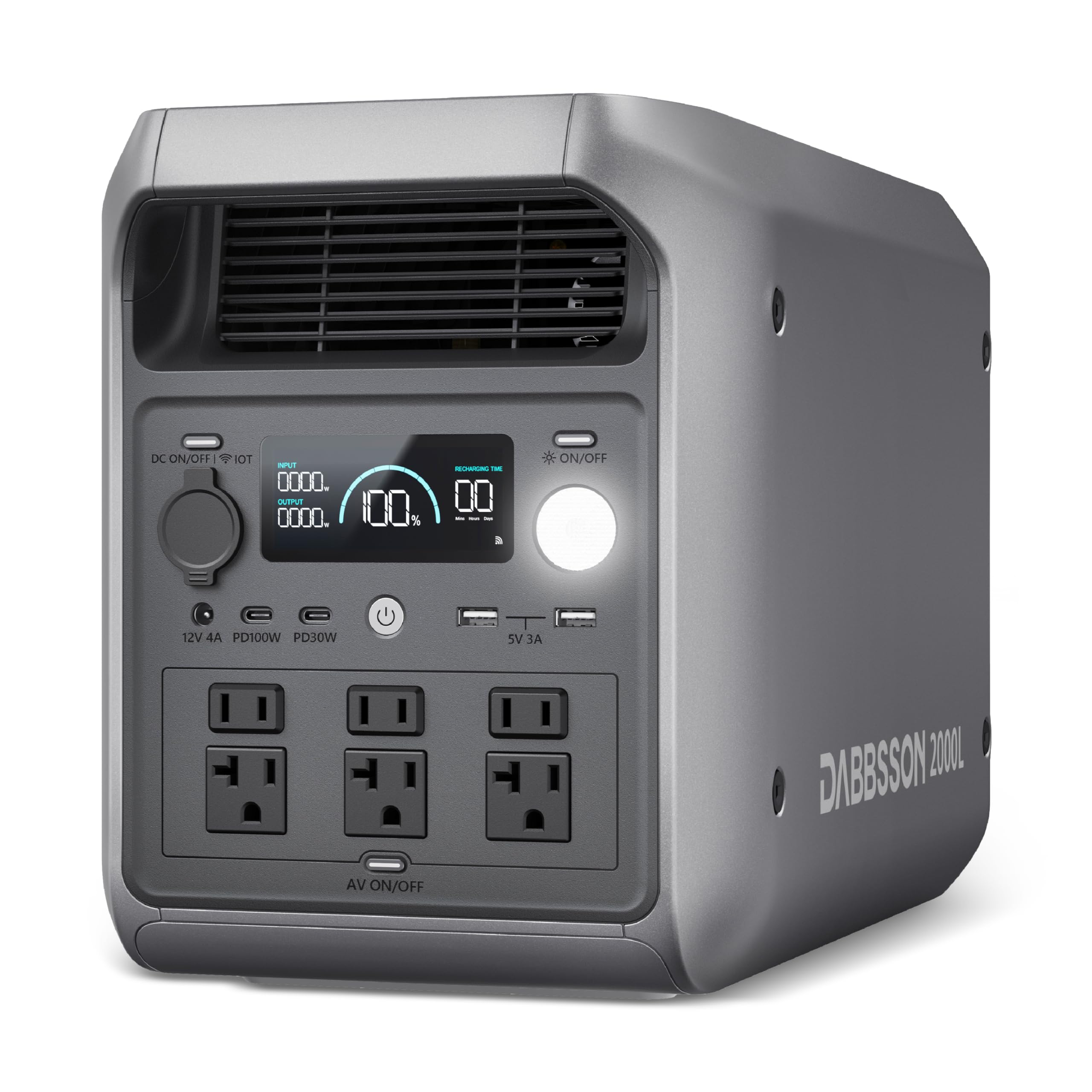
The DABBSSON 2000L brings semi-solid LiFePO4 cell technology to the consumer power station market, and the payoff is immediate: 41 pounds for a full 2048Wh of capacity — roughly 25% lighter than traditional LFP stations with the same watt-hour rating. The 2200W inverter (3300W Power Boost) handles six AC outlets simultaneously, and the <15ms EPS switch keeps sensitive electronics safe during grid transitions. The UL94-V0 flame-retardant housing adds genuine safety for indoor installation.
Charging is equally impressive: a full AC recharge takes just one hour, and the dual-input hybrid mode (AC + solar up to 800W) can refill the battery even faster during peak sun. Real-world user reports confirm 8-10 hours of runtime powering lights and small appliances off solar alone, and the Dabbsson app provides remote monitoring via WiFi and Bluetooth. At 11.2 x 18.3 x 8.9 inches, the horizontal form factor stacks neatly in a garage or closet.
Build quality is good but not great — the ABS+PC shell feels slightly thin compared to metal chassis units, and the 5-year warranty (3-year standard + 2-year extension with registration) is solid but not class-leading. The semi-solid chemistry is relatively new, so long-term degradation data is limited compared to standard LFP. Still, for anyone who needs full 2kWh capacity without the back-breaking weight, this is a breakthrough option.
Why it’s great
- Only 41 lbs for 2048Wh — best power-to-weight ratio in class
- 1-hour AC recharge with 800W MPPT solar input
- Semi-solid LFP cells offer enhanced safety and stability
- 6 AC outlets provide serious device flexibility
Good to know
- Semi-solid chemistry is newer — less long-term track record
- Plastic shell feels less premium than metal-clad competitors
- 5-year warranty requires registration for full coverage
6. Jackery Explorer 2000 v2

The Jackery Explorer 2000 v2 leverages EV-grade Cell-to-Body (CTB) technology to squeeze 2042Wh of LiFePO4 capacity into a chassis that’s 41% lighter and 34% smaller than the typical 2kWh station. At 39.5 pounds with a recessed handle, it’s the most portable true-2kWh station here — manageable enough for a single person to load into an SUV for camping or move from a garage to a living room during an outage. The 2200W pure sine wave inverter powers essential home appliances including full-size refrigerators (tested at 21+ hours runtime) and window AC units.
AC fast charging hits 80% in 66 minutes and full in 102 minutes using Emergency Super Charging mode via the app. The Silent Charging mode completes a full charge in 5 hours at just 30dB — ideal for overnight topping off in a bedroom. Solar input at 400W refills in about 6 hours, and the 20ms UPS transfer is UL1778 certified for reliable automatic backup. Three AC outlets, two USB-C (one at 100W PD), and a dedicated USB-A port cover most device charging needs.
Jackery’s brand reliability and customer support are well-documented, but the Explorer 2000 v2 lacks expansion battery support — you’re capped at 2042Wh without the ability to daisy-chain additional units. The CTB chassis, while lighter, also limits aftermarket repair options compared to modular designs. For users who prioritize weight savings and brand trust over expandability, this is a top-tier choice.
Why it’s great
- Lightest 2kWh station at 39.5 lbs with EV-inspired CTB tech
- UL1778 certified UPS with 20ms seamless transfer
- Silent Charging mode — full charge at 30dB fan noise
- Tested to run a full-size fridge for over 21 hours
Good to know
- No expansion battery support — capacity is fixed
- Limited to 3 AC outlets — fewer than some competitors
- CTB chassis limits serviceability compared to modular designs
7. BLUETTI AC70

The BLUETTI AC70 delivers the best cost-per-watt-hour ratio in this guide without sacrificing build quality or charging speed. Its 768Wh LiFePO4 battery feeds a 1000W inverter with 2000W Power Lifting for high-startup appliances, and the 950W AC input refills from 0-80% in just 45 minutes — a full charge in 1.5 hours. The robust XT-60 solar input (up to 500W) is a significant upgrade over the fragile 7909 connectors found on older budget stations.
Real-world testing shows the AC70 running a 100W guitar amp and pedals for over 19 hours of continuous use, and powering a full desktop PC, monitor, TV, and lights simultaneously during an outage with room to spare. The two 1000W AC outlets plus USB-C 100W PD (tested to charge a MacBook Pro 16″ at full speed) make it versatile for both work and play. The bright LCD display provides clear real-time wattage and state-of-charge data without needing an app.
The primary compromise is physical size: at 22.5 pounds, the AC70 is heavier than similarly specced 700-800Wh units, and the plastic chassis lacks the premium feel of higher-end BLUETTI models. The 3000-cycle battery rating is standard for the category but falls short of the 4000+ cycles offered on newer premium stations. For budget-conscious buyers who refuse to compromise on charging speed or real-world power delivery, the AC70 is the clear winner.
Why it’s great
- 45-minute 80% recharge via 950W AC input
- True 1000W continuous with 2000W surge for motor startup
- USB-C PD 100W charges full-size laptops at native speed
- Robust XT-60 solar connector handles up to 500W input
Good to know
- 22.5 lbs is heavy for a 768Wh station
- Only 2 AC outlets — may need a power strip for multiple devices
- Plastic chassis less durable than metal alternatives
8. LIBRIDS C600
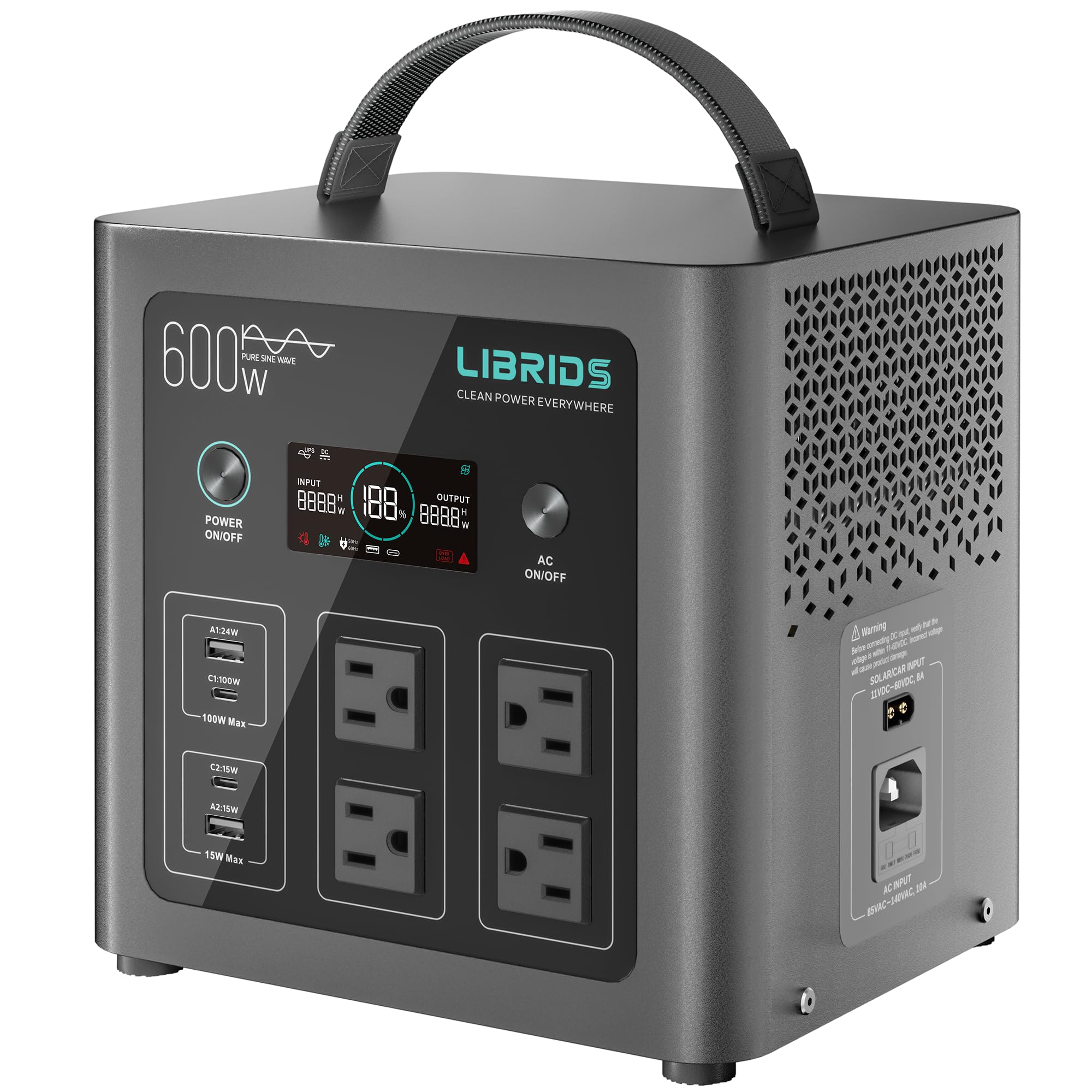
The LIBRIDS C600 fills a specific niche: a compact, metal-enclosed 640Wh station with a 600W inverter (1200W peak) for users who prioritize thermal dissipation and build quality over raw capacity. The automotive-grade LiFePO4 battery is rated for 4000+ cycles — one of the highest cycle ratings in the mid-capacity tier — and the metal casing acts as a heat sink, keeping internal temps lower during sustained high-draw use. The 10ms UPS transfer is fast enough for CPAP machines and aquarium pumps, which real users have confirmed for reef tank emergency backup.
Charging is straightforward: 1.5 hours from AC input, with the smart LCD showing real-time battery percentage, input, and output wattage. The four AC outlets are pure sine wave certified for safe operation with sensitive medical and networking gear. Real-world testing shows a Resmed Airsense 11 CPAP running for over 7 hours using only 24% battery (with humidifier off), translating to roughly 29 hours of CPAP runtime on a full charge — best-in-class for this price tier.
The “Indoor Use Only” label on the unit is a UL safety requirement, but in practice the C600 has been used reliably at dry campsites during clear weather. The 5-year warranty is reassuring, though the brand lacks the extensive support infrastructure of BLUETTI or Jackery. For aquarium owners, CPAP users, or anyone who needs a reliable mid-range UPS with a metal chassis, the C600 delivers exceptional per-dollar value.
Why it’s great
- Metal enclosure provides superior heat dissipation
- 4000+ cycle LFP battery — longest cycle life in mid-range
- CPAP runtime of ~29 hours per charge (no humidifier)
- 1.5-hour AC recharge is competitive for 640Wh capacity
Good to know
- UL-labelled for indoor use only — avoid rain exposure
- Brand support infrastructure smaller than BLUETTI or Jackery
- 600W inverter limits appliance options
9. VTOMAN Jump 600X

The VTOMAN Jump 600X occupies a unique crossover category: a portable power station that also jump-starts 12V vehicles. Its 299Wh LiFePO4 battery and 600W inverter (1200W surge) are modest by modern standards, but the integrated jump-start port eliminates the need to carry a separate battery booster in your vehicle. Real-world testing shows it jumping a Dodge Ram truck instantly with only 9% battery remaining, and the 3000-cycle LFP chemistry ensures longevity through years of roadside use.
The regulated 12V DC outputs (two DC5521 ports plus a cigarette lighter port, all at 12V/10A) are a standout feature for powering car refrigerators, CPAP machines, and tire inflators without voltage sag. The 60W PD USB-C charges laptops at reasonable speed, and the pass-through charging capability lets you power devices while the station itself recharges — a rare feature at this price point. Expandability to 939Wh with an add-on battery provides a future capacity upgrade path.
The main trade-offs are capacity and charging speed. At 299Wh (expandable), runtime is limited — expect roughly 10 hours of CPAP use without heated humidification, or half a day powering a mini fridge. AC recharge takes about 3 hours, which feels slow compared to the sub-90-minute mid-range units. The 14.6-pound weight is reasonable for the feature set, but the bulkier form factor (10.2 x 8.7 x 8.6 inches) won’t slip into a backpack. For drivers who want one device for both jump-starting and basic backup power, the Jump 600X is a uniquely practical choice.
Why it’s great
- Integrated car jump-start port eliminates a separate device
- Regulated 12V/10A DC outputs for CPAP and car fridge
- Pass-through charging — use devices while recharging
- Expandable to 939Wh with add-on battery
Good to know
- 3-hour AC recharge is slower than category average
- 299Wh base capacity limits runtime for high-draw gear
- Larger footprint than similarly specced battery-only stations
FAQ
How long can a battery power station run a refrigerator?
Can I leave a battery power station plugged in 24/7?
What is the difference between LiFePO4 and standard lithium-ion batteries?
How do I calculate the right capacity for my needs?
Do battery power stations work while charging?
Final Thoughts: The Verdict
For most users, the best battery power station winner is the BLUETTI Elite 100 V2 because it delivers the ideal balance of capacity (1024Wh), power (1800W), charging speed (70 minutes), and portability (25 lbs) for the vast majority of home backup and camping scenarios. If you want high-draw appliance capability with the fastest recharge available, grab the Anker SOLIX C2000 Gen 2. And for a budget-friendly entry-level unit with car jump-start utility, nothing beats the VTOMAN Jump 600X.

Mo Maruf
I created WellFizz to bridge the gap between vague wellness advice and actionable solutions. My mission is simple: to decode the research and give you practical tools you can actually use.
Beyond the data, I am a passionate traveler. I believe that stepping away from the screen to explore new environments is essential for mental clarity and physical vitality.