Our readers keep the lights on and my smoothie glass nicely filled. As an Amazon Associate, I earn from qualifying purchases.
Camping trips often trade electricity for isolation, and that trade is fine until your phone dies, the lantern flickers out, or you realize the campsite doesn’t have a single outlet near your tent. A portable battery that refuses to quit changes the entire experience — not by bringing the grid with you, but by letting you choose exactly when and how to recharge, without hunting for a picnic shelter plug.
I’m Mohammad Maruf — the founder and writer behind WellFizz. I track battery chemistry advances, solar input rates, and real-world capacity claims across dozens of power station brands to separate marketing specs from actual campsite performance.
Whether you need to keep a CPAP running overnight or just want enough juice for three days of phone charging and camp lights, this guide breaks down the best options to help you find the right battery pack for camping.
How To Choose The Best Battery Pack For Camping
Camping battery packs range from compact USB-only bricks to full power stations with AC outlets. Picking the right one depends on how many devices you bring and how long you stay off-grid. Here are the key factors that matter at a campsite.
Capacity: Watt-Hours Tell the Real Story
Manufacturers often list milliamp-hours (mAh) because the numbers look bigger, but watt-hours (Wh) is the spec that actually tells you how long your devices will run. A 40,000 mAh pack at 3.7V holds roughly 148 Wh — enough to charge a typical phone seven or eight times. If you plan to run a laptop, a small fan, or a CPAP machine, look for packs that list watt-hours clearly and aim for at least 100 Wh for multi-day trips.
AC Outlets vs USB-Only
If every device you own charges via USB-C or USB-A, a standard power bank with high capacity works fine. The moment you bring a laptop that needs a wall adapter, a camera battery charger, or any device with a two-prong plug, you need a power station with a pure sine wave AC outlet. These units are heavier but eliminate the need for multiple adapters and inverters.
Battery Chemistry: LiFePO4 Wins for Longevity
Standard lithium-ion batteries degrade after about 500 charge cycles. Lithium iron phosphate (LiFePO4) cells last 3,000 to 3,500 cycles before dropping to 80% capacity — roughly six times longer. If you camp regularly or want a pack that doubles as emergency home backup, the higher upfront cost of LiFePO4 saves money over time. For occasional use, standard lithium polymer packs offer lower entry cost with adequate lifespan.
Solar Input and Recharge Speed
Not all battery packs with solar panels printed on them actually charge effectively in sunlight. Look for a dedicated DC input port rated for at least 60W from a solar panel. Packs that only trickle-charge through a small built-in panel (the “emergency use only” type) take days to refill in real conditions. If solar recharging matters to you, buy a separate folding panel and a pack that clearly states its solar input wattage and voltage range.
Weight and Portability
A battery pack that weighs eight pounds might sit in your trunk campsite just fine but becomes a burden on a hike to a backcountry spot. For car camping, weight matters less than total capacity. For backpacking or hike-in sites, stick to packs under three pounds. Handle design also counts — a built-in carry handle or soft grip makes a two-pound brick feel easier to move around than a smooth block that slides out of your hand.
Quick Comparison
On smaller screens, swipe sideways to see the full table.
| Model | Category | Best For | Key Spec | Amazon |
|---|---|---|---|---|
| VTOMAN Jump 600X | Power Station | Extended trips & vehicle jump-start | 299Wh LiFePO4 | Amazon |
| DARAN Power Station | Power Station | Ultra-compact backup with fast AC charging | 89.6Wh LiFePO4 | Amazon |
| MARBERO M168 | Power Station | Multi-output medium-capacity camping | 162.8Wh capacity | Amazon |
| ZeroKor G120 | Power Station | Lightweight AC outlet for small electronics | 97.6Wh / 120W AC | Amazon |
| MINRISE Solar Bank | Power Bank | Budget-friendly multi-device USB charging | 40000mAh / 4 cables | Amazon |
In‑Depth Reviews
1. VTOMAN Jump 600X

The VTOMAN Jump 600X packs a 299Wh LiFePO4 battery into a rugged unit that also jump-starts 12V vehicles — a rare combo that saves carrying a separate jumper pack. Its 600W continuous output (1200W surge) powers mini-fridges, CPAP machines, and power tools without tripping. The regulated 12V DC ports are a standout for anyone running a 12V cooler or tire inflator at the campsite.
Recharge speed is solid: the included AC adapter brings it to 80% in about 2.7 hours, and a 110W solar panel can top it off in 5-6 hours under direct sun. The 60W USB-C PD port charges laptops quickly, while the three USB-A ports handle phones and tablets simultaneously. Pass-through charging means you can keep your devices plugged in while the station itself recharges — useful for basecamp setups.
At 14.6 pounds, this is not a pack you toss in a daypack, but for car camping, RV trips, or home backup it earns the weight. The expandable capacity (up to 939Wh with an extra battery) future-proofs the investment. Early adopters report running CPAP units for 10+ hours overnight with battery to spare, and the jump-start function has rescued dead truck batteries in seconds.
Why it’s great
- LiFePO4 chemistry lasts thousands of cycles
- Combines power station and vehicle jump starter
- Regulated 12V output for sensitive DC equipment
- Expandable capacity with optional add-on battery
Good to know
- Heavier than typical camping battery packs
- Battery drains faster near full discharge under heavy load
- Jumper cables sold separately
2. DARAN Portable Power Station
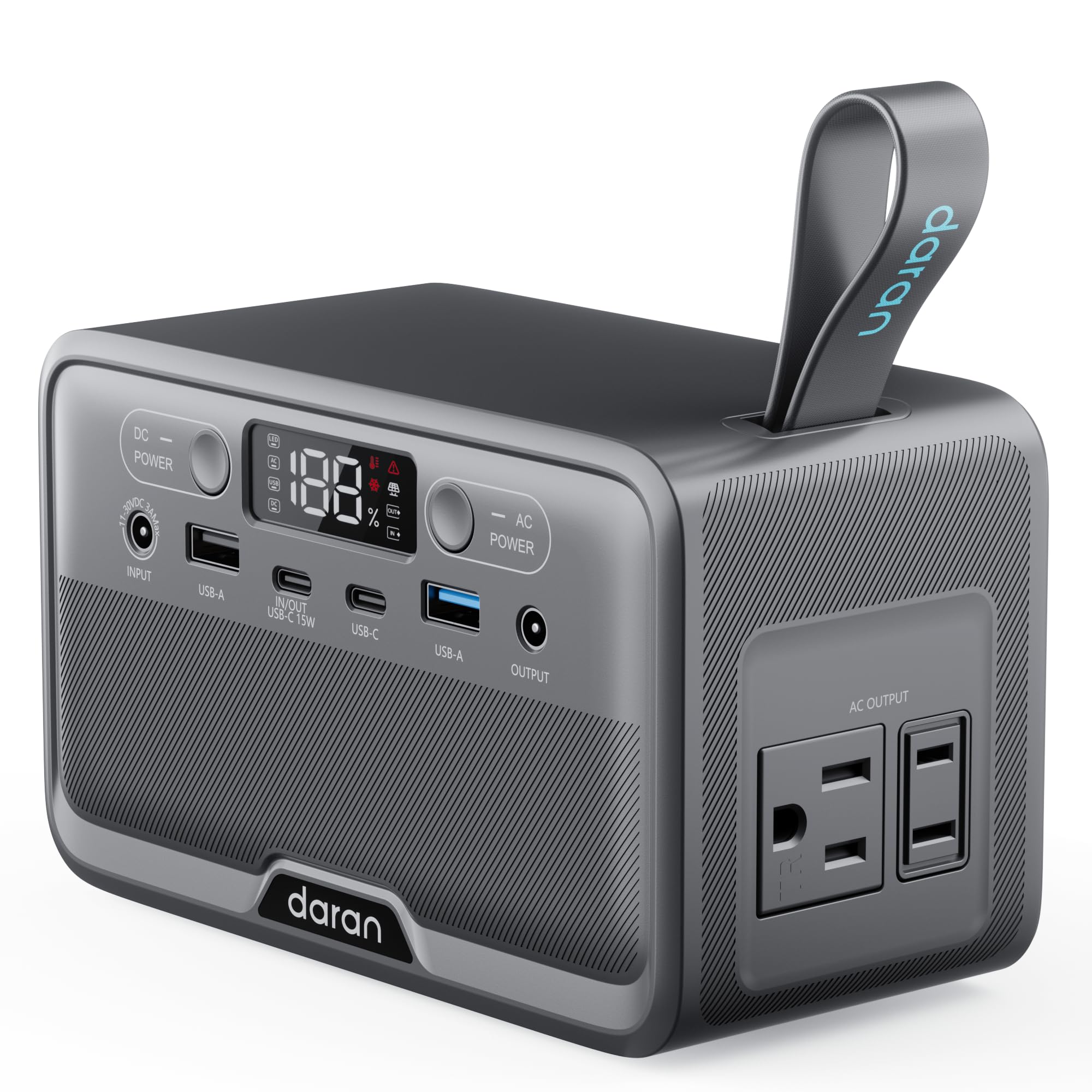
The DARAN power station is roughly the size of a thick smartphone and weighs only 2.5 pounds, making it one of the most portable units that still includes a 100W AC outlet. Its 89.6Wh LiFePO4 battery holds a charge that runs a laptop for a full work day or charges a phone around eight times. What sets it apart is the charging speed — from 0 to 80% in just 1.5 hours via the wall adapter, far faster than most packs in this size class.
Output ports include two AC sockets (100W total), two USB-C ports (45W PD and 15W), two USB-A ports, and DC5521 barrel ports. The LED display shows remaining power and output status clearly, though the icons can be small to read in dim light. Its fanless, silent operation makes it ideal for sleeping in a tent or using as a UPS for a small router during power outages.
Some users note the fan kicks on audibly when charging via AC, but during discharge it stays silent. The LiFePO4 cells are rated for 3,500 cycles — roughly ten times the lifespan of standard lithium-ion packs. If you want a pack small enough to fit in a backpack pocket but capable of running small AC appliances, this is the most power-dense option here.
Why it’s great
- Ultra-compact and lightweight for the AC output
- LiFePO4 battery with 3,500+ cycle life
- 0-80% charge in 1.5 hours
- Silent fanless operation during discharge
Good to know
- 100W AC limit cannot power high-wattage devices
- USB-C PD maxes at 45W on one port
- Small LCD icons can be hard to read at a glance
3. MARBERO M168

The MARBERO M168 splits the difference between compact USB banks and full-sized power stations. Its 162.8Wh capacity (44,000mAh equivalent) charges a phone ten times, a laptop twice, or runs a 10W LED light for over twelve hours. Two 110V AC outlets rated at 100W total let you plug in small appliances like a fan, TV, orCPAP without needing a separate inverter.
It offers three recharge methods: wall socket (7-8 hours to full), car lighter outlet, or solar panel. The solar input uses MC4 connectors and accepts 16.6-25V DC at up to 1.5A. While the solar charge rate is modest, it provides a genuine off-grid refuel option. The built-in white LED flashlight with steady and SOS modes adds practical value at the campsite — no need to carry a separate emergency light.
At 2.9 pounds with a compact handle, it travels easily between car and tent. Users report running four camping fans simultaneously with minimal battery drain. Just keep expectations in check: the 100W AC limit means no hair dryers, coffee makers, or electric kettles. For phones, laptops, lights, and small fans, this is the most capacity you can get without jumping to the 10+ pound class.
Why it’s great
- High 162.8Wh capacity in a portable form factor
- Two AC outlets for small plug-in devices
- Solar charging with standard MC4 connectors
- Integrated flashlight with multiple modes
Good to know
- AC output limited to 100W total
- Wall recharge takes 7-8 hours
- Solar panel sold separately
4. ZeroKor G120

The ZeroKor G120 is one of the lightest power stations with a real AC outlet — just 2.2 pounds with a handle that fits in one hand. Its 97.6Wh (26,400mAh) battery and 120W AC output handle smartphones, tablets, laptops, cameras, and drones. Two AC outlets give you flexibility to run a small projector and speakers simultaneously during camp movie nights.
Charging options include wall adapter, USB-C, car lighter, and solar panel input. The built-in BMS provides short circuit, over-current, over-voltage, overload, and over-temperature protection. A cooling fan runs during heavy use but stays relatively quiet. The LED screen displays remaining power and AC/DC status, though some users found the AC/DC buttons confusing at first — holding the DC button for a few seconds activates the AC output.
The main trade-off is capacity: 97.6Wh covers a weekend for light phone and tablet charging but won’t run a CPAP all night or power a mini-fridge through a long weekend. For day trips, overnight car camping, or as an emergency backup that lives in your glove box, its weight-to-output ratio is excellent. One reviewer ran five air mattresses off it without losing a bar — likely a best-case scenario — but the consensus confirms it punches above its size for small electronics.
Why it’s great
- Very lightweight for an AC-outlet power station
- Two separate AC outlets for multiple devices
- Includes USB-C input for flexible recharging
- Comprehensive BMS safety protections
Good to know
- 97.6Wh capacity limits extended off-grid use
- AC/DC button operation requires reading the manual
- Solar charging effectiveness reported as slow by some users
5. MINRISE Solar Power Bank
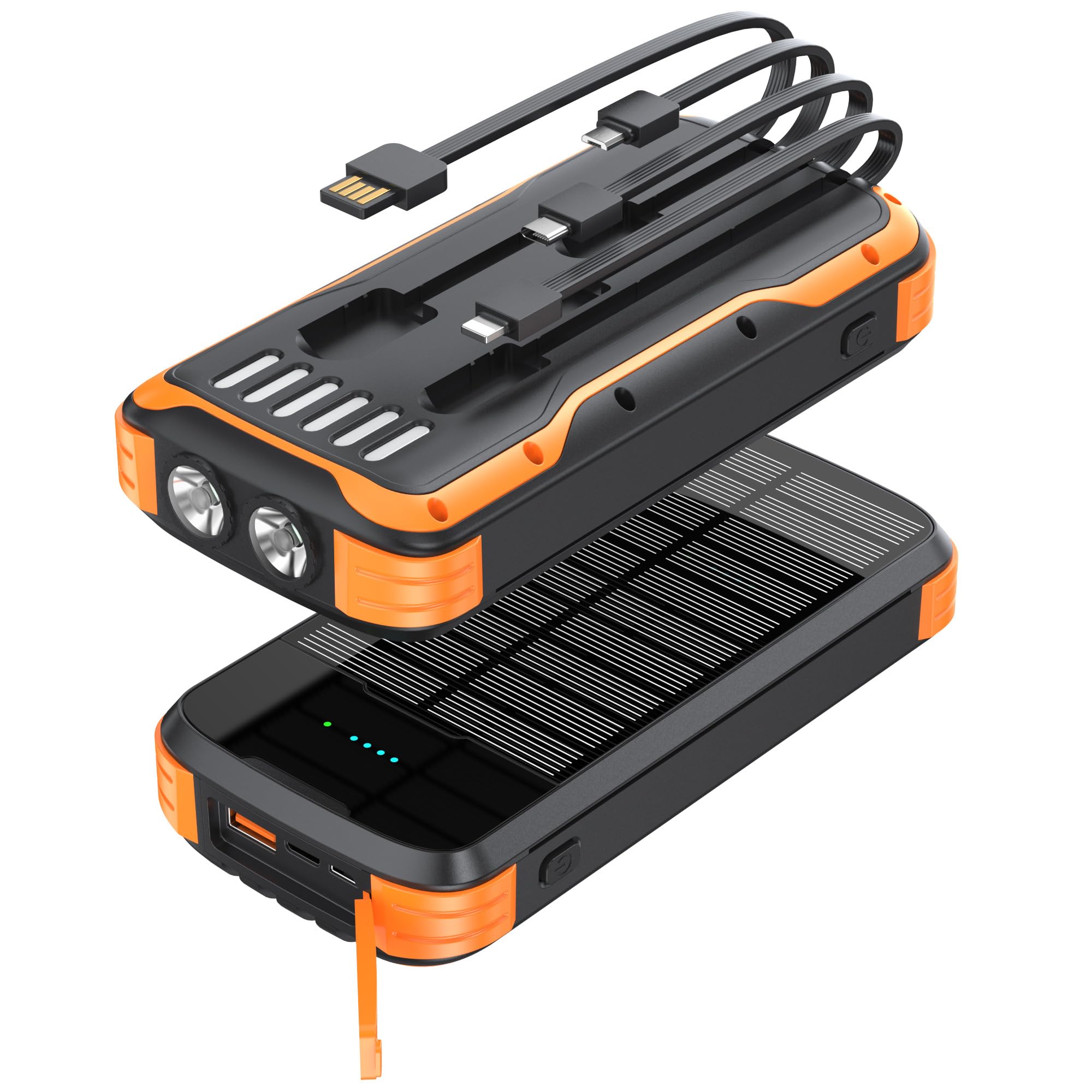
The MINRISE 40,000mAh solar power bank takes a different approach: instead of AC outlets, it packs four built-in cables (Type-C, iOS, Micro USB, and USB-A input) directly into the unit, so you never forget a cable at home. Its 20W PD USB-C output charges an iPhone 15 from 15% to 65% in about 30 minutes. For a group camping trip where everyone has different devices, this plug-and-play convenience saves hassle.
The rugged ABS shell with silicone corner bumpers and a silicone port cover provides real drop and dust resistance. Twin LED flashlights emit light up to 165 feet and last up to 25 hours — useful for late-night camp setup or emergency signaling. The solar panel on the back is explicitly described as an emergency backup, not a primary recharge method. In direct sun, it trickle-charges slowly; plan to refill via wall adapter or USB-C for regular use.
At 1.1 pounds, it’s the lightest option here and fits easily in a daypack. The main durability concern: some users note the battery depletes faster than expected when charging multiple devices simultaneously, and the built-in cables are short. For car campers who just need phone charging and a bright light without carrying extra cables, this is the most straightforward entry-level choice.
Why it’s great
- Built-in cables for all主流 phone types
- Very lightweight and portable at 1.1 lbs
- Dual bright LED flashlights with long runtime
- Durable ABS body with silicone protection
Good to know
- Solar charging is very slow — emergency use only
- Built-in cables are short for convenient reach
- Battery depletes faster under simultaneous multi-device load
FAQ
Can I fly with a battery pack for camping?
How do I charge my battery pack from a solar panel?
Why does my power bank drain faster in cold weather?
What size battery pack do I need for a CPAP machine?
Can I leave my camping battery pack plugged in all the time?
Final Thoughts: The Verdict
For most users, the battery pack for camping winner is the VTOMAN Jump 600X because it combines a long-lasting LiFePO4 battery with a car jump-start feature and enough capacity to run a CPAP or mini-fridge for a full night. If you want a pack that fits in a backpack and recharges in under two hours, grab the DARAN Power Station. And for the best capacity-to-weight ratio without breaking the bank, nothing beats the MARBERO M168.

Mo Maruf
I created WellFizz to bridge the gap between vague wellness advice and actionable solutions. My mission is simple: to decode the research and give you practical tools you can actually use.
Beyond the data, I am a passionate traveler. I believe that stepping away from the screen to explore new environments is essential for mental clarity and physical vitality.