Our readers keep the lights on and my smoothie glass nicely filled. As an Amazon Associate, I earn from qualifying purchases.
A battery pack that dies after one night or adds half a pound of dead weight is worse than carrying no power at all. When you’re miles from an outlet, every gram and milliamp-hour must earn its place in your pack. The right pack keeps your phone alive for navigation, photos, and emergencies without feeling like you’re hauling a cinder block.
I’m Mohammad Maruf — the founder and writer behind WellFizz. I’ve spent over a decade analyzing outdoor power solutions, comparing cell chemistry, drop-test ratings, and real-world discharge curves to find the packs that actually survive the trail and deliver on their capacity claims.
Whether you need a weekend’s worth of juice or a rugged companion for alpine conditions, this guide breaks down the specs that matter. Here is my take on the battery pack for backpacking that balances weight, durability, and real charge output.
How To Choose The Best Battery Pack For Backpacking
Backpacking demands a specific balance: enough capacity to keep your devices alive between resupply points, yet light enough to carry up switchbacks. You need to weigh three core factors before buying.
True Capacity vs. Sticker Claims
Many budget-focused power banks list a high milliamp-hour number that assumes ideal lab conditions. In real backpacking use, cold temperatures, charge-conversion losses, and heavy device draw can reduce usable output by 20–30 %. Look for packs that maintain output under load and check independent discharge tests rather than the printed spec.
Durability That Matches the Trail
A plastic-shelled power bank can crack if dropped on a rock or fail when rain hits your pack pocket. Seek out models with an IP67 rating (dust-tight and submersible up to 1 meter for 30 minutes) or MIL-STD-810G drop-test certification. A rugged shell adds a few grams but saves you from a dead phone mid-traverse.
Weight and Form Factor
A 20,000 mAh pack often weighs over 300 grams — that’s like carrying an extra energy bar. The best backpacking packs use high-density lithium polymer cells to shave ounces. Ultra-compact designs under 250 grams allow you to slide the pack into a hip-belt pocket without bouncing against your leg all day.
Quick Comparison
On smaller screens, swipe sideways to see the full table.
| Model | Category | Best For | Key Spec | Amazon |
|---|---|---|---|---|
| ELECOM NESTOUT 10000mAh | Rugged | Alpine & wet conditions | IP67 / MIL-STD-810G drop test | Amazon |
| Baseus PicoGo AC22 Mini | Ultra-Compact | Pocket carry & fast top-ups | 45W PD / 6 oz / 2.8″ x 2.4″ | Amazon |
| INIU Smallest 20000mAh | Mid-Range | Multi-day trips with light gear | Four full phone charges / nylon lanyard | Amazon |
| Anker Zolo 10000mAh 30W | Reliable | Daily carry & backup power | 30W bi-directional / 10,000-bend cable | Amazon |
| Orfeika 20000mAh | All-in-One | Group trips & device sharing | 4 built-in cables / 6 outputs | Amazon |
| MaiVoz 56800mAh | Massive Capacity | Base camp / extended off-grid | 56,800 mAh / 10+ phone charges | Amazon |
| YBYP 50000mAh | High Capacity | Long car-camping & emergencies | 4 built-in cables / 5-device charging | Amazon |
In‑Depth Reviews
1. ELECOM NESTOUT 10000mAh Rugged Power Bank

The ELECOM NESTOUT redefines what a backpacking power bank should be. Its IP67 rating means it survives rain, river crossings, and even a 30-minute dunk at 1 meter. The shockproof hard shell, tested to MIL-STD-810G drop standards, shrugs off falls onto granite. This is the pack you can trust on multi-day alpine traverses where weather changes fast. The 10,280 mAh capacity is honest — you get a full charge and a half for most modern phones, and the USB-C PD at 20W delivers fast top-ups even in cold temps when lithium-ion packs normally stall.
Design carries function further: the bottom ¼-20 tripod mount works with NESTOUT modular accessories like the LAMP-1 lantern, turning the pack into a camp lighting station. The vintage fuel-bottle shape isn’t just award-winning — it fits securely in a backpack side pocket without sliding around. The battery automatically detects device power requirements, allocating more juice to power-hungry gadgets like tablets or GPS units.
At 32 grams claimed weight (though real-world is closer to 320 grams with the rugged shell), this is not the lightest 10,000 mAh pack. But for conditions where durability matters more than shaving 50 grams, the NESTOUT is the clear leader. The premium price reflects true engineering for outdoor extremes, not marketing hype.
Why it’s great
- IP67 waterproof and dustproof for all-weather reliability
- Passed MIL-STD-810G drop test for trail durability
- Modular tripod mount integrates with lanterns and lights
Good to know
- Heavier than standard 10,000 mAh packs due to rugged construction
- Charges at 20W max — slower than premium 45W options
2. Baseus PicoGo AC22 Mini Power Bank
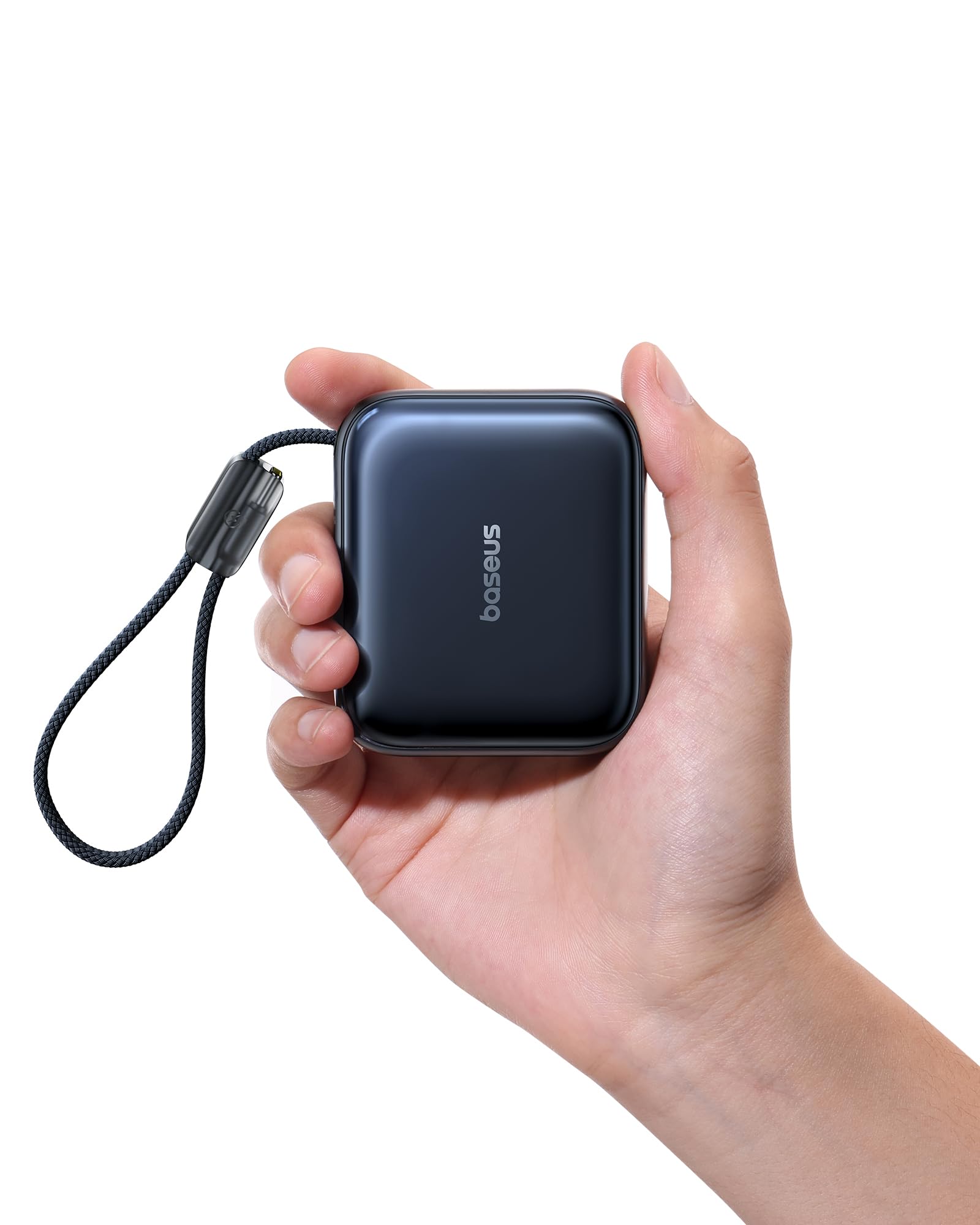
The Baseus PicoGo AC22 is the smallest 10,000 mAh pack we’ve tested that still delivers full 45W PD fast charging. At just 6 ounces and roughly the size of an earbuds case, it disappears into a hip-belt pocket or stuff sack. The built-in braided USB-C cable doubles as a carry strap tested to 12,000 bends and 25 lbs of load — no more fumbling for a cable in twilight. It charged an iPhone 17 Pro to 50% in 20 minutes and a MacBook Air to 42% in 25 minutes, making it one of the fastest options for hikers who carry both a phone and a small laptop.
The dual-port system (built-in cable plus an extra USB-C port) lets you charge two devices simultaneously without bottlenecking. The intelligent LED display shows remaining percentage and active fast-charging status, so you know exactly when to start conserving power for the next day. The cooling system with an NTC temperature control chip keeps heat in check even during sustained 45W output.
This pack shines for fast-and-light backpackers who value every gram. The only compromises are the 10,000 mAh capacity, which limits you to roughly two phone charges, and the absence of an IP rating — you’ll need a dry bag for wet conditions. For fair-weather fast missions, it’s hard to beat this tiny powerhouse.
Why it’s great
- Smallest physical footprint for 10,000 mAh with 45W PD fast charging
- Built-in braided cable tested to 12,000 bends for long-term reliability
- Can charge a MacBook Air to 42% in 25 minutes
Good to know
- No IP or drop-test rating — not for wet or rocky conditions
- 10,000 mAh only enough for two full phone charges
3. INIU Smallest 20000mAh Power Bank

The INIU packs 20,000 mAh into a 313-gram frame, delivering four full phone charges from a unit that feels denser than its dimensions suggest. The detachable USB-C cable woven with ultra-durable nylon attaches to your backpack as a lanyard — a clever solution that eliminates cable clutter at camp. True 22.5W PD fast charging blasts a Samsung S25 to 70% in 25 minutes, and the built-in thermal sensors actively dissipate heat during sustained output, preventing the throttling that slower packs exhibit.
The smart digital display shows exact battery percentage, eliminating guesswork. The integrated flashlight is a welcome addition for tent setup at dusk or finding gear in your pack at night. At 4.1 inches long and 1.2 inches thick, it slides into a side pocket without adding bulk. The TSA-approved capacity means it’s flight-safe, so this pack transitions seamlessly from trail to air travel.
The main drawback is that the detachable cord strap can be easy to lose if you’re not deliberate about clipping it back. Some users note the pack is slightly bulkier than expected for 20,000 mAh, but given the price point, the capacity-to-weight ratio is excellent for weekend backpackers who want to skip recharging mid-trip.
Why it’s great
- Four full phone charges from 20,000 mAh in a compact package
- Detachable nylon lanyard doubles as a USB-C cable
- Flight-safe and includes a bright built-in flashlight
Good to know
- Detachable cord is easy to misplace if not clipped back
- Slightly heavier than standard 10,000 mAh packs, as expected
4. Anker Zolo 10000mAh 30W Power Bank
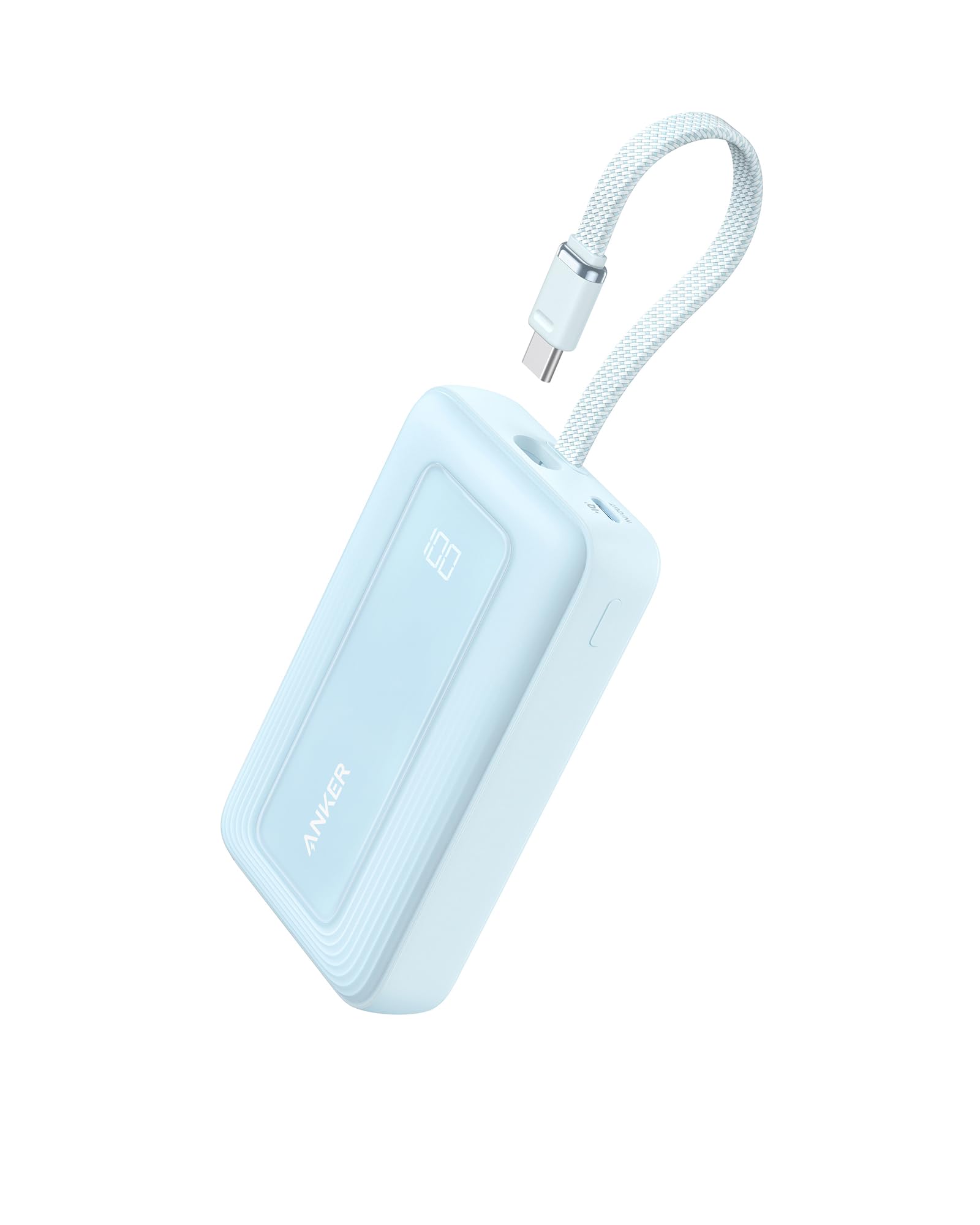
Anker’s Zolo brings their signature reliability to a 10,000 mAh form designed for daily carry and weekend trips. The 30W bi-directional charging means you can recharge the pack itself at up to 20W input, so it’s ready for the next day faster than 18W rivals. The built-in USB-C cable, tested to over 10,000 bends, is 5.4 inches long — short enough to avoid tangling but long enough for comfortable use. On the trail, it delivered two full charges for an iPhone 15 with the pack still showing 10% remaining.
The LED display gives precise percentage readout, a small but critical feature when conservation matters. At 4.32 x 2.58 x 0.98 inches and 223 grams, this is one of the most pocketable 10,000 mAh packs available. The 30W output charges an iPhone 16 Pro Max to 50% in 27 minutes — legitimately twice as fast as entry-level 5V/3A power banks. For backpackers who rely on Anker’s proven track record, this is a no-surprises choice.
Users report the pack survives drops with no shell damage, though it lacks an official IP rating for wet conditions. The 10,000 mAh capacity means you’ll need to recharge on longer trips, but for overnighters and day hikes, this balance of speed, size, and build quality is exceptional. The blue color adds a subtle personality without screaming “gear nerd.”
Why it’s great
- 30W PD output charges phones twice as fast as standard packs
- Built-in cable tested to 10,000 bends for long-term durability
- Bi-directional 20W input for faster pack recharging
Good to know
- No official water or dust resistance rating
- 10,000 mAh limits you to about two full phone charges
5. Orfeika 20000mAh Power Bank
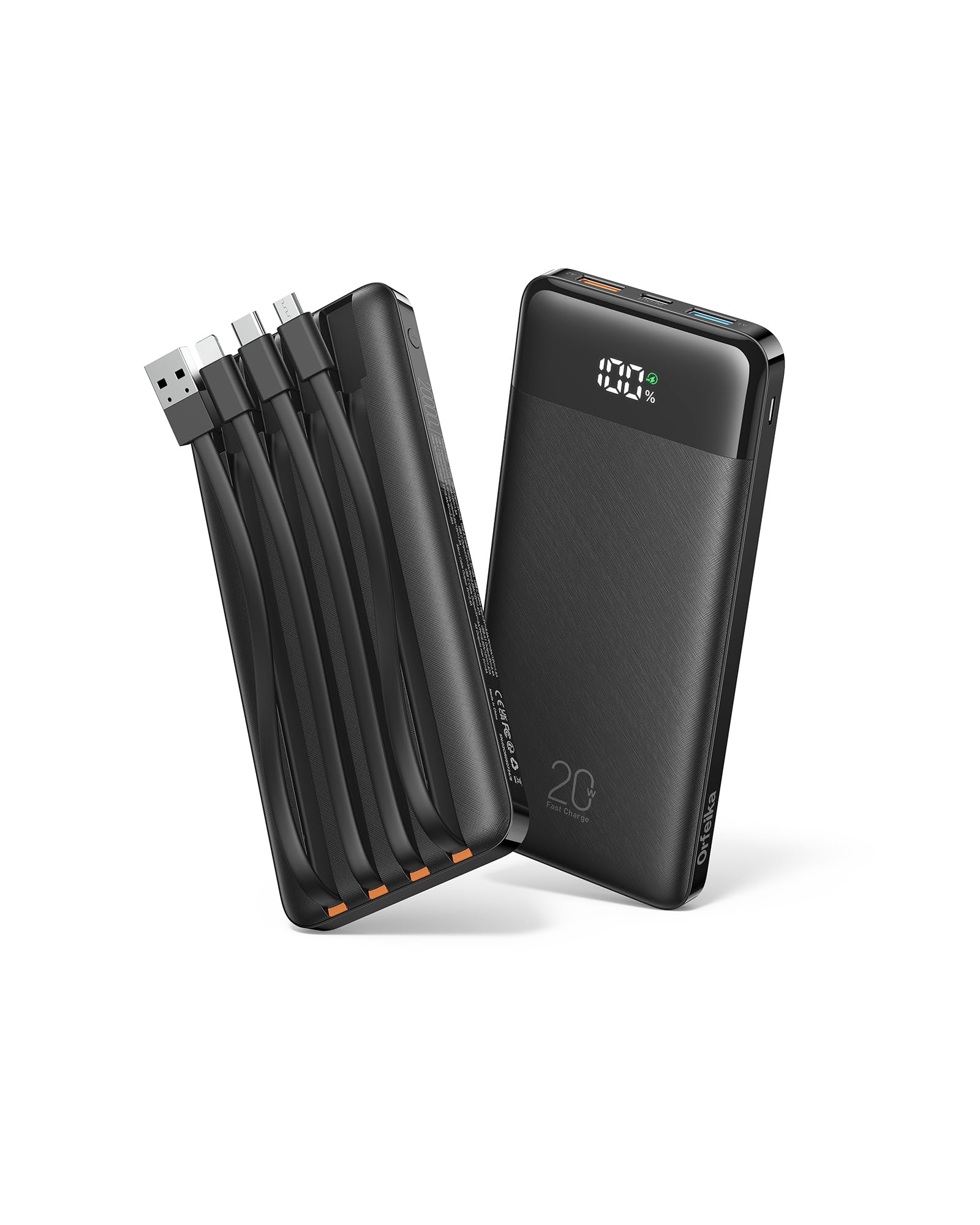
The Orfeika 20000 mAh pack solves the biggest headache on group backpacking trips: cable compatibility. Four built-in cables (Lightning, USB-C, USB-A, and Micro) plus three external ports let you charge up to six devices simultaneously — perfect for a camp full of friends with different phones, tablets, and earbuds. The 20W PD USB-C output charges an iPhone 16 to 50% in 45 minutes, and the pack itself recharges at up to 18W input, so downtime between trail days is minimal.
The scratch-resistant, fire-retardant shell with diagonal texture provides a secure grip even with cold or wet hands. An LED display shows exact remaining battery percentage, and a Low Power Mode safely charges small devices like smartwatches and earbuds without overloading them. At 0.73 lb and 6.33 x 2.85 x 0.74 inches, it’s slim enough to slide into a pack’s front pocket. The included travel pouch keeps everything organized when not in use.
The built-in cables add convenience but also represent potential failure points if they wear out mid-trip. The 20W PD speed, while adequate, is slower than the 30W or 45W options on this list. For group hikes or family car-camping where multiple people need juice, the Orfeika’s all-in-one approach saves packing separate cables and adapters.
Why it’s great
- Four built-in cables eliminate the need to carry separate cords
- Six total outputs charge multiple devices simultaneously
- Low Power Mode protects sensitive electronics like earbuds
Good to know
- Built-in cables may wear out faster than a single high-quality cord
- 20W PD output is slower than 30W or 45W alternatives
6. MaiVoz 56800mAh Portable Charger
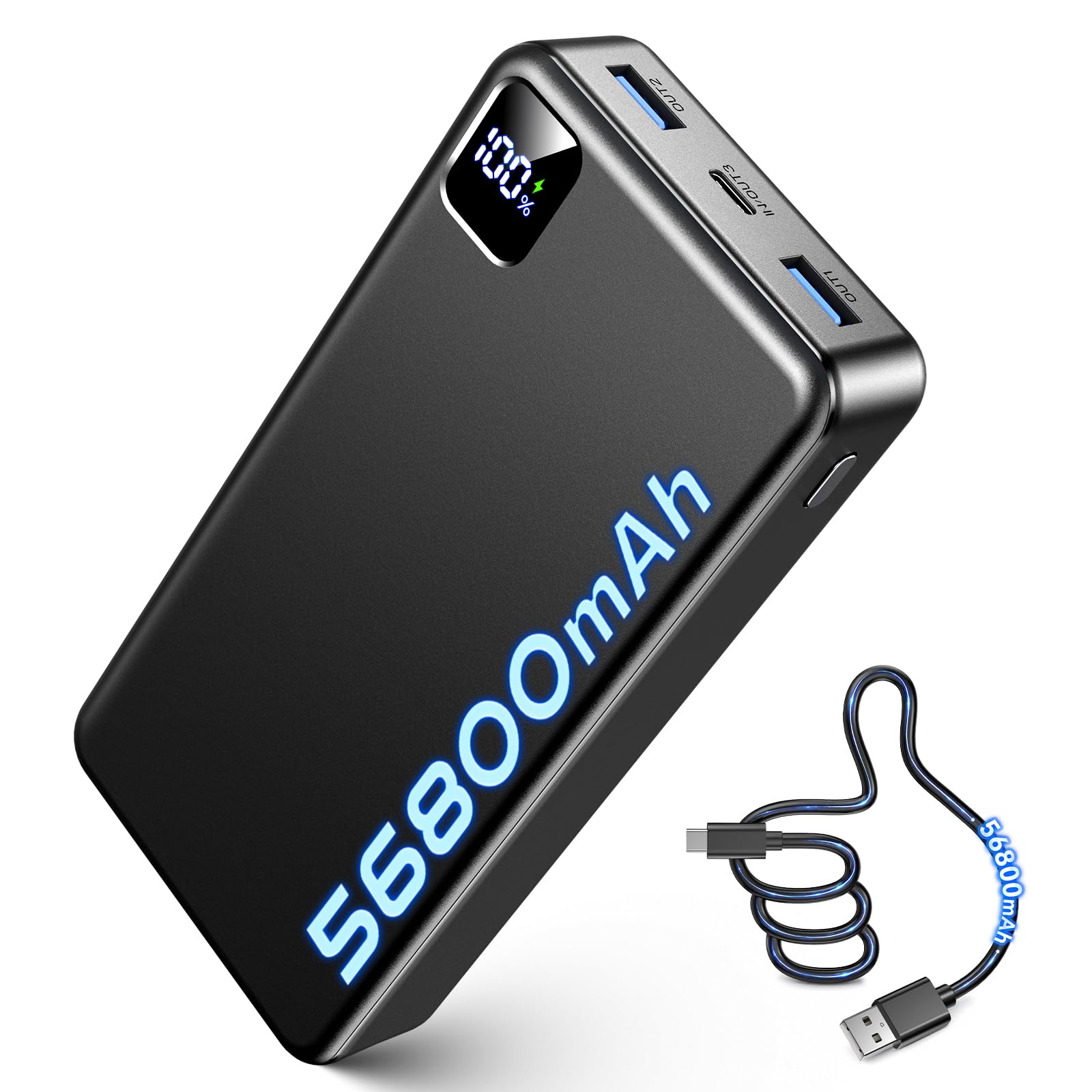
The MaiVoz packs a staggering 56,800 mAh — enough to charge an iPhone 17 more than ten times or run a small camp light for days. With 22.5W PD fast charging, it tops up an iPhone 17 to 60% in 40 minutes, and the dual USB-A plus one USB-C port let you charge three devices simultaneously. The LED digital display shows exact remaining battery, and multi-layer safety protection guards against overvoltage, overheating, and short circuits.
This is not a pack you carry in your pocket while bushwhacking. At 7 x 1.3 x 3.4 inches and roughly 460 grams, the MaiVoz is best suited for base camp, car camping, or long stays at a backcountry hut where weight isn’t the primary constraint. Users report the pack uses 20-25% charge to fully top up an iPhone 17 Pro Max, meaning you could share this with a group for a full week without recharging the pack itself.
The main limitation: it’s not allowed on airplanes due to the 56,800 mAh capacity exceeding the 100 Wh limit for carry-on batteries. For backpackers driving to the trailhead or using this as a stationary power hub at camp, the raw capacity is unmatched. Reviews note the pack is heavy but well-built — the weight is the price of carrying a week’s worth of power in a single device.
Why it’s great
- 56,800 mAh capacity powers a phone for over a week off-grid
- 22.5W PD fast charging tops phones to 60% in 40 minutes
- Triple-device charging with clear LED percentage display
Good to know
- Heavy at 460 grams — not for ultralight backpacking
- Exceeds airline carry-on limits for battery capacity
7. YBYP 50000mAh Portable Charger
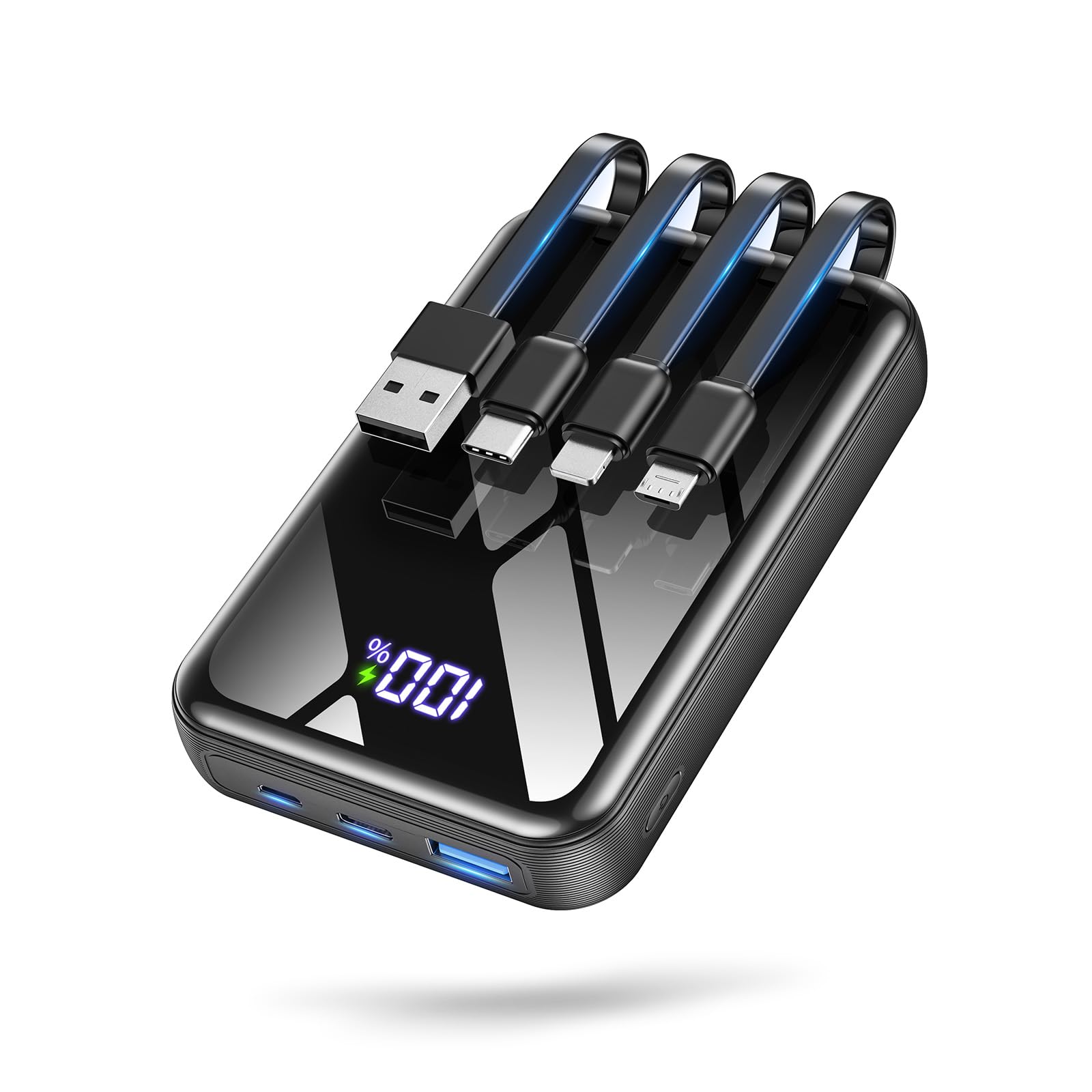
The YBYP 50,000 mAh pack offers 22.5W fast charging with an ultra-compact footprint for its capacity — 30% smaller and 15% lighter than traditional high-capacity models at just 0.75 lb. It charges an iPhone 17 up to 9.1 times or a Galaxy S25 up to 8.1 times, making it one of the highest-capacity packs that still fits in a large pocket. The four built-in cables (Micro-B, USB-A, Type-C, and Lightning) plus three extra ports allow up to five devices to charge simultaneously.
The smart LED display shows exact battery percentage, and 8-layer safety protection (overcurrent, overvoltage, short-circuit, temperature control) provides peace of mind during extended use. Users report excellent charge retention — the pack holds its juice for weeks between trips, and the built-in cables eliminate the need to carry separate cords. For car-camping, power outages, or base camp setups, this pack delivers near-generator-level capacity in a manageable form factor.
As with the MaiVoz, the 50,000 mAh capacity exceeds airline carry-on limits. The claimed 22.5W charging delivers decent speed, but some users note it charges slightly slower than dedicated 30W PD packs for individual devices. The included USB-C cable is a nice bonus. For stationary camp use or emergency home backup, the YBYP is an exceptional value with its built-in cable ecosystem and high capacity.
Why it’s great
- 50,000 mAh charges a phone 9+ times for extended off-grid stays
- Four built-in cables plus three ports for five-device simultaneous charging
- 8-layer safety protection with real-time temperature monitoring
Good to know
- Not flight-safe due to capacity exceeding 100 Wh
- 22.5W charging slower than premium 30W or 45W packs per device
FAQ
Can I take a 50,000 mAh battery pack on a plane?
How does cold weather affect battery pack performance?
Should I choose a pack with built-in cables for backpacking?
How many times will a 10,000 mAh pack charge my phone?
Final Thoughts: The Verdict
For most backpackers, the best battery pack for backpacking is the ELECOM NESTOUT 10000mAh because its IP67 rating, MIL-STD-810G drop certification, and modular design make it the only pack that truly matches the harshness of alpine and wet trail conditions. If you prioritize weight and pocketability above all else, grab the Baseus PicoGo AC22 Mini. And for group trips or base camp setups where capacity rules, nothing beats the MaiVoz 56800mAh for keeping a whole crew powered for a week without recharging.

Mo Maruf
I created WellFizz to bridge the gap between vague wellness advice and actionable solutions. My mission is simple: to decode the research and give you practical tools you can actually use.
Beyond the data, I am a passionate traveler. I believe that stepping away from the screen to explore new environments is essential for mental clarity and physical vitality.