Our readers keep the lights on and my smoothie glass nicely filled. As an Amazon Associate, I earn from qualifying purchases.
Specs are compiled from manufacturer listings and verified buyer reviews and can change over time — please confirm the key details on the product page before buying.
When the power goes out and your phone battery is draining fast, a battery operated radio is the one device that keeps you connected to the outside world. You get weather updates, emergency alerts, and news — all without Wi-Fi or cell service. The trick is finding one that actually holds a charge, pulls in stations clearly, and doesn’t quit on you mid-storm.
I’m Mohammad Maruf — the founder and writer behind WellFizz. This guide is built by comparing the manufacturers’ published specifications and the patterns across verified customer reviews, so you get each pick’s real strengths and trade-offs instead of marketing spin.
Whether you are prepping for hurricane season or just want a reliable companion for camping trips, this roundup of the best battery operated radio models helps you pick the one that suits your situation and budget.
Our Picks at a Glance


How To Choose The Best Battery Operated Radio
Not every radio that runs on batteries is built the same. Some are designed for everyday kitchen listening, while others are purpose-built to withstand a blackout. Here is what separates a smart buy from a regret.
Power Source Versatility
You do not want a radio that goes silent the moment one battery dies. The most practical models give you at least two ways to stay powered — disposable batteries (AA, AAA, or D cells) for immediate use, plus a built-in rechargeable cell you can top up via USB, solar panel, or hand crank. If you are building an emergency kit, look for at least three power options so a dead flashlight battery never silences your news.
AM / FM / NOAA Coverage
Standard AM and FM cover local news and music stations, but NOAA weather band is the feature that can save your day during a storm. These dedicated channels broadcast direct alerts from the National Weather Service — tornado warnings, flash flood watches, hurricane updates — that may not be repeated on regular AM/FM. If severe weather is a concern in your area, a radio with seven NOAA channels gives you the widest safety net.
Speaker Quality and Output Power
A small speaker sounds tinny when the room is noisy and the AC is off. Speaker size and power output (measured in watts) determine how clearly you hear important alerts from across the room. A full-range speaker around 5W delivers clear, balanced sound that fills a living room or tent without distortion, while smaller units work fine for close listening at your bedside or workbench.
Quick Comparison
| Model | Best For | Battery Capacity | Speaker | Power Sources | Amazon |
|---|---|---|---|---|---|
| Roxicosly CR1030★ Best Overall | All-round emergency kit | 12000mAh | 5W | 5-way | Amazon |
| PRUNUS J15WBBest Value | Simple daily listening + weather | — | — | AC or 3x D cell | Amazon |
| FosPower A1Compact Pick | Compact go-bag companion | 7400mWh (2000mAh) | — | 3-way | Amazon |
| Rychi Emergency Radio | Long runtime between charges | 10000mAh | — | 4-way | Amazon |
| Vokida 37000mWh | Survival kit extras | 37000mWh | — | 3-way | Amazon |
| Panasonic RF-2400D | Analog simplicity for seniors | — | — | AC or 4x AA | Amazon |
| PPLEE CR1030 | Power bank plus radio | 12000mAh / 44400mWh | 5W | 5-way | Amazon |
| Mesqool Weather Radio | Off-grid solar efficiency | 12000mAh | — | 5-way | Amazon |
In‑Depth Reviews
1. Roxicosly CR1030 Emergency Weather Radio
Our pick — over 4.5★ from 400+ verified ratings; the strongest balance of quality and price.
The five-way charger that keeps your phone alive when the storm is at its worst.
The Roxicosly is the most versatile battery operated radio in this lineup, and the 4.8-star rating across hundreds of owners reflects that. Its standout feature is the real 12000mAh battery — unlike radios with exaggerated claims, this one gives you dependable power to charge your phone, run the reading lamp, and keep the FM playing through a blackout. The 5W full-range speaker delivers clear, balanced sound for AM, FM, and NOAA weather alerts without that hollow tinny tone smaller units suffer from. Buyers report the reception is loud and clear, and the IPX6 waterproof rating means you can leave it out on a rainy campsite without worry.
What wins people over is the sound quality — mentioned more than any other aspect, with over sixty owners praising how the radio sounds for a preparedness device. The 8500mm² monocrystalline solar panel is noticeably larger than standard models, so it captures more sunlight and converts it faster. Owners also note the hand crank is efficient, and the dual emergency lights — a 5W adjustable-beam flashlight and a soft 12-LED reading lamp — offer multiple brightness levels. The compact 6.8 x 2.88 x 4.74-inch body fits easily into a go-bag or kitchen drawer.
The rubber flap covering the charge port arrived loose from the start for some units — a minor fix with a piece of tape, but worth knowing before you need it in a hurry. Also, there is no volume control for the storm warning tone, so when the NOAA alert triggers, the 9-second alarm plays at full volume no matter what. For most households, that is a safety feature, not a flaw.
Why owners love it
- Genuine 12000mAh battery charges phones and runs lights during extended blackouts
- 5W speaker produces clear, room-filling sound for FM and weather alerts
- Five power sources — solar, hand crank, USB-C, AAA batteries, and built-in rechargeable
Honest trade-offs
- Rubber charge port cover can be loose from the factory
- Storm warning alarm has no volume adjustment — it plays at full blast
- Tuner is not the most sensitive; strong local stations come in best
Reach for it if: you want a single emergency radio that does it all — charges your phone, lights a room, and pulls in weather alerts for years to come.
Think twice if: you need silent weather monitoring; the alert siren is loud and non-adjustable.
2. PRUNUS NOAA Weather AM FM Portable Radio J15WB
The straightforward radio that runs for weeks on three D cells and costs less than a pizza dinner.
The PRUNUS is the antithesis of the feature-packed emergency bricks above — and that is exactly its appeal. It uses three D cell batteries (not included) that buyers call a huge plus versus fiddly AA or AAA cells, and it also runs on AC power when you are near a wall outlet. The 31-inch telescopic antenna combined with a DSP chip pulls in AM, FM, shortwave, and seven NOAA weather channels with reception that owners say beats their car radio. At 9.33 inches tall and 1.29 pounds, it is lightweight enough to carry from room to room but stable enough to stay put on a countertop.
Owners describe the sound as crisp, and the large dynamic speaker fills a room without distortion. Controls are deliberately simple — an On-Off-Vol wheel, band switch, light switch, and tuning knob with a large easy-to-read dial. This simplicity makes it a popular Christmas gift for elderly parents and grandparents who do not want to wrestle with menus or Bluetooth pairing. The built-in flashlight is a practical bonus for power outages, and the headphone jack lets you listen privately without disturbing others.
The main trade-off is that the volume knob sits under a non-folding handle, so it can be awkward to reach if the handle is in the upright position. There is no USB or 12V input, so you cannot use this radio to charge your phone. And unlike the Roxicosly above, the PRUNUS has no rechargeable battery — you either plug it in or buy D cells. For everyday listening and basic emergency coverage, that is a fair compromise for the price.
Simple and dependable: A no-fuss AM/FM/NOAA radio with excellent reception and long battery life from three D cells — perfect for anyone who wants to twist a knob and listen, not dig through menus.
One real limitation: No USB charging output means it cannot double as a power bank for your phone during extended outages.
Best for: seniors, budget-minded households, and anyone who wants a reliable radio that runs on widely available D batteries.
Look elsewhere if: you need to charge your phone from the radio or want a built-in rechargeable battery.
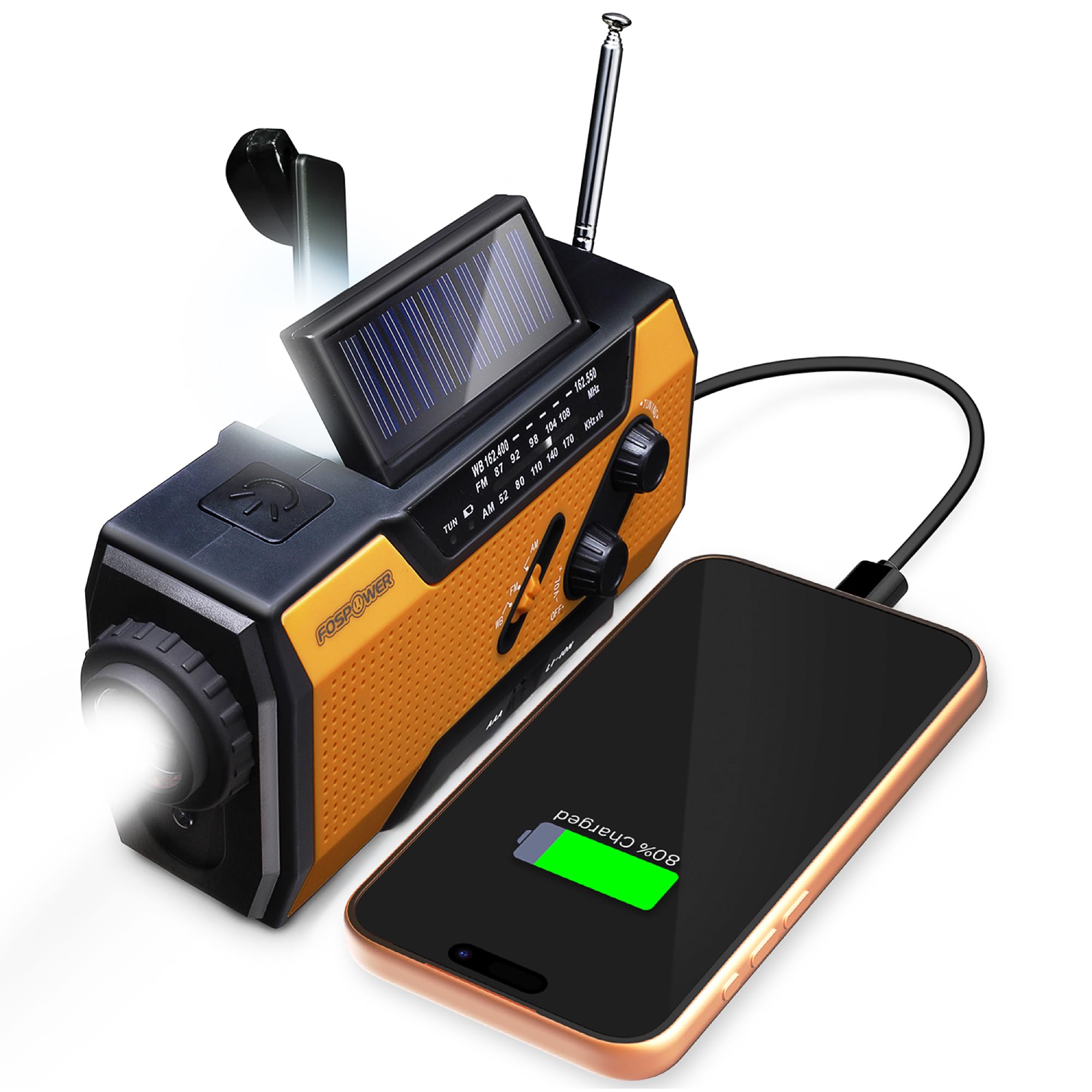
3. FosPower NOAA Emergency Weather Radio A1
A palm-sized emergency kit that slips into a bug-out bag and still charges your phone.
The FosPower A1 is the most compact of the emergency radios here, measuring just 6.2 x 2.1 x 2.9 inches and weighing 14.8 ounces. Despite the small footprint, it packs a 7400mWh (2000mAh) power bank capable of giving your phone a partial emergency charge. Owners appreciate that it works right from the start — the hand crank regenerates power for the radio, lights, and SOS alarm, and the small solar panel on the back adds another charging path. The 4-LED reading light and 1W flashlight provide enough illumination to navigate a dark house or tent, and the speaker is loud enough to hear across a room.
Hundreds of owners call this a durable piece of gear for emergency kits. The radio receives NOAA weather broadcasts (a dedicated network of stations broadcasting continuous weather info from the National Weather Service) and AM/FM stations with decent sensitivity, and the tuning dial is straightforward even in a panic. The AAA battery backup ensures the radio works even if the internal rechargeable cell is depleted — a smart redundancy that the PRUNUS lacks. The limited lifetime warranty adds confidence that budget radios rarely offer.
Charging via the hand crank and solar panel is effective but slow compared to the Roxicosly or Mesqool models with larger panels. Owners note the charging speed is mixed — fine for topping off the radio, but expect to spend time cranking if you need to charge a phone. Also, the sound quality is limited compared to larger units; it is perfectly adequate for talk radio and alerts, but music lovers will notice the lack of bass.
What fits the pocket
- Ultra-compact size and under a pound — disappears into a go-bag or glove compartment
- Triple power sources: hand crank, solar, and AAA backup batteries
- Limited lifetime warranty backs the purchase long-term
What to know
- Solar panel is small — trickle charging only in direct sunlight
- Speaker sound is adequate for news but lacks depth for music
- Internal battery capacity (2000mAh) is modest; expect one partial phone charge
Grab it for: building a compact emergency kit where every ounce and inch counts — camping, hiking, and car survival bags.
Pass if: you need all-day music listening or enough power to recharge a tablet fully.
4. Rychi 10000mAh Emergency Radio

The radio that plays 25 hours on a single charge and still has power left for your phone.
The Rychi stands out for its claimed runtime — up to 25 hours of radio playback at medium volume, 30 hours with the reading lamp, and 40 hours with the flashlight from its 10000mAh rechargeable battery. That kind of endurance means you are not cranking or solar-charging every few hours during a multi-day outage. The four charging methods (USB Type-C, hand crank, solar panel, and AAA batteries) give you flexibility no matter the situation. Owners call it well-built and compact at 6.69 x 2.83 x 3.26 inches and 1.2 pounds — light enough for a child to carry.
The extended 7-section antenna pulls in AM (520-1710 kHz), FM (87-108 MHz), and WB (162.400-162.550 MHz) frequencies with good clarity, and the bright LCD display makes tuning easy even in dim light. The 3W super-bright flashlight and LED reading lamp cover both wide-area and focused lighting needs. Pressing the SOS button triggers a loud alarm with flashing lights — a feature owners appreciate during hurricanes and tornadoes. The 18-month warranty is longer than most budget emergency radios offer.
The solar panel is functional but owners describe it as useless for normal charging — it works in direct sunlight for trickle topping but should not be your primary power source. A few owners reported the solar charging failed after about a year. Also, at 1.2 pounds it is heavier than the FosPower A1, so ultralight backpackers may leave it behind. The sound quality is described as so-so: clear enough for talk radio and weather updates, but not rich enough for dedicated music listening.
Long runtime champion: The 10000mAh battery delivers days of radio, flashlight, and phone charging before needing a recharge — ideal for extended power outages.
One honest caveat: The solar panel is a backup, not a primary charger — expect it to contribute slowly in bright sun only.
Choose it if: you want the longest possible runtime between charges and need a radio that can keep your phone alive for days.
skip it if: you rely on solar charging as a main power source — this panel is too small for that role.
5. Vokida 37000mWh Emergency Radio
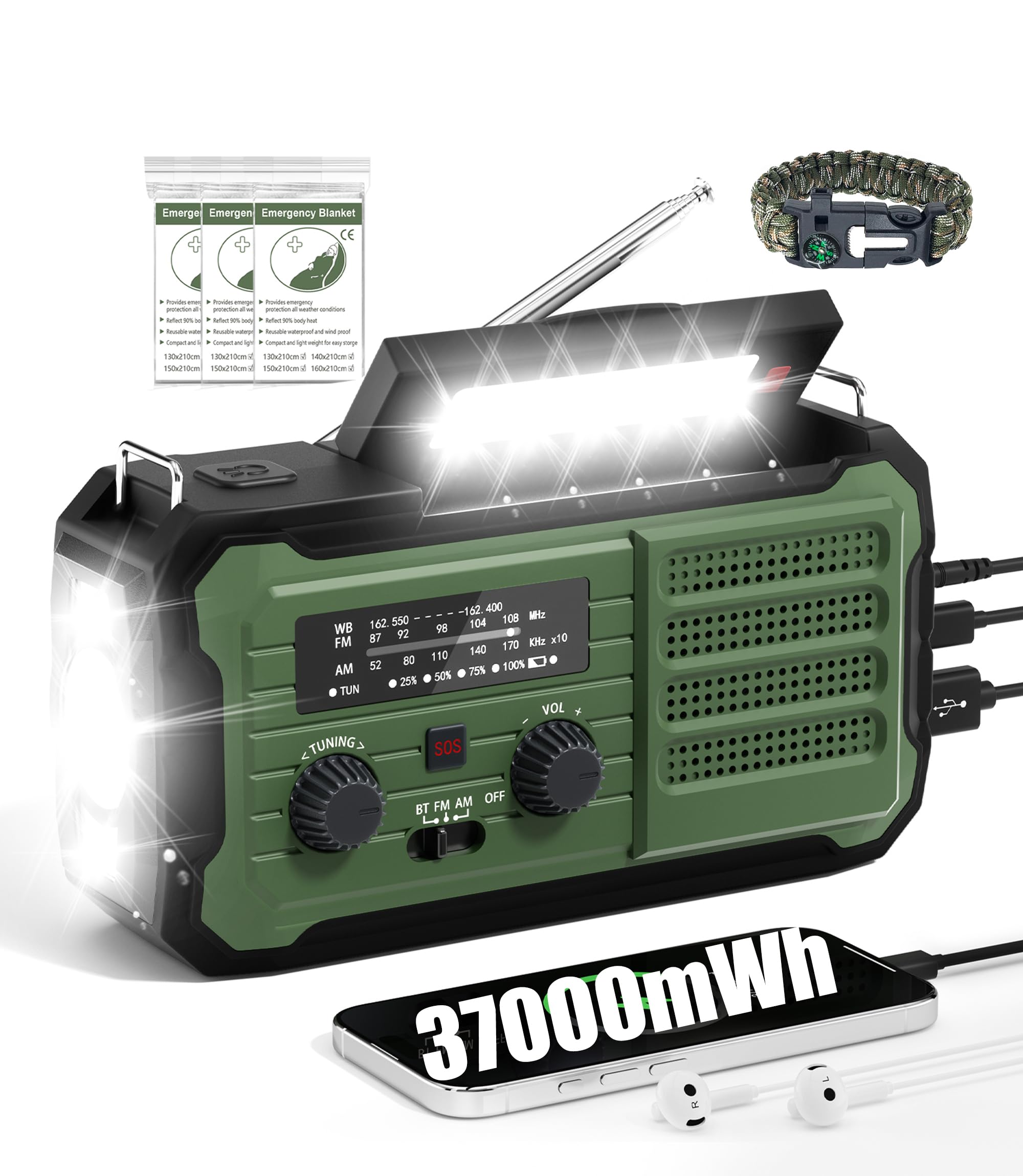
The radio that arrives with thermal blankets and a paracord bracelet — ready for the wilderness right from the start.
The Vokida is a survival-centric battery operated radio that bundles extras most competitors leave out. Inside the box you get three emergency thermal blankets (each weighing 55g, designed to reflect body heat and signal rescuers), a 5-in-1 survival paracord bracelet with a compass, blade, whistle, and magnesium fire rod, plus the radio itself. The 37000mWh rechargeable battery powers clear AM, FM, and NOAA reception, and the three charging methods (hand crank, solar panel, and internal lithium-ion battery) ensure you can keep it running when the grid is down. Owners praise the strong reception — it works with or without the antenna extended.
Quality is the most-mentioned positive, with over forty owners calling it a solid, durable build. The automatic NOAA weather scan cycles through all seven weather band channels and alerts you even while you are asleep — a critical feature during winter storms, tornadoes, and hurricanes. The built-in super-bright flashlight offers multiple brightness levels, and the headphone jack lets you listen closely without draining the speaker battery. USB-A and USB-C ports let you charge your smartphone or tablet, and the SOS button triggers a loud siren with flashing red light.
The thermal blankets and paracord bracelet are thoughtful additions, but they add bulk to an already packable radio. The solar panel, like many in this class, is best for trickle charging rather than primary power — expect slow top-ups in direct sun. A few owners note the radio is too heavy for serious backpacking at roughly the same weight as the Rychi, but for car camping, home emergency kits, and storm prepping it is a complete survival bundle.
What makes it different
- Comes with three thermal blankets and a survival paracord bracelet — a full emergency kit in one box
- Automatic NOAA scan alerts you to weather dangers even while you sleep
- USB-A and USB-C ports for charging phones and tablets
What to consider
- Solar panel charges slowly — best used as a backup rather than primary source
- Heavier than compact options; not ideal for ultralight backpacking
Buy it for: a complete emergency preparedness kit in one purchase — radio, power, blankets, and survival tools.
Reconsider if: you only need a radio and already have a survival kit — the extras may be redundant.
6. Panasonic Portable AM/FM Radio RF-2400D

The analog workhorse that grandpa can tune without reading glasses and that outlasts every smartphone on the shelf.
The Panasonic RF-2400D is the opposite of the multi-function emergency radios above — it is a pure, simple AM/FM portable that does one thing and does it exceptionally well. It runs on four AA batteries or the included AC adapter, making it equally at home on a kitchen counter or in a camping tent. The large analog dial features a fluorescent pointer that glows in the dark, so you can find your favorite station even during a blackout. Quality is the most-praised aspect, with thousands of owners calling it a reliable, well-made radio that keeps going year after year.
Sound quality is the second most-mentioned positive, with thousands of owners praising the clear speaker that delivers AM and FM without the noise and interference that plague smaller palm-sized radios. The 3.5mm headphone jack provides private listening, and the simple controls — a large tuning knob and a volume wheel — are intuitive for all ages. Owners specifically mention it as a perfect radio for seniors who want easy operation, and families who need a dependable battery operated radio for severe weather. It is lightweight and portable enough to carry around the house or toss into a weekend bag.
There is no NOAA weather band, no Bluetooth, and no phone charging. The AM reception can be weak depending on your location — some owners found FM excellent but AM lacking compared to older Panasonic models. The tuning scale can be off by about 20 units, so you may need to fine-tune by ear rather than trusting the printed numbers. And the headphone output is monaural, not stereo, so music through headphones sounds flat. For basic news, talk radio, and emergency broadcasts, none of that matters — this is a radio built for function, not features.
Pure reliability: A time-tested analog radio with a glowing dial, clear sound, and battery life measured in weeks — the definition of set-and-forget.
One real limitation: No weather band means tornado warnings come from regular AM/FM stations, not the NOAA alert system.
Ideal for: seniors, minimalist households, and anyone who values dead-simple operation over feature lists.
Not for: storm chasers or anyone who needs automatic NOAA weather alerts during severe weather.
7. PPLEE CR1030 Emergency Radio
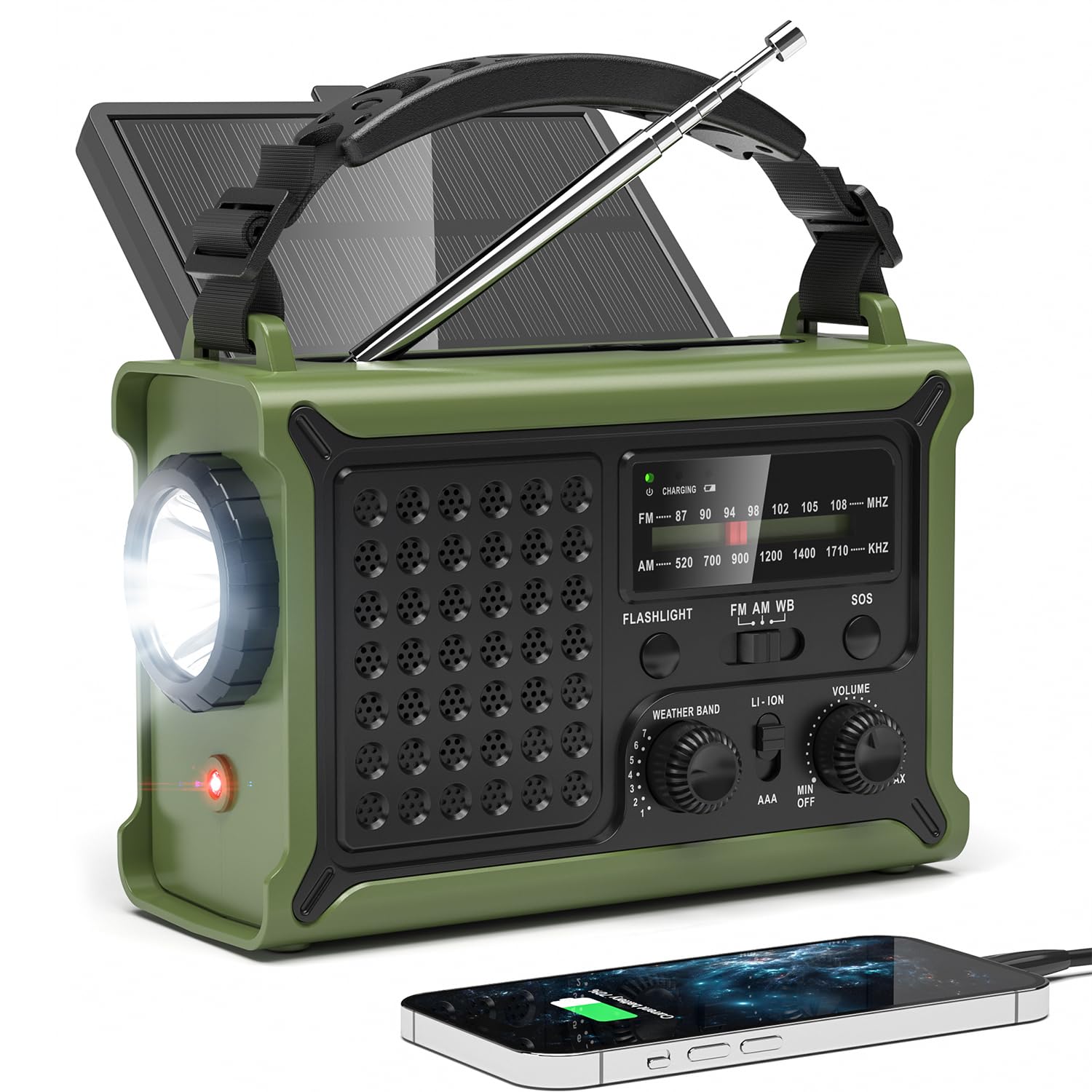
The bass-rich 5W speaker and verified 12000mAh battery that make this radio feel like a serious piece of emergency gear.
The PPLEE CR1030 matches the Roxicosly in battery capacity (12000mAh / 44400mWh) and adds a verified 5W full-range speaker that delivers clear, balanced audio for AM, FM, and NOAA weather broadcasts. The 57mm 5W speaker is noticeably larger than typical emergency radio speakers, so talk radio and weather alerts sound natural instead of tinny. Owners praise the excellent AM/FM/weather reception, attributing it to the high-sensitivity IC chip and precision antenna that lock onto distant signals even in basements, cabins, and concrete buildings. The hand crank design features a 650mA output for reliable backup charging during outages.
The 8500mm² monocrystalline solar panel matches the Roxicosly’s size, providing faster solar charging than standard small-panel radios. The flashlight offers a focused beam, and the 12-LED reading lamp provides soft area lighting. Five power sources — built-in rechargeable battery, solar, hand crank, USB cable, and three AAA batteries — give you the maximum flexibility for any scenario. Owners describe the controls as simple with large analog tuning knobs, clear labels, and tactile buttons that are easy to operate in the dark or by seniors. The compact 6.8 x 2.9 x 4.7-inch body with a non-slip grip fits comfortably in hand.
The weather alert feature must be activated manually by sitting on the weather band with the volume down — it does not passively alert you if the radio is off. Owners note that reception can be spotty when the radio is plugged into AC power; it works best with the antenna fully extended. The rubber hatch protecting the jacks is splash-resistant but not fully waterproof, so keep it out of heavy rain. For the price, this is a well-thought-out, sturdy unit that competes directly with the top pick above.
What stands out
- Verified 12000mAh (44400mWh) battery provides extended power for days of radio and phone charging
- 5W full-range speaker delivers clear, balanced sound that fills a room
- Five-way power sources offer maximum charging flexibility in any situation
What to note
- Weather alert requires manually tuning to WB channel — no automatic passive alert
- Reception can degrade when plugged into AC; best with antenna fully extended
- Rubber port hatch is splash-resistant, not fully waterproof
Reach for it if: you want a premium emergency radio with a big speaker and verified battery capacity that competes with the top pick feature-for-feature.
Pass if: you need automatic passive weather alerts that sound even when the radio is turned off.
8. Mesqool Weather Radio
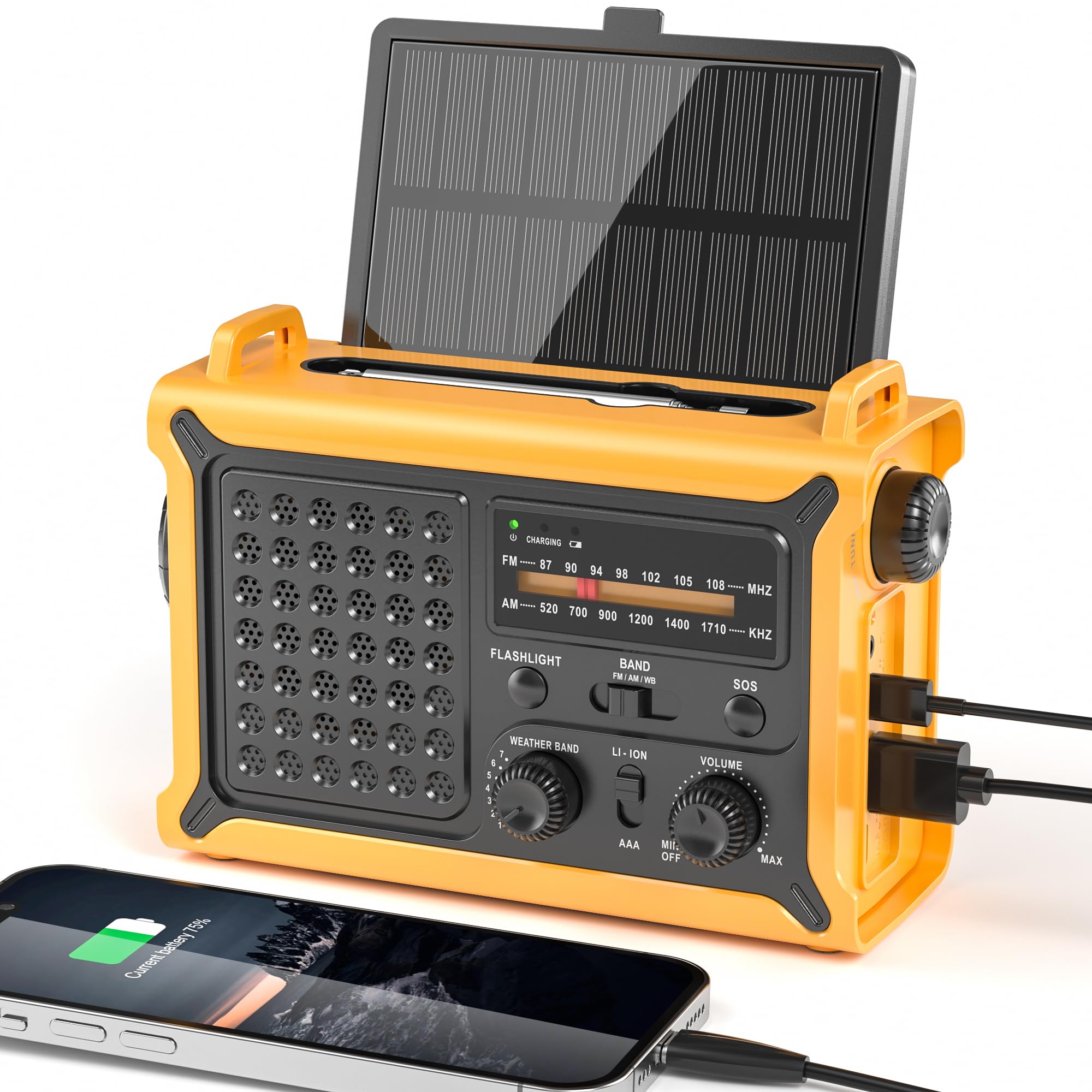
The solar-powered radio that one owner used daily for months without ever plugging it in — even in cloudy weather.
The Mesqool radio is built around the same 8500mm² monocrystalline solar panel (a single-crystal silicon panel that converts sunlight to electricity) found on the premium models, but owners mention it works remarkably well — one buyer used it daily on a camping trip and the radio ran all night at low volume while the solar panel charged it back up during the day, 99% solar-powered. That real-world experience backs up the claim that this large panel captures significantly more sunlight than the 2000mm² decorative panels found on cheaper models. The true 12000mAh lithium battery keeps the radio and lights running for days, and the five-way power sources (solar, hand crank, USB, AAA batteries, and internal rechargeable) give you every option to stay powered.
Quality is the most-discussed positive, and over 150 owners praise the sturdy ABS construction. The high-sensitivity signal chip and noise-reduction circuitry deliver fast, stable reception across NOAA, FM, and AM bands — owners say the sound is crisp and the speaker is excellent. The flashlight casts a focused beam, and the frosted reading lamp provides a soft warm glow, both with two brightness levels. The ergonomic 6.8 x 4.7 x 2.9-inch body with non-slip grip feels natural in hand, and owners say the large tuning knob and responsive buttons are easy to operate even in the dark or for elderly users.
The hand crank features a high-torque design with a larger copper coil and reinforced magnet. Owners say it is smooth and low-effort. The main missing feature is a battery level indicator — you cannot tell exactly how much charge remains without using the radio and seeing if it powers on. A few owners note the weather alert system works well but requires being on the weather band with the volume down to activate passively. For off-grid campers and serious preppers, this is the solar champion of the lineup.
Why it shines
- Large 8500mm² solar panel charges reliably even in cloudy weather, per owner reports
- True 12000mAh battery runs radio and lights for extended off-grid use
- High-torque hand crank with reinforced internals charges faster than standard models
Honest trade-offs
- No battery level indicator — you cannot check remaining charge at a glance
- Sturdy ABS body adds weight; it is the heaviest radio here at 1.6 pounds
- Weather alert requires manual tuning to WB channel; no automatic passive alert
Best for: off-grid campers and preppers who want solar charging to be a primary power source, not a gimmick.
Think twice if: you need a lightweight radio for backpacking — the 1.6-pound build is built to last, not to be ultralight.
Understanding the Specs
Battery Capacity: mAh vs mWh
Battery capacity tells you how long your radio runs before needing a recharge. Milliamp-hours (mAh) is the most common rating — a 10000mAh battery can theoretically deliver 1000 milliamps for 10 hours. Milliwatt-hours (mWh) accounts for voltage, so a 37000mWh rating is roughly equivalent to 10000mAh. A higher number means longer runtime for the radio and more emergency charging for your phone. For reference, a typical smartphone battery is around 3000-5000mAh, so a 12000mAh radio can fully charge most phones at least once.
NOAA Weather Band vs Standard AM/FM
Standard AM and FM radio stations broadcast local news, music, and general weather reports. NOAA Weather Radio, by contrast, is a dedicated network of stations that broadcast continuous weather information directly from the National Weather Service — including severe storm warnings, tornado alerts, and flood watches that may not be repeated on commercial stations. Radios with seven NOAA channels can scan through all available frequencies in your area to lock onto the strongest signal, ensuring you hear alerts specific to your region.
FAQ
How long do batteries last in a battery operated radio?
Can I charge my phone from a battery operated radio?
What is the difference between a standard radio and a NOAA weather radio?
How does a hand crank charge the radio?
Will the solar panel work on cloudy days?
Can I use a battery operated radio during a power outage?
What size batteries do most portable radios use?
Is a hand crank radio better than a solar-powered radio?
Final Thoughts: The Verdict
For most buyers, the best battery operated radio winner is the Roxicosly CR1030 because it combines a genuine 12000mAh battery, a 5W speaker, five power sources, and IPX6 waterproofing into a compact package that owners consistently rate highest. If you want something simpler that runs for weeks on D cells and costs less, grab the PRUNUS J15WB. And for off-grid campers who want solar charging to actually work, the Mesqool Weather Radio is the one to reach for — reviewers point out using it for days without ever plugging it into a wall.
How We Picked
We do not accept paid placement. Every pick is matched to a real buyer and a real use-case; we do not hands-on test units.
Sources & Methodology
Specifications: manufacturer listings and product documentation. Review insights: verified customer reviews, as of July 2026. Pricing: not shown on this page (it changes often); check the current price via the retailer link.
As an Amazon Associate, WellFizz earns from qualifying purchases. This does not affect which products we feature.
Related Guides

Mo Maruf
I created WellFizz to bridge the gap between vague wellness advice and actionable solutions. My mission is simple: to decode the research and give you practical tools you can actually use.
Beyond the data, I am a passionate traveler. I believe that stepping away from the screen to explore new environments is essential for mental clarity and physical vitality.