Our readers keep the lights on and my smoothie glass nicely filled. As an Amazon Associate, I earn from qualifying purchases.
When the grid goes silent and your phone battery drains to zero, the only voice you can trust comes through the airwaves. A dedicated emergency radio with multiple power sources — hand crank, solar, and rechargeable battery — ensures you stay locked onto NOAA weather alerts, AM/FM broadcasts, and critical news when cell towers and Wi-Fi vanish. This is not a casual transistor for a picnic; it is a lifeline device built to weather storms, blackouts, and extended off-grid situations.
I’m Mohammad Maruf — the founder and writer behind WellFizz. I’ve spent hundreds of hours analyzing battery capacities, solar panel efficiency, cranking torque, and signal reception across dozens of emergency radio models to find the units that genuinely perform when conditions turn severe.
Whether you are assembling a hurricane kit or building a bug-out bag, the right battery operated radio for emergencies keeps you connected when every other device has gone dark.
How To Choose The Best Battery Operated Radio For Emergencies
An emergency radio is only as useful as its ability to keep running when power is gone and signals are weak. Before you buy, understand the four critical factors that separate a true survival tool from a gadget that collects dust.
Battery Capacity and Power Bank Function
The built-in rechargeable battery is your radio’s heart. Capacity is measured in milliampere-hours (mAh) or milliwatt-hours (mWh). A 10,000 mAh battery can run the radio for 25+ hours on a single charge and still reserve enough juice to top off a smartphone. Lower-capacity units (around 2,000 mAh) drain quickly and may not provide meaningful phone charging. Look for radios with at least 10,000 mAh if you need extended runtime without access to wall power.
Solar Panel Quality and Area
Not all solar panels are equal. Many budget radios use small decorative polysilicon panels around 2,000 mm² that barely trickle-charge in direct sun. Premium units use large monocrystalline panels — 8,500 mm² or more — that capture significantly more energy even in overcast conditions. The panel area directly determines how fast the battery recovers when sunlight is available. A larger monocrystalline panel can make the difference between a radio that stays charged and one that slowly dies.
Hand Crank Efficiency
When sunlight and USB power are unavailable, the hand crank is your last resort. Crank efficiency depends on the internal generator’s copper coil size and magnet strength. High-torque cranks with reinforced magnets can generate meaningful power in 3 minutes of cranking — enough for a short phone call or extended radio playback. Cheap cranks feel loose and produce minimal voltage, making them nearly useless in an actual emergency.
NOAA Weather Band Reception
An emergency radio must receive NOAA Weather Radio (WX) broadcasts on 7 specific frequencies between 162.400 and 162.550 MHz. This is not optional — it is the primary channel for tornado, hurricane, flood, and winter storm warnings. A radio with a long, sturdy antenna and a sensitive receiver will lock onto distant NOAA stations even inside a building with a steel roof. Units without a dedicated NOAA band are not true emergency radios.
Quick Comparison
On smaller screens, swipe sideways to see the full table.
| Model | Category | Best For | Key Spec | Amazon |
|---|---|---|---|---|
| Mesqool (Army Green) | Premium | High-torque crank & large solar | 12000mAh / 8500mm² monocrystalline panel | Amazon |
| PPLEE CR1030 | Premium | 60-hour runtime & loud speaker | 12000mAh / 5W full-range speaker | Amazon |
| OnLyee Yellow/Black | Mid-Range | Tough build & 120dB SOS alarm | 12000mAh / IPX6 water-resistant | Amazon |
| QAUYYW Orange | Mid-Range | Largest capacity & shortwave bands | 20000mAh / SW/AM/FM/NOAA | Amazon |
| Rychi Dark Green | Mid-Range | Compact size & fast USB-C charging | 10000mAh / 7-section telescopic antenna | Amazon |
| Mesqool (Yellow) | Premium | Dual power outputs & bright strobe | 12000mAh / 260ft flashlight beam | Amazon |
| FosPower A1 Orange | Budget | Entry-level reliability & lifetime warranty | 2000mAh / 3 power sources | Amazon |
In‑Depth Reviews
1. Mesqool Emergency Radio (Army Green)
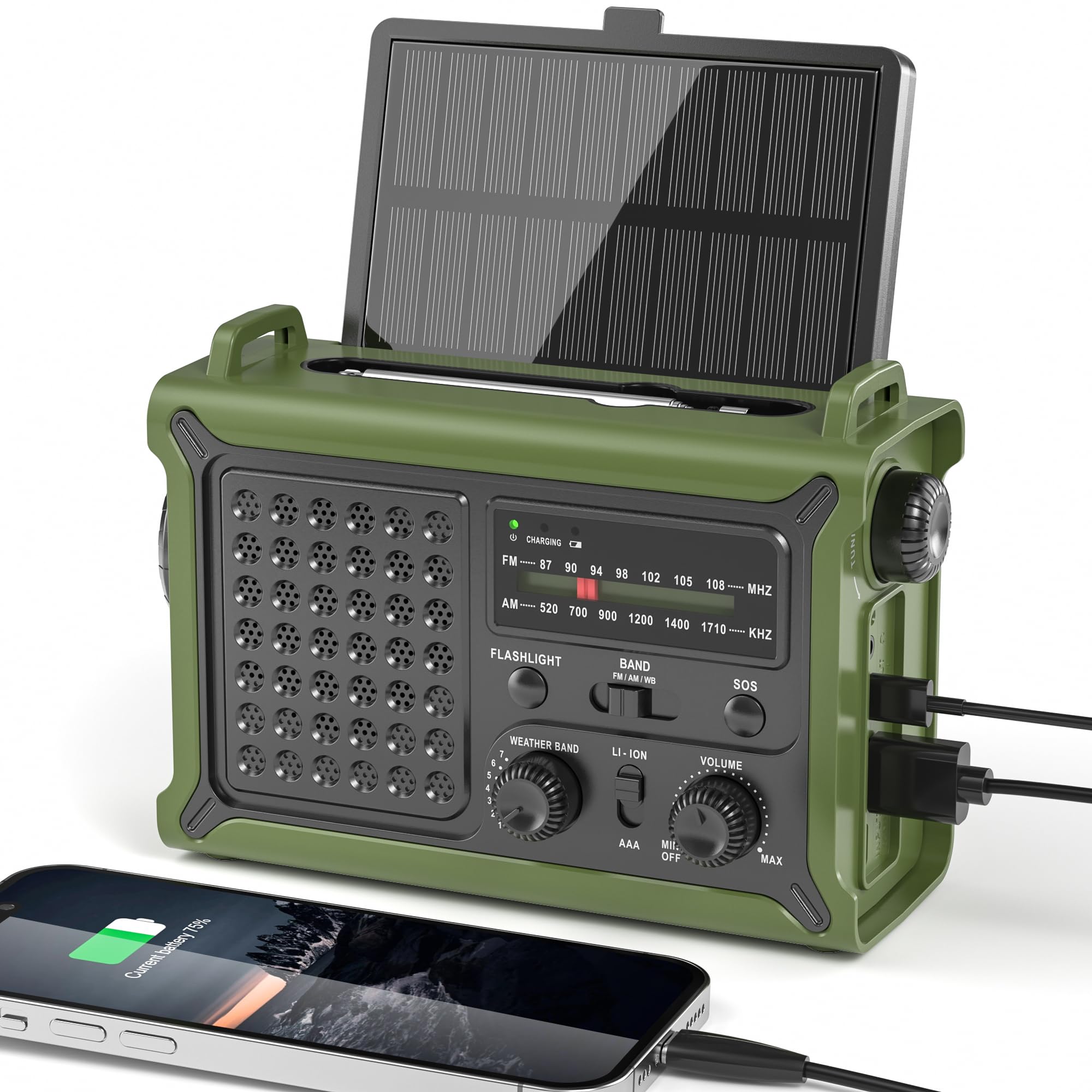
The Mesqool stands out because it pairs a genuine 12,000 mAh battery with an 8,500 mm² monocrystalline solar panel — over four times the surface area of the decorative panels found on cheaper competitors. This means meaningful solar recharge even under light cloud cover, not just a useless sticker. The high-torque hand crank, equipped with a larger copper coil and reinforced magnet, delivers nearly double the charging efficiency of standard cranks. Three minutes of rotation gives you enough power for a short phone call or extended radio listening.
The analog tuning dial is large and clearly labeled, making it easy to dial in AM, FM, or any of the seven NOAA weather frequencies even in complete darkness. Sound quality is surprisingly clear thanks to DSP noise reduction, and the 57 mm speaker fills a room without distortion at high volume. The flashlight beam reaches up to 260 feet with two brightness levels, and the flip-up frosted reading lamp provides soft, glare-free light for close tasks.
Users consistently praise the brick-like build quality and the fact that the solar panel actually works — one reviewer reported that the radio stayed fully charged for months on a windowsill without ever needing the crank. The only common critique is the absence of a battery level indicator, which would help users know exactly how much reserve power remains.
Why it’s great
- Genuine 12,000 mAh capacity with real solar efficiency
- High-torque crank charges phone in 3 minutes
- Excellent AM/FM/NOAA reception with DSP clarity
- Dual lighting — 260ft flashlight and soft reading lamp
Good to know
- No battery charge level indicator
- Slightly heavier than compact alternatives due to large panel
2. PPLEE CR1030 Emergency Radio (Amy Green)
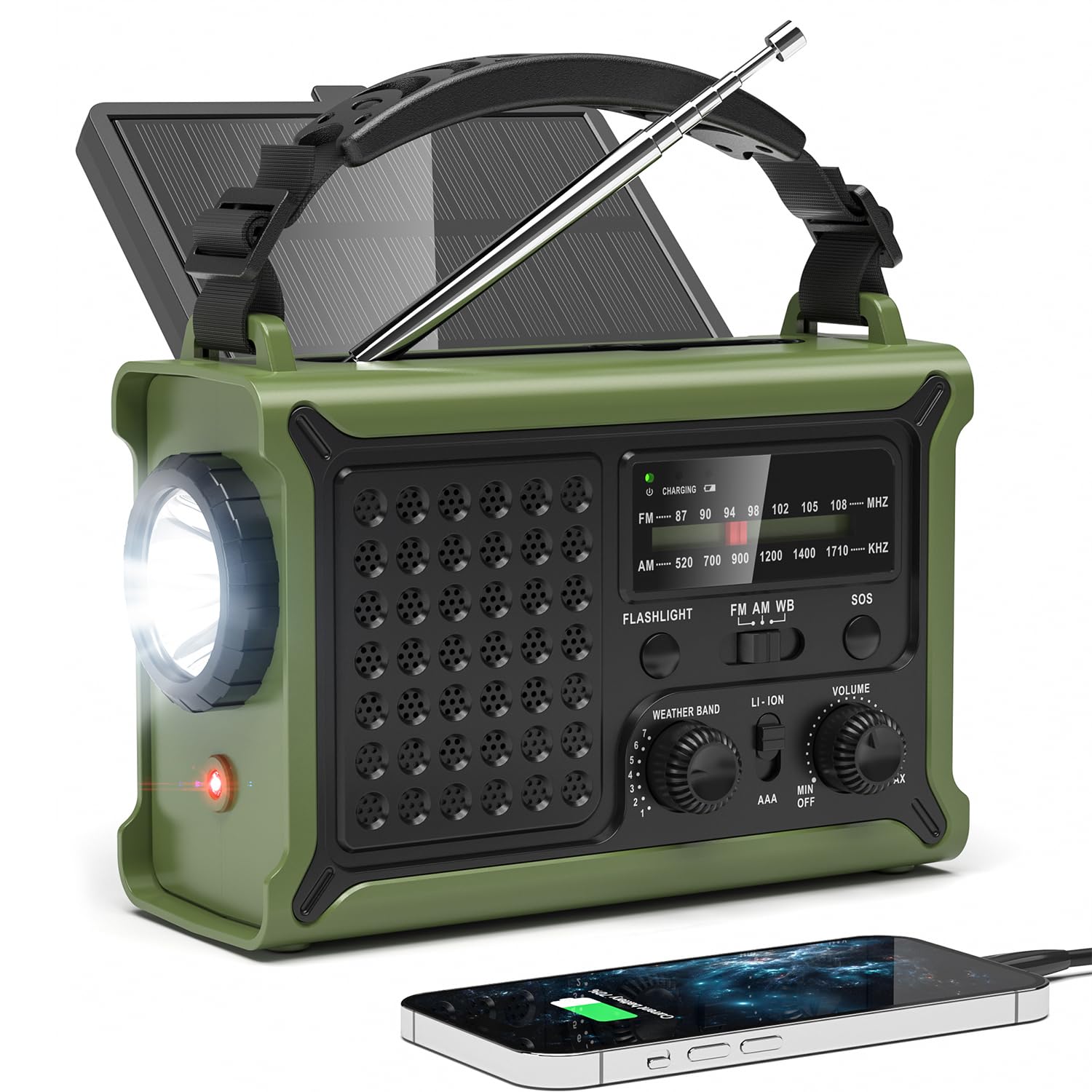
The PPLEE CR1030 is built around a verified 12,000 mAh / 44,400 mWh battery that supports up to 60 hours of AM/FM playback at moderate volume. This is one of the longest runtimes in its class, making it an excellent choice for extended power outages that stretch beyond a single night. The 5W full-range speaker delivers clear, balanced audio that outpaces most emergency radios, and the large analog tuning knob with tactile buttons simplifies operation for all ages.
The 8,500 mm² monocrystalline solar panel is identical in size to the Mesqool’s, providing fast solar recovery even in indirect light. The hand crank is smooth but less aggressive in torque than the Mesqool — expect around 5–7 minutes of cranking for a meaningful phone charge. Five power sources (built-in battery, solar, crank, USB-C, and AAA batteries) give you total redundancy. The flashlight offers two brightness levels, and the 12-LED reading lamp provides ample illumination for a tent or dark room.
Reviewers highlight the “must-have” value proposition — the combination of long battery life, loud speaker, and multiple charging paths makes it a top pick for household emergency kits. A retired electrical engineer praised the sensible circuit design and reliable AM/NOAA reception. The only downside reported is that the solar panel hinge feels slightly less rigid than the Mesqool’s, but this is a minor concern given the price-to-performance ratio.
Why it’s great
- 60-hour runtime on full charge
- 5W speaker produces room-filling, clear sound
- Five power sources including AAA backup
- Two-level flashlight and 12-LED reading lamp
Good to know
- Crank torque is lower than high-torque competitors
- Solar panel hinge could be sturdier
3. OnLyee Emergency Radio (Yellow/Black)
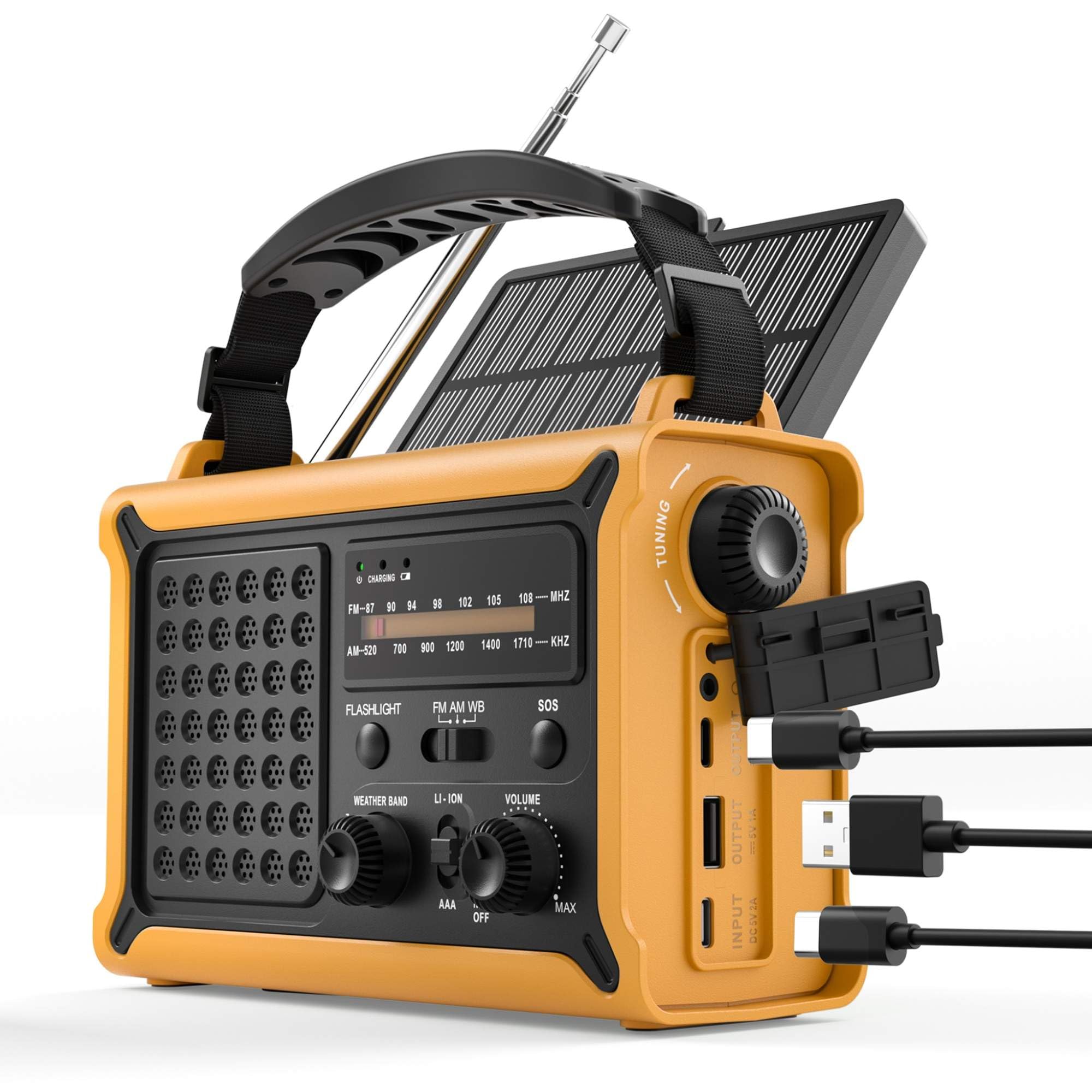
The OnLyee radio is built for abuse. The ABS enclosure carries an IPX6 water-resistance rating, meaning it can withstand powerful water jets — a serious advantage during hurricane conditions or heavy rain. The 12,000 mAh battery powers a 5W flashlight, a 12-LED reading lamp, and a 120 dB SOS alarm that cuts through storm noise. The oversized 8,500 mm² monocrystalline solar panel is flanked by a hand crank and USB-C input, giving you four ways to recharge without AAA cells.
DSP signal processing cleans up AM, FM, and the 7 NOAA weather bands, providing crisp reception even inside structures with steel roofing. The 57 mm 5W speaker delivers clear audio with surprising bass for its size. The SOS alarm triggers both a pulsing siren and a flashing beacon, making it visible and audible from a significant distance — critical if you are trapped or lost. The carrying handle is built into the frame, so you can grab and go without fumbling for straps.
Owners describe it as “the most versatile little radio in the world” and praise the crystal-clear NOAA reception across multiple states. One reviewer noted that 10 cranks provide 15–20 minutes of runtime, and the phone charging output works reliably in a pinch. The main tradeoff is that the larger, ruggedized body is slightly heavier at 1.6 pounds, making it less pocket-friendly for ultralight backpacking kits.
Why it’s great
- IPX6 water-resistant for severe weather use
- 120 dB SOS alarm with flashing strobe beacon
- DSP-enhanced reception on all weather bands
- Integrated carrying handle for quick grab-and-go
Good to know
- Heavier and bulkier than compact alternatives
- Solar panel hinge requires careful handling
4. QAUYYW Emergency Radio (Orange)
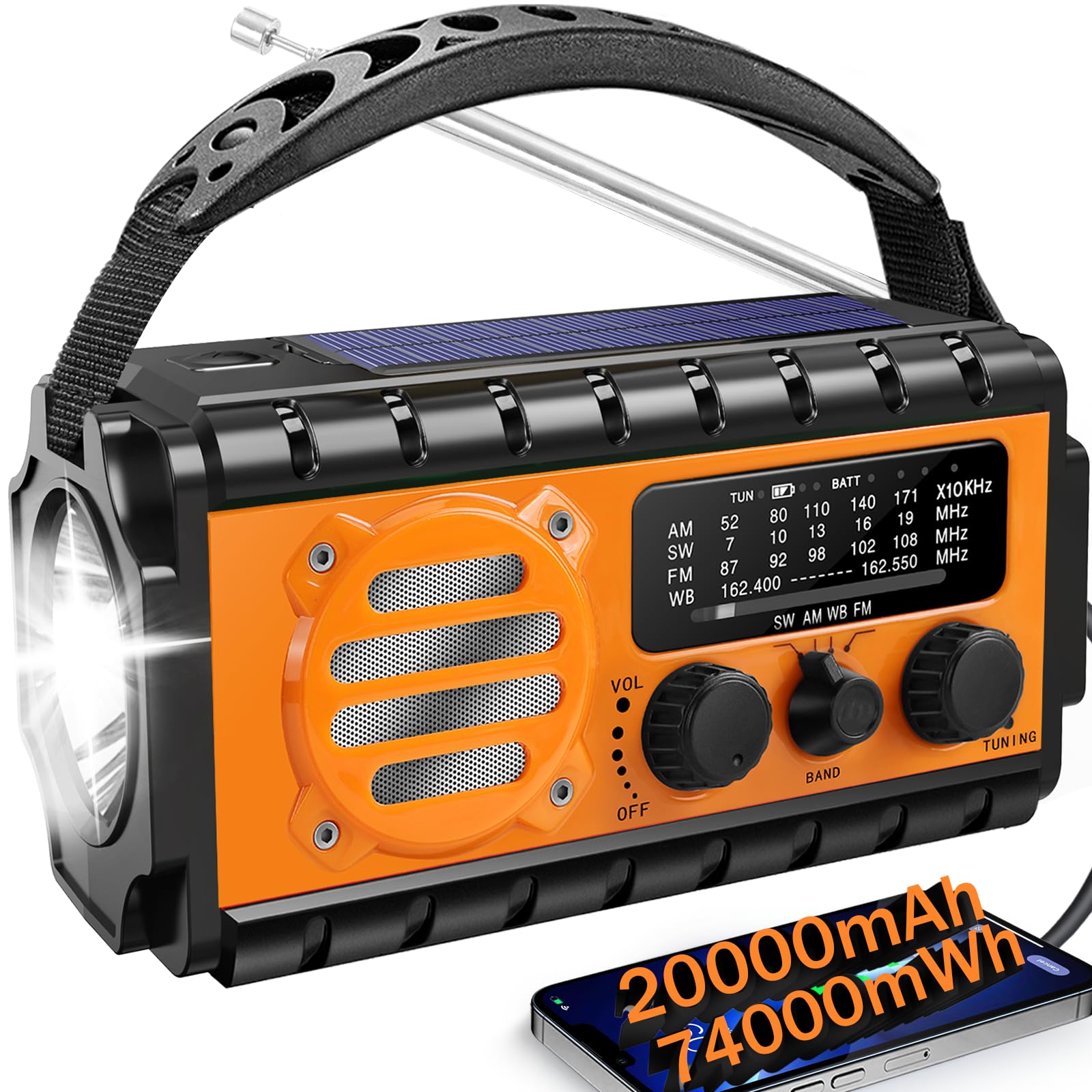
The QAUYYW distinguishes itself with a massive 20,000 mAh battery — the largest capacity in this roundup, equating to roughly 74,000 mWh. This allows for 35 hours of radio playback at medium volume and up to 50 hours of reading lamp operation. It also covers shortwave bands in addition to AM, FM, and NOAA, making it valuable for receiving international broadcasts when local stations go silent. The 52 cm extended antenna pulls in distant signals with authority.
Three charging modes (USB-C, solar, and hand crank) keep the battery topped off, though the solar panel is smaller than the 8,500 mm² monocrystalline panels found on the premium Mesqool and PPLEE units. The IPX6 rating adds water resistance, and the 3W flashlight and 3.5W reading lamp provide adequate illumination. The SOS siren and flashing light are standard-issue but effective for attracting attention in the dark.
Customer feedback consistently notes the solid build and lack of static on AM and FM frequencies. One reviewer bought four units for family members after testing the first one — a strong endorsement for reliability. The tradeoff is that the 20,000 mAh battery adds weight and bulk (though still under a pound), and the smaller solar panel means longer recovery times when relying solely on sunlight.
Why it’s great
- 20,000 mAh battery — class-leading capacity
- Shortwave band reception for international broadcasts
- IPX6 water-resistant and well-built
- Extended 52 cm antenna for distant signal lock
Good to know
- Smaller solar panel reduces recharge efficiency
- Heavier than standard 10,000–12,000 mAh units
5. Rychi Emergency Radio (Dark Green)

The Rychi is the smallest and lightest radio here at just 1.19 pounds and 6.69 inches tall, making it ideal for slipping into a bug-out bag, glove compartment, or backpack without eating up space. Despite the compact dimensions, it houses a 10,000 mAh polymer battery that delivers 25 hours of radio playback, 30 hours of reading lamp use, or 40 hours of flashlight operation. The 7-section telescopic antenna extends to a generous length for pulling in distant NOAA, AM, and FM stations.
Four charging methods — USB Type-C, solar panel, hand crank, and AAA batteries — provide full redundancy. The solar panel is smaller than the premium monocrystalline panels, so it functions more as a trickle charger than a primary power source. The 3W flashlight and LED reading lamp are sufficient for close-range tasks but lack the brightness of the 5W units found on more expensive models. The SOS button triggers both a loud siren and flashing light.
Reviewers praise the long, sturdy antenna and the radio’s ability to pick up stations in deep forest where smaller radios fail. The analog tuning dial lights up for visibility in the dark, and the compact footprint fits easily into an emergency kit alongside other essentials. The main drawback is that the solar charging stopped working after a year for some users, so this unit should be treated as a reliable battery-first radio with solar as a secondary bonus.
Why it’s great
- Compact and lightweight for easy packing
- 10,000 mAh battery for extended runtime
- Excellent reception with 7-section antenna
- Four charging methods including AAA backup
Good to know
- Solar panel is small — acts as trickle charger only
- Solar function may degrade over extended use
6. Mesqool Emergency Radio (Yellow)
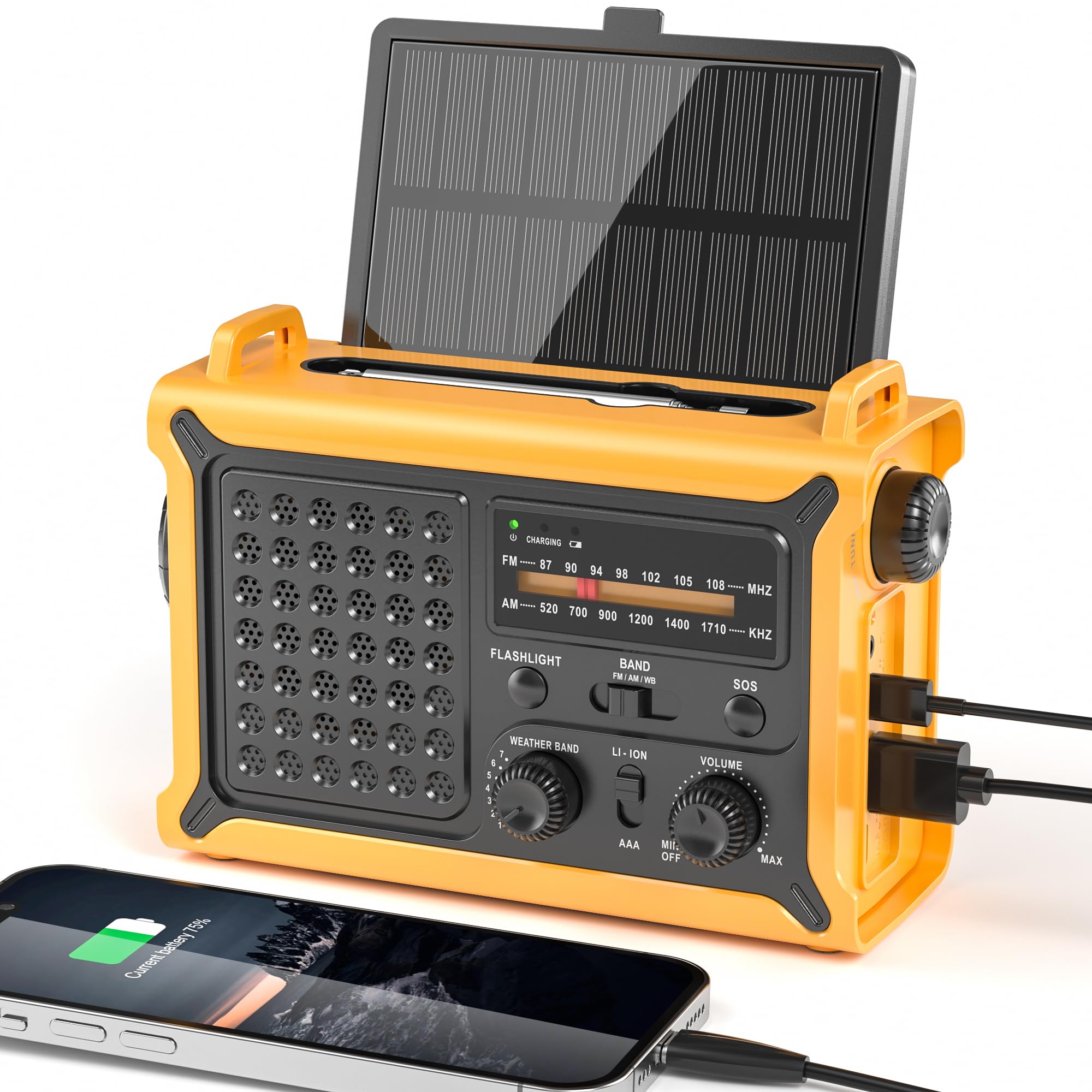
The yellow variant of the Mesqool shares the same core hardware as the army green Best Overall pick — 12,000 mAh battery, 8,500 mm² monocrystalline solar panel, and high-torque hand crank with reinforced magnet generator. The key difference is the yellow colorway improves visibility in low-light conditions, making it easier to spot inside a cluttered emergency kit or dark tent. The flashlight still reaches 260 feet, and the frosted reading lamp offers the same soft, warm glow.
Reception across AM, FM, and all 7 NOAA weather bands is identical to the green version — fast, stable, and clear thanks to DSP noise reduction. The dual USB outputs (USB-A and USB-C) allow simultaneous charging of two devices, which is useful for powering a phone and a headlamp at the same time. The SOS alarm produces a loud siren paired with a strobe flash that is visible from a significant distance. The ABS enclosure is weather-resistant and feels dense in hand.
User reports mirror those of the green model: excellent solar charging even on cloudy days, smooth hand crank operation, and long battery life. One reviewer noted that the radio stayed charged on a kitchen windowsill for weeks without needing a top-up. The lack of a battery level indicator is the only recurring complaint, and the yellow finish may appeal to those who prefer high-visibility gear for emergency situations.
Why it’s great
- High-visibility yellow shell for easy spotting
- Dual USB outputs for charging two devices
- Same high-torque crank and large solar panel as green model
- Crystal-clear DSP reception on all bands
Good to know
- No battery charge level indicator
- Identical performance to the green version at same price
7. FosPower A1 Emergency Radio (Orange)
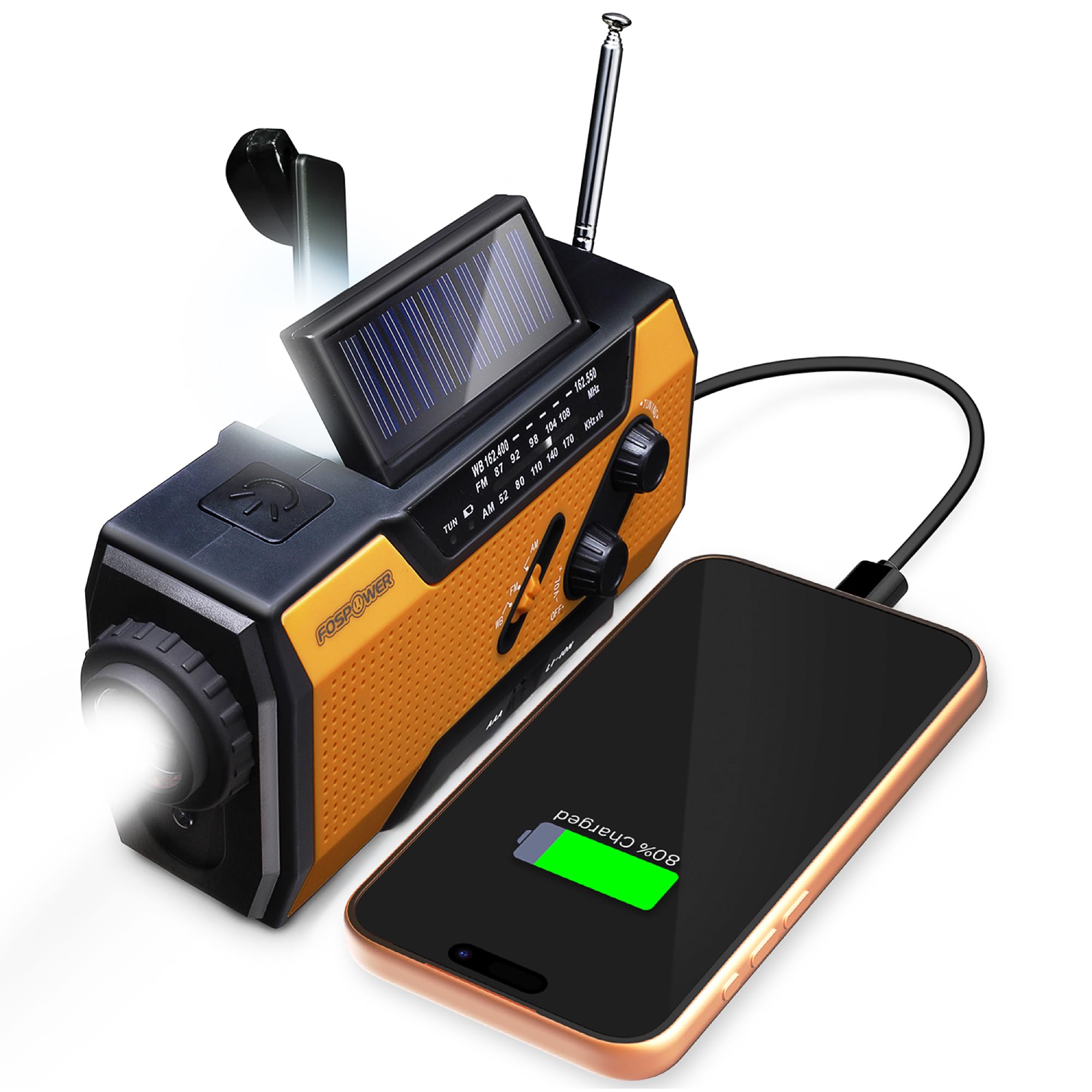
The FosPower A1 is the entry-level workhorse that has proven its reliability over years of real-world use. Its 2,000 mAh battery is modest compared to the 10,000–20,000 mAh units above, but it is backed by three charging sources (hand crank, solar, and AAA batteries) and a limited lifetime warranty — a rare commitment in this product category. The radio receives NOAA, AM, and FM broadcasts, and the 4-LED reading light plus 1W flashlight provide basic illumination for dark environments.
The hand crank generates enough power to keep the radio running and can trickle-charge a phone for emergency calls. The solar panel is small and works best as a maintenance charger rather than a primary power source. Sound quality is decent for a small speaker, and the analog tuning is straightforward for users of all ages. The orange color and compact 6.2-inch height make it easy to store in a glove compartment or emergency drawer.
Long-term owners report that the radio still functions after years of storage, though some experienced AAA battery leakage over time. The flashlight is dimmer than premium units, and the speaker may fail after several months of heavy use. For the price, the FosPower A1 is a solid entry point for someone building their first emergency kit, but serious preppers should budget for a higher-capacity model for extended outages.
Why it’s great
- Very affordable entry point for emergency readiness
- Limited lifetime warranty provides peace of mind
- Reliable AM/FM/NOAA reception
- Compact size fits in glove compartments
Good to know
- 2,000 mAh battery drains quickly under heavy use
- Solar panel is small — backup AAA cells are essential
- Flashlight is dim; speaker may fail over time
FAQ
How long does a 10000mAh battery power an emergency radio?
Can I rely on solar charging alone to keep my radio powered?
What does NOAA weather band mean on an emergency radio?
Why does hand crank efficiency vary so much between models?
Final Thoughts: The Verdict
For most users, the battery operated radio for emergencies winner is the Mesqool Emergency Radio (Army Green) because it combines a genuine 12,000 mAh battery, the large 8,500 mm² monocrystalline solar panel that actually works, and the highest-torque hand crank in this lineup — all at a mid-range price that beats premium competitors on value. If you need 60-hour runtime and the loudest speaker, grab the PPLEE CR1030. And for the toughest build that can survive rain and rough handling, nothing beats the OnLyee Emergency Radio with its IPX6 rating and 120 dB SOS alarm.

Mo Maruf
I created WellFizz to bridge the gap between vague wellness advice and actionable solutions. My mission is simple: to decode the research and give you practical tools you can actually use.
Beyond the data, I am a passionate traveler. I believe that stepping away from the screen to explore new environments is essential for mental clarity and physical vitality.