Our readers keep the lights on and my smoothie glass nicely filled. As an Amazon Associate, I earn from qualifying purchases.
The hum of a gas generator drowns out a campsite conversation and fills the air with fumes you can taste. A battery generator eliminates both, delivering clean, silent electricity to power your fridge, charge your laptop, or run a CPAP machine through the night. The decision is no longer about whether to go battery—it’s about choosing the right capacity, inverter type, and recharge speed for your specific load.
I’m Mohammad Maruf — the founder and writer behind WellFizz. I’ve spent years analyzing the technical specifications of portable power stations, comparing inverter efficiencies, cycle life ratings, and solar input limits to separate genuine value from marketing hype.
Whether you are prepping for storm season, outfitting an RV, or equipping a job site, finding the best battery generator means matching watt-hours to your daily draw and inverter wattage to your peak surge demands — not just picking the biggest number on the box.
How To Choose The Best Battery Generator
Selecting the right battery generator requires understanding three interconnected specifications: total energy capacity (measured in watt-hours), the inverter’s continuous and surge output (measured in watts), and the battery chemistry’s cycle life. Ignoring any one of these leads to either a unit that shuts down under load or one that you paid too much for.
Match Capacity to Your Daily Draw
Start by listing every device you plan to power and its average wattage. A standard refrigerator draws roughly 150–200 watts, a modem and router about 20 watts, and a CPAP machine around 30–60 watts. Multiply each device’s wattage by the hours you need it running — that total is your minimum watt-hour requirement. A 300Wh unit handles overnight phone charging and a cooler, while a 1000Wh+ station keeps a fridge running through a power outage and recharges via solar the next day.
Check the Inverter’s Real Rating
Battery generators list both a continuous wattage and a surge wattage. Devices with motors — like a sump pump, furnace fan, or refrigerator compressor — draw two to three times their running wattage during startup. If your generator’s surge capacity cannot handle that spike, the unit trips its overload protection. Look for a pure sine wave inverter with a surge rating at least double the continuous output for reliable motor starting.
Evaluate Recharge Speed and Solar Input
How fast a generator refills depends on its AC input wattage and its solar charge controller. Units with 500W+ AC input refill from zero to 80% in under two hours, while budget models with 100W input require six hours or more. For off-grid use, confirm the MPPT controller’s voltage range and maximum solar input wattage — a higher ceiling lets you add larger panels later without buying a new station.
Quick Comparison
On smaller screens, swipe sideways to see the full table.
| Model | Category | Best For | Key Spec | Amazon |
|---|---|---|---|---|
| BLUETTI AC70 | Mid-Range | Fast AC recharging, compact camping | 768Wh / 1000W inverter | Amazon |
| EF ECOFLOW DELTA 3 Plus | Mid-Range | UPS for sensitive electronics | 1024Wh / 1800W inverter | Amazon |
| Anker SOLIX C1000 + 200W Panel | Mid-Range | All-in-one solar bundle | 1056Wh / 1800W inverter | Amazon |
| Jackery Explorer 2000 v2 | Premium | Lightweight high-capacity portable | 2042Wh / 2200W inverter | Amazon |
| Generac GB2000 | Premium | Durable build, wireless charging | 2106Wh / 1600W inverter | Amazon |
| Anker SOLIX F3000 | Premium | Whole-home backup with 240V output | 3072Wh / 3600W inverter | Amazon |
| Jackery HomePower 3000 + 2x200W | Premium | Long-term solar home emergency backup | 3072Wh / 3600W inverter | Amazon |
| EF ECOFLOW DELTA Pro 3 | Premium | Whole-home 120/240V with expandability | 4096Wh / 4000W inverter | Amazon |
| VTOMAN Jump 600X | Budget | Entry-level camping and car jump-start | 299Wh / 600W inverter | Amazon |
In‑Depth Reviews
1. BLUETTI AC70 Portable Power Station

The BLUETTI AC70 hits a rare sweet spot: 768Wh of LFP capacity with a 1000W inverter that surges to 2000W for motor startup. Its 950W AC input fills the battery to 80% in 45 minutes — a speed that beats most competitors at this watt-hour class. The XT-60 solar input handles up to 500W of panels, and the display shows real-time draw and remaining runtime clearly.
At 22.5 pounds, it remains manageable for one-handed carry between the garage and a campsite. The USB-C port delivers a full 100W, enough to sustain a MacBook Pro 16-inch under heavy use. Customers consistently note the UPS function switches under 20 milliseconds, keeping network equipment running through brief flickers without a hiccup.
What pushes the AC70 ahead of similarly priced units is its charge speed. You can top it off during a lunch break and have full power for the evening. The LCD screen’s brightness is adjustable, and the silent operation at low loads makes it suitable for indoor backup during a storm without sleep disruption.
Why it’s great
- Fastest AC recharge in its class: 45 minutes to 80%
- 2000W power lifting handles fridge compressor spikes
- Robust XT-60 solar input is more durable than older 7909 connectors
Good to know
- No bundled solar panel, so factor that into initial cost
- The fan runs audibly during high-rate charging, though it’s not excessive
2. EF ECOFLOW Portable Power Station DELTA 3 Plus

The DELTA 3 Plus from EcoFlow combines a 1024Wh LFP battery with a 1800W inverter that X-Boost can sustain beyond 2200W for resistive loads. Its 10ms switch-over UPS function is certified for NAS and server equipment, making it the strongest choice for home network infrastructure. The unit accepts up to 1500W AC input, charging to 80% in 40 minutes.
Dual MPPT solar controllers allow up to 1000W of panel input, which means you can pair two 500W arrays and fill the battery from solar in roughly one hour of peak sun. At 27 pounds, it is heavier than the BLUETTI AC70 but still manageable. The IP65-rated battery pack offers splash, dust, and oil resistance, adding durability for job site or garage use.
The EcoFlow app provides storm alerts, low-battery reminders, and time-of-use scheduling that automatically shifts charging to off-peak hours when paired with solar. Customers running a small business rack report over eight hours of runtime on a single charge. The main trade-off is a higher AC idle draw than some competitors, so enabling power-saving mode through the app is recommended.
Why it’s great
- 10ms UPS switch ideal for sensitive electronics and servers
- Dual MPPT supports up to 1000W solar input for fast off-grid recharge
- IP65 battery pack adds durability against dust and moisture
Good to know
- AC idle phantom load is higher than some peers; use app power-saving mode
- At 27 lbs, it’s not the lightest option for backpacking
3. Anker SOLIX C1000 with 200W Solar Panel

The Anker SOLIX C1000 bundle pairs a 1056Wh LFP power station with a 200W monocrystalline solar panel featuring IP67 waterproofing. The station’s SurgePad technology allows it to drive appliances up to 2400W, covering 99% of household plug-in devices. AC charging hits 80% in 43 minutes when ultra-fast mode is enabled through the app.
The included solar panel has four adjustable kickstand angles (30°, 40°, 50°, and 80°) for maximizing sun absorption throughout the day. Its 23% conversion efficiency is above average for portable panels. Customers note the panel performs well in partial cloud cover but is sensitive to full shading — even a small shadow drops output noticeably. The station itself is not weatherproof, so keep it dry while the panel handles rain.
With six AC outlets and 11 total ports, the C1000 powers a refrigerator for 14–16 hours on a single charge. The app allows remote monitoring and charging speed adjustment. Drawbacks include that the expansion battery cannot charge independently from the main unit, and some users report a mildew-like smell from the panel when first unpacked, though Anker replaced affected units under warranty.
Why it’s great
- IP67 waterproof solar panel included, ready for outdoor use
- SurgePad technology handles 2400W peaks for motor-driven appliances
- Ultra-fast AC recharge to 80% in 43 minutes via app toggle
Good to know
- Station is not weatherproof; protect from rain
- Single 200W panel is adequate for camping but may be slow for full recharge after heavy use
4. Jackery Explorer 2000 v2

Jackery’s Explorer 2000 v2 uses CTB (Cell-to-Body) technology borrowed from EV manufacturing to pack 2042Wh into a chassis that is 41% lighter and 34% smaller than typical 2kWh stations. At 39.5 pounds with a 2200W inverter, it is the easiest high-capacity generator to move around. AC fast charging fills to 80% in 66 minutes, while emergency super charging mode through the app reaches full in 102 minutes.
The unit supports silent charging mode at under 30 dB, which is quieter than a library. Users running a CPAP report overnight operation without disturbance. The 20ms UPS switch ensures seamless transition during power flickers, and the LCD shows input/output wattage and remaining charge with high accuracy.
Customer reports show it runs a 190W refrigerator for over 21 hours on a single charge. Solar input accepts up to 400W, which refills the battery in about six hours of full sun. The main limitation is the 100W USB-C PD port — while sufficient for most laptops, power users may prefer the 140W+ ports found on premium competitors.
Why it’s great
- Lightest 2kWh+ station available at 39.5 lbs
- Silent charging mode under 30 dB for undisturbed sleep
- Seamless 20ms UPS switch verified in real-world testing
Good to know
- 100W USB-C PD is adequate for most laptops but not the fastest available
- Solar recharging from 200W panels is slow; 400W panels recommended for meaningful off-grid refill
5. Generac 2106Wh Portable Power Station GB2000

Generac brings its generator legacy to the battery category with the GB2000, a 2106Wh station wrapped in a rugged metal enclosure with an ergonomic handle. The 1600W inverter is modest compared to competitors at this price, but the build quality and integrated 15W wireless charging pad set it apart for users who prioritize durability over raw power output.
Wall charging reaches 80% in 3.3 hours — slower than the competition, but the unit also accepts solar, car, and generator inputs. The 4.7-inch multi-color display shows battery level, remaining runtime, and input/output wattage clearly. Customers in Florida who endured multiple hurricanes report running a refrigerator and lights for 10–13 hours per charge, often purchasing a second unit for extended outages.
At 48.8 pounds, it is not the lightest, but the handle design makes it carryable. The wireless charging pad is a genuine convenience for keeping phones topped off without cable clutter on a campsite table. Some users have reported early failure with the unit showing a warning light and stopping output, though Generac’s support is mixed on resolution speed.
Why it’s great
- Rugged metal enclosure built for transport and outdoor use
- Wireless charging pad eliminates cable clutter for phones
- Large clear display with real-time runtime estimation
Good to know
- Slower AC recharge (3.3 hrs to 80%) compared to newer LFP models
- Some early units experienced failure; check warranty terms before purchase
6. Anker SOLIX F3000 Portable Power Station
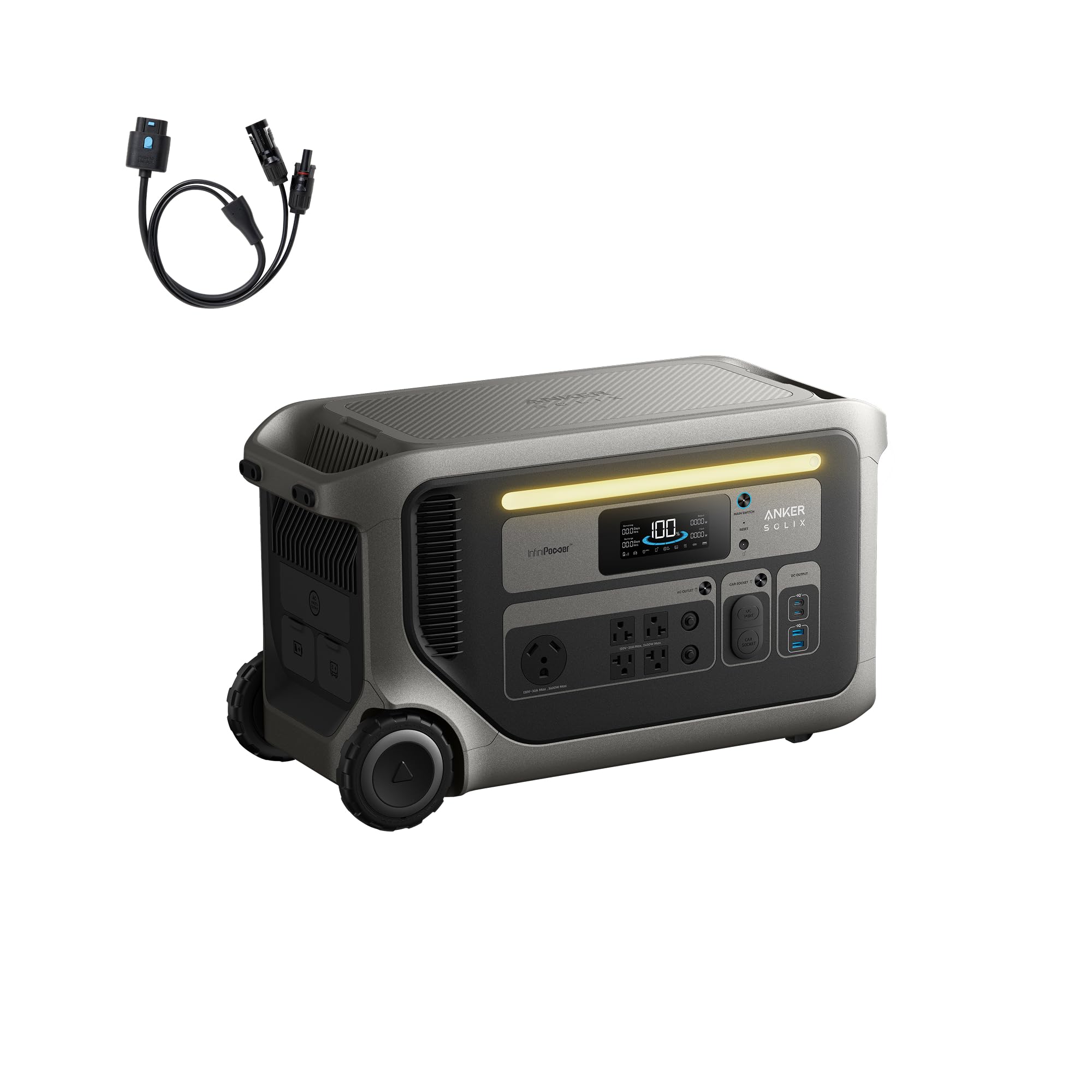
The Anker SOLIX F3000 delivers 3072Wh of LFP storage with a 3600W inverter that supports 120/240V output when paired with a second unit. Its standout feature is 6000W combined recharging — plugging a gas generator into the AC input while simultaneously running solar panels can refill the battery from zero in under two hours, making it viable for extended outage scenarios where fuel is available but intermittent.
The unit’s ultra-low idle power consumption achieves 125 hours of AC standby time, meaning the battery lasts much longer between charges when serving as a UPS for a home network. A 190W refrigerator runs for approximately 42 hours on a full tank. The F3000 expands to 24kWh with extra batteries, turning it into a whole-home backup solution for all but the largest 240V appliances.
The app provides charge limit customization, power-saving schedules, and remote monitoring. At 91 pounds, it comes with a handle but not wheels — you will want to place it on a cart for regular movement.
Why it’s great
- 6000W combined recharge from generator + solar for fastest refill in class
- 125-hour AC idle standby for long-term UPS use
- Expandable to 24kWh for whole-home coverage
Good to know
- No wheels or built-in dolly at 91 pounds; plan for cart transport
- App is required to unlock some features like port memory and charge limits
7. Jackery HomePower 3000 with 2x200W Solar Panels
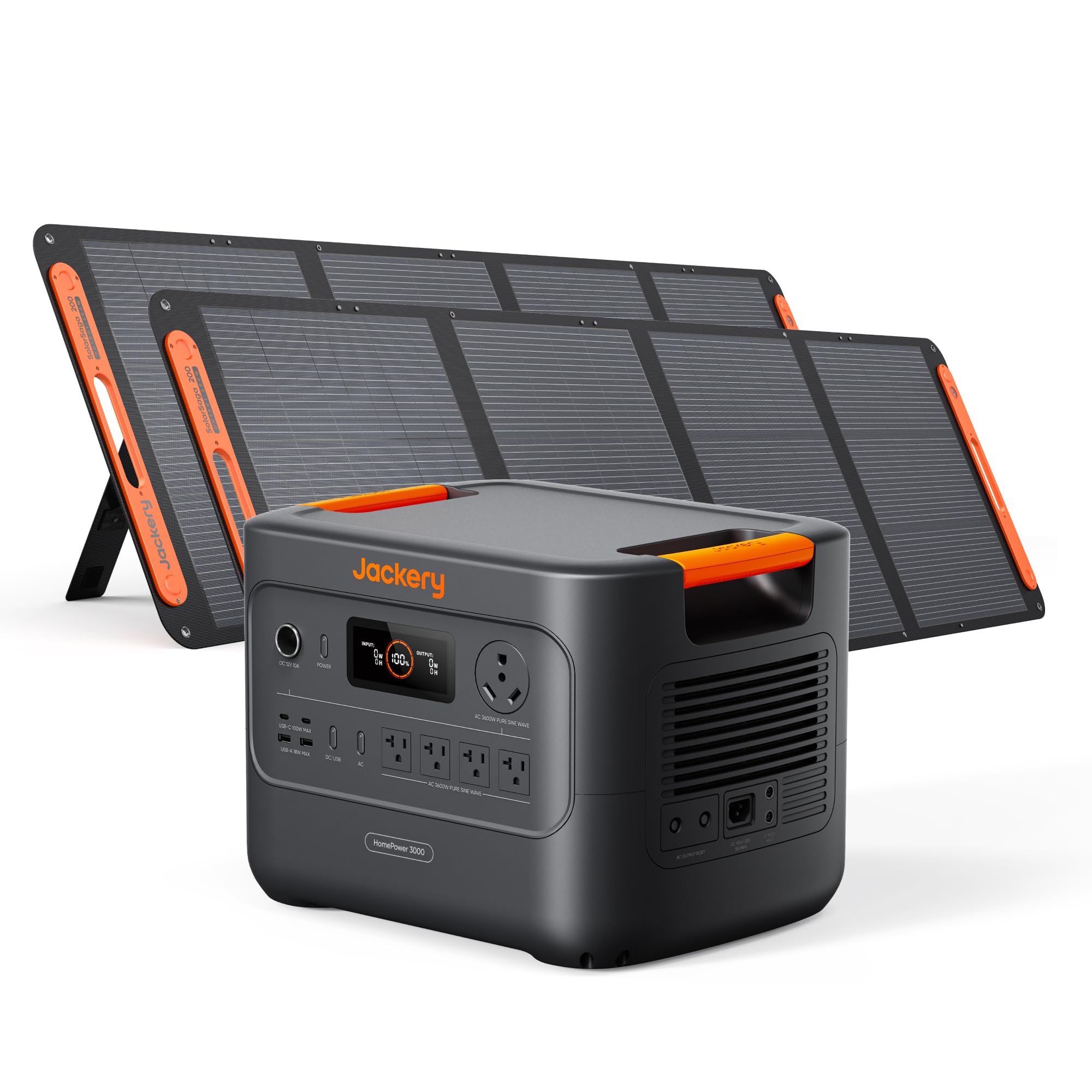
The Jackery HomePower 3000 is a 3072Wh station with a 3600W inverter (7200W surge) that ships with two 200W SolarSaga panels, making it a true plug-and-play solar generator out of the box. The CTB construction makes it 47% smaller and 43% lighter than comparable 3kWh units, weighing 59.5 pounds — heavy but feasible to move with the optional wheel kit.
AC charging refills the battery in 2.2 hours, while hybrid AC+DC mode cuts that to 1.7 hours. The dual 100W USB-C PD ports charge laptops and tablets at full speed, and the built-in TT-30 RV port connects directly to a trailer’s electrical system without an adapter. Customers running an RV at a hunting camp report the unit runs all appliances except the air conditioner, saving generator fuel significantly.
The ChargeShield 2.0 algorithm adjusts charge current based on temperature and battery state to prolong cycle life to 4000 cycles before dropping to 70% capacity. Solar recharge from the two included panels takes about 9 hours for 80% charge in full sun. The station cannot be expanded with extra batteries, so what you buy is the maximum capacity you will have.
Why it’s great
- Includes two 200W panels for immediate solar capability
- CTB construction creates lightest and smallest 3kWh station available
- Built-in TT-30 RV port simplifies trailer power connections
Good to know
- Battery is not expandable; limited to the internal 3072Wh
- At 59.5 lbs, a wheel kit is almost essential for regular movement
8. EF ECOFLOW DELTA Pro 3

The DELTA Pro 3 from EcoFlow is the flagship of the battery generator category, offering 4096Wh of LFP storage with a 4000W inverter capable of both 120V and 240V output from a single unit. X-Boost pushes the inverter to 6000W, and expandability to 48kWh makes this a true whole-home backup. A 3-ton central AC or a 1 HP well pump runs without breaking a sweat.
Charging is equally impressive: AC input at 1800W reaches 80% in 50 minutes, and solar input up to 2600W via two MPPT ports can fill the battery in under two hours of peak sun. Combined charging from AC and solar hits 7000W, the fastest recharge rate on this list. The X-Quiet technology keeps fan noise at 30 dB, allowing bedside placement during outages.
The IP65-rated CTC battery pack offers automotive-grade protection against dust and water ingress. At 115 pounds, the unit has a handle but no built-in wheels — a heavy-duty cart is mandatory. The app provides full control, though some users note the app requires internet connectivity for initial setup, which could be problematic during a grid-down scenario without cell service.
Why it’s great
- Single-unit 240V output for well pumps and central AC
- Expandable to 48kWh with additional batteries and smart generator
- 7000W combined recharge rate for near-instant refill
Good to know
- At 115 lbs, you must invest in a wheeled dolly for transport
- App-based controls may require internet, limiting off-grid configuration
9. VTOMAN Jump 600X Portable Power Station

The VTOMAN Jump 600X is a 299Wh LFP power station with a 600W inverter (1200W surge) that doubles as a car jump starter — a rare combination that adds genuine utility for drivers. The LiFePO4 battery offers 3000 cycles to 80% capacity, and the station expands to 939Wh with an add-on battery purchased separately. It charged nine devices simultaneously during testing and supports pass-through charging.
AC recharge takes about three hours to full, and a 110W solar panel refills in five to six hours. The regulated 12V DC outputs deliver a clean, stable 12V at 10A, which is critical for running a CPAP or car refrigerator without voltage fluctuation. Customers report jump-starting a Dodge Ram truck from 9% battery in seconds, and running a CPAP machine for 10 hours on a single charge.
The unit weighs 14.6 pounds and fits in a trunk easily. The LED light with five modes (including SOS) adds emergency versatility. The main compromise is the 600W continuous inverter — you cannot run a space heater or a full-size refrigerator, but for phone charging, a laptop, a mini cooler, and a CPAP, it is an ideal compact companion for weekend camping or roadside emergencies.
Why it’s great
- Integrated car jump starter eliminates need for a separate battery pack
- Regulated 12V DC output protects sensitive CPAP and refrigerator electronics
- Expandable from 299Wh to 939Wh with optional add-on battery
Good to know
- 600W inverter limits appliance compatibility; no high-power heating or cooking
- Jumper cables are sold separately, so budget for that additional purchase
FAQ
Can a battery generator run a refrigerator during a power outage?
How long does it take to recharge a battery generator from a wall outlet?
What does MPPT mean and why does it matter for solar charging?
Final Thoughts: The Verdict
For most users, the best battery generator winner is the BLUETTI AC70 because it balances a fast-recharging 768Wh capacity with a 1000W pure sine wave inverter at a mid-range price that hits the sweet spot between portability and real-world backup power. If you need whole-home backup with 240V output, grab the EF ECOFLOW DELTA Pro 3. And for an entry-level portable unit that also jump-starts your car, nothing beats the VTOMAN Jump 600X.

Mo Maruf
I created WellFizz to bridge the gap between vague wellness advice and actionable solutions. My mission is simple: to decode the research and give you practical tools you can actually use.
Beyond the data, I am a passionate traveler. I believe that stepping away from the screen to explore new environments is essential for mental clarity and physical vitality.